CMA CGM Reflags Ship to Become Largest U.S.-Flagged Containership
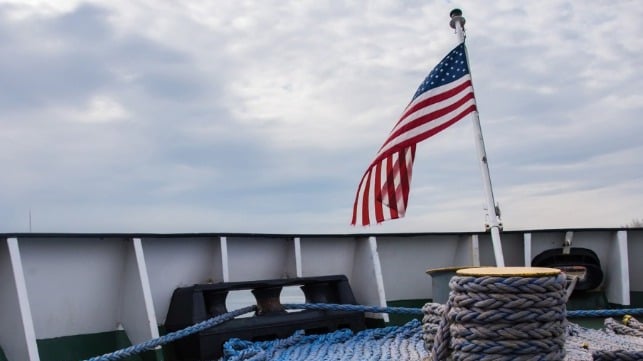
CMA CGM is moving forward with its commitment to triple the size of its U.S.-flagged fleet as part of a $20 billion investment into its U.S. ship and logistics operations. Today, July 24, the company officially reflagged the first of four vessels it plans to move into the U.S. registry.
The CMA CGM Phoenix (115,000 dwt – 9,326 TEU) hoisted the U.S. flag in Charleston, South Carolina, in a ceremony to mark the completion of its transfer from Singapore to the U.S. registry. Built in 2013 by South Korea’s Daewoo Shipbuilding & Marine Engineering, the vessel had previously operated as the APL Phoenix. A Neo-Panamax containership measuring 1,079 feet (328 meters) in length, the company and the U.S. Maritime Administration (MARAD) are reporting that it has become the largest container vessel ever to sail under the U.S. flag.
“Adding the CMA CGM Phoenix into the U.S.-flagged fleet is a powerful move toward reclaiming America’s maritime strength,” said Acting Administrator of the Maritime Administration Sang Yi. “This is about more than ships; it’s also about jobs, trade, and economic strength and national security for Americans.”
CMA CGM reports the vessel employs 42 American mariners, with 21 onboard at any given time, and members of two U.S. maritime unions. The ship is being deployed on the company’s service connecting the U.S. East Coast with Pakistan, India, and Sri Lanka.
According to the company, the CMA CGM Phoenix will be followed by three other vessels, each with a capacity of 9,300 TEU. When the transfers are completed, the company will have increased by 50 percent the number of American seafarers it employs. In addition, it highlights that the CMA CGM Phoenix will serve as a training platform for future officers. Two cadets will be aboard each voyage from the U.S. Merchant Marine Academy at Kings Point and the state maritime academies.
Chairman and CEO of CMA CGM Group Rodolphe Saadé met with President Donald Trump in March, announcing the company’s plans to expand its role in the U.S. shipping industry. He committed the company to growing its U.S.-flagged fleet to 30 ships over the next four years. MARAD reports the CMA CGM Phoenix is the 11th U.S. flagged vessel in CMA CGM service.
CMA CGM also owns APL (the former American President Lines), which it acquired in the 2016 acquisition of Neptune Orient Lines. APL is a niche brand today servicing the United States Government, providing its U.S. flag service, and its service to the Guam-Pacific trade. The company also plans to invest in growing its terminal operations and air freight base in the United States.
MARAD said the reflagging advances President Trump’s Executive Order of Restoring America’s Maritime Dominance. It reports, the current U.S.-flagged fleet consists of 189 vessels, including tankers, containerships, dry bulk carriers, vehicle carriers, and more. The order mirrors a bipartisan initiative in Congress that calls for the rebuilding of the American merchant marine.
CMA CGM in JV with TotalEnergies to Offer LNG Bunkering from Rotterdam
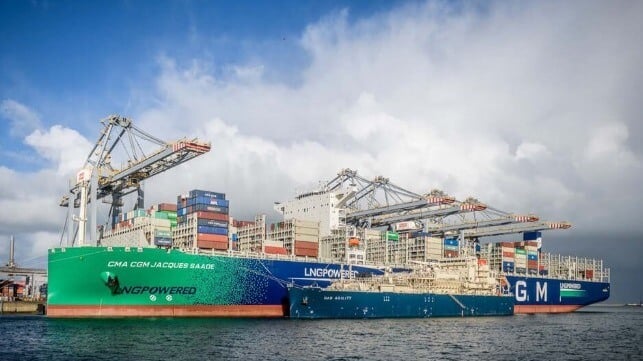
CMA CGM is making a unique move, announcing it is forming a joint venture with TotalEnergies to launch an LNG bunkering and logistics operation based in Rotterdam. It is the first time a shipping company is partnering with an energy provider for LNG bunkering and a key step to support the French carriers’ growing fleet of LNG-fueled vessels.
The companies report they will position a new 20,000 cbm LNG bunker vessel in Rotterdam by the end of 2028. The new company, which will be jointly operated, will offer a complete logistics service, from reload access at the Gate terminal facility to LNG bunker deliveries. They will service a wide range of vessels operating in the Amsterdam, Rotterdam, and Antwerp region.
As part of the agreement, CMA CGM will be supplied with up to 360,000 tons of LNG per year starting in 2028 until 2040. CMA CGM and TotalEnergies have been working together for the past eight years since the first deal was signed to supply CMA CGM with 300,000 tons of LNG annually in Rotterdam. The companies also have a supply agreement for Marseille Fos in the south of France. The first LNG bunkering took place in 2020 in Rotterdam for CMA CGM and has expanded to fueling in Dunkirk and the Port of Marseille Fos.
CMA CGM has been a pioneer in the use of LNG, including the launch of its first large LNG-fueled vessel, CMA CGM Jacques Saadé (23,000 TEU) in 2020. The company reports that by 2029, it will have 123 vessels that are dual-fuel and operate on low-carbon fuels. It has also recently taken delivery of its first dual-fuel methanol vessels.
“We are proud to further contribute, alongside a partner like CMA CGM, to the development of an LNG bunkering supply chain in one of Europe’s leading port hubs. LNG is today the most mature and immediately available solution to reduce the environmental footprint of maritime transport. This strategic partnership not only strengthens our position as a major player in LNG bunkering but also illustrates the shared commitment of two leading French companies to actively support the energy transition,” said Patrick Pouyanné, Chairman and CEO of TotalEnergies.
The French companies said they are working together to accelerate the energy transition in the maritime sector. TotalEnergies reports it is the world's third-largest LNG player with a global portfolio of 40 MT per year in 2024.
One of the challenges remains the infrastructure to support the fuel transition. Companies have been working to increase the number of bunker vessels and expand the locations where alternative fuels are available. Other carriers such as Maersk have invested in the production capacity for alternative fuels, but CMA CGM is the first large carrier to expand into LNG bunkering operations.
Rotterdam boasts that it was the first port in Europe to establish LNG bunkering. The first ship-to-ship transfer took place in 2018, and by 2020, the service was fully available. The Gate terminal, a joint venture of Gasunie and Vopak, is the LNG import terminal in Rotterdam. Located on the Maasvlakte near the port entrance, the LNG terminal has three storage tanks, each with a storage capacity of 180,000 m3, making it possible to unload large amounts of LNG at once.

No comments:
Post a Comment