Palestinian groups in Lebanon begin handing over weapons under state deal
Some Palestinian armed groups in Lebanese refugee camps started handing over their weapons Thursday as part of a state-backed deal aimed at establishing government control and enabling a state monopoly on arms.
Issued on: 21/08/2025 -
By: FRANCE 24
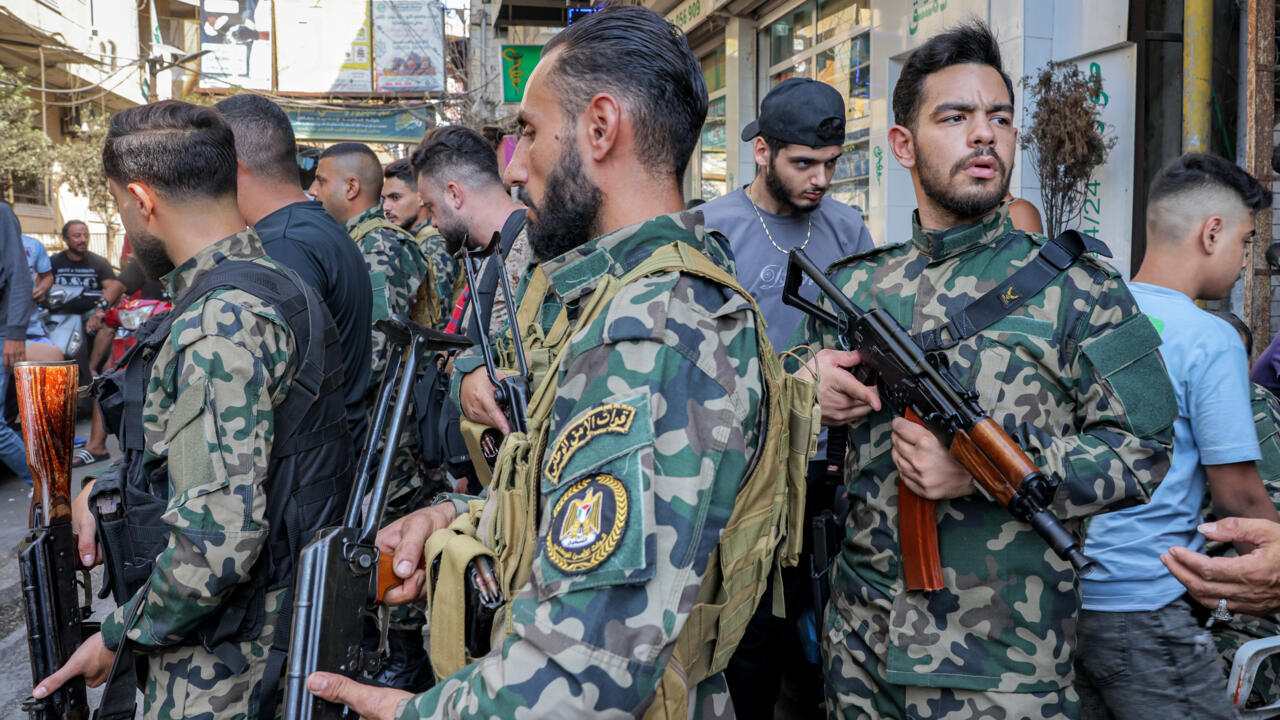
Some Palestinian armed groups in Lebanese refugee camps started handing over their weapons Thursday as part of a state-backed deal aimed at establishing government control and enabling a state monopoly on arms.
Issued on: 21/08/2025 -
By: FRANCE 24
File photo shows Palestinian fighters in the Burj al-Barajneh camp for Palestinian refugees in Beirut's southern suburbs. © Anwar Amro, AFP
Palestinian factions began handing over some of the weapons held in a refugee camp on the outskirts of Beirut to the Lebanese army Thursday, an initial step in implementing a plan officials announced three months earlier for removing arms from the camps.
It was a modest first step. One pickup left the camp loaded with light weapons packed in bags. The butts of machine guns could be seen protruding from some of the sacks.
It remains unclear whether all factions will abide by the decision.
Representatives of Hamas and the allied Palestinian Islamic Jihad did not respond to requests for comment.
A spokesperson for Hamas sent a statement signed by “the Palestinian Factions in Lebanon” that called Thursday’s handover of weapons “an internal organizational matter within the Fatah movement” that “has no connection, near or far, to the issue of Palestinian weapons in the camps.”
It added, “Our weapons have always been and will always be linked to the right of return and the just Palestinian cause and will remain so as long as the occupation remains on Palestinian soil.”
The decision to remove weapons from the camps was announced in May during a visit by Palestinian President Mahmoud Abbas to Lebanon, during which he and Lebanese President Joseph Aoun announced that arms would be consolidated under the authority of the Lebanese government.
The step of removing weapons from the camps was seen as a precursor to the much more difficult step of disarming the Lebanese militant group Hezbollah, which last year fought a bruising war with Israel that ended in a ceasefire in November. The group has been under domestic and international pressure since then to give up its remaining arsenal, which it has so far refused to do.
Read moreHezbollah leader accuses govt of ‘handing’ Lebanon to Israel with disarmament plan
Implementation of the plan for the Palestinian camps was delayed amid disagreements among and within the various Palestinian factions operating in Lebanon, which include Abbas’ Fatah movement, the rival Hamas group and a range of other Islamist and leftist groups, over the mechanism for handing over the weapons.
Ramez Dimashkieh, head of the Lebanese-Palestinian Dialogue Committee, a government body that serves as an interlocutor between Palestinian refugees and officials, said in a statement that the handover of weapons Thursday at the Burj al-Barajneh camp south of Beirut “will be the first step, with further batches to be delivered in the coming weeks from Burj al-Barajneh camp and the rest of the camps,” the statement said.
Nabil Abu Rdeneh, a spokesperson for Abbas, said in a statement that weapons were also handed over Thursday at al-Bass camp in southern Lebanon and would continue in other camps in implementation of the agreement between Abbas and the Lebanese government.
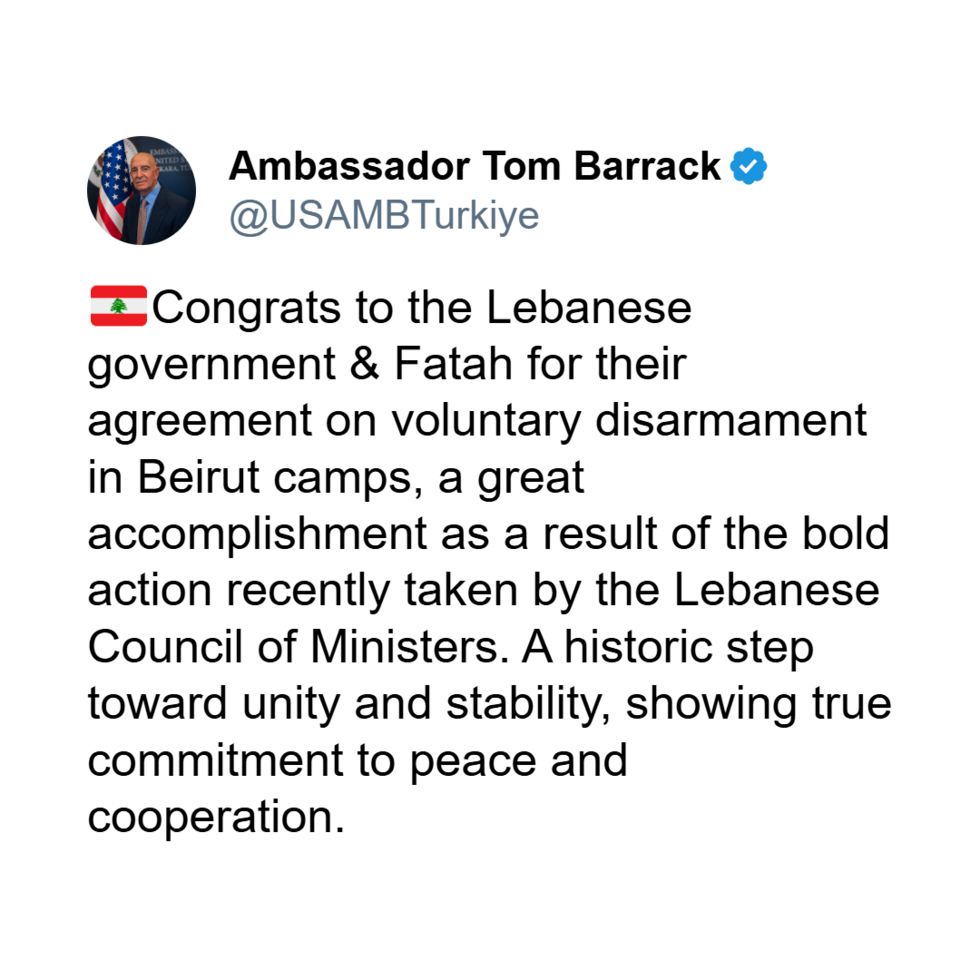
US envoy Tom Barrack congratulated the Lebanese government and Fatah “for their agreement on voluntary disarmament in Beirut camps.” In a post on X, he called it “a historic step toward unity and stability, showing true commitment to peace and cooperation.”
Palestinian factions began handing over some of the weapons held in a refugee camp on the outskirts of Beirut to the Lebanese army Thursday, an initial step in implementing a plan officials announced three months earlier for removing arms from the camps.
It was a modest first step. One pickup left the camp loaded with light weapons packed in bags. The butts of machine guns could be seen protruding from some of the sacks.
It remains unclear whether all factions will abide by the decision.
Representatives of Hamas and the allied Palestinian Islamic Jihad did not respond to requests for comment.
A spokesperson for Hamas sent a statement signed by “the Palestinian Factions in Lebanon” that called Thursday’s handover of weapons “an internal organizational matter within the Fatah movement” that “has no connection, near or far, to the issue of Palestinian weapons in the camps.”
It added, “Our weapons have always been and will always be linked to the right of return and the just Palestinian cause and will remain so as long as the occupation remains on Palestinian soil.”
The decision to remove weapons from the camps was announced in May during a visit by Palestinian President Mahmoud Abbas to Lebanon, during which he and Lebanese President Joseph Aoun announced that arms would be consolidated under the authority of the Lebanese government.
The step of removing weapons from the camps was seen as a precursor to the much more difficult step of disarming the Lebanese militant group Hezbollah, which last year fought a bruising war with Israel that ended in a ceasefire in November. The group has been under domestic and international pressure since then to give up its remaining arsenal, which it has so far refused to do.
Read moreHezbollah leader accuses govt of ‘handing’ Lebanon to Israel with disarmament plan
Implementation of the plan for the Palestinian camps was delayed amid disagreements among and within the various Palestinian factions operating in Lebanon, which include Abbas’ Fatah movement, the rival Hamas group and a range of other Islamist and leftist groups, over the mechanism for handing over the weapons.
Ramez Dimashkieh, head of the Lebanese-Palestinian Dialogue Committee, a government body that serves as an interlocutor between Palestinian refugees and officials, said in a statement that the handover of weapons Thursday at the Burj al-Barajneh camp south of Beirut “will be the first step, with further batches to be delivered in the coming weeks from Burj al-Barajneh camp and the rest of the camps,” the statement said.
Nabil Abu Rdeneh, a spokesperson for Abbas, said in a statement that weapons were also handed over Thursday at al-Bass camp in southern Lebanon and would continue in other camps in implementation of the agreement between Abbas and the Lebanese government.
US envoy Tom Barrack congratulated the Lebanese government and Fatah “for their agreement on voluntary disarmament in Beirut camps.” In a post on X, he called it “a historic step toward unity and stability, showing true commitment to peace and cooperation.”
"Congrats to the Lebanese government & Fatah for their agreement on voluntary disarmament in Beirut camps," US envoy Tom Barrack said on social media. © Screenshot, FRANCE 24
However, the extent to which the decision would actually be implemented remained unclear. Some officials with the Palestinian factions said only “illegal” weapons would be handed over, not those belonging to organized factions. They also said personal light weapons would not be included.
Badih al-Habet, a spokesperson for Fatah in Beirut, told reporters that Aoun had acknowledged that “personal weapons are part of Arab and national culture."
(FRANCE 24 with AP)
However, the extent to which the decision would actually be implemented remained unclear. Some officials with the Palestinian factions said only “illegal” weapons would be handed over, not those belonging to organized factions. They also said personal light weapons would not be included.
Badih al-Habet, a spokesperson for Fatah in Beirut, told reporters that Aoun had acknowledged that “personal weapons are part of Arab and national culture."
(FRANCE 24 with AP)
France and its European partners are resisting Washington’s push to end the UN peacekeeping mission in Lebanon – UNIFIL – arguing its presence remains essential for stability along Israel’s northern border.
Issued on: 19/08/2025 - RFI

French soldiers of the United Nations Interim Force in Lebanon (UNIFIL) march during the Bastille Day parade, Monday, 14 July 2025 in Paris. AP - Michel Euler
The United Nations Security Council began to debate Monday a resolution drafted by France to extend the UN peacekeeping force in south Lebanon for a year with the ultimate aim to withdraw it.
The future of UNIFIL has become the latest flashpoint between Washington and its European allies.
While the Trump administration has been pressing to draw down and shut the operation within months, France and its European partners are rallying behind it, arguing its continued presence is vital for stability in the region.
Created in 1978 and expanded after the 2006 war between Israel and Hezbollah, UNIFIL has long served as a buffer force in southern Lebanon.
Its 10,000-strong contingent of international troops patrols a volatile border and supports the Lebanese army as it works to consolidate authority. For many in Europe, the mission is imperfect but indispensable.
The United Nations Security Council began to debate Monday a resolution drafted by France to extend the UN peacekeeping force in south Lebanon for a year with the ultimate aim to withdraw it.
The future of UNIFIL has become the latest flashpoint between Washington and its European allies.
While the Trump administration has been pressing to draw down and shut the operation within months, France and its European partners are rallying behind it, arguing its continued presence is vital for stability in the region.
Created in 1978 and expanded after the 2006 war between Israel and Hezbollah, UNIFIL has long served as a buffer force in southern Lebanon.
Its 10,000-strong contingent of international troops patrols a volatile border and supports the Lebanese army as it works to consolidate authority. For many in Europe, the mission is imperfect but indispensable.

UNIFIL vehicles drive in the town of Qlayaa, near the border with Israel, amid ongoing hostilities between Hezbollah and Israeli forces, southern Lebanon 19 October 2024. © REUTERS - Karamallah Daher
'Expensive failure'
The White House, however, has made no secret of its desire to curtail the operation.
Senior officials, echoing longstanding Israeli frustrations, see UNIFIL as an expensive failure that has done little to weaken Hezbollah’s grip in the south of the country.
US Secretary of State Marco Rubio recently endorsed a plan to wind down the mission over six months, part of a broader retreat from multilateral commitments and UN spending.
But France – backed by Italy and Britain – has mounted a determined diplomatic campaign to resist an abrupt end.
European envoys argue that cutting short UNIFIL’s work would create a dangerous security vacuum.
France has pointed to the example of Mali, where a premature UN withdrawal left government forces overstretched and paved the way for extremist groups to expand.
As one French diplomat, speaking on condition of anonymity, warned: “If you leave too soon, others will rush to fill the space – and not the kind of actors anyone wants.”
France secures UNIFIL extension
After a series of negotiations last week, France and its allies secured provisional US agreement to a one-year extension of the mandate, buying time to keep the mission alive.
Israel, though long hostile to the peacekeepers, reluctantly accepted the compromise. What happens beyond next year, however, remains the subject of debate.
The French draft resolution, circulated in New York ahead of an upcoming Security Council vote on 25 August, deliberately avoids setting a fixed withdrawal date.
Instead, it extends UNIFIL’s mandate for a year while signalling the Council’s “intention to work on a withdrawal”.
For Paris, keeping the mission's closure open-ended is crucial to avoid emboldening Hezbollah or undermining the Lebanese army before it is ready to assume full responsibility.
Disarming Hezbollah
Lebanon’s government is itself deeply wary of any rapid pullback. With only 6,000 troops currently deployed in the south, Beirut says it needs time and resources to scale up to the planned 10,000.
Retired general Khalil Helou has warned that without UNIFIL, the army would have to divert soldiers from the Syrian border or other critical posts, risking wider instability. “For Lebanon, their presence is important,” he said.
Even Washington’s own representatives have softened their tone. Tom Barrack, the US envoy to Lebanon, this week called on Israel to fully honour its ceasefire commitments, including withdrawal from five Lebanese border points it still occupies.
He praised Beirut for taking steps to disarm Hezbollah and urged an “economic plan for prosperity, restoration and renovation” in the country.
Meanwhile, UN officials, have continued to underline the mission’s contribution. Peacekeepers have uncovered weapons caches and rocket launchers in recent weeks, sharing intelligence with the Lebanese army.
“UNIFIL remains critical to regional stability,” spokesman Stephane Dujarric said.
Financial constraints may still force adjustments. With UN budgets under strain, diplomats acknowledge that troop numbers could be reduced, offset by the greater use of surveillance technology.
(with newswires)
'Expensive failure'
The White House, however, has made no secret of its desire to curtail the operation.
Senior officials, echoing longstanding Israeli frustrations, see UNIFIL as an expensive failure that has done little to weaken Hezbollah’s grip in the south of the country.
US Secretary of State Marco Rubio recently endorsed a plan to wind down the mission over six months, part of a broader retreat from multilateral commitments and UN spending.
But France – backed by Italy and Britain – has mounted a determined diplomatic campaign to resist an abrupt end.
European envoys argue that cutting short UNIFIL’s work would create a dangerous security vacuum.
France has pointed to the example of Mali, where a premature UN withdrawal left government forces overstretched and paved the way for extremist groups to expand.
As one French diplomat, speaking on condition of anonymity, warned: “If you leave too soon, others will rush to fill the space – and not the kind of actors anyone wants.”
France secures UNIFIL extension
After a series of negotiations last week, France and its allies secured provisional US agreement to a one-year extension of the mandate, buying time to keep the mission alive.
Israel, though long hostile to the peacekeepers, reluctantly accepted the compromise. What happens beyond next year, however, remains the subject of debate.
The French draft resolution, circulated in New York ahead of an upcoming Security Council vote on 25 August, deliberately avoids setting a fixed withdrawal date.
Instead, it extends UNIFIL’s mandate for a year while signalling the Council’s “intention to work on a withdrawal”.
For Paris, keeping the mission's closure open-ended is crucial to avoid emboldening Hezbollah or undermining the Lebanese army before it is ready to assume full responsibility.
Disarming Hezbollah
Lebanon’s government is itself deeply wary of any rapid pullback. With only 6,000 troops currently deployed in the south, Beirut says it needs time and resources to scale up to the planned 10,000.
Retired general Khalil Helou has warned that without UNIFIL, the army would have to divert soldiers from the Syrian border or other critical posts, risking wider instability. “For Lebanon, their presence is important,” he said.
Even Washington’s own representatives have softened their tone. Tom Barrack, the US envoy to Lebanon, this week called on Israel to fully honour its ceasefire commitments, including withdrawal from five Lebanese border points it still occupies.
He praised Beirut for taking steps to disarm Hezbollah and urged an “economic plan for prosperity, restoration and renovation” in the country.
Meanwhile, UN officials, have continued to underline the mission’s contribution. Peacekeepers have uncovered weapons caches and rocket launchers in recent weeks, sharing intelligence with the Lebanese army.
“UNIFIL remains critical to regional stability,” spokesman Stephane Dujarric said.
Financial constraints may still force adjustments. With UN budgets under strain, diplomats acknowledge that troop numbers could be reduced, offset by the greater use of surveillance technology.
(with newswires)

No comments:
Post a Comment