How Black Workers Drove Interracial Labor
Solidarity

Cover art for the book Freedom Train: Black Politics and the Story of Interracial Labor Solidarity by Cedric De Leon
The elusive promise of interracial solidarity is an age-old question, one made all the more urgent in the current political climate. Can Black and white workers stick together against their bosses? Might their solidarity scale up to a multiracial working class movement, powerful enough to defy the capitalist system?
In the sociology of labor and labor movements, the debate turns on a similar question: are American unions exclusionary toward, or protective of, Black labor? Some highlight cases in which white workers and labor leaders have engaged in racist behavior. Others point out that progressive unions have welcomed Black workers into their ranks and even elected them to positions of power.
Although both camps offer important lessons for anyone studying or building social movements, this way of framing the question is problematic for two reasons. First, white people are the main protagonists in these stories. Black people, conversely, are the passive victims or beneficiaries of white people. Second, most sociologists look for interracial solidarity in unions, even though for much of U.S. labor history, Black people were unable to join unions. The result is that Black workers show up as minor players in their own history. We know much less about instances of interracial solidarity in which Black people played the leading role.
In my new book, Freedom Train: Black Politics and the Story of Interracial Labor Solidarity, I urge scholars and labor activists to ask a different question: what conditions within the Black community enabled interracial labor solidarity? Once we look at the encounter from the Black worker’s point of view — that is from the “subaltern” standpoint — the story of interracial solidarity looks very different. The archives reveal that white people were hardly the architects of a racially unified labor movement, but were instead inconsistent in their support of, if not hostile to, that vision. Archival data reveal, too, that Black workers had to continually push for their own inclusion even in unions accounted progressive for their time.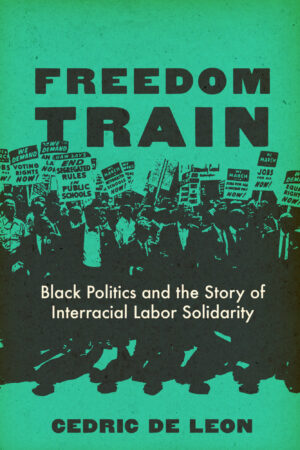
Moreover, the energy that propelled the struggle for interracial solidarity was the conflict and
consensus among competing factions in Black civil society. This is what I mean by “Black Politics.” The Centrist faction, led by A. Philip Randolph, worked internally within the bureaucracy of the American Federation of Labor (AFL) to win membership and affiliation for Black workers in international unions. The Left faction, led by successive cadres like Cyril Briggs, Thelma Dale, and Vicki Garvin, were suspicious of the AFL’s apparent racism and class collaboration and favored militant direct action, mass mobilization, and open conflict with capital. This factional struggle in the Black community, while tense and often painful, led to tactical innovations, such as marches in the nation’s capital and the organization of sectors like steel, auto, tobacco, and meatpacking where Black workers were disproportionately concentrated.
What lessons do we learn about the dynamics of interracial solidarity when we start with the lived experience of Black people?
One lesson is that those who already benefitted from unions were not the vanguard of that struggle. White workers were just as likely to oppose integrated unions as they were to support them. Instead, subaltern groups — those whom the labor movement excluded — were the most consistent champions of desegregation.
Moreover, having being shut out of official union channels, Black workers employed alternative organizational forms to achieve integration. I call these “independent Black labor organizations.”
Next, Black women played a pivotal role in integrating unions and the workplace. They were key leaders in every major independent Black labor organization of the twentieth century and insisted, sometimes against the objection of their male counterparts, that gender equity be an organizational priority.
Lastly, the fight for interracial solidarity was not a straightforward story of unified collective struggle. It was instead a messy story of disagreement, intrigue, and marriages of convenience. Nevertheless, it was precisely the conflict and consensus among factions in Black civil society that gave rise to new tactics. These tactics, in turn, extracted deep concessions from the state and capital, perhaps most famously in the 1963 March on Washington for Jobs and Freedom.
To learn more about Freedom Train, listen to my interview with Steven Pitts, co-founder of the National Black Worker Center and former host of the podcast, “Black Work Talk.”
This originally appeared on the University of California Press blog and is reprinted here with permission.
How Grassroots Labor Activist Fight Callous
Policies
August 4, 2025

Photograph by Nathaniel St. Clair
Harmon Dent’s congregation “adopted” an apartment building in Beaumont, Texas, and started handing out gift baskets, food, and other treats to the disadvantaged children living there.
Dent, the pastor, also leads church members in donating money and time to a regional food bank that serves about 12,000 households every month through an eight-county network of nonprofits.
There’s more. Rev, as he’s known, introduces kids to trades through the local labor council, helps disaster victims to rebuild, and assists Beaumont police on high-stress calls.
Unfortunately, it isn’t enough for the longtime union and social justice activist to fight chronic hunger, hurricanes, and homelessness these days. He also has to battle the callousness of Donald Trump and congressional Republicans, who have the power to help but prefer to inflict additional hardships on the people they ostensibly represent.
“They don’t care,” summed up Dent, citing the recent spending bill—passed entirely by Republicans, then signed by a gleeful Trump —that slashes $186 billion from nutrition programs and compounds the need that nonprofits already struggled to address.
“They’re taking food away from babies and giving money to the rich. They’re taking money away from senior citizens and giving it to people who are billionaires,” he added, noting the bill’s cuts to nutrition programs, Medicaid, and other lifelines enable Trump to funnel huge tax giveaways to the 1 percent.
It’s a mindset completely opposite to that of activists like Dent, a former member of United Steelworkers (USW) Local 13-243, who devotes much of his time to the growing needs in his community.
“There are a lot of people who are hungry,” said Dent, who leads Temple of Praise Church of God in Christ. “There are a lot of people who go to bed at night with their stomachs growling.”
Dent grew up poor himself, in a home without a telephone or plumbing.
But he landed a good job at ExxonMobil, made fair wages, and retired at 58, thanks to strong USW contracts that afforded him the wherewithal to give back.
The USW also exposed Dent to the power of collective action, fueled his concern for others, and he recalled, “helped to make me who I am today.” What’s more, union trainings and workshops provided him with a blueprint for action.
He joined the Steelworkers Organization of Active Retirees (SOAR), co-founded a chapter of the Texas Alliance for Retired Americans, and participates in an NAACP scholarship program. He completed Beaumont’s Clergy and Police Partnership training and helps officers defuse mental health and domestic violence crises.
Dent also serves with the Jefferson County Long Term Recovery Group, which rebuilds homes damaged by floods and hurricanes. And he participates in a childhood literacy program that’s essential to preparing young people for the family-sustaining jobs of tomorrow.
“I enjoy doing what I am doing,” he said. “To me, it is the greatest thing to say I helped a child or I helped someone to succeed or be successful.”
Sadly, Trump and congressional Republicans have other priorities.
Instead of supporting leaders like Dent, they undermine community-building and put more people at risk.
Senator Ted Cruz of Texas supported the spending bill, which cut funds for weather forecasting in addition to nutrition programs, and then took a vacation to Greece as the flooding over the July 4 weekend killed at least 136 and wiped out a youth camp in the state’s Hill Country.
Some Republicans even had the gall to joke about the pain they cause.
When a constituent warned about the lethal impact of Medicaid cuts, Senator Joni Ernst of Iowa retorted, “Well, we all are going to die.” Ernst followed that flub with a ham-handed Instagram post that doubled down on her cynical disdain for her constituents.
“She showed her true colors,” observed Randy Hughes, a SOAR activist and longtime member of USW Local 105 at Arconic’s Davenport Works.
Local 105 and SOAR have long worked together to serve veterans in the Davenport area, and Hughes and his wife, Deb, help to keep the tradition going.
They donate to a veterans’ organization. They volunteer for their SOAR chapter’s chili suppers, which benefit veterans and a family services nonprofit.
“We all pitch in. We serve, we clean, we do everything,” said Hughes, who knows his SOAR unit now will face growing demand for help.
Trump’s decision to kill tens of thousands of jobs at the Department of Veterans Affairs will further burden the very veterans that Hughes and his fellow activists work to keep alive.
The spending bill’s cuts to nutrition funding will also increase pressure on local food distribution efforts, including, Hughes predicted, a hot-meal program and pantry operated by a coalition of churches that he and his wife support.
Hughes, who relied on government-provided staples while scraping by early in his marriage, said the gratitude of the people he serves only inspires him to give more. But he’s clear-eyed about the crises of Trump’s making.
“It’s only going to get worse,” he said.
Like Ernst, Senator Mitch McConnell of Kentucky brushed aside concerns about the bill’s impact on working people.
“[T]hey’ll get over it,” he said.
But Kendall Kilgore, a SOAR member in northeastern Kentucky, knows that won’t be easy for those who are barely hanging on.
Kilgore volunteers at fundraisers for local fire departments, assists with teen dances, and otherwise helps to hold together far-flung rural communities with high unemployment and poverty rates.
“It’s just the right thing to do,” said Kilgore, a longtime USW leader at the former AK Steel mill in Ashland, Kentucky.
McConnell “doesn’t have to worry. He’s got plenty of money,” Kilgore said, noting that many others in the region have little to sustain them beyond the supports that Republicans just shredded.
For example, the Medicaid cuts that McConnell made light of will not only cost hundreds of thousands of Kentuckians their health care but also imperil dozens of rural hospitals across the state and put health care workers’ jobs at risk.
And Kentucky can’t afford to lose more jobs. Factories and other workplaces that once lined the Ohio River, including the AK Steel mill, disappeared over the years amid McConnell’s failed leadership.
“There’s no work,” Kilgore said, stressing residents’ need for a safety net. “They could surely use the help.”
This article was produced by the Independent Media Institute.

No comments:
Post a Comment