Opinion
(RNS) — The protection of the Palestinian people is a matter of faith and conscience.
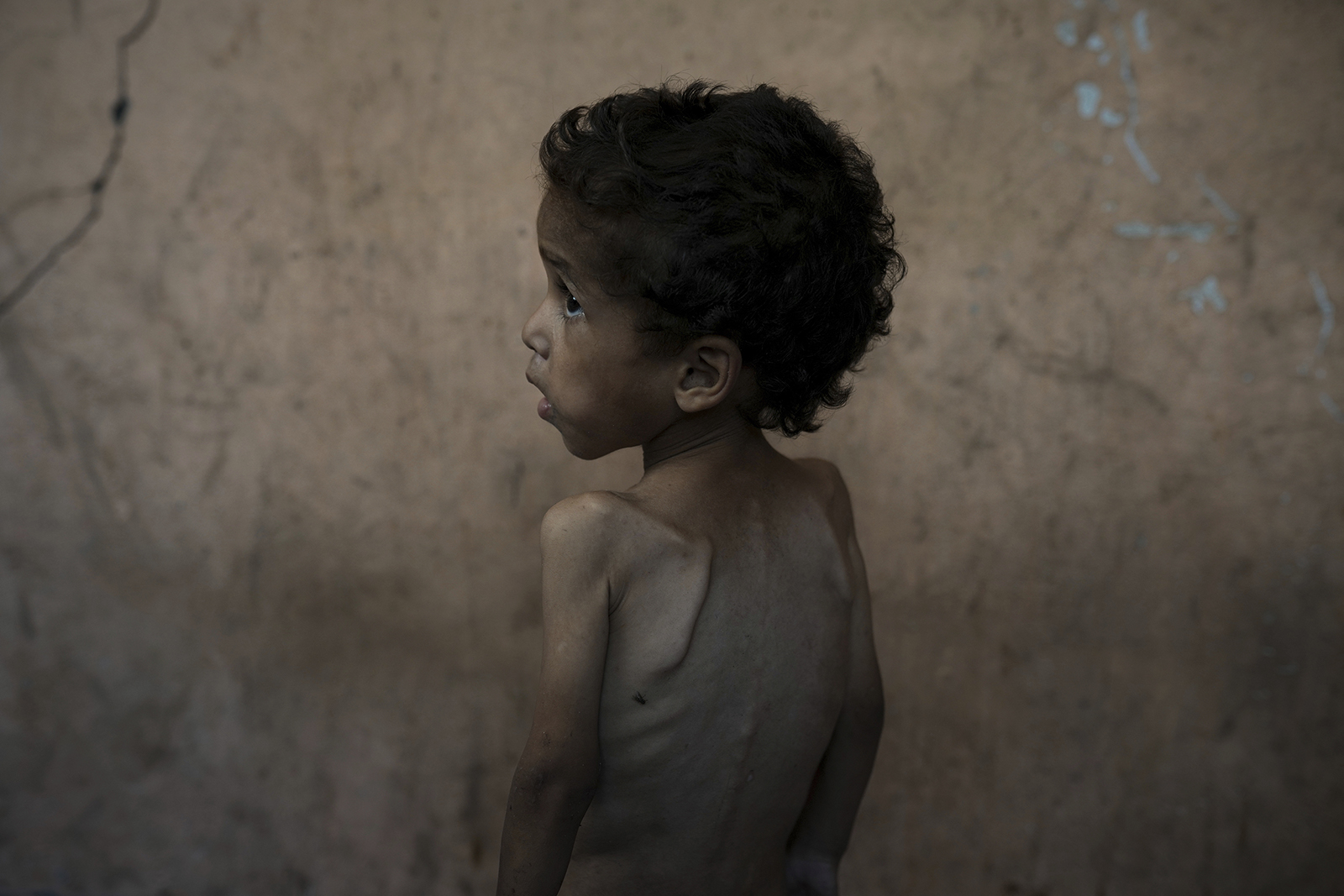
Yazan Abu Ful, a 2-year-old malnourished boy, stands shirtless for a photo at his family's home in the Shati refugee camp in Gaza City, July 23, 2025. In Gaza, malnutrition is often worsened by preexisting conditions and compounded by illnesses linked to inadequate health care and poor sanitation, largely the result of the ongoing war. (AP Photo/Jehad Alshrafi)
Jim Wallis
August 6, 2025
RNS
(RNS) — Starvation, especially mass starvation, must transcend politics. What we are witnessing in Gaza is exactly that: the brutal starvation of a population. This crisis should unite people and nations in urgent common purpose to stop it and save lives — particularly because, as is the case in Gaza, the first to suffer and die are often children.
According to the United Nations, nearly 1 in 3 people are going multiple days without eating and hospitals are reporting rising deaths from malnutrition and starvation. The Gaza Health Ministry said more than 600 people have been killed while trying to reach food aid at the new Gaza Humanitarian Foundation sites, The New York Times reported.
The risk is particularly great for children and pregnant women. Ross Smith, the director of emergency preparedness and response at the U.N. World Food Programme, reported that nearly 100,000 women and children are suffering from severe acute malnutrition. Doctors Without Borders said the two clinics it runs in Gaza were treating over 700 pregnant and breastfeeding women for malnutrition.
The Washington Post shared this sobering and traumatic story:
In Gaza City’s Sabra district, Ayat al-Soradi, 25, said she was so malnourished during her pregnancy this year that she gave birth to her twins, Ahmed and Mazen, two months early. They each weighed about two pounds, and for almost a month, she had watched over them in their incubators as the nurses fed them with powdered milk.
We must not shy away from the deadly reality facing millions in Gaza. Evidence of starvation has seemingly pushed the conversation around Gaza and Palestine to new levels in Israel, the U.S. and Europe.
In the United States last week, 27 Democratic senators, an unprecedented number, voted to block more than $675 million in offensive weapons sales to Israel. A similar vote garnered only 15 Democratic senators in April 2025, down from 18 in November 2024.
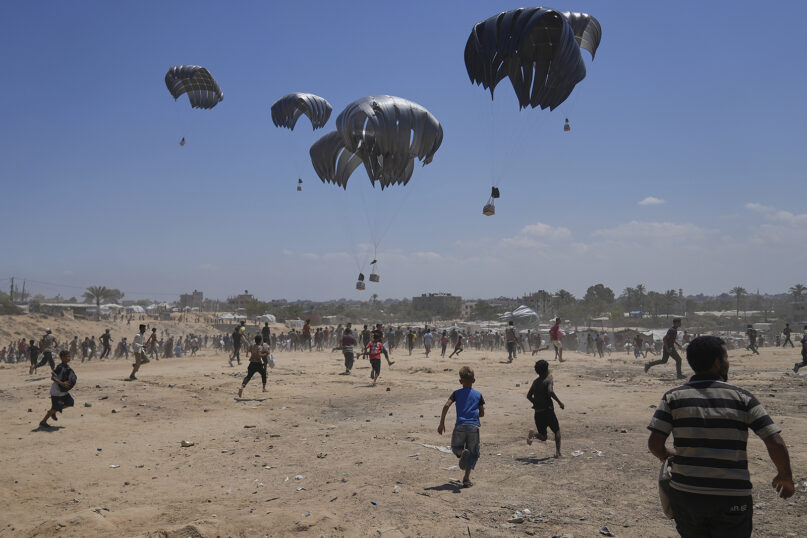
Palestinians rush to collect humanitarian aid airdropped by parachutes into Zawaida in the central Gaza Strip, Aug. 4, 2025. (AP Photo/Abdel Kareem Hana)
I’m currently in Europe, where the conditional commitment to recognize a Palestinian state by British Prime Minister Keir Starmer is front-page news. French President Emmanuel Macron has signaled plans to do the same. And now, Canadian Prime Minister Mark Carney has promised to recognize Palestine at the U.N. General Assembly in September — joined by a growing number of other countries. Their message is clear: If urgent commitments around humanitarian aid and the safety of Palestinians are not met, recognition will move forward. With neither Israel nor the U.S. providing these assurances, the recognition of a Palestinian state is now a moral imperative — one grounded in protecting both peoples.
While the recognition of the Palestinian state in this current moment is largely a symbolic action (given the reality of U.S. veto power in the U.N. and the illegal Israeli settlements that have violently encroached into Palestinian territory), it is an important step in the process of bringing about a tenable, fair and secure two-state solution or another alternative solution that recognizes the dignity and sovereignty of two peoples sharing the same land. While such a prospect may seem politically hopeless now, a just and meaningful sharing of the land is the only alternative to endless war and suffering for all — including the suffering that continues to fall most heavily on the Palestinian people.
There is widespread agreement that Hamas cannot be a part of a future Palestinian state, because of its terrorist atrocities and its rejection of a two-state solution. Likewise, Prime Minister Benjamin Netanyahu’s right-wing Israeli government would never accept a two-state solution and continues to carry out violent policies against civilians — including attacks on people waiting in line for food.
We must remember what terrorism truly means: the unlawful use of violence and intimidation, especially against civilians, in the pursuit of political aims. By that definition, both sides are guilty.
A fair and just sharing of the land requires new leadership on both the Israeli and Palestinian sides. Netanyahu’s extreme right-wing government is pushing for the annexation of the West Bank and complete control over Gaza, while Donald Trump has even suggested turning Gaza into a resort bearing his name.
Israel’s denial of the starvation in Gaza — and its refusal to take responsibility despite being the occupying power in full control — has created an international moral crossroads.
Governments hold the power here, and any U.N. resolution in September recognizing a Palestinian state can be vetoed by the United States.
But what if churches in the U.S. and around the world took the lead in recognizing a Palestinian state? That would send a clear moral message — the recognition and protection of the Palestinian people is a matter of faith and conscience, grounded in a commitment to sovereignty, security and multifaith pluralism for all. Elevating these moral truths in the public narrative is now essential. It may be the only path forward.

The Rev. Jim Wallis. (Courtesy photo)
(The Rev. Jim Wallis is Archbishop Desmond Tutu chair and director of Georgetown University’s Center on Faith and Justice and the author, most recently, of New York Times bestseller “The False White Gospel: Rejecting Christian Nationalism, Reclaiming True Faith, and Refounding Democracy.” The views expressed in this commentary do not necessarily reflect those of RNS.)
Gaza’s Starvation, Israeli Lies and the Tail that Wags the Dog
August 5, 2025
Whenever Israel yields to international pressure and allows aid trucks into Gaza, it devises other methods to ensure that food is never delivered. On the same day, July 26, Israel announced airdrops and “humanitarian corridors” for UN convoys, its forces murdered 53 humans seeking aid in those corridors. Aid distribution points, rather than feeding the starving population, Israel turns them into killing zones. Time and again, since December 2023, Palestinians have been paying with blood for a loaf of bread or a bottle of water.
In less than two months, death by Israeli bullets at the so-called Gaza Humanitarian Foundation (GHF) has reached over 1,054, averaging about 20 murders daily. Since July 26 when Israel announced the new “humanitarian (death) corridors,” the murder toll has more than doubled compared to those killed daily at GHF distribution centers, 325 last week alone. Meanwhile, the tokenistic airdrops by Arab collaborators is nothing short of a disgrace.
The $60 million Donald Trump brags about giving to GHF is blood money funding the deaths of hungry Palestinians. For the starved, GHF stands for Gaza Humiliation Front, not a lifeline, but an Israeli murder-line. Instead of wasting American taxpayer money on GHF death traps, Trump should consider restoring U.S. funding to UNRWA, the only agency that has offered real hope to Palestinian children for more than 75 years.
Steve Witkoff’s visit to a GHF center in Gaza, followed by his statement that there is no starvation, was a textbook case of confirmation bias. His tour did not show the absence of starvation, but rather his willful blindness not to see. Witkoff sought out information that would reinforce his predetermined narrative to whitewash starvation.
To be sure, no one had seriously expected him to witness starvation at a carefully staged (safe) site, far removed from the people. He declined an invitation to visit a hospital in Gaza to see the starved children, and hear directly from the life-saving medical professionals. Instead, he chose a photo op and listen to the mercenaries of death at GHF.
The engineered starving in Gaza, supported by the U.S., has always been a central pillar of Israel’s psychological warfare; a calculated strategy aimed at expelling the population or driving them into a survivalist frenzy. Israel, and the U.S. funded GHF, have become the perfect linchpin of this Israeli designed contraption. Replacing a well-established UN infrastructure that operated 400 distribution centers, GHF offered only four aid points. These limited sites made it easier for Israel to surveil, shoot at the starving, and leave the survivors to fight over the meager crumbs that remained.
GHF role was exposed by Anthony Aguilar, a retired U.S. Special Forces officer, West Point graduate, and recipient of the Purple Heart and Bronze Star. Choking back tears, Lt. Col. Aguilar recounted the story of a child who “walked 12 kilometers to reach” one of GHF’s food distribution sites. “He got nothing but scraps, thanked us for it…” and then he was shot dead by the Israeli army. I urge readers to listen to the powerful three minutes testimony from a decorated U.S. military officer.
Still, the Israeli-managed “free” Western media has too often acted as Israel’s public relations arm. It downplays Israel’s horrific crimes and markets Israeli falsehood, such as the baseless claim that the resistance steals food aid. This fabricated narrative persisted even after USAID concluded that Israel failed to provide any evidence supporting that food aid was being diverted. Or they excuse the lack of food on a faulty distribution system, not the Israeli blockade. When in fact, other than for Israeli military hindrance, under UN oversight, there has been no issues delivering food to all of Gaza. Israel’s objective is simple: deflect responsibility by blaming the starving for their own starvation.
Even after these lies were debunked, the Trump administration continued to parrot Israeli disinformation. Notably, however, following his trip to Scotland, Trump’s tone has noticeably softened, acknowledging for the first time, the taunting images of starving babies. Perhaps, a few days outside the Washington bubble of his Israel-first advisors, has offered him a rare glimpse of reality.
Meanwhile, it took one video of an emaciated Zionist captive for Israelis to cry Holocaust. But not the food blockade against 2.3 million humans (including the Israeli captive soldiers), nor the images of starving Palestinians murdered at Israel’s humiliating food lines, or babies with hollow eyes, abdominal bloating, and skeletal limbs. These barely get their attention. Instead of showing human empathy, they chose to dismiss the haunting photos of dying infants, maybe because these children were less “chosen.”
Early last June, I wrote on the Israeli scheme to “lie, deny, and distort the truth.” In the article, I detailed a long list of Israeli lies and how the American media disseminated the disinformation with little to no effort to verify or challenge. You see, Israel does not just enjoy political impunity from the U.S. administration; it also has the freedom to lie with complete immunity from the American media.
The daunting question remains, how many lies must Israel tell before the media call them out, just as they do with the American President, Donald J. Trump—or other nations?
A recent example of how the Israeli-managed “free” media misrepresents facts is the latest failed ceasefire talks. Listening to U.S. media, BBC and government mouthpieces, one might conclude that the Palestinian negotiators rejected a “generous” offer for a ceasefire. In reality, the talks collapsed because Netanyahu sought only a pause to secure the release of captive Israeli soldiers, refusing to agree to end the war, or the starvation blockade.
No rational party would accept, let alone consider, such a half-measure. When Palestinians rejected a proposal short of a lasting ceasefire, Netanyahu cried foul. President Trump, and his envoy Witkoff, rushed to absolve his intransigence and refusal to accept a permanent ceasefire, and then blamed the Palestinians.
The reluctance, or perhaps intimidation of the Arab mediators like Qatar and Egypt to publicly challenge Washington’s pro-Israel stance has only deepened the media distortions. The mediators’ silence allowed Netanyahu’s false narratives to dominate international discourse, while serving as a fig leaf for the blatant submissive American bias.
Nonetheless, the tide could be turning. France and UK’s recent promise to recognize the state of Palestine, although long overdue, signals the growing frustration with Netanyahu’s lies and deceit. The European officials made it clear, they were no longer willing to tolerate the Israeli farce. The symbolic act, however, would never atone for Britain’s original sin: the 1917 Balfour Declaration, which promised European settlers a homeland in Palestine, while failing to enshrine the rights of the indigenous Palestinians on their land. Nor does it exonerate France who conspired with Britain in the secret 1916 Sykes-Picot Agreement to carve up the eastern part of the Arab world.
Still, recognition matters. Fourteen other countries are poised to follow France’s lead next month. The growing calls demanding Netanyahu to agree to a ceasefire, is also telling. These governments have finally realized, what their subjects had long known, that the absence of peace is not due to Palestinian rejectionism, but to Netanyahu’s deception and insatiable thirst for the never-ending wars.
Despite the dominance of Israeli-embedded journalists and pundits in Western media, the world is finally waking up to the true face of Israel. Alternative media has, to a great extent, succeeded in piercing through the wall of Israeli lies, offering an unfiltered view into the lived horrors of starvation and the genocide. No amount of Israeli propaganda can obscure the images of skeletal ribs jutting from the bodies of dying children. The sight of starving infants suckling on their bony fists, indicts the liars more powerfully than any polished Israeli hasbara could ever hide.
To that end, a recent Gallup poll shows a clear shift in the U.S., where American support for the Israeli military action in Gaza has dropped to 32%, and disapproval has soared to 60%. For a while, Israel was enabled to “fool all the people some of the time,” and it continues to “fool some of the people all the time,” but ultimately, and as the latest poll shows, it “cannot fool all the people all the time.”
Yet babies are starving, the genocide continues and there is no ceasefire is in sight. This is only possible because Netanyahu and AIPAC continue to wag the dogs of Washington.

Samy Magdy and Wafaa Shurafa
August 4, 2025
DEIR AL-BALAH, Gaza Strip (AP) — Every morning, Abeer and Fadi Sobh wake up in their tent in the Gaza Strip to the same question: How will they find food for themselves and their six young children?
The couple has three options: Maybe a charity kitchen will be open and they can get a pot of watery lentils. Or they can try jostling through crowds to get some flour from a passing aid truck. The last resort is begging.
If those all fail, they simply don’t eat. It happens more and more these days, as hunger saps their energy, strength and hope.
The predicament of the Sobhs, who live in a seaside refugee camp west of Gaza City after being displaced multiple times, is the same for families throughout the war-ravaged territory.
Hunger has grown throughout the past 22 months of war because of aid restrictions, humanitarian workers say. But food experts warned earlier this week the “worst-case scenario of famine is currently playing out in Gaza.”
Israel enforced a complete blockade on food and other supplies for 2½ months beginning in March. It said its objective was to increase pressure on Hamas to release dozens of hostages it has held since its attack on Israel on Oct. 7, 2023.
Though the flow of aid resumed in May, the amount is a fraction of what aid organizations say is needed.
A breakdown of law and order has also made it nearly impossible to safely deliver food. Much of the aid that does get in is hoarded or sold in markets at exorbitant prices.
Here is a look at a day in the life of the Sobh family:
A morning seawater bath
The family wakes up in their tent, which Fadi Sobh, a 30-year-old street vendor, says is unbearably hot in the summer.
With fresh water hard to come by, his wife Abeer, 29, fetches water from the sea.
One by one, the children stand in a metal basin and scrub themselves as their mother pours the saltwater over their heads. Nine-month-old Hala cries as it stings her eyes. The other children are more stoic.
Abeer then rolls up the bedding and sweeps the dust and sand from the tent floor. With no food left over from the day before, she heads out to beg for something for her family’s breakfast. Sometimes, neighbors or passersby give her lentils. Sometimes she gets nothing.
Abeer gives Hala water from a baby bottle. When she’s lucky, she has lentils that she grinds into powder to mix into the water.
“One day feels like 100 days, because of the summer heat, hunger and the distress,” she said.
A trip to the soup kitchen
Fadi heads to a nearby soup kitchen. Sometimes one of the children goes with him.
“But food is rarely available there,” he said. The kitchen opens roughly once a week and never has enough for the crowds. Most often, he said, he waits all day but returns to his family with nothing “and the kids sleep hungry, without eating.”
Fadi used to go to an area in northern Gaza where aid trucks arrive from Israel. There, giant crowds of equally desperate people swarm over the trucks and strip away the cargo of food. Often, Israeli troops nearby open fire, witnesses say. Israel says it only fires warning shots, and others in the crowd often have knives or pistols to steal boxes.
Fadi, who also has epilepsy, was shot in the leg last month. That has weakened him too much to scramble for the trucks, so he’s left with trying the kitchens.
Meanwhile, Abeer and her three eldest children — 10-year-old Youssef, 9-year-old Mohammed and 7-year-old Malak — head out with plastic jerrycans to fill up from a truck that brings freshwater from central Gaza’s desalination plant.
The kids struggle with the heavy jerrycans. Youssef loads one onto his back, while Mohammed half-drags his, his little body bent sideways as he tries to keep it out of the dust of the street.
A scramble for aid
Abeer sometimes heads to Zikim herself, alone or with Youssef. Most in the crowds are men — faster and stronger than she is. “Sometimes I manage to get food, and in many cases, I return empty-handed,” she said.
If she’s unsuccessful, she appeals to the sense of charity of those who succeeded. “You survived death thanks to God, please give me anything,” she tells them. Many answer her plea, and she gets a small bag of flour to bake for the children, she said.
She and her son have become familiar faces. One man who regularly waits for the trucks, Youssef Abu Saleh, said he often sees Abeer struggling to grab food, so he gives her some of his. “They’re poor people and her husband is sick,” he said. “We’re all hungry and we all need to eat.”
During the hottest part of the day, the six children stay in or around the tent. Their parents prefer the children sleep during the heat — it stops them from running around, using up energy and getting hungry and thirsty.
Foraging and begging in the afternoon
As the heat eases, the children head out. Sometimes Abeer sends them to beg for food from their neighbors. Otherwise, they scour Gaza’s bombed-out streets, foraging through the rubble and trash for anything to fuel the family’s makeshift stove.
They’ve become good at recognizing what might burn. Scraps of paper or wood are best, but hardest to find. The bar is low: plastic bottles, plastic bags, an old shoe — anything will do.
One of the boys came across a pot in the trash one day — it’s what Abeer now uses to cook. The family has been displaced so many times, they have few belongings left.
“I have to manage to get by,” Abeer said. “What can I do? We are eight people.”
If they’re lucky, lentil stew for dinner
After a day spent searching for the absolute basics to sustain life — food, water, fuel to cook — the family sometimes has enough of all three for Abeer to make a meal. Usually it’s a thin lentil soup.
But often there is nothing, and they all go to bed hungry.
Abeer said she’s grown weak and often feels dizzy when she’s out searching for food or water.
“I am tired. I am no longer able,” she said. “If the war goes on, I am thinking of taking my life. I no longer have any strength or power.”
___
Magdy reported from Cairo.
Associated Press religion coverage receives support through the AP’s collaboration with The Conversation US, with funding from Lilly Endowment Inc. The AP is solely responsible for this content.

No comments:
Post a Comment