Negotiations in Alaska: Does Trump’s peace deal for Putin have a future?
First published at Posle.
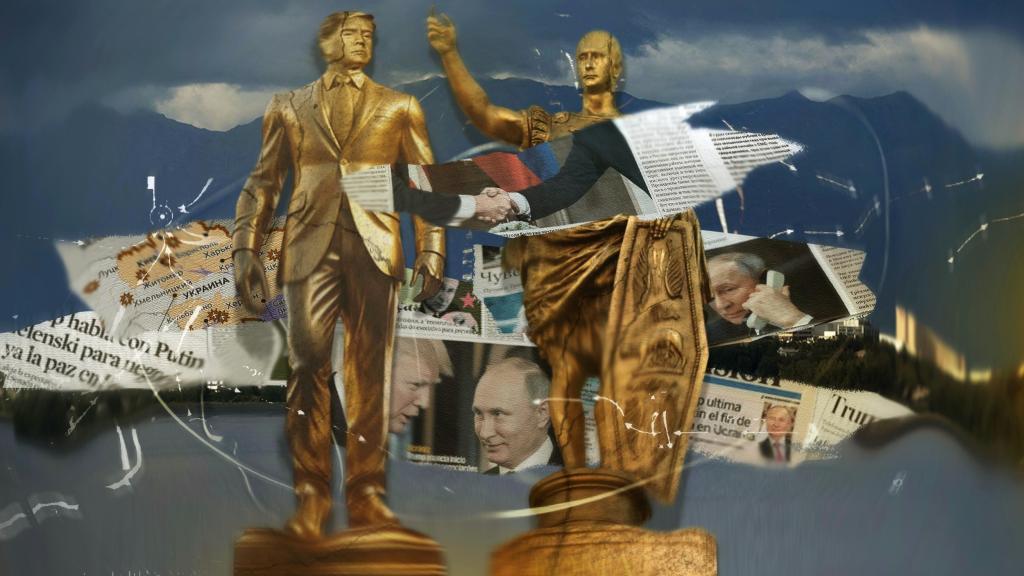
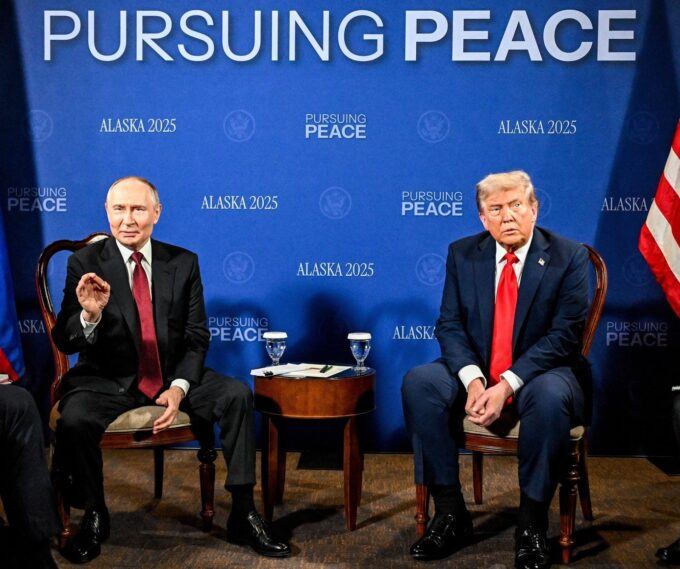
On August 15, negotiations between President Trump and President Putin took place in Anchorage, Alaska. The primary topic of discussion was the “Ukraine deal.” Despite reports of successful negotiations by both parties, a definitive agreement has not been reached. This meeting followed Trump’s pre-election promises to end the war swiftly, a series of ultimatums to Putin, and criticism of the Ukrainian leadership by the US president. Strangely, the meeting, which sought to decide the possible future of Ukraine and Europe, took place without the participation of either.
The fact that direct negotiations took place between the US and Russian delegations can be considered a foreign policy success for Putin. It is important to acknowledge that the primary objective of the invasion of Ukraine has never been to protect “Russian speakers.” Instead, one of the primary factors driving this agenda has been the Russian dictator’s pursuit of a sphere of influence that is recognized by world leaders. Putin has expressed his belief that Ukraine lacks sovereignty and is instead under the influence of the “West,” indicating that, in his opinion, meaningful negotiations are only possible with the United States. This is the reason why Trump’s earlier efforts to “bring the leaders of Russia and Ukraine to the negotiating table” have been unsuccessful, with Russia systematically undermining all negotiations by consistently presenting its own unrealistic ultimatums.
Trump’s decision to meet with Putin in person effectively acknowledges Russia’s claims to its own sphere of influence. This shift in perspective effectively transforms the Russian invasion and its consequences from a blatant violation of international law into a matter of routine negotiation. While at the onset of the full-scale war, diplomacy centered on Russia’s obligation to respect international law and recognized borders, now Ukraine and Europe are forced to acknowledge “Russia’s legitimate interests.” The United States president’s role is to compel Ukraine to accept this state of affairs — to accept it without suffering military defeat and even after dealing several painful blows to the aggressor’s vastly superior army. However, they are forced to accept it while navigating the changing political landscape in democratic nations, particularly the growing influence of politicians who are willing to collaborate with authoritarian leaders. In his interview with Fox News after the talks, Trump emphasized that “now everything depends on Volodymyr Zelensky” and that Zelensky “must agree to the ‘deal’.”
The meeting between Trump and Putin in a democratic state is a significant development in global politics. This development indicates a notable shift in Putin’s international standing, elevating him out of political isolation and providing a respite from sanctions. This development also suggests a strategic reappraisal of Russian diplomacy, potentially leading to a broader recognition of the alleged “fairness” of its demands and absolving it of responsibility for unleashing military aggression. This, in turn, only reinforces militarism and dictatorship in Russia. The elites have received a clear signal that business relations will resume in the near future, while the population is becoming increasingly convinced that no change is possible and that the authorities will get away with anything. The ongoing militarization of society and the expansion of the military-industrial complex are bound to continue even after the end of the war, until they ultimately lead to another military conflict.
The future for peace
Trump’s negotiations have captured everyone’s attention, evoking mixed emotions: hope for an end to the war, but also anxiety about its consequences and the terms of the potential deal. Public statements by the negotiators are vague and often contradictory, further heightening the sense of uncertainty.
For residents of both warring countries and concerned people around the world, a ceasefire is the most desirable outcome. However, whether Russia’s position of impossible ultimatums has changed or if all the talks are just another delaying tactic remains a mystery. Today [August 16], Minister Lavrov stated that the goal of the “special military operation” is to “protect” Russian people, not to seize territory. So far, at least, Trump’s meetings and phone calls with Putin have had no effect on how the war is going. Russia continues its slow advance, grinding down its own soldiers and those of other countries in assaults and striking cities daily, causing destruction and dozens of civilian casualties. Meanwhile, Russia’s economy is facing mounting challenges: the impact of budget allocations to the military is fading, and the modest GDP growth is slowing down rapidly.
In this context, Putin’s diplomatic success was that Trump brought him out of political isolation and made some of Russia’s imperialist foreign policy claims seem legitimate. This is already obvious, as is the fact that Trump is putting maximum pressure on Ukraine regarding the claims he has deemed acceptable. For now, however, Putin’s only compelling argument remains military force and the threat of using it.
Peace is necessary not only to stop the killing but also to begin healing the wounds inflicted by war. Forgiving, understanding, acknowledging responsibility, and rebuilding relationships is always difficult. It will be three times as difficult if Ukraine is forced into an unjust peace, and if Putin continues to threaten the world and corrode Russian society with propaganda and militarism.
The Trump-Putin Summit: Negotiating With
the Devil(s)
August 22, 2025
Photograph Source: kremlin.ru – CC BY 4.0
Vladimir Putin has been demonized. Not only is the president of the Russian Federation under indictment by the International Criminal Court for war crimes, he has been compared to Hitler, Stalin, and Saddam Hussein. Already in 2012, Reuters cited references to Putin as a “czar-like autocrat,” a “KGB thug,” More recently, after the invasion of Ukraine, Al Jazeera referenced Putin with words like “evil,” “unhinged,” and “unstable.” Should heads of states negotiate with people who are under indictment for war crimes or worse and are called “evil,” “unhinged,” and “unstable”?
One reference to answer the question about negotiating with the evil Putin is Biblical. The Book of Job begins with a casual negotiation between “the Lord” and his sons, including Satan. “The Lord” boasts about “his servant” Job and Job’s piety. Satan replies that the only reason Job is so pious is because he is blessed with success in family and wealth. As Satan notes; “But put forth thine hand now, and touch all that he hath, and he will curse thee to thy face.” That’s the challenge. Will Job remain pious if he is no longer blessed?
And “the Lord” accepts the challenge. “Behold, all that he hath is in thy power, only upon himself put not forth thine hand.” So “the Lord” accepts that Satan could take away all Job’s privileges, but not kill him.
According to the Bible, “The Lord” negotiated with the Devil. Negotiating with the Devil is also the title of a book by the journalist/activist Pierre Hazan – Negotiating with the Devil. Hazan’s argument is that to establish peace in conflict zones requires negotiations with all relevant parties. In a phrase often used by conflict mediators; “If you are part of the problem, you are part of the solution.”
In this sense, there is no question that Putin must be included in negotiations to stop the Russia/Ukraine conflict. Despite Putin’s pariah legal status, with numerous sanctions and obligations by states to arrest him if he enters their territory, the Russian president cannot be ignored. (The United States is under no such obligation to arrest him since it did not sign the Rome Treaty.) Putin must be included in any negotiation. As far as we know, only he can stop the war. So to headline that Putin had already won the negotiations by being invited to the U.S. and regaining legitimacy ignores the necessity of talking to him.
But even assuming Putin to be evil and that negotiating with him is a necessity, it does not follow that he should be treated with great fanfare. It was not necessary, for instance, to give him the royal red carpet treatment when he arrived in Anchorage, Alaska, or to invite him to ride in the presidential vehicle, the Beast. There should be limits on how the Devil is treated.
Also, who is talking to Putin? Mediators are generally neutral, such as delegates of the International Committee of the Red Cross (ICRC). Imagine the moral difficulty of those who negotiated with Slobodan Milosevic about access to prisoners of war during the Yugoslav crisis at the same time they were aware of atrocities being committed by the Serb forces under his control. Negotiating with the Devil does not include being chummy with him.
Which brings me to the role of DJT. Who is Trump to act as mediator in Ukraine/Russia negotiations? He claims he has mediated a truce between Armenia and Azerbaijan, between India and Pakistan, between the Democratic Republic of Congo and Rwanda among several others. His attempts to negotiate peace in larger conflicts such as between Russia/Ukraine and Israel/Palestine are part of his Nobel Peace Prize campaign.
But DJT is not a professional international mediator. Negotiating peace between opposing countries or international groups has become a profession. There are people who have done this as a career in various conflict zones, such as Pierre Hazan. This is not the moment for an amateur to organize a cease-fire or peace agreement between Russia and Ukraine, even the president of the United States. Not only is Trump an amateur diplomatic negotiator, his point man in the Ukraine negotiations and other peace missions, Steven Witkoff, has a background as a real estate investor, quite unlike former American career professional mediators such as Aaron David Miller or Dennis Ross.
(I purposively refrain from mentioning someone who shared a Nobel Peace Prize for “having negotiated a cease fire” in a war that never should have started and that he could have ended earlier then when the fighting finally stopped.)
Beyond neutrality and amateurism, Trump has his own military agenda. He has increased the U.S. military budget beyond any reasonable means and challenged NATO allies to do the same. He is militarizing the domestic U.S. police forces. There is no aspect of peaceful neutrality in all he does. Trump continues to confuse differences between the art of a real estate deal and international diplomacy. One cannot be mediator, guarantor of security (even if it’s only “by air”) and interested financial party all at the same time. Transactionalism has its diplomatic limits.
In addition, if more is necessary; if Trump had arranged some cease-fire deal, he would have taken all the credit. Since the summit was a failure, he returned responsibility for the negotiations to Ukrainian President Zelensky, Europeans and others professionally engaged with the problem. “Now it’s really up to President Zelensky to get it done,” he said after the summit. “I would also say the European nations have to get involved a little bit,” he added.
In typical Trumpian manner, he will never admit defeat. He tried, now it’s for others to continue. No more insisting on a cease-fire. No more if Putin doesn’t agree to some settlement within 10 days there would be “very severe consequences” or a “rough situation.” That’s not how professional mediators act.
A brief mention is also necessary about Trump’s failed diplomacy concerning the specifics of the summit’s negotiations. The announced negotiating time of roughly 3 hours included interpretation. I was told during the Geneva Biden-Putin summit that 3 hours of talk with interpreters actually means 11/4 hours of true negotiations. The lack of serious negotiations in Alaska was also confirmed when neither Putin nor Trump accepted questions at the end of the very short press conference after their meeting.
If DJT is not a diplomatic negotiator, what is he? If you want to demonize Putin, you might also demonize Trump as “evil,” “unhinged,” and “unstable.” That two devils negotiated in Alaska explains the (s) in my title.

No comments:
Post a Comment