Psychedelics researcher reveals how MDMA and LSD transform human connectedness
Dr. Harriet de Wit's groundbreaking 45-year journey bridges animal and human drug research, reshaping global understanding of consciousness
image:
Harriet de Wit, PhD, University of Chicago, USA.
view moreCredit: Harriet de Wit
CHICAGO, Illinois, USA, 26 August 2025 -- In a revealing Genomic Press Interview published today in Psychedelics, Dr. Harriet de Wit shares insights from her extraordinary 45-year scientific journey that has fundamentally transformed global understanding of how psychoactive drugs affect human behavior and consciousness. The Director of the Human Behavioral Pharmacology Laboratory at the University of Chicago discusses breakthrough discoveries that are reshaping psychiatric treatment approaches worldwide, from PTSD therapy to addiction science.
The interview unveils how this internationally recognized researcher, whose work has been continuously funded by the National Institutes of Health for an unprecedented 42 years, developed innovative methodologies that bridge the critical gap between animal research and human studies. Her pioneering investigations into MDMA, LSD, and other psychedelics have established new paradigms that influence therapeutic protocols across continents.
Revolutionary Discoveries Transform Global Treatment Approaches
Dr. de Wit recounts her scientific evolution from studying cocaine self-administration in rats during her doctoral work with renowned scientist Jane Stewart at Concordia University to becoming the world authority consulted by authors like Michael Pollan for understanding psychedelic neuroscience. "The challenge of translating behavioral observations across species has continued to be a central theme in my research for the past 45 years," she explains in the interview.
Her laboratory has produced groundbreaking findings that resonate throughout the international scientific community. Most notably, research demonstrating that MDMA enhances feelings of social connectedness during interpersonal interactions has profound implications for treating trauma-related disorders globally. These discoveries have particular significance as mental health challenges affect populations worldwide, transcending cultural and geographic boundaries.
The interview reveals fascinating details about translational research breakthroughs that connect findings across species. Dr. de Wit describes how her team discovered that human cigarette smokers, like laboratory rats, show increased rather than decreased craving after extended periods of abstinence—a counterintuitive finding with major implications for addiction treatment strategies worldwide. Could this discovery fundamentally alter how rehabilitation programs approach relapse prevention across different cultures and healthcare systems?
Mind-Altering Substances Reveal Universal Human Experiences
Over the past 15 years, Dr. de Wit has focused intensively on what she calls "mind-altering" drugs that produce novel psychological states impossible to assess in nonverbal animals. "Drugs such as MDMA and low doses of LSD produce unusual alterations in self-reported internal states, such as feelings of empathy, awe, and oneness with the environment," she notes.
These investigations raise profound questions about consciousness that resonate across philosophical and scientific traditions globally. Do feelings of empathy and connectedness induced by these substances change subsequent behavior or alter perspectives on life in ways that transcend cultural differences? Her research suggests these experiences may represent universal aspects of human consciousness that unite rather than divide humanity.
The interview exemplifies the type of transformative scientific discourse found across Genomic Press's portfolio of open-access journals reaching researchers worldwide. By making such crucial insights freely available, the publication advances global scientific collaboration and knowledge sharing.
From Ottawa to Chicago: A Journey of Scientific Discovery
Dr. de Wit traces her path from birthplace Ottawa through formative experiences at Oxford University, where working in Jeffrey Gray's laboratory sparked her passion for experimental psychology. Her story illustrates how international scientific collaboration shapes breakthrough discoveries. The cross-cultural experiences and diverse mentorship she encountered—from British psychology to Canadian neuroscience to American pharmacology—enriched her unique perspective on drug effects across species.
Her current research on microdosing and drug-induced neuroplasticity establishes new frameworks for understanding consciousness that influence laboratories from Tokyo to Berlin. As Field Editor for Psychopharmacology and Deputy Editor for Alcoholism: Clinical and Experimental Research, she shapes global scientific discourse while mentoring the next generation of international researchers.
Personal Philosophy Drives Scientific Excellence
Beyond professional achievements, the interview reveals personal dimensions that humanize this distinguished scientist. Dr. de Wit shares her love for traveling to remote corners of the globe—from Svalbard to Patagonia to Madagascar—experiences that mirror her scientific exploration of consciousness frontiers. Her persistent pursuit of watercolor painting "despite little visible progress" reflects the patience and resilience she brings to decades-long research programs.
When asked about her greatest achievement, she cites maintaining her primary NIH grant for 42 years—testament to sustained excellence that benefits global scientific progress. Her motto "keep it simple" resonates with researchers worldwide struggling to design elegant experiments that answer complex questions about human behavior. What lessons might emerging scientists across different research traditions learn from this approach to scientific inquiry?
Dr. de Wit expresses concern about declining respect for science and scholarship globally, advocating for investment in public education at every level. This perspective underscores how scientific advancement depends not just on individual brilliance but on societal commitment to knowledge and discovery that transcends national boundaries.
Dr. Harriet de Wit's Genomic Press interview is part of a larger series called Innovators & Ideas that highlights the people behind today's most influential scientific breakthroughs. Each interview in the series offers a blend of cutting-edge research and personal reflections, providing readers with a comprehensive view of the scientists shaping the future. By combining a focus on professional achievements with personal insights, this interview style invites a richer narrative that both engages and educates readers. This format provides an ideal starting point for profiles that explore the scientist's impact on the field, while also touching on broader human themes. More information on the research leaders and rising stars featured in our Innovators & Ideas -- Genomic Press Interview series can be found on our publications website: https://genomicpress.kglmeridian.com/.
The Genomic Press Interview in Psychedelics titled "Harriet de Wit: What can we learn about behavior and brain processes by studying psychoactive drugs in humans? How can we harmonize behavioral research in humans and nonhuman species?," is freely available via Open Access on 26 August 2025 in Psychedelics at the following hyperlink: https://doi.org/10.61373/pp025k.0029.
About Psychedelics: Psychedelics: The Journal of Psychedelic and Psychoactive Drug Research (ISSN: 2997-2671, online and 2997-268X, print) is a peer-reviewed medical research journal published by Genomic Press, New York. Psychedelics is dedicated to advancing knowledge across the full spectrum of consciousness altering substances, from classical psychedelics to stimulants, cannabinoids, entactogens, dissociatives, plant derived compounds, and novel compounds including drug discovery approaches. Our multidisciplinary approach encompasses molecular mechanisms, therapeutic applications, neuroscientific discoveries, and sociocultural analyses. We welcome diverse methodologies and perspectives from fundamental pharmacology and clinical studies to psychological investigations and societal-historical contexts that enhance our understanding of how these substances interact with human biology, psychology, and society.
Visit the Genomic Press Virtual Library: https://issues.genomicpress.com/bookcase/gtvov/
Our full website is at: https://genomicpress.kglmeridian.com/
Attendees of the Harriet de Wit Festschrift, June 27, 2025. De Wit (center, back row) pictured with collaborators and former trainees who gathered for a day-long symposium celebrating her scientific contributions and mentorship. The program featured talks blending personal reflections on Chicago lab experiences with presentations of subsequent scientific accomplishments, embodying the intersection of social connection and scientific achievement that characterized de Wit’s laboratory. The formal symposium was followed by an evening reception in the garden of an Italian restaurant.
Credit
Harriet de Wit
Journal
Psychedelics
Method of Research
News article
Subject of Research
People
Article Title
Harriet de Wit: What can we learn about behavior and brain processes by studying psychoactive drugs in humans? How can we harmonize behavioral research in humans and nonhuman species?
Article Publication Date
26-Aug-2025
Episcopal Church removes priest who
founded Christian psychedelic society

(Image by Steve Johnson/Pexels/Creative Commons)
Kathryn Post
August 20, 2025
RNS
(RNS) — In 2016, a priest in the Episcopal Church had what he described as a profound, “very Christian” encounter with psychedelics in a study on religious professionals and psilocybin. Five years later, Hunt Priest said his experience inspired him to pivot from being a parish priest to founding the nonprofit Ligare, a Christian psychedelic organization.
But on Aug. 5, after 20 years in the priesthood, Priest was removed from ordained ministry in the Episcopal Church, largely due to concerns that he was using pastoral authority to endorse psychedelics, most of which are illegal under federal law. Bishop Frank Logue of the Diocese of Georgia concluded after a 13-month process that Priest committed “conduct unbecoming a member of the clergy” and “conduct involving dishonesty, fraud, deceit or misrepresentation.”
Priest’s removal suggests debates involving Christianity and psychedelics, long reserved for academic circles and grassroots or underground groups, are surfacing in institutional church settings. Experts say the situation raises important questions about the risks, benefits and theological legitimacy of framing psychedelic use in spiritual terms.
Ligare, founded in 2021, was designed to convene Christians and spiritual leaders looking to learn about and process psychedelic experiences. In September of that year, the Rev. Joe Welker, then a Harvard Divinity School student with his own history of psychedelic experimentation, enthusiastically joined Ligare as an intern. Six months later, he resigned.
Welker’s concerns in his resignation letter centered on Ligare not being upfront about potential negative outcomes from psychedelic use. He worried that framing psychedelics as a spiritual experience could lead to spiritual harm if a person had a bad trip.
“I felt there was a really reckless disregard for public safety and for considering the risks of psychedelic usage,” Welker told RNS.

The Rev. Joe Welker. (Video screen grab)
He also raised concerns about Ligare putting on a legal psychedelic retreat in the Netherlands without proper training.
“None of us in Ligare had any kind of medical or clinical background,” Welker told RNS.
Priest said Ligare had five trained facilitators for 13 people at the retreat and hasn’t held other retreats since.
Welker continued to share his critiques on Substack, including about the clergy psilocybin study by Johns Hopkins University and New York University that had kickstarted Priest’s interest in religion and psychedelics.
“It was done to try to influence religious attitudes to accept psychedelics by giving clergy drugs which make you really open to suggestion,” Welker told RNS. “I came to believe that Priest was a victim, and the other folks were a victim of a really unethical study.”
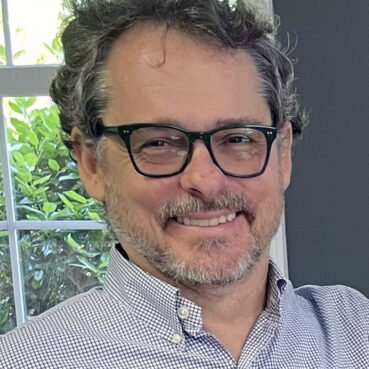
Hunt Priest. (Photo courtesy of Ligare)
Matthew Johnson, a researcher on the study, has raised concerns about it, saying researchers had biased the outcome by framing the trial in spiritual terms and involving funders and psychedelic legalization advocates in the study itself. An audit by the Johns Hopkins Medicine Institutional Review Board noted that two of the study’s funders had been involved in the trial. These conflicts of interest, per the audit, “were not appropriately disclosed nor managed.” The review board’s reservations were included in the study’s findings.
When the study’s findings were finally released in May, they indicated that 96% of the 24 participants retroactively rated one of their psilocybin experiences among the top five most spiritually significant of their lives.
Priest has vehemently rejected Welker’s characterization of his experience, saying the trial was “the most edifying and supportive and respectful process I’ve ever been through.” Several trial participants told RNS that while the trial was imperfect, it is “offensive” and “patronizing” for Welker to speak for them and imply they were brainwashed into promoting a pro-psychedelic agenda.
In May 2024, Priest’s lawyer issued a cease-and-desist letter in response to Welker’s posts.
Welker saw the letter, which incorrectly claimed Welker had been terminated from Ligare, as defamatory and he filed a complaint with the Episcopal Church. That complaint launched a Title IV process, the denomination’s procedure for responding to clergy misconduct allegations.
In April 2025, after an investigation conducted by an outside lawyer, a four-person reference panel of the Diocese of Georgia recommended the bishop seek an agreement for discipline with Priest. In that report, which Priest shared with RNS, the panel cited three examples of “conduct unbecoming a clergy member.” They claimed Priest began speaking publicly about the “safe” use of psychedelics, rather than their “legal” use; that he allowed a cease-and-desist letter to be sent “without being sure the information presented was true”; and that Priest’s role with Ligare did not involve sacramental ministries of the priesthood, such as celebrating the Eucharist or presiding over other rites.
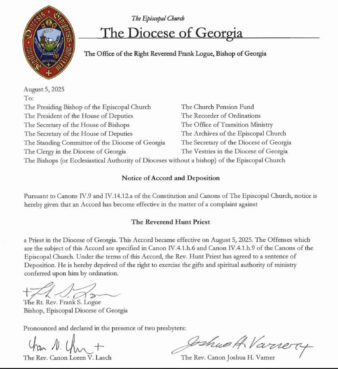
The deposition agreement between the Episcopal Diocese of Georgia and Hunt Priest. (Screen grab)
“This leads the Reference Panel to the conclusion that his priesthood is solely a way to lend credence to the work of Ligare,” the report said. Logue later concluded the reference panel had also found evidence of misrepresentation, resulting in a second offense of “conduct involving dishonesty, fraud, deceit or misrepresentation,” according to the Rev. Canon Loren Lasch, canon to the Ordinary and chief of staff for the Episcopal Diocese of Georgia.
On Aug. 5, Priest submitted to the terms of that agreement, which deposed him from ordained ministry.
Welker posted the news on his Substack three days later.
The following week, in a letter to some 2,500 recipients on the Ligare email list, Hunt said he had “resigned” his ordination, emphasizing he had been offered the choice to resign from Ligare or resign his ordination, and noting he could later apply to be reinstated. “Had the investigating committee or the bishop determined that I was harming individuals or communities, or if I was somehow operating outside Christian orthodoxy, I would have been removed, not given a choice,” he wrote.
However, per denominational bylaws, an Episcopal priest cannot resign during a Title IV process, and deposition is the most serious disciplinary action that can be taken against a clergy member. Priest, like any deposed clergyperson, can apply to be restored to ministry, but the process outlined in the bylaws is rigorous and rarely executed. In an email to RNS, Lasch clarified that prior to Priest’s being deposed, Logue offered him a path to return to active ministry. (Priest was restricted from ministry during the Title IV process.) That path would have required Priest to stop his work with Ligare, and “there would have been additional stipulations,” she said.
RELATED: After a decade of controversy, clergy psychedelic study is published
In interviews with RNS, Priest reiterated that he and Ligare do not promote the illegal use of psychedelics. He said Ligare is “neutral” on using them and added that he tends to use the words “safe” and “legal” interchangeably. Priest said the Title IV outcome highlights why Ligare’s educational efforts around psychedelics and religion are necessary.
“I understand that on these big, hot-button issues in the culture, when you’re out front on them, there can be a cost to that,” said Priest. “And I’m willing to bear it, because I do continue to believe this is a very important cultural conversation.”
Welker, who is now a pastor in the Presbyterian Church (USA) serving a congregation in Vermont, sees the outcome of the Title IV process as a consequence of the Hopkins/NYU research trial, though the Diocese of Georgia did not cite the trial in its decision.
“This hype has, I do believe, contributed to Priest and others just having their guard down. We’re dealing with a risky medical intervention,” said Welker. “People do get hurt. It may not be the majority, but they regularly have prolonged harm, and when it happens, it’s sometimes quite catastrophic.”
(Photo by Merlin Lightpainting/Pexels/Creative Commons)
For others in the Christian psychedelic space, Priest’s removal from ordination is less a referendum on the clergy psychedelic study, and more of a gauge for measuring the institutional church’s current comfort with psychedelics. Like many Christian denominations, the Episcopal Church doesn’t have a churchwide policy on psychedelics, but so far that hasn’t stifled conversation on the topic. In the Episcopal Diocese of Eastern Oregon, psychedelics are part of an ongoing conversation among clergy.
Eastern Oregon’s bishop, the Rt. Rev. Patrick Bell, said in a statement he appreciated other Episcopal leaders’ caution regarding “the use of psychedelics for healing purposes” but has “come to a place of openness to the potential of their use,” noting he lives in a state where psilocybin is legal under certain conditions. Earlier this year another mainline denomination, the United Church of Christ, was poised to consider a resolution advocating for psychedelic decriminalization before it was delayed on technical grounds.
According to scholar Bryan McCarthy, a friend of Priest who studies the religiosity of psychedelic medicine, Priest’s removal from ordination is prompting Christians to have necessary discussions about psychedelics.
“It’s the conversation I always thought should be happening. Should we? Shouldn’t we? Is it good? Is it bad? How to do these things, if we do them?” said McCarthy. But while essential, McCarthy noted that, at least in this case, these debates have real consequences.

No comments:
Post a Comment