Bipartisan US Push Tries to Label Democratic African Government as “Terrorist”
The UN treats the Polisario as the legitimate representative of the Western Sahara people. The US is now vilifying it.
By Stephen Zunes ,PublishedAugust 2, 2025
 The delegate of the Polisario Front in Madrid, Jadiyetu El Mohtar, waits at Terminal 4 of the Adolfo Suarez Madrid-Barajas Airport, on January 20, 2025, in Madrid, Spain.Carlos Lujan / Europa Press via Getty Images
Washington’s designation of armed groups as Foreign Terrorist Organizations (FTO) has always been politicized, but it may now reach a new level of absurdity thanks to a bipartisan resolution in the U.S. House of Representatives introduced by Joe Wilson (R-South Carolina) and Jimmy Panetta (D-California) targeting the Frente Polisario, the government of Western Sahara, officially known as the Sahrawi Arab Democratic Republic. Morocco, an important U.S. ally, invaded Western Sahara in 1975 on the eve of its independence from Spain and currently occupies nearly 80 percent of the territory, while the Polisario appears to govern roughly 40 percent of the Western Saharan population in the liberated zones and in refugee camps in western Algeria.
According to the UN Security Council, terrorism is defined as:
…criminal acts, including against civilians, committed with the intent to cause death or serious bodily injury, or taking of hostages, with the purpose to provoke a state of terror in the general public or in a group of persons or particular persons, intimidate a population or compel a government or an international organization to do or to abstain from doing any act.
Most nations, including the United States, have traditionally only applied that label to irregular forces. But the U.S. has broken with that practice in recent years, with Washington designating Iran’s Islamic Revolutionary Guard Corps (IRGC) — the largest branch of the country’s armed forces — as a terrorist group. Since the IRGC controls major sectors of Iranian industry, colleges, and other non-military institutions, large segments of the Iranian population, as a result of military conscription or simply taking classes and going to civilian jobs at IRGC-affiliated institutions, are now deemed to have terrorist affiliations.
The Houthis of Yemen, who constitute the de facto government of three-quarters of that country’s population, have also been labeled a Foreign Terrorist Organization by the United States, thereby complicating desperately-needed relief efforts to starving Yemenis who live under Houthi-governed areas.
Related Story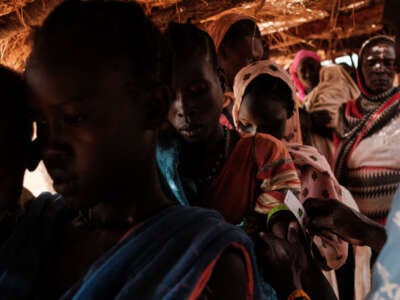
From Regional Uprisings to Reactionary Regimes: How Sudan Relates to Palestine
Leaders of Sudan’s counterrevolutionary forces have expressed affinity with Israel and have used Israeli-made weapons. By Shireen Akram-Boshar , Truthout July 11, 2024
This new legislation targeting the Polisario — which would classify as a terrorist group the entire ruling body of a nation-state which has been recognized at various points by more than 80 countries and is a full member state of the African Union — may constitute the most extreme politicization of the FTO designation to date.
50 Years of Occupation and Resistance
Morocco invaded Western Sahara in 1975, just prior to the territory’s scheduled independence from Spain in direct defiance of a landmark ruling by the International Court of Justice and series of United Nations resolutions. The Security Council unanimously called on Moroccan forces to immediately withdraw from the territory and allow the people of Western Sahara to determine their own destiny. However, both France and the United States, wanting to support the pro-Western king and wary of a leftist revolutionary movement coming to power, prevented the Security Council from enforcing its mandate.
The Polisario, which had been fighting Spain for independence, was forced to then fight off the Moroccan invaders. By 1982, they had liberated most of the country. However, the United States and France dramatically increased their assistance to Morocco’s conquest, reversing the Polisario’s gains and created a military stalemate. In 1991, the Polisario agreed to a ceasefire in return for Morocco accepting a UN-supervised referendum on the fate of the territory. Morocco never allowed the referendum to go forward, however. They were again supported by the U.S. and France, which blocked the UN from forcing Morocco to proceed with the plebiscite, which most observers believe would have resulted in an overwhelming majority supporting independence.
After nearly three decades of futile diplomatic efforts, sporadic nonviolent resistance in the occupied territory, and ongoing Moroccan violations of the ceasefire, the Polisario resumed the armed struggle in November 2020.
The following month, during the final weeks of his first administration, Donald Trump made the United States the first country to formally recognize Morocco’s annexation of Western Sahara. In return, Morocco gave in to U.S. pressure to recognize Israel, becoming one of the nations to break with the longstanding Arab League position of refusing to establish formal diplomatic relations until Israel withdrew from occupied Arab territories, including the Golan Heights, West Bank, and Gaza Strip.
While Biden did not formally endorse Trump’s decision, he allowed it to stand. U.S. government maps under Biden began depicting Western Sahara as part of Morocco, with nothing delineating the two. Reports by the State Department and other federal agencies, which until then had treated Western Sahara as a separate entity, began including the territory as a part of Morocco. While the administration claimed it still supported the UN-led peace process, its recognition emboldened the Moroccans to take an even more hardline posture, arguing that U.S. recognition essentially resolved the issue.
In 2023, Israel became the second country to recognize Moroccan sovereignty over Western Sahara, no doubt encouraged by the precedent of the world’s most powerful nation breaking with the UN’s longstanding prohibition against recognizing the expansion of territory by military force.
Rules Don’t Apply
During the 50 years of resistance against Moroccan occupation forces, the Polisario has never engaged in any acts of terrorism. They have formally ratified the Geneva Conventions and their protocols and they are a party to the African Union’s Convention on Counter-Terrorism.
The United Nations recognizes the Polisario as the legitimate representative of the Western Sahara people and the African Union recognizes Western Sahara as a full member state. Neither they nor any other credible international legal entity classify the Polisario as a terrorist group.
Supporters of Morocco’s autocratic monarchy have tried to link the Polisario — which is a democratic, secular, moderately left-leaning liberation movement — with Islamist groups like Hezbollah, in addition to the Iranian government. This is a ludicrous claim, especially as the U.S. State Department has found no indication that the Polisario has any operational ties with such entities. Moreover, I have spoken to Polisario leaders who have been quite explicit that their interpretation of Islam is more liberal than the model espoused by Iran’s leaders.
Even former U.S. National Security Adviser John Bolton, one of the most extreme critics of Iran, recently noted that allegations of Iranian influence on the Polisario were groundless. Similarly, former U.S. Secretary of State James Baker said the Polisario-governed refugee camps and liberated zones of Western Sahara have “exercised a degree of democracy, maintained a high literacy rate, and never resorted to terrorism.”
The Western Saharan liberation struggle is unified, democratic, has never questioned Morocco’s right to exist, and has never targeted civilians, yet they are still being denied their right to self-determination and are now being labeled as terrorists.
As with the Russian and Israeli annexations of neighboring territories, Morocco’s 1975 annexation of Western Sahara is a flagrant violation of international law. As long as civilians are not targeted, it is not terrorism for a people to engage in armed resistance to a foreign belligerent occupation.
Morocco’s claim on Western Sahara is rejected by the United Nations, the International Court of Justice, the African Union, and a broad consensus of international legal scholars that consider the region a non-self-governing territory that must be allowed self-determination. The Sahrawis have a distinct dialect, kinship system, dress, cuisine, and colonial history and have no desire to live under the rule of their autocratic neighbor.
Unlike the Polisario-controlled areas, those living in the Moroccan-occupied parts of Western Sahara suffer under brutal repression. Human Rights Watch, Amnesty International and other reputable human rights groups have documented widespread suppression of peaceful pro-independence activists by Moroccan occupation forces, including torture, beatings, detention without trial, and extrajudicial killings.
If the effort to get the Polisario classified as a Foreign Terrorist Organization succeeds, it would jeopardize the U.S.-backed United Nations peace process. U.S. officials could no longer be part of the negotiations if one of the parties is labeled a terrorist group.
And, as with the FTO designation against the Houthis, the 170,000 Sahrawi civilians living in Polisario-governed refugee camps would no longer be able to receive much of their desperately needed humanitarian aid. It would criminalize many of the interactions and transactions on which the refugees are dependent to survive.
The irony is that the establishment of a democratic secular Arab nation like the Polisario-led Western Sahara is what the U.S. government has long claimed to support. In reality, however, they are siding with a conservative and repressive monarchy against those very same forces of democracy and secularism.
One possible motivation for pursuing an FTO designation is that it would likely lead the United States to place strict sanctions on the Polisario’s two biggest supporters — Algeria and South Africa — on the grounds that they were “state sponsors of terrorism.” Algeria is the last of the left-leaning secular nationalist Arab governments that once dominated the region and is a historical rival of the U.S.-backed Moroccan monarchy. And the Trump administration has been going after South Africa, a leading power in the Global South challenging U.S. hegemony, since its return to the White House, including makign false charges of a “genocide” against that country’s relatively well-off white minority.
Targeting the Polisario also underscores how Washington’s opposition to Palestinian rights is not really about concerns over terrorism or Israel’s security. The Western Saharan liberation struggle is unified, democratic, has never questioned Morocco’s right to exist, and has never targeted civilians, yet they are still being denied their right to self-determination and are now being labeled as terrorists.
By labeling the Western Saharan nationalist movement as terrorist, it makes it easier for Washington to ignore the flagrant double standards in its policies of opposing Russia’s expansionism in Ukraine as a violation of the “rules-based international order” while defending Morocco for doing the same thing.
Terrorism is a real threat in North Africa, the Middle East, and elsewhere. Yet Washington’s willingness to label a popular movement and even a recognized government as a “terrorist organization” simply for pursuing their recognized right to national self-determination through legal means further underscores how politicians are willing to manipulate legitimate concerns about terrorism in order to undermine longstanding international legal principles.
This article is licensed under Creative Commons (CC BY-NC-ND 4.0), and you are free to share and republish under the terms of the license.
Stephen Zunes is a professor of politics and director of Middle Eastern studies at the University of San Francisco. Zunes is also the co-author, with Jacob Mundy, of Western Sahara: War, Nationalism, and Conflict Irresolution (Syracuse University Press, 2023).
By Stephen Zunes ,
Washington’s designation of armed groups as Foreign Terrorist Organizations (FTO) has always been politicized, but it may now reach a new level of absurdity thanks to a bipartisan resolution in the U.S. House of Representatives introduced by Joe Wilson (R-South Carolina) and Jimmy Panetta (D-California) targeting the Frente Polisario, the government of Western Sahara, officially known as the Sahrawi Arab Democratic Republic. Morocco, an important U.S. ally, invaded Western Sahara in 1975 on the eve of its independence from Spain and currently occupies nearly 80 percent of the territory, while the Polisario appears to govern roughly 40 percent of the Western Saharan population in the liberated zones and in refugee camps in western Algeria.
According to the UN Security Council, terrorism is defined as:
…criminal acts, including against civilians, committed with the intent to cause death or serious bodily injury, or taking of hostages, with the purpose to provoke a state of terror in the general public or in a group of persons or particular persons, intimidate a population or compel a government or an international organization to do or to abstain from doing any act.
Most nations, including the United States, have traditionally only applied that label to irregular forces. But the U.S. has broken with that practice in recent years, with Washington designating Iran’s Islamic Revolutionary Guard Corps (IRGC) — the largest branch of the country’s armed forces — as a terrorist group. Since the IRGC controls major sectors of Iranian industry, colleges, and other non-military institutions, large segments of the Iranian population, as a result of military conscription or simply taking classes and going to civilian jobs at IRGC-affiliated institutions, are now deemed to have terrorist affiliations.
The Houthis of Yemen, who constitute the de facto government of three-quarters of that country’s population, have also been labeled a Foreign Terrorist Organization by the United States, thereby complicating desperately-needed relief efforts to starving Yemenis who live under Houthi-governed areas.
Related Story
From Regional Uprisings to Reactionary Regimes: How Sudan Relates to Palestine
Leaders of Sudan’s counterrevolutionary forces have expressed affinity with Israel and have used Israeli-made weapons. By Shireen Akram-Boshar , Truthout July 11, 2024
This new legislation targeting the Polisario — which would classify as a terrorist group the entire ruling body of a nation-state which has been recognized at various points by more than 80 countries and is a full member state of the African Union — may constitute the most extreme politicization of the FTO designation to date.
50 Years of Occupation and Resistance
Morocco invaded Western Sahara in 1975, just prior to the territory’s scheduled independence from Spain in direct defiance of a landmark ruling by the International Court of Justice and series of United Nations resolutions. The Security Council unanimously called on Moroccan forces to immediately withdraw from the territory and allow the people of Western Sahara to determine their own destiny. However, both France and the United States, wanting to support the pro-Western king and wary of a leftist revolutionary movement coming to power, prevented the Security Council from enforcing its mandate.
The Polisario, which had been fighting Spain for independence, was forced to then fight off the Moroccan invaders. By 1982, they had liberated most of the country. However, the United States and France dramatically increased their assistance to Morocco’s conquest, reversing the Polisario’s gains and created a military stalemate. In 1991, the Polisario agreed to a ceasefire in return for Morocco accepting a UN-supervised referendum on the fate of the territory. Morocco never allowed the referendum to go forward, however. They were again supported by the U.S. and France, which blocked the UN from forcing Morocco to proceed with the plebiscite, which most observers believe would have resulted in an overwhelming majority supporting independence.
After nearly three decades of futile diplomatic efforts, sporadic nonviolent resistance in the occupied territory, and ongoing Moroccan violations of the ceasefire, the Polisario resumed the armed struggle in November 2020.
The following month, during the final weeks of his first administration, Donald Trump made the United States the first country to formally recognize Morocco’s annexation of Western Sahara. In return, Morocco gave in to U.S. pressure to recognize Israel, becoming one of the nations to break with the longstanding Arab League position of refusing to establish formal diplomatic relations until Israel withdrew from occupied Arab territories, including the Golan Heights, West Bank, and Gaza Strip.
While Biden did not formally endorse Trump’s decision, he allowed it to stand. U.S. government maps under Biden began depicting Western Sahara as part of Morocco, with nothing delineating the two. Reports by the State Department and other federal agencies, which until then had treated Western Sahara as a separate entity, began including the territory as a part of Morocco. While the administration claimed it still supported the UN-led peace process, its recognition emboldened the Moroccans to take an even more hardline posture, arguing that U.S. recognition essentially resolved the issue.
In 2023, Israel became the second country to recognize Moroccan sovereignty over Western Sahara, no doubt encouraged by the precedent of the world’s most powerful nation breaking with the UN’s longstanding prohibition against recognizing the expansion of territory by military force.
Rules Don’t Apply
During the 50 years of resistance against Moroccan occupation forces, the Polisario has never engaged in any acts of terrorism. They have formally ratified the Geneva Conventions and their protocols and they are a party to the African Union’s Convention on Counter-Terrorism.
The United Nations recognizes the Polisario as the legitimate representative of the Western Sahara people and the African Union recognizes Western Sahara as a full member state. Neither they nor any other credible international legal entity classify the Polisario as a terrorist group.
Supporters of Morocco’s autocratic monarchy have tried to link the Polisario — which is a democratic, secular, moderately left-leaning liberation movement — with Islamist groups like Hezbollah, in addition to the Iranian government. This is a ludicrous claim, especially as the U.S. State Department has found no indication that the Polisario has any operational ties with such entities. Moreover, I have spoken to Polisario leaders who have been quite explicit that their interpretation of Islam is more liberal than the model espoused by Iran’s leaders.
Even former U.S. National Security Adviser John Bolton, one of the most extreme critics of Iran, recently noted that allegations of Iranian influence on the Polisario were groundless. Similarly, former U.S. Secretary of State James Baker said the Polisario-governed refugee camps and liberated zones of Western Sahara have “exercised a degree of democracy, maintained a high literacy rate, and never resorted to terrorism.”
The Western Saharan liberation struggle is unified, democratic, has never questioned Morocco’s right to exist, and has never targeted civilians, yet they are still being denied their right to self-determination and are now being labeled as terrorists.
As with the Russian and Israeli annexations of neighboring territories, Morocco’s 1975 annexation of Western Sahara is a flagrant violation of international law. As long as civilians are not targeted, it is not terrorism for a people to engage in armed resistance to a foreign belligerent occupation.
Morocco’s claim on Western Sahara is rejected by the United Nations, the International Court of Justice, the African Union, and a broad consensus of international legal scholars that consider the region a non-self-governing territory that must be allowed self-determination. The Sahrawis have a distinct dialect, kinship system, dress, cuisine, and colonial history and have no desire to live under the rule of their autocratic neighbor.
Unlike the Polisario-controlled areas, those living in the Moroccan-occupied parts of Western Sahara suffer under brutal repression. Human Rights Watch, Amnesty International and other reputable human rights groups have documented widespread suppression of peaceful pro-independence activists by Moroccan occupation forces, including torture, beatings, detention without trial, and extrajudicial killings.
If the effort to get the Polisario classified as a Foreign Terrorist Organization succeeds, it would jeopardize the U.S.-backed United Nations peace process. U.S. officials could no longer be part of the negotiations if one of the parties is labeled a terrorist group.
And, as with the FTO designation against the Houthis, the 170,000 Sahrawi civilians living in Polisario-governed refugee camps would no longer be able to receive much of their desperately needed humanitarian aid. It would criminalize many of the interactions and transactions on which the refugees are dependent to survive.
The irony is that the establishment of a democratic secular Arab nation like the Polisario-led Western Sahara is what the U.S. government has long claimed to support. In reality, however, they are siding with a conservative and repressive monarchy against those very same forces of democracy and secularism.
One possible motivation for pursuing an FTO designation is that it would likely lead the United States to place strict sanctions on the Polisario’s two biggest supporters — Algeria and South Africa — on the grounds that they were “state sponsors of terrorism.” Algeria is the last of the left-leaning secular nationalist Arab governments that once dominated the region and is a historical rival of the U.S.-backed Moroccan monarchy. And the Trump administration has been going after South Africa, a leading power in the Global South challenging U.S. hegemony, since its return to the White House, including makign false charges of a “genocide” against that country’s relatively well-off white minority.
Targeting the Polisario also underscores how Washington’s opposition to Palestinian rights is not really about concerns over terrorism or Israel’s security. The Western Saharan liberation struggle is unified, democratic, has never questioned Morocco’s right to exist, and has never targeted civilians, yet they are still being denied their right to self-determination and are now being labeled as terrorists.
By labeling the Western Saharan nationalist movement as terrorist, it makes it easier for Washington to ignore the flagrant double standards in its policies of opposing Russia’s expansionism in Ukraine as a violation of the “rules-based international order” while defending Morocco for doing the same thing.
Terrorism is a real threat in North Africa, the Middle East, and elsewhere. Yet Washington’s willingness to label a popular movement and even a recognized government as a “terrorist organization” simply for pursuing their recognized right to national self-determination through legal means further underscores how politicians are willing to manipulate legitimate concerns about terrorism in order to undermine longstanding international legal principles.
This article is licensed under Creative Commons (CC BY-NC-ND 4.0), and you are free to share and republish under the terms of the license.
Stephen Zunes is a professor of politics and director of Middle Eastern studies at the University of San Francisco. Zunes is also the co-author, with Jacob Mundy, of Western Sahara: War, Nationalism, and Conflict Irresolution (Syracuse University Press, 2023).
Supporting the people of Western Sahara

AUGUST 2, 2025
By Sally Hobbs
At a time when the long history of colonial land theft is at the fore with the unimaginable level of suffering being experienced in Gaza, the case of Western Sahara may be going under the radar. Fifty years ago the Saharawi were driven from their own land by Morocco which unlawfully annexed the Western Saharan territory as the Spanish colonial power abandoned it. Since then, Western Saharan people have been living in refugee camps in the Algerian desert, in the most inhospitable conditions for human life. Last week, the temperature was 48 degrees C.
Connections in our area have a long history and we have a really exciting present-day project. I was one of the founders of Levenshulme Woodcraft Folk in the 1990s, alongside other local parents, at a time when there was virtually nothing for local children to do outside school times. During the 1990s and 2000s, we formed strong links to the camps, hosting children’s visits here three times – the Mayor showed the children around the Town Hall on one visit; the local paper displayed a full page photo of local kids and Saharawis at our local baths; Gerald Kaufmann MP was also featured on the steps of the baths, welcoming them, and we went on many trips, including camping in Wales.
The experience was definitely very enriching for many local children, as well as for our visitors. Over the years, some parents and now grown-up children including my own have visited the camps and participated in projects there and in the annual Western Sahara marathon organised by Sandblast.
Since these visits, one of the children who stayed with our community here, Fatimalu, is now a grown woman with children in the camps. She is leading a truly transformational project; she has successfully built and is developing vegetable and tree-growing in the Sahara desert, to enable the refugees – who rely on food aid, with a recent WHO report expressing growing concern at the high levels of malnutrition there – to access fresh, home grown fruit and veg in the most inhospitable place imaginable. Grow Hope Saharawi is now a registered charity supporting this project with local directors from our area.
Fatimalu will be accompanying this group, together with two teachers from Sandblast Charity, who work with these young people, focusing on English language learning, creative and performance arts. The group are here as part of a longer visit to London and to the 100th Anniversary International Woodcraft Folk camp in Nottingham.
The context is ever more urgent. Over 43% of nations recognise Saharawi Democratic Arab Republic as an independent country, and there has been a UN mandate to hold a referendum of all Saharawi citizens since 1991, reaffirmed most recently in 2019.
Despite this, no referendum has taken place and numerous Western countries – Spain included – are now supportive of the occupying Morocco’s claim. Morocco has now put forward proposals for some autonomy for Western Sahara in a devolved region under Moroccan control.
In a recent visit to Morocco, UK Foreign Secretary David Lammy described the proposal as the most “credible, viable and pragmatic solution” for ending the dispute. Stakes are high; lucrative trade deals are in prospect, particularly infrastructure projects with the forthcoming World Cup in 2030 to be hosted by Morocco, Spain and Portugal.
Since then, the UK Minister Hamish Falconer reaffirmed that the government will continue to support the UN-led political efforts to reach a just, lasting, and mutually acceptable political solution based on compromise. But there is no clarity about what that compromise might mean for Western Saharans, and in particular for the 170,000 and generations of displaced and refugee Saharawi. Their position is and always has been precarious, dependent on international aid and Algerian support. The potential for these stateless families to become hostages to the decisions of colonial negotiations is great. It is ever more important to press for government backing to the UN resolution and to raise awareness of the situation.
Please raise the profile of the Western Saharan dispute and put forward resolutions in branches and trade unions and press MPs to confirm:
– continued support for Saharawi people’s democratic rights
– protect the human rights and self-determination of the Saharawi people
– and increase UK humanitarian support for the refugees.
Donate to Grow Hope Saharawi using this link.
Sally Hobbs is a Palestine supporter and activist in Manchester.
Image: https://freesvg.org/anonymous-flag-of-western-sahara. Licence: CC0 1.0 Universal CC0 1.0 Deed

No comments:
Post a Comment