Op-Ed
Trump’s Executive Order Criminalizing Houselessness Reveals a Familiar Dystopia
For years, mad and disabled people have been asking Americans to fight the criminalization of disability. Will they?
By Leah Harris & Liat Ben-Moshe ,

The Dystopia Has Always Been Here
Online, this executive order has already been compared to the earliest chapters of the Nazi Holocaust, with some commentators drawing parallels to the “Aktion Arbeitsscheu Reich,” or Operation Work-Shy, which began in 1938 and targeted “anti-social elements” including alcoholics, the unemployed, and vagrants, among many other categories. This operation preceded Aktion T4, the Nazi euthanasia program that in 1939 ushered in the holocaust with the mass murder of disabled people.
Related Story
Disability Activists Bring Wisdom From the Pandemic to New Struggles Under Trump
White House rhetoric dehumanizes disabled communities, but activists continue to organize for access, care and justice. By Mara Mills , Harris Kornstein , Faye Ginsburg , Rayna Rapp , Truthout /NYUPress June 7, 2025
Public health educator Azrael Mae Ní Mháille, who is active in PWUD organizing (harm reduction activism led by people who use drugs), posted on July 25, 2025, in response to the executive order, saying: “Calls for a return of the violently ableist asylum system, or the continued restrengthening of the deeply racist post-emancipation anti-vagrancy laws, stop just short of calling for a return to legalized chattel slavery, or for a new Aktion T4.”
In the U.S., the birthplace of the eugenics movement that inspired Adolf Hitler, the rounding up and confinement of “undesirables” in asylums, institutions, and detention centers is what scholar Jess Whatcott terms carceral eugenics.
While the historical parallels are chilling, we need not look that far back. Efforts to bring the asylum into the community have been underway in the U.S. since the late 1990s, in the form of states’ involuntary outpatient commitment laws. These laws create civil courts that mandate treatment, with the threat of psychiatric incarceration for noncompliance with orders.
The provisions in the new executive order will be familiar to anyone tracking “anti-camping” legislation that has emerged in a number of states and over 100 cities over the last several years, with an involuntary psychiatric intervention component. At the forefront of these efforts is the Koch-funded Cicero Institute, a right-wing think tank led by venture capitalist Joe Lonsdale, who co-founded Palantir along with Peter Thiel.
Regressive measures like California’s Community Assistance, Recovery, and Empowerment (CARE) Act signed by Governor Gavin Newsom in 2022 enacted the CARE Court system, which compels people with psychiatric disabilities into treatment, and as Disability Rights California noted, creates a “new pathway to conservatorship.”
In New York, Mayor Eric Adams’ involuntary removals policy promotes similar approaches that disappear people with mental health differences from public and private spaces under the guise of treatment.
And little over a year ago, the Supreme Court’s ruling in Grants Pass v. Johnson further criminalized houselessness, giving cities the go-ahead to fine, ticket, and detain unhoused neighbors even when no shelter is available.
The executive order’s dystopic vision has always been here, driven by “carceral sanism” and “racial criminal pathologization” — language that Liat Ben-Moshe, one of the authors of this piece, coined to describe the varied ways in which the state pathologizes madness, disability, race, and class to justify disappearing and mandating people into prisons, psychiatric facilities, and other coercive systems that are simultaneously branded as care and public safety.
With housing and health care still considered privileges for the deserving and not rights in the United States, the scapegoating of disabled and unhoused people continues.
The various bans on sleeping outside have been described as a war on the unhoused, reminiscent of past wars on drugs and the war on poverty. They are about building out racial criminal pathologization infrastructure, alongside other forms of capture and confinement (the prison-industrial complex, ICE, and immigration detention).
It’s therefore important to consider the executive order alongside the budget reconciliation megabill that became law on July 4, 2025. This legislation advances a death-making necropolitics that is distinctly all-American. The megabill’s eugenicist provisions include $1 trillion in cuts to Medicaid that will strip 17 million Americans of health insurance and food assistance, leading to hunger, disablement, chronic illness, and preventable death. Hand in hand, it includes unprecedented funding for state-sponsored violence over the next four years: $75 billion for ICE and $150 billion for the military — the largest defense budget in U.S. history. Then there are the billions annually that successive administrations have pumped into the Israeli military machine to enable occupation, apartheid, and mass disablement and genocide in Palestine.
With public dollars pouring into the hands of the billionaires and the jaws of the military, police, and surveillance states, and with housing and health care still considered privileges for the deserving and not rights in the United States, the scapegoating of disabled and unhoused people continues.
Putting the Executive Order Into Perspective
This executive order deploys well-worn fascist tactics designed to instill fear and confusion into the populace. Critically, such orders only apply to the actions of the federal government. While the feds can give or withhold resources to incentivize states to follow certain carceral federal policies, many states are already pushing back on these new orders.
We can look to history for parallel horrors, but we can also find analogues for resistance. Prior to the early 1970s, most folks could be put away in an institution for life with virtually no due process. Deinstitutionalization was the outcome of decades of multi-faceted organizing and analysis by mad and disabled people and movements, and the activist parents, attorneys and policymakers connected to them. They successfully pushed through reforms that fundamentally altered a century of mental health policy, granting disabled people legal protections from arbitrary confinement. For now, the federal government cannot simply erase these momentous achievements, censor the lessons learned from closing down asylums, or eliminate states’ existing civil commitment laws and standards, eroding as they may be, at the stroke of a pen.
Prior to the early 1970s, most folks could be put away in an institution for life with virtually no due process.
Despite the well-worn argument that deinstitutionalization, or the closure of large institutions beginning in the mid-1950s in America and continuing through the 1980s, was a colossal failure, abandoning people in the streets and in prisons, it is important to remind that it was one of the largest decarceration movements in U.S. history — a success of activism, not its failure. Rather, a well-organized campaign of political haranguing and media narratives steeped in neoliberal racism has driven policies and priorities over decades that scapegoated this activism against criminal racial pathologization and have culminated in the present moment.
Time will tell how the ongoing dystopia unfolds. Will venture capitalists and private equity firms snake into “cradle to grave” services, as they have already done with other forms of carceral sanism and the prison industry? For example, GEO Care, the subsidiary of the for profit prison company GEO Group, already operates residential psychiatric treatment hospitals in such states as Florida, South Carolina, and Texas. Alternatively, perhaps billions will be extracted from taxpayers and spent on programs that provide no housing and little discernable on-the-ground impact, as with Newsom’s CARE Court — enacting the true “waste, fraud, and abuse” (as opposed to the false claims of waste, fraud, and abuse that Trump has been circulating).
Resistance Has Also Always Been Here
When a war is declared, it is not only about the money but the dispersal of weapons and the creation of scapegoat targets. This is why it is vital to heed what activists in the housing justice, mad justice, disability justice, abolitionist, and harm reduction movements have to say about this new executive order, and what this means for our movements now.
“We are not helpless to prevent the worst of this,” wrote Ní Mháille. “In spite of the many who will willingly collaborate, there are those of us who will resist what is coming at the cost of our salaries, our reputations, our freedom, and our safety. We have seen what this leads to. We must refuse to be collaborative, compliant, nor complacent.”
Mad and disabled organizers have long been building and preparing for times like these, showing us how to build and deepen diffuse networks of collective care. One such organization is Project LETS, which is dedicated to creating “just, responsive, and transformative peer support collectives and community mental health care structures that do not depend on state-sanctioned systems that trap our folks in the medical/prison-industrial complex.” We the Unhoused, a podcast hosted by Theo Henderson, has tracked rising criminalization in Los Angeles and beyond for years, uplifting needed insights from unhoused and disabled organizers.
With or without executive orders, mutual aid, harm reduction, and abolition efforts continue on the ground as they always have.
Note: For further insights and analysis of the executive order, as well as ideas on what communities can do now, we urge readers to turn to the Quick Guide to Trump’s New Executive Order by @neuroabolition and @projectlets.
This article is licensed under Creative Commons (CC BY-NC-ND 4.0), and you are free to share and republish under the terms of the license.

Leah Harris
Leah Harris is a writer and journalist whose work centers mad/disability justice and abolition. Their essays and journalism appear in Passengers Journal, Rooted in Rights, Truthout, Disability Visibility Project, and the anthologies The Mad Studies Reader, We’ve Been Too Patient: Voices from Radical Mental Health, and Disability Vulnerability (forthcoming 2026).

Liat Ben-Moshe
Liat Ben-Moshe is an activist-scholar working at the intersection of incarceration, abolition and disability/madness. She is an Associate Professor of Criminology, Law and Justice at the University of Illinois at Chicago, author of Decarcerating Disability: Deinstitutionalization and Prison Abolition (2020) and co-editor of Disability Incarcerated (2014). For more of her work, visit liatbenmoshe.com/
Trump’s Executive Order Criminalizing Houselessness Reveals a Familiar Dystopia
For years, mad and disabled people have been asking Americans to fight the criminalization of disability. Will they?
By Leah Harris & Liat Ben-Moshe ,
July 31, 2025
Demonstrators protest outside the U.S. Supreme Court in support of unhoused people as the Court hears the case of City of Grants Pass v. Johnson, in Washington, D.C., on April 22, 2024.SAUL LOEB / AFP via Getty Images
Americans love a Victorian asylum. As paranormal entertainment, they offer thrill-seeking with the assumption that the days are long gone when almost anyone could have you committed for almost any reason, often for life.
Yet for decades, academics, pundits, and politicians across the political spectrum have been openly calling for a return to the asylum. Now, a new executive order signed by Trump on June 24, 2025, proposes that states use civil commitment laws to disappear unhoused people, mad and disabled people, and (some) people who use drugs into long-term congregate institutions and coercive programs. Welcome back to the asylum.
Deploying a punitive approach to houselessness, substance use, and psychiatric disability, the executive order, aptly titled “ENDING CRIME AND DISORDER ON AMERICA’S STREETS,” paints a familiar picture of dangerous and undesirable vagrants that must be purged from society and forcibly cured for the sake of order. It reproduces a long-perpetrated false narrative that the root causes of houselessness are “serious mental illness and addiction,” rather than skyrocketing housing costs. The executive order ends federal support for harm reduction programs and the Housing First model, instead incentivizing states and localities to adopt or expand the law-and-order approach. It would also allow police to access the protected health data of unhoused people, contributing to the growth of carceral AI beyond its already expansive reach on disabled and mad people and their caregivers.
While the publication of the executive order has led to panicked coverage in the media and online, mad, disabled, and unhoused people have been sounding the alarm for years. “Disabled people have been telling you that the weaponization of disability against you was coming,” said disability advocate Imani Barbarin in a post calling out the overwrought reactions of those who have previously been largely silent on the ongoing scapegoating, abandonment, confinement, and social murder of people with psychiatric and other disabilities.
Americans love a Victorian asylum. As paranormal entertainment, they offer thrill-seeking with the assumption that the days are long gone when almost anyone could have you committed for almost any reason, often for life.
Yet for decades, academics, pundits, and politicians across the political spectrum have been openly calling for a return to the asylum. Now, a new executive order signed by Trump on June 24, 2025, proposes that states use civil commitment laws to disappear unhoused people, mad and disabled people, and (some) people who use drugs into long-term congregate institutions and coercive programs. Welcome back to the asylum.
Deploying a punitive approach to houselessness, substance use, and psychiatric disability, the executive order, aptly titled “ENDING CRIME AND DISORDER ON AMERICA’S STREETS,” paints a familiar picture of dangerous and undesirable vagrants that must be purged from society and forcibly cured for the sake of order. It reproduces a long-perpetrated false narrative that the root causes of houselessness are “serious mental illness and addiction,” rather than skyrocketing housing costs. The executive order ends federal support for harm reduction programs and the Housing First model, instead incentivizing states and localities to adopt or expand the law-and-order approach. It would also allow police to access the protected health data of unhoused people, contributing to the growth of carceral AI beyond its already expansive reach on disabled and mad people and their caregivers.
While the publication of the executive order has led to panicked coverage in the media and online, mad, disabled, and unhoused people have been sounding the alarm for years. “Disabled people have been telling you that the weaponization of disability against you was coming,” said disability advocate Imani Barbarin in a post calling out the overwrought reactions of those who have previously been largely silent on the ongoing scapegoating, abandonment, confinement, and social murder of people with psychiatric and other disabilities.
The Dystopia Has Always Been Here
Online, this executive order has already been compared to the earliest chapters of the Nazi Holocaust, with some commentators drawing parallels to the “Aktion Arbeitsscheu Reich,” or Operation Work-Shy, which began in 1938 and targeted “anti-social elements” including alcoholics, the unemployed, and vagrants, among many other categories. This operation preceded Aktion T4, the Nazi euthanasia program that in 1939 ushered in the holocaust with the mass murder of disabled people.
Related Story
Disability Activists Bring Wisdom From the Pandemic to New Struggles Under Trump
White House rhetoric dehumanizes disabled communities, but activists continue to organize for access, care and justice. By Mara Mills , Harris Kornstein , Faye Ginsburg , Rayna Rapp , Truthout /NYUPress June 7, 2025
Public health educator Azrael Mae Ní Mháille, who is active in PWUD organizing (harm reduction activism led by people who use drugs), posted on July 25, 2025, in response to the executive order, saying: “Calls for a return of the violently ableist asylum system, or the continued restrengthening of the deeply racist post-emancipation anti-vagrancy laws, stop just short of calling for a return to legalized chattel slavery, or for a new Aktion T4.”
In the U.S., the birthplace of the eugenics movement that inspired Adolf Hitler, the rounding up and confinement of “undesirables” in asylums, institutions, and detention centers is what scholar Jess Whatcott terms carceral eugenics.
While the historical parallels are chilling, we need not look that far back. Efforts to bring the asylum into the community have been underway in the U.S. since the late 1990s, in the form of states’ involuntary outpatient commitment laws. These laws create civil courts that mandate treatment, with the threat of psychiatric incarceration for noncompliance with orders.
The provisions in the new executive order will be familiar to anyone tracking “anti-camping” legislation that has emerged in a number of states and over 100 cities over the last several years, with an involuntary psychiatric intervention component. At the forefront of these efforts is the Koch-funded Cicero Institute, a right-wing think tank led by venture capitalist Joe Lonsdale, who co-founded Palantir along with Peter Thiel.
Regressive measures like California’s Community Assistance, Recovery, and Empowerment (CARE) Act signed by Governor Gavin Newsom in 2022 enacted the CARE Court system, which compels people with psychiatric disabilities into treatment, and as Disability Rights California noted, creates a “new pathway to conservatorship.”
In New York, Mayor Eric Adams’ involuntary removals policy promotes similar approaches that disappear people with mental health differences from public and private spaces under the guise of treatment.
And little over a year ago, the Supreme Court’s ruling in Grants Pass v. Johnson further criminalized houselessness, giving cities the go-ahead to fine, ticket, and detain unhoused neighbors even when no shelter is available.
The executive order’s dystopic vision has always been here, driven by “carceral sanism” and “racial criminal pathologization” — language that Liat Ben-Moshe, one of the authors of this piece, coined to describe the varied ways in which the state pathologizes madness, disability, race, and class to justify disappearing and mandating people into prisons, psychiatric facilities, and other coercive systems that are simultaneously branded as care and public safety.
With housing and health care still considered privileges for the deserving and not rights in the United States, the scapegoating of disabled and unhoused people continues.
The various bans on sleeping outside have been described as a war on the unhoused, reminiscent of past wars on drugs and the war on poverty. They are about building out racial criminal pathologization infrastructure, alongside other forms of capture and confinement (the prison-industrial complex, ICE, and immigration detention).
It’s therefore important to consider the executive order alongside the budget reconciliation megabill that became law on July 4, 2025. This legislation advances a death-making necropolitics that is distinctly all-American. The megabill’s eugenicist provisions include $1 trillion in cuts to Medicaid that will strip 17 million Americans of health insurance and food assistance, leading to hunger, disablement, chronic illness, and preventable death. Hand in hand, it includes unprecedented funding for state-sponsored violence over the next four years: $75 billion for ICE and $150 billion for the military — the largest defense budget in U.S. history. Then there are the billions annually that successive administrations have pumped into the Israeli military machine to enable occupation, apartheid, and mass disablement and genocide in Palestine.
With public dollars pouring into the hands of the billionaires and the jaws of the military, police, and surveillance states, and with housing and health care still considered privileges for the deserving and not rights in the United States, the scapegoating of disabled and unhoused people continues.
Putting the Executive Order Into Perspective
This executive order deploys well-worn fascist tactics designed to instill fear and confusion into the populace. Critically, such orders only apply to the actions of the federal government. While the feds can give or withhold resources to incentivize states to follow certain carceral federal policies, many states are already pushing back on these new orders.
We can look to history for parallel horrors, but we can also find analogues for resistance. Prior to the early 1970s, most folks could be put away in an institution for life with virtually no due process. Deinstitutionalization was the outcome of decades of multi-faceted organizing and analysis by mad and disabled people and movements, and the activist parents, attorneys and policymakers connected to them. They successfully pushed through reforms that fundamentally altered a century of mental health policy, granting disabled people legal protections from arbitrary confinement. For now, the federal government cannot simply erase these momentous achievements, censor the lessons learned from closing down asylums, or eliminate states’ existing civil commitment laws and standards, eroding as they may be, at the stroke of a pen.
Prior to the early 1970s, most folks could be put away in an institution for life with virtually no due process.
Despite the well-worn argument that deinstitutionalization, or the closure of large institutions beginning in the mid-1950s in America and continuing through the 1980s, was a colossal failure, abandoning people in the streets and in prisons, it is important to remind that it was one of the largest decarceration movements in U.S. history — a success of activism, not its failure. Rather, a well-organized campaign of political haranguing and media narratives steeped in neoliberal racism has driven policies and priorities over decades that scapegoated this activism against criminal racial pathologization and have culminated in the present moment.
Time will tell how the ongoing dystopia unfolds. Will venture capitalists and private equity firms snake into “cradle to grave” services, as they have already done with other forms of carceral sanism and the prison industry? For example, GEO Care, the subsidiary of the for profit prison company GEO Group, already operates residential psychiatric treatment hospitals in such states as Florida, South Carolina, and Texas. Alternatively, perhaps billions will be extracted from taxpayers and spent on programs that provide no housing and little discernable on-the-ground impact, as with Newsom’s CARE Court — enacting the true “waste, fraud, and abuse” (as opposed to the false claims of waste, fraud, and abuse that Trump has been circulating).
Resistance Has Also Always Been Here
When a war is declared, it is not only about the money but the dispersal of weapons and the creation of scapegoat targets. This is why it is vital to heed what activists in the housing justice, mad justice, disability justice, abolitionist, and harm reduction movements have to say about this new executive order, and what this means for our movements now.
“We are not helpless to prevent the worst of this,” wrote Ní Mháille. “In spite of the many who will willingly collaborate, there are those of us who will resist what is coming at the cost of our salaries, our reputations, our freedom, and our safety. We have seen what this leads to. We must refuse to be collaborative, compliant, nor complacent.”
Mad and disabled organizers have long been building and preparing for times like these, showing us how to build and deepen diffuse networks of collective care. One such organization is Project LETS, which is dedicated to creating “just, responsive, and transformative peer support collectives and community mental health care structures that do not depend on state-sanctioned systems that trap our folks in the medical/prison-industrial complex.” We the Unhoused, a podcast hosted by Theo Henderson, has tracked rising criminalization in Los Angeles and beyond for years, uplifting needed insights from unhoused and disabled organizers.
With or without executive orders, mutual aid, harm reduction, and abolition efforts continue on the ground as they always have.
Note: For further insights and analysis of the executive order, as well as ideas on what communities can do now, we urge readers to turn to the Quick Guide to Trump’s New Executive Order by @neuroabolition and @projectlets.
This article is licensed under Creative Commons (CC BY-NC-ND 4.0), and you are free to share and republish under the terms of the license.
Leah Harris
Leah Harris is a writer and journalist whose work centers mad/disability justice and abolition. Their essays and journalism appear in Passengers Journal, Rooted in Rights, Truthout, Disability Visibility Project, and the anthologies The Mad Studies Reader, We’ve Been Too Patient: Voices from Radical Mental Health, and Disability Vulnerability (forthcoming 2026).
Liat Ben-Moshe
Liat Ben-Moshe is an activist-scholar working at the intersection of incarceration, abolition and disability/madness. She is an Associate Professor of Criminology, Law and Justice at the University of Illinois at Chicago, author of Decarcerating Disability: Deinstitutionalization and Prison Abolition (2020) and co-editor of Disability Incarcerated (2014). For more of her work, visit liatbenmoshe.com/
In April 2024, the Kentucky legislature passed HB 5—the bill that paved the way for Kentucky to ticket and arrest people trying to survive outside. Then, homelessness rose 10%.
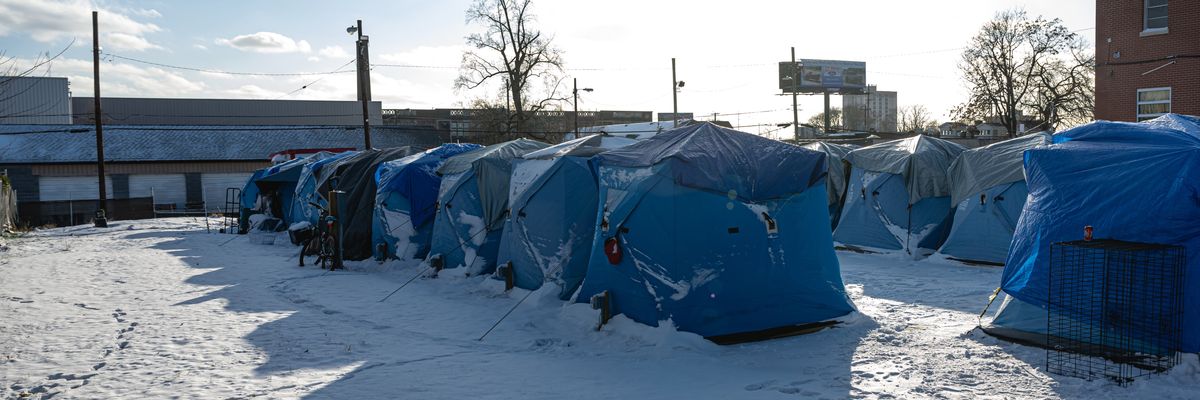
A row of tents is seen at The Hope Village, a secure tent encampment established for homeless people, on December 24, 2022 in Louisville, Kentucky.
(Photo: Jon Cherry/Getty Images)
Shameka Parrish-Wright
Aug 03, 2025
OtherWords
Punishing people for being poor doesn’t make them less poor. And jailing someone who’s homeless doesn’t make them housed. But that’s exactly what President Donald Trump’s new executive order does: It makes criminals out of people trying to survive our nation’s housing crisis.
Only affordable housing and accessible healthcare will get people off the streets so they can live a stable life. Instead, Trump’s order calls for local and state governments to ticket and arrest people for living on our streets
These policies waste taxpayer dollars just to make our homelessness crisis worse. If you need a preview of how Trump’s disastrous order will play out, just look at my home state of Kentucky.
In April 2024, the Kentucky legislature passed HB 5—the bill that paved the way for Kentucky to ticket and arrest people trying to survive outside. These laws, labeled “camping bans,” are popping up across the country. They’re rooted in the myth that people choose to be homeless—and the only way to help is through jail or involuntary commitment.
Not only is this cruel and inhumane. It also doesn’t work.
Instead of distractions and dictatorial decrees rooted in stereotypes and stigma, we need real leadership on real solutions to homelessness, like higher wages, and rents people can afford.
In Louisville earlier this year, a pregnant woman in active labor was ticketed by police because she had no choice but to sleep outside. Law enforcement did not offer her help,
Fortunately, she was able to deliver a healthy baby. But she’s still housing insecure—and now burdened with a citation too. Her story proves that making criminals out of people who have nowhere to go doesn’t reduce suffering—it makes it worse.
So it’s not surprising that even with this new law in place, there was still an over 10% rise in homelessness in Kentucky just last year. Similarly, national rates continue to increase even as more cities and states pass “camping bans.”
I’m the director at VOCAL-KY, a movement of low-income people. I’ve gotten to know the folks living in Louisville’s shelters and on the streets. It’s not hard for me to relate. When I lost my housing, my family and I lived out of my car until we could get back on our feet.
We work day in and day out to support our neighbors who live outside by providing a safe space and connection to services. And the pregnant woman, Samantha, who was cited while in active labor, is now a part of our drop-in center community.
This is what compassion looks like—not citations that put struggling people further in debt or behind bars.
People living on our streets and in our shelters want services and housing, but there isn’t enough to go around. With this executive order, the Trump administration is diverting even more money toward arresting and jailing people—and away from the housing and care that urban, rural, and suburban America all need.
Instead of distractions and dictatorial decrees rooted in stereotypes and stigma, we need real leadership on real solutions to homelessness, like higher wages, and rents people can afford. The reality is most Americans are closer to becoming homeless than becoming billionaires.
But instead of investing in solutions, Trump and the GOP gave massive tax breaks to the ultra rich—including to some of the same people and companies who make billions off driving up rents—while cutting programs for low-income people. In all likelihood, next year we’ll see another record number of Americans in homelessness.
We need federal lawmakers to sign onto the Housing, Not Handcuffs Act and invest in communities by directing federal funds to support local solutions that address the root causes of homelessness, not just force people into jail or detention centers dressed up as treatment.
Trump’s plan to arrest our way out of homelessness won’t work, because it’s never worked. Only housing, care, and services will help people get back on their feet, and we need our policies and politicians to act on those solutions now more than ever.
Punishing people for being poor doesn’t make them less poor. And jailing someone who’s homeless doesn’t make them housed. But that’s exactly what President Donald Trump’s new executive order does: It makes criminals out of people trying to survive our nation’s housing crisis.
Only affordable housing and accessible healthcare will get people off the streets so they can live a stable life. Instead, Trump’s order calls for local and state governments to ticket and arrest people for living on our streets
These policies waste taxpayer dollars just to make our homelessness crisis worse. If you need a preview of how Trump’s disastrous order will play out, just look at my home state of Kentucky.
In April 2024, the Kentucky legislature passed HB 5—the bill that paved the way for Kentucky to ticket and arrest people trying to survive outside. These laws, labeled “camping bans,” are popping up across the country. They’re rooted in the myth that people choose to be homeless—and the only way to help is through jail or involuntary commitment.
Not only is this cruel and inhumane. It also doesn’t work.
Instead of distractions and dictatorial decrees rooted in stereotypes and stigma, we need real leadership on real solutions to homelessness, like higher wages, and rents people can afford.
In Louisville earlier this year, a pregnant woman in active labor was ticketed by police because she had no choice but to sleep outside. Law enforcement did not offer her help,
Fortunately, she was able to deliver a healthy baby. But she’s still housing insecure—and now burdened with a citation too. Her story proves that making criminals out of people who have nowhere to go doesn’t reduce suffering—it makes it worse.
So it’s not surprising that even with this new law in place, there was still an over 10% rise in homelessness in Kentucky just last year. Similarly, national rates continue to increase even as more cities and states pass “camping bans.”
I’m the director at VOCAL-KY, a movement of low-income people. I’ve gotten to know the folks living in Louisville’s shelters and on the streets. It’s not hard for me to relate. When I lost my housing, my family and I lived out of my car until we could get back on our feet.
We work day in and day out to support our neighbors who live outside by providing a safe space and connection to services. And the pregnant woman, Samantha, who was cited while in active labor, is now a part of our drop-in center community.
This is what compassion looks like—not citations that put struggling people further in debt or behind bars.
People living on our streets and in our shelters want services and housing, but there isn’t enough to go around. With this executive order, the Trump administration is diverting even more money toward arresting and jailing people—and away from the housing and care that urban, rural, and suburban America all need.
Instead of distractions and dictatorial decrees rooted in stereotypes and stigma, we need real leadership on real solutions to homelessness, like higher wages, and rents people can afford. The reality is most Americans are closer to becoming homeless than becoming billionaires.
But instead of investing in solutions, Trump and the GOP gave massive tax breaks to the ultra rich—including to some of the same people and companies who make billions off driving up rents—while cutting programs for low-income people. In all likelihood, next year we’ll see another record number of Americans in homelessness.
We need federal lawmakers to sign onto the Housing, Not Handcuffs Act and invest in communities by directing federal funds to support local solutions that address the root causes of homelessness, not just force people into jail or detention centers dressed up as treatment.
Trump’s plan to arrest our way out of homelessness won’t work, because it’s never worked. Only housing, care, and services will help people get back on their feet, and we need our policies and politicians to act on those solutions now more than ever.
Trump Pushes Policies That 'Treat Homelessness and Mental Illness as a Crime'
"Homelessness is a policy failure," said one ACLU leader. "Weaponizing federal funding to fuel cruel and ineffective approaches to homelessness won't solve this crisis."
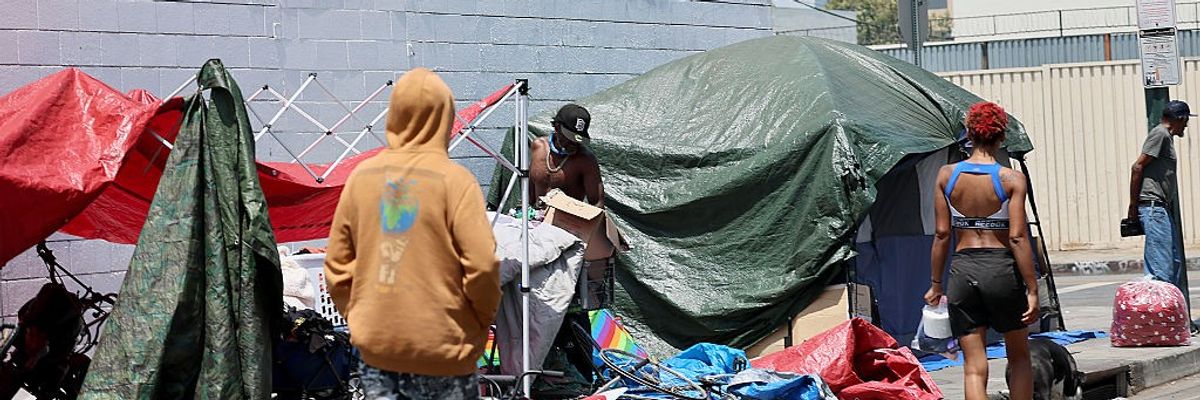
Tents are set up on a sidewalk in "Skid Row" in Los Angeles, California on June 25, 2025.
(Photo: Allen J. Schaben/Los Angeles Times via Getty Images
Jessica Corbett
Jul 24, 2025
"Homelessness is a policy failure," said one ACLU leader. "Weaponizing federal funding to fuel cruel and ineffective approaches to homelessness won't solve this crisis."
Tents are set up on a sidewalk in "Skid Row" in Los Angeles, California on June 25, 2025.
(Photo: Allen J. Schaben/Los Angeles Times via Getty Images
Jessica Corbett
Jul 24, 2025
COMMON DREAMS
Advocates for mental health and unhoused people blasted U.S. President Donald Trump on Thursday over his executive order titled "Ending Crime and Disorder on America's Streets."
Trump's order directs U.S. Attorney General Pam Bondi to end policies that restrict the government from institutionalizing "individuals on the streets who are a risk to themselves or others." She must also work with other Cabinet members "to prioritize grants for states and municipalities that enforce prohibitions on open illicit drug use, urban camping and loitering, and urban squatting, and track the location of sex offenders."
As a White House fact sheet highlights, the order also "redirects funding to ensure that individuals camping on streets and causing public disorder and that are suffering from serious mental illness or addiction are moved into treatment centers, assisted outpatient treatment, or other facilities." Further, it ensures grant money does not "fund drug injection sites or illicit drug use."
In a statement to USA Today, which first reported on the executive action, White House Press Secretary Karoline Leavitt said that "by removing vagrant criminals from our streets and redirecting resources toward substance abuse programs, the Trump administration will ensure that Americans feel safe in their own communities and that individuals suffering from addiction or mental health struggles are able to get the help they need."
Meanwhile, National Coalition for the Homeless executive director Donald Whitehead Jr. declared that "everyone deserves a safe place to live."
Trump's policies, he said, "ignore decades of evidence-based housing and support services in practice. They represent a punitive approach that has consistently failed to resolve homelessness and instead exacerbates the challenges faced by vulnerable individuals."
The National Homelessness Law Center (NHLC) similarly called out the president for pushing policies that "treat homelessness and mental illness as a crime."
"Across America, sky-high rents are both the leading cause of homelessness and a primary cause of financial stress for most families," NHLC said. "Instead of helping people who are struggling to make ends meet, Donald Trump remains focused on backwards, expensive, and ineffective policies that make homelessness worse."
"The National Homelessness Law Center strongly condemns today's executive order, which deprives people of their basic rights and makes it harder to solve homelessness," the group added. "This executive order is rooted in outdated, racist myths about homelessness and will undoubtedly make homelessness worse."
Scout Katovich, senior staff attorney with the ACLU's Trone Center for Justice and Equality, tied the order to the Republican Party's broader agenda, saying that "from the so-called 'Big Beautiful Bill' that will strip healthcare from millions to this dangerous executive order, every action this administration takes displays remarkable disdain for the rights and dignity of vulnerable people."
"Pushing people into locked institutions and forcing treatment won't solve homelessness or support people with disabilities," she said. "The exact opposite is true—institutions are dangerous and deadly, and forced treatment doesn't work. We need safe, decent, and affordable housing as well as equal access to medical care and voluntary, community-based mental health and evidence-based substance use treatment from trusted providers."
"But instead of investing in these proven solutions, President Trump is blaming individuals for systemic failures and doubling down on policies that punish people with nowhere else to go—all after signing a law that decimates Medicaid, the number one payer for addiction and mental health services," Katovich added. "Homelessness is a policy failure. Weaponizing federal funding to fuel cruel and ineffective approaches to homelessness won't solve this crisis."
As The Washington Post reported:
The executive order was issued as the Trump administration has slashed more than $1 billion in Covid-era grants administered by the Substance Abuse and Mental Health Services Administration and is proposing to slash hundreds of millions more in agency grants.
"There's no question we need to do more to address both homelessness and untreated substance use disorder and mental health conditions in the U.S.," said Regina LaBelle, director of the Addiction and Public Policy Initiative at the Georgetown University Law Center and a former drug policy official in the Biden White House. "But issuing an executive order, while disinvesting in treatment and other funding that will help prevent homelessness and untreated health conditions, will do nothing to address the fundamental issues facing the country."
Trump's order comes after the latest federal figures showed a surge in homelessness, and the U.S. Supreme Court's right-wing majority ruled last year that local governments can enforce bans on sleeping outdoors, effectively criminalizing homelessness.
Trump's order directs U.S. Attorney General Pam Bondi to end policies that restrict the government from institutionalizing "individuals on the streets who are a risk to themselves or others." She must also work with other Cabinet members "to prioritize grants for states and municipalities that enforce prohibitions on open illicit drug use, urban camping and loitering, and urban squatting, and track the location of sex offenders."
As a White House fact sheet highlights, the order also "redirects funding to ensure that individuals camping on streets and causing public disorder and that are suffering from serious mental illness or addiction are moved into treatment centers, assisted outpatient treatment, or other facilities." Further, it ensures grant money does not "fund drug injection sites or illicit drug use."
In a statement to USA Today, which first reported on the executive action, White House Press Secretary Karoline Leavitt said that "by removing vagrant criminals from our streets and redirecting resources toward substance abuse programs, the Trump administration will ensure that Americans feel safe in their own communities and that individuals suffering from addiction or mental health struggles are able to get the help they need."
Meanwhile, National Coalition for the Homeless executive director Donald Whitehead Jr. declared that "everyone deserves a safe place to live."
Trump's policies, he said, "ignore decades of evidence-based housing and support services in practice. They represent a punitive approach that has consistently failed to resolve homelessness and instead exacerbates the challenges faced by vulnerable individuals."
The National Homelessness Law Center (NHLC) similarly called out the president for pushing policies that "treat homelessness and mental illness as a crime."
"Across America, sky-high rents are both the leading cause of homelessness and a primary cause of financial stress for most families," NHLC said. "Instead of helping people who are struggling to make ends meet, Donald Trump remains focused on backwards, expensive, and ineffective policies that make homelessness worse."
"The National Homelessness Law Center strongly condemns today's executive order, which deprives people of their basic rights and makes it harder to solve homelessness," the group added. "This executive order is rooted in outdated, racist myths about homelessness and will undoubtedly make homelessness worse."
Scout Katovich, senior staff attorney with the ACLU's Trone Center for Justice and Equality, tied the order to the Republican Party's broader agenda, saying that "from the so-called 'Big Beautiful Bill' that will strip healthcare from millions to this dangerous executive order, every action this administration takes displays remarkable disdain for the rights and dignity of vulnerable people."
"Pushing people into locked institutions and forcing treatment won't solve homelessness or support people with disabilities," she said. "The exact opposite is true—institutions are dangerous and deadly, and forced treatment doesn't work. We need safe, decent, and affordable housing as well as equal access to medical care and voluntary, community-based mental health and evidence-based substance use treatment from trusted providers."
"But instead of investing in these proven solutions, President Trump is blaming individuals for systemic failures and doubling down on policies that punish people with nowhere else to go—all after signing a law that decimates Medicaid, the number one payer for addiction and mental health services," Katovich added. "Homelessness is a policy failure. Weaponizing federal funding to fuel cruel and ineffective approaches to homelessness won't solve this crisis."
As The Washington Post reported:
The executive order was issued as the Trump administration has slashed more than $1 billion in Covid-era grants administered by the Substance Abuse and Mental Health Services Administration and is proposing to slash hundreds of millions more in agency grants.
"There's no question we need to do more to address both homelessness and untreated substance use disorder and mental health conditions in the U.S.," said Regina LaBelle, director of the Addiction and Public Policy Initiative at the Georgetown University Law Center and a former drug policy official in the Biden White House. "But issuing an executive order, while disinvesting in treatment and other funding that will help prevent homelessness and untreated health conditions, will do nothing to address the fundamental issues facing the country."
Trump's order comes after the latest federal figures showed a surge in homelessness, and the U.S. Supreme Court's right-wing majority ruled last year that local governments can enforce bans on sleeping outdoors, effectively criminalizing homelessness.

No comments:
Post a Comment