NUCLEAR NEWS
European nuclear research body reviews Pakistan’s progress in science and technology during visit
A high-level delegation from the European Organisation for Nuclear Research (CERN) reviewed the country’s progress during a visit on Aug 24-28, the Foreign Office (FO) said on Friday.
CERN, one of the world’s largest and most respected centres for scientific research, was established in 1954 on the principle of “science for peace”, according to its website. Pakistan became CERN’s associate member on July 31, 2015, contributing to the centre’s projects as a “significant partner”. The Pakistan Atomic Energy Commission (PAEC) is the lead agency for the Pak-CERN collaboration.
“During the visit, a team of five top experts from CERN met with the chairman of the PAEC and toured various science and technology institutions,” a statement from the FO said.
“The purpose of these visits was to assess Pakistan’s progress in the field of science and technology.”
The institutions include the National Centre for Physics, Heavy Mechanical Complex-3, Pakistan Institute of Engineering and Applied Sciences, Pakistan Institute of Nuclear Science and Technology, Institute of Nuclear Medicine and Oncology, National Institute for Laser and Optronics and other advanced facilities, the statement read.
“Through its associate membership, Pakistan has gained significant benefits — advancing the frontiers of scientific knowledge, fostering technological development, and training a new generation of scientists and engineers,” it further noted.
In 2022, a task force of the CERN held meetings with different entities in Pakistan to review the associate membership.
Pakistan has attained numerous benefits from the membership, such as an increased number of engineering contracts to support CERN programmes, which are beneficial for the country’s industrial sector, human resources development and sharing of techniques and technology in key areas, besides numerous intellectual benefits.
Power play: why NASA is betting on nuclear to outpace rivals on the Moon
The United States is racing to build nuclear power reactors for the Moon, with the first system planned for the end of the decade. This would keep astronauts alive through weeks-long lunar nights, as well as powering permanent bases and outposts – and giving Washington an edge over China and Russia in a new space race.
Issued on: 30/08/2025 - RFI
NASA confirmed in a directive signed at the end of July that it will appoint a nuclear power czar and select two commercial proposals for the project within six months.
The aim is a 100-kilowatt reactor, ready to launch by 2029 or 2030. Unlike solar panels, nuclear systems can work around the clock – vital in a place where one night lasts 14 days.
Why nuclear, why now?
The announcement comes as the US prepares for Artemis III – the first planned crewed Moon landing since Apollo, now delayed to 2027.
NASA hopes to build a permanent base near the lunar south pole, but that requires a reliable energy source.
"The sunlight would not be continuous enough to produce the electricity needed for a facility where crews would live," Xavier Pasco, director of the Foundation for Strategic Research, told RFI.
Many analysts therefore see nuclear power as the only practical option. A constant energy supply would allow life-support systems, communications and even mining equipment to run without interruption.
"A nuclear reactor would allow great flexibility of use," explained Paul Wohrer, who leads the space programme at the French Institute of International Relations. He told RFI that such a system would "provide greater electricity availability".
Mona Luna takes off: Europe’s all-new lunar rover set to land by 2030
Investment and delays
NASA has spent around $200 million since 2000 developing compact nuclear systems, although none have yet flown.
In 2023, it funded three contracts worth $five million each, aimed at building units that could generate 40 kilowatts – enough to power 30 households for a decade.
Yet the schedule looks tight. The Artemis III landing has already slipped to 2027 – a date many still doubt is achievable given the planned lander, SpaceX’s Starship, is far from ready.
China, in contrast, is targeting 2030 for its first crewed mission and has been more consistent in meeting deadlines.
“According to all the specialists, 2030 seems extremely optimistic,” Pasco said.
Earthcare satellite to probe the impact of clouds on climate
Technical obstacles
Even if the timeline holds, the challenges are enormous.
"We are starting to talk about SMRs – small modular reactors capable of generating energy in a compact version,"said Pasco.
"But we also have to make sure they work well in extreme temperature conditions and can dissipate heat. There are major questions that are not resolved."
Cooling is one of the toughest challenges. On Earth, nuclear reactors use water for this – but that is not possible on the Moon.
“It will require the development of particular technologies, notably in terms of reactor cooling capacity, since the reactors we know on Earth are cooled with water," Wohrer explained. "But there is no way to circulate water intelligently on the Moon."
There are also questions about transporting uranium and managing nuclear risks in space.
Senegal joins space pact shaping the next era of Moon missions
Race with China
NASA says the project is not just about technology, but geopolitics too.
Its directive notes that since March 2024 "China and Russia have announced on at least three occasions a joint effort to place a reactor on the Moon by the mid-2030s".
The memo warns that the first nation to place a reactor could "declare a keep-out zone, which would significantly prevent the US from establishing its planned Artemis presence if it is not there first".
"China seems more advanced than Russia in the space field," said Wohrer, adding that human missions to the Moon are "the main priority for NASA in this geopolitical contest between the US and China".
This rivalry is also shaping how NASA presents its plans.
"The interest for its current leadership – which is a political leadership – is of showing that there is momentum and that the agency wants to invest in this programme in a determined and stable manner," Pasco added.
Space arms treaty should cover threat posed by debris - EU
A long history
Nuclear power in space is not a new idea. Since the 1960s, it has powered probes sent far from the Sun. The US even tested nuclear propulsion rockets.
“They had gone quite far in the tests. There was a model that was almost ready to fly at the time,” said Wohrer.
The Soviet Union has also experimented in the field.
“Spacecraft have already used nuclear technologies, for example for very distant scientific probes. There were even Soviet satellites that used nuclear reactors in space,” Pasco said.
The idea of developing reactors for long missions arrived back on the table in the early 2010s.
At that time NASA began work on a programme called Kilopower, which focused on developing nuclear reactors for lunar missions and possible future missions to Mars.
European space mission seeks out new life on Jupiter's icy moons
International law does not forbid nuclear power in space – a 1992 UN resolution allows it if no other energy source is possible.
The 1967 Outer Space Treaty bans countries from owning the Moon but says they must take the interests of others into account.
In 2020, the United States launched the Artemis Accords, signed by 56 countries including France. They propose “safety zones” on the Moon to prevent interference between missions.
China and Russia, however, refused to sign, and critics argue such zones could be used to block rivals once a country is established.
Partially adapted from this story by RFI's French-language service
Sweden to scrap uranium mining ban with nuclear buildout looming
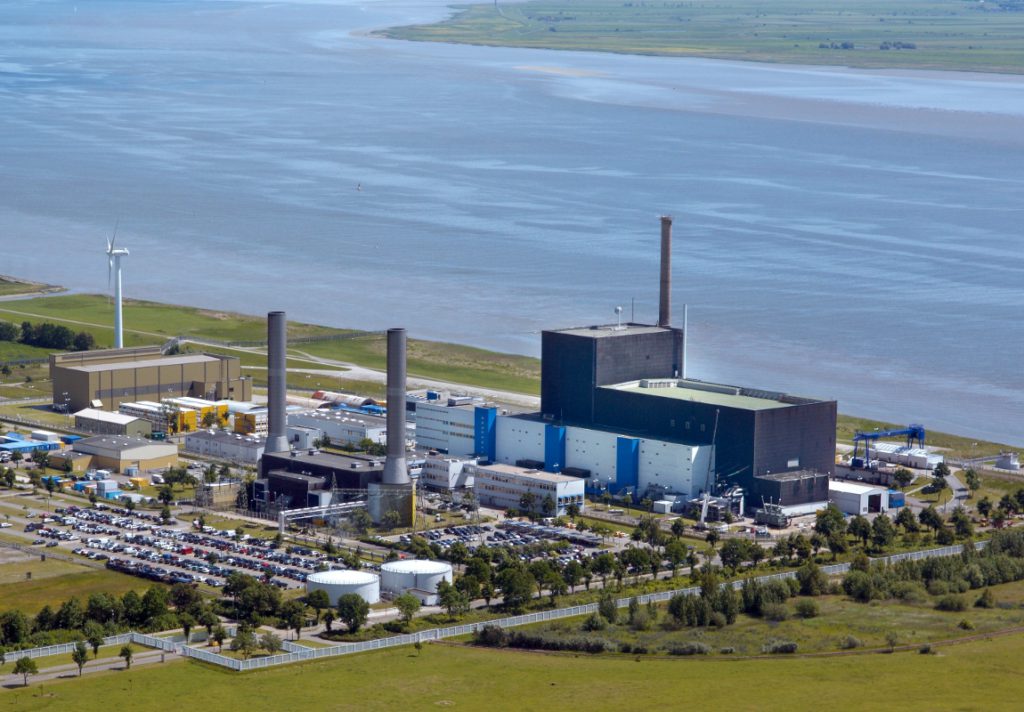
The Swedish government proposed to remove a ban on uranium mining to reduce the need for imports as the country eyes a renaissance in nuclear power.

The change is due to take place from Jan. 1 next year and means that the ban in the nation’s environmental law will be removed, according to a statement on Thursday.
Sweden generates about a third of its electricity from nuclear but relies completely on imported uranium, the fuel used in reactors, from nations including Canada, Australia and Kazakhstan. State-owned utility Vattenfall AB has also purchased Russian fuel in the past, but those deliveries stopped in 2022 after the invasion of Ukraine.
“I want to reduce this vulnerability in our energy supply and start to extract the uranium we have here in Sweden,” Climate and Environment Minister Romina Pourmokhtari said Wednesday at a press conference ahead of the publication of the proposal.
Sweden currently has six reactors in operation and Vattenfall plans to build several new units over the next decade to meet the growth in power demand. Finland’s Fortum Oyj is also studying whether to invest in new plants.
Local municipalities in Sweden can currently veto applications for uranium mines and a separate process is also underway to decide whether this veto right should also be scrapped. Most of the known uranium deposits are in the north of the country.
There continues to be commercial interest in developing mines in the Nordic nation, for example a collaboration between Australia’s Aura Energy Ltd. and Neu Horizon Uranium Ltd. Aura’s Haggan deposit in central Sweden is the fourth largest in the world, the firm said in June.
The ban on mining was introduced in 2018 by the previous Swedish government led by the Social Democrats, which argued it would risk contaminating water and agricultural resources.
(By Lars Paulsson and Charlie Duxbury)
Legislative proposals to lift Sweden's uranium mining ban
_91012.jpg)
In May 2018, the Swedish parliament passed an amendment to the Environmental Code banning uranium exploration and mining in the country. As from 1 August that year, no permits for uranium exploration or mining have been issued for any such applications submitted from that date.
In February last year, Climate and Environment Minister Romina Pourmokhtari announced that a government inquiry would look into abolishing the uranium mining ban. In December, the inquiry concluded that Sweden should remove its prohibition on uranium mining to allow it to be exploited like other natural resources regulated under the Minerals Act.
The government has now proposed that the prohibition in the Environmental Code against granting permits for mining or processing facilities that involve uranium-containing material be removed and that uranium be a concession mineral according to the Minerals Act.
These changes mean that it will be possible to extract uranium in Sweden and that a complete investigation of the bedrock can be carried out during exploration. The changes also make it possible to apply for and, under certain conditions, obtain an exploration permit and processing concession for uranium.
"It must be legal to take care of the Swedish uranium that is already out of the ground; it is completely incomprehensible that the miners had to treat it as waste," Pourmokhtari said. "The Swedish mining and mineral industry is crucial for Sweden, Europe and for the climate."
"The ban on uranium mining was wrong when it was introduced - the fact that we are now removing it is positive for Sweden as an industrial and mining nation," said Mats Green, group leader in the Moderate Party's economic affairs committee. "The ban has made it more difficult for us to mine other critical and strategic minerals that are often found together with uranium. With this decision, we can improve Sweden's and Europe's energy dependence and secure our self-sufficiency in critical minerals."
Tobias Andersson, chairman of the Sweden Democrats' business committee, added: "The Sweden Democrats opposed the ideologically motivated ban on uranium mining in Sweden and since the ban came into place have worked to return to the previous order. It is time that we do so now, which is a prerequisite for coping with the increased need for uranium in the wake of the nuclear renaissance."
In November 2023, Sweden's parliament approved a bill that cleared the way for new nuclear power in the country by removing the current limit on the number of nuclear reactors in operation, as well as allowing reactors to be built on new sites. The amendment entered into force on 1 January 2024.
There is currently no uranium mining in Sweden, which has six nuclear power reactors providing about one-third of its electricity. Sweden imports most of its nuclear fuel, including all enrichment services.
In June this year, Australian mineral company Aura Energy and Neu Horizon Uranium Limited announced plans plan to enter into a strategic collaboration agreement to develop Sweden's uranium resources should the country remove its prohibition on uranium mining. Aura Energy owns the Häggån vanadium, potash and uranium project in Sweden, which is claimed to be "one of the largest undeveloped uranium resources globally" with an Inferred Mineral Resource of 800 million pounds of contained U3O8 (307,718 tU). Neu Horizon Uranium is an Australian-based unlisted public company focused on advancing Sweden's uranium resources. The company holds a portfolio of high potential uranium projects in key mineralised regions of Sweden.
IAEA team seeks access to new dam at Zaporizhzhia plant
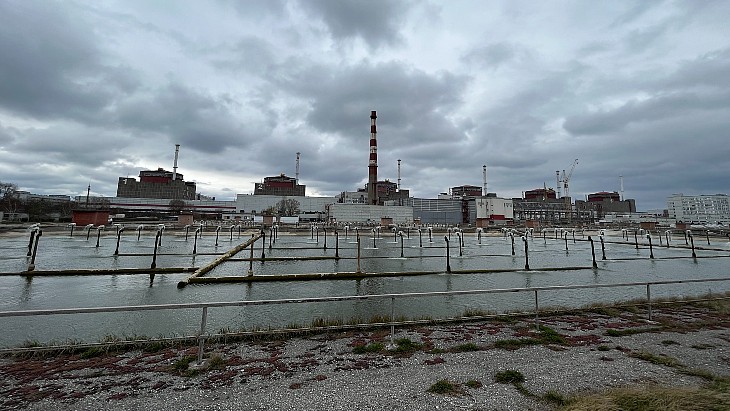
In his latest - 311th - update on the situation in Ukraine, Grossi said the agency's experts at the plant had been given details about the location of the dam and its purpose, which is to isolate one of the plant's channels - which supplies service water for cooling several systems including the main unit transformers - from the cooling pond.
The operators of the plant, which has been under Russian military control since early March 2022, have told the International Atomic Energy Agency (IAEA) that "the dam will maintain the water level in the channel at about 14 metres, which is about 2 metres above the threshold at which the water pumps would no longer be able to operate".
The plant continues to use groundwater wells on site to provide cooling water for its safety systems to cool the reactor cores and used fuel pools. The cooling water is required even though all six units are in cold shutdown. The previous long-term water supply for the plant was based on the Kakhovka dam, which was destroyed in June 2023.
The IAEA team at the site have requested "access to the newly constructed dam but have not yet been permitted due to security concerns".
Grossi said: "Our access to this dam is essential to assess the cooling water situation which is crucial given the fragile nuclear safety situation at the ZNPP."
The update says that the IAEA team at the Zaporizhzhia plant "heard military activities on most days over the past week", and report maintenance work on safety systems and the site’s electrical systems, including the backup power transformers. The plant has been relying on a single external power line for four months.
The Zaporizhzhia nuclear power plant is located on the frontline of Russian and Ukrainian forces. The IAEA experts have been stationed there since September 2022 as part of efforts to boost nuclear safety and security. There are also IAEA teams at Ukraine’s Khmelnytsky, Rivne and South Ukraine nuclear power plants, and Chernobyl. The IAEA says its experts at South Ukraine and Chernobyl heard air raid sirens on most days in the past week.
Further proposal submitted for SMR plant in Norway
_38537.jpg)
The proposal was submitted by Grenland Kjernekraft AS - a newly-created wholly-owned subsidiary of Norsk Kjernekraft AS. The proposed plant will comprise several SMRs, with a total capacity of up to 1500 MW and an annual production of 12.5 TWh of electrical power. This corresponds to about 10% of Norway's total power consumption.
The notification is the first formal step towards establishing a nuclear power plant based on SMRs in Grenland. After the ministry has determined the assessment programme, a thorough impact assessment can begin.
Norsk Kjernekraft said the study will focus on a currently unregulated area of land at Herre i Bamble municipality, just south of the Skien port terminal, but as part of the investigations, other relevant locations will also be considered.
The notification describes the location, the need for power and how nuclear power can contribute to meeting local, regional and national climate goals. It also explains which topics will be included in a future impact assessment, including the environment, safety, society and economy.
"Grenland is currently one of the regions in Norway with the highest power prices, and the industry is concerned about security of supply," said Norsk Kjernekraft CEO Jonny Hesthammer. "With a nuclear power plant strategically located in Grenland, we can help solve both the price and capacity challenges."
Norsk Kjernekraft announced the creation of Grenland Kjernekraft AS earlier this week. It said the company's mandate includes developing a planning initiative for an impact assessment of relevant areas. If the assessments show the project to be feasible within acceptable limits, the company will continue to work towards the necessary licenses and permits.
Norsk Kjernekraft said it has sent an invitation to Skien and Porsgrunn municipalities, in addition to existing dialogue with Bamble municipality, to become future co-owners of Grenland Kjernekraft AS.
Project company created for East Finnmark plant
Norsk Kjernekraft has also announced the establishment, together with Vardø Municipality, of a company - Varanger Kjernekraft AS - to investigate the possibility of constructing a nuclear power plant in East Finnmark.
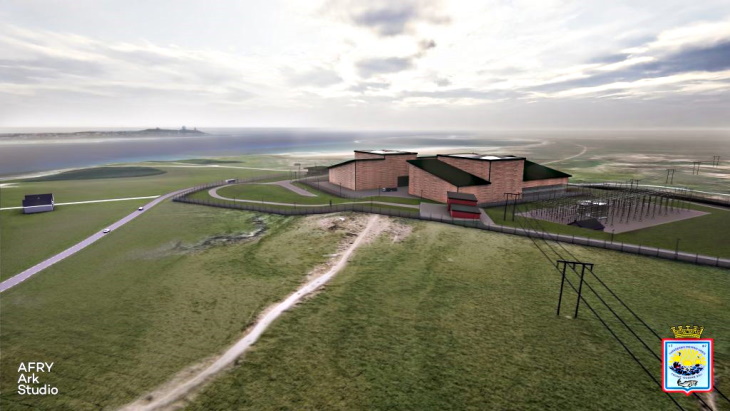
(Image: Vardø Municipality)
This initiative is the result of more than two years of collaboration between Vardø Municipality and Norsk Kjernekraft. Vardø Municipality initiated the collaboration in April 2023, and in June last year Norsk Kjernekraft submitted a notification with a proposal for a study programme for a nuclear power plant at Smelror in Vardø.
"The start-up of this company is an important step towards strengthening societal security throughout northern Norway," Hesthammer said. "Secure and predictable energy supply is a prerequisite for Norwegian sovereignty in the region."
Tepco to remove fuel from Kashiwazaki-Kariwa 7
_16769.jpg)
Tepco applied for Nuclear Regulation Authority (NRA) approval of its design and construction plan for Kashiwazaki-Kariwa units 6 and 7 in September 2013. It submitted information on safety upgrades across the site and at those two units. These 1356 MWe Advanced Boiling Water Reactors began commercial operation in 1996 and 1997, respectively, and were the first Japanese boiling water reactors to be put forward for restart.
In 2017, Tepco received permission from the NRA to restart units 6 and 7. However, in early 2021, Tepco notified the NRA of malfunctions in intruder detection equipment on the Kashiwazaki-Kariwa site. In addition, it reported the unauthorised use of an ID card. In April 2021, the NRA issued an administrative order to Tepco prohibiting it from moving nuclear fuel at the plant until improvements in security measures there have been confirmed by additional inspections. This order was lifted in December last year after inspections confirmed that measures had been enhanced at the site.
Tepco announced in April 2024 that it had completed loading fuel into unit 7, which it aimed to restart as early as this summer. The unit, however, would have to be taken offline again in October to implement anti-terrorism safety measures. The company has determined that unit 7 cannot be restarted before the completion of the antiterrorism facility scheduled for August 2029.
"As the installation deadline for the Specially Designated Severe Accident Response Facilities approaches on 13 October 2025, we have decided to suspend the test operation of the reactor itself, as we will be removing the loaded fuel without conducting inspections involving critical reaction operations," the company has now announced.
According to Tepco, the fuel removal work will begin on 14 October, Jiji Press reported. A total of 872 nuclear fuel assemblies will then be transferred to a used fuel storage pool over about two weeks from 21 October.
Tepco is now prioritising restarting Kashiwazaki-Kariwa unit 6, where fuel loading was completed in June. The company has until September 2029 to implement anti-terrorism safety measures at unit 6, and it could operate until that time, pending local approval.
Aalo breaks ground for experimental reactor
Two weeks after being selected as one of the advanced reactor projects to receive support under the US Department of Energy's Nuclear Reactor Pilot Program, Aalo Atomics has broken ground at a site in Idaho to start construction of its first experimental extra modular nuclear reactor, the Aalo-X.
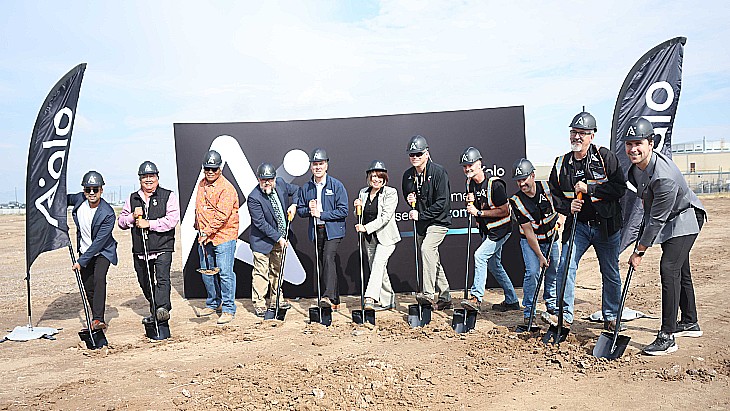
Aalo says it plans to complete construction and achieve criticality by 4 July 2026, the goal date set by the Department of Energy (DOE) for at least three test reactors to reach criticality under the programme to expedite the testing of advanced reactor designs it announced in June. The initiative is part of the Reforming Nuclear Reactor Testing at the Department of Energy executive order signed by President Donald Trump in May.
"Our selection for the Nuclear Reactor Pilot Program is a significant catalyst for achieving our goal of going from 'founding to fission' in less than three years - a feat many deemed impossible just a year ago," Aalo Atomics CEO and co-founder Matt Loszak said, describing the groundbreaking event at the site, located next to Idaho National Laboratory (INL)'s Materials and Fuels Complex, as "a testament to the potential that can be unlocked when public entities and private companies partner together in the critical interest of the nation" at a "pivotal time" for the US nuclear energy industry.
"When Aalo-X achieves criticality next year, it will become the first new sodium-cooled reactor to start operation in the US in over four decades," Aalo Atomics co-founder and CTO Yasir Arafat said.
_96445.jpg)
The company's vision for the Aalo Pod power plant (Image: Aalo Atomics)
Aalo-X will be manufactured at Aalo's pilot factory in Austin, Texas, before being transported to and installed at the INL site. The test reactor is the precursor to the Aalo Pod, a 50 MWe XMR (Extra Modular Reactor) power plant power plant purpose-built for data centres. Each fully modular Aalo Pod will contain five factory built, sodium-cooled, Aalo-1 reactors, using low-enriched uranium dioxide fuel. The company says it will be in commercial use by 2029.
"Today's groundbreaking symbolises the progress that can be achieved when innovation, vision and national purpose come together," said INL Director John Wagner. "Projects like Aalo-X reflect the promise of nuclear energy to meet our nation's historic demand growth and help enable a more prosperous future for our nation," he added.
The companies selected by the DOE for support under the programme are: Aalo Atomics Inc; Antares Nuclear Inc; Atomic Alchemy Inc; Deep Fission Inc; Last Energy Inc; Natura Resources LLC; Oklo Inc (selected for two projects); Radiant Industries Inc; Terrestrial Energy Inc; and Valar Atomics Inc.
Inner containment construction set to begin for Leningrad’s seventh unit
The required specialist reinforcement and concreting works of the circular 'corridor' have been completed at Leningrad II’s unit 3 allowing the start of installation of the lower tier of the inner containment building.
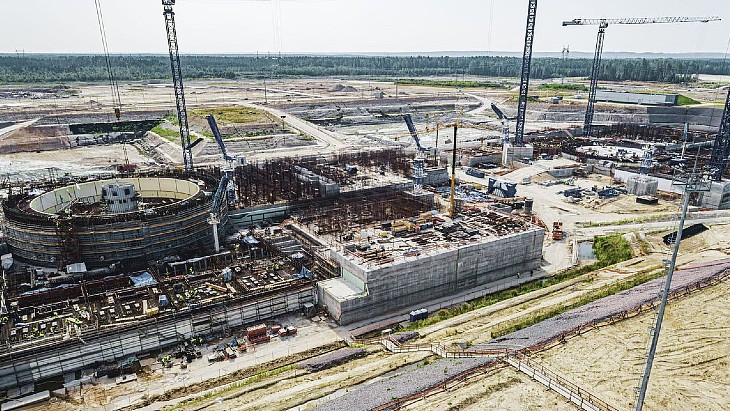
Pre-assembly and welding of the first tier of the inner containment has been taking place over the past few weeks next to the reactor building site and Rosenergoatom - part of Rosatom - said it will soon be ready for installation.
It is planned to begin the work on installing the first tier - to be followed by concreting and subsequent tiers of the inner containment building - during September, with the entire process expected to last for two and a half years with the entire structure due to be completed, with dome, in 2028.
Evgeny Milushkin from Leningrad NPP-2 said the inner containment would comprise a "concrete structure more than a metre thick, reinforced for strength with steel … the inner protective shell will prevent radioactive substances and ionising radiation from leaving the reactor building. This means that the personnel of the nuclear power plant, the population living next to it and the environment will be safe".
There will also be a second, external containment building, which will "protect the reactor, steam generators and other important equipment from extreme external natural and man-made influences" including hurricanes, plane crashes or earthquakes.
Background
The Leningrad nuclear power plant is one of the largest in Russia, with an installed capacity of 4400 MWe, and provides more than 55% of the electricity demand of St Petersburg and the Leningrad region, or 30% of all the electricity in northwest Russia.
Leningrad 1 shut down in 2018 after 45 years of operation. Leningrad 2, also a 1000 MWe RBMK unit, started up in 1975 and was permanently shut down in November 2020. As the first two of the plant's four RBMK-1000 units shut down, new VVER-1200 units started at the neighbouring Leningrad II plant. The 60-year service life of these fifth and sixth units (also known as Leningrad II-1 and Leningrad II-2) secures power supply until the 2080s. Units 7 and 8 (also known as Leningrad II-3 and Leningrad II-4) will replace units 3 and 4 as they are shut in the coming years.
The pouring of the first concrete for unit 7 in March 2024 marked the start of the main phase of construction of the new power unit, which is expected to generate power for 60 years, with the possibility of a 20-year extension.

No comments:
Post a Comment