WAR AT SEA
Video: Russia Damages Ukrainian Spy Ship in First Naval Drone Attack
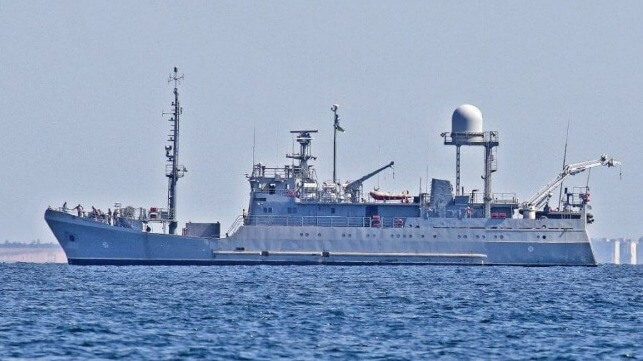
The Ministry of Defense of Russia released a video and announced it had successfully attacked a Ukrainian surveillance vessel in what reports say is its first successful naval drone attack. Ukraine’s Navy confirmed an attack, reporting the death toll has risen to two sailors, while others are missing or injured.
Neither side released extensive details, but reports are identifying the vessel as the Simferopol, a reconnaissance vessel built in Ukraine in 2019 based on a trawler. The vessel is 1,220 tons displacement and about 55 meters (180 feet) in length and was designed for 29 crew. It was outfitted with electronic intelligence and surveillance equipment in support of the Ukrainian Navy’s operations.
The vessel was reported to be operating in the Danube Delta region when it was struck on August 28. Russia’s statement claimed the vessel was sunk, but a spokesperson for the Ukrainian Navy today on television said they could not confirm that the vessel had sunk.
Ukraine initially confirmed one death, but today raised the death count to two sailors while saying a search and rescue mission was proceeding. They declined to say how many sailors are missing or injured, with the spokesperson emphasizing that most of the sailors were safe.
They said the Russian naval drones were known and that there had been attempts in the past to deploy them in the Black Sea. This was the first known successful attack using the naval drones.
Ukraine has successfully deployed a range of naval and aerial drones during the campaign, inflicting a range of losses on the Russian Navy and support vessels. Yesterday, Ukraine claimed that it had successfully attacked a Russian naval vessel deep inside Crimea in what was being described as a bold attack far behind enemy lines.
Last month, a Ukrainian dredger working in the Danube reportedly struck a mine, killing three crewmembers. The canal connecting to the Danube was closed for weeks before it reopened.
Video: Ukraine Damages Russian Missile Boat in the Sea of Azov
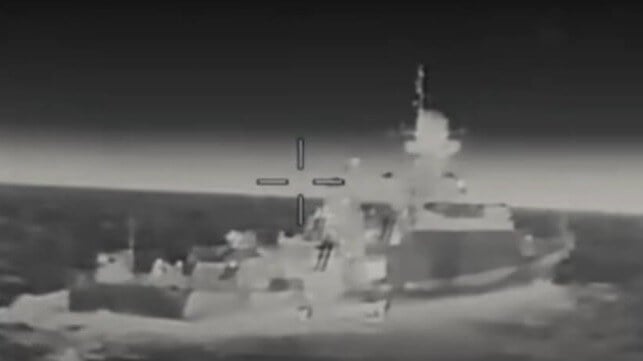
Ukraine military intelligence has released a video showing one of its one-way attack aerial drones attacking a Buyan-M Class Project 21631 missile corvette in the Sea of Azov. The corvette was hit and damaged on August 28, but it is not yet clear if the vessel has been able to recover to port.
The attack is noteworthy because of the location of the attack. The Sea of Azov is effectively a Russian lake, Ukraine having lost its control of coastline in Donetsk and Zaporizhzhia in 2022. Hence Ukraine will have had to fly the attack drone either through Russian land-based air defenses in Donetsk and Zaporizhzhia, or taken a longer route over the sea and around Crimea. The drone’s pilots will then need to have locked onto the target at this long range.
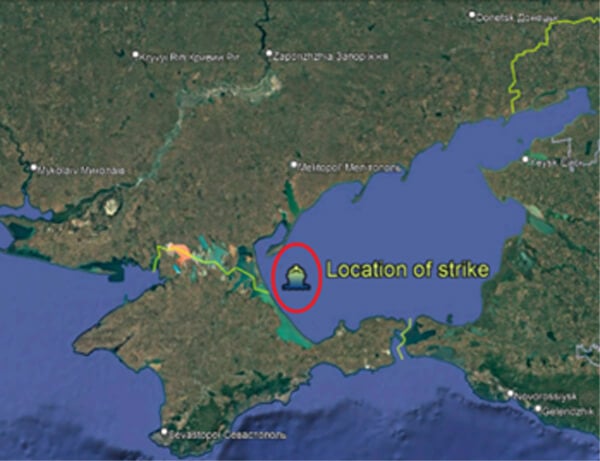
Location of the corvette when struck in the Sea of Azov (45°42′N 35°18′E ) (Google Earth, Landsat Copernicus, CJRC)
Ukraine has demonstrated it can do this against static targets at extreme range. However, to be able to do so against a moving target at long range is technically a considerable accomplishment. This should once again cause Russian naval commanders to consider the security of their naval assets even in ports far distant from Crimea such as Novorossiysk, to where vessels have already been pulled back for safety. The attack may have been mounted by Ukraine to demonstrate that it can control sea approaches to the Sea of Azov ports of Mariupol and Berdyansk, which Russia has recently sought to open to foreign shipping.
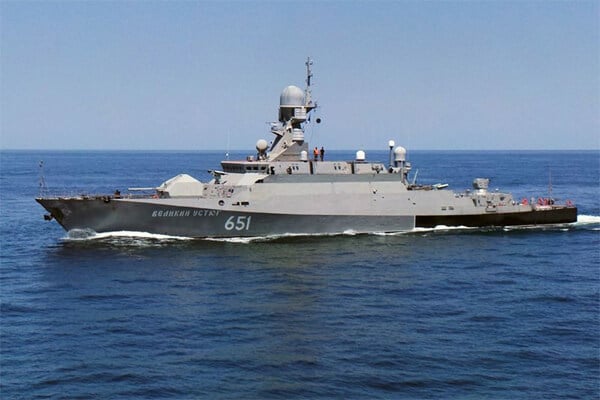
Buyan-M Class Project 21631 missile corvette (Ministry of Defense of the Russian Federation)
Buyan-M Class corvettes are primarily designed for littoral coastal defense, and are the mainstay of both what remains of the Black Sea Fleet and the Caspian Flotilla. They are however armed with two vertical launch cells, each able to hold four Kalibr missiles. The Kalibr is designed to be an anti-ship weapon, but has frequently been used to hit ground targets in Ukraine. In its land-attack version, the Kalibr has a range of 1,500 miles, and can therefore hit targets anywhere in Ukraine form the Black Sea and Sea of Azov.

No comments:
Post a Comment