Minister confirms environmental authorisation for South African new build
South Africa's Minister of Forestry, Fisheries and the Environment has upheld a 2017 decision to grant Eskom environmental authorisation to construct and operate a new nuclear power station in Duynefontein, in the Western Cape.
_16342.jpg)
The authorisation for Eskom's Final Environmental Impact Report for a new nuclear power plant at Duynefontein was originally granted by South Africa's Department of Environmental Affairs, but had been the subject of challenges from various environmental organisations. Those appeals have now been dismissed.
Minister of Forestry, Fisheries and the Environment Dion George announced his decision to uphold the 2017 decision on 8 August.
"In considering these appeals, I have carefully reviewed the Environmental Impact Assessment Report (EIAr), as well as the independent peer review conducted in respect of the project," George said.
"In the end, my decision was made in respect of the principles of the National Environmental Management Act, 1998 (Act No. 107 of 1998), and with full appreciation of the environmental, social and economic considerations involved."
The granting of an Environmental Authorisation "does not exempt an applicant from complying with any other applicable legal requirements or obtaining permits from other competent authorities," George said.
Eskom would still be required to obtain additional statutory authorisations before proceeding with the project, including a nuclear installation licence from the National Nuclear Regulator (NNR); approval from the National Energy Regulator of South Africa; water use licences from the Department of Water and Sanitation; and other approvals.
Duynefontain is next to Eskom's existing Koeberg nuclear power plant. In March 2016, the state-owned utility submitted site licence applications to the NNR for Duynefontein and another site, Thyspunt, to construct and operate "multiple nuclear installations (power reactors) and associated auxiliary nuclear installations." The Department of Environmental Affairs in 2017 authorised 4000 MWe nuclear capacity to be built at either site.
Loyiso Tyabashe, Group Chief Executive Officer of the Nuclear Energy Corporation of South Africa Ltd (Necsa), today welcomed the ministerial decision.
"This approval marks an important milestone for the nuclear industry and South Africa’s journey towards implementing a balanced energy mix that enables socio-economic development and is climate friendly. The Minister’s decision shows rigour of the process that was followed to choose appropriate site for nuclear new build and reflects confidence in nuclear technology as a safe, clean, and reliable energy solution. Necsa continues to work with the Department of Electricity and Energy as well as Eskom as a partner and commits to contribute its technical expertise to maximise the benefits of nuclear energy, " he said.
In January 2024 the South African government published plans to procure 2.5 GWe of new nuclear capacity. However in August 2024 the government paused the procurement process to allow for further public consultation.
Radiant signs deal to supply microreactor for US military base
_51865.jpg)
The company is developing the 1 MWe Kaleidos high-temperature gas-cooled portable microreactor, which will use a graphite core and TRISO (tri-structural isotropic) fuel. Earlier this year, it was one of eight technology developers selected as potential microreactors suppliers made eligible to receive funding under the Advanced Nuclear Power for Installations programme: an initiative launched in 2024 by the Defense Innovation Unit in collaboration with the Department of the Army and the Department of the Air Force, with the goal of "working to design, license, build, and operate one or more microreactor nuclear power plants on military installations".
"We're proud to be the first agreement designed to deliver mass-manufactured nuclear microreactors for a US military base," said Radiant CEO and Founder Doug Bernauer. "In 36 months, Kaleidos reactors will arrive via truck and within 48 hours plug in, power on, and provide resilient, cyber-secure power to our nation's Air Force for years without refueling."
Radiant says it plans to test its first reactor in 2026, with initial customer deployments beginning in 2028.
In July, Radiant was one of the two companies selected by the US Department of Energy to perform the first tests in the National Reactor Innovation Center's Demonstration of Microreactor Experiments test bed at the Idaho National Laboratory.
Detailed site survey begins at Dukovany
_20523.jpg)
The ceremony was attended by Korea Hydro & Nuclear Power (KHNP) President Hwang Joo-ho, project development company Elektrárna Dukovany II (EDU II) President Zavodski, Czech Minister of Industry Lukáš Vlček, South Korean Ambassador to the Czech Republic Hong Young-ki, and executives from local survey company CEZ EP.
KHNP said the detailed site survey will be conducted over about the next 12 months. It said, as the first step in the nuclear power plant project, the characteristics of the proposed construction site will be investigated and used as basic data for the design.
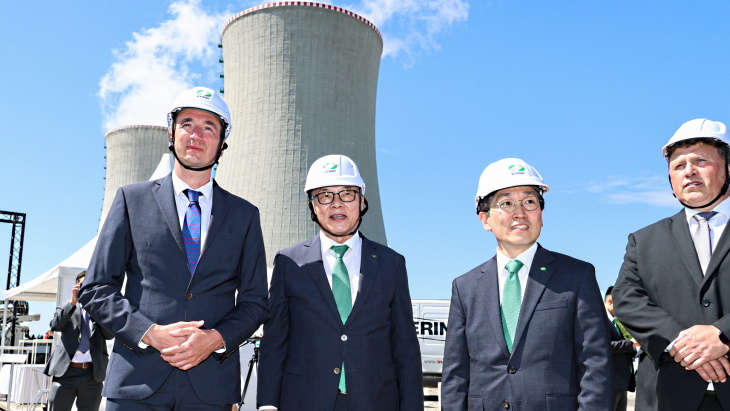
(Image: KHNP)
"The detailed site survey is the first on-site process for the Dukovany nuclear power plant project and the practical starting point for the APR1000 design," Hwang Joo-ho said. "This is a crucial task for the timely execution of the contract, and we will conduct the survey thoroughly and systematically according to plan."
The Czech government selected KHNP as its preferred bidder in July 2024 for two APR1000 units near the current Dukovany plant, about 200 kilometres southeast of Prague. Two more units at the Temelin nuclear power plant are also being considered and, according to KHNP "if the Czech government decides within the next three years to proceed with Temelin units 3 and 4, KHNP will be eligible to sign additional contracts with EDU II after further negotiations".
The contract with KHNP for new nuclear capacity at the Dukovany site was signed on 4 June. The aim is to start construction in 2029.
The Czech Republic currently gets about one-third of its electricity from the four VVER-440 units at Dukovany, which began operating between 1985 and 1987, and the two VVER-1000 units in operation at Temelín, which came into operation in 2000 and 2002.
Construction gets under way of first unit at Jinqimen plant
_50257.jpg)
A ceremony was held at the plant site on 10 August to mark the pouring of first concrete for unit 1, a milestone that means the unit has officially entered the construction phase, China National Nuclear Corporation (CNNC) said.
The construction of two 1200 MWe Hualong One reactors as Phase I of the Jinqimen plant was approved by China's State Council at a meeting on 29 December 2023. A ground-breaking ceremony was held in February 2024 to mark the start of work on the units.
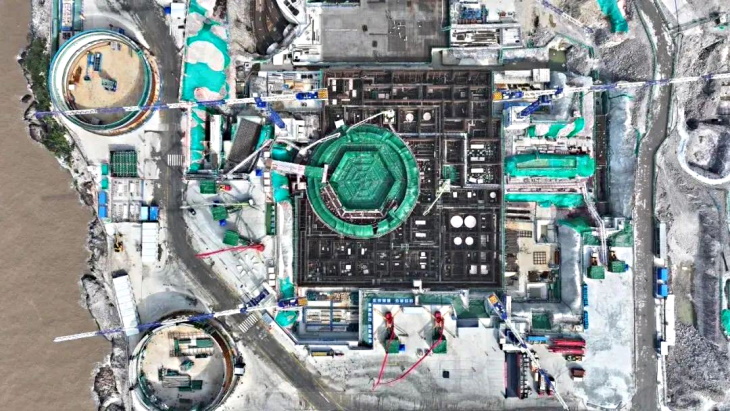
(Image: CNNC)
China's National Nuclear Safety Administration issued a construction licence on 5 August for units 1 and 2 at the Jinqimen plant, clearing the way for first concrete to be poured for the foundation of the reactor building of the first unit.
CNNC subsidiary CNNC Zhejiang Energy Co Ltd is responsible for project investment, construction and operations management of the new plant, which will eventually house six Hualong One units. Another CNNC subsidiary, China Nuclear Engineering & Construction Corporation, is responsible for the construction of the nuclear island, conventional island, and key facilities of the Jinqimen nuclear power project.
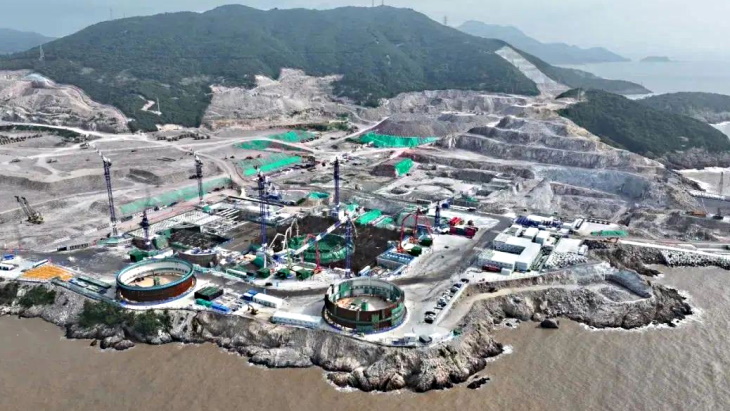
(Image: CNNC)
Once all six units have been completed, the total installed capacity of the Jinqimen plant will be about 7.2 GWe, and the annual grid-connected electricity will be some 55 TWh, which according to CNNC is equivalent to half of Ningbo's total electricity consumption in 2024. The plant, it said, will reduce carbon dioxide emissions by about 45 million tonnes.
Following the pouring of first concrete for Jinqimen unit 1, the number of nuclear power units under construction controlled by CNNC has reached 13, with an installed capacity of 15.138 GWe. The Jinqimen plant becomes the company's third nuclear power base in Zhejiang Province.

No comments:
Post a Comment