Texas Judge Overrules Jury to Send Anti-Genocide Activist to Jail for Graffiti
Now, as Raunaq Alam’s team attempts to appeal the judge’s decision, he reportedly continues to be targeted.
By Marwa Elbially ,
September 26, 2025

A Banksy mural depicting a judge beating a protester on the outside of the Royal Courts of Justice in London, England, on September 9, 2025.
Dan Kitwood / Getty Images
THIS WAS COVERED UP BY SECURITY THE SAME DAY
Truthout is an indispensable resource for activists, movement leaders and workers everywhere. Please make this work possible with a quick donation.
The artist Banksy recently drew a mural at the Royal Courts of Justice in London depicting a judge in a traditional wig and a black robe, thrashing an unarmed protester with his gavel. The protester is lying on the ground in a defensive position, with one hand raised, while the other hand holds up a blank sign splattered with blood — the only red in the otherwise black-and-white mural. A judge promptly directed for it to be removed, only further highlighting the mural’s message regarding free expression.
A similar form of state repression, cloaked in the black robes of “justice,” was recently on display in Tarrant County, Texas, where the full power of the state and judiciary came pummeling down upon anti-genocide activist Raunaq Alam.
In March 2024, Alam was charged with a Class B misdemeanor of graffiti with a pecuniary loss of less than $750 for allegedly spray painting Uncommon Church’s exterior wall with “F*** ISRAEL.” The maximum custodial penalty for a Class B misdemeanor is 180 days in jail. This represents the lowest penalty range for offenses that result in jail time. But in a move that should chill free speech advocates everywhere, the county eventually brought new charges against Alam, including a hate crimes enhancement that could have led to 10 years in prison.
At the time of Alam’s alleged spray-painting, Uncommon Church was flying the State of Israel’s flag outside its building. Months before the graffiti was painted, the church posted a photograph of its pastor, Brad Carignan, alongside 11 Israeli soldiers carrying automatic weapons, on Facebook. The caption stated, “Pastor Brad made it safely to (near) the frontline to bring clean socks, sleeping bags and encouragement to the Israeli troops.”
The case took place in Tarrant County, the third-largest county in Texas and a bellwether for both the state and the nation. A demographic shift has helped transition the county from a once-reliable Republican stronghold to an electoral battleground, and the far right has expended significant resources to maintain its political footing there.
Related Story
Truthout is an indispensable resource for activists, movement leaders and workers everywhere. Please make this work possible with a quick donation.
The artist Banksy recently drew a mural at the Royal Courts of Justice in London depicting a judge in a traditional wig and a black robe, thrashing an unarmed protester with his gavel. The protester is lying on the ground in a defensive position, with one hand raised, while the other hand holds up a blank sign splattered with blood — the only red in the otherwise black-and-white mural. A judge promptly directed for it to be removed, only further highlighting the mural’s message regarding free expression.
A similar form of state repression, cloaked in the black robes of “justice,” was recently on display in Tarrant County, Texas, where the full power of the state and judiciary came pummeling down upon anti-genocide activist Raunaq Alam.
In March 2024, Alam was charged with a Class B misdemeanor of graffiti with a pecuniary loss of less than $750 for allegedly spray painting Uncommon Church’s exterior wall with “F*** ISRAEL.” The maximum custodial penalty for a Class B misdemeanor is 180 days in jail. This represents the lowest penalty range for offenses that result in jail time. But in a move that should chill free speech advocates everywhere, the county eventually brought new charges against Alam, including a hate crimes enhancement that could have led to 10 years in prison.
At the time of Alam’s alleged spray-painting, Uncommon Church was flying the State of Israel’s flag outside its building. Months before the graffiti was painted, the church posted a photograph of its pastor, Brad Carignan, alongside 11 Israeli soldiers carrying automatic weapons, on Facebook. The caption stated, “Pastor Brad made it safely to (near) the frontline to bring clean socks, sleeping bags and encouragement to the Israeli troops.”
The case took place in Tarrant County, the third-largest county in Texas and a bellwether for both the state and the nation. A demographic shift has helped transition the county from a once-reliable Republican stronghold to an electoral battleground, and the far right has expended significant resources to maintain its political footing there.
Related Story
Op-Ed |
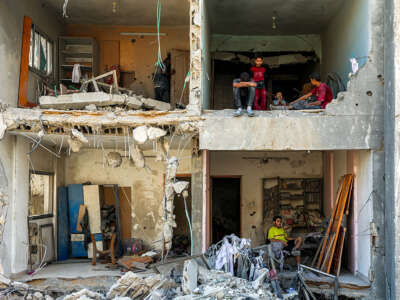
In Gaza City, I Have Been Rendered Homeless in My Homeland
After our apartment was bombed, we tried to flee south but failed, returning to our ruined home only to be bombed again. By Dalia Abu Ramadan , Truthout September 24, 2025
Before the Texas legislature began its mid-decade redistricting effort this summer to dilute the voting power of people of color, County Judge Tim O’Hare blazed the trail, providing a test case for redrawing electoral maps in an off-census year. The new maps, which passed 3-2 along party lines, gerrymandered Commissioner Alisa Simmons, the only Black woman on the court, out of her district.
O’Hare also passed new rules of decorum to minimize dissent and quash protected speech during commissioner court meetings. Under this policy, people have been arrested, charged, and prosecuted.
It was in this climate that Alam’s case was presented to a grand jury for indictment in October 2024, seven months after the original misdemeanor was filed. The new charge alleged Alam had caused damage between $750 and $30,000, raising it from a misdemeanor to a state jail felony, which carries a maximum punishment of two years in jail. That indictment also included the hate crime enhancement, which, if found true, would increase the penalty range to a third-degree felony, carrying a maximum of 10 years in prison.
The political show trial was manufactured to criminalize speech by conflating legitimate criticism of the state of Israel with antisemitism. The case was originally filed in County Criminal Court No. 5. Months later, it was transferred to County Criminal Court No. 9, Judge Brian Bolton’s court. Even when the case was indicted to a felony and the case was transferred to a felony district court, Judge Bolton was assigned to proceed over the trial. Though legal, it is unusual for a misdemeanor judge to preside over a felony trial. Further, First Assistant Prosecutor Lloyd Whelchel, an attorney with 29 years of experience who routinely handles death penalty prosecutions, represented the state once Alam was indicted. The jury trial was scheduled so the closing arguments and a possible verdict would be rendered on September 11, 2025. This was no run-of-the-mill prosecution; from the onset, even a cursory façade of neutrality was not afforded.
Months earlier, the same duo — Whelchel and Bolton — were involved in the prosecution of Carolyn Rodriguez, a local cop watcher charged with hindering proceedings by disorderly conduct. Rodriguez was ordered out of Commissioner’s Court by O’Hare after using expletives to challenge the new decorum rules and unlawful restriction of protected speech. Judge Bolton ruled that the prosecution had nothing to do with speech, accepting Whelchel’s argument that the charges were about Rodriguez’s disruptive actions, severely limiting the evidence attorney Mark Streiff was able to present to the jury. Rodriguez was convicted.
To categorize criticism of a nation-state committing genocide as racially motivated hate speech is intentionally designed to have a chilling effect on a very specific type of speech and dissent.
Hate crime legislation and enhancements were designed to protect marginalized groups from bias-motivated crimes. To bring higher charges against Alam, a racial and religious minority and a Bengali American descendant of genocide survivors, illustrates just how far the state can turn a law intended to protect a marginalized group into the opposite — a tool of oppression.
Judge Bolton upheld most of the prosecution’s objections, including barring defense counsel from presenting repair evidence, fully questioning the pastor about his support of the Israeli military, testimony from a doctor who personally witnessed the horror in Gaza, or arguing flag burning as First Amendment-protected activity. At the close of the evidence, the jury rendered a unanimous verdict: The hate crime enhancement was not valid. Despite the fact that defense counsel Adwoa Asante was hindered from providing a full and fair defense, the jury saw through the machinations and rejected the argument that criticizing a genocidal foreign government is hate speech. While the jury did find Alam guilty of criminal mischief of the building, they sentenced him to community supervision.
To the bewilderment of the jury, Judge Bolton unilaterally added 180 days of jail as a condition of community supervision. One juror even raised her hand for clarification since the jury had rendered a sentence that opposed jail time. Jail time can be added as a condition of community supervision, and in some cases, it is statutorily required to be added. However, this was not such a case. It supplanted the jury’s decision for the judge’s wrath — a clear and unequivocal rejection of the jury’s stated desires. Now, as Alam’s team attempts to appeal the judge’s decision, he reportedly continues to be targeted. At a press conference, his lawyer announced that Alam was being indicted on perjury charges.
To be clear, spray-painting private property is a criminal offense. But, as the jury found, what happened was not a hate crime. To categorize criticism of a nation-state committing genocide as racially motivated hate speech is intentionally designed to have a chilling effect on a very specific type of speech and dissent.
To quell dissent through criminalization is a distraction from the real issue: Israel is almost two years into its genocide of the Palestinian people. Israeli forces have systematically targeted hospitals, turned life-saving humanitarian food sites into killing fields, turned all of Gaza’s institutions of higher learning into dust, and forcibly displaced and murdered hundreds of thousands of people.
However, in a misguided attempt to quash dissent, the state drew far more attention to Israel’s genocide. Supporters crowded the courtroom, and locals questioned spending state resources on prosecuting graffiti that had already been removed. Meanwhile, Israel’s continuous slaughter of Palestinians leaves a permanent bloody stain on our collective conscience.
This article is licensed under Creative Commons (CC BY-NC-ND 4.0), and you are free to share and republish under the terms of the license.
Marwa Elbially is a civil rights and immigration lawyer.

No comments:
Post a Comment