China, Pakistan, And A Different Kind Of Partnership – OpEd
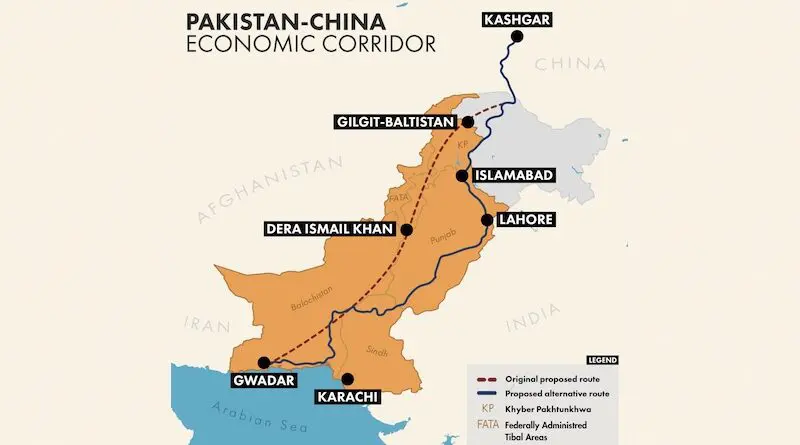
Approximate routes for the China Pakistan Economic Corridor (CPEC). This map is for illustrative purposes only. Credit: RFE/RL
When CPEC first started making headlines, the story was all about big things: motorways cutting across mountains, power plants lighting up cities, ports promising to turn Pakistan into a trade hub. Those projects mattered, no doubt, but they often felt distant to ordinary people. You couldn’t always see how a new highway in Balochistan or another coal plant would change life for a farmer in Punjab or a student in Karachi.
That’s why these new agreements between Pakistan and China caught my attention. Agriculture, education, green growth, these aren’t flashy subjects that make for glossy brochures, but they’re exactly the areas that hit closest to home. The Pakistan-China Joint Chamber of Commerce and Industry is calling them transformative, and while that word gets overused, I think they might be onto something.
Start with farming. Pakistan still depends heavily on agriculture, yet much of our system runs on outdated canals and guesswork. Farmers waste water, yields stay low, and we end up importing food we should be able to grow ourselves. If Chinese expertise can modernize irrigation and bring in smart farming tech, the potential is huge. Imagine higher yields, better food security, and rural communities tapping into food processing or packaging industries. That could create jobs where they’re most needed.
The big question is who benefits. If new technologies only end up in the hands of wealthy landowners, then we’ve just widened the rural gap. For these changes to matter, small farmers need access—credit, training, cooperatives. Otherwise, it’s the same old story, just with fancier machinery.
Education feels even more urgent. We love to talk about Pakistan’s youth bulge as some kind of golden ticket, but the truth is more complicated. A young population without skills is not a strength; it’s a risk. Scholarships, joint degree programs, and vocational training could change that equation. The idea of expanding IT education and technical skills through Chinese partnerships is especially promising, because that’s where the global economy is headed.
What I’d like to see is a real focus on vocational training, not just a handful of scholarships for elite families. Coding bootcamps, manufacturing skills, agricultural training, things that touch the lives of thousands, not dozens. If our youth are equipped for modern industries, that’s when the so-called bulge becomes an asset.
Then there’s the green development agreement. Pakistan doesn’t treat climate change like the emergency it is, even though we’re among the countries most vulnerable to it. Floods, droughts, smog, we’re living through the consequences already. If China can help us adopt sustainable technologies, invest in green energy, or improve urban air quality, that’s not just a nice-to-have. It’s survival.
I don’t think anyone expects these agreements to fix Pakistan’s economy overnight. MoUs are easy to sign and often vanish into thin air once the news cycle moves on. Our history is full of ribbon-cuttings that never lived up to the promises. The PCJCCI says it’ll help push these through, and that’s reassuring, but the real work begins after the cameras go away.
Still, the symbolism matters. These MoUs mark a shift in how CPEC is being shaped. It’s no longer only about pouring concrete and building power lines. It’s about skills, livelihoods, and sustainability. For once, the average Pakistani can look at CPEC and think this might touch my life. Better crops, better job training, cleaner air. That’s the kind of development people notice.
There’s also something interesting about China’s strategy here. They’ve realized that hard infrastructure doesn’t automatically buy goodwill. People-to-people ties, education, and sustainable projects create softer, longer-lasting influence. That’s smart geopolitics, but it’s also good for us, if we know how to use it.
The real test is going to be implementation. Do farmers get access to smart irrigation? Do vocational centres really expand across the country? Does green development go beyond pilot projects and scale? If the answer is yes, then these agreements could genuinely reshape Pakistan’s development path. If not, they’ll just be another line in a long list of “transformative” deals that transformed very little.
I’d like to believe this marks a turning point. It feels different this time, less about grand symbols and more about practical change. Whether that optimism is justified, only time will tell. But at least, for once, the conversation around CPEC is shifting away from machinery and megawatts and closer to where it should have been all along: the people.
Dr. Hamza Khan has a Ph.D. in International Relations, and focuses on contemporary issues related to Europe and is based in London, UK.

No comments:
Post a Comment