PHILIPPINES
It’s Not ‘Climate Change’ After All, It’s Corruption – OpEd
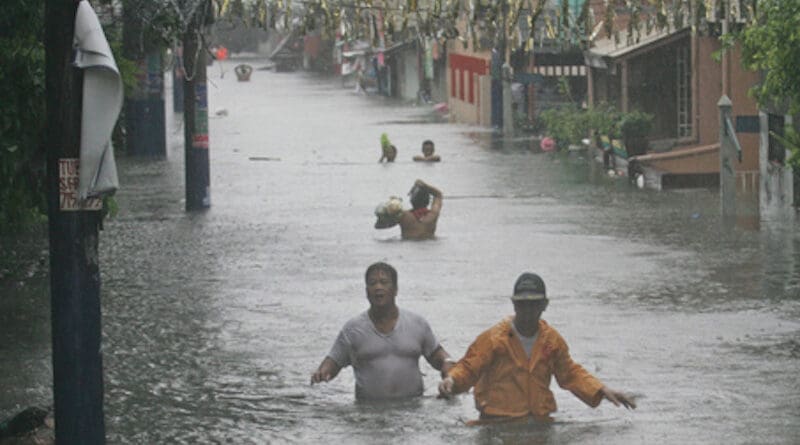
File photo of flooding in the Philippines. Photo Credit: Marconarajos, Wikipedia Commons
When the country was hit by southwest monsoon during July 2025 and subsequently intensified by tropical typhoons Wipha (named locally as Crising), Francisco (Dante), and Co-may (Emong), leading to massive flooding, loss of lives, and destruction of infrastructures, peoples’ livelihood, and properties in the Philippines, President Marcos Jr. declared this environmental phenomenon as the “new normal.” He stated that people should adapt themselves to more frequent and intense storms due to climate change. This involves accelerating disaster mitigation efforts, improving response and recovery by pre-positioning aid, mapping community vulnerabilities to specific hazards, and implementing long-term solutions like flood control.
While it is true that climate change, particularly global warming and rising temperatures, means typhoons are becoming more powerful, increasing the risk of both inland flooding and dangerous storm surges along the coasts, the Philippines is exceptionally vulnerable and highly prone to flash floods and prolonged heavy downpours. Considering that the country is located along the typhoon belt in the Pacific, it is visited by an average of 20 typhoons every year, with around 5 are expected to be destructive and powerful. However, the weather is not the sole reason. Notably, disasters caused by flooding are often fundamentally linked to governance failures.
Scale of corruption
In the same month of July, Marcos Jr. acknowledged in his fourth State of the Nation Address (SONA) that wanton corruption in the government’s flood control infrastructure projects and flawed management of its program rather than climate change was primarily responsible for the devastating flooding that severely impacted millions of people across multiple regions. In spite of government’s spending almost PHP 2 trillion on disaster risk reduction from 2015 to 2022, yet people and communities remain defenseless from floods.
The scale of corruption is huge. Diverting public funds into the pockets of government officials, legislators and top bureaucrats, as well as business individuals, primarily contractors. Billions of pesos earmarked for protection are systematically siphoned away from public infrastructures to private hands, making the nation’s physical vulnerability a direct consequence of its political and ethical corruption.
Initial investigations by the Philippine Senate (PS) Committee on Accountability of Public Officers and Investigations (popularly known as the Blue Ribbon Committee) tasked to investigate alleged wrongdoings of the government, its officials, and its attached agencies, to draft a new legislation or amend an existing law, disclosed that as much as P 1.089 trillion (almost USD 20 billion) of the government’s climate-tagged expenditures could have potentially been lost to corruption since 2023, including P 560 billion (almost USD 10 billion) in early September 2025 alone.
Moreover, testimonies of “resource persons” in the Senate suggest that kickbacksof 20-25% were common, leaving only 30-40% of the project’s budget for actual construction. In addition, allegations were made that “ghost” (non-existent) projects were fully paid by the government implementing agency (Department of Public Works and Highways [DPWH]) to private business contractors, and substandard construction was done using cheaper materials to cover up for kickbacks remitted either to contractors or DPWH officials; national government budgets are manipulated and re-aligned to benefit public officials’ infrastructure projects, bids and rewards are rigged, and contractors’ license are rented out to DPWH’s corrupt officials. Systemic corruption is in operation for several decades as a network of conspiring lawmakers, top bureaucrats (some at the level of cabinet secretaries), officials of constitutional bodies, and construction business enterprises with impunity — not simply an alliance of unholy trinity but alliance of unholy quartet!
Entrusted by the people to safeguard their taxes, the so-called public servants have plundered public funds. People and communities were left on their own to address government’s negligence and man-made failures that turned heavy rains into catastrophic disasters. Beneath the surface of the climate narrative lies a deep-rooted system of corruption that directly cripples the nation’s ability to manage floods. This corruption does not just steal money; it steals security, resilience, and peoples’ future, creating a vicious cycle that worsens the nation’s vulnerability. The ultimate failure is one of accountability. If those who hold the gavel are themselves the culprits, where can citizens turn for justice?
The theft of climate funds represents a profound betrayal. Every peso lost to corruption is a peso not spent on building resilient communities. The ostentatious displays of wealth by the families of contractors — the so-called “nepo babies” (which highlights a systemic issue where privilege, rather than merit, determines success) — flaunting dozens of luxury cars and designer shopping sprees, have ignited public fury. This stark contrast, against the backdrop of teachers and school children needing to paddle boats, cross hanging bridges, through floodwaters to reach schools or hospitals, has fueled mass protests and a deep-seated anger that is reshaping the political landscape.
Competing political consequences
The scandal has triggered prominent political consequences, including a change in leadership in both the Senate and the House of Representatives (HoR). but lasting justice requires more than political theatrics; it demands a fundamental restructuring of institutions to ensure transparency and punish corruption. Although the outrage led to mass public protests in Manila and in major regional centers of the country on 21, 2025 (53rd commemoration of the declaration of martial law in the Philippines by the late President Ferdinand Marcos Sr.), protesters were still divided between partisan interests- – supporting Marcos Jr. on one hand, and current Vice-President Sarah Duterte (daughter of former President Rodrigo Duterte, now detained at The Hague’s International Criminal Court).
The continuing partition of anti-corruption campaigns between opposing political forces has divided the people to the advantage of corrupt government officials who persist in exploiting the disunity of the polity to conceal the ultimate culprit in peoples’ disastrous predicament. The rivalry has led to the anti-corruption drive being used as a strategic weapon, with accountability applied selectively based on political alignment. Evidently, the political struggle between the Marcos and Duterte camps has channelled this anger toward specific factions. Given the limitation of space, this issue is subject to another review.
In conclusion, while the climate crisis provides the storm clouds, it is the corruption on the ground that ensures the floodwaters rise unimpeded. Redirecting public focus toward the systemic graft that plunders disaster funds is not just a matter of fiscal responsibility—it is a fundamental requirement for national survival.
- 1. Illicit payment made to someone in return for facilitating a transaction or appointment.

Rizal G. Buendia
Rizal G. Buendia, PhD, is an independent consultant and researcher in Southeast Asian Politics based in Wales and England, UK. Currently Philippine country expert of the Global V-Dem Institute, University of Gothenburg, Sweden; Non-Resident Fellow of Stratbase ADR Institute for Strategic and International Studies (ADRi); Honorary Fellow of the Bangsamoro Parliament’s Policy Research and Legal Services of the Bangsamoro Autonomous Region of Muslim Mindanao (BARMM); Former Teaching Fellow in Security and Southeast Asian Politics and Governance at the Department of Political Science and International Relations and the Department of Development, School of Oriental and African Studies (SOAS), University of London, and former Chair and Associate Professor, Political Science Department, De La Salle University-Manila, Philippines.

No comments:
Post a Comment