Op-Ed: US Navy's Networks Aren't Ready for a Contested Comms Environment
Recent acquisitions have focused on bandwidth-heavy, compute-intensive, headquarters-focused systems that are doomed to fail in contested communication environments
[By Nicholas A. Kristof]
In his remarks at his assumption of office ceremony, Admiral Caudle stated that, “Great power competition is sharpening, threats and capabilities are proliferating, technological disruption is accelerating, the maritime domain is increasingly contested and the margin for error is shrinking. To prevail in this environment, we must build and sustain a Navy that is resilient, agile, globally present, and credible in combat.”
To accomplish this, the Navy must ruthlessly pursue two seemingly disparate capabilities – technical interoperability and the capability to operate in contested communications environments. The need for interoperability in naval operations has never been more critical. However, these operations will increasingly be forced to occur in contested communication environments, where data access and connectivity cannot be guaranteed. Balancing these two imperatives—interoperability and resilience in contested conditions—will be vital to successful maritime operations.
Interoperability enables coalition and joint forces to share information, coordinate actions, and execute missions with speed and precision. In a security environment where no single nation can address threats alone, it allows navies from different countries to communicate and share situational awareness and use common data standards and communication protocols. It also allows forces to integrate sensors and weapons systems for combined lethality and efficiency. Naval operations today—conducted with NATO partners, regional partnerships, or ad-hoc coalitions—depend on interoperability for command and control, intelligence sharing, and battle management.
Despite advances in networking and communications, contested conditions remain a harsh reality. Adversaries will employ electronic warfare, cyberattacks, and other anti-access/area denial (A2/AD) strategies to disrupt communications and links. Operating effectively in these conditions requires resilient systems that degrade gracefully, continue core functions autonomously, and then reconstitute automatically. It also requires bandwidth efficient communications protocols that send only the minimum number of bits required to accomplish the mission. Forces also need data prioritization and edge processing, enabling platforms to process and act on information locally when disconnected from the network.
Systems that possess these capabilities exist today. But these principles have not served as first-order design considerations for many systems, and the Navy acquisition enterprise is not well-organized to test novel solutions from industry.
The challenge is to design and field systems that support improved interoperability yet can still remain effective in communications-degraded environments. This demands modular, open architectures that allow systems to plug and play across nations while still functioning independently when disconnected. It also requires distributed C2 models to ensure that no single point of failure can collapse operational effectiveness. Zero-trust cybersecurity frameworks will help maintain data integrity even when network control is lost.
Despite “interoperability” being a buzzword for years, the Navy and Marine Corps team, and the wider Joint force, has been extremely slow to improve. Stovepiped acquisitions, lip service instead of ruthless prioritization, and institutional inertia all stand in the way of much-needed change. Worse still, recent acquisitions have focused on bandwidth-heavy, compute-intensive, headquarters-focused systems that are doomed to fail in contested communication environments and leave commanders blind and unable to communicate with their forces. In some of these cases, Navy leadership has been won over by fancy and buzzworthy pitches for capabilities that do not actually operate as marketed.
Admiral Caudle must provide forceful and clear direction to the naval acquisition enterprise that he ultimately oversees. That enterprise must prioritize systems that maximize interoperability when conditions permit, and the ability to operate alone and unafraid when necessary.
Nicholas A. Kristof is a 1996 graduate of the United States Naval Academy and a retired submarine officer. The views expressed are the author’s own and do not necessarily reflect the official views of any organization with which he is affiliated.
This article appears courtesy of CIMSEC and may be found in its original form here.
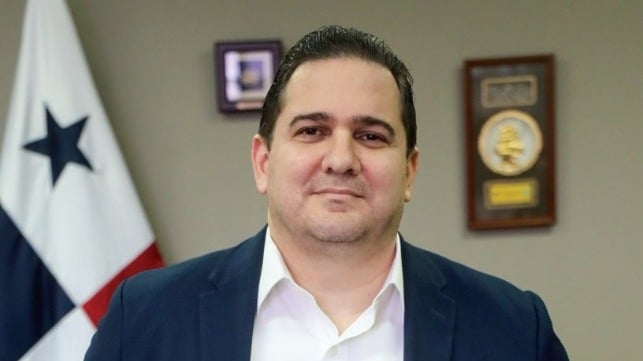
Interview: Ramon Franco, General Director, Panama Ship Registry
New leadership at the Panama Ship Registry, the world’s largest by number of vessels, has dramatically improved compliance, purged sanctioned vessels and improved its image.
(Article originally published in July/Aug 2025 edition.)
Born and raised in Panama, Franco comes from a family of lawyers – mainly maritime lawyers. After earning a degree in Law and Political Science in Panama, he went to Madrid for a Master's degree in Maritime Law and Business. He then returned to Panama and joined the law firm founded by his grandfather. "I was destined to be a lawyer even before I was born, maybe," he quips, "because of my background."
Franco soon distinguished himself in the private sector and was named to the technical panel established by the Panama Maritime Authority for the reform of the General Merchant Marine Law of 2008. He was further involved in the development of the APADEMAR Maritime Society Project and in the preparation of the Executive Decree that organizes and regulates the operations of the General Directorate of the Public Registry of Ship Ownership. He also served on the Organizing Committee of the Panama Maritime Conference and Exhibition.
In recognition of his achievements, he was elected President of the Panamanian Maritime Law Association (APADEMAR) for two consecutive terms (2022-23 & 2023-24). On July 1, 2024, the newly elected President of Panama, José Mulino, appointed him General Director of the Merchant Marine of the Panama Maritime Authority, the entity responsible for the Panama Ship Registry, the world's largest with approximately 15% of the global fleet.
After a year on the job, Franco says he's "living his dream." He's also remaking the registry into not just the biggest but also the best by purging substandard vessels, transforming the organization and reinforcing compliance.
WELCOME, RAMÓN, THANK YOU FOR JOINING US. WE'RE HONORED TO HAVE YOU ON OUR COVER. LET'S START WITH THE PANAMA MARITIME AUTHORITY AND HOW IT'S ORGANIZED.
Yes, thank you. The Panama Maritime Authority is the government entity in charge of supervising the maritime sector in Panama. There are four different Directorates – Ports, Seafarers, Public Registry and Merchant Marine. Merchant Marine is the one I head, and it's basically the Panama Ship Registry. In this sense, the Director General of the Merchant Marine is the head of the Panama Ship Registry.
IS IT DIFFERENT FROM THE PANAMA CANAL AUTHORITY?
Yes. Completely different and separate. We are both Panamanian government entities, and we share the same goals of promoting the development of the maritime industry, encouraging investment and innovation in the sector and strengthening Panama's position as a global logistics hub. But we are both physically and organizationally separate.
TELL US MORE ABOUT THE REGISTRY.
Yes. The Panama Maritime Authority through the General Director of Merchant Marine operates and manages the Panama Ship Registry, which has two main components. One is the regulatory or compliance component through which the registry complies with IMO regulations – SOLAS, pollution prevention, environmental restrictions and so forth. The other is the commercial component through which we offer incentives to attract shipowners to the Panamanian flag.
WHAT ARE SOME OF THE INCENTIVES? WHY CHOOSE THE PANAMANIAN FLAG?
Well, the question actually is, "Why NOT choose Panama?" At the Panama registry, you have a whole state supporting your vessel and the registry, not a company or an authority. The registry of a vessel and registration of the vessel's mortgage or financing is backed by the Republic of Panama. That makes the registration strong and secure because you have the whole infrastructure of a country behind that registry.
Another big advantage is our wide international consular network. We have 53 consulates, which are basically commercial offices around the world. We have 22 technical offices providing services to shipowning companies and vessels worldwide on a 24/7 basis as well as a network of highly trained maritime lawyers. We have a network of a inspectors worldwide and are signatories of the main IMO conventions. So that makes our quality standards very high. In addition, we provide specialized incentive programs for individual companies' needs. It's personalized attention, and it gives our clients access to an international service catalog that Panama can offer not only for the ship but the company as well. If the company wants to establish in Panama or have a branch in Panama, it gives access to the whole international service platform that Panama as a Republic has to offer.
Impressive. Can you give us a little history of the Registry, how it evolved over the years?
Certainly. It didn't start as we know it today, and it started over 100 years ago in 1917 as the International Ship Registry of Panama. Then in 1925 the Panamanian Merchant Marine was created as an open registry without restrictions as to the nationality or residency of vessel owners. And it operated until 1980, when it came under the department of Consular and Maritime Affairs.
Then, because of the importance of the registry to the Panamanian and world economies – and because it had become the number one registry in the world by 1993 – it was elevated to a ministry. That was in 1998 when it became part of the Panama Maritime Authority, which also houses the three other Directorates mentioned earlier.
In 2008, the first official General Merchant Marine Law was issued, and that's a little bit of the history of the registry.
EXCELLENT! WHAT'S THE FOCUS OF THE REGISTRY TODAY?
We're focused on three different areas.
One is the organizational transformation. We made adjustments in some departments to bring them more in line with their functions. We've given more responsibilities to our international service officers. We are in the process of making some changes.
We're improving the customer experience, making it easier and more transparent – 24/7 access, online applications and forms, more electronic books. We're in the process of reforming the Merchant Marine Law of 2008 in order to be more effective and simplify processes, and we're consulting with major industry players in doing so. We also have a very aggressive strategy for getting into new markets and attracting new tonnage.
The third area is purging sanctioned vessels and maintaining a reliable and safe fleet. Basically, we're strengthening our quality management system. We're deleting vessels that are substandard or sanctioned. We're improving our fleet performance.
GREAT. IS THE REGISTRY ON THE WHITE LIST OF THE PARIS AND TOKYO MOUs?
We are on the White List of the Tokyo MOU but not the Paris MOU. We are on the Gray List there. But we're determined to get back on the Paris White List and that is one of my primary goals. We have a very high global compliance level of over 95 percent and, as noted earlier, we are busy purging the fleet of unwanted, underperforming vessels. We have a strategy in place to return to the Paris White List, and you will see us there soon.
THAT MUST BE A REAL CHALLENGE – MAINTAINING QUALITY STANDARDS WHEN YOU'RE THE BIGGEST REGISTRY IN THE WORLD.
Well, it is. But with a new administration in the Republic of Panama under President José Mulino, we have a special moment in time, an opportunity to change the emphasis.
Under this new administration, the vision that we have for the registry is to focus on the quality more than on the quantity that we are flagging. We're focusing on compliance with international regulations and on strengthening our operational and safety procedures.
For medium and high-risk vessels that are registered in the Panamanian merchant marine fleet, we are requiring additional inspections, additional surveys and additional verification of the ship's management systems. We give them six months to get their compliance level up to an acceptable level. Otherwise, they have to change flags.
WHAT IS YOUR ROLE AS GENERAL DIRECTOR?
I have a very broad range of functions overseeing the technical, legal, commercial, compliance and promotional areas. So I do a little bit of everything – kind of like a handyman. But of course I have a great team here in the Directorate of Merchant Marine to work with, so I must be a team player who knows how to work with his team.
For me, the main asset of the Panama Registry is the human talent we have here, and the first rule of leadership is that I do not ask them to do anything that I myself am not willing to do. So we have to take it up a notch and go the extra mile. I have to be the first one in and the last one out. Leadership is very important, but teamwork is crucial.
IS WORKING IN THE PUBLIC SECTOR DIFFERENT FROM THE PRIVATE SECTOR?
Yes! To come from the private sector to a public office is a whole different ball game. It's like you're playing soccer and now you're playing basketball because things are different. But we try to complement each other. I bring a private sector mentality and learn from the public sector way of thinking and doing things, and that makes for a very good complementary relationship.
I'm fortunate to have a very talented and professional team here at the Registry, and that is key. I've worked in the private sector on maritime authority cases for more than 20 years now, and to have the opportunity to work with staff in the Panama Maritime Authority that have been working the same or more years than me is very fulfilling.
WHAT DO YOU LIKE MOST ABOUT YOUR JOB?
You never get bored. There's always something new happening – a new situation or a new challenge. So it's very rewarding to come here every day to work with my team. I'm also very thankful to the President for appointing me and giving me the opportunity to work for my country and my industry – to give back to those who have given me so much.
My father did it before me, and my grandfather before that. So you can say I was born into the shipping legal world and now have the opportunity to give back. For a maritime lawyer who grew up in Panama, the opportunity to be in charge of the number-one ship registry in the world is a dream come true. I am, literally, living my dream.
The opinions expressed herein are the author's and not necessarily those of The Maritime Executive.
ABS Approves HD KSOE Design of an Ammonia Vent Gas Treatment System
[By: ABS]
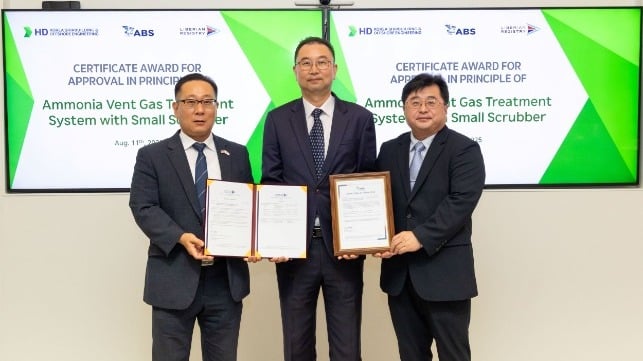
An advanced design of an ammonia vent treatment system from HD Korea Shipbuilding & Offshore Engineering (HD KSOE) received approval in principle (AIP) from ABS and the Liberian International Ship and Corporate Registry (LISCR).
The ammonia vent treatment system integrates compact scrubbers to treat ammonia fuel, which can escape during the purging process, to maintain safe concentration levels before discharge through the vent mast. HD KSOE says this design also minimizes wastewater production. ABS completed design reviews based on class requirements and IMO Interim Guidance.
“With our deep insight into the safety aspects of ammonia and advanced treatment technologies, we are supporting innovative clients like HD KSOE in developing equipment to accelerate the maritime industry’s journey to low or no carbon emissions,” said Patrick Ryan, ABS Senior Vice President and Chief Technology Officer.
“This certification from ABS strengthens HD KSOE's technology portfolio for eco-friendly equipment,” said Young-Joon Nam, head of the SD Business Division at HD KSOE. “We will continue to develop unique technologies and lead the global market for eco-friendly ships.”
ABS provides industry-leading guidance on the application of ammonia as a marine fuel. Download a copy of the latest ABS publication Safety Insights for Ammonia as a Marine Fuel here.
The products and services herein described in this press release are not endorsed by The Maritime Executive
Autonomous Vessel Navigation System Verified by ABS
[By: ABS]
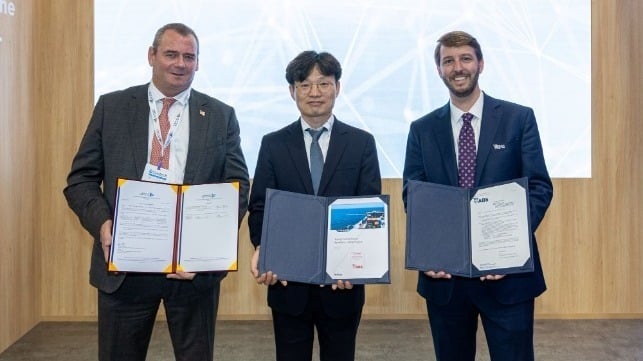
ABS awarded a statement of compliance certificate to AVIKUS Co., Ltd., for the fuel-saving verification framework that AVIKUS has developed for HiNAS Control, an autonomous navigation system.
ABS joined AVIKUS, shipping company HMM Co., Ltd., and the Liberian International Ship and Corporate Registry in a project to assess the fuel-saving potential of the navigation system by analyzing ship performance data from vessels with HiNAS Control installed. A verification framework was developed by AVIKUS to predict potential fuel savings in general vessel operations. ABS reviewed the framework based on existing international standards.
The HiNAS Control system provides vessels with suggested optimal route and speed data and also automatically controls steering and RPMs that enable route tracking, collision avoidance and fuel savings. ABS reviewed the installation of the system based on ABS Requirements for Autonomous and Remote-Control Functions.
“Autonomous technologies are not isolated products but fully integrated within vessel infrastructure and the result of numerous advancements in a wide variety of mechanisms including sensors, imaging, connectivity, machine learning and more. When used in vessel operations, autonomous functions have the potential to increase safety, reduce greenhouse gas emissions and improve performance,” said Joshua Divin, ABS Senior Vice President, Marine Business Development.
“Securing ABS verification is a critical milestone, but it is more than a certificate—it is data-driven proof that AI-powered autonomy is a powerful lever for decarbonization and operational efficiency for the industry. A 4 to 5 percent fuel savings is not an incremental improvement; for a global fleet, it represents a fundamental shift in profitability and environmental compliance. We are proud to partner with industry leaders like HMM, ABS, and the Liberian Registry to commercialize this transformative capability and define the future of maritime logistics,” said Dohyeong Lim, CEO of AVIKUS.
“At HMM, our operational philosophy is clear: strengthening our core competitiveness is the foundation of customer trust. The adoption of advanced autonomous technology is a strategic imperative, not an option, and is part of the transformation and innovation required to become a global top-tier shipping company. This joint initiative with AVIKUS provides a tangible tool to enhance service reliability and profitability, which reinforces our market position and accelerates our commitment to a sustainable, decarbonized future,” said Wonhyok Choi, CEO of HMM.
“The Liberian Registry is proud to support this impactful joint initiative between AVIKUS, HMM, ABS, and our Administration. By issuing a Factual Statement for the HiNAS voyage optimization system, we affirm its alignment with international standards for energy savings verification and congratulate the stakeholders on the successful outcome. This collaboration underscores our commitment to maritime innovation, improved vessel efficiency, and meaningful contributions to industry decarbonization,” said Thomas Klenum, Executive Vice President, Innovation & Regulatory Affairs, Liberian Registry.
The ABS Intelligent Systems Technology Center in Korea provides guidance in autonomous and remote operations as well as SMART Technologies. Learn more about ABS services related to these technologies here.
The products and services herein described in this press release are not endorsed by The Maritime Executive.

No comments:
Post a Comment