Urenco doubles expansion plans for uranium enrichment in the Netherlands
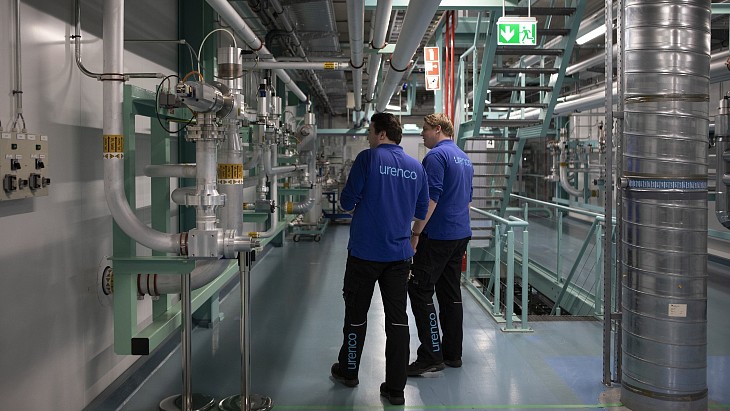
The first stage of expansion at Almelo, of about 750,000 separative work units (SWU), was announced in 2023 and is scheduled to come online in 2027. That will increase the site's capacity by about 15%. The company is now planning a second stage, to build an additional centrifuge hall providing a similar amount of extra capacity, so in total providing 1.5 million SWU of extra capacity by 2030.
Ad Louter, Managing Director of Urenco Almelo, said: "This project is the largest buildout of new enrichment capacity undertaken so far as part of the company's capacity expansion programme and ensures that we can offer security of supply to global customers, while providing stable and long-term employment opportunities in our region.
"We are encouraged by the actions of both utilities and governments to support the nuclear industry and the fuel supply chain specifically. We will evaluate other expansions as supported by long-term contracts. Stable government policy is also critical and a positive development in the EU has been the intention to phase out Russian nuclear material through the REPowerEU plan."
The announcement means Urenco has globally now committed to 2.5 million SWU of new enrichment capacity, including the first two centrifuge cascades now online in Eunice, New Mexico in the USA. At its site in Gronau, Germany, the company is re-fitting an existing space with more modern centrifuge technology which will enhance the capacity of the plant.
In addition to the Almelo, Eunice and Gronau plants, Urenco also operates an enrichment facility at Capenhurst in the UK.
The nuclear fuel cycle
Unenriched, or natural, uranium contains about 0.7% of the fissile uranium-235 (U-235) isotope. ("Fissile" means it's capable of undergoing the fission process by which energy is produced in a nuclear reactor). The rest is the non-fissile uranium-238 isotope. Most nuclear reactors need fuel containing between 3.5% and 5% U-235. This is also known as low-enriched uranium, or LEU. Advanced reactor designs that are now being developed - and many small modular reactors - will require higher enrichments still. This material, containing between 5% and 20% U-235 - is known as high-assay low-enriched uranium, or HALEU. And some reactors - for example the Canadian-designed Candu - use natural uranium as their fuel and don’t require enrichment services. But more of that later.
Enrichment increases the concentration of the fissile isotope by passing the gaseous UF6 (uranium hexafluoride) through gas centrifuges, in which a fast spinning rotor inside a vacuum casing makes use of the very slight difference in mass between the fissile and non-fissile isotopes to separate them. As the rotor spins, the concentration of molecules containing heavier, non-fissile, isotopes near the outer wall of the cylinder increases, with a corresponding increase in the concentration of molecules containing the lighter U-235 isotope towards the centre.
Enriched uranium is then reconverted from the fluoride to the oxide - a powder - for fabrication into nuclear fuel assemblies.
World Nuclear Association’s information paper on uranium enrichment contains more details about the enrichment process and technology.
Netherlands aims to extend operation of Borssele plant
_78957.jpg)
The 485 MWe (net) pressurised water reactor at Borssele - operated by EPZ - has been in operation since 1973 and accounts for about 3% of the country's total electricity generation. It is scheduled to close in 2033, but the government has requested it remain in operation until 2054, if this can be done safely. The government has said it will consider acquiring a stake in the Borssele plant should a decision be made to extend its operation beyond 2033.
"The amendment to the law is an important step towards keeping the nuclear power plant operational longer," the government said. "If the amendment is adopted, Borssele's operator can apply to the independent regulator ANVS to keep the nuclear power plant operating beyond 2033. This will allow the Netherlands to continue consuming CO2-free energy for a longer period. The extension aligns with the government's policy of not relying solely on green energy sources, such as offshore wind or solar panels, but also fully committing to CO2-free and reliable nuclear energy. This will ensure our country can keep running, even when the sun doesn't shine and the wind doesn't blow."
In December 2021, the Netherlands' new coalition government placed nuclear power at the heart of its climate and energy policy. In addition to keeping the Borssele plant in operation for longer, the government also called for the construction of new reactors. Based on preliminary plans, two new reactors will be completed around 2035 and each will have a capacity of 1000-1650 MWe. The two reactors would provide 9-13% of the country's electricity production in 2035. The cabinet announced in December 2022 that it currently sees Borssele as the most suitable location for the construction of the new reactors. Three other locations are also being considered for the reactors: the Tweede Maasvlakte near Rotterdam, Terneuzen in Zeeland and Eemshaven in Groningen.
The government will establish a new state-owned company - the Nuclear Energy Organisation of the Netherlands (NEO NL) - for this purpose, Minister of Environment and Green Growth Sophie Hermans informed the House of Representatives. "This company will contract with the builder and will also operate the new plants. NEO NL will take the form of a 'policy participation', with the Ministry of Climate and Green Growth as the sole shareholder. At least EUR45 million (USD52 million) is available for its establishment," she said.
The government is also taking steps to prepare the Netherlands for the possible deployment of small modular reactors (SMRs). It said it is allocating EUR20 million "to stimulate developments in the Netherlands".
"In Europe, the United Kingdom is one of the frontrunners in this field," it said. "The Netherlands and the UK have therefore joined forces and signed a cooperation agreement in July 2025, allowing the Netherlands to learn from the British."
"Our country cannot survive without nuclear energy," Hermans said. "With the proposed establishment of NEO NL and the continued operation of Borssele, we are now taking a historic step towards a future with reliable nuclear energy. I hope that the next cabinet will continue on the path we have embarked on with the same energy and dedication."
Outer containment work under way for Leningrad's seventh unit
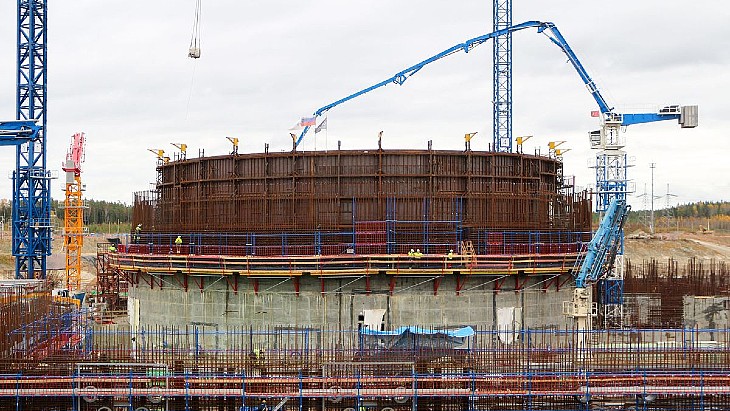
The new phase of the plant - known as Leningrad II - features two VVER-1200 units, commissioned in 2018 and 2021 respectively, with a third and fourth new unit currently under construction. Together, they will replace the four RBMK-1000 units from the original 1970s phase of the Leningrad nuclear power plant.
The outer containment work involves successively constructing and erecting tiers of a reinforced steel 'cage' which will then be filled with concrete. When complete, it will be 70 metres high, 52 metres in diameter and 80 centimetres thick.
Containment buildings for nuclear power units are safety features, with the VVER-1200 involving an internal and an outer containment building as part of a double containment protection system - with the outer containment designed to provide extra protection from external hazards such as earthquakes and aircraft crashes.
Leningrad NPP-2's Evgeny Milushkin, said: "The outer containment shell will be constructed in tiers. We plan to have the first one ready as early as November. The structure, approximately four metres high, will require over 200 tonnes of steel reinforcement and nearly 600 cubic metres of concrete. Early next year, the shell will grow another four metres. The entire outer containment shell will be ready in 2028."
Construction of the inner containment is taking place at the same time as the outer containment. The lower tier of the inner containment building - with a 44-metre diameter, measuring 10 metres high and weighing 227 tonnes - was lowered into place last month. Work is also taking place on the reactor building and core catcher.
Rosatom says there are more than 1,000 people involved in the construction of the unit and the fourth new unit. The new units are scheduled to be commissioned in 2030 and 2032.
Background
The Leningrad nuclear power plant is one of the largest in Russia, with an installed capacity of 4,400 MWe, and provides more than 55% of the electricity demand of St Petersburg and the Leningrad region, or 30% of all the electricity in northwest Russia.
Leningrad 1 shut down in 2018 after 45 years of operation. Leningrad 2, also a 1,000 MWe RBMK unit, started up in 1975 and was permanently shut down in November 2020. As the first two of the plant's four RBMK-1000 units shut down, new VVER-1200 units started up at the neighbouring Leningrad II plant. The 60-year service life of these fifth and sixth units (also known as Leningrad II-1 and Leningrad II-2) secures power supply until the 2080s. Units 7 and 8 (also known as Leningrad II-3 and Leningrad II-4) will replace units 3 and 4 as they are shut in the coming years.
The pouring of the first concrete for unit 7 in March 2024 marked the start of the main phase of construction of the new power unit, which is expected to generate power for 60 years, with the possibility of a 20-year extension.

No comments:
Post a Comment