Left Foot Forward
"We remembered people with love, care and compassion."
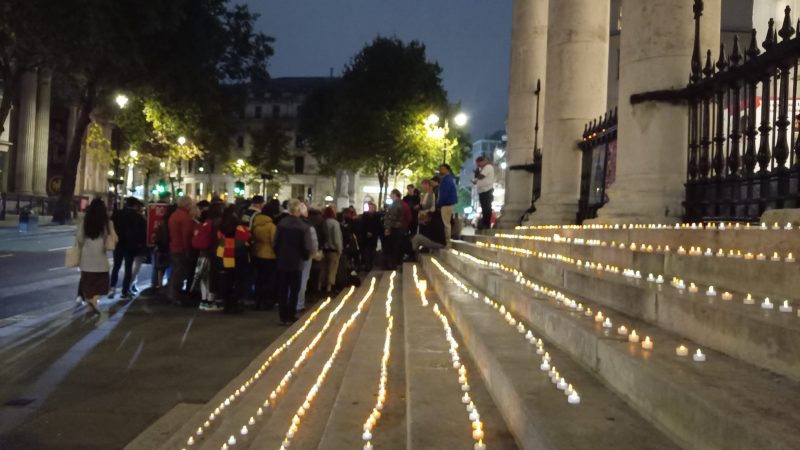
On October 9, the Museum of Homelessness (MoH) held a national vigil on the steps of St Martin-in-the-Fields, Trafalgar Square, to honour the lives of those who died while homeless in 2024. During the ceremony, the names of all those who had passed away were read aloud.
According to new research from the MoH’s Dying Homeless Project, 1,611 people died while homeless in the UK in 2024, an increase of 9 percent from the previous year. This equates to an average of four deaths per day.
The report highlights a rise in ‘deaths of despair,’ with a growing number of deaths by suicide and drug-related causes. The MoH points to increasing issues with dangerous psychoactive substances such as spice and synthetic opioids. Drugs and alcohol were involved in 44 percent of all recorded deaths.
The Dying Homeless Project, which the MoH has run since 2019, found that a growing number of people are dying in insecure housing situations. Of the cases where accommodation status was known, 49 percent of deaths occurred in temporary accommodation, such as hostels or hotels, and 18 percent in supported housing.
The research also uncovered that at least eleven children died while experiencing homelessness in 2024, though the MoH believes this is an undercount.
“We know from the project that many temporary accommodation placements are unfit for children,” the MoJ states.
Founded in 2015, the Museum of Homelessness is led by people with lived experience of homelessness. It combines independent research, campaigning, and collaborations with artists and creatives to challenge injustice and raise public awareness.
The campaigners are calling on the government to get a grip of the homelessness crisis and to do more to prevent such tragic deaths.
Talking to Left Foot Forward about the vigil this week, Matt Turtle, founder and co-director of Museum of Homelessness, said:
“We remembered people with love, care and compassion including people like Steve Broe who helped us develop our bricks and mortar site that the museum runs in Finsbury Park before we opened last year. Steve was a legendary busker and community organiser whose wisdoms inspired us and continue to inspire us today. His memory reminds us of the full, complex and wonderful lives that are all too often lost too soon. We hold him and all those names in our heart as we grieve for those we’ve lost.”
The Museum of Homelessness has an online memorial, where over 8,500 people who have died whilst homeless since October 2017 when the count began by the Bureau of Investigative Journalism, are remembered.
Gill Taylor, strategic lead for the Dying Homeless Project, said it is with “heavy hearts” they report the deaths of so many homeless people.
“Whilst it is positive that local authorities and Safeguarding Adult Boards appear to be taking the issue more seriously, with better reporting and evidence of improved local partnership working to prevent deaths, turning the tide on this enormous loss of life needs more than better counting,” she said.
“We remember with love all those who died and continue our work in solidarity with bereaved loved ones and the homeless community.”
Image credit: 2025 Museum of Homelessness vigil at St Martin – Museum of Homelessness
“The lack of housing is such a fertile source of human misery”

How, and why, did the Labour leadership prevent a debate on council housing? Martin Wicks investigates.
For the fourth year running, housing has been kept off the agenda of the Labour Party Conference. This was no accident. The Labour leadership has sought to prevent a debate.
The main instrument for stopping resolutions which the leadership doesn’t want debated is their unofficial faction, Labour to Win. For the fourth year in a row, all the priorities which Labour to Win called on delegates to vote for, were voted through. Such is the level of cynicism of the Conference Arrangements Committee they don’t even bother to hide their factional intent. They arranged for Labour to Win’s priorities to be set up in an easily rememberable format. They were numbers 1, 3, 5, 7, 9, 11, 13 in the list of 46 issues to be voted on. Last year, with one less resolution allowed, it was 1,3,5, 7, 9 and 11. This is no accident. It shows that the CAC is a factional instrument in the hands of the leadership.
The rule on ‘contemporary resolutions’ is a second string to their bow, in trying to prevent discussion on resolutions which conflict with existing government policy. The rule states that a ‘contemporary resolution’ is one which is ‘not substantially covered’ by the National Policy Forum report. This is sufficiently elastic to mean whatever they determine it will mean. When Horsham CLP (which sent in our resolution) put in an appeal, the CAC gave no explanation of what their decision was based on. As Carol Hayton, the Horsham CLP delegate, pointed out, there was nothing in our motion that was covered in the NPF report.
Even if an issue is ‘substantially covered’, the members may disagree with the content. Do they not have the right to put in a resolution which poses an alternative?
We were not alone in having our resolution rejected – 146 CLP resolutions were deemed not to be ‘contemporary’. Only 101 were accepted onto the agenda. Last year, housing came within 11,000 votes of making it through the priorities ballot. This year, not only did the CAC rule out our resolution, but the four resolutions on housing issues, which were allowed through, were all placed in separate categories, rather than putting them together under housing.
For instance, Bury North sent in a resolution which called on the government to stop Right to Buy. It was placed in splendid isolation, under the heading Right to Buy. A resolution from Harrow South was on Accessibility in Housing, which also got its own heading. This was obviously designed to undermine the chance of them winning through on the priorities ballot. Housing would attract a much higher vote, notwithstanding the fact that Labour to Win would oppose it. This is nothing less than shameless manipulation designed to get the result that the leadership wants. The same method was also applied to other issues.
More evidence that the leadership wanted to prevent a debate on housing came with the news that the Labour Housing Group, a Labour Party affiliate, had withdrawn its resolution. As one of their officers admitted to us “the Party asked us to withdraw it”, even though it was a supine one, which placed no demands on the government.
Why does the leadership want to prevent a discussion on housing? Because it knows that the membership and affiliates will demand policies that the government does not want to concede. The last opportunities the membership had to vote on housing resolutions was in 2019 and 2021 when they overwhelmingly voted for 150,000 social rent homes a year (100,000 council homes), ending Right to Buy and more besides. But in their Social and Affordable Home Programme, the government has only committed to funding 18,000 social rent homes a year, a meagre 6% of their 300,000 target. It will be even less when you take account of Right to Buy sales and demolitions.
“Build, baby, build”
Anybody concerned with resolving the housing crisis should also be worried by Housing Secretary Steve Reed doing an embarrassing imitation of Donald Trump, with his triplet, “build baby build” – plagiarised from Trump’s “drill baby drill”. It was chanted by a throng of YIMBYs (yes in my backyard) behaving like the crowd at a Trump MAGA rally. Reed told one newspaper, “we just have to let the developers do what they do best”.
What, they do, of course, is to build at a pace and a scale which maximises their profits, often with poor quality. Ironically, he closed his speech to Conference by invoking the words of Nye Bevan when he took to Labour’s conference stage in 1945: “We have been the dreamers, we have been the sufferers, but now, we are the builders.” Yet Bevan made council housing Labour’s first housing priority and restricted the number of homes for sale to one in five (see “Lessons from the Attlee government”).
This government’s policy does not prioritise council housing. That is why they have prevented the issue being debated at conference.
With this autocratic machine in place, it’s difficult to see how housing can be placed on the agenda of future Conferences via CLP resolutions (the highest-scoring non-Labour to Win resolution, on the two-child cap, gained 57,000 votes, compared to Labour to Win’s lowest, 151,000).
Perhaps the only way it can be forced onto the agenda is via the trade union affiliates. A number of trades unions have good housing policies on paper, but they need to step forward to demand that council housing be made the government’s first housing priority. One of the key factors in the ‘cost of living crisis’ that their members face is that rent is increasingly unaffordable.
While the main focus has tended to be on the private rented sector where rents have far outstripped inflation, council and housing association rents are becoming unaffordable for some people, as well. The government has kept in place the Tory policy of above-inflation rent increases – CPI+1% – and will increase it from five to ten years! It has also maintained the Tories’ ‘affordable rent’ (up to 80% of market rent). It is also reintroducing New Labour’s ‘rent convergence’ (see “Why we oppose rent convergence”) with a probable extra £2 a week on top.
So the question of rent controls in the private sector and council and housing associations is a crucial one for unions if they want to improve their members’ financial circumstances. Equally, those members who are forced to live in the private rented sector need a largescale council house building/acquisitions programme to rescue them from the expensive and often poor quality sector.
The housing crisis will not be resolved by the large volume builders being allowed to continue their profiteering. The dash to build will ignore tenure and quality. In fact the government decided to allow the continuation of the Tories’ “Permitted Development Rights”, previously denounced by Matthew Pennycook as “adding to the quantum of poor quality/slum housing”. It allows conversion of offices or commercial properties to housing without having to apply for planning permission. This underlines their build quickly and build anything mentality.
As housing journalist Peter Apps says: “If Reed wants to understand the folly of this approach, he need only attend his own civil service briefings. It is bitterly ironic that we have a Housing Secretary who wants to charge into housebuilding at all costs when his department is barely a third of the way through cleaning up the mess made by this sort of policy in the very recent past.”
The Grenfell Inquiry concluded that a government focused on housing targets and economic growth allowed enthusiasm for deregulation “to dominate its thinking to such an extent” that matters impacting life safety were “ignored, delayed, or disregarded”.
Apps gives the example of more than 5,000 buildings with ‘life-critical’ defects identified since the Grenfell fire, only 34% of which have been fixed.
One of the lessons from the experience of the winter fuel allowance and disability benefit cuts, was that the extra-parliamentary movement, driven by those impacted by these policies, put MPs under intense pressure. That was why the government made partial retreats. We need to lobby MPs on the need for sufficient funding for Housing Revenue Accounts and at least funding for 90,000 social rent homes a year.
The gulf between the government’s commitment to 18,000 social rent homes a year and what is needed is huge. All the funding available for ‘affordable housing’ should be directed at social rent homes instead of the Tories’ ‘affordable rent’ and so-called ‘shared ownership’. Yet even that would only support 30,000 social rent properties. This is completely insufficient to provide housing for the 131,000 households in temporary accommodation and the 1.3 million households on council waiting lists.
Without a significant increase in government grant, the housing crisis will drag on, with all the desperate social consequences. The widest possible unity around these demands needs to be built in order that MPs feel the pressure of campaigning groups and those suffering the consequences of the acute housing crisis.
The government may be able to fend off debate at Conference but it cannot stop the test of its policy in the real-world results of it: councils in danger of financial collapse because of the freeze of Local Housing Allowance, resulting in the growing gulf between the cost of temporary accommodation and government funding; and the acute council housing shortage. Pressure will need to stepped up as the failure of its housing policy becomes more obvious.
In 1946, in an interview, Aneurin Bevan said: “Dissatisfaction with the government is the real dynamic of democracy, the elemental force of political action. How on earth can people be satisfied when the lack of housing is such a fertile source of human misery.”
So it is today.
Martin Wicks is Secretary of the Labour Campaign for Council Housing.

No comments:
Post a Comment