Federal Judge Sides With Journalists, Protesters in Chicago Over Violent Tactics of Trump’s Federal Agents
“Individuals are allowed to protest,” the judge said. “They are allowed to speak. That is guaranteed by the First Amendment to our Constitution, and it is a bedrock right that upholds our democracy.”
“Individuals are allowed to protest,” the judge said. “They are allowed to speak. That is guaranteed by the First Amendment to our Constitution, and it is a bedrock right that upholds our democracy.”
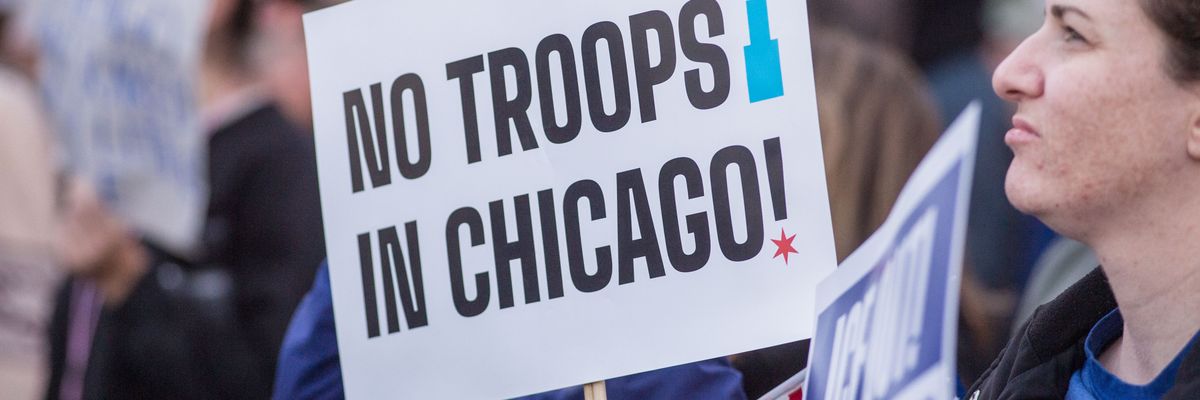
Crowds gather at Ida B. Wells Dr, & Michigan Ave. in downtown Chicago for an emergency rally, waving flags and holding signs to oppose ICE and National Guard presence in Chicago, United States on October 8, 2025.
(Photo by Jacek Boczarski/Anadolu via Getty Images)
Brad Reed
Oct 09, 2025
COMMON DREAMS
A federal judge has placed new restrictions on the use of force that federal agents can use on protesters and journalists in Chicago.
In a Thursday ruling, US District Judge Sara Ellis barred Department of Homeland Security officials from using riot control weapons “on members of the press, protestors, or religious practitioners who are not posing an immediate threat to the safety of a law enforcement officer or others.”
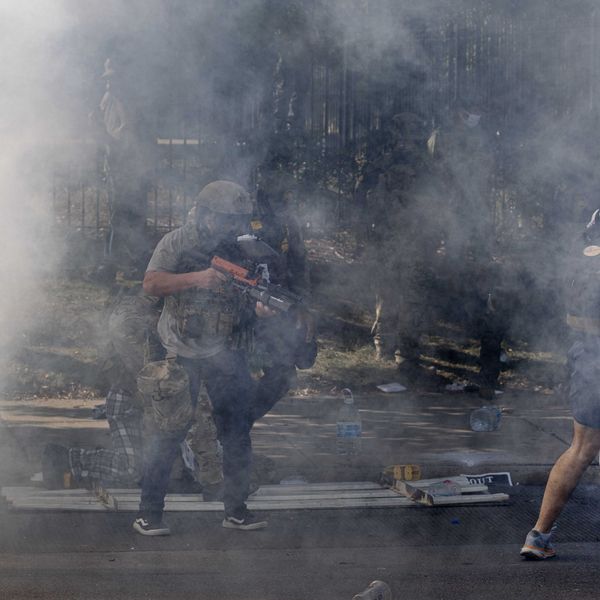
Lawsuits Target Trump, Noem to Beat Back Federal ‘War on Chicago’
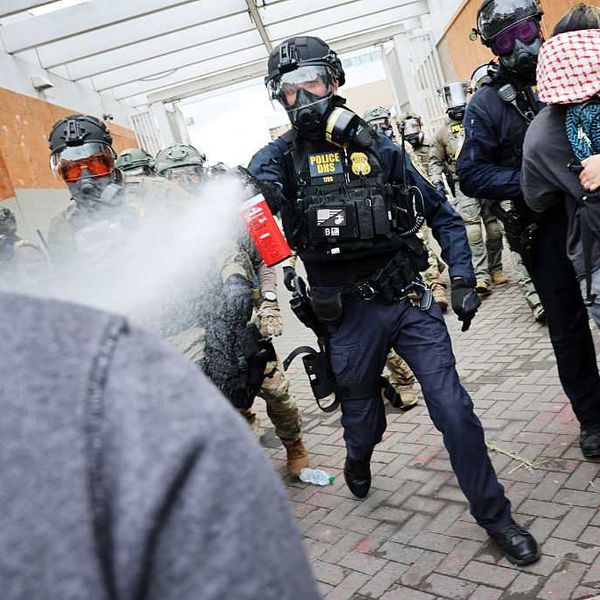
Trump Troops ‘Deliberately Attacking Peaceful Protesters’ in US Cities, Senator Says
Ellis’ decision came in response to a complaint filed by independent media publication Block Club Chicago, along with other news organizations.
In its report on the ruling, Block Club Chicago explained that four of its reporters “were indiscriminately hit with pepper-spray bullets and tear-gassed by federal agents” while they were covering protests outside of an Immigration and Customs Enforcement (ICE) facility in the Chicago suburb of Broadview, Illinois.
The publication also quoted Ellis saying in court on Thursday that some of the actions carried out by federal agents against journalists and protesters “clearly violate the constitution.”
“Individuals are allowed to protest,” she emphasized. “They are allowed to speak. That is guaranteed by the First Amendment to our Constitution, and it is a bedrock right that upholds our democracy.”
The temporary restraining order (TRO) issued by Ellis will be in effect for the next 14 days, and she could extend its length significantly by granting a preliminary injunction later in the month.
Chicago Mayor Brandon Johnson, a consistent critic of federal officials’ conduct in his city, hailed the ruling but lamented that it was even necessary in the first place.
“It’s a sad state in America when reporters have to go to court to not get shot at by the federal government,” he said, in a video posted on X by local talk radio station WCPT 820. “That we have to go to court so that teachers can run their classrooms and that students can get inside safely and that we can protect them from chemical agents. We have to go to court to protect the people of our city from chemical agents.”
Federal immigration officials have been employing increasingly aggressive and violent tactics in the Chicago area in recent weeks, including attacking a journalist and a protesting priest with pepper balls outside an Immigration and Customs Enforcement facility; slamming a congressional candidate to the ground; dragging US citizens, including children, out of their homes during a raid in the middle of the night; and fatally shooting a man during a traffic stop.
Federal Judge Blocks Trump’s National Guard Deployment in Illinois
The judge said she saw “no credible evidence that there is a danger of rebellion in the state of Illinois,” and allowing troops into Chicago “will only add fuel to the fire that the defendants themselves have started.”
The judge said she saw “no credible evidence that there is a danger of rebellion in the state of Illinois,” and allowing troops into Chicago “will only add fuel to the fire that the defendants themselves have started.”
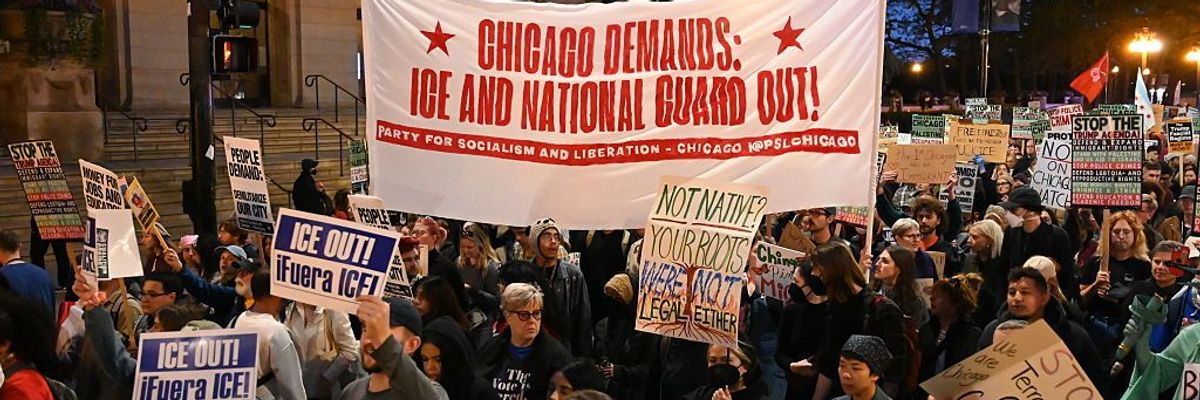
People gather at Ida B. Wells Dr. and Michigan Ave. in downtown Chicago to protest President Donald Trump deploying National Guard troops and Immigration and Customs Enforcement agents to Illinois on October 8, 2025.
(Photo by Jacek Boczarski/Anadolu via Getty Images)
Jessica Corbett
Oct 09, 2025
COMMON DREAMS
US District Judge April Perry on Thursday partially granted Chicago and Illinois’ request for a temporary restraining order against President Donald Trump’s deployment of National Guard troops, purportedly to protect immigration officials carrying out “Operation Midway Blitz” in and around the nation’s third-largest city.
Perry—who pledged to issue a written opinion on Friday—said in an oral ruling that the US Department of Homeland Security’s descriptions of recent events in the area are “simply unreliable,” noting that “in the last 48 hours, in four separate unrelated legal decisions from different neutral parties, they all cast significant doubt on DHS’s credibility and assessment of what is happening on the streets of Chicago.”
RECOMMENDED...
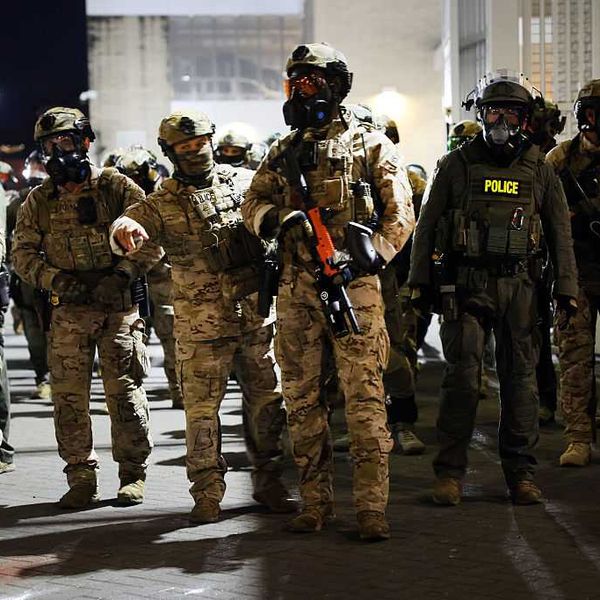
Governors Warn of ‘Martial Law’ and Trump ‘Invasion’ as US Judge Halts Troop Order—for Now
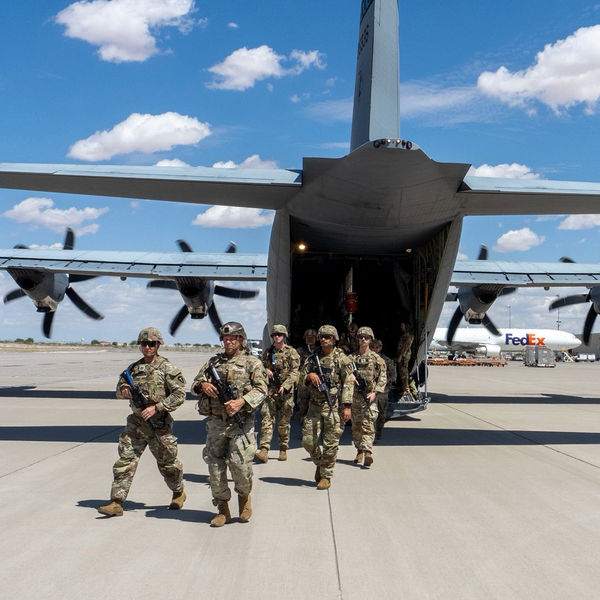
‘Illegal... Unconstitutional... Dangerous... Wrong’: Texas National Guard Troops Invade Illinois
Federal law—specifically, 10 US Code § 12406—allows the president to federalize the National Guard under three conditions, “not whenever he determines when one of them is met,” said Perry, an appointee of former President Joe Biden.
Those conditions are: invasion or a danger of invasion by a foreign nation; rebellion or danger of rebellion against the authority of the federal government; or if the president “is unable with the regular forces to execute the laws of the United States.”
“When President Trump is trying his best to imperil the rights of residents of major American cities, it’s encouraging to see this court ruling based on adherence to law and facts.”
Reporting on an argument made during a hearing earlier Thursday, the Chicago Tribune detailed:
[Christopher] Wells, the attorney for Illinois, said the country's founders did not use words like "rebellion, insurrection, or war" lightly.
"The president of the United States believes there is a rebellion brewing in the United States? That is such an audacious claim," Wells argued before US District Judge April Perry. "Who are the rebels? Are the rebels well-armed? ...There is no rebellion in Illinois."
[US Departmnet of Justice attorney Eric] Hamilton, meanwhile, repeatedly summarized violence in the Chicago area he said has been perpetrated by the "rioters" on immigration agents, including the boxing in of vehicles, assaults, and the alleged $10,000 bounty put on Border Patrol boss Greg Bovino's head.
"There doesn't have to be an actual rebeller," Hamilton said. "It is enough that there is a danger of a rebellion here. Which there is."
The judge said in her oral decision that she had seen “no credible evidence that there is a danger of rebellion in the state of Illinois,” and allowing troops into Chicago “will only add fuel to the fire that the defendants themselves have started.”
Illinois Attorney General Kwame Raoul said in a statement that “today’s ruling is a victory for the rule of law. The administration has provided no lawful explanation for its deployment of federal troops, and none exists. It’s clear that this attempted occupation within the state of Illinois is driven by political animus and not because federal officials are unable to protect federal property or enforce federal law.”
“The president does not have the unfettered discretion to turn America’s military against its own citizens when they exercise their constitutional rights,” he continued. “I am absolutely committed to upholding the Constitution and defending the rule of law, and I will continue to fight back against this unlawful attack on our state’s sovereignty.”
“The president does not have the unfettered discretion to turn America’s military against its own citizens when they exercise their constitutional rights.”
Hina Shamsi, director of ACLU’s National Security Project, said in a statement that “this decision reinforces that the president’s expansive claim of power to federalize state troops when there’s no actual emergency and good faith factual basis is unlawful. Like district court judges in Oregon and California, this court looked at the facts on the ground and rightly found that the Trump administration’s version of events is quite simply unreliable.”
“As the founders of this country made abundantly clear, turning troops on civilians is an intolerable threat to our liberties,” Shamsi added. “When President Trump is trying his best to imperil the rights of residents of major American cities, it’s encouraging to see this court ruling based on adherence to law and facts.”
Perry’s decision came in response to Chicago and Illinois’ Monday lawsuit over Trump’s move to deploy National Guard troops weeks into the US Immigration and Customs Enforcement (ICE) operation. Rather than immediately weighing in, the judge scheduled Thursday’s hearing.
In the meantime, around 1,000 protesters took to the city’s streets Wednesday night; Trump called for the arrest of Chicago Mayor Brandon Johnson and Illinois Gov. JB Pritzker, both Democrats; and members of the Texas National Guard began arriving in the suburb Joliet. As Wells put it during the hearing, despite the pending legal challenge, the federal government “plowed ahead anyway,” and “now, troops are here.”
US Northern Command said late Wednesday that approximately 200 Texas National Guard soldiers and 300 members of the Illinois National Guard “were activated into a Title 10 status” and are in the Chicagoland area to protect ICE and “other US government personnel who are performing federal functions.”
The village of Broadview confirmed to NBC Chicago that on Wednesday night, three vans carrying 45 members of the Texas National Guard arrived at the suburban ICE facility that has been the site of several protests in recent weeks.
“During their patrols, Broadview police officers observed the vans parked in the rear of 2000 25th Ave. and all of the guards were sleeping,” the statement said. “We let them sleep undisturbed. We hope that they will extend the same courtesy in the coming days to Broadview residents who deserve a good night’s sleep, too.”
As Chicago and Illinois filed their suit on Monday, demonstrators and journalists sued over federal agents’ violent violations of First Amendment rights at Broadview’s ICE facility. On Thursday, US District Judge Sara Ellis—appointed to the Northern District of Illinois by former President Barack Obama—issued a temporary restraining order barring officials from using pepper spray, tear gas, and other weapons “on members of the press, protestors, or religious practitioners who are not posing an immediate threat to the safety of a law enforcement officer or others.”
Also on Thursday, a three-judge panel from the US Court of Appeals for the 9th Circuit heard arguments over Trump’s move to deploy the National Guard in Portland, Oregon, as he has previously done in Los Angeles, California and Washington, DC. That followed US District Judge Karin Immergut blocking the deployment—after which the Trump appointee was quickly accused of “legal insurrection” by Stephen Miller, the White House deputy chief of staff.
Meanwhile, officials in Memphis confirmed in an online update Thursday that National Guard troops are set to start patrolling the city on Friday. In sharp contrast to Pritzker and Democratic Oregon Gov. Tina Kotek, Republican Tennessee Gov. Bill Lee has welcomed the planned deployment.
Unlike Trump’s efforts in Chicago and Portland, “National Guard troops in Memphis have not been federalized,” The Tennessean reported Thursday. “They are deployed under federal Title 32 rules, which preserve state authority over the National Guard with the federal government paying for expenses. As such, the Tennessee National Guard remains under Lee’s control.”
Neither Lee nor Tennessee Attorney General Jonathan Skrmetti has “publicly explained the legal basis of the operation,” the newspaper also noted. While Lee, when questioned by reporters, deferred to Skrmetti, a spokesperson for the state’s top lawyer said in an email that “we do not have a comment at this time.”
Trump dealt blow in National Guard deployment as judge finds no evidence of 'rebellion'
Daniel Hampton
October 9, 2025
Daniel Hampton
October 9, 2025
RAW STORY
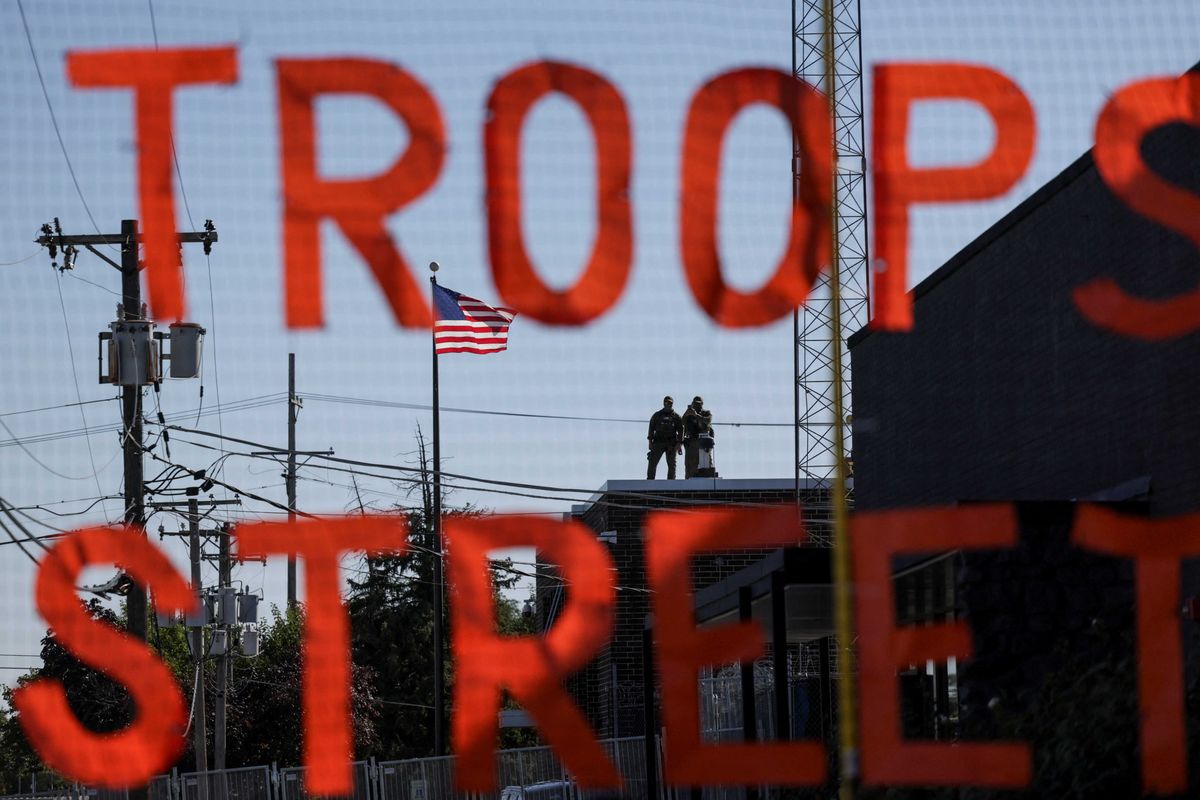
U.S. Border Patrol officers look at protester from the rooftop of the U.S. Immigration and Customs Enforcement (ICE) Broadview facility in Chicago, Illinois, U.S., October 9, 2025. REUTERS/Jeenah Moon
President Donald Trump's effort to send National Guard troops to curb crime suffered a setback on Thursday as a federal judge blocked the move for at least 14 days
Trump sent National Guard troops to Chicago earlier this month, citing rampant crime and to aid federal immigration enforcement efforts. Trump called the U.S. city a "hellhole" of crime, even though police data showed significant decreases in violent crime. About 300 troops were federalized from the Illinois National Guard, and 200 troops were sent via the Texas National Guard.
Judge April Perry on Thursday orally granted an emergency motion to block the deployment, the Chicago Tribune reported. A written ruling is expected on Friday.
Chicago Tribune reporter Jason Meisner relayed the judge's remarks, noting she described the facts surrounding a Broadview Immigration and Customs Enforcement facility.
"On Sept. 27, Perry says, CBP informed Broadview police they should prepare for increased use of tear gas on protesters, saying it was 'going to be a s---show.' (that's a quote)," noted Meisner on X. He added: "Perry says after the mayhem that day, state police and other local law enforcement got involved in crowd control and things calmed down. Despite this, on Oct. 4, the president issued a memorandum stating the situation in Illinois was out of control, Perry says."
The judge noted that on Oct. 5, the Department of Homeland Security's internal communications team called it a "great weekend" and that state police were “difference makers” in controlling the situation in Broadview, Meisner said.
The judge noticed the discrepancy.
"Perry: The defense portrays an entirely different scenario that 'cannot be aligned' with the view of local officials. Perry says she 'simply can’t credit the defendant’s declarations' due in large part of a growing body of evidence that DHS's views are 'simply unreliable.'
Later, the judge said a rebellion is "a deliberate organized resistance openly opposing the laws and government as a whole" via armed violence, said Meisner.
"I have found no credible evidence that there is a danger of rebellion in the state of Illinois," she said.
U.S. Border Patrol officers look at protester from the rooftop of the U.S. Immigration and Customs Enforcement (ICE) Broadview facility in Chicago, Illinois, U.S., October 9, 2025. REUTERS/Jeenah Moon
President Donald Trump's effort to send National Guard troops to curb crime suffered a setback on Thursday as a federal judge blocked the move for at least 14 days
Trump sent National Guard troops to Chicago earlier this month, citing rampant crime and to aid federal immigration enforcement efforts. Trump called the U.S. city a "hellhole" of crime, even though police data showed significant decreases in violent crime. About 300 troops were federalized from the Illinois National Guard, and 200 troops were sent via the Texas National Guard.
Judge April Perry on Thursday orally granted an emergency motion to block the deployment, the Chicago Tribune reported. A written ruling is expected on Friday.
Chicago Tribune reporter Jason Meisner relayed the judge's remarks, noting she described the facts surrounding a Broadview Immigration and Customs Enforcement facility.
"On Sept. 27, Perry says, CBP informed Broadview police they should prepare for increased use of tear gas on protesters, saying it was 'going to be a s---show.' (that's a quote)," noted Meisner on X. He added: "Perry says after the mayhem that day, state police and other local law enforcement got involved in crowd control and things calmed down. Despite this, on Oct. 4, the president issued a memorandum stating the situation in Illinois was out of control, Perry says."
The judge noted that on Oct. 5, the Department of Homeland Security's internal communications team called it a "great weekend" and that state police were “difference makers” in controlling the situation in Broadview, Meisner said.
The judge noticed the discrepancy.
"Perry: The defense portrays an entirely different scenario that 'cannot be aligned' with the view of local officials. Perry says she 'simply can’t credit the defendant’s declarations' due in large part of a growing body of evidence that DHS's views are 'simply unreliable.'
Later, the judge said a rebellion is "a deliberate organized resistance openly opposing the laws and government as a whole" via armed violence, said Meisner.
"I have found no credible evidence that there is a danger of rebellion in the state of Illinois," she said.

No comments:
Post a Comment