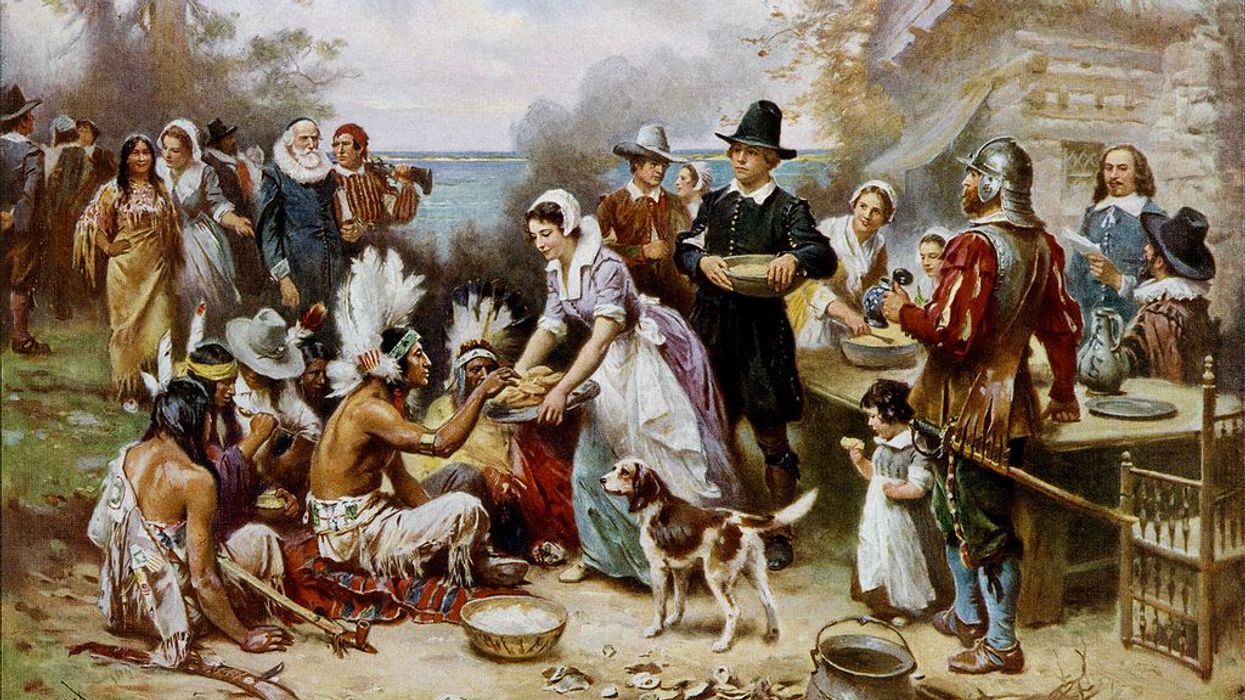
The first Thanksgiving, 1621, Pilgrims and natives gather to share a meal, oil painting by Jean Louis Gerome Ferris, 1932/Shutterstock
November 26, 2025
ALTERNET
The settlers who arrived in Plymouth were not escaping religious persecution, writes Jane Borden in The Nation. The Pilgrims and Puritans "left on the Mayflower to establish a theocracy in the Americas," she says, and effectively were part of what is today known as a doomsday cult.
"The Pilgrims and Puritans were high-control radical Protestant doomsday groups. If they were around today, most Americans would identify them as cults," Borden says.
Despite their differences, she says, they were all “Hot Protestants ... as such radicals were known in England. They believed the end of the world as prophesied in the New Testament book of Revelation was imminent."
Religious figures in the colonies were doomsday preppers who predicted different dates for the big day.
“The Day of Doom,” writes Borden, "a long-form poem published in 1662 about the return of a vengeful Jesus, was so popular in New England it’s known as America’s first bestseller."
"The radical Protestants believed, as apocalyptic thinkers always have, that the world contained good and evil forces, eradication was the only goal of both, and each supernatural side had pursued it since the beginning of time," she explains.
These early doomsdayers, she explains, "wanted to hasten the apocalypse by blotting out everything that didn’t fit their ever-shrinking view of righteousness."
UCLA historian Carla Gardina Pestana says that Pilgrim governor William Bradford “thought anyone hostile to Plymouth itself risked God’s anger.”
And contrary to what is taught in most American elementary schools, Borden refutes the fact that these groups came to the New World seeking religious freedom.
"The Pilgrims, in particular, already had religious freedom in Holland, where they lived for 12 years after fleeing England," she explains.
"Along with economic motivations, they came to America because they didn’t want to raise their children in a liberal society. They wanted theocracy. They wanted to be able to expel nonconformists and exert total control over culture," she adds.
The Puritans, she explains, wanted much of the same and executed it — quite literally — in a more violent fashion.
"The Puritans wanted the same — this is why they hanged Quakers, banished dissidents, and, eventually, ended the practice of questions and comments following sermons, because, as Cotton Mather wrote, it was “an occasion of much contention, vexation and folly.” Church attendance was mandatory. They made it illegal to disagree with ministers," she says.
Punishment was a source of humiliation and entertainment for The Puritans, she says.
"Punishment for transgressions was extreme and designed to humiliate, just as it is in cults. Punishment was also a source of entertainment," Borden explains, noting how taverns opened early on trial days so the crowd could pregame the brutality.
Much was taboo, however, including "gossiping, flirting, swearing, smoking, playing ball sports and doing almost anything on the Sabbath were crimes," Borden says.
"Skipping church or criticizing the pastor were also punishable. Residents were encouraged to inform on one another. It was even a crime to interrupt the preacher. Blasphemy called for the death sentence," she notes.
Freedom in the New World seemed a foreign concept, in fact, she explains.
"In Pilgrim and Puritan communities, there was not just a culture of punishment; there was a culture of conformity. These were high-control groups, meaning the groups’ leaders used community pressure and threats of punishment, ostracism, and damnation to regulate residents’ behavior, thoughts, and information intake," she writes.
Children had it particularly bad, Borden says.
"Cults and high-control groups are typically most destructive to the children raised in them. In addition to uncertainty of their status among the saved, New England children were subject to fear-based indoctrination and extreme discipline," she writes, adding that parents eschewed affection out of fear it would "spoil them into wickedness."
"Scholars who’ve pored over diaries kept by the Puritans found that the second and third generations exhibited during adolescence significant increases in melancholy, pathological abnormalities, nervous breakdowns, suicide and insanity," she notes.
Despite all of this, Pilgrims and The Puritans became the poster-children for America's founding, she explains.
"Nevertheless, in the mid-to-late 1800s, the Pilgrims and Puritans became the avatars of America’s founding — in part because of associations with the new Thanksgiving holiday, and in part, as some scholars have argued, because the nation was struggling to define its identity and to separate its origins from the slave trade," she says.
Their radical ideology never went away, Borden writes. In fact, it has become the foundation of American culture.
"From these remarkably successful colonies, we inherited our knee-jerk anti-intellectualism, obsession with self-investigation, tendency to worship the wealthy and desire for a strong man to rescue us from crisis," she writes.
"Americans today often wonder “how we got here” as a nation. My answer: the Mayflower and Arabella," Borden says.
"This Thanksgiving is as good a time as any to begin coming to terms with the country’s radical cultish origins. The consequences are ongoing, and we’re all in this together. There’s no going back. The Mayflower and Arabella aren’t offering return tickets."
The settlers who arrived in Plymouth were not escaping religious persecution, writes Jane Borden in The Nation. The Pilgrims and Puritans "left on the Mayflower to establish a theocracy in the Americas," she says, and effectively were part of what is today known as a doomsday cult.
"The Pilgrims and Puritans were high-control radical Protestant doomsday groups. If they were around today, most Americans would identify them as cults," Borden says.
Despite their differences, she says, they were all “Hot Protestants ... as such radicals were known in England. They believed the end of the world as prophesied in the New Testament book of Revelation was imminent."
Religious figures in the colonies were doomsday preppers who predicted different dates for the big day.
“The Day of Doom,” writes Borden, "a long-form poem published in 1662 about the return of a vengeful Jesus, was so popular in New England it’s known as America’s first bestseller."
"The radical Protestants believed, as apocalyptic thinkers always have, that the world contained good and evil forces, eradication was the only goal of both, and each supernatural side had pursued it since the beginning of time," she explains.
These early doomsdayers, she explains, "wanted to hasten the apocalypse by blotting out everything that didn’t fit their ever-shrinking view of righteousness."
UCLA historian Carla Gardina Pestana says that Pilgrim governor William Bradford “thought anyone hostile to Plymouth itself risked God’s anger.”
And contrary to what is taught in most American elementary schools, Borden refutes the fact that these groups came to the New World seeking religious freedom.
"The Pilgrims, in particular, already had religious freedom in Holland, where they lived for 12 years after fleeing England," she explains.
"Along with economic motivations, they came to America because they didn’t want to raise their children in a liberal society. They wanted theocracy. They wanted to be able to expel nonconformists and exert total control over culture," she adds.
The Puritans, she explains, wanted much of the same and executed it — quite literally — in a more violent fashion.
"The Puritans wanted the same — this is why they hanged Quakers, banished dissidents, and, eventually, ended the practice of questions and comments following sermons, because, as Cotton Mather wrote, it was “an occasion of much contention, vexation and folly.” Church attendance was mandatory. They made it illegal to disagree with ministers," she says.
Punishment was a source of humiliation and entertainment for The Puritans, she says.
"Punishment for transgressions was extreme and designed to humiliate, just as it is in cults. Punishment was also a source of entertainment," Borden explains, noting how taverns opened early on trial days so the crowd could pregame the brutality.
Much was taboo, however, including "gossiping, flirting, swearing, smoking, playing ball sports and doing almost anything on the Sabbath were crimes," Borden says.
"Skipping church or criticizing the pastor were also punishable. Residents were encouraged to inform on one another. It was even a crime to interrupt the preacher. Blasphemy called for the death sentence," she notes.
Freedom in the New World seemed a foreign concept, in fact, she explains.
"In Pilgrim and Puritan communities, there was not just a culture of punishment; there was a culture of conformity. These were high-control groups, meaning the groups’ leaders used community pressure and threats of punishment, ostracism, and damnation to regulate residents’ behavior, thoughts, and information intake," she writes.
Children had it particularly bad, Borden says.
"Cults and high-control groups are typically most destructive to the children raised in them. In addition to uncertainty of their status among the saved, New England children were subject to fear-based indoctrination and extreme discipline," she writes, adding that parents eschewed affection out of fear it would "spoil them into wickedness."
"Scholars who’ve pored over diaries kept by the Puritans found that the second and third generations exhibited during adolescence significant increases in melancholy, pathological abnormalities, nervous breakdowns, suicide and insanity," she notes.
Despite all of this, Pilgrims and The Puritans became the poster-children for America's founding, she explains.
"Nevertheless, in the mid-to-late 1800s, the Pilgrims and Puritans became the avatars of America’s founding — in part because of associations with the new Thanksgiving holiday, and in part, as some scholars have argued, because the nation was struggling to define its identity and to separate its origins from the slave trade," she says.
Their radical ideology never went away, Borden writes. In fact, it has become the foundation of American culture.
"From these remarkably successful colonies, we inherited our knee-jerk anti-intellectualism, obsession with self-investigation, tendency to worship the wealthy and desire for a strong man to rescue us from crisis," she writes.
"Americans today often wonder “how we got here” as a nation. My answer: the Mayflower and Arabella," Borden says.
"This Thanksgiving is as good a time as any to begin coming to terms with the country’s radical cultish origins. The consequences are ongoing, and we’re all in this together. There’s no going back. The Mayflower and Arabella aren’t offering return tickets."
Thanksgiving? No, thanks.
Robert Jensen ,
AlterNet
Robert Jensen ,
AlterNet
November 26, 2025
One indication of moral progress in the United States would be the replacement of Thanksgiving Day and its self-indulgent family feasting with a National Day of Atonement accompanied by a self-reflective collective fasting.
In fact, indigenous people have offered such a model; since 1970 they have marked the fourth Thursday of November as a Day of Mourning in a spiritual/political ceremony on Coles Hill overlooking Plymouth Rock, Massachusetts, one of the early sites of the European invasion of the Americas.
Not only is the thought of such a change in this white-supremacist holiday impossible to imagine, but the very mention of the idea sends most Americans into apoplectic fits -- which speaks volumes about our historical hypocrisy and its relation to the contemporary politics of empire in the United States.
That the world's great powers achieved "greatness" through criminal brutality on a grand scale is not news, of course. That those same societies are reluctant to highlight this history of barbarism also is predictable.
But in the United States, this reluctance to acknowledge our original sin -- the genocide of indigenous people -- is of special importance today. It's now routine -- even among conservative commentators -- to describe the United States as an empire, so long as everyone understands we are an inherently benevolent one. Because all our history contradicts that claim, history must be twisted and tortured to serve the purposes of the powerful.
One vehicle for taming history is various patriotic holidays, with Thanksgiving at the heart of U.S. myth-building. From an early age, we Americans hear a story about the hearty Pilgrims, whose search for freedom took them from England to Massachusetts. There, aided by the friendly Wampanoag Indians, they survived in a new and harsh environment, leading to a harvest feast in 1621 following the Pilgrims first winter.
Some aspects of the conventional story are true enough. But it's also true that by 1637 Massachusetts Gov. John Winthrop was proclaiming a thanksgiving for the successful massacre of hundreds of Pequot Indian men, women and children, part of the long and bloody process of opening up additional land to the English invaders. The pattern would repeat itself across the continent until between 95 and 99 percent of American Indians had been exterminated and the rest were left to assimilate into white society or die off on reservations, out of the view of polite society.
Simply put: Thanksgiving is the day when the dominant white culture (and, sadly, most of the rest of the non-white but non-indigenous population) celebrates the beginning of a genocide that was, in fact, blessed by the men we hold up as our heroic founding fathers.
The first president, George Washington, in 1783 said he preferred buying Indians' land rather than driving them off it because that was like driving "wild beasts" from the forest. He compared Indians to wolves, "both being beasts of prey, tho' they differ in shape."
Thomas Jefferson -- president #3 and author of the Declaration of Independence, which refers to Indians as the "merciless Indian Savages" -- was known to romanticize Indians and their culture, but that didn't stop him in 1807 from writing to his secretary of war that in a coming conflict with certain tribes, "[W]e shall destroy all of them."
As the genocide was winding down in the early 20th century, Theodore Roosevelt (president #26) defended the expansion of whites across the continent as an inevitable process "due solely to the power of the mighty civilized races which have not lost the fighting instinct, and which by their expansion are gradually bringing peace into the red wastes where the barbarian peoples of the world hold sway."
Roosevelt also once said, "I don't go so far as to think that the only good Indians are dead Indians, but I believe nine out of ten are, and I shouldn't like to inquire too closely into the case of the tenth."
How does a country deal with the fact that some of its most revered historical figures had certain moral values and political views virtually identical to Nazis? Here's how "respectable" politicians, pundits, and professors play the game: When invoking a grand and glorious aspect of our past, then history is all-important. We are told how crucial it is for people to know history, and there is much hand wringing about the younger generations' lack of knowledge about, and respect for, that history.
In the United States, we hear constantly about the deep wisdom of the founding fathers, the adventurous spirit of the early explorers, the gritty determination of those who "settled" the country -- and about how crucial it is for children to learn these things.
But when one brings into historical discussions any facts and interpretations that contest the celebratory story and make people uncomfortable -- such as the genocide of indigenous people as the foundational act in the creation of the United States -- suddenly the value of history drops precipitously and one is asked, "Why do you insist on dwelling on the past?"
This is the mark of a well-disciplined intellectual class -- one that can extol the importance of knowing history for contemporary citizenship and, at the same time, argue that we shouldn't spend too much time thinking about history.
This off-and-on engagement with history isn't of mere academic interest; as the dominant imperial power of the moment, U.S. elites have a clear stake in the contemporary propaganda value of that history. Obscuring bitter truths about historical crimes helps perpetuate the fantasy of American benevolence, which makes it easier to sell contemporary imperial adventures -- such as the invasion and occupation of Iraq -- as another benevolent action.
Any attempt to complicate this story guarantees hostility from mainstream culture. After raising the barbarism of America's much-revered founding fathers in a lecture, I was once accused of trying to "humble our proud nation" and "undermine young people's faith in our country."
Yes, of course -- that is exactly what I would hope to achieve. We should practice the virtue of humility and avoid the excessive pride that can, when combined with great power, lead to great abuses of power.
History does matter, which is why people in power put so much energy into controlling it. The United States is hardly the only society that has created such mythology. While some historians in Great Britain continue to talk about the benefits that the empire brought to India, political movements in India want to make the mythology of Hindutva into historical fact.
Abuses of history go on in the former empire and the former colony. History can be one of the many ways we create and impose hierarchy, or it can be part of a process of liberation. The truth won't set us free, but the telling of truth at least opens the possibility of freedom.
As Americans sit down on Thanksgiving Day to gorge themselves on the bounty of empire, many will worry about the expansive effects of overeating on their waistlines. We would be better to think about the constricting effects of the day's mythology on our minds.
One indication of moral progress in the United States would be the replacement of Thanksgiving Day and its self-indulgent family feasting with a National Day of Atonement accompanied by a self-reflective collective fasting.
In fact, indigenous people have offered such a model; since 1970 they have marked the fourth Thursday of November as a Day of Mourning in a spiritual/political ceremony on Coles Hill overlooking Plymouth Rock, Massachusetts, one of the early sites of the European invasion of the Americas.
Not only is the thought of such a change in this white-supremacist holiday impossible to imagine, but the very mention of the idea sends most Americans into apoplectic fits -- which speaks volumes about our historical hypocrisy and its relation to the contemporary politics of empire in the United States.
That the world's great powers achieved "greatness" through criminal brutality on a grand scale is not news, of course. That those same societies are reluctant to highlight this history of barbarism also is predictable.
But in the United States, this reluctance to acknowledge our original sin -- the genocide of indigenous people -- is of special importance today. It's now routine -- even among conservative commentators -- to describe the United States as an empire, so long as everyone understands we are an inherently benevolent one. Because all our history contradicts that claim, history must be twisted and tortured to serve the purposes of the powerful.
One vehicle for taming history is various patriotic holidays, with Thanksgiving at the heart of U.S. myth-building. From an early age, we Americans hear a story about the hearty Pilgrims, whose search for freedom took them from England to Massachusetts. There, aided by the friendly Wampanoag Indians, they survived in a new and harsh environment, leading to a harvest feast in 1621 following the Pilgrims first winter.
Some aspects of the conventional story are true enough. But it's also true that by 1637 Massachusetts Gov. John Winthrop was proclaiming a thanksgiving for the successful massacre of hundreds of Pequot Indian men, women and children, part of the long and bloody process of opening up additional land to the English invaders. The pattern would repeat itself across the continent until between 95 and 99 percent of American Indians had been exterminated and the rest were left to assimilate into white society or die off on reservations, out of the view of polite society.
Simply put: Thanksgiving is the day when the dominant white culture (and, sadly, most of the rest of the non-white but non-indigenous population) celebrates the beginning of a genocide that was, in fact, blessed by the men we hold up as our heroic founding fathers.
The first president, George Washington, in 1783 said he preferred buying Indians' land rather than driving them off it because that was like driving "wild beasts" from the forest. He compared Indians to wolves, "both being beasts of prey, tho' they differ in shape."
Thomas Jefferson -- president #3 and author of the Declaration of Independence, which refers to Indians as the "merciless Indian Savages" -- was known to romanticize Indians and their culture, but that didn't stop him in 1807 from writing to his secretary of war that in a coming conflict with certain tribes, "[W]e shall destroy all of them."
As the genocide was winding down in the early 20th century, Theodore Roosevelt (president #26) defended the expansion of whites across the continent as an inevitable process "due solely to the power of the mighty civilized races which have not lost the fighting instinct, and which by their expansion are gradually bringing peace into the red wastes where the barbarian peoples of the world hold sway."
Roosevelt also once said, "I don't go so far as to think that the only good Indians are dead Indians, but I believe nine out of ten are, and I shouldn't like to inquire too closely into the case of the tenth."
How does a country deal with the fact that some of its most revered historical figures had certain moral values and political views virtually identical to Nazis? Here's how "respectable" politicians, pundits, and professors play the game: When invoking a grand and glorious aspect of our past, then history is all-important. We are told how crucial it is for people to know history, and there is much hand wringing about the younger generations' lack of knowledge about, and respect for, that history.
In the United States, we hear constantly about the deep wisdom of the founding fathers, the adventurous spirit of the early explorers, the gritty determination of those who "settled" the country -- and about how crucial it is for children to learn these things.
But when one brings into historical discussions any facts and interpretations that contest the celebratory story and make people uncomfortable -- such as the genocide of indigenous people as the foundational act in the creation of the United States -- suddenly the value of history drops precipitously and one is asked, "Why do you insist on dwelling on the past?"
This is the mark of a well-disciplined intellectual class -- one that can extol the importance of knowing history for contemporary citizenship and, at the same time, argue that we shouldn't spend too much time thinking about history.
This off-and-on engagement with history isn't of mere academic interest; as the dominant imperial power of the moment, U.S. elites have a clear stake in the contemporary propaganda value of that history. Obscuring bitter truths about historical crimes helps perpetuate the fantasy of American benevolence, which makes it easier to sell contemporary imperial adventures -- such as the invasion and occupation of Iraq -- as another benevolent action.
Any attempt to complicate this story guarantees hostility from mainstream culture. After raising the barbarism of America's much-revered founding fathers in a lecture, I was once accused of trying to "humble our proud nation" and "undermine young people's faith in our country."
Yes, of course -- that is exactly what I would hope to achieve. We should practice the virtue of humility and avoid the excessive pride that can, when combined with great power, lead to great abuses of power.
History does matter, which is why people in power put so much energy into controlling it. The United States is hardly the only society that has created such mythology. While some historians in Great Britain continue to talk about the benefits that the empire brought to India, political movements in India want to make the mythology of Hindutva into historical fact.
Abuses of history go on in the former empire and the former colony. History can be one of the many ways we create and impose hierarchy, or it can be part of a process of liberation. The truth won't set us free, but the telling of truth at least opens the possibility of freedom.
As Americans sit down on Thanksgiving Day to gorge themselves on the bounty of empire, many will worry about the expansive effects of overeating on their waistlines. We would be better to think about the constricting effects of the day's mythology on our minds.

No comments:
Post a Comment