“None of the individuals on the targeted boats appeared to pose an imminent threat to the lives of others or otherwise justified the use of lethal armed force against them under international law,” said Volker Türk.
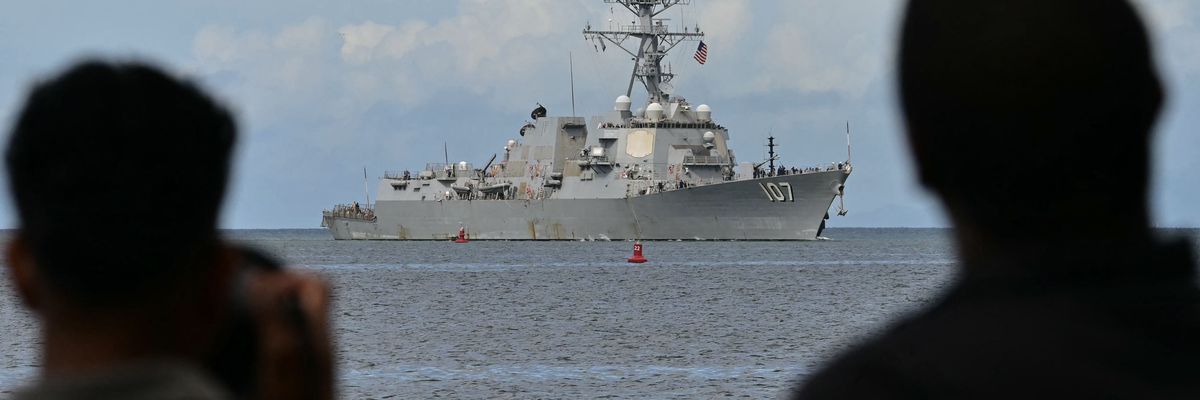
Photographers take pictures as the USS Gravely warship enters the Port of Spain on October 26, 2025.
(Photo by Martin Bernetti/AFP via Getty Images)
Jake Johnson
Oct 31, 2025
COMMON DREAMS
The United Nations’ top human rights official said Friday that US President Donald Trump’s deadly strikes on boats in international waters in recent weeks amount to “extrajudicial killing” that must stop immediately, remarks that came as the White House appeared poised to expand the unlawful military campaign to targets inside Venezuela.
Volker Türk, the UN high commissioner for human rights, said of the administration’s boat strikes that “these attacks—and their mounting human cost—are unacceptable.”
RECOMMENDED...
‘Another Unlawful Extrajudicial Killing’ as Trump Expands Boat-Bombing Spree to Pacific
UN Experts Decry Trump Warmongering Against Venezuela as ‘Extremely Dangerous Escalation’
“The US must halt such attacks and take all measures necessary to prevent the extrajudicial killing of people aboard these boats, whatever the criminal conduct alleged against them,” said Türk, noting that the administration has not substantiated its claim that those killed by the strikes in waters off Central and South America were smuggling drugs.
The Trump administration has also kept secret a US Justice Department memo purportedly outlining an internal legal justification for the deadly strikes.
Türk noted that “countering the serious issue of illicit trafficking of drugs across international borders is—as has long been agreed among states—a law-enforcement matter, governed by the careful limits on lethal force set out in international human rights law.”
“Under international human rights law, the intentional use of lethal force is only permissible as a last resort against individuals who pose an imminent threat to life,” said the UN human rights chief. “Based on the very sparse information provided publicly by the US authorities, none of the individuals on the targeted boats appeared to pose an imminent threat to the lives of others or otherwise justified the use of lethal armed force against them under international law.”
The Trump administration’s strikes have killed more than 60 people thus far. At least one of the targeted vessels appeared to have turned around before the US military bombed it, killing 11 people.
Türk’s statement came as the Miami Herald reported that the Trump administration “has made the decision to attack military installations inside Venezuela and the strikes could come at any moment.”
Trump has said publicly that land strikes inside Venezuela would be the next phase of the military assault, which he has described as a “war” on drug cartels. The president has not yet received—or even sought—congressional authorization for any of the military actions taken in the Caribbean and Pacific.
In a statement last week, a group of UN experts denounced the Trump administration’s strikes and belligerent posturing toward Venezuela as “an extremely dangerous escalation with grave implications for peace and security in the Caribbean region.”
“The long history of external interventions in Latin America must not be repeated,” the experts said.
“Congress must speak up now to stop another endless, regime-change war,” said Democratic US Rep. Ro Khanna.
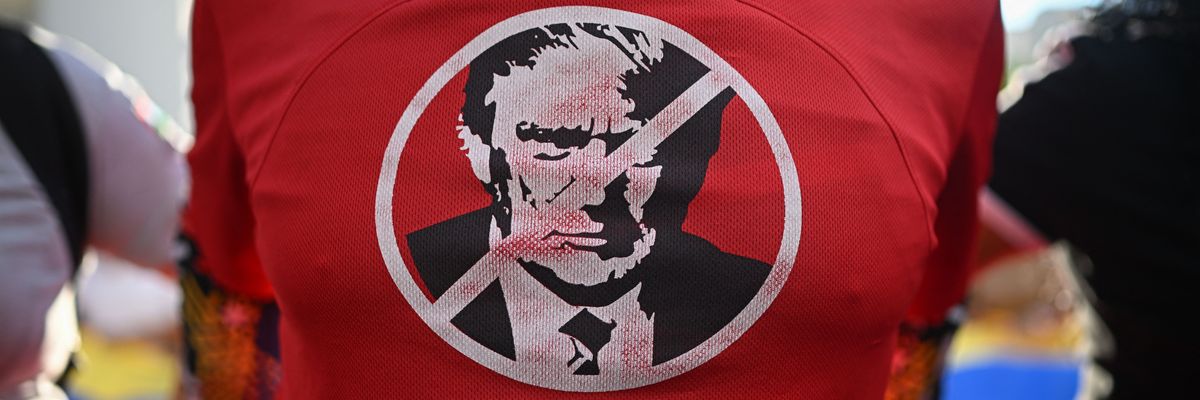 A demonstrator protesting US military attacks in the Caribbean wears a shirt depicting US President Donald Trump and the slogan “Yankee Go Home” in Caracas, Venezuela on October 30, 2025.
(Photo by Federico Parra/AFP via Getty Images)
Jake Johnson
Oct 31, 2025
COMMON DREAMS
US Rep. Ro Khanna on Friday demanded urgent congressional action to avert “another endless, regime-change war” amid reports that President Donald Trump is weighing military strikes inside Venezuela.
Such strikes, warned Khanna (D-Calif.), would be “blatantly unconstitutional.”
‘They’re Going to Be, Like, Dead’: Trump Says Land Strikes on Venezuela Are Next
Senators Launch Bipartisan Bid to Block Trump War on Venezuela
“The United States Congress must speak up and stop this,” Khanna said in a video posted to social media. “No president, according to the Constitution, has the authority to strike another country without Congress’ approval. And the American people have voted against regime change and endless wars.”
Watch:
Khanna’s remarks came in response to reporting by the Miami Herald and the Wall Street Journal on internal Trump administration discussions regarding possible airstrike targets inside Venezuela.
The Herald reported early Friday that the administration “has made the decision to attack military installations inside Venezuela and the strikes could come at any moment.” The Journal, in a story published Thursday, was more reserved, reporting that the administration “has identified targets in Venezuela that include military facilities used to smuggle drugs,” but adding that “the president hasn’t made a final decision on ordering land strikes.”
Citing unnamed US officials familiar with the matter, the Journal reported that “the targets would send a clear message to Venezuelan leader Nicolás Maduro that it is time to step down.”
Following the reports, the White House denied that Trump has finalized plans for a military strike on Venezuela. Trump himself told reporters aboard Air Force One on Friday that he has not made a final decision, signaling his belief he has the authority to do so if he chooses.
Last week, the president said publicly that land strikes are “going to be next” following his illegal, deadly strikes on boats in waters off Central and South America.
Trump has said he would not seek approval from Congress before attacking Venezuela directly.
“The American people oppose being dragged into yet another endless war, this time in Venezuela, and our constitutional order demands deliberation by the U.S. Congress—period.”
A potentially imminent, unauthorized US attack on Venezuela and the administration’s accelerating military buildup in the Caribbean have thus far drawn vocal opposition from just a fraction of the lawmakers on Capitol Hill, currently embroiled in a shutdown fight.
Just three senators—Tim Kaine (D-Va.), Rand Paul (R-Ky.), and Adam Schiff (D-Calif.)—are listed as official backers of a resolution aimed at preventing Trump from attacking Venezuela without congressional authorization. Other senators, including Bernie Sanders (I-Vt.) and Ruben Gallego (D-Ariz.), have spoken out against Trump’s belligerence toward Venezuela.
“Trump is illegally threatening war with Venezuela—after killing more than 50 people in unauthorized strikes at sea,” Sanders wrote in a social media post on Friday. “The Constitution is clear: Only Congress can declare war. Congress must defend the law and end Trump’s militarism.”
Dylan Williams, vice president of government affairs at the Center for International Policy, wrote Friday that “most Americans oppose overthrowing Venezuela’s leaders by force—and an even larger majority oppose invading.”
“Call your senators and tell them to vote for S.J.Res.90 to block Trump’s unauthorized use of military force,” Williams added. “The Capitol switchboard can connect you to your senators’ offices at 202-224-3121.”
A similar resolution led by Rep. Jason Crow (D-Colo.) in the US House has just over 30 cosponsors.
Rep. Joe Neguse (D-Colo.) announced his support for the House resolution on Thursday, saying in a statement that “Trump does not have the legal authority to launch military strikes inside Venezuela without a specific authorization by Congress.”
“I am deeply troubled by reports that suggest this administration believes otherwise,” said Neguse. “Any unilateral directive to send Americans into war is not only reckless, but illegal and an affront to the House of Representatives’ powers under Article I of our Constitution.”
“The American people oppose being dragged into yet another endless war, this time in Venezuela, and our constitutional order demands deliberation by the U.S. Congress—period,” Neguse added.
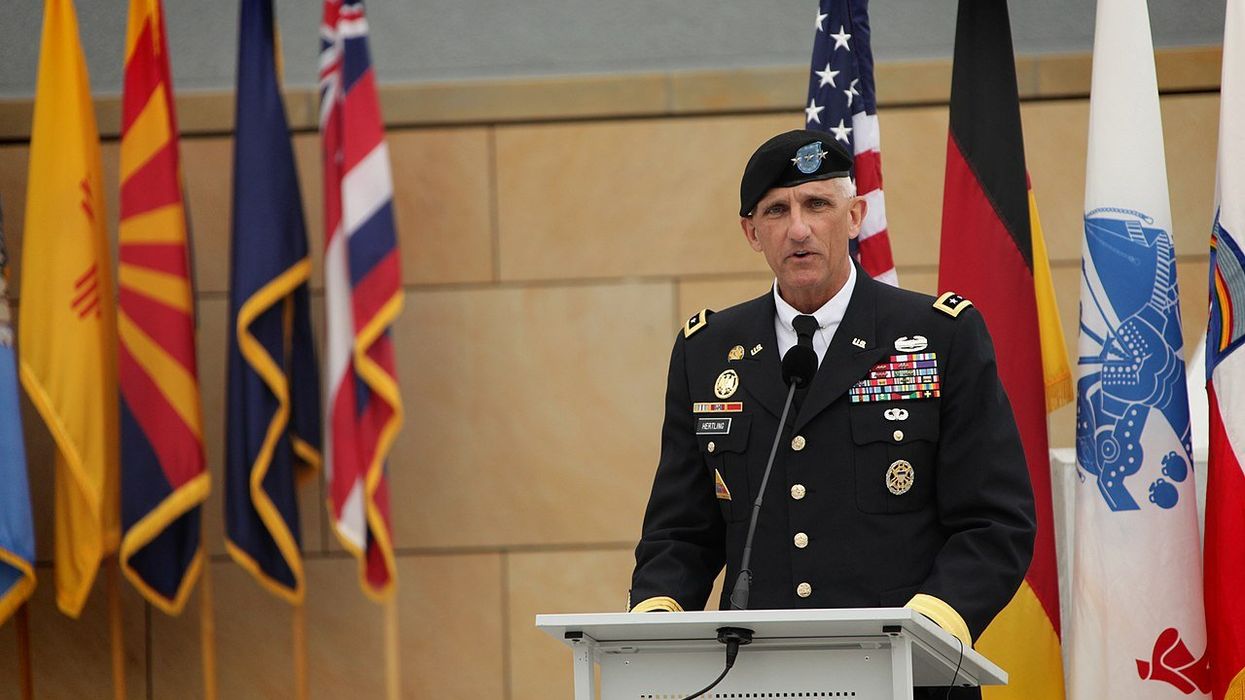
Lt. Gen. Mark Hertling, commander of U.S. Army Europe, in Wiesbaden, Germany on June 14, 2012 (U.S. Army Europe Images/Flickr)
On Friday morning, October 31, the Miami Herald's Antonio María Delgado reported that the Trump administration "has made the decision to attack military installations inside Venezuela."
President Donald Trump has been ordering military strikes against Venezuela boats that, he claims, are smuggling illegal drugs to the United States. But military strikes inside Venezuela itself, according to Delgado, would "initiate the next stage of" the Trump administration's "campaign against the Soles drug cartel."
Delgado's reporting follows reporting from the Wall Street Journal a day earlier. But while the Journal reported that the airstrikes were a possibility after "the Trump administration ... identified targets in Venezuela that include military facilities used to smuggle drugs," Delgado reported that according to Miami Herald sources, the Trump administration wasn't merely contemplating them, but had made a firm decision.
In response to the Herald's reporting, MSNBC's Ana Cabrera interviewed retired U.S. Army Gen. Mark Hertling — former commander for the U.S. Army in Europe, and now a writer for the anti-Trump conservative website The Bulwark.
When Cabrera noted that according to the Herald, a strike inside Venezuela "could come at any time," Hertling responded, "What I'm more interested in, as a military guy, is: What are the strategic objectives? What's the end state? What's the administration clearly defining as mission success in this? Is it just to bomb targets, or is there something related to that?"
Hertling continued, "Secondly, how does how does this campaign, if you will — if they describe it as such — challenge broader U.S. national defense interests in the western hemisphere? How are they coordinating with other countries in the region? A strike against Venezuela is certainly going to affect countries like Colombia, Honduras, Guatemala, Mexico. And have they assessed a second and third-order effects of a major naval air strike capability against Venezuela, against not only the other countries in the region, but what does that end state look like?"
Herling went on to describe the "legal ramifications" of such airstrikes under the War Powers Act of 1973, telling Cabrera and her MSNBC colleague David Rohde, "The questions are endless, and I don't think the Trump White House has answered any of them."
Rohde weighed in as well, telling Cabrera and Hertling, "So this would be a direct strike. I mean, you could argue it's an act of war on Venezuelan military facilities. The administration says they're used for drug trafficking. I'm not, again, sure if evidence has been presented of that, but if they strike a Venezuelan military facility, that is an act of war."
When Cabrera mentioned that the Trump administration only briefed fellow Republicans — not Democrats — on the reported plans to strike inside Venezuela, Rohde commented, "It's off the chart, Ana ... You're putting American men and women — they're soldiers, sailors, airmen and marines — in harm's way. And the nation needs to understand why that's happening."
Watch the segment below:
David Edwards
October 31, 2025
RAW STORY
.png)
President Donald Trump has reportedly decided to order attacks on Venezuela's military installations.
Sources told the Miami Herald that the strikes could come at any moment. The Trump administration has suggested that it is opposing the Sóles drug cartel.
According to the paper, the targets "could be struck by air in a matter of days or even hours" in an effort to destroy the cartel hierarchy.
Trump has been clear that he wants Venezuelan leader Nicolas Maduro out of power. Earlier this month, the U.S. president reportedly ordered covert CIA operations in Venezuela. The Herald's sources "declined to say" if Maduro was a target.
On Friday, Trump denied that he had decided on strikes inside the country. The president's remarks came as the FAA issued flight restrictions over Ceiba, Puerto Rico, a potential refueling site for U.S. military airstrikes.
“Trump’s military buildup in the Caribbean isn’t about ‘drugs,’ it’s about oil, power, and regime change,” said on critic of potential strikes in Venezuela.
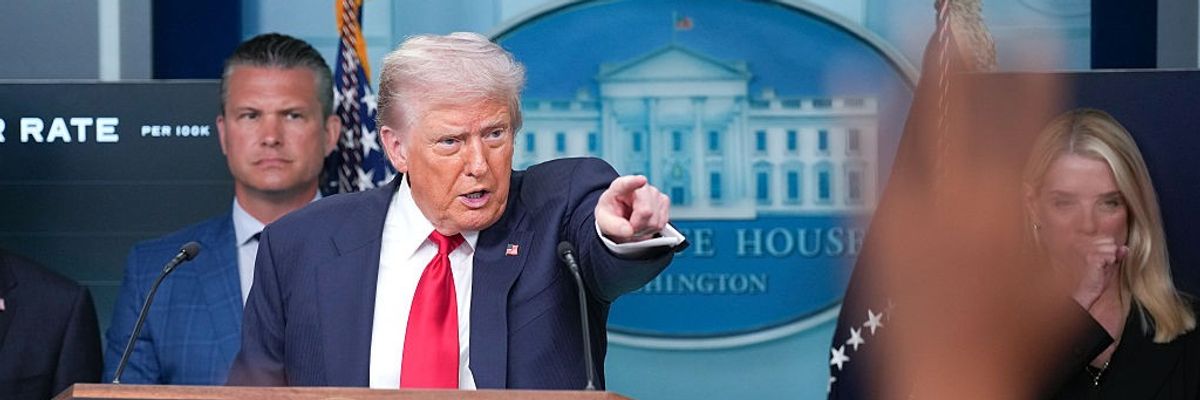
US President Donald Trump answers questions during a press conference in the White House on August 11, 2025 in Washington, DC.
(Photo by Andrew Harnik/Getty Images)
Brad Reed
Oct 31, 2025
COMMON DREAMS
Two reports claim that the Trump administration is poised to launch strikes against military targets inside Venezuela.
The Wall Street Journal reported on Thursday night that the administration is preparing to attack a variety of targets inside Venezuela, including “ports and airports controlled by the military that are allegedly used to traffic drugs, including naval facilities and airstrips.”
RECOMMENDED...
‘They’re Going to Be, Like, Dead’: Trump Says Land Strikes on Venezuela Are Next
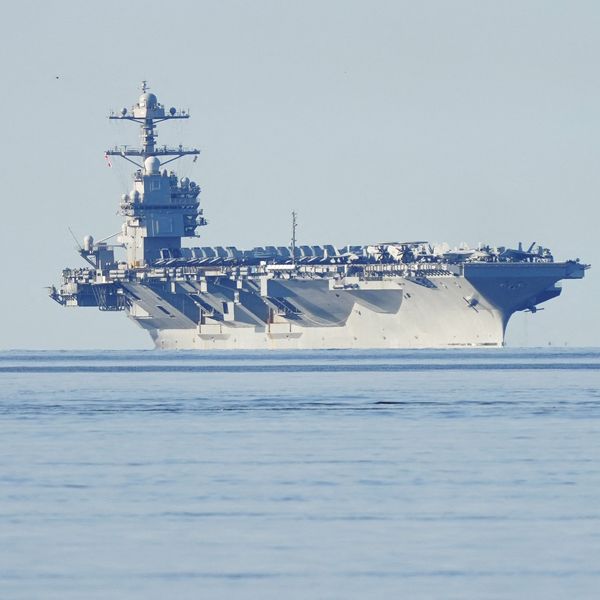
Trump’s Escalation Against Venezuela Continues as Hegseth Deploys Aircraft Carrier Strike Group to Latin American Waters
Reports from the US government and the United Nations have not identified Venezuela as a significant source of drugs that enter the United States, and the country plays virtually no role in the trafficking of fentanyl, the primary cause of drug overdoses in the US.
While the WSJ report said that the administration had not yet decided to carry out the operations against Venezuela, the Miami Herald reported on Friday morning that the administration “has made the decision to attack military installations inside Venezuela and the strikes could come at any moment.”
A source who spoke with the Miami Herald didn’t explicitly say that Venezuelan leader Nicolás Maduro would be the target of these actions, but they nonetheless hinted that the goal was to weaken his grip on power.
“Maduro is about to find himself trapped and might soon discover that he cannot flee the country even if he decided to,” the source said. “What’s worse for him, there is now more than one general willing to capture and hand him over, fully aware that one thing is to talk about death, and another to see it coming.”
While the Trump administration has accused Maduro of leading an international drug trafficking organization called the Cartel de los Soles, some experts have expressed extreme skepticism of this claim.
Phil Gunson, analyst at the International Crisis Group think tank, said in an interview with Agence Presse-France earlier this year that he doubts that so-called “Cartel de los Soles” even exists, and noted that “direct, incontrovertible evidence has never been presented” to show otherwise.
Earlier this year, the administration attempted to tie Maduro to another gang, Tren de Aragua, despite US intelligence agencies rejecting the notion that the street gang had government connections.
Launching strikes on Venezuelan soil would mark a major escalation in the administration’s military campaign targeting purported drug traffickers, which so far has consisted of drone strikes against boats in international waters that many legal experts have described as a campaign of extrajudicial murder.
Dozens of political leaders throughout Latin America earlier this month condemned the administration’s attacks on the purported drug boats, and they warned that they could just be the start of a regime change war reminiscent of the coups carried out by the US government in the last century that installed military dictatorships throughout the region.
“We have lived this nightmare before,” they emphasized in a joint letter. “US military interventions of the 20th century brought dictatorships, disappearances, and decades of trauma to our nations. We know the terrible cost of allowing foreign powers to wage war on our continent. We cannot—we will not—allow history to repeat itself.”
Medea Benjamin, cofounder of anti-war group CodePink, accused the Trump administration of using a fight against alleged drug trafficking as a false pretext to seize Venezuela’s vast oil reserves.
“Trump’s military buildup in the Caribbean isn’t about ‘drugs,’ it’s about oil, power, and regime change,” she wrote in a post on X. “Venezuela has the largest proven oil reserves in the world, that’s why they’re escalating toward war.”
No to a US war on Venezuela!

Tim Young on the silence of the UK government as US aggression against Venezuela intensifies.
For the past few weeks, the Trump administration has intensified its long-standing aggression against Venezuela by deploying warships (including a nuclear submarine) in the Caribbean Sea in a purported anti-narcotics operation. US forces have carried out at least five incidents of strikes on boats in Venezuelan waters to date, killing 37 people. Trump’s latest move has been to authorise the CIA to conduct covert operations inside Venezuela.
President Nicolas Maduro, as Venezuela’s current leader, has been a focus of this ‘war on drugs’ narrative, justifying the US’s illegal actions by demonising him as a ‘narco-terrorist’ engaged in drug trafficking, despite UN evidence to the contrary. The US also portrays him as being an illegitimate leader, offering a bounty of $50 million for his capture.
But overthrowing the Bolivarian Revolution has been a project of US imperialism ever since Hugo Chávez became President in 1999 and set about transforming the country through a series of far-reaching measures, including healthcare, education, land redistribution and anti-poverty programmes.
Key to these revolutionary changes was, and still is, the massive wealth in oil reserves that Venezuela has – the largest in the world – and the revenues generated from them. Chávez’s massive programme of wealth redistribution redirected these oil revenues to collective social purposes rather than funding the opulent lifestyle of Venezuela’s elites.
Additionally, to help realise his vision that “another world is possible”, not just for Venezuela, Chávez also envisaged (and ultimately helped create) key regional organisations to unite Latin American voices and provide progressive economic alternatives to neo-liberalism.
Aghast at what this represented, both politically and economically, the US has ever since then, in concert with the extreme right-wing elites in Venezuela, sought to destabilise the country and effect ‘regime change’.
In 2002, a US-backed military coup temporarily ousted Chávez before a spontaneous popular uprising restored him to the presidency. Other US tactics to destabilise the country have included massive funding of opposition groups to try –unsuccessfully – to win elections, coupled with disinformation campaigns to isolate the country, campaigns of violence on the streets, further coup attempts and domestic sabotage.
But the most powerful US weapon against Venezuela has been an increasingly severe set of economic sanctions, illegal under international law, designed to destroy the economy and bring the country to its knees.
The US sanctions, first introduced by Obama in 2015 and ramped up by Trump in his first presidency into a crippling economic, trade and financial blockade, led to a 99% fall in oil revenues and well over a hundred thousand unnecessary deaths.
Complementing this, Trump has at various times threatened military action against Venezuela. He also backed minor politician Juan Guaidό’s attempt to bring about ‘regime change’ by declaring himself ’interim president’ in 2019. But despite lavish bankrolling of his activities, including insurrectionary adventures, with confiscated Venezuelan assets, this attempt at ‘regime change’ fizzled out when the right-wing Venezuelan opposition ditched Guaidó in December 2022.
Throughout and to this day, the British government has supported the US’s policy, even levying its own sanctions and withholding 31 tons of Venezuelan gold worth roughly $2 billion lodged in the Bank of England’s vaults.
Despite all this, the Venezuelan economy has survived – even growing by between 5 to 6% in 2024 – though at the cost of great hardship for millions of ordinary Venezuelans.
But the political and economic dynamics motivating this drive by US imperialism to secure ‘regime change’ have not lessened.
Politically, Venezuela’s commitment to Latin American independence and resistance to neo-liberalism are anathema to the US’s historic and continuing commitment to the Monroe Doctrine. Recent progressive left electoral successes in Mexico, Colombia, Honduras, Brazil and Uruguay, for example, are seen by the US government as a challenge to its dominance.
Economically, Venezuela is a rich country with vast mineral reserves, but the prize is its oil. In 2023, Trump himself publicly admitted that he wanted to overthrow Maduro to secure control over Venezuela’s oil, mirroring the way he boasted in 2020 that he was militarily occupying Syria’s crude oil-rich regions in order to “take the oil”.
The overthrow of the Bolivarian Revolution would enable the US to control Venezuela’s oil and help sustain the US’s faltering economy, as well as shore up the rhetoric of Trump’s ‘America First’ agenda.
But Trump is being challenged domestically, in the media and Congress. Although Congressional Democrats have long supported sanctions against Venezuela, their Senate resolution requiring Trump to seek Congressional authorisation before any further military strikes purportedly aimed at drug cartels was defeated 48-51 (with two Republicans in favour and one Democrat against).
Opposition in Latin America and the Caribbean is much more forthright. The region is clear about the enormous implications if the US were to be successful in securing ‘regime change’, especially for the future of blockaded Cuba, which has been in US Secretary of State Marco Rubio’s sights for longer than Venezuela, and for heavily-sanctioned Nicaragua. Trump has also been making very similar threats against President Petro’s government in Colombia, calling openly for ‘regime change’.
Encapsulating these concerns, the ALBA bloc of countries issued a statement strongly condemning the US’s actions: “These manoeuvres not only constitute a direct attack on the independence of Venezuela, but also a threat to the stability and self-determination of all the peoples of Latin America and the Caribbean (…) We categorically reject the orders from the United States government to deploy military forces under false pretexts, with the clear intention of imposing illegal, interventionist policies that are contrary to the constitutional order of the States of Latin America and the Caribbean.”
The Venezuela Solidarity Campaign (VSC) has launched a petition urging governments and political actors internationally to join in opposing military intervention and all threats to peace in the region.
The British government has disgracefully failed to join the criticism being voiced in Latin America and the US of Trump’s illegal actions, committing only to “fighting the scourge of drugs…accordance with the fundamental principles of the UN Charter”.
A linked letter to Keir Starmer and Yvette Cooper is therefore urging them to join the international effort against military intervention and in support of peace.
VSC will be joining with forces across the British labour, peace and solidarity movements to express maximum opposition to US military aggression in the weeks and months ahead.
- You can sign VSC’s petition calling for no war in Venezuela here.
- Tim Young is a member of the Venezuela Solidarity Campaign executive.
- This article was originally published on Stop The War’s website on 23 October 2025.
The White House cannot “satisfy the evidentiary burden” to prosecute those they have been killing, one lawmaker said.
By Chris Walker ,

Department of Defense (DOD) officials told Democratic lawmakers in a brief on the U.S. military’s strikes against boats off the coast of northern South America that the military is not identifying the occupants of the boats before they bomb them.
The Trump administration has targeted more than a dozen boats, mostly in the Caribbean Sea but some in the Pacific Ocean, killing at least 61 people total. While the administration has tried to justify the killings by claiming the occupants of the boats were drug traffickers, many of the victims’ families have indicated they were fishermen and not part of any organized crime.
Critics have said that, even if the administration is correct in its assessment, the attacks on the vessels amount to extrajudicial killings.
On Thursday, Rep. Sara Jacobs (D-California) told CNN that the Pentagon briefed her and other lawmakers on the attacks, informing them that the administration does not “need to positively identify individuals on the vessel to do the strikes.”
The administration attacked the boats — rather than detaining and then prosecuting the people they claimed were drug traffickers — “because they could not satisfy the evidentiary burden” to successfully prosecute them, Jacobs elaborated.
Jacobs — who serves on the House Foreign Affairs Committee and the House Armed Services Committee, including the subcommittee on Intelligence and Special Operations and the Subcommittee on Seapower and Projection Forces — indicated that some information was still being withheld by the Trump administration, with Pentagon officials stating they would not go into their legal justifications for killing people on the boats until their lawyers were present.
“There’s nothing that we heard in there that changes my assessment that this is completely illegal, that it is unlawful and even if Congress authorized it, it would still be illegal because there are extrajudicial killings where we have no evidence,” she added.
Rep. Jason Crow (D-Colorado), who was also part of the briefing, came to the same conclusion.
“I’m walking away without an understanding of how and why they’re making an assessment that the use of legal force is adequate here,” he said.
Senate Republicans have reportedly received a more comprehensive briefing on the matter, with Democrats being blocked from being able to take part — a highly unusual situation, as matters of military intelligence and operations typically involve informing members of both political parties.
“Shutting Democrats out of a briefing on U.S. military strikes and withholding the legal justification for those strikes from half the Senate is indefensible and dangerous,” Sen. Mark Warner (D-Virginia) said.
Warner added:
Decisions about the use of American military force are not campaign strategy sessions, and they are not the private property of one political party. For any administration to treat them that way erodes our national security and flies in the face of Congress’s constitutional obligation to oversee matters of war and peace.
Several human rights groups condemned the United States’s actions as war crimes.
“A systematic attack on civilians is a crime against humanity under international law,” said Ben Saul, the UN Special Rapporteur for the protection of human rights while countering terrorism. “When will other governments speak out?”
“In the last two months, the U.S. military’s Southern Command has gone on a murder spree by following the Trump administration’s illegal orders,” said Daphne Eviatar, Amnesty International’s director for human rights and security. “The administration has not even named its victims, nor provided evidence of their alleged crimes. But even if they did, intentionally killing people accused of committing crimes who pose no imminent threat to life is murder, full stop.”
The Trump administration’s illegal killings may be part of a broader strategy to antagonize Venezuela, with the goal of eventual regime change, an outcome Trump has repeatedly expressed a desire for.
“In addition to its increasing numbers of murders of alleged drug smugglers at sea, the Trump administration is positioning tremendous military firepower for what appears to be an imminent attack on Venezuela, ” Marjorie Cohn, professor emerita at Thomas Jefferson School of Law, wrote in a column for Truthout earlier this week.
Cohn urged concerned residents in the U.S. to speak out against the strikes.
“We must mobilize a powerful antiwar movement to demand that the U.S. government stop the illegal boat murders and stay out of Venezuela,” Cohn said.
Trump Is Moving Relentlessly Toward Illegal War in Venezuela
The Trump administration’s murderous strikes on small boats at sea constitute unlawful extrajudicial killings.
By Marjorie Cohn ,

Truthout is a vital news source and a living history of political struggle. If you think our work is valuable, support us with a donation of any size.
As the Trump administration continues to murder people in small boats on the high seas and mounts the largest U.S. military buildup in decades in the Caribbean, it is moving inexorably toward an all-out, illegal attack and forcible regime change in Venezuela.
Despite Team Trump’s feeble attempts to legally justify its ocean strikes, which have now killed 57 people since early September, those extrajudicial killings are also unlawful.
Donald Trump’s murderous campaign came into focus on February 20, when the State Department designated eight drug trafficking organizations, including Tren de Aragua, as foreign terrorist organizations. Although the administration has attempted — so far unsuccessfully — to use that designation to justify sending immigrants to a notorious prison in El Salvador, Trump is now invoking it in an effort to validate his illegal strikes at sea.
Moreover, on March 15, Trump issued “A Proclamation,” alleging that Tren de Aragua has been engaged, in association with Venezuelan President Nicolás Maduro, in “irregular warfare” in the United States, with no explanation of what is meant by irregular warfare. But on February 26, most U.S. intelligence agencies had made a finding that Tren de Aragua was neither controlled by the Venezuelan government, nor was it committing crimes in the United States on its orders.
On September 2, Trump announced that the U.S. had conducted a “kinetic strike” against an alleged drug smuggling vessel in the Caribbean, even though Secretary of State Marco Rubio said the U.S. military could have interdicted the vessel rather than killing all of those on board. Trump wanted to “send a message,” hardly an excuse for premeditated murder.
The lawful procedure would have been to arrest people if there was probable cause they were involved in drug trafficking and bring them to justice in accordance with due process. Both U.S. and international law provide for the arrest of alleged drug traffickers or individuals suspected of acts of terrorism, both on the high seas and in U.S. territorial waters.
Although Trump’s stated rationale is preventing drugs from Venezuela entering the United States, Venezuela isn’t even mentioned in the U.S. Drug Enforcement Administration’s National Drug Threat Assessment 2024.
In a post on social media accompanied by a video clip of the strike, Trump declared that the attack was “against positively identified Tren de Aragua Narcoterrorists” and referred to the February 20 foreign terrorist organization designation. This did not provide a lawful basis for murdering alleged drug dealers.
Although Trump’s stated rationale is preventing drugs from Venezuela entering the United States, Venezuela isn’t even mentioned in the U.S. Drug Enforcement Administration’s National Drug Threat Assessment 2024.
No State of Armed Conflict, No Unlawful Combatants, No Self-Defense
It was reported in early October that Trump had notified several congressional committees that the U.S. is engaged in a formal “armed conflict” with drug cartels that his administration has branded terrorist organizations, and that suspected drug smugglers are “unlawful combatants” in order to justify the strikes as self-defense.
“The President determined that the United States is in a non-international armed conflict with these designated terrorist organizations,” the memo says. Trump ordered the Defense Department to “conduct operations against them pursuant to the law of armed conflict,” adding, “The United States has now reached a critical point where we must use force in self-defense and defense of others against the ongoing attacks by these designated terrorist organizations.”
The memo referred to a September 15 strike by the U.S. that “resulted in the destruction of the vessel, the illicit narcotics, and the death of approximately 3 unlawful combatants.”
By labeling the murdered people in the boats “unlawful combatants,” Trump is conflating them with al-Qaeda, which the Bush administration targeted in its “war on terror.” Last week, Secretary of War Pete Hegseth said, “If you are a narco-terrorist smuggling drugs in our hemisphere, we will treat you like we treat al-Qaeda.” But Tren de Aragua is no al-Qaeda.
The Supreme Court determined after the September 11, 2001, attacks that the conflict with al-Qaeda was a real war, and therefore the George W. Bush administration could hold captured members indefinitely. But the court also said that the government must treat them humanely under the Geneva Conventions, which means they can’t torture or kill them. Al-Qaeda had attacked the U.S. by weaponizing hijacked planes and intentionally killing people, and Congress had authorized the use of armed force against the group.
Trump cannot rely on the 2001 Authorization for the Use of Military Force (AUMF) that Congress enacted after the September 11 attacks. That AUMF, which was misused by the Obama and Biden administrations to justify several drone strikes and other illegal uses of military force, authorized the president “to use all necessary and appropriate force against those nations, organizations, or persons he determines planned, authorized, committed, or aided the terrorist attacks that occurred on September 11, 2001, or harbored such organizations or persons.” That statute does not provide a legal basis to use force against Tren de Aragua.
“International law does not allow governments to simply murder alleged drug traffickers.”
Nor can Trump rely on his constitutional authority to use lethal force in self-defense under Article II. He would have to be acting to prevent an imminent attack on the United States or U.S. persons abroad. “There is no evidence that this group is committing an armed attack against the U.S. that would allow the U.S. to use military force against it in national self-defence,” three UN experts said.
“International law does not allow governments to simply murder alleged drug traffickers,” the experts noted, calling Trump’s strikes extrajudicial executions. “Criminal activities should be disrupted, investigated and prosecuted in accordance with the rule of law, including through international cooperation.”
There is no current state of armed conflict, there is no evidence that the people on the boats were combatants, and it is illegal to deliberately attack civilians. “This is not stretching the envelope,” Geoffrey Corn, a retired judge advocate general lawyer who was formerly the Army’s senior adviser for law-of-war issues, told The New York Times. “This is shredding it. This is tearing it apart.”
The strikes on boats also violate the right to life enshrined in the International Covenant on Civil and Political Rights, which the U.S. has ratified, making it part of U.S. law under the Supremacy Clause of the Constitution. The covenant says that “no one shall be arbitrarily deprived of his life.” It outlaws extrajudicial killing outside the context of armed conflict or by law enforcement when necessary to protect against an imminent threat to life.
An Attack on Venezuela Would Be an Unlawful Act of Aggression
In addition to its increasing numbers of murders of alleged drug smugglers at sea, the Trump administration is positioning tremendous military firepower for what appears to be an imminent attack on Venezuela.
Hegseth ordered the USS Gerald R. Ford aircraft-carrier strike group with five destroyers to deploy to the region to “bolster U.S. capacity to detect, monitor, and disrupt illicit actors and activities that compromise the safety and prosperity of the United States,” according to a Pentagon spokesperson.
“The only thing you could use the carrier for is attacking targets ashore, because they are not going to be as effective at targeting small boats at sea,” Bryan Clark, senior fellow at the Hudson Institute and retired Navy officer, told The Atlantic. “If you are striking inside Venezuela, the carrier is an efficient way to do it due to the lack of basing in the region.”
There are now over 6,000 sailors and Marines on eight warships in the area. The USS Ford strike group could add nearly 4,500 more sailors and nine squadrons of aircraft. B-52H bombers deployed near Venezuela are capable of dropping nuclear weapons.
“There will be land action in Venezuela soon,” Trump said on October 23. “I’m not going to necessarily ask for a declaration of war. I think we’re just going to kill people that are bringing drugs into our country. Okay? We’re going to kill them. You know, they’re going to be like, dead.”
The Pentagon has reportedly prepared plans for military attacks inside Venezuela, and Trump has authorized the CIA to engage in lethal covert operations in the country.
A report from the Center for Strategic and International Studies outlined options for regime change in Venezuela. It sets forth the requisite numbers of troops, naval assets, air assets, and ground assets that would be required.
The United Nations Charter prohibits the threat or use of force against another state unless conducted in self-defense against an armed attack or authorized by the UN Security Council. As explained above, there has been no armed attack. Self-defense is thus not available to Trump. The Charter is part of U.S. law under the Supremacy Clause.
If Trump attacks Venezuela, his administration would be committing an unlawful act of aggression. According to the definition set forth in General Assembly Resolution 3314, which has been adopted by the Rome Statute for the International Criminal Court, “Aggression is the use of armed force by a State against the sovereignty, territorial integrity or political independence of another State, or in any other manner inconsistent with the Charter of the United Nations.”
In addition, the Charter of the Organization of American States (OAS) requires all member states, including the U.S., to refrain from the use of armed force against any other member state (including Venezuela) except in self-defense.
Forcible Regime Change Violates Venezuela’s Right to Self-Determination
During his first term, Trump repeatedly voiced his desire to invade Venezuela and change its regime. He was preoccupied with the idea of an invasion, the AP reported.
In 2019, the Trump administration orchestrated an unsuccessful strategy led by Rubio to carry out a coup d’état, seize power from Maduro, and install Juan Guaidó as “interim president” of Venezuela.
Venezuela has fortified its borders and begun massive military drills to oppose any U.S. entry into its territory.
Now as secretary of state, Rubio is once again leading the charge to oust Maduro. The State Department is offering a reward of up to $50 million for information leading to Maduro’s arrest and conviction on drug charges.
U.S. officials have clearly said in private that the goal is the removal of Maduro from power.
Both the UN Charter and the International Covenant on Civil and Political Rights guarantee the right to self-determination. That means no forcible regime change.
The OAS Charter says:
Every State has the right to choose, without external interference, its political, economic, and social system and to organize itself in the way best suited to it, and has the duty to abstain from intervening in the affairs of another State.
In a statement, Venezuela rebuffed Trump’s “bellicose” language, accusing him of seeking “to legitimize regime change with the ultimate goal of appropriating Venezuela’s petroleum resources.”
The International Association of Democratic Lawyers (IADL) condemned the U.S. deployment of military firepower off the coast of Venezuela and illegal bombing and boarding of Venezuelan fishing vessels and issued the following statement:
These developments also come after over 23 years of direct US involvement in coups and coup attempts in Venezuela, routine interference in Venezuelan elections, the imposition of unlawful unilateral coercive measures designed to impoverish the Venezuelan people, the arrest and detention of Venezuelan diplomats, the unlawful confiscation of Venezuelan assets held in foreign banks, and prior attempted landings by US mercenaries.
IADL also noted that Venezuela “holds the largest recorded oil resources globally, as well as the fourth largest resources of natural gas, and US corporations have repeatedly interfered to block or seek to control the country’s independent economic development and trade in resources.”
On October 24, Maduro announced that Venezuela is assembling an international volunteer brigade to confront U.S. intervention or aggression there. “We have received proposals from all over Latin America and the Caribbean, from Asia, Africa, and from many other places. I have seen videos on social media from many people, social leaders, saying that they too are getting ready,” he said. Commenting on the U.S. military deployment and deadly strikes on small boats in the Caribbean, Maduro called Washington’s aggression “a new eternal war.”
We must mobilize a powerful antiwar movement to demand that the U.S. government stop the illegal boat murders and stay out of Venezuela.
Venezuela has mobilized the Bolivarian Militia, adding 3 million members to the 8 million already part of that branch of the military. In addition, Venezuela has fortified its borders and begun massive military drills to oppose any U.S. entry into its territory.
National courts around the world should investigate and charge U.S. officials, including Trump, Rubio, and Hegseth, with murder under well-established principles of universal jurisdiction.
And we must mobilize a powerful antiwar movement to demand that the U.S. government stop the illegal boat murders and stay out of Venezuela.
This article is licensed under Creative Commons (CC BY-NC-ND 4.0), and you are free to share and republish under the terms of the license.

Marjorie Cohn
Marjorie Cohn is professor emerita at Thomas Jefferson School of Law, dean of the People’s Academy of International Law and past president of the National Lawyers Guild. She sits on the national advisory boards of Veterans For Peace and Assange Defense, and is a member of the bureau of the International Association of Democratic Lawyers and the U.S. representative to the continental advisory council of the Association of American Jurists. Her books include Drones and Targeted Killing: Legal, Moral and Geopolitical Issues.

No comments:
Post a Comment