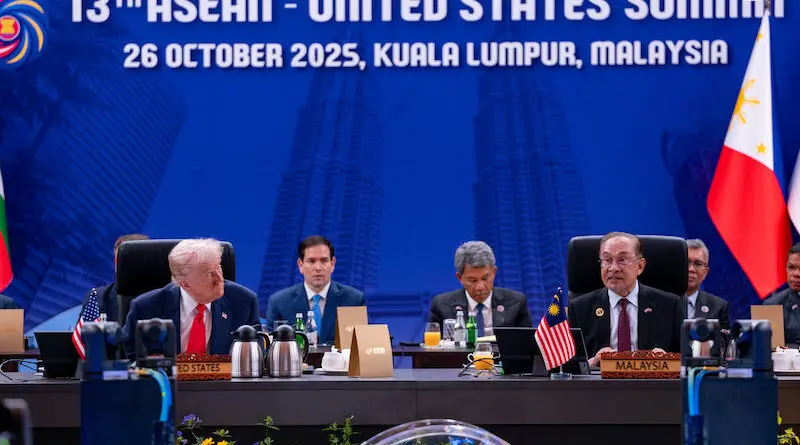
US President Donald Trump with Malaysia's Prime Minister Anwar Ibrahim. Photo Credit: @anwaribrahim, X
November 2, 2025
By Murray Hunter
Just as former president Barak Obama made his Asian pivot, a cornerstone of US foreign policy back in 2009, Trump’s pivot was met with turbulence as well. Obama met a very muted welcome in Cambodia after ecstatic welcomes in Thailand and Myanmar. Although Trump started his trip by dancing, he found that his charisma doesn’t work with the Chinese and North Korean leadership like it did in Kuala Lumpur, Japan and Korea – highlighting major strategic problems.
While the US government has been in complete shutdown for a number of weeks and unlikely to be resolved quickly, US president Donald Trump made a three stop Asian tour. There were two important items on the agenda, a meeting with China’s President Xi Jinping and to preside over a Thai-Cambodia peace agreement.
Dancing his way in Kuala Lumpur
Trump’s first stop was Kuala Lumpur where the annual ASEAN Summit was going on and the Thai-Cambodian peace agreement was to be signed in front of him. A nervous Malaysian prime minister Anwar Ibrahim greeted president Trump on the tarmac at KLIA. Anwar had been a very outspoken supporter of Hamas and the Palestinians and there were high local expectations he would confront Trump, especially when Israel is breaching the ceasefire agreement.
However, Trump’s arrival became very jovial when he walked up to the traditional Malaysian dancers greeting him and danced along with them. Prime minister Anwar very uncomfortably joined Trump in dancing. Trump then invited Anwar to accompany him on the 60 km drive to Kuala Lumpur in the presidential limousine known as the beast, where they had a private one-to-one discussion.
Trump signed a controversial trade deal with Malaysia. Although, it looks more like this document was created as an agreement very hastily to please both Trump and Anwar. The Thailand-Cambodia peace agreement was the real highlight of the day, where Thai prime minister Anutin Charnvirakul came down to Kuala Lumpur to sign and quickly returned to Bangkok due to ceremonies related to the recent passing away of the Queen Mother Sirikit. Anutin was heard to say this was the first step in a road to peace with Cambodia. Over the last few days, both sides have been making an effort to ease the tensions and follow the terms.
Trump also signed a number of other agreements with other ASEAN leaders. These included reciprocal trade agreements with Cambodia, Thailand and Vietnam. These agreements highlighted Trump’s intent to deal bilaterally with ASEAN nations, rather than as a block. Trump also signed the Artemis Accords with Malaysia and the Philippines, bringing the total signatories to 59. Trump also had side talks with Brazilian president Lula.
Most of the agreements signed were ceremonial rather than of great substance. Perhaps the most telling thing is that Trump did not extend any invitations to any ASEAN national leader to visit the White House at any future point of time.
The coming out of Sanae Takaichi
The second leg of president Trump’s Asia tour was Japan. Trump was given a warm welcome by Japan’s first female prime minister Sanae Takaichi. Yet to be tested diplomatically, Trump’s visit was her debut and a metaphoric ‘coming out’ of prime minister Takaichi. Trump came to Japan as a ‘ceremonial chief’. Much of his visit was symbolic and ceremonial.
Prime minister Takaichi skillfully handled her guest watching the World Series with Trump before going out to join the official meetings. She presented Trump with the late Shinzo Abe’s golf putter and presented to the City of Washington 250 cherry trees for the 250th anniversary of the United States, plus Akita fireworks for next year’s July 4th celebration.
Trump with prime minister Takaichi in tow visited the aircraft carrier USS George Washington at Yokosuka Naval Base.
Perhaps the prominent images of Trump’s Japan visit, was the small Takaichi dancing around a grump old man. The pictures show Takaichi’s spontaneity that really outshone Trump. Trump’s moves to “YMCA” on the USS George Washington looked tired and hugged.
Korea – Where Trump got his crown
Korea has always been an important market for South Korea. Just short of 19 percent of Korean exports go to the United States. South Korea reached a record level of USD 683.8 billion in 2024, up 8.2 percent on 2023. Almost 20 percent of South Korea’s exports to the United States are semiconductors.
On the sidelines of the Asia Pacific Economic Cooperation (APEC) Summit Trump and his South Korean counterpart Lee Jae Myung in an hour and a half meeting, agreed to reduce US tariffs on Korean goods from 25 to 15 percent on most goods. This is on the basis of South Korea agreeing to invest US$350 billion in the US over the next decade. US$150 billion will come from the South Korean ship building industry. South Korea will build a nuclear submarine for the US in the United States, with US technology sharing. This will expand the US capacity to build nuclear submarines. South Korea also wants this technology to build its own nuclear submarines at home.
President Lee requested the taking over of wartime operational control from the current United Nations-US led command structure on the peninsula. This is being welcomed by the Trump administration.
President Lee presented Trump with a gold jewel-crusted Grand Order of Mugungwha, the nation’s highest award, and a copy of the Silla Dynasty Gold Crown worn by 8th Century Korean Monarch.
The Trump-Xi meeting
The Trump-Xi meeting inside a meeting room at a military airbase in Busan was a low point in the Trump Asian tour. The meeting was as sterile as the room it was held in. While en route to the APEC Summit in Busan in Marine one, Trump said he had instructed the Department of War to resume nuclear weapons testing. This not only looked antagonistic, but hollowed an sense of inferiority as well.
China’s President XI and his team were very frosty, evidence by the two leaders’ public appearances together. Trump attempted to tell the media cluster of the close relationship he had with president Xi a number of times, but this was not reciprocated. Although Trump lowered US tariffs on Chinese goods from 57 to 47 percent, nothing of note eventuated, except for some movement by China on their rare earth export ban to the United States.
The meeting signifies a chronic failure of US policy on China since Trump’s inauguration last January.
Kim didn’t answer
The final letdown of Trump’s Asia visit was the silence from North Korean Leader Kim Jung Un to meet with Trump, as he did during his 2019 visit to the DMZ between the north and south. No final pictures to echo any statesmanship of the US president. There was total silence by North Korea to White House overtures. Kim has already had very successful meetings with Russian president Putin and the Chinese President Xi over the last few months. The Trump meeting was unnecessary from Kim’s point of view.
The frosty response to the Trump-Xi meeting in Busan and silence from Kim Jung Un, comes at a time when Russian-US relations as taking a spiral downwards since the Anchorage summit last August. This should be very concerning where the prime theatre of antagonism will be East Asia. All momentum towards a peaceful multipolar co-existence is being erased by US primacy being surpassed by nations possessing much more modern weapons than the US arsenal. It appears Trump and his military and security advisors have not realized the US is no longer the unchallenged military power in the world.
Much of Trump’s visit indicated the transactional level of relationships with most of the region’s leadership. Certainly, the leaders of the members of ASEAN were polite enough to placate the president during his overnight visit to Kuala Lumpur. Its unlikely, Trump will ever attend another ASEAN Summit unless there is something in it for him.
One of the negative spin-offs of “The Art of the Deal” is that resulting relationships seem to become very transactional. That’s how president Trump left his Asian pivot. Perhaps the only real takeaway was the rare earth agreements signed wherever Trump went, although it may take a decade for any of them to come to fruition.
While Trump’s “Independence Day” tariff strategy worked well with countries smaller than its own economy, it seems to have backfired on China. The cost of Trump’s tariff policy has not only set back Sino-American relations, US consumers are paying for them with the higher prices they are paying for goods.
Trump’s pivot, as with Obama before him may in history be seen as Trump’s folly. Just as Obama was humiliated in Cambodia back in 2009, Trump was humiliated by the frosty reception of China’s president Xi and the silence of Kim Jung Un. This showed that in Asia, Trump isn’t appreciated as the “biggest show on Earth” by all. The US will have to re-focus upon the western hemisphere over the next few months, where Chinese and Russian influence aren’t too far away.

Murray Hunter
Murray Hunter has been involved in Asia-Pacific business for the last 30 years as an entrepreneur, consultant, academic, and researcher. As an entrepreneur he was involved in numerous start-ups, developing a lot of patented technology, where one of his enterprises was listed in 1992 as the 5th fastest going company on the BRW/Price Waterhouse Fast100 list in Australia. Murray is now an associate professor at the University Malaysia Perlis, spending a lot of time consulting to Asian governments on community development and village biotechnology, both at the strategic level and “on the ground”. He is also a visiting professor at a number of universities and regular speaker at conferences and workshops in the region. Murray is the author of a number of books, numerous research and conceptual papers in referred journals, and commentator on the issues of entrepreneurship, development, and politics in a number of magazines and online news sites around the world. Murray takes a trans-disciplinary view of issues and events, trying to relate this to the enrichment and empowerment of people in the region.

No comments:
Post a Comment