A Ceasefire in Name Only: Gaza’s Prolonged Purgatory

Photograph by Nathaniel St. Clair
A ceasefire can be a strange thing. The assumption, generally speaking, is that the parties to it restrain themselves for a period of time, ordering their forces and disciplining their charges from straying. But straying happens, transgressions inevitable. Some are genuine enough: silly misunderstandings, hot headed confusion, a fear that the other side has broken it. Room for error, and a degree of death and injury, is crudely permitted.
In the case of the Israel-Hamas ceasefire, transgressions have become the lingua franca of the parties, though Israel remains, by far, the perpetrator par excellence. The latter’s departures from the agreement have been so vicious as to prompt the observation that they are pursuing a mutilated reading of the agreement, essentially a “reducefire”. The deaths of 347 Palestinians in Gaza since October 10, including 136 children, do not point to cooling restraint.
On October 28, at least 104 Palestinians were slaughtered in a single day. This might have suggested a breach so serious as to suggest a repudiation. Not so, claimed Qatari Prime Minister, Sheikh Mohammed bin Abdul Rahman Al Thani. “Fortunately,” he told a US audience, “I think the main parties – both of them [Israel and Hamas] – are acknowledging that the ceasefire should hold and they should stick to the agreement.”
What is becoming apparent is that the ceasefire has led to a state of affairs where Israeli forces have been permitted enormous latitude in the way it inflicts violence on local Gazans. The UN Women’s Chief of Humanitarian Action, Sofia Calltorp, reveals how Gazan women told her “again and again: there may be a ceasefire, but the war is not over. The attacks are fewer, but the killings continue.” Agnès Callmard, Secretary General of Amnesty International, goes so far as to declare that the ceasefire has created “a dangerous illusion that life in Gaza is returning to normal.” What has in fact happened is a mere reduction of “the scale of [Israel’s] attacks” and the meagre allowance of humanitarian aid into the Strip.
In a briefing note released on November 27, the organisation is adamant that “Israeli authorities are still committing genocide against Palestinians in the occupied Gaza Strip, by continuing to deliberately inflict conditions of life calculated to bring about their physical destruction.” Expulsions continue, prosecutions of alleged atrocities and war crimes by Israeli forces non-existent. The means to build the crucial infrastructure required to sustain life is being hampered, while unexploded ordnance, contaminated rubble and sewage, remain unaddressed.
Structural realities have also intruded. The Israeli Defense Forces remain in control of over 58% of Gaza. According to a clutch of special rapporteurs and experts in the employ of the United Nations, including Francesca Albanese, Ben Saul and Irene Khan, 40 active Israeli sites continue to operate “beyond the agreed withdrawal line, in clear breach of the ceasefire terms.” They also warn that the UN Security Council resolution authorising the deployment of an International Stabilisation Force (ISF), with Egypt and Israel coordinating border matters alongside a spanking new Palestinian trained police force “risks replicating – if not aggravating – the model of security coordination that has entrenched Israel’s settler-colonial apartheid regime in the West Bank”.
Humanitarian assistance remains at a painful trickle, an obscene state of affairs given the levelling devastation wrought by the war (85% of water and sanitation facilities were damaged or destroyed; likewise 92% of homes). The charity Oxfam does not spare any details in what is needed: “The most pressing needs include food and healthcare and shelter, as well as water, sanitation and hygiene services (WASH) including menstrual products and waste management services.” While some food and goods have become more available in local markets, they remain prohibitively expensive for Gaza’s residents.
Between October 10 and 21, seventeen international non-government organisations had essential aid shipments for Gaza, including water, food, tents, and medical supplies, blocked, with Israeli authorities claiming they were not authorised to do so. Some 99 requests by international NGOs to deliver aid were rejected, along with six requests from UN agencies. “This includes,” stated Oxfam last month, “agencies that continue to have long-standing INGO registration with Palestinian and Israeli authorities and are legally permitted to operate by the latter while new registration processes are ongoing.”
A system of brutality, practised, insistent, even casual, has been entrenched against those in Gaza and, increasingly, the West Bank. The summary execution of two men in Jenin by Israeli soldiers after their surrender was lauded by Israel’s National Security Minister, Itamar Ben-Gvir, who thought the killings the very thing “expected of them”. Implicit is the suggestion that Palestinians are required to behave in specific, tolerated ways: humbly submit to their apparently generous oppressors, suffer ceaseless purgatorial deprivation and accept a ceasefire in name only.
The US-Israeli Scheme to Partition Gaza and Break Palestinian Will
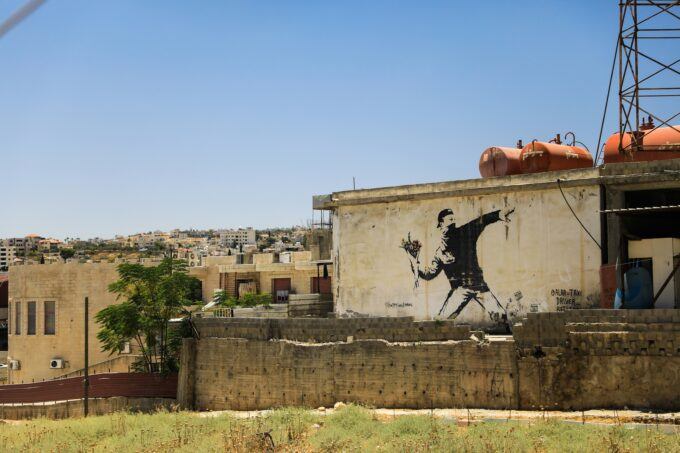
Image by Dylan Shaw.
United Nations Security Council Resolution 2803 is destined to fail. That failure will come at a price: more Palestinian deaths, extensive destruction, and the expansion of Israeli violence to the West Bank and elsewhere in the Middle East.
The resolution, passed on November 14, 2025, was a consolation prize to Israel after failing to achieve its ultimate objective from the two-year Gaza genocide: the ethnic cleansing of the population and the complete takeover of the Gaza Strip.
Gaza shattered a core Israeli doctrine: the absolute certainty of its military supremacy to subdue the Palestinian people using far superior US and Western-supplied technology. Though the occupation was never expected to be easy – as Israel’s history of violence in the Strip attests – the complete takeover was, in the mind of the Israeli leadership, a certainty. In August, Israeli Prime Minister Benjamin Netanyahu stated with total confidence that Israel aimed to “take control of all of Gaza.” That proved to be wishful thinking.
How Israel has failed to subdue an impoverished and besieged population of 2 million people, subjected to a blockade, a famine, and one of the world’s most horrific genocides, is a question for future historians. The immediate consequence, however, is political: Israel and its Western backers, especially the US, understand that an utter Israeli failure in Gaza would be interpreted by Israel’s victims as a pivotal sign of the times.
In fact, the notion of Israel’s implosion and the end of the Zionist project has moved from the margins of intellectual conversation into the center. These ideas are bolstered by the Israelis themselves and are a recurring topic in Israeli media. Such a headline in Haaretz on November 15 is hardly shocking: “At a Secret Harvard Site, a Massive Archive of Israeliana Is Preserved – in Case Israel Ceases to Exist”.
Thus, US President Donald Trump’s so-called “Comprehensive Stabilization Plan for Gaza,” signed in Sharm el-Sheikh on October 30, 2025, was the official start of the American scheme to save Israel from its own blunders. That supposed ‘ceasefire’ was meant to give Israel the chance to maneuver. Instead of occupying all of Gaza and pushing Palestinians out, Israel would now use social and political engineering to achieve the same goal.
The first phase of the plan, which placed most of Gaza under Israeli military control in anticipation of a gradual withdrawal, is already proving to be a sham. As of the time of writing this article, Israel, according to the Gaza government media office, has violated the agreement nearly 400 times, killing over 300 Palestinians. Israel continues to systematically demolish Palestinian areas and has increasingly begun operating west of the Yellow Line, which separates Gaza into two regions.
Worse still, according to Gaza authorities, Israel has been expanding its share of Gaza, estimated at approximately 58 percent, westward. The ‘ceasefire’ has effectively enforced a new mechanism that allows Israel to carry out a one-sided war – with further territorial expansion, destruction, assassination, and occasional massacres – while Palestinians expect nothing but the mere slowing down of the Israeli death machine. This is not sustainable, especially since Israel has also violated the most basic principle of the imaginary ceasefire: allowing vital aid to enter Gaza.
UNSC 2803 endorses the “Comprehensive Stabilization Plan for Gaza” without placing any legally binding expectations on Israel. It establishes a Transitional Administration and Oversight Council (TAOC), which entirely excludes Palestinians, including the Western-supported Palestinian Authority.
The executive branch of this TAOC would be the International Stabilization Force (ISF), whose sole job is to “stabilize the security environment in Gaza” on behalf of Israel, notably by disarming Palestinian groups. The ISF, according to the resolution, operates “in close consultation and cooperation,” meaning the force is tasked with achieving Israel’s military objectives, thereby allowing Israel to determine the timing and nature of its supposed gradual withdrawal.
Since Palestinians refuse to disarm – as unconditional disarmament without meaningful international guarantees would surely lead to the full return of the Israeli genocide – Israel will certainly refuse to leave Gaza. Netanyahu made that clear on November 16, when he stated that “Israel would not withdraw” without disarming Hamas, “either the easy way or the hard way”.
The partition of Gaza is a US-led attempt to change the nature of the challenge for Tel Aviv, but ultimately aims at achieving the same original objectives. The resolution has served Israel’s interests fully, hence Netanyahu’s enthusiasm, yet Israel is still refusing to respect it, making it clear there will be no phase two of Trump’s original plan.
The entire political scheme, however, is doomed to fail. Though Palestinian suffering will certainly worsen in the coming months, the US-Israeli gambit is fundamentally flawed: it is built on trickery and coercion, resting on the false assumption that Palestinians, fearing genocide, will accept any plan imposed on them. This premise ignores history. Palestinians have consistently defeated such sophisticated mechanisms designed to break them, meaning this new arrangement is equally unsustainable.
Ultimately, the failure of UNSC Resolution 2803 confirms one enduring truth: the Israeli war on Gaza has not stopped. It has simply changed form. It is crucial that people around the world understand this next phase for what it is: a diplomatic maneuver designed to facilitate the ongoing Israeli plan to control the Gaza Strip and ethnically cleanse its population.
How Did We Get Here?—Palestine and the Mandates of Deception

Each day, we learn of Israel’s theft of yet another slice of Palestine. Piece by piece, acre by acre, the Palestinian nation has been seized by Israeli offensive forces and carved up by Zionist colonizers in contravention of all treaties, accords, “peace” agreements and the like.
Meanwhile, Israel remains accountable to no laws, no treaties and no global organizations. It takes what it wants, when it wants. It kills, destroys, pillages, imprisons, rapes and tortures because it has been allowed to.
It is important to understand how Israel’s wantonness and lawlessness unfolded, especially as the United Nations Security Council (UNSC) recently delegated trusteeship (authority) of Gaza to the Trump administration, essentially handing the United States an internationally sanctioned “mandate” of the enclave.
It is the shameful story of the manner in which the League of Nations, created by the British and other imperial powers, “gave” itself the “mandate” of Palestine;
how 28 years later, the United Nations authored a plan to partition the mandate; and how, in 2025, the American empire has sought, in collaboration with Israel, to assume “trusteeship” over Palestinian land in Gaza.
The Imperial Mandate System, 1919
The British and French empires learned, after the horrors of World War I, that they
could further their colonial interests in the Middle East, not by aggression, but within the legal framework of international institutions.
The League of Nations served that purpose when, in 1919, after the First World War, the victorious Allied powers established the mandate system—traditional colonialism disguised as benevolence. The mandates, meant to be temporary, served to legalize British and French imperial gains over former Ottoman Empire colonies in the Arab Middle East.
Underlying the mandate system was the imperious racist assumption that the people who had lived for thousands of years on the land were incapable of governing themselves, that they needed the “tutelage of an advanced nation” before achieving independence—an attitude that has yet to change.
The text of the 1919 League of Nations Covenant (Article 22), for example, reveals the inherent racism of the imperial powers; it stated:
“To those colonies and territories… which are inhabited by peoples not yet able to stand by themselves under the strenuous conditions of the modern world, there should be applied the principle that the well-being and development of such peoples form a sacred trust of civilization and that securities for the performance of this trust should be embodied in this Covenant….”
The Mandate of Palestine, 1922
Betrayal of the Palestinian nation began in 1920 when the League assigned the role of mandatory power in Palestine to the British government. The Mandate of Palestine (1922-1948) laid the foundation for the atrocities and colonial wars waged thereafter by Britain, Israel and the United States.
In total disregard for the political rights of the indigenous Arab majority (90 percent at that time), the British government included the text of the 1917 Balfour Declaration in its mandate, pledging to support a “national home for the Jewish people” in Palestine.
By formally approving the mandate in 1922, the League gave legitimacy under international law—law defined by the imperial powers —to the Zionist project, as well as the green light to continue their aggressive expansionist pursuits.
There was nothing in the mandate that gave Britain the right to give away another peoples’ land; land lived on for thousands of years. Instead of decolonization and independence as required, the British government callously and illogically handed Palestine to European colonizers.
United Nations Mandate of Palestine, 1947
Palestine was, once again, betrayed when the disdainful “trusteeship” of the League of Nations was replaced with its political invalidation by the United Nations in 1947.
Like its colonial predecessor, the United Nations—created largely by the United States—was structured to institutionalize the dominance and further the interests of major imperial powers. After the devastation of the Second World War, the United States assumed that autocratic power.
With the establishment in 1945 of the United Nations and dissolution of the League of Nations in 1946, Britain transferred all of its mandate territories—except Palestine—to a UN Trusteeship system.
Despite the rising cycle of violence and unrest, Britain continued its “trusteeship” until 1947 when it officially ceded its mandate, described as a “wasps nest,” to the United Nations. It should be noted that all of the League of Nations mandates were ultimately “guided” toward independence—except Palestine.
The United Nations’ solution to the Palestine “problem” was adoption in 1947 of UN General Assembly (UNGA) Resolution 181 recommending its partition into two unequal states, one Arab and one Jewish, with Jerusalem under international administration.
Although General Assembly resolutions are largely symbolic and are not legally binding on member states, Zionist leaders declared statehood in May 1948. Resolution 181 did, consequently, sow the seeds for Palestinian anti-colonial resistance and perpetual regional conflict and discord.
The Proposed U.S. Mandate of Gaza, 2025
Like all previous imperial actions, the United States has sought to obtain global legitimacy from international institutions to shield the Zionist colony and to impose control over the land of Palestine and the entire region.
By protecting Israel, the United States has sided with powers that exist in a liminal space, outside the law, no matter how dastardly their behavior.
The most recent act of U.S. initiated deception against the Palestinians came with the adoption by the UN Security Council (UNSC) of Resolution 2803, the so-called “Trump Gaza peace plan.” In so doing, it gave international credibility to his proposal and in effect, handed the United States a colonizing mandate over Gaza, passing the occupation and oppression of the Palestinians from Tel Aviv to Washington.
The U.S. “guardianship” plan mirrors the legacy of colonial land theft in Palestine—seizure repackaged and rebranded as peaceful resolution. Once again, plunder and dispossession have been shrouded in the guise of diplomatic “solutions.”
By systematically sidelining the Palestinians, denying their voice, their right to self-determination and their very existence, the United States is continuing the colonial dynamic—imperial policies and racism—that began with the Balfour Declaration and British mandate of Palestine. It has not and will not succeed.
The Palestinian people and leaders cannot be fooled. Interactions and transactions, with their adversaries, forged over decades, have fostered a keen understanding of them. Despite unimaginable hardships and extreme duress, they have refused to surrender and to give up their struggle for national liberation.
Conclusion: Partnership not Obstruction
The historical manipulation of international organizations by powerful states cleared the way for betrayal of the Palestinians and facilitated Israel’s horrors and lawlessness.
Although the United Nations has, since its birth, created a comprehensive body of international treaties, laws, condemnations and countless reports, as well as multinational bodies, like the International Court of Justice, to provide legal interpretation and rulings, it has yet to insure justice for Palestine and its people.
What the Security Council has done, however, is allow the genocidal and rogue Zionist colony of Israel to remain a member of the world body and unaccountable for its 78-year war on Palestine.
Mirroring the United States, the Council’s failure to impose restraints or consequences has cultivated, in Israel, a sense of absolute entitlement and belief that, since 7 October 2023, it has unmitigated impunity to commit genocide, sow discord and wreak havoc across the region.
If it is to have any credibility now and in the future, the United Nations must take measures to redress more than a half-century of failure to fulfill its obligations and to correct the life-altering injustice it wrought with passage of Resolution 181.
One of the first steps it could and should take to restrain Israeli terrorism is to enact UNGA Resolution 377(V), “Uniting for Peace” (adopted in 1950). The resolution empowers the General Assembly to use armed force if the Security Council fails to exercise its primary responsibility of maintaining global peace and security. Text of Section A on the “use of armed force,” informs:
“Resolves that if the Security Council, because of lack of unanimity of the permanent members, fails to exercise its primary responsibility for the maintenance of international peace and security in any case where there appears to be a threat to the peace, breach of the peace, or act of aggression, the General Assembly shall consider the matter immediately with a view to making appropriate recommendations to Members for collective measures, including in the case of a breach of the peace or act of aggression the use of armed force when necessary, to maintain or restore international peace and security.”
Unquestionably, Israel is a regional and global threat, warring on Gaza, the West Bank, on its Arab neighbors and provoking confrontation with Iran. Given that the UNSC has failed its primary responsibilities of preventing genocide, maintaining peace and security, it is time for the majority—the 193 members of the General Assembly—to exert authority (two-thirds majority vote required).
In addition, the United Nations needs to state unequivocally that resisting occupation is a fundamental human right; it isn’t terrorism, it is survival; and that Palestinian resistance, including armed struggle, is legally reinforced under international law.
Also, given Israel’s refusal to adhere to international and humanitarian law, as well as the principles of the UN Charter, the U.N. should determine that the Zionist colony lacks standing within the international community and should be expelled from the world body.
The Middle East and the global community are at a crossroads, and Palestine and its people are at its heart. The need for benign international intervention on behalf of the Palestinians is long overdue. The United Nations must acknowledge, however belatedly, its role in one of the greatest deceptions of history. And, if it is to live up to its charter and conventions, it has an obligation to work toward the liberation and self-determination of the Palestinian people and ultimately to the restoration of their homeland.

No comments:
Post a Comment