Saturday, January 16, 2021

Facebook to ban ads promoting weapon accessories, protective gear in U.S.

(Reuters) - Facebook Inc said on Saturday it will ban advertisements for weapon accessories and protective equipment in the United States with immediate effect until at least two days after U.S. President-elect Joe Biden's inauguration on Jan. 20.
© Reuters/SHANNON STAPLETON FILE PHOTO: Supporters of U.S. President Donald Trump rally outside the State Capitol building as votes continue to be counted following the 2020 U.S. presidential election, in Lansing

Following the attack by supporters of President Donald Trump against the U.S. Capitol on Jan. 6, the social media company said it will now prohibit ads for accessories such as gun safes, vests and gun holsters in the United States.

"We already prohibit ads for weapons, ammunition and weapon enhancements like silencers. But we will now also prohibit ads for accessories," Facebook said in a blog post.

Three U.S. senators sent a letter to Facebook Chief Executive Mark Zuckerberg on Friday asking him to permanently block advertisements of products that are clearly designed to be used in armed combat.

The senators, all Democrats, said the company must take this and other actions to "hold itself accountable for how domestic enemies of the United States have used the company's products and platform to further their own illicit aims."

Facebook on Friday blocked the creation of any new Facebook events in close proximity to places such as the White House and U.S. Capitol in Washington, as well as state capitol buildings, through Jan. 20.

The FBI has warned of armed protests being planned for Washington and all 50 state capitals in the run-up to the inauguration.

Buzzfeed reported this week that Facebook has been running ads for military equipment next to content promoting election misinformation and news about the violence on Jan. 6.

A Facebook company spokesperson said all the pages identified in the Buzzfeed story had been removed, and that the company was working with intelligence and terrorism experts and law enforcement.

(Reporting by Ann Maria Shibu in Bengaluru; Editing by Sonya Hepinstall)
MY PILLOW GUY WANTS TO SMOTHER DEMOCRACY
Attorney in Mike Lindell martial law plan denies knowing of pro-Trump plot

A US army cyber attorney has expressed confusion at apparent plans among Trump allies to place him in a senior national security role, as part of a mooted move to impose martial law and reverse the president’s election defeat. 

.
© Provided by The Guardian Photograph: REX/Shutterstock

A day after his name and location appeared in notes carried into the White House by the My Pillow founder, Mike Lindell, Frank Colon told New York magazine he was “just a government employee who does work for the army” at Fort Meade, in Maryland.

Reporter Ben Jacobs added that Colon “seemed befuddled [over] why he would be floated to the president in any senior role and said that he never met Lindell”, although he said he had “seen him on TV”.

Ads for his sleep-aiding pillows made the mustachioed Lindell a familiar figure on American screens before he emerged as a leading Trump ally and booster.

The president was this week impeached a second time, for inciting supporters to attack the US Capitol on 6 January, leaving five people dead. Trump will leave office on Wednesday, when Joe Biden becomes the 46th president. Nonetheless, Trump still has not conceded defeat in an election he claims without evidence was stolen through mass voter fraud. Lindell has insisted Trump will begin a second term.

“I get called into a lot of projects for the Pentagon,” Colon told Jacobs, formerly of the Guardian, saying such projects included the Operation Warp Speed programme for coronavirus vaccine development and delivery.

He also said it “would be odd to reach that far down” in the Department of Defense for a role like national security adviser, but also said “people know me in the Pentagon” because not many people practise cyber law.

Jacobs reported that though Colon said he did not use Twitter, an account under the name Frank Colon Esq contained messages supportive of Trump and said of Biden: “If you need the military to protect you from the people during your fraudulent inauguration the people didn’t vote for you.”

Lindell did not respond to the pool reporter at the White House on Friday, when his notes were captured by a photographer from the Washington Post. He did not comment to New York magazine.

But on Friday the New York Times reporter Maggie Haberman reported that Lindell had been “carrying the notes for an attorney he’s been working with to prove the election was really won by Trump, wouldn’t say who it was. Said some of it related to reports Trump is now unable to see because he doesn’t have Twitter.”

Twitter and other platforms banned Trump after the Capitol attack, in which a police officer who confronted rioters and a supporter of the president shot by law enforcement were among those who died. Multiple arrests have been made amid reports of further pro-Trump protests before the inauguration.

Haberman said Lindell’s White House meeting was “brief” and “contentious”.

“Lindell,” she wrote, “insists the papers he was holding, which were photographed and visible, didn’t reference ‘martial law’. An administration official says they definitely referenced martial law.

“But an administration official says Trump wasn’t really entertaining what Lindell was saying. Lindell also seemed frustrated he wasn’t getting more of a hearing.”

Haberman also reported that “among the items on Lindell’s list was replacing [national security adviser Robert] O’Brien”.
The super-rich are using luxury concierge services to get COVID-19 vaccine

If you have a net worth of $800 million, then you may be in luck when it comes to securing the COVID-19 vaccine
.
© GIUSEPPE CACACE/AFP via Getty Images A sign indicates the way to the COVID-19 vaccination service at al-Barsha Health Centre in Dubai on December 24, 2020.

According to Forbes, that's the minimum standard you must reach to join Knightsbridge Circle, a prestigious luxury concierge service that has been flying its members to places like the United Arab Emirates to get inoculated.

The Telegraph in the U.K. first reported the news of the luxury vaccination "holidays."

On its website, Knightsbridge Circle is described as "an exclusive travel and lifestyle service" that "has encapsulated a simple idea: exceptional personal service at an unsurpassed level."

"A carefully curated membership ensures that clients receive unparalleled access to the very best of everything that life has to offer," it reads.

Indeed, the concierge service currently has a long waiting list, and you're only able to join if you're personally invited. Additionally, the services are capped to 50 members only.

Knightsbridge Circle describes its services at length, saying it anticipates clients' needs by "sourcing the most desirable events and bespoke journeys; locating luxurious accommodation and transport; negotiating premium upgrades and savings; opening doors to unique and unforgettable experiences."

One of these "unique and unforgettable experiences" is flying to another country to get a COVID-19 vaccine, which the vast majority of the worldwide populace isn't even close to receiving.


"It's like we're the pioneers of this new luxury travel vaccine program," founder of Knightsbridge Circle Stuart McNeill said to The Telegraph, adding that approximately 20 per cent of members have already flown to Abu Dhabi and Dubai in the UAE to receive the vaccine.

"You go for a few weeks to a villa in the sunshine, get your jabs and your certificate and you're ready to go."

McNeill says the two UAE cities are offering up private vaccinations of the Pfizer vaccine, and in India, the Oxford/AstraZeneca vaccine. His services have only just secured the Indian trips, and he's started booking them this week.

He estimates a cost of almost $70,000 for a month-long trip to Dubai with first-class Emirates flights, a meet-and-greet, accommodation in a sea-view apartment and, of course, the purpose of the voyage: the COVID-19 vaccination.

"They land, have their first jab and wait for the second one," he said. "We've got some people that are going to India for the whole time and others are talking about flying in, having the first jab, flying out to Madagascar, and then coming back for the second jab later."


Sure, why not?

One caveat to the vaccination via Knightsbridge is it will not facilitate the package for anybody under 65 years of age. As of this writing, no one under that age has received the COVID-19 vaccine through the concierge service.

McNeill says his service has a "moral responsibility" to prioritize individuals who "really need" the vaccine.

"It's not just been our members, but their parents and their grandparents as well," he said to The Telegraph. "But if you're a 35-year-old young chap who goes to the gym twice a day, you've got no chance of getting the vaccine through us. That's for sure."

Around 40 per cent of Knightsbridge Circle members are from the U.K. It's unclear how many members, if any, are Canadian. The services report a 15 per cent increase in membership numbers since the pandemic began last year.


In the past, Knightsbridge Circle has made some outrageous, dream-like scenarios come to fruition, including vow renewals by the Pope himself and a private viewing of the U.K.'s Crown Jewels in Tower Bridge.

News of the private trips comes as the world rushes to vaccinate amid big surges in COVID-19 infections, and as Canadian doctors call for more transparency about the vaccine rollout.

The Canadian Association of Emergency Physicians is calling for a clear description of who is being prioritized for the first doses and why. It also wants priority to go to those directly caring for patients who are critically ill or suspected of having COVID-19.

The association says many members in areas with limited human resources have not been vaccinated, but urban providers who have less patient contact appear to have received doses.

— With files from The Canadian Press


How Anti-Abortion Terrorism Fueled The MAGA Attack On The Capitol

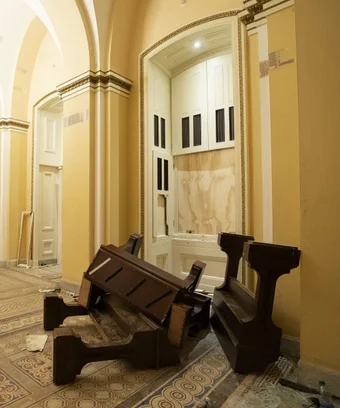
Last week, the world watched in horror as a pro-Trump mob, urged by the President himself, attacked the U.S. Capitol in an effort to overturn the results of the 2020 presidential election. Thousands of angry people, rushed the Capitol building, overwhelming the law enforcement officers who were staged outside. They smashed windows and broke down doors; thousands of them flooded into the Capitol building itself. For several hours, they occupied congressional offices and triumphantly paraded through the House and Senate floors, wreaking havoc and calling for violence against and death for politicians and police officers, alike. By the end of the seditious melee, five people were dead.

© Provided by Refinery29

One of the people there was John Brockhoeft, who posted online about his presence at the Capitol. Brockhoeft isn’t just any Trump supporter. He’s also a convicted anti-abortion terrorist.

His presence wasn’t a coincidence, but an example of the long-standing crossover between anti-abortion and white supremacist terrorist movements, and how America’s complacency around both has helped pave the way for this moment of terrifying insurrection.

There were other anti-abortion activists who were involved in the attack, according to a NARAL report. One of them was Abby Johnson, a former Planned Parenthood clinic director turned anti-choice extremist, who was present during Trump’s speech inciting the riot. Another was Taylor Hansen, an anti-choice activist connected to a group called Baby Lives Matter, who posted violent videos to Twitter during the riots.

As long as abortion has been legal in this country, it has been under siege. Since 1977, there have been 11,905 acts of violence against abortion providers, including 42 bombings, 189 arsons, and 11 assassinations. Clinics have experienced more than 700,000 incidents of disruption.

These acts of violence and harassment grew steadily over decades, as anti-abortion extremists saw how little retribution they faced for escalated their tactics. In 1982, Joseph Scheidler, an anti-abortion activist who literally wrote the book on how to harass abortion patients and staff, hired a private detective to find a teenager’s address and then harangued her mother from an adjacent balcony to talk her out of an abortion. Scheidler inspired Randall Terry, another anti-abortion extremist, to found Operation Rescue — a radical, direct-action anti abortion group — in 1987. Terry once proclaimed, “If you think abortion is murder, then act like it’s murder.” He also led thousands of people in massive blockades at abortion clinics, chaining themselves to doors, laying down in front of traffic, gluing locks — anything to prevent the clinic from operating. Law enforcement’s presence was often lax or non-existent; in San Francisco, it took the police two hours just to show up after the blockade began.

Operation Rescue was able to shut down clinics across the country and terrorize abortion patients, unchecked by the federal government, for nearly a decade. That sense of complacency among lawmakers and apathy on the part of some law enforcement officials helped fuel the dramatic rise and escalation in anti-abortion extremism. By 1993, just two decades after Roe v. Wade was decided, anti-abortion extremists had escalated from picketing to stalking to blockading to bombing to assassination.

Brockhoeft came of age as an extremist in that environment. He bombed two abortion clinics in Cincinnati in 1985, and was convicted three years later of attempting to bomb an abortion clinic in Florida. He was out of prison by 1995 and further embraced the far-right. In April 2020, he was spotted outside the Ohio Statehouse, surrounded by armed, right-wing extremists, aggressively protesting the COVID-19 shutdown order.

Much has been made of the racist double standard that law enforcement displayed in their response toward the Capitol rioters as compared to how they dealt with Black Lives Matter protesters. A video appeared to show Capitol police officers opening the protective gates around the building, allowing a swarm of pro-Trump rioters to march past. Once the mob had successfully broken in, a Capitol police officer, in full uniform and a neon vest, posed for a selfie with a rioter. The mob kept moving, marching toward their next site of desecration.

It was a harrowing moment of familiarity between law enforcement and law breaker, one that is well known in abortion rights circles. In August 1979, a Fort Wayne, Indiana abortion clinic received a bomb threat. The city refused to dispatch either police or fire officials, forcing clinic staff to search for the bomb themselves. Nearly 40 years later, Becca Ballenger, a clinic escort in New York City, called in a complaint about protesters violating the 15-foot buffer zone at the clinic. When he arrived, she told Refinery29, she watched the responding officer approach the violator, shake his hand, and give him a hug. He then turned to the group of clinic escorts and said, “What are you doing to restrict their First Amendment rights today?”

When law enforcement refuses to take anti-abortion harassment and violence seriously, even if it’s only in certain cities, it signals their tolerance of that behavior. But it’s not just law enforcement––our cultural complacency around anti-abortion terrorism has helped normalize what should be unthinkable. The image of sweet grandmothers quietly praying the rosary and polite teenagers, standing alone with a gentle sign (a la Juno) belie the very real aggression and violence that has always existed. Under the Trump administration, clinics have reported receiving an increasing number of harassment, threats, and violence. As a clinic escort myself, I’ve seen the rhetoric and behavior outside the clinic shift, with harsher, more openly racist rhetoric from increasingly angry men wearing a mix of “Abortion is Murder” T-shirts and “Make America Great Again” red hats. It’s no coincidence that at the same time, white nationalist groups have risen by 55% over the last few years, emboldened by a President who called them “very fine people” after rioting in Charlottesville.

If you asked yourself, “How did this happen? Where did these people come from?” while watching the riot unfold, ask yourself another question: When was the last time you saw what was happening outside an abortion clinic? When was the last time you really paid attention? When was the last time you just ignored someone spouting well-known falsehoods about abortion, about Black Lives Matter, about the results of the 2020 election? We hear so much about “breaking out of our siloes,” but we don’t have to excuse right-wing extremism to see it happening. At the very least, we have to start acknowledging that it’s happening, that it’s been happening, and many of us just haven’t cared enough to speak up because it didn’t affect us. Until it did.

Conspiracy theories and outlandish rhetoric aren’t without consequences, particularly when encouraged by those in power. In 2015, anti-abortion extremists launched a highly visible smear campaign against Planned Parenthood, featuring doctored videos that accused the organization of illegally selling fetal body parts. It was absurd and completely untrue, but that didn’t stop Congressional Republicans from embracing the conspiracy theory, decrying Planned Parenthood, and opening an investigation into the organization. Just a few months later, Robert Dear opened fire on a Planned Parenthood clinic in Colorado Springs, killing three people, including a security guard. Dear confessed that he was “upset with them performing abortions and the selling of baby parts,” a direct reference to the cooked-up, anti-abortion smear campaign — a conspiracy theory that certainly has echoes in other far-right conspiracies like QAnon.

President Trump has been booted off various social media platforms, but he doesn’t need a Twitter account to continue to fuel the the same kinds of wild conspiracy theories that led Robert Dear to murder three people. He doesn’t need a video on Facebook to incite his supporters to ever-more rabid and racist violence. The coup attempt at the Capitol wasn’t inevitable––it was entirely preventable. But not without a justice system that prioritizes the rights and lives of the marginalized. Not with police officers who pose for selfies and even join the insurrectionist riot. Not with city officials ignoring credible bomb threats. Not without each of us decrying right-wing fascism and violence, no matter who the target may be.

UNIONS OPPOSE USE OF PRISON LABOUR
White Supremacists Attacked The Capitol. 
Now, Prison Labor Will Clean Up The Mess

WHIZY KIMLAST UPDATED JANUARY 8, 2021,


PHOTO: KBD/UPI/SHUTTERSTOCK.

On Wednesday, January 6, a violent mob of Trump supporters stormed and occupied the Capitol in an attempt to stop Congress from counting the electoral votes that would confirm Joe Biden as the 46th president. At the time of writing, five people have died as a result of the insurrection.

After the mob was sufficiently amused by their selfies and live streams and had stolen enough artifacts to remember the insurrection, they left behind a heap of broken glass, furniture, and trash — and also a very important question. Who, exactly, would clean up this mess? It's important to ask exactly whose labor we rely on to return to a veneer of normalcy and civility in the wake of a violent riot of white supremacists. Does the U.S. government go antiquing for some replacement mahogany desks?

As TikTok user Jessica Jin (@jinandjuice) explained in a viral video yesterday, one possible replacement for damaged government furniture could be new pieces produced by incarcerated people in federal prisons:

Related Stories

Police Treat White Rioters Like Their Lives Matter


Let's Not Forget That Nazi's Stormed The Capitol


Why Inmates Were Fighting California Wildfires


@jinandjuice
Cleaning up after a coup is literally dirty business. #coup #fyp #congress #capitol #furniture #justice #prisonlabor #america♬ original sound - jessica jin


Federal Prison Industries (FPI), also known as UNICOR, is a government-owned corporation that uses prison labor to produce everything from office furniture to awards and plaques. As Jin explains in the video, FPI is a "mandatory source" for government agencies, meaning it must be given priority when the government is considering the purchase of goods of the kind that FPI manufactures, such as office furniture. After an agency realizes it doesn't have the goods it needs in its inventory, and other agencies don't have excess supplies, it must next consider if FPI's products are comparable to other commercial sources for "price, quality, and time of delivery."

There are exceptions to this process, which means it's not as simple as every single government office chair having to be sourced from FPI — but according to the Federal Acquisition Regulation, which lays out the rules for the federal government to procure goods and services, "agencies are encouraged to purchase FPI supplies and services to the maximum extent practicable [emphasis added]." According to its fiscal year 2019 annual management report, "FPI sells products and services to the majority of federal departments, agencies, and bureaus."

Prison labor has a long history in our country, codified by the 13th Amendment, which outlaws slavery and indentured servitude in the U.S. "except as a punishment for crime." Within federal prisons, FPI jobs are coveted as some of the higher-paying ones — boasting rates between 23 cents to $1.15 an hour. Federal inmates are required to work unless medically exempt, with workdays lasting upwards of 12 hours, and a large portion of their meager earnings automatically go toward "court-ordered fines, victim restitution, child support, incarceration fees, and other monetary judgments" and paying for their own room and board in prison — paying to be imprisoned.

While Jin's TikTok focused specifically on replacing items in the Capitol, prison labor goes beyond federal buildings. Many state universities also procure furniture produced by the exploitation of incarcerated people; inmates pick potatoes in Idaho, fight California wildfires, and during COVID, inmates in New York have been forced to make hand sanitizer — a product they were not allowed to use themselves.

The government, for its part, insists that prison labor is for the good of incarcerated people. FPI's website claims that it is "first and foremost, a correctional program," and on a page that delves into the corporation's history, states that "despite periods of criticism from detractors, increasingly constrictive procurement laws, misinformation and stigma associated with the value of inmate-made goods, prison industry work programs have endured."

Prison labor pretends that forcing incarcerated people to work for little to no pay is meant to be rehabilitation, a generous path to moral salvation. FPI claims that their laborers show reduced instances of recidivism, but the Government Accountability Office reported this year that in fact, FPI had not "reviewed its impact on recidivism (a person's relapse into criminal behavior) in over two decades." Overall, there is very little data on the idea that prison labor programs are effective in their stated intent to rehabilitate.

What is clear is that it can be a profitable enterprise. In the 2019 fiscal year, FPI employed about 16,500 people incarcerated in federal prisons. Its biggest customer is the Department of Defense, which provides FPI with over half of its total sales. In 2019, its net sales were about $531,453,000.

Given the incomparably higher rates of incarceration of Black Americans compared to white Americans, the exploitation of incarcerated people isn't simply a labor issue. More precisely, it's an intended function of institutional racism — what many call modern-day slavery — rearing its ugly head in the aftermath of a display of violent white supremacy.
The Alt Right Is Planning Armed Actions On Inauguration Day. Here’s What We Know So Far.

It’s only been a little over one week since the failed but deadly Capitol coup staged by far right extremists. And there are only five days left until Inauguration Day when President-elect Joe Biden will officially be sworn in. Although Trump has now finally denounced the violence that took place January 6 and asked for armed protesters to cease any further action — especially on his behalf — many are still planning to crash Inauguration Day in the worst ways.
© Provided by Refinery29 TOPSHOT – Trump supporters clash with police and security forces as they try to storm the US Capitol in Washington, DC on January 6, 2021. – Demonstrators breeched security and entered the Capitol as Congress debated the a 2020 presidential election Electoral Vote Certification. 
(Photo by JOSEPH PREZIOSO/AFP via Getty Images)

Ahead of next Wednesday’s event, Washington, D.C. and many states across the country are ramping up security measures and preparing reinforcements in case of armed protests on or before Inauguration Day. Currently, federal officials have reiterated warnings to leaders around the country that there are indefinite concerns about more extremists gathering for rallies and riots. An internal agency bulletin that was obtained by CNN this week warned that the FBI has received threats of “armed protests” in all 50 state capitols and at the Capitol.

“While our standard practice is to not comment on specific intelligence products, the FBI is supporting our state, local, and federal law enforcement partners with maintaining public safety in the communities we serve,” the FBI said in a statement. “Our efforts are focused on identifying, investigating, and disrupting individuals that are inciting violence and engaging in criminal activity. As we do in the normal course of business, we are gathering information to identify any potential threats and are sharing that information with our partners. The FBI respects the rights of individuals to peacefully exercise their First Amendment rights. Our focus is not on peaceful protesters, but on those threatening their safety and the safety of other citizens with violence and destruction of property.”

Additionally, Facebook has identified a serious rise in violent rhetoric surrounding the inauguration. A spokesperson at Facebook, who chose to remain anonymous for safety purposes, told Reuters that the company has tracked content that shows the storming of the Capitol has galvanized other far-right extremists who are now planning other gatherings.

But various states are taking extreme measures to prevent any further violence. Extra security precautions are being implemented in battleground states like Pennsylvania that were crucial to Biden’s presidential victory, given the dangerous rhetoric around the “stolen election.” Governors are making plans to activate the National Guard, closing state capitols, and putting up barriers to protect property. In Virginia, a state of emergency has already been declared in Richmond, and Capitol Square will be closed ahead of anticipated protests and potential violence. Larger, more populous states like New York and California are also on high alert. In New York, police are boosting security both in and surrounding the State Capitol in Albany, and in California fences have been erected around the Capitol.

Washington, D.C., specifically, is going all out: the National Guard has already practically taken over on Capitol Hill to protect government officials, with images of guardsmen littering the entire building for the duration of the week. Robert Contee, the D.C. Police Chief, said this week that more than 20,000 National Guard members could be expected in that area alone to protect Biden’s inauguration.

In spite of all of this, the in-person inauguration has not been traded in for a virtual one — which many are concerned about both because of the pandemic as well as potential violence. Already, Trump supporters who stormed the Capitol planned to capture and assassinate public officials, federal prosecutors said in court filings released this week. Congresswoman Alexandria Ocasio-Cortez spoke at length about the “close encounter” she had with rioters, during which she thought she was going to die. And Trump has already faced his second impeachment, while many of the extremists who were part of the violent attack are still being arrested.

With all of this coming to light, it’s very likely that this is not the last we’ve seen from Trump supporters who seek to cause havoc and exact revenge for what they believe is Biden’s “false” win. The same dangerous actors who raided the Capitol on January 6 — including QAnon conspiracists, the Proud Boys, Nazis and more — are expected to show up to riot within the next week. Right now, the only thing known for sure is that this will be an Inauguration Day unlike any other.
Mexico says US 'fabricated' charges, releases evidence

MEXICO CITY — Mexican President Andrés Manuel López Obrador said Friday that the U.S. Drug Enforcement Administration had “fabricated” drug trafficking accusations against his country's former defence minister and then his government published what he said was the entire case file provided by U.S. authorities when they sent him back to Mexico.
© Provided by The Canadian Press

The unprecedented move came one day after Mexico’s Attorney General’s Office announced it was dropping the drug trafficking case against retired Gen. Salvador Cienfuegos. The 751-page file included transcripts of intercepted Blackberry messenger exchanges that were marked: “Shared per court order, not for further distribution.”

It wasn't immediately clear if release of the documents would affect other court cases in the U.S.

The U.S. government dropped its charges against Cienfuegos in November in a diplomatic concession to the important bilateral relationship and sent him back to Mexico, where he was immediately released.

López Obrador said there was a lack of professionalism in the U.S. investigation and suggested that there could have been political motivations behind U.S. authorities' arrest of Cienfuegos at Los Angeles International Airport in October, noting that the investigation had been ongoing for years, but the arrest came shortly before U.S. presidential elections.

The U.S. government quickly responded that it reserved the right to prosecute Cienfuegos in the future. López Obrador's comments threatened to get the security relationship with the incoming administration of President-elect Joe Biden off to a rocky start.

López Obrador said Friday that Mexican prosecutors had dropped the case because the evidence shared by the United States had no value to prove he committed any crime.

“Why did they do the investigation like that?” López Obrador said. “Without support, without proof?”

The released documents include purported text messages from December 2015 between two drug gang figures based in Nayarit state that refer to a meeting at the Defence Department with a man they describe as ”The Godfather” at one point and as “Salvador Sinfuego Sepeda” at another.

In the exchange between Daniel Silva-Garate and Juan Francisco Patrón Sánchez, both of whom later were killed, Silva-Garate describes being picked up by men with short, military-style haircuts who tell him they are going to the Defence Department headquarters in Mexico City and describe a meeting with “The Godfather.”

He wants you to work so there is a crapload of money,” Silva Garate texts his boss. “We have to do something from Colombia.”

Silva-Garate tells his boss the “The Godfather” told him “Now we are going to do big things with you … that what you have done is small-time.”

Patrón Sanchez says he wants unmolested routes to ship drugs from Colombia and Silva Garate texts back, “He says that as long as he is here, you will be free … that they will never carry out strong operations,” or raids.

Silva Garate tells his boss the “The Godfather” told him that, “You can sleep peacefully, no operation will touch you.”

Speaking at his daily news conference Friday, López Obrador insisted his government would cover up for no one.

“We’re not going to fabricate crimes. We’re not going make up anything," he said. "We have to act based on the facts, the evidence, the realities.”

López Obrador acknowledged that many Mexicans have confidence in the U.S. justice system, seeing them as “the good judges, flawless, those don’t make mistakes, those are honest."

“In this case, with all respect, those that did this investigation did not act with professionalism,” he said.


Nicole Navas Oxman, acting deputy director of public affairs at the U.S. Department of Justice said, “The United States reserves the right to recommence its prosecution of Cienfuegos if the Government of Mexico fails to do so.”

In a statement Thursday night, Mexico’s Attorney General’s Office went beyond just announcing it was closing the case by clearing the general entirely.

“The conclusion was reached that General Salvador Cienfuegos Zepeda never had any meeting with the criminal organization investigated by American authorities, and that he also never had any communication with them, nor did he carry out acts to protect or help those individuals,” the office said in a statement.

It said Cienfuegos had not been found to have any illicit or abnormal income, nor was any evidence found “that he had issued any order to favour the criminal group in question.”

A seven-year investigation by the U.S. authorities was completely disproved by Cienfuegos within five days of having the U.S. evidence shown to him, the statement said.

All charges were dropped and Cienfuegos, who was never placed under arrest after he was returned by U.S. officials, is no longer under investigation.

López Obrador asked why he'd been arrested so close to the U.S. election. “What was the message? Who from? What were they trying to do, weaken the Mexican government, weaken Mexico’s armed forces, spark a conflict with the current government?”

Gladys McCormick, an associate professor in history at Syracuse University’s Maxwell School of Citizenship and Public Affairs, said the only surprise was that Mexico didn’t make a better show of looking into Cienfuegos.

“One would think that they would have at least followed through on some semblance of an investigation, even if it was just to put some window dressing on the illusion that the rule of law exists,” McCormick said. “From the Mexican side, this signals the deep-seated control the military as an institution has on power. It also shows that the level of complicity at play in this case.”

López Obrador has given the military more responsibility and power than any president in recent history, relying on it to build massive infrastructure projects and most recently to distribute the COVID-19 vaccine, in addition to expanded security responsibilities.

Cienfuegos was arrested after he was secretly indicted by a federal grand jury in New York in 2019. He was accused of conspiring with the H-2 cartel in Mexico to smuggle thousands of kilos of cocaine, heroin, methamphetamine and marijuana while he was defence secretary from 2012 to 2018.

Prosecutors said intercepted messages showed that Cienfuegos accepted bribes in exchange for ensuring the military did not take action against the cartel and that operations were initiated against its rivals. He was also accused of introducing cartel leaders to other corrupt Mexican officials.

Under the pressure of Mexico’s implicit threats to restrict or expel U.S. agents, U.S. prosecutors dropped their case so Cienfuegos could be returned to Mexico and investigated under Mexican law.

Acting U.S. Attorney Seth DuCharme told a judge at the time, “The United States determined that the broader interest in maintaining that relationship in a co-operative way outweighed the department’s interest and the public’s interest in pursuing this particular case.”

Even though the U.S. yielded on Cienfuegos, Mexico’s Congress a few weeks later passed a law that will restrict U.S. agents in Mexico and remove their diplomatic immunity.

Those restrictions, combined with dropping the case against Cienfuegos and suggesting the DEA made up the case against Mexico's former defence secretary, could sour the security relationship for the Biden administration, experts say.

“It is surely going to be a relationship of much more mistrust,” said Ana Vanessa Cárdenas Zanatta, a political science professor at Monterrey Technological and Anahuac universities in Mexico City. “This gives Biden all of the cards to distrust the relationship with Mexico so that they continue in secrecy and resume the pressure on the Mexican government of ’what are you doing in the fight against drug trafficking?'”

Mike Vigil, the Drug Enforcement Administration’s former chief of international operations, said clearing Cienfuegos “could be the straw that broke the camel’s back as far as U.S.-Mexico co-operation in counter-drug activities.”

“It was preordained that Mexican justice would not move forward with prosecuting General Cienfuegos,” Vigil said. “It will greatly stain the integrity of its judicial system and despite the political rhetoric of wanting to eliminate corruption, such is obviously not the case. The rule of law has been significantly violated.”

__

AP writer E. Eduardo Castillo in Mexico City contributed to this report.

Christopher Sherman And Mark Stevenson, The Associated Press
WAR IS RAPE
Rare conviction of South Sudan soldiers for rape raises hope

YEI RIVER, South Sudan — First, the soldiers stole their belongings. Then they took their food. On their third and final visit, the woman said, the soldiers raped her and her daughter-in-law until they were unable to walk
.
© Provided by The Canadian Press

What sets these assaults in South Sudan apart from many other rapes by soldiers in the troubled country is this: The women brought the men to court and won.

Ten years after South Sudan gained its independence and two years after its own deadly civil war ended, large-scale fighting has subsided but clashes continue between communities and between the government and groups that did not sign the peace deal — and the use of rape as a weapon remains rampant. Justice is exceedingly rare, but the September conviction has raised hopes that such crimes will increasingly be prosecuted.

“I was traumatized,” the older of the two women, a 48-year-old mother of eight, told The Associated Press in Yei, a town in the southern state of Central Equatoria where she now lives. The AP does not typically identify people who say they have been sexually assaulted unless they grant permission, and the woman said she continues to fear for her safety and is too afraid, for instance, to return to her home village of Adio.

She said she has found some solace in seeing her two attackers convicted and sent to prison after she reported the rape in May to South Sudan's army chief when he visited her village. A new army chief of staff, responding to growing frustration with such crimes, sent military judges from the capital, Juba, to oversee the case and those of 10 other women and girls who also came forward.

In the end, 26 soldiers were convicted, some for rape but others for offences including looting. It was the first time soldiers had been convicted of rape since the 2016 rampage at the Terrain Hotel, where five international aid workers were gang-raped and a local journalist was killed.

The army hopes the trial will be a warning to its troops.

“We apologize, we won’t let it happen again, and we’ll arrest people who do it,” said Michael Machar Malual, head of civilian-military relations for the army in Central Equatoria state. A government spokesman did not respond to a request for comment.

The woman hopes the verdict will encourage more survivors to speak up in a country where sexual assault is a scourge.

Some 65% of women and girls in South Sudan have experienced sexual or other physical violence, the United Nations children’s agency said in 2019.

Between July and September, the U.N. reported an 88% increase in conflict-related sexual violence from the previous quarter even as overall violence dropped. It said there were more than 260 “violent incidents” in total during the period, but it did not specify how many involved sexual violence.

The villages around Yei have been hit hard as fighting continues between government forces and the National Salvation Front, which did not sign the peace deal.

Civilians say they are caught in the middle, with women often accused by soldiers of supporting the rebels — and assaulted — especially if their husbands aren’t around.

In February, three women and a 14-year-old girl were raped by soldiers about 40 kilometres (25 miles) from Yei, according to a report by the independent body charged with overseeing the implementation of the peace deal. One woman was gang-raped while held at gunpoint, the report said.


When the AP visited Yei in December, civilians and soldiers said the situation was improving and there had been fewer reports of sexual violence since the trial. The once-bustling town and nearby villages are slowly returning to life after the war.

Yet some residents said they feel as unsafe as ever. A group of women walking home from the market said they hide their food in the bushes, worried that hungry soldiers will steal it from their homes. An economic crisis in South Sudan fueled by a drop in oil prices and the fallout from the COVID-19 pandemic means soldiers haven’t been paid in months — and experts are warning of famine.

Rights groups have hailed the recent case as important — but only a first step — and are pushing the government for more accountability.

“This should be a lesson for those with power, especially those with guns, to know that they are not above the law,” said Riya William Yuyada, executive director of Crown the Woman South Sudan, an advocacy group that has pressed the government for accountability.

A hybrid court is meant to be established as part of the peace deal to try people accused of committing wartime atrocities, but implementation is slow. Nyagoah Tut Pur, a researcher with Human Rights Watch, noted that those convicted of such crimes are often lower-level officers, and senior leaders should be held responsible. She added that accountability must also include compensation and services for survivors.

Some women brutalized by soldiers have taken matters into their own hands.

In 2017, Mary Poni said she watched soldiers decapitate her father and gang-rape three of her sisters until they died, before she was assaulted herself. She has written a book about her experience in the hope that it will be a small step toward reconciliation in her country.

“I want the civilian population to be confident in the army, and the army to be able to protect our women and girls,” Poni said. “Women are living in silent fear, not able to open up about things they went through.”

___

Associated Press writer Maura Ajak in Juba, South Sudan, contributed to this report

Sam Mednick, The Associated Press


CRIMINAL CAPITALI$M
Heir to South Korea's Samsung faces day of reckoning after four years of graft trial


By Joyce Lee
© Reuters Hong-Ji FILE PHOTO: Samsung Group heir Jay Y. Lee arrives for a court hearing to review a detention warrant request against him at the Seoul Central District Court in Seoul

SEOUL (Reuters) - A South Korean court will sentence Samsung Electronics Co Ltd heir Jay Y. Lee on a bribery charge on Monday, a ruling likely to have ramifications not just for his company but for all of South Korea's chaebol conglomerates.


Lee, 52, was convicted of bribing an associate of former President Park Geun-hye and jailed for five years in 2017. He denied wrongdoing, the sentence was reduced and suspended on appeal, and he was released after serving a year.

The Supreme Court then sent the case back to the Seoul High Court, which will rule on it, and the sentencing, on Monday. Prosecutors have called for a nine-year jail term.

Legal experts say the court is highly unlikely to acquit Lee but it could suspend his sentence, allowing him to remain free. Lee is involved in a separate trial for accounting fraud and stock manipulation.

For many South Koreans, it is not just Lee who will be in the dock on Monday but the whole chaebol system of family-run conglomerates, long credited with building Asia's fourth-largest economy but criticised for wielding too much power and lapses in governance and compliance.

President Moon Jae-in was elected in 2017 on a reformist platform vowing to clean up chaebol practices but he has since encouraged the big businesses to create jobs, especially as the novel coronavirus undermined growth.

Similarly, public sentiment seems to have swung back in favour of the chaebol and many South Koreans would like to see a decisive Lee at the helm of the Samsung empire as it navigates intensifying global competition and pressure to innovate.

"Any absence could affect Samsung from taking on major deals to jump ahead of the competition in fields it is trying to expand in, perhaps buying a struggling competitor in contract chip manufacturing, for example," said Lee Jae-yun, an analyst at Yuanta Securities Korea.

'MITIGATING FACTOR'

On the broader question of chaebols, Cho Chang-hoon, professor at Hallym University of Graduate Studies, said while the conglomerates benefit from centralised decision-making they are often open to attack, including from investors, on environmental, social and governance issues.

Lee has pledged to change Samsung and make compliance and social responsibility top priorities, in part by ensuring that an independent compliance panel set up last year continues to operate.

The judges who will rule on Monday have said they will take the issue of compliance into account in making their decision.

"This is the first trial that proposed compliance as a mitigating factor in sentencing and it could lead to it being utilised in South Korea's charisma-led chaebol culture as a way to build consensus with external stakeholders," Cho said.

Lee's father, Lee Kun-hee, who died in October, was convicted of bribery in 1996 and tax evasion in 2008 but never served time in jail and eventually got a presidential pardon, leniency that was typically shown to business leaders.

But such treatment can no longer taken for granted. The leader of the third-largest conglomerate, SK, served more than two years in prison for embezzlement in 2013-2015.

A petition signed by 57,440 members of the public and lodged with the presidential office hailed Samsung as "the pride of South Korea" and called for Lee to remain free and run the company that pays so much in taxes and provides so many jobs.

(Reporting by Joyce Lee; Editing by Jack Kim, Robert Birsel)
Uganda says president wins 6th term as vote-rigging alleged

KAMPALA, Uganda — Uganda’s electoral commission said Saturday that President Yoweri Museveni won a sixth five-year term, extending his rule to four decades, while top opposition challenger Bobi Wine dismissed “cooked-up, fraudulent results” and officials struggled to explain how polling results were compiled amid an internet blackout.
© Provided by The Canadian Press

In a generational clash watched across the African continent with a booming young population and a host of aging leaders, the 38-year-old singer-turned-lawmaker Wine posed arguably Museveni's greatest challenge yet. The self-described “ghetto president” had strong support in urban centres where frustration with unemployment and corruption is high. He has claimed victory.

In a phone interview from his home, which he said was surrounded by soldiers who wouldn't let him leave, Wine urged the international community to “please call Gen. Museveni to order” by withholding aid, imposing sanctions and using Magnitsky legislation to hold alleged human rights users accountable.

Wine repeated that all legal options are being considered, including challenging the results in court and calling for peaceful protests.

The electoral commission said Museveni received 58% of ballots and Wine 34%, and voter turnout was 52%, in a process that the top United States diplomat to Africa called “fundamentally flawed.”

The commission advised people celebrating to remember COVID-19 precautions, but reaction in the capital, Kampala, was muted. At one point, hundreds of Museveni supporters on motorcycles sped by, honking and chanting. The military remained in the streets.

AP journalists who tried to reach Wine's home on Kampala's outskirts were turned away by police. Wine has said he is alone with his wife, Barbie, and a single security guard after police told a private security company to withdraw its protection ahead of Thursday's election.

“I'm alive,” Wine said. After declaring “the world is watching” on the eve of the vote, he said “I don’t know what will happen to me and my wife" now. He said he won't leave Uganda and abandon its 45 million people to the kind of treatment he has faced.

The vote followed the East African country’s worst pre-election violence since the 76-year-old Museveni took office in 1986. Wine and other candidates were beaten or harassed, and more than 50 people were killed when security forces put down riots in November over his arrest. Wine, whose real name is Kyagulanyi Ssentamu, was detained several times while campaigning but never convicted. He said he feared for his life.

This month, Wine petitioned the International Criminal Court over alleged torture and other abuses by security forces and named several officials including Museveni.

In response to his allegations of vote-rigging, Uganda’s electoral commission said Wine should prove it. Wine says he has video evidence and will share it once internet access is restored.

Museveni said in a national address that “I think this may turn out to be the most cheating-free election since 1962,” or independence from Britain.

The electoral commission deflected questions about how countrywide voting results were transmitted during the internet blackout by saying “we designed our own system.”

“We did not receive any orders from above during this election,” commission chair Simon Byabakama told reporters, adding his team was “neither intimidated nor threatened.”

While the president holds on to power, at least nine of his Cabinet ministers, including the vice-president, were voted out in parliamentary elections, many losing to candidates from Wine’s party, local media reported.

Tracking the vote was further complicated by the arrests of independent monitors and the denial of accreditation to most members of the U.S. observer mission, leading the U.S. to call it off. The European Union said its offer to deploy electoral experts “was not taken up.”

“Uganda’s electoral process has been fundamentally flawed,” the top U.S. diplomat for Africa, Tibor Nagy, tweeted, warning that “the U.S. response hinges on what the Ugandan government does now.”

Museveni, once praised as part of a new generation of African leaders and a longtime U.S. security ally, still has support in Uganda for bringing stability. He once criticized African leaders who refused to step aside but has since overseen the removal of term limits and an age limit on the presidency.

He alleged repeatedly that foreign groups were trying to meddle in this election, without providing evidence. He accused Wine of being “an agent of foreign interests.” Wine denies it.

The head of the African Union observer team, Samuel Azuu Fonkam, told reporters he could not say whether the election was free and fair, noting the “limited” mission which largely focused on Kampala. Asked about Wine’s allegations of rigging, he said he could not “speak about things we did not see or observe.”

The East African Community observer team noted “disproportionate use of force in some instances” by security forces, the internet shutdown, some late-opening polling stations and isolated cases of failure in biometric kits to verify voters. But it called the vote largely peaceful and said it “demonstrated the level of maturity expected of a democracy.”

Uganda’s elections are often marred by allegations of fraud and abuses by security forces.

___

Cara Anna in Nairobi, Kenya contributed.

The Associated Press