Monday, June 14, 2021

SPACE WAR DOING WHAT REAGAN COULDN'T 
NATO nations ready to jointly respond to attacks in space


BRUSSELS (AP) — NATO leaders on Monday expanded the use of their all for one, one for all, mutual defense clause to include a collective response to attacks in space.
© Provided by The Canadian Press

Article 5 of NATO’s founding treaty states that an attack on any one of the 30 allies will be considered an attack on them all. Until now, it’s only applied to more traditional military attacks on land, sea, or in the air, and more recently in cyberspace.

In a summit statement, the leaders said they “consider that attacks to, from, or within space" could be a challenge to NATO that threatens "national and Euro-Atlantic prosperity, security, and stability, and could be as harmful to modern societies as a conventional attack.”

“Such attacks could lead to the invocation of Article 5. A decision as to when such attacks would lead to the invocation of Article 5 would be taken by the North Atlantic Council on a case-by-case basis,” they said.

Around 2,000 satellites orbit the earth, over half operated by NATO countries, ensuring everything from mobile phone and banking services to weather forecasts. Military commanders rely on some of them to navigate, communicate, share intelligence and detect missile launches.

In December 2019, NATO leaders declared space to be the alliance’s “fifth domain” of operations, after land, sea, air and cyberspace. Many member countries are concerned about what they say is increasingly aggressive behavior in space by China and Russia.

Around 80 countries have satellites, and private companies are moving in, too. In the 1980s, just a fraction of NATO’s communications was via satellite. Today, it’s at least 40%. During the Cold War, NATO had more than 20 stations, but new technologies mean the world’s biggest security organization can double its coverage with a fifth of that number.

NATO’s collective defense clause has only been activated once, when the members rallied behind the United States following the Sept. 11, 2001, attacks.

Former President Donald Trump raised deep concern among U.S. allies, notably those bordering Russia like Estonia, Latvia, Lithuania and Poland, when he suggested that he might not rally to their side if they didn’t boost their defense budgets.

President Joe Biden has been trying to reassure them since taking office and has used the summit, his first at NATO, as a formal opportunity to underline America’s commitment to its European allies and Canada.

Biden said Monday that Article 5 is “a sacred obligation” among allies. “I just want all of Europe to know that the United States is there," he said. "The United States is there.”

Lorne Cook, The Associated Press
World's smallest dinosaur is actually a 'weird' prehistoric lizard, scientists say

By Katie Hunt, CNN 

A tiny skull entombed in 99-million-year-old amber that became the subject of scientific debate last year was initially thought to belong to the world's smallest dinosaur species.

© Stephanie Abramowicz/Peretti Museum Foundation/Current Biology Oculudentavis naga, depicted in this artist's impression, is a bizarre lizard that research initially categorized as a tiny, birdlike dinosaur.

However, the high-profile March 2020 scientific paper that unveiled the discovery of Oculudentavis khaungraae was retracted later that year. New research published on Monday, based on another, better-preserved amber specimen, suggests that the skull was from a prehistoric lizard.
© Adolf Peretti/Handout/Peretti Museum Foundation/Current Biology The amber helped to preserve the tiny lizard in great detail, with CT scans revealing its scales, skin and soft tissue.

"It's a really weird animal. It's unlike any other lizard we have today," said co-author of the new study Juan Diego Daza, a herpetologist and assistant professor of biological sciences at Sam Houston State University in Texas, in a news release.

"We estimate that many lizards originated during this time, but they still hadn't evolved their modern appearance," he said. "That's why they can trick us. They may have characteristics of this group or that one, but in reality, they don't match perfectly."

The authors of the new paper published in the journal Current Biology named the creature Oculudentavis naga in honor of the Naga people of India and Myanmar, where the amber was found. They said it was from the same family or genus as Oculudentavis khaungraae, but likely a different species
.
© Edward Stanley/Handout/Peretti Museum Foundation/Current Biology Oculudentavis naga, top, is in the same family as Oculudentavis khaungraae, bottom. Both specimens' skulls deformed during preservation, emphasizing lizardlike features in one and birdlike features in the other.

Oculudentavis means "eye tooth bird" in Latin, but Daza said taxonomic rules for naming and organizing animal species meant that they had to continue using it even though it wasn't accurate.

"Since Oculudentavis is the name originally used to describe this taxon, it has priority and we have to maintain it," Daxa said. "The taxonomy can be sometimes deceiving."

The better-preserved amber, which was found in the same amber-mining region in Myanmar as the first described Oculudentavis specimen, held part of the lizard's skeleton, including its skull, with visible scales and soft tissue. Both pieces of amber were 99 million years old.

Video: Model brings to life newly discovered species of dinosaur (CNN)


Distorted skulls

The authors said the creature was difficult to categorize, but by using CT scans to separate, analyze and compare each bone from the two species, they detected characteristics that identified the animals as lizards.

These included the presence of scales; teeth attached directly to the jawbone rather than nestled into sockets, as dinosaur teeth were; lizardlike eye structures and shoulder bones; and a hockey-stick-shaped skull that is universally shared by other scaled reptiles.

In the better-preserved specimen, the team spotted a raised crest running down the top of the snout and a flap of loose skin under the chin that may have been inflated in display, characteristics shared by other lizards.

The authors believe that both species' skulls had become deformed as the amber, made from globs of resin from ancient tree bark, hardened around them. They said that Oculudentavis khaungraae's snout was squeezed into a narrower, more beaklike shape while Oculudentavis naga's braincase was compressed.

The distortions magnified birdlike features in one skull and lizardlike features in the other, said coauthor Edward Stanley, director of the Florida Museum of Natural History's Digital Discovery and Dissemination Laboratory.

"Imagine taking a lizard and pinching its nose into a triangular shape," Stanley said in a statement. "It would look a lot more like a bird." Birds are the only living relatives of dinosaurs.

An ethical minefield


Some of paleontology's most exciting finds in recent years have emerged from northern Myanmar's rich amber deposits. Much of the amber finds its way to markets in southwest China, where it is bought by collectors and scientists. However, ethical concerns about who benefits from the sale of amber have emerged, particularly since 2017, when Myanmar's military took control of amber mines. Government forces and ethnic minorities have fought in this region for years, and a United Nations report has accused the military of torture, abductions, rape and sexual violence.

The study authors said in the news release that the amber was purchased by gemologist Adolf Peretti before 2017 from an authorized company that has no ties to Myanmar's military, and money from the sale did not support armed conflict.

They said use of the specimen followed guidelines set out by the Society of Vertebrate Paleontology, which has asked colleagues to refrain from working on amber sourced from Myanmar since June 2017.

"As scientists we feel it is our job to unveil these priceless traces of life, so the whole world can know more about the past. But we have to be extremely careful that during the process, we don't benefit a group of people committing crimes against humanity," Daza said.


"In the end, the credit should go to the miners who risk their lives to recover these amazing amber fossils."


UPDATED
Rockton fire: Public health administrator urges residents near chemical fire to wear a mask and not pick up debris falling from the sky

By Shawn Nottingham, Paul P. Murphy, Deanna Hackney and Amir Vera, CNN 2 hrs ago

A public health official is asking residents within a 3-mile radius of a chemical fire that broke out Monday to wear a mask when outside to avoid respiratory irritation
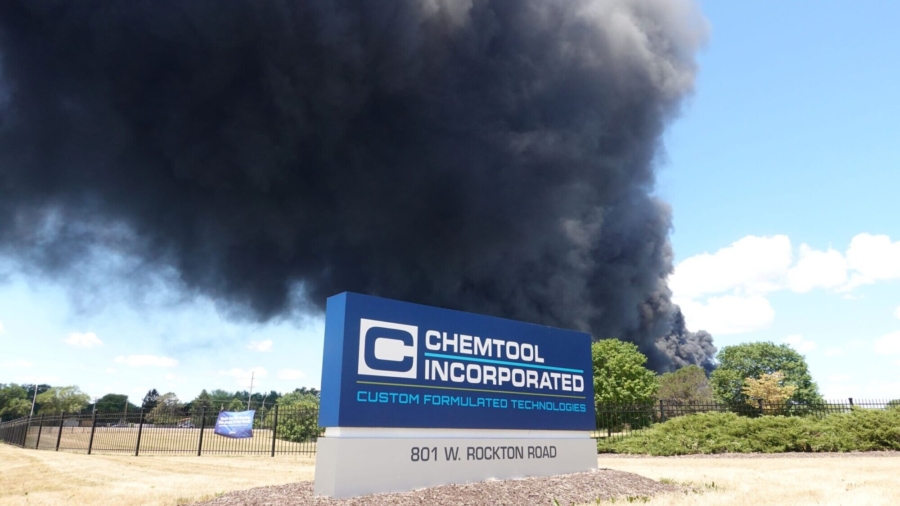
© WLS The cause of the fire at the Chemtool Inc. plant in Rockton, Illinois, is not yet known.

The fire at the Chemtool Inc. plant in Rockton, Illinois, broke out Monday morning and prompted the city fire department to order a mandatory evacuation for all residents and businesses in a 1-mile radius of the plant, police said in a message on Twitter.

The mandatory 1-mile evacuation area around the site, as well as the mask wearing, is due to concerns about "particulate matter that can become pulmonary irritants," especially to those with compromised immune systems, said Dr. Sandra Martell, public health administrator for Winnebago County.

"Please do not pick up waste that falls from the sky and is related to the fire," Martell advised at a news conference Monday evening. "We do not know what that waste contains. Please do not handle it with bare hands. Use a shovel, use gloves and sequester it -- meaning keep it separate from your household waste -- so that we know how to properly dispose of it. It's very important. We are reliant on our groundwater in this community and keeping that safe is of utmost importance to us."

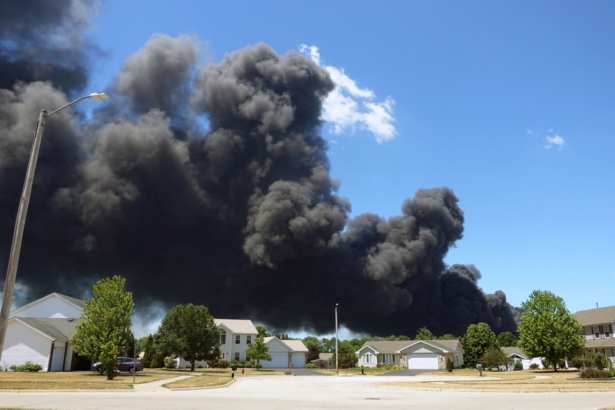
Rockton Fire Chief Kirk Wilson said the incident is expected to be a "several-day event" for the product to burn off. A large plume of smoke has been seen moving south and southeast of the explosion site. However, Wilson said, air quality analysis has shown no compromise of quality at ground level at this time.

Wilson said the city hopes to avoid "an environmental nightmare" that could occur if any of Chemtool's oil-based lubricants ran off into the Rock River, about 300 meters (330 yards) west. One of their main concerns is product spilling into the river, he said.

Speaking at a news conference earlier Monday, Wilson said the department's water-based firefighting suppression has stopped inside the building, and they're now letting the product "burn off."

About 150 homes are in the evacuation zone, he said.

The burn-off at the plant is expected to take several days. More than 40 agencies and 150-175 fire personnel are on the scene. The cause of the "catastrophic incident" has not been determined, Wilson said.

The 70 employees at the factory were able to get out safely, Wilson said. When fire crews arrived, the flames were through the roof and clouds of smoke filled the sky, CNN affiliate WREX reported.

Wilson said Monday night one firefighter was hospitalized with breathing difficulties.

"He's been evaluated and been sent home. So he's doing fine," Wilson said.

Gov. J.B. Pritzker has activated the State Emergency Operations Center to mobilize emergency response personnel and facilities that will monitor the fire.

According to a release from the governor's office, the Illinois National Guard has been deployed, as well as crews from the Illinois Environmental Protection Agency (IEPA), the Illinois Emergency Management Agency (IEMA) and others.

Explosion sounded like 'a decent-sized firework'

Residents of Rockton, located about 15 miles north of Rockford near the state line with Wisconsin, reported hearing a series of explosions.

"My family and I live in the evacuation zone," Thomas Rollette told CNN. "We heard the explosions this morning and decided to check outside maybe five minutes afterwards when our dogs wouldn't calm down. By that point the smoke was already filling the sky."

He said the first explosion sounded "like somebody lit off a decent-sized firework."

"It wasn't until more and louder explosions came that I even thought something was going on. Seeing the wall of smoke outside just confirmed it for me, and pretty soon after they were telling the nearby residents to evacuate."


Company thanks first responders

According to the company's website, "Chemtool Incorporated offers a wide variety of lubricating greases to meet your needs."

The Lubrizol Corporation, which owns the facility, released a statement about the incident.

"At approximately 7 a.m. today, local emergency personnel responded to a fire at the Lubrizol Corporation's Chemtool Facility in Rockton, Ill. We have confirmed all on site are safe and accounted for. Our concern right now is for the safety of all our employees and the surrounding community," the statement said.

"As a precaution, authorities have evacuated residents in a one-mile radius of the site. We do not yet know what caused this incident, but we will be working with local authorities and with our own risk management team to determine what happened and identify any corrective actions.

"We will share more details as they are known. We are grateful to our employees, first responders and safety forces responding to this incident."

Salvation Army staff and volunteers set up a mobile unit to provide food to first responders, the Salvation Army of Rockford & Winnebago County said, according to WIFR

Illinois Chemical Plant Explosion, Fires Prompt Evacuations
The Associated Press Jun 14, 2021
An industrial fire burns at Chemtool Inc. in Rockton, Ill., on June 14, 2021. (Scott Olson/Getty Images)

CHICAGO—An explosion at a northern Illinois chemical plant Monday morning sparked massive fires that sent flames and huge plumes of thick black smoke high into the air and debris raining onto the ground, prompting evacuations.

After 7 a.m., emergency crews rushed to the scene of the fire near Rockton, northwest of Chicago, at Chemtool Inc., a company that manufactures lubricants, grease products and other fluids, and is, according to the company, the largest manufacturer of grease in the Americas.

Rockton Fire Department Chief Kirk Wilson said about 70 employees who were at the plant when firefighters arrived were evacuated safely, and that one firefighter suffered a minor injury. Chemtool’s parent company, Lubrizol Corp., later said there were closer to 50 employees present when the plant was evacuated.

Following reports that the plumes of smoke were so big they were being picked up on weather radar, the Rockton Police Department posted an alert at 8:46 a.m. warning that fire officials had ordered a mandatory evacuation near the plant. It told people to evacuate homes and businesses, and to await further instructions.


“At this point and time there is no danger to air quality at ground level,” Wilson said, adding that given the enormous plumes of smoke, the evacuation order was a precautionary measure.

He also said firefighters had stopped using water to extinguish the blaze because they don’t want the runoff to enter the nearby Rock River.

“We don’t want an environmental nightmare to occur,” he said.

It could be “several days” before the fluids that caught fire burn out, he said.
An industrial fire burns at Chemtool Inc. in Rockton, Ill., on June 14, 2021.
 (Scott Olson/Getty Images)

Crews from the 40 or so fire departments that responded to the blaze were fanning out to respond to spot fires, grass fires, and burning debris that the wind pushed into the community. Wilson said those fires were caused by burning pieces of cardboard boxes and chunks of wooden pallets, not chemicals falling from the sky.

Trisha Diduch, the planning and development administrator for Rockton, said she estimates about 1,000 people are affected by the 1-mile radius evacuation order, she said.

One of those residents was 29-year-old Alyssa King. She said after she walked outside to see black smoke and what appeared to be pieces of cardboard boxes and “small chunks of the building” falling from the sky, she called a police non-emergency line. “You gotta go,” she said she was told.


There were no immediate reports of injuries.

“We have confirmed all on-site are safe and accounted for. Our concern right now is for the safety of all our employees and the surrounding community,” Chemtool said in a statement, adding that it will share more details as they become known.

“We do not yet know what caused this incident, but we will be working with local authorities and with our own risk management team to determine what happened and identify any corrective actions,” it said.

King, who lives in an apartment less than a mile from the site, said she woke up to what sounded like slamming doors.


“It woke me up. It was shaking the whole apartment building,” said King, who had been at home with her 8-year-old daughter.

They went to her mother’s house about 2 miles (3 kilometers) away. King then returned to the apartment to collect the family’s rabbit, Oreo. As she drove near the plant, King saw smoldering embers along the roadway, and there was “burned material” all over the yard of the apartment building, she said. The air had a chemical smell, she added.

“It was awful,” she said. “I’m terrified I won’t have a home to go back to.”

U.S. Environmental Protection Agency investigators from Chicago were headed to the scene and would issue a statement later Monday, spokeswoman Rachel Bassler said. They were coordinating with the Illinois EPA, which also was sending a team, according to spokeswoman Kim Biggs.

Rockton is located in Winnebago County, near the Wisconsin border, about 95 miles northwest of Chicago.

By Sara Burnett and Don Babwin


Brampton high schooler helps city join ‘red movement’ to ensure access to menstrual products

Imagine having to bring your own toilet paper and hand soap every time you use a public restroom. The thought is ridiculous – these items are vital to basic hygiene.

Yet many across the country can’t escape this bizarre reality when they’re forced to supply their own feminine hygiene products.

“This is a basic right,” Keyna Sarkar told The Pointer. “Why not pads and tampons? How are they any different?”


Feminine hygiene products aren’t any different to other necessities offered in public restrooms, but unlike toilet paper and hand wash, the products have rarely been offered in public washrooms and support for the idea has too often faced prudish attitudes toward a basic fact of female biology.

It’s taboo to talk about menstruation openly in many cultures across the world and the sign of good reproductive health is seen as an unsavory subject. Some cultures forbid certain types of interaction during menstruation and ban those experiencing their period from places of worship. Others are confined to “menstruation huts” used in particular parts of South Asia and Africa (Nepal, Ethiopia for example) as isolated structures even though they often lack proper ventilation. Those inside are forbidden from touching other people or objects.

The stigma has led many to talk about the topic in hushed tones, often using euphemisms (like “time of month” and “Aunt Flo”) to hide behind, instead of dealing openly with personal needs around a biological event that occurs approximately once every four weeks.

A 2018 study from Plan International Canada (PIC) found 41 percent of female respondents were teased for being on their period and 63 percent said they had to hide feminine hygiene products if they were bringing them to the washroom at school or work. This number jumps to 81 percent for women under 25. “It’s hidden because it’s stigmatized so deeply, for no apparent reason,” the Brampton high schooler said.

There are billions of females around the world who experience menstruation and use feminine hygiene products, and the secrecy, something Sarkar personally experienced, doesn't make sense to her.

Sarkar and her family resided in Dubai before they moved to Brampton and menstruation was not a subject people spoke freely about, even in Sarkar’s all-girls class. Her teachers told her it was an “awkward” subject. Sarkar recalled the hesitancy in their voices that barely went above a whisper. “That doesn't mean you're just going to ignore it. It's something super important. There were girls who thought they were going to die.”

Sarkar said the issue can be just as hard to speak about in Canada. While some feel comfortable, she has seen many who are “very scared” to discuss their own body’s reproductive process.

She credits her mother for empowering her on a topic that she herself was originally reluctant to speak of. “She’s like, ‘In our culture it's not spoken about, but I think it should be. So I'm going to start talking about it with you and know that you can reach out to any of the males in our family if you ever need to because we're going to start this from our household’.” Her family members have stayed true to their word, and she says she approaches her dad, uncle, or grandfather if she ever needs anything.

Others aren’t as lucky, and Sarkar said there are many girls her age who struggle with purchasing menstrual products. In some cases, they or their families may not be able to afford them, or they may not feel comfortable asking.

This is commonly known as period poverty: the struggle of many low income individuals unable to afford menstrual products and related items like underwear and pain medication, according to the United Nations.

In some cases, the same sanitary product is used for hours at a time without being changed, increasing the risk of infections, including toxic shock syndrome. While this is rare, it requires immediate medical attention if it occurs. Using products besides sanitary items, like rags or cotton pads, can also lead to trouble.

Advocacy group Canadian Menstruators estimated nearly $520 million was spent on menstrual hygiene products by approximately 17.8 million Canadian women between 12 and 49 in 2014, breaking down to roughly $29 per person annually.

Other estimates are much higher; Chatelaine estimates a cost of $65.82 every year. An analysis from Huffington Post showed menstruation will cost more than $18,000 over a lifetime; PIC found 33 percent of females under 25 have struggled to afford products for themselves or their dependents and 75 percent have missed school or work because of their period.

The Toronto Youth Cabinet (TYC), a youth advisory body in Toronto, sent a statement to Stephen Lecce, the Minister of Education, in March asking for the Province to require all 76 school boards across Ontario to provide free menstrual products in secondary and elementary schools.

Stephen Mensah, TYC’s executive director, told The Pointer the group has not received a direct response from the Minister. “We are still waiting to meet directly with him on this issue.”

Other provinces have already taken action; B.C. was the first in 2019, and P.E.I followed suit soon after. Similar discussions are also taking place in Quebec.

Some school boards have taken the step independently. The Toronto District School Board voted to provide free menstrual products to all its schools in 2019. Peel District School Board’s 2020-2021 budget includes such products to be introduced in phases. Phase one focuses on secondary schools and phase two, expected to be rolled out in the coming months, will expand the program to elementary schools. The Dufferin Peel Catholic District School Board is working to retrofit existing dispensers in their 26 secondary schools, expected to be completed by June 30. Elementary students will be part of Phase 2, Bruce Campbell, general manager of communications told The Pointer. A date was not provided to when the school board would enter this phase. The average age for a first period is 12-years-old, but it differs from person to person.

Sarkar is happy to see, what she calls, the “red movement” make its way across Canada but she wants more to be done faster. It inspired her to start a chapter of Girl Up in Brampton this past September. The non-profit organization is a UN initiative focused on empowering women across the world.

The group’s first initiative, a sanitary kit drive held in December, saw them collect 10,000 products in Brampton within three weeks. Sarkar drove around for days picking up donations from whoever was offering them in the community. She admitted the group was apprehensive of the initiative given the stigma around the topic among many in the community. But Sarkar has been pleasantly surprised.

“I knew that seeing the change starting up within moms like mine, there are definitely other moms outside who are willing, and there absolutely were.” Donations went to womens’ shelters across the GTA and were shipped to Indigenous communities in Nunavut and Quebec.

In her latest push, Sarkar took on Brampton City Council, delegating members who she implored to take responsibility for providing menstrual products in all City run facilities. Her push led to council approving a plan to pay for products in all City-run women’s and gender neutral bathrooms and change rooms. In total, 49 facilities will see the installation of a dispenser, at a total cost of $52,400, while annual estimated costs are $73,913.

Sarkar was not expecting the discussion to be as agreeable as it was. “I was completely ready to fight,” citing the challenges her fellow advocates have faced while presenting a similar request to other municipalities. “They (in other jurisdictions) had some really, very stupid excuses from council members that saying that no, this doesn't make sense.”

That wasn’t the case at Brampton City Hall.

Brampton is now one of a handful of cities offering the service to its residents; London became the first when it began a pilot project in September 2019.

Scotland made headlines in November for being the first country to make feminine hygiene products free for anyone who needs them. While Canada lifted the GST on feminine hygiene products in 2015, many, like Sarkar, say it’s not enough.

She has plans to make her pitch to restaurants and other facilities, but she feels “the smarter way to go about it is actually starting [with] the government first” and then approaching businesses. “I feel like the government is the one that models and sets an example.”

Email: nida.zafar@thepointer.com
Twitter: @nida_zafar
Nida Zafar, Local Journalism Initiative Reporter, The Pointer


Walmart getting rid of cashiers at B.C. store as part of test


Walmart is replacing cashiers at its Terrace store in northwest B.C., with self-serve checkouts this summer, making it a test project along with a select number of other outlets in Canada.

In an emailed statement to The Terrace Standard, Walmart Canada said its Terrace store was selected as a test location because a large number of customers were using self-checkouts.

“Our business is transforming and we’re relentlessly focused on making our stores simpler and faster for our customers. That’s why we’re constantly innovating and trying new initiatives so we can be the very best retailer,” said spokesperson Felicia Fefer.

“Our customers have embraced self-checkouts as they’ve rolled out across the country over the past few years,” she added.

But while Walmart will eliminate cashier positions here that don’t necessarily mean an overall job loss, the corporation said.

“Over the years we’ve heard concerns that self-checkouts will impact jobs but that’s simply not the case. The self-checkout area will be staffed by dedicated associates to help our customers and there will be no job loss as a result of this change,” said Fefer.

She said 40 more people will be hired in the coming months in the Terrace branch as it prepares to launch an online grocery purchase option.

Binny Paul, Local Journalism Initiative Reporter, Terrace Standard


Reality Winner, NSA contractor in leak case, out of prison


WASHINGTON (AP) — A former government contractor who was given the longest federal prison sentence imposed for leaks to the news media has been released from prison to home confinement, a person familiar with the matter told The Associated Press on Monday.
© Provided by The Canadian Press

Reality Winner, 29, has been moved to home confinement and remains in the custody of the federal Bureau of Prisons, the person said. The person could not discuss the matter publicly and spoke to the AP on condition of anonymity.


She pleaded guilty in 2018 to a single count of transmitting national security information. Winner was sentenced to five years and three months in prison, which prosecutors said at the time was the longest ever imposed for leaking government information to the news media.

Her release was hailed as a cause for celebration after advocates had spent years fighting for her release or a pardon. Her lawyer, Alison Grinter Allen, said in a statement that Winner and her family are working to “heal the trauma of incarceration and build back the years lost.”

She said they are “relieved and hopeful” after her release from prison.

The former Air Force translator worked as a contractor at a National Security Agency office in Augusta, Georgia, when she printed a classified report and left the building with it tucked into her pantyhose. Winner told the FBI she mailed the document to an online news outlet.

Authorities never identified the news organization. But the Justice Department announced Winner’s June 2017 arrest the same day The Intercept reported on a secret NSA document. It detailed Russian government efforts to penetrate a Florida-based supplier of voting software and the accounts of election officials ahead of the 2016 presidential election. The NSA report was dated May 5, the same as the document Winner had leaked.

At the time of her sentencing, Winner was given credit for more than a year she spent in jail while the case was pending in U.S. District Court. She was sent to home confinement just a few months ahead of her release date of Nov. 23, according to the Bureau of Prisons.

"My actions were a cruel betrayal of my nation’s trust in me,” Winner told the judge at her sentencing in August, 2018.

Previously, Winner had unsuccessfully tried to shorten her sentence by seeking a pardon from President Donald Trump — whom she had once mocked on social media as a “soulless ginger orangutan” — and by arguing she had health conditions that made her more vulnerable to COVID-19 infection. Her sister said last July that Winner tested positive for the coronavirus but didn't show symptoms.

Michael Balsamo, The Associated Press


#FREECHELSEA

JAPANESE STATE MONOPOLY CAPITALI$M
Mizuho's system failures caused by corporate culture, third-party probe says


TOKYO (Reuters) - Mizuho Financial Group Inc's corporate culture has been responsible for repeated system failures as it is not able to respond well to crises, lacks technological expertise and is not able to show improvement, a third-party investigation found.

© Reuters/Toru Hanai FILE PHOTO: Mizuho Financial Group logo is seen at the company's headquarters in Tokyo

Japan's third-largest lender commissioned the report after having had four system breakdowns despite spending more than 400 billion yen ($3.6 billion) to revamp its banking system in 2019.

One of the glitches affected most of its ATMS, leaving thousands of bank cards and passbooks stuck inside.

"The atmosphere within the company is one where managers believe the best course is to take the stance that they have done what they are supposed do rather than taking the risk of actively expressing their opinion. This contributes to a lack of positive and proactive action on their part," the report said.

A Mizuho spokesperson said the bank would announce business improvement measures as soon as they were decided.

The report was compiled by a four member team led by lawyer Shuji Iwamura and included another lawyer, a former Fair Trade Commission official and a former NTT DoCoMo executive.

Asked about the report, Finance Minister Taro Aso told a regular press briefing that the government planned to form an appropriate response but did not elaborate.

Mizuho's shares were up 0.5% in morning trade in line with the broader market.

($1 = 110.0700 yen)

(Reporting by Takashi Umekawa; Editing by Edwina Gibbs)
New Book ‘Blackface’ Examines Hollywood’s Painful, Enduring Ties to Racist Performances

Matt Donnelly 
VARIETY


© Courtesy Images


Conversations about Blackface, when white people darken their skin to perform exaggerated versions of nonwhite characters, often centers on the historical when it comes to the media’s role in perpetuating the racist act.

In some cases, historical means the minstrels of 19th century theater, silent films, or the more recent history of satire like Robert Downey Jr.’s 2008 film “Tropic Thunder,” which has aged horribly in a Hollywood landscape that demands sensitive and authentic portrayals, regardless of genre.

More from Variety
New 'Borat' Film Opens with Blackface Content Warning from Amazon

But it’s not always about decades or centuries ago. In the past seven days, however, at least three headlines directly or indirectly involved the damaging tradition have run — from the aesthetics of the Kardashian-Jenner family, to the astonishing rebound of Virginia Governor Ralph Northam, to the crisis team helping fashion label Prada recover from scandal.

In short, says academic and author Ayanna Thompson, the continued prevalence of Blackface — both in content and old images of prominent figures — is not so easily explained away by heartfelt apologies and warning labels on classic movies.

In her new book “Blackface,” Thompson calls it “the ultimate zombie performance mode,” a practice that will not die despite the numerous icons and world leaders taken down by backlash, and countless think pieces about the stereotypes it feeds. Last summer, comedians and entertainers seemed to reach some resolve around the issue following the murder of George Floyd, with power players like Tina Fey and Jimmy Kimmel decrying past works and disappearing images of Blackface from their libraries.

Thompson recently discussed her new book with Variety, on a topic she finds increasingly relevant for creators and executives in show business who may lack deeper context around this issue.

This topic is sadly evergreen, but what specifically got you thinking about exploring this topic in book form?

In 2012, when my son was in the third grade, he had to do a research project where the students had to pick a famous person from history and present as that person. My son was William Shakespeare, and my little brown son was not in white face. That would never have occurred to him or to me. There were three [white] 8-year-olds in Blackface, performing their heroes Martin Luther King, Serena Williams and Arthur Ashe. I could not believe it.

These were little kids. Whose idea was it to put the makeup on? Whose idea was it that this was a form of celebration? Whose idea was that, to fully inhabit your hero, you had to employ racial prosthetics? When I asked teachers and other parents, no one though it was an issue. When I approached the principal, he thought I was insane. I could see through his eyes that I was in irrationally angry Black woman. It dawned on me that white privilege meant this principal didn’t feel he had to know this history. He didn’t feel this was something we shared collectively. It’s taken me 10 years to write this book. I had to write something that people could hand to their teachers, their friends, their colleagues, students, to say ‘Here’s why this is problematic.’ Why don’t Black and brown kids think that they should put white face on when they’re doing Halloween costumes? What is it that white people think when they’re putting on Halloween costumes, doing special projects, that Black makeup is part of what they should do? The book is an exploration on that. And I take it seriously that this is our shared American history. The onus can’t be on people of color to carry this history forward. We’ve killed Blackface several times in our history, but it keeps coming back to life because of this unwillingness to have it be our collective history. I hope this book is the last book about this.

One of the most interesting things in the book is a concept you introduce called “white innocence,” can you unpack that?

Before I get there — the history of performing Black and brown people on English-speaking stages has always been a white property. Since the middle ages, when there have been devilish characters in religious plays, and then non-religious works in Shakespeare’s time where they had tons of Africans and Moors and Turks all performed with racial prosthetics. This includes makeup, fake noses, wigs, and so on. We’ve got hundreds of years of Black characters in performance being a white property. That’s important as a foundation for what allows people to believe in their own white innocence.

For example, when you’re Megyn Kelly defending Luann de Lesseps’ doing Blackface as Diana Ross in 2018 saying, “But who doesn’t want to be Diana Ross for a day?” White innocence is, “I love Black people, I love Black culture.” This was also Governor Ralph Northam, when he performed as Michael Jackson [in 1984]. Same for Justin Trudeau. This idea that you can celebrate Black culture, Black heroes, identities by putting on Black makeup. On some weird unconscious level, that patches into some hundreds of years old history, that to be a Black character in a play or a film is actually to be a white person performing that. That’s where white innocence stems from. I do ask, are Black and brown people not as innocent because we don’t presume that this is a performance mode that is open to us?

Comedy specifically seems to be a big problem area over the past few decades, why is that?

I feel like the birth of Blackface minstrelsy as a genre is the 19th century. It lives a long time well into the 20th century — even the BBC had a minstrel show that was on primetime until 1978. In the Black arts movement in the late 1960s, there was an attempt by BIPOC artists to say, “We’re going to create our own art where we can represent ourselves fully.” That helped kill Blackface minstrelsy.

Weirdly, by the time we get to the ’80s, it comes back. It’s the birth of the neo-conservative and the Reagan presidency. “The Cosby Show” was huge and there was a feeling of, “We’re so over all the problems.” This was also when neo-cons had started celebrating that they embraced a colorblind approach to the world — which was, “We no longer have to see, talk or think about race because we’re all equal.” Then you see this flare up of Blackface. You really saw it hugely right before and right after Barack Obama’s election. I think it had the same ethos of “We are post racial and racist.”

Let’s talk about all of the comedians: Jimmy Fallon doing Chris Rock on “SNL,” Jimmy Kimmel doing Oprah Winfrey and Carl Malone on “The Man Show,” Sarah Silverman doing a whole Blackface routine on “The Sarah Silverman Program,” four episodes of “30 Rock,” and five years of Fred Armisen as Obama on “SNL”. All of this happened in the 21st century. And let’s not even to get into “Tropic Thunder” and “Zoolander.”

There was a desire by comedians. Not explicitly in their ideological thinking, but a feeling of “I’m post-racial, I can’t be a racist.” So all of these things I have studied and noticed is that all of those people are students of comedy. They’re all interested in pushing the boundaries of comedy and thinking about what’s taboo. This was something that had been taboo, and now they’re like, “We want to see if we can do it!’ Since it’s clear that I’m not racist, I can do it!”

Your hope is that this book will be resonant within the walls of show business, why?

Because that’s a hard climb. I don’t think people in the industry are reading anything other than what they create. It would be nice if there was someone to say, “We should talk about this.” Perhaps the Academy could sponsor a book club or something. I think about the way that television and film has moved dramatically away from something simple like depictions of people smoking. They recognized that that was a harm, something actively harming the public because it was creating perceptions of smoking as either sexy or something you do when you need self care. We’ve moved away from that pretty hard, to the benefit of society. This was obviously a collective decision. They could all come to the collective decision that Blackface is a public harm and we can play a role in stopping it. That would be the ultimate goal.

“Blackface,” published by Bloomsbury’s Object Lessons label, is currently for sale.
Comics and graphic novels are examining refugee border-crossing experiences

Elizabeth "Biz" Nijdam, Assistant Professor (without review) of German, University of British Columbia 

Comics about refugee experiences are not new. After all, even the superhero created by Jerry Siegel and Joe Shuster, Superman, is a refugee who landed on Earth after his flight from Krypton.

© Detail from Reinhard Kleist's 'An Olympic Dream: The Story of Samia Yusuf Omar/SelfMadeHero 'An Olympic Dream: The Story of Samia Yusuf Omar' recounts how the Somali Olympic runner drowned while trying to reach Italy in 2012.

However, recently there has been renewed interest in comics representing migrant experience — namely, that of refugees and asylum-seekers. Since 2011, in particular, and the start of the civil war in Syria, comics and graphic novels have become an important forum for examining global forced migration.

These so-called “refugee comics” range from newspaper comic strips to webcomics and graphic novels that combine eyewitness reportage or journalistic collaboration with comic-book storytelling. These stories are written with the aim of incorporating the points of views of refugees, artists, volunteers or journalists working on-the-ground in displaced communities, war zones and along the migrant journey. They sometimes emerge in collaboration with human rights organizations.

In light of their subject matter, these comic artists contend with complex and distressing themes that are otherwise difficult to represent.

They draw on the traditional comics format, including the medium’s sequential nature, the use of panel walls and a combination of text and image to foster empathy and compassion for the migration journey. In so doing, they aim to give voice to asylum-seekers and refugees, part of 80 million individuals and families forcibly displaced worldwide, whose anonymous images often appear in western media.
Complex issues, narrator’s perspective

These comics are typically drawn by western cartoonists, based on direct testimonies by migrants and refugees or those who have worked with them or encountered them. They are typically not by refugees but about refugees. Scholar Candida Rifkind, who studies alternative comics and graphic narratives, explores how comics about migrant experience often emerge when witnesses to migrant stories grapple with feelings of “shame, guilt and responsibility” to make western society at large more aware of and responsive to refugee realities.

These narratives prompt ethical questions about what it means to tell a story and who has the right or responsibility to do so. While questions about the power relations embedded in how these texts are produced remain, comics on global forced migration are still an important avenue for interrogating the representation of migrants and the socio-political circumstances surrounding their journeys.

These comics also challenge what may otherwise be relayed in mainstream media as the story of a global migrant crisis that has no human face, with perilous effects for migrants who face xenophobia and hate. In Rifkind’s words, they are a kind of intervention into “the photographic regime of the migrant as Other that has emerged as the dominant visual record” of contemporary globalization.

In comics about forced migrant experiences, people experiencing life as refugees become centred as the subjects of their own stories. But cartooning can allow storytellers to represent individuals anonymously, making it easier for people “to give testimony fully and candidly,” while affording them the specificity of their humanity.

There can be consequences for refugees who testify about their circumstances and the oppression and violence they encounter. Photographic evidence of unlawful or undocumented residence in migrant encampments or someone’s journey to seek asylum could in fact jeopardize a person’s safety and end goal.
© (HMH Books) The violence encountered by the refugees depicted in ‘The Unwanted: Stories of the Syrian Refugees,’ by Don Brown is the only graphic element that breaks through the panel frame.


New visual strategies


Notably, comics on forced migration are also inventing new visual strategies to recount refugee experiences. Artists use panel borders to add a layer of storytelling that typically vacillates between the creators’ ability to represent a specific experience, emotion or event and the very inability to portray some forms of trauma and lived experience.

In The Unwanted: Stories of the Syrian Refugees (2018), American author and illustrator Don Brown depicts moments of hardships and hope in the lives of the refugees that Brown met in three Greek refugee camps in Ritsona, in Thessaloniki and on Leros.

The violence encountered by the refugees of Brown’s graphic novel is the only graphic element that breaks through panels. Bullets fracture the panel edges, bombs explode out of the picture planes and toxic smoke rises through the frames.

Brown draws on the convention of exceeding and playing with borders in comics to demonstrate a relationship between violence and transgressing borders. Not only did violence in Syria force many of its citizens to journey in search of safety and freedom; fleeing Syrians also also faced violence and hostility beyond the borders of their homeland on their journeys and where they landed.

© (Verso) Detail of a page shows how lace is used as a panel border in ‘Threads,’ by Kate Evans.

The panel borders in Threads: From the Refugee Crisis (2016) by British cartoonist, non-fiction author and graphic novelist Kate Evans are comprised of clippings of delicate lace. Threads is a socio-political and cultural critique rooted in the author’s experience volunteering in the largest though unofficial refugee encampment in Calais, France, which operated from January 2015 to October 2016.

My research has examined how this lace integrated into the comic is more than simply an analogy for the intertwining factors and complex relationships that emerged in Calais. The lacework is a fundamental structuring principle in Evans’ text that engages with the region’s history of lacemaking, Calais’ most essential industry and refugee experience simultaneously.
Frames within stories

The aesthetics of the smartphone have also begun to play a role in the representation of refugee experiences in comics. Smartphone screens and social media platforms function as frames within some stories.

German graphic designer and cartoonist Reinhard Kleist embeds social media into the comics grid in An Olympic Dream: The Story of Samia Yusuf Omar (2016). The story recounts how Omar, the Somali Olympic runner, died by drowning en route to Italy in 2012.

Some of the story is narrated through Facebook posts based on interviews conducted on that platform with Omar’s sister and a journalist who had interviewed and known Omar.
© (SelfMadeHero) Panel from ‘An Olympic Dream: The Story of Samia Yusuf Omar,’ by Richard Kleist.

Somalian athletes lifted up Omar’s story to draw attention to the Olympics as a venue to promote awareness about global conflict and peace. In Kleist’s introduction, he writes that too often, “abstract numbers represent human lives.”

This comic and others joins several examples of new media, such as viral videos, mobile games and documentary film that are highlighting the role mobile devices can play during the migration journey.

Through their personal stories, comics on forced migration humanize refugee experience. This category of graphic narrative also offers opportunities for articulating the complexity of refugee experience through the narrative techniques and visual strategies of comic art.

This article is republished from The Conversation under a Creative Commons license. Read the original article.

Elizabeth "Biz" Nijdam does not work for, consult, own shares in or receive funding from any company or organisation that would benefit from this article, and has disclosed no relevant affiliations beyond their academic appointment.


Tailoring of climate change messaging could shift conservative views on crisis: Study

The key to easing partisanship on the topic of global warming may be in the way the messages are conveyed, according to new research.

Tailoring online messaging and advertising toward Republican voters could shift their views on climate change, a new study published Monday in Nature Climate Change suggests.MORE: This is how climate change may alter 10 of the world's natural wonders

As of 2020, 73% of Americans believed that global warming was happening, and 62% think that it was caused by human activities. In 2010, only 57% of Americans thought that global warming was happening, researchers said.

But, the shift in public opinion on climate change has largely been driven by Democrats. In previous research, when asked how high of a priority global warming should be, just 22% of Republicans said it should be a "high" or "very high" priority, compared to 83% of Democrats, according to the study.
© Ben McCanna/Portland Press Herald via Getty Images, FILE A worker from Kimball & Sons Logging and Trucking swings a crane in a small woodlot in Mechanic Falls, Maine, July 16, 2020.

However, altering the messages to appeal to conservative ideals can increase Republicans' opinions of climate change, new research found.

The study was conducted through a one-month advertising campaign field experiment that tailored climate change-themed online messaging for conservative voters in two competitive districts -- Missouri-02 and Georgia-07. Those areas were chosen for their "purple" status, a "solid" mix of both Democrats and Republicans, Matthew Goldberg, associate research scientist at the Yale Program on Climate Change Communication and author of the study, told ABC News.
© Bing Guan/Bloomberg via Getty Images

MORE: Republicans ask why White House removed climate scientist

The campaign presented a series of videos called "New Climate Voices," which used social identity theory, elite cues and theories of persuasion presented by spokespersons who were likely to resonate with conservatives, Goldberg said.

For example, one video features a retired Air Force General who explains that climate change poses a national security threat and creates challenges for the U.S. military. In another video, Dr. Katharine Hayhoe, a climate scientist and evangelical Christian, speaks about the consistency between her faith and caring about climate change. In another, former Rep. Bob Inglis, R-S.C., describes how his conservative values motivate his drive for political action on climate change.

© Smith Collection/gado/Getty Images, FILE Close-up of cellphone displaying alert from utility Pacific Gas and Electric (PGE) warning of an unprecedented Public Safety Power Shutoff, or planned power outage to reduce wildfire risk, San Ramon, California, October 8, 2019.

The researchers targeted people on Facebook, YouTube and other online advertisements and made sure the people were exposed to the videos often, Goldberg said.

After the campaign, the researchers compared 1,600 surveys administered before and after the campaign, which revealed that the videos increased understanding among Republicans in the two districts on two topics: that global warming is happening and that it's being "caused mostly by human activities." The understanding increased by several percentage points, according to the study.MORE: House Republicans roll out 'realistic' platform to tackle climate change, including planting trees

The belief that climate change is "somewhat," "very" or "extremely" personally important and that it would cause "moderated" to a "great deal" of harm to future generations also increased among those surveyed, researchers said.

The results of the study show that it's possible to design messaging interventions that are both persuasive and scalable, and that climate change communication is more likely to persuade people when the message and messenger resonate with the audience’s values and identities, Goldberg said.

© Bing Guan/Bloomberg via Getty Images, FILE A U.S. flag flies outside the Marathon Petroleum Corp. Los Angeles Refinery in Wilmington, California, April 21, 2021.

The tricky part is getting the messaging through in a competitive environment where people are fielding messages across multiple platforms, Goldberg said.

"You can imagine seeing an advertisement in your Facebook newsfeed or in a video that we're passing by on YouTube, it's often hard to persuade people, especially to do so durably, because you have you have you have more of that shallow engagement," Goldberg said. "So we usually have that worry that it's hard to, to compellingly move people's beliefs through these kinds of ads."

In addition, since the study was conducted in only two congressional districts, it is unclear how much results might vary depending on geographic location or cultural context, the researchers said.