Sunday, November 07, 2021

BLUE H2
Alberta government unveils goal of becoming hydrogen export superpower


Jason Kenney unveils Hydrogen roadmap -- The Canadian Press
By The Canadian Press

Nov 6, 2021 | 2:29 PM

EDMONTON, AB. — The Alberta government has released its road map to reach a goal of becoming a world leader in hydrogen exports by the end of the decade.

Premier Jason Kenney says Alberta is well-positioned with its existing energy infrastructure to become a global supplier of choice for hydrogen.

And he calls it a “game changer” in the climate change fight, given that hydrogen emits no greenhouse gases when burned.

He says the global hydrogen market is expected to become worth up to $2.5 trillion within the next 30 years.

The plan calls for catching up on clean hydrogen technologies in the short term before moving to growth and commercialization in the long term.

Alberta is already the largest hydrogen producer in Canada at 2.4 million tonnes per year.
MEDICINE HAT PRODUCES AND OWNS ITS OWN NAT GAS PLANT
Invest Medicine Hat is leading a task force consisting of city officials in Medicine Hat, Brooks, and other partners with the hopes of bringing industry investment to the region.

Alberta unveils plan it hopes will make it a hydrogen export superpower

By Dean Bennett | NewsPolitics | November 6th 2021

#1842 of 1845 articles from the Special Report:Race Against Climate Change

The Alberta government has released its road map to reach a goal of becoming a world leader in hydrogen exports by the end of the decade.

Premier Jason Kenney says Alberta is well-positioned with its existing energy infrastructure to become a global supplier of choice for hydrogen.

And he calls it a “game changer” in the climate change fight, given that hydrogen emits no greenhouse gases when burned.

He says the global hydrogen market is expected to become worth up to $2.5 trillion within the next 30 years.

The plan calls for catching up on clean hydrogen technologies in the short term before moving to growth and commercialization in the long term.

Alberta is already the largest hydrogen producer in Canada at 2.4 million tonnes per year.

Dale Nally, the associate minister for natural gas and electricity, compares the hydrogen revolution to the breakthrough energy boom brought on by the oilsands.

“Hydrogen can absolutely be a game changer for our province on many levels,” Nally told a news conference Friday.

“We have the natural advantages to make hydrogen that is both clean and affordable.”

Along with export potential, the report identifies four leading domestic markets for clean hydrogen, which is hydrogen produced with minimal greenhouse gas emissions.

#Alberta government unveils road map with goal of becoming #hydrogen export superpower. #ABPoli

They include home and business heating, power generation, transportation and hydrogen for industrial use.

Opposition NDP critic Kathleen Ganley says the United Conservative government's plan builds on proposals from the former NDP government but lacks concrete goals, objectives and details.

“This strategy lacks detail and thoughtfulness that would be required to actually attract investment,” she said.

“It sets targets, but it doesn’t actually provide a pathway to achieve those targets.

“It doesn’t even give a commitment to how much investment they are willing to contribute at the provincial level.”

The government said the plan will be revisited in 2025.


This report by The Canadian Press was first published Nov. 5, 2021.

Varcoe: Hydrogen has the potential to be Alberta's next oilsands in importance

'This is an opportunity for Alberta to create generational wealth for the province. We have an opportunity to be a leader in clean, affordable energy,' said Associate Natural Gas Minister Dale Nally


Author of the article: Chris Varcoe • Calgary Herald
Publishing date: Nov 05, 2021 • 
Associate Minister of Natural Gas and Electricity, Dale Nally. 
PHOTO BY CHRIS SCHWARZ Government of Alberta

If you want to know how big the potential prize is for Alberta to grow its hydrogen industry, Associate Natural Gas Minister Dale Nally is quick to provide the answer.

Think of the oilsands, he says.

Nally’s new Alberta Hydrogen Roadmap, to be released Friday, details a number of ways to measure success in the province for the emerging sector under a “transformative” future outlook.

It projects tens of thousands of jobs created during the construction of new projects, Alberta’s GHG emissions falling by five per cent and more than $30 billion in capital investment being attracted by 2030.

“For me, that is the minimum. I think we could do well more than that,” Nally said.

“This is an opportunity for Alberta to create generational wealth for the province. We have an opportunity to be a leader in clean, affordable energy.”

There is no denying the keen interest in developing hydrogen in a world acutely focused on decarbonizing energy systems. Hydrogen, which doesn’t directly emit carbon dioxide when used, is seen as a prime energy opportunity for the province.

Several proposed projects provide a tantalizing hint of what could be in store in the years ahead.

In May, ATCO and Suncor Energy announced plans for a project that would produce 300,000 tonnes of hydrogen annually. Air Products rolled out a proposed $1.3-billion net-zero hydrogen production and liquefaction complex in Edmonton the following month.

In August, Petronas and Japan-based Itochu unveiled a development that could see the companies build a $1.3-billion facility in Alberta that would export ammonia as a hydrogen carrier to markets in Asia.

Just last month, pipeline giant TC Energy announced it will work with electric truck manufacturer Nikola to co-develop and operate low-carbon hydrogen production hubs in North America.

More announcements are coming
.
The Alberta government announces a strategy to expand the natural gas sector, in Edmonton on Oct. 6, 2020, and seize emerging opportunities for clean hydrogen, petrochemical manufacturing, liquefied natural gas and plastics recycling.

Nally compares the potential for Alberta’s hydrogen sector to the opportunity presented to the Lougheed government in the 1970s by the oilsands industry.

“It will not replace the oilsands, but I absolutely believe it could be as impactful as the oilsands, in terms of investment, in terms of jobs, in terms of royalties,” said the Morinville-St. Albert MLA.

The provincial blueprint, which Nally discussed Thursday at a net-zero emissions conference held by Petroleum Technology Alliance Canada, aims to leverage the existing advantages Alberta already has in this area.

Canada is one of the world’s largest manufacturers of hydrogen. Alberta produces about 2.4 million tonnes of hydrogen annually, primarily for industrial purposes.

It’s estimated hydrogen could provide up to 24 per cent of global energy demand by 2050 as the world pivots towards a net-zero emissions future.

The roadmap describes Alberta’s hydrogen ambitions in domestic markets — growing in transportation, residential and commercial heating, power generation and storage, as well as in industrial applications.

It has even bigger aspirations for the export market. “With an estimated global market of $2.5 trillion by 2050, hydrogen can be the next great energy opportunity for our province,” Nally told the conference.

The Transition Accelerator, a non-profit group based in Calgary that examines the shift to net-zero energy, has estimated hydrogen could create an estimated $100-billion-a-year market for Canada.

Alberta also has existing expertise in the energy sector, massive natural gas reserves and the geology necessary for carbon capture, utilization and storage (CCUS) projects to sequester emissions created to make so-called blue hydrogen.

(Green hydrogen is produced from water in a process powered by renewable or low-carbon electricity.)

“We are agnostic to the colour of hydrogen, as long as it’s clean hydrogen,” Nally said at the conference. “It will be industry that decides the colour of the hydrogen.”


The minister said one key challenge to overcome will be the cost to produce hydrogen, although the International Energy Agency said recently it’s expected to fall over time as the sector gains economies of scale.

The blueprint identifies several policy pillars for Alberta to pursue.

These include building new demand for hydrogen, enabling cost-effective CCUS projects needed to store emissions, as well as de-risking early investments. The study also focuses on promoting technology, ensuring a modern regulatory framework is in place and pursuing exports.

If hydrogen is widely integrated into Alberta’s energy system, the province could cut its emissions by 14 megatonnes annually by 2030, the blueprint states

.
Provincial leaders, along with the federal government, are hoping Alberta can build an economy out of hydrogen. 
PHOTO BY MICHAL WACHUCIK/AFP VIA GETTY IMAGES

A separate report released Thursday by the University of Calgary’s School of Public Policy says hydrogen and its derivatives can play a key role in some emissions-intensive sectors, such as steel, chemical and clean fuel production, and long-haul transportation.

Hydrogen has the potential for “broad participation” across the country, thanks to the ability to produce hydrogen from natural gas and from clean electricity, the report says.

Another study by the school notes Alberta also has advantages that make hydrogen a feasible way to decarbonize the electricity grid.


Business Council of Alberta president Adam Legge said the province has many strengths to capitalize on, although there are issues to address, such as ensuring the industry has enough skilled workers, providing investment certainty and approving infrastructure needed to get product to market.

Last December, Ottawa put out its own blueprint that aims to establish Canada as a global supplier of hydrogen. Having the federal and provincial governments headed in the same direction is important, Legge added.


“Everybody recognizes there is a huge potential in hydrogen, but we do have to make sure we get some of the key pieces lined up before we really recognize the mass potential,” Legge said.

At the PTAC conference, David Layzell with the Transition Accelerator said another key challenge is to ensure adequate demand for hydrogen is in place as the industry grows supply.

But he agrees Alberta’s prospects for hydrogen are significant because the world needs to embrace major changes to develop net-zero energy sources.

“It is as big an opportunity for Alberta today as perhaps 50 years ago when Peter Lougheed was looking at the oilsands,” Layzell said in an interview.

“We have got to make it work — and we have to demonstrate that it can work.”

Chris Varcoe is a Calgary Herald columnist.
cvarcoe@postmedia.com

TWO 'MAYBE' TECHS

Alberta bullish on hydrogen strategy that relies heavily on carbon capture technology

Province wants to export hydrogen by 2030

The Alberta government says the province's history with natural resource development positions it perfectly to become a global hydrogen energy hub. (Sebastian Kahnert/dpa via AP)

The Alberta government wants the province to become a hydrogen powerhouse by 2030, piggybacking on the natural gas industry to export hydrogen.

The Alberta Hydrogen Roadmap, released Friday, depends heavily on the use of carbon capture, utilization and storage (CCUS) in its early stages to reduce greenhouse gas emissions and aim for Canada's net-zero goals.

The approach also banks on the federal government helping to fund some of the pricey up-front costs of scaling up CCUS, Premier Jason Kenney said in a news conference Friday.

"Hydrogen gives the world an exciting new tool to build a stronger, more reliable low-emission energy future," Kenney said. "And Alberta is uniquely positioned to become a dominant global player in this burgeoning new technology."

The report paints a picture of a future where hydrogen is integrated into the province's electricity and heating systems, fuels the trucking sector and public transit, used in industrial processes, and exported internationally.

Although the strategy cites $30 billion in capital investment by 2030 as a goal, the government made no specific funding commitments. It points to existing policies, such as the province's lower corporate tax rate, a petrochemical incentives program and loan guarantees for Indigenous-run corporations as carrots to dangle for investors.

Kenney says the plan will be a key driver of economic recovery, create thousands of jobs and position the province to "write a new chapter in Alberta's rich story as a global energy supplier."

Premier Jason Kenney touts hydrogen as a tool in Alberta's stronger, more reliable, low emission energy future with the Alberta Hydrogen Roadmap. 1:32

The report does note the technology to transport hydrogen long distances cheaply and efficiently is still under development.

The strategy lists an annual greenhouse gas emissions reduction of 14 megatonnes per year by 2030 by integrating hydrogen into industrial processes.

In 2019, Alberta emitted nearly 276 megatonnes of greenhouse gases, half of which came from oil and gas.

The report says Alberta would have to rely at first on more emissions-intensive processes of hydrogen production, using natural gas. In time, it could generate more so-called "green" hydrogen using renewable energy to split water molecules.

'Green' hydrogen challenges

Some environmentalists are skeptical of hydrogen produced from natural gas, which is called blue or grey hydrogen, depending how it's made.

Even if the resulting carbon dioxide byproduct is pumped and stored underground, capturing all those emissions is difficult. And the upstream production of the natural gas can be problematic, resulting in leaks of methane, which is a much more potent greenhouse gas than carbon dioxide.

Nina Lothian, Pembina Institute director responsible for fossil fuels, says Alberta's hydrogen strategy is promising, but should emphasize the methods of production with the lowest emissions intensities.

Developing better technology with lower environmental footprints will require public funding to help offset the business risks, she said.

Lothian said Alberta also needs a more comprehensive climate plan that sets provincial emissions targets and creates more local demand for hydrogen, rather than relying on export markets.

Although hydrogen produced from natural gas is more emissions intensive, University of Alberta mechanical engineering Prof. Amit Kumar says investing in blue hydrogen would bring the province closer to making green hydrogen production viable. Transportation and storage methods can be re-used no matter how the gas is produced, he said.

For now, the production costs of green hydrogen are much higher than using natural gas, he said.

NDP energy critic Kathleen Ganley said the United Conservative Party government was sluggish to embrace hydrogen, and that could have already sent investors looking elsewhere.

The Opposition published a hydrogen strategy a year ago that proposes studying the viability of a hydrogen export pipeline and offering royalty incentives to producers.

With files from Andreane Williams, Michelle Bellefontaine and Mirna Djukic


'MAYBE'TECH

Pembina Pipeline looks to work together with rival Canada carbon capture plans

    Canada’s Pembina Pipeline Corp is asking backers of two competing proposals for carbon capture hubs in the oil-producing province of Alberta to combine efforts with its own plan, the company’s chief executive said on Tuesday.

Pembina and TC Energy Corp said in June they were looking to develop a system to transport and sequester carbon. The Alberta government, which controls underground space for burying carbon, called for expressions of interest this autumn.

Carbon capture facilities are expected to be a key part of global efforts to contain emissions from fossil fuel production. Canada is the world’s fourth-largest oil producer and aims to cut national greenhouse gas emissions by at least 40% by 2030.

The Pembina-TC plan, called Alberta Carbon Grid, faces competition from at least two others – Oil Sands Pathways, pitched by the largest oil sands producers, and Polaris, a proposal by Royal Dutch Shell.

Pembina has spoken with both groups about joining together and talks remain active, CEO Mick Dilger told Reuters.

“A single, large carbon capture program at scale is by far the most sensible way to do things,” Dilger said. “If everybody works together, we’ll come up with a more cost-effective solution.”

Whether such cooperation happens remains to be seen, Dilger said.

Pembina and TC would need to convince Shell and the Pathways partnership of Canadian Natural ResourcesCenovus EnergyImperial OilSuncor Energy and MEG Energy, of a change in concept, he said.

Pembina and TC proposed a plan that would make use of spare pipelines that they own to reduce costs. The other proposals rely more on new infrastructure, Dilger said.

There is also the unknown of how Alberta will allocate space for sequestering carbon, Dilger said, adding that the provincial government is “reassessing how that might be done.”

The rival companies and the Alberta government could not be reached for comment.

Pembina and TC have picked a reservoir at Fort Saskatchewan, an industrial hub near Edmonton, and not far from where Shell proposes its own carbon sequestration site. Pathways proposes a storage hub at Cold Lake in the oil sands.

Pembina and TC say their plan’s first phase could operate by 2025.

“Normally we like to do things on our own because they’re simpler,” Dilger said. “But carbon capture is something that the sector can and should do cooperatively, with government. We would love to come together.”


Miners look to carbon capture to move beyond net zero

Reuters | October 29, 2021 |

Image from Metso.

(The opinions expressed here are those of the author, Andy Home, a columnist for Reuters.)


The global race to carbon neutrality is a double-edged sword for the metals and mining sector.


The world is going to need a lot more of metals such as lithium, copper and nickel to decarbonise, but the mining sector is itself a big carbon emitter.

Mining contributes between 4% and 7% of man-made greenhouse gases, much of it generated by coal both as a mined resource and as a power source, a 2020 report by consultancy McKinsey found.

The world’s mining companies are rushing to reduce their carbon footprint through electrification and a shift to renewable power.

Carbon capture could allow some to move beyond neutrality to become net carbon negative.

Read more: COP26 will be a colossal mining cop-out

The technology for industrial-scale carbon capture and storage is still in its infancy and largely untested.

But some minerals do it naturally. It’s just a case of having the right rock and speeding up the process.

Miners tend to be the perennial villains in the environmental debate, but they could yet be the unlikely pioneers of large-scale and permanent carbon storage.
Circular carbon

Carbfix, a subsidiary of Iceland’s Reykjavik Energy, has since 2014 captured over 73,000 tonnes of carbon dioxide from the Hellisheidi geothermal power plant and pumped it underground.

Iceland’s basalt rock formations are perfect for converting carbon dioxide into carbonate minerals, effectively trapping the gas in a stable form for millennia.

Nature does this all the time. Rocks dissolve with rain-water and flow into rivers, picking up other minerals such as calcium and magnesium along the way before settling on the ocean bed eventually to become carbonate minerals such as limestone.

Such rock weathering absorbs around one gigatonne of carbon dioxide each year. Unfortunately, that’s about how much the earth also creates each year in the form of volcanic activity.

The natural process also plays out in painfully slow geological time.


Carbfix’s solution is to inject as much carbon dioxide as possible into the water before pumping it into the basalt, which speeds up the mineral reaction time to under two years.

The process just needs carbon, water and basalt and is a neat way of returning the carbon to the ground from whence it came. And it’s cheap at around 15 euros (US$17.50) per tonne.

Carbfix has just announced a tie-up with Rio Tinto to scale up the technology at the company’s ISAL aluminium smelter, which also sits on basalt rock formations.

The initial injection wells for the Coda Terminal, the world’s first mineral carbon storage hub, will be drilled next year with commercial production due in 2025.

Rio will benefit not only from carbon capture within its smelter and power supplier but also from the carbon credits accruing from its basalt-rich land, a significant asset in a market that is already starting to fracture between low- and high-carbon aluminium products.

Carbon-hungry tailings

It doesn’t have to be basalt and you don’t have to inject carbon dioxide underground for this mineralisation process to work.

As BHP Group has found out at its Nickel West operations in Western Australia.

The tailings at the Mt Keith mine, rich in magnesium oxide, another carbon absorber, have been capturing around 40,000 tonnes per year “accidentally and unknowingly”, according to Greg Dipple, the University of British Columbia professor who led a study on the waste material.

Tailings speed up the weathering process because the rock has been crushed, exponentially increasing the surface area for mineral reaction, he told the Canadian Mining Journal.

BHP is now conducting further studies on its tailings dam to see just how much more carbon might be absorbed by tweaking the natural process.

Nickel is a key metallic input for lithium-ion batteries and BHP signed in July a supply deal with Tesla. The company boasts its nickel carries half the carbon footprint of even the newest producers in top supplier Indonesia.

Its green nickel could become greener still thanks to its tailings dam.

Greener metal


Nickel and precious group metals are often found in the right sort of rock – ultramafic in geologist speak – for carbon sequestration, adding a new dynamic to project financing.

Talon Metals Corp is hoping its Tamarack nickel-cobalt-copper project in Minnesota will not only supply U.S. battery makers with green metal but will actively absorb carbon while doing so.

The company is studying the potential of carbon capture both via tailings and through injection into the surrounding rock formation.

The first can shift the carbon dial down towards neutrality. Mt Keith’s tailings, for example, offset around 11% of its carbon footprint each year, according to Dipple.

The second, actively buying up carbon from nearby industries such as steel makers before injecting it underground, is the way towards becoming net carbon negative.

As with both Rio’s Iceland aluminium smelter and BHP’s nickel operations, this reinforces the green credentials of the product for discerning buyers such as Tesla’s Elon Musk.

But the real significance could be as much about image as economics.


Talon Metals is hoping to fast-track the Tamarack project, which ticks all the Biden Administration’s boxes for enhancing domestic supply chains for critical and battery minerals.

However, steering a new mine through the U.S. permitting process is getting increasingly difficult.

The Twin Metals copper-nickel project, also in Minnesota, is facing a potential 20-year ban on the land it wants to mine. Antofagasta, the project owner, is appealing the U.S. Forest Service’s proposal.

The fate of the Resolution copper project, a long-stalled joint venture between Rio Tinto and BHP, is also now at an appeals court as Native Indians seek a reversal of the original land agreement.

It’s unclear how the Biden Administration can square its green environmental credentials with its vision of a green industrial revival made with domestically-sourced metals.

Carbon capture injects a whole new dimension into the heated debate around new mines and metals plants.

Mining is “the most toxic industry in America”, according to Becky Rom, national chair of The Campaign To Save The Boundary Waters, an environmental group opposed to the Twin Metals project.

Would new projects attract such venom if they could prove that they were part of the environmental solution rather than the problem?

We may not have long to find out.

The idea of a nickel mine or aluminium smelter being net negative in terms of carbon emissions may seem far-fetched, but the reality may be coming sooner than you think.

(Editing by Mark Potter)
'MAYBE' TECH
The truth about carbon capture technology

Buzz-worthy concepts for carbon removal have been met with both praise and controversy.


BY CHARLOTTE HU 
POP SCI
PUBLISHED NOV 5, 2021 

Carbon negative technologies may be one of the solutions for sifting carbon dioxide out of the air. Viktor Kiryanov / Unsplash

Climate change is on everyone’s minds this week, as world leaders convene at the 2021 United Nations 

There’s a lot of industry talk about whether applying counter carbon technologies and techniques like carbon storage, carbon capture, carbon conversion, and carbon sequestration could make a sizable impact in removing carbon dioxide, the most abundant greenhouse gas emitted today.

Here’s a debrief on what these terms mean, the current state of technology, and what they would look like in practice.

Carbon capture

Carbon capture most commonly refers to the process of removing carbon dioxide from various sources like the smokestacks of power plants running on fossil fuels like coal, oil, or gas, as well as from manufacturing and production facilities.

Capture also refers to removing carbon dioxide directly from the atmosphere, called Carbon Dioxide Removal (CDR), or Direct Air Capture (DAC).

However, the flue gas coming out of a smokestack from the chimney of a power plant or industrial facility carries a much heftier amount of carbon, at around 10 to 15 percent carbon dioxide. Meanwhile, the concentration of carbon dioxide in the general atmosphere is around 400 to 450 ppm (parts per million), or about 0.04 percent.

“In the atmosphere, we have carbon dioxide that we’re worried about that’s significant from the point of view of affecting the radiative forcing and climate warming. But it’s very dilute from the point of view of capture,” says Harry Atwater, professor of applied physics and materials science at California Institute of Technology. “So people have to develop ingenious methods for capturing and then concentrating the carbon dioxide as a pure stream.”

The Swedish company Climeworks, for example, is one of the leading companies in the carbon capture space. Across Europe, there are more than a dozen direct air capture facilities that use fan-like machines to filter out carbon dioxide from the air and then heat up the captured molecules to pump them underground.

Another company, like Carbon Engineering, mist a basic chemical like potassium hydroxide to bind and draw down the carbon dioxide (which is acidic) from the air.

“There are multiple technologies for doing direct air capture that are being pursued. There’s also capture of carbon dioxide from the oceans,” says Atwater, like the ARPA-E project he’s working on which received funding from the Department of Energy.

Several National Academies reports indicate that technologies that actively remove carbon dioxide from the atmosphere need to be seriously considered as one of the many climate change combating solutions.

[Related: Carbon capture could keep global warming in check—here’s how it works]

“There has been a lot of work on how to separate that carbon dioxide from other gases,” Peter Kelemen, a professor of earth and environmental sciences at Columbia University, says. “Once you have it, of course, you have to store it someplace.”
 
Carbon sequestration and storage


From Kelemen’s perspective, storage and sequestration are “pretty much synonymous,” except sequestration is used when the storage of the carbon dioxide is “essentially permanent” through methods like geological storage. The Norwegian Sleipner Project in the North Sea, for example, stores dense carbon dioxide fluid under pressure in a pore space under the seabed, Kelemen says.

Carbon sequestration underground has one major flaw, however—the major market for the technology is in enhanced recovery of fossil fuel, Atwater notes, where companies want to pump pressurized carbon dioxide into existing oil and gas reservoirs to get more product out.

For example, someone from the enhanced fracking industry can advocate that they are net carbon negative because they’re technically taking carbon dioxide from the air and injecting it underground. “But of course, what they’re doing is also enhancing the recovery of methane, which is a greenhouse gas, and then carbon dioxide,” he says. So an important question to always ask is whether the whole process a company is employing is net carbon-negative, positive, or neutral.

Iceland is using a combination technology from Climeworks and CarbFix to not only capture the carbon dioxide and pump it underground, but also permanently store it in the form of solids. These carbon-bearing minerals, which are mostly “carbonates” like calcite and magnesite, can store the carbon dioxide for thousands of years.

“If there are favorable strata that allow the conversion of the sequestered carbon dioxide to a solid form, then that renders it much more geologically stable, and we can say that it was safely sequestered without much fear or concern that it’s going to be emitted right back out again,” says Atwater. “CarbFix managed to understand the reaction between the injected carbon dioxide in the mineral strata to create stable carbonates.”

Simply putting extra carbon underground makes less sense than sequestering carbon dioxide into a marketable product that has economic value, says Atwater. Luckily, multiple companies and scientists have turned down this path. Many researchers have considered embedding solid forms of carbon in building materials like steels and cement, an already emissions-heavy industry, says Atwater. “What if we could actually take the carbon dioxide emitted through all the past synthesis of construction materials and then turn it back into materials that we could use like carbon fiber composites and other forms of more benignly stored carbon,” he adds. “That would be an indefinite form of storage.”

In contrast with solid carbon storage, there’s another type of less indefinite form of carbon storage: as fuel.

[Related: If we’re going to capture our carbon emissions, we might as well put them to use]

Fossil fuels, like gasoline (a type of liquid hydrocarbon), combine with oxygen to undergo a combustion reaction in our cars to make carbon dioxide and water. Many scientists have been tinkering with ways of running that reaction backwards, taking carbon dioxide and water and turning it back into fuel and oxygen.

Atwater and Caltech are part of the Department of Energy-sponsored Liquid Sunlight Alliance whose goal is to figure out how to use solar energy to drive that fuel-forming reaction backwards. A big bonus of this method would be the ability to reuse fuel for those tricky-to-decarbonize industries like flight, shipping, and steel production.

“It could be jet fuel you could recycle [and then] reuse in an airplane. It would be zero-carbon in the sense that you would balance the conversion of carbon dioxide into fuel with the combustion of fuel into carbon dioxide,” says Atwater. “That would be a way of producing renewable jet fuel, and that’s something that a lot of airlines are interested in.”

This idea is already well underway. A company based in the Bay Area called Twelve (named after the atomic mass of carbon in the periodic table) is working on converting carbon dioxide back to fuels. A German company called Atmosfair is also making synthetic carbon dioxide-neutral jet fuel by combining hydrogen generated by wind turbines with captured carbon dioxide (its first customer is Lufthansa).
 
The cost of carbon


Over the next few years, experts have to weigh the pros and cons of some of the options we have for cleaning carbon dioxide out of the atmosphere.

Even traditional methods like planting forests and creating natural biomass to store carbon can be challenging to implement and sustain. “Reforestation in the developing world is politically and ethically problematic because the folks who cut down the trees did so for a reason, and may own the land,” Kelemen says. “Afforestation and biofuel production are problematic because they compete with food production for arable land.”

Also, new forests only remove significant amounts of carbon while the forest, or kelp forest in the ocean, is growing, Kelemen explains. “Once they reach ‘steady state’ (a mature forest, for example), the rate of carbon dioxide uptake due to growth is not much larger than the rate of carbon dioxide emissions due to respiration from living plants and decomposition of ‘dead’ biomass.”

To keep a big forest-based carbon sink going, plants will have to be continuously harvested and protected from decay.

Meanwhile, a huge issue for carbon capture and sequestration technology is the price tag. “If you’re simply going to sequester carbon, it requires citizens and leaders of advanced industrial societies to agree to basically tax themselves to underwrite the cost of storing that carbon,” says Atwater. “There’s no worldwide agreed-upon price of carbon per tonne at the moment, which is one of the problems.”

While carbon credit markets are emerging across the corporate sector, right now, there’s a gap between demand and capacity for storage methodologies. “We simply don’t have enough technologies to meet the demand. We’re in a weird moment,” says Atwater. “There’s literally gigatonnes of demand for carbon credits, and there’s only kilotonnes of capacity.”

Most anti-carbon tech are in their infancy. There’s also no large-scale infrastructure supporting their growth and expansion. “Carbon negative technologies, unless you’re going to just pump that carbon dioxide underground that you’ve captured, they’re going to have to create new products like fuels, specialty chemicals and materials,” says Atwater. “The big markets are for things like fuel, cement, and steels. Those are the things that we make at the gigatonne scale.”

These techniques are sometimes shrouded with controversy—namely because many argue that capture and storage lets fossil fuel companies off the hook for their giant carbon footprints. Atwater says “to reach our condition of sustainable level of carbon in the atmosphere below our current levels and back towards pre-industrial levels, we’re going to need to decarbonize and electrify everything that we can.” But for industries that are “almost impossible to decarbonize,” storage opens up an opportunity to put those emissions to good use.


Charlotte Hu is the Assistant Technology Editor at Popular Science. She covers internet culture, AI, privacy, security, human-machine interactions, the digital economy, and general tech news. She holds a Master's degree from Columbia Journalism School, and her work has previously appeared in GenomeWeb, Business Insider, and Discover Magazine.

'MAYBE'TECH

US Department of Energy wants to dramatically reduce the cost of carbon capture technology


It's an ambitious target.


I. Bonifacic
@igorbonifacic
November 5th, 2021
Todd Korol / reuters


The US Department of Energy wants to accelerate the development of carbon capture technology. On Friday, the agency announced a program called Carbon Negative Shot. Part of its Energy Earthshots initiative, the goal here is to foster the development of carbon capture technology that can sequester CO2 at a cost of less than $100 per ton, and can be deployed at the gigaton scale. To put that in perspective, that much carbon is equivalent to the annual emissions of approximately 250 million cars.

“By slashing the costs and accelerating the deployment of carbon dioxide removal — a crucial clean energy technology — we can take massive amounts of carbon pollution directly from the air and combat the climate crisis,” said Secretary of Energy Jennifer M. Granholm. “With our Carbon Negative Shot, we can help remove the greenhouse gases already warming our planet and affecting our health — positioning America as a net-zero leader and creating good-paying jobs for a transitioning clean energy workforce.”

If it wasn’t clear already, the Energy Department has set an ambitious target. In September, Orca, the largest direct carbon capture facility ever, opened in Iceland. The plant will capture 4,000 tons of CO2 per year at a cost of about $600 per ton for bulk purchases. Chimeworks, the company that operates Orca, aims to reduce the cost to $300 or less per ton by 2030. That’s a long way away from the Energy Department’s goal of less than $100 per ton, but sustained and substantial support and investment from the government is exactly what could make that happen.

The US has big, new plans to pull CO2 out of the air

Collector containers at the ‘Orca’ direct air capture and storage facility, operated by Climeworks AG, in Hellisheidi, Iceland, on Tuesday, Sept. 7, 2021. Startups Climeworks and Carbfix are working together to store carbon dioxide removed from the air deep underground to reverse some of the damage CO2 emissions are doing to the planet. Arnaldur Halldorsson/Bloomberg via Getty Images

Despite the efforts of delegates at this month’s climate summit in Glasgow, the world is still careening toward potentially catastrophic levels of global warming. Now, some countries and corporations are turning to new technologies to pull carbon out of the air.

Today, the US Department of Energy (DOE) announced a bold new plan to make those technologies, called carbon dioxide removal (CDR) technologies, cost-effective and scalable with the launch of a new “Carbon Negative Shot” initiative. Through this initiative, the agency seeks to bring the cost of CDR down dramatically this decade — to less than $100 a ton — so that it can be deployed at a big enough scale to remove “gigatons,” or billions of tons, of carbon dioxide from the atmosphere.

That is a hell of a lot of CO2 pollution. Sequestering one gigaton of carbon dioxide would amount to removing the pollution of about 250 million vehicles — the US’s entire light-duty fleet — in one year, according to the DOE. With CDR technologies still in pretty early stages of development, there are significant hurdles to overcome before the DOE can do so.

CDR is a suite of strategies aimed at drawing down CO2 to keep it from trapping heat in the atmosphere. Nature can do some of that for us — trees and plants pull CO2 out of the air. There’s also “direct air capture” technology that mimics that process using carbon-sucking machines, but it has yet to be deployed at a large scale.

To draw down enough heat-trapping pollution, the US will likely need large-scale direct air capture plants. The largest direct air capture plant came online in Iceland earlier this year, and it’s only able to pull out 4,000 tons of carbon dioxide annually. That’s roughly equivalent to the emissions from 790 passenger vehicles in a year. To date, there are only 19 direct air capture plants around the world, according to the International Energy Agency, and they only have the capacity to capture a tiny fraction of what the DOE’s aims are.

Cost is one big reason why the tech hasn’t advanced further. Companies like Microsoft pay about $600 for each ton of CO2 the Iceland plant captures. The company pumped out the equivalent of 11,164,000 metric tons of carbon dioxide in its 2020 fiscal year. At $600 a ton, Microsoft would need to pay almost $6.7 billion to remove just one year of its pollution.

But cost isn’t the only challenge. Direct air capture plants trap CO2 using filters or chemical solutions. To release the trapped CO2 so that it can be safely stored, the filter or chemical solution needs to be heated up to very high temperatures — between 100 and 900 degrees Celsius. That takes a lot of energy. In a catch-22, the machines that pull carbon out of the air could wind up using as much as a quarter of the global energy supply by 2100, according to a 2019 study published in the journal Nature Communications. If that energy comes from burning fossil fuels, it could contribute to the problem it’s trying to solve. (And it’s still technically difficult to use purely renewable energy to reach the extremely high temperatures required for the chemical solution method of direct air capture.) That’s likely why the DOE says in its announcement today that it wants to ensure that “emissions created when running and building the removal technology are accounted for.”

Lastly, the DOE is aiming to secure places to store CO2 where it can be monitored for at least 100 years. It ideally needs to stay sequestered for much longer to keep humanity from falling deeper into climate crisis. At the Iceland plant, CO2 is pumped underground, where the companies behind the project say it can be stored in rock formations for thousands of years. Volcanically active Iceland has relatively young and porous basalt rock that’s ideal for this kind of storage.

The US will not only need to find similarly well-suited locations — it’ll need to transport it there via new pipelines. The Biden administration’s infrastructure bill that’s inching closer to a final vote includes billions of dollars for new pipelines, and $3.5 billion for four direct air capture “hubs.” That already has some environmental groups concerned about pipeline ruptures, like one that sickened residents of a small, majority-Black community in Mississippi last year. At high concentrations, carbon dioxide is a dangerous asphyxiant.

Despite all those challenges, leading climate scientists working with the United Nations have included carbon removal in roadmaps for limiting the climate crisis to somewhat manageable levels. That’s gotten criticism from some progressive activists who see carbon removal as a distraction from transitioning from fossil fuels to renewable energy. And even experts optimistic about the future of the technology caution that it’s meant to be a side dish and not the main course in any plan to combat climate change.

“It is at most a supplement that can help us reduce climate change,” David Morrow, director of research at the Institute for Carbon Removal Law and Policy at American University, told The Verge in September when the Iceland plant came online. “But it can’t take the place of cutting emissions.”

The US, the world’s second-biggest CO2 polluter, still needs to focus primarily on finding alternatives to fossil fuels so that it can prevent greenhouse gas emissions in the first place.

Fractured artificial rock helps crack a 54-year-old mystery

Fractured artificial rock helps crack a 54-year-old mystery
Princeton researchers have developed a technique to better understand how polymers 
flow through small channels under pressure. Credit: David Kelly Crow

Princeton researchers have solved a 54-year-old puzzle about why certain fluids strangely slow down under pressure when flowing through porous materials, such as soils and sedimentary rocks. The findings could help improve many important processes in energy, environmental and industrial sectors, from oil recovery to groundwater remediation.

The fluids in question are called  solutions. These solutions—everyday examples of which include cosmetic creams and the mucus in our noses—contain dissolved polymers, or materials made of large molecules with many repeating subunits. Typically, when they're put under pressure, polymer solutions become less viscous and  faster. But when going through materials with lots of tiny holes and channels, the solutions tend to become more viscous and gunky, reducing their flow rates.

To get at the root of the problem, the Princeton researchers devised an innovative experiment using a see-through porous medium made of tiny glass beads—a transparent artificial rock. This lucid medium allowed the researchers to visualize a polymer solution's movement. The experiment revealed that the long-baffling increase in viscosity in porous media happens because the polymer solution's flow becomes chaotic, much like turbulent air on an airplane ride, swirling into itself and gumming up the works.

"Surprisingly, until now, it has not been possible to predict the viscosity of polymer solutions flowing in porous media," said Sujit Datta, an assistant professor of chemical and biological engineering at Princeton and senior author of the study appearing Nov. 5 in the journal Science Advances. "But in this paper, we've now finally shown these predictions can be made, so we've found an answer to a problem that has eluded researchers for over a half-century."

"With this study, we finally made it possible to see exactly what is happening underground or within other opaque, porous media when polymer solutions are being pumped through," said Christopher Browne, a Ph.D. student in Datta's lab and the paper's lead author.

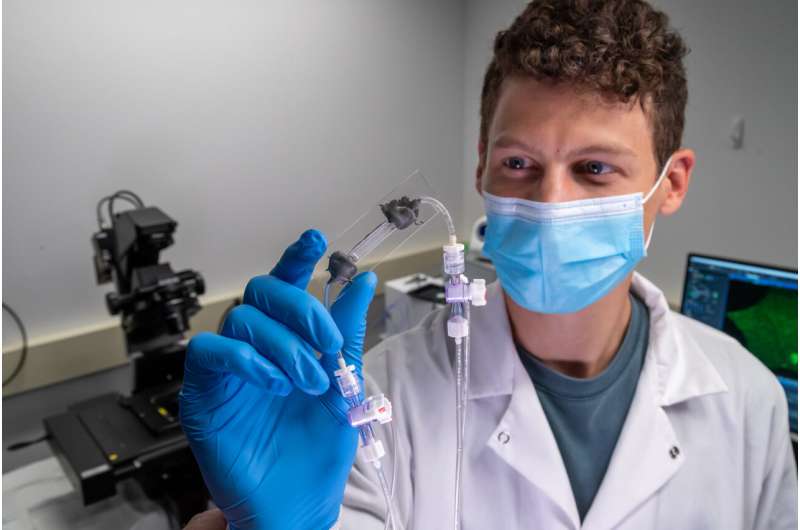
Browne ran the experiments and built the experimental apparatus, a small rectangular chamber randomly packed with tiny borosilicate glass beads. The setup, akin to an artificial sedimentary rock, spanned only about half the length of a pinky finger. Into this faux rock, Browne pumped a common polymer solution laced with fluorescent latex microparticles to help see the solution's flow around the beads. The researchers formulated the polymer solution so the material's refractive index offset light distortion from the beads and made the whole setup transparent when saturated. Datta's lab has innovatively used this technique to create see-through soil for studying ways to counter agricultural droughts, among other investigations.

Browne then zoomed in with a microscope on the pores, or holes between the beads, which occur on the scale of 100 micrometers (millionths of a meter) in size, or similar to the width of a human hair, in order to examine the  through each pore. As the polymer solution worked its way through the porous medium, the fluid's flow became chaotic, with the fluid crashing back into itself and generating turbulence. What's surprising is that, typically, fluid flows at these speeds and in such tight pores are not turbulent, but "laminar": the fluid moves smoothly and steadily. As the polymers navigated the pore space, however, they stretched out, generating forces that accumulated and generated turbulent flow in different pores. This effect grew more pronounced when pushing the solution through at higher pressures.

"I was able to see and record all these patchy regions of instability, and these regions really impact the transport of the solution through the medium," said Browne.

Fractured artificial rock helps crack a 54-year-old mystery
Princeton researchers have developed a technique to better understand how polymers flow through small channels under pressure. Credit: David Kelly Crow

The Princeton researchers used data gathered from the experiment to formulate a way to predict the behavior of polymer solutions in real-life situations.

Gareth McKinley, a professor of mechanical engineering at the Massachusetts Institute of Technology who was not involved in the study, offered comments on its significance.

"This study shows definitively that the large increase in the macroscopically observable pressure drop across a porous medium has its microscopic physical origins in viscoelastic flow instabilities that occur on the pore scale of the porous medium," McKinley said.

Given that viscosity is one of the most fundamental descriptors of fluid flow, the findings not only help deepen understanding of polymer solution flows and chaotic flows in general, but also provide quantitative guidelines to inform their applications at large scales in the field.

"The new insights we have generated could help practitioners in diverse settings determine how to formulate the right polymer  and use the right pressures needed to carry out the task at hand," said Datta. "We're particularly excited about the findings' application in groundwater remediation."

Because polymer solutions are inherently goopy, environmental engineers inject the solutions into the ground at highly contaminated sites such as abandoned chemical factories and industrial plants. The viscous solutions help push out trace contaminants from the affected soils. Polymer solutions likewise aid in oil recovery by pushing oil out of the pores in underground rocks. On the remediation side, polymer solutions enable "pump and treat," a common method for cleaning up groundwater polluted with industrial chemicals and metals that involves bringing the water to a surface treatment station. "All these applications of polymer solutions, and more, such as in separations and manufacturing processes, stand to benefit from our findings," said Datta.

Overall, the new findings on  flow rates in  brought together ideas from multiple fields of scientific inquiry, ultimately disentangling what had started out as a long-frustrating, complex problem.

"This work draws connections between studies of polymer physics, turbulence, and geoscience, following the flow of fluids in rocks underground as well as through aquifers," said Datta. "It's a lot of fun sitting at the interface between all these different disciplines."

Tiny polymer springs give a boost to environmental cleanup
More information: Christopher A. Browne et al, Elastic turbulence generates anomalous flow resistance in porous media, Science Advances (2021). DOI: 10.1126/sciadv.abj2619. www.science.org/doi/10.1126/sciadv.abj2619
Journal information: Science Advances 
Provided by Princeton University 
Guinea junta names AngloGold executive as mines minister

Cecilia Jamasmie | November 5, 2021 

Siguiri gold mine is AngloGold’s only operation in Guinea. (Image courtesy of AngloGold Ashanti.)

Guinea’s junta has appointed Moussa Magassouba, the director general of AngloGold Ashanti’s (JSE: ANG) (NYSE: AU) local subsidiary as the country’s mines and geology minister, two months after the army unit overthrew President Alpha Conde.


Magassouba, a western educated mining engineer and fluent English speaker, has more than 20 years’ of experience in the industry. He joined AngloGold Guinea in 2016 and held the role of managing director.

Experts, such as Eric Humphery-Smith, Africa analyst at risk consultancy Verisk Maplecroft, believe Magassouba’s nomination is a positive step towards putting mining executives’ minds to rest.
Moussa Magassouba. (Image: Siguiri mine.)

“The fact that Magassouba is a pure technocrat, with no obvious political experience, is reassuring for operators,” Humphery-Smith wrote. “It also proves that the National Rallying Committee for Development (CNRD) — one of the four institutions or figures in charge of the transition — is attentive to industry stakeholders.”

Abé Sylla, a United States-based businessman, has been appointed as energy and hydrocarbons minister, while artist Alpha Soumah was named culture minister.

Guinea is the world’s top exporter of bauxite, which is refined into alumina and then smelted to produce aluminum. The reddish ore accounts for most of the West African nation’s mining exports, though the country also has vast deposits of iron ore, gold and diamonds.

While the coup has been condemned by Guinea’s neighbours and exacerbated concerns about supply constraints that pushed aluminum prices to the highest level in 13 years, the junta took early steps to reassure miners.

One of its first actions was to lift a curfew in mining areas, urging companies to keep operating and keeping the nation’s ports open.

The junta also unveiled a “transitional charter” that it says will steer the country back to civilian rule.
Apolitical

Magassouba’s job will be specially challenging, Humphery-Smith says, due mainly to his lack of experience in politics.

“The largely apolitical nature of Magassouba’s profile means we expect him to give way to the junta’s policy directives. Indeed, the Transition Charter makes it explicitly clear that Doumbouya and the CNRD will instruct the government on policy matters,” the Verisk Maplecroft analyst says.

The expert notes the junta’s slow decision-making pace to date, hints that the government will not be “especially responsive” to the private sector.

Besides Australia, Guinea is one of China’s largest supplier of bauxite. Yet poverty remains endemic as the ore is sent as raw material, with little effort made so far to transform it locally.

The country’s new leadership has said its focus will be to accelerate the second phase of the mining value chain by boosting local processing.

Leaders of the 15-nation regional bloc Economic Community of West African States (ECOWAS), from which Guinea is currently suspended, meet on Sunday to discuss the situation in the country as well as in neighbouring Mali, where a junta took power last year.

ECOWAS has demanded that the Guinea junta organize elections by the end of March 2022.