Wednesday, December 08, 2021

CRIMINAL CAPITALI$M
'National embarrassment': Malaysian ex-PM loses corruption appeal


Supporters of former Malaysian prime minister Najib Razak shout slogans outside his residence in Kuala Lumpur (AFP/Mohd RASFAN)More

Tue, December 7, 2021, 8:17 PM·3 min read

Former Malaysian leader Najib Razak lost his appeal against a corruption conviction and 12-year jail term Wednesday, with the judge branding his actions a "national embarrassment" but allowing him to remain free.

The 68-year-old was found guilty on all counts last year in the first of several trials he is facing related to the looting of the 1Malaysia Development Berhad (1MDB) sovereign wealth fund.

Najib and his cronies were accused of stealing billions of dollars from the investment vehicle, with the allegations contributing to his long-ruling coalition's ejection from power in 2018.

The former prime minister's first trial was related to the transfer of 42 million ringgit ($9.9 million) from a former 1MDB unit to his bank accounts.

Najib -- who has remained free on bail -- denies wrongdoing, but the Court of Appeal upheld his conviction on charges including money-laundering and abuse of power.

Judge Abdul Karim Abdul Jalil rejected the defence's argument that some of Najib's actions were in the national interest.

"There is no national interest here, only national embarrassment," he told the court in the administrative capital Putrajaya.

Najib had "dishonestly misappropriated" the money, he added.

Judge Karim also rejected Najib's defence that he believed the cash was a donation from Saudi royalty, saying there was "no evidence" for the claim.

But he agreed to a request for Najib to stay out of prison on bail while he lodges a final appeal with Malaysia's top court.

Najib has been making a political comeback in recent months, campaigning for his party and presenting himself as a man of the people who defends the interests of the ethnic Malay Muslim majority.

He followed proceedings online after a member of his legal team tested positive for the coronavirus, and said he was "disappointed" with the verdict.

"I did not know, nor did I ask nor did I order the transfer of 42 million ringgit to my account," he told reporters.

- 'Nightmare for Malaysia' -

His lawyers had sought to delay Wednesday's ruling over the Covid case in the legal team, and by seeking to introduce new evidence at the 11th hour as part of the appeal.

But the court rejected both moves.

Najib's final appeal to the top court will likely take months. If that fails, his only option will be a pardon from the king.

If Najib -- who remains an MP -- loses the next court challenge, he will be jailed and barred from holding political office.

Despite his conviction, he is still influential and popular among some voters -- a group of supporters gathered outside court Wednesday, urging the judges to rule in Najib's favour.

The blue-blooded politician, whose father and uncle were both prime ministers, has about 4.6 million followers on Facebook, where he frequently comments on the news and criticises rivals.

He campaigned at local polls last month in the bellwether state of Malacca, helping his party, the United Malays National Organisation (UMNO), to a landslide victory.

Bridget Welsh, a Malaysia expert from the University of Nottingham, predicted Najib will "fight on, couching his personal interest as that of the party and nation".

But she added: "His comeback dream is a nightmare for Malaysia, fuelling polarisation and damaging the country's reputation."

Najib is currently facing two other ongoing 1MDB-related trials. The most significant centres on allegations he illicitly obtained more than $500 million.

jsm-sr/qan
On Africa's 'chocolate islands', cocoa producers target luxury market


Bean counters: The Diogo Vaz plantation in Sao Tome places out its cocoa harvest to dry (AFP/Adrien Marotte)

Jean-Remy Martin took over a dying cocoa plantation to launch the successful 
Diogo Vaz brand of high-end chocolate (AFP/Adrien Marotte)


Time to test: Claudio Corallo's chocolate workshop in Sao Tome. Cocoa grown in the islands' volcanic soil has a famously complex taste signature (AFP/Adrien Marotte)


Agronomist Claudio Corallo's background is in coffee, but he saw potential for Sao Tome in the growing market for top-quality chocolate (AFP/Adrien Marotte)


Just give me a tub: Chocolate testing in Claudio Corallo's workshop (AFP/Adrien Marotte)


Goat guardians: The Diogo Vaz cocoa plantation now has a bright future thanks to its foray into top-quality chocolate (AFP/Adrien Marotte)

Adrien MAROTTE
Tue, 7 December 2021

A morsel of chocolate sits on the tongue, and a strong yet subtle flavour starts to blossom.

"When the chocolate starts to soften, you bite into it," orders chocolatier, Claudio Corallo.

The chocolate tasting then expands into different flavours -- ginger, coffee, pepper, sea salt -- but underpinning each of these delights is an earthiness, a richness that comes from cocoa trees that grow in volcanic soil, wafted by the tropical Atlantic breeze.

They grow in Sao Tome and Principe, a tiny island nation off the west coast of Africa that has a rich but also tragic association with chocolate.

Once named the "chocolate islands", the Portuguese-speaking archipelago was the world's leading cocoa producer at the end of the 19th century.

Then, as competition mounted in the second half of the 20th century, the sector was almost wiped out. Many plantations were abandoned, and their fields and buildings were taken over by nature.

Today, though, there is talk of a comeback as a handful of entrepreneurs pitch to the growing world market for high-end chocolate.

"Focusing on quality is the only way to survive," said Jean-Remy Martin, a Frenchman who revived an old, dying plantation about a decade ago on the island of Sao Tome, in Diogo Vaz.

The place gave its name to a brand of chocolate Martin created with his son. Its 82-percent "Grand Cru" organic chocolate -- with "hints of flowers, smoke, spices and fruit" -- sells to online buyers in Europe for 6.40 euros ($7.42) a bar.

His spread of 420 hectares (about 1,000 acres) lies on the slopes of an ancient volcano overlooking the Atlantic, using cocoa trees that are the descendants of plants brought in by the Portuguese in the 18th century.

Mechanised farming on this terrain is impossible, but the trees grow under a lush natural canopy and in soil so fertile that Martin says he can do without chemical inputs.

- Grow cocoa, make chocolate -

But going organic was not enough.

"We have organic certification, but growing cocoa by itself won't cover the costs," Martin said. "We had to go for 100 percent production," taking charge of the entire chain from cocoa pod to chocolate.

The business model demanded a seismic change.

The farm moved from "a monoculture regime, whose cocoa prices were determined by world buyers, to exercising total control over our prices and boosting our cocoa in the value chain," he said.

Since then, Diogo Vaz chocolate has established an international reputation, winning numerous awards and earning enough profit to create an ambitious -- and sustainable -- business.

Around 250 people, almost all of them locals, are employed by the firm, which aims to replicate its success with fruit and vanilla cultivation, to be transformed into pastries and alcoholic drinks.

Corallo, an Italian from Florence, moved to Sao Tome in the early '90s and became a pioneer in developing top-of-the-range cocoa.

He set up "laboratories" at his plantation on the island of Principe and his workshop on Sao Tome to try to unravel the unique taste signatures of cacao grown on the archipelago.

"I don't like chocolate myself," Corallo told AFP mischievously, alluding to his professional record as a specialist in coffee.

Corallo's chocolate has developed a growing and devoted international following, although he said that the logistics of exporting from a location more than 300 kilometres (185 miles) from the coast of Gabon were often a headache.

Sao Tome and Principe is one of a growing number of cocoa-producing countries to aim at the burgeoning demand for organic.

The world market is expected to grow at nearly eight percent annually over the next five years, to reach $1.3 billion (1.16 billion euros) by 2026, according to industry research published in October.

- Bittersweet history -

Cocoa plantations are rooted in the islands' history.

At the industry's peak at the end of the 19th century, the islands cranked out nearly 35,000 tonnes of cocoa per year -- the fruit of the labour of thousands of immigrants from Portugal's other African colonies, Cape Verde, Angola and Mozambique.

But once the colonies gained independence in 1975, "the Portuguese left with their know-how, the plantations were hit by outbreaks of pests and the state redistributed land to former employees without any supervision," said Maria Nazare Ceita, a historian at the University of Sao Tome.

"Production collapsed."

"The whole population is linked to cocoa in one way or another," Carlos Vila Nova, the country's president, told AFP.

"Thanks to our know-how we understand the product very well," he said.

"In the globalised economy, we must give cocoa added value. We have to bet on quality. By extending the sector to processing, the cocoa business has a future again."

amt/dyg/nb/ri/gd
Indonesian leader visits volcano eruption survivors, vows to rebuild

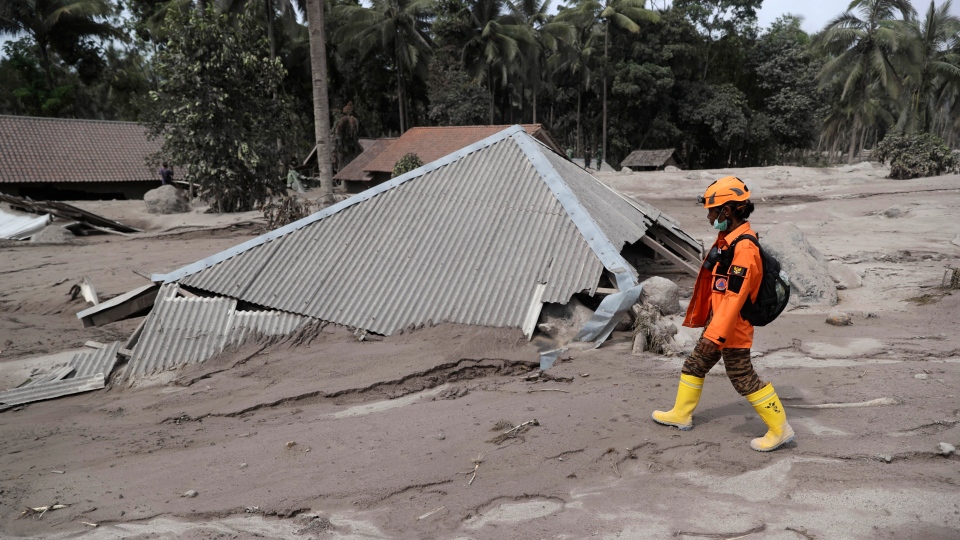
A rescuer walks past a house buried in the ash following the eruption of Mount Semeru in Lumajang district, East Java province, Indonesia, Sunday, Dec. 5, 2021. (AP Photo/Trisnadi)

Agoes Basoeki
The Associated Press
Tuesday, December 7, 2021 

LUMAJANG, INDONESIA -- Indonesia's president on Tuesday visited areas devastated by a powerful volcanic eruption that killed at least 22 people and left thousands homeless, and vowed that communities would be quickly rebuilt.

Clouds of hot ash shot high into the sky and an avalanche of lava and searing gas swept as far as 11 kilometres (7 miles) down Mount Semeru's slopes in a sudden eruption Saturday triggered by heavy rain. Villages and towns were blanketed by tons of volcanic debris.

President Joko Widodo visited eruption-hit areas in Lumajang district in East Java province to reassure people that the government's response is reaching those in need.

Related Stories
27 still missing after Indonesia volcanic eruption kills 22

After visiting survivors in shelters on a soccer field, he pledged to rebuild infrastructure, including the main bridge connecting Lumajang to other cities, and move more than 2,000 houses out of danger zones.

Officials earlier said residents of the hardest-hit villages will be relocated within the next six months, and each family waiting for a new house will be provided 500,000 rupiah (US$34.50) per month in compensation.

National Disaster Mitigation Agency spokesperson Abdul Muhari said 56 people were hospitalized after the eruption, mostly with burns. He said rescuers are still searching for 27 villagers reported missing. Nearly 3,000 houses and 38 schools were damaged, he said.

Cargo planes carrying food, tents, blankets and other supplies landed Tuesday for distribution in temporary shelters.

The eruption of the 3,676-metre (12,060-foot) mountain eased pressure that had been building under a lava dome in its crater. But experts warned that the dome could further collapse, causing an avalanche of blistering gas and debris trapped beneath it.

Relief workers struggled Tuesday to clear tons of volcanic debris, and focused on three locations in the worst-hit village of Sumberwuluh, where people are still believed trapped in houses that were buried to their rooftops, said Wayan Suyatna, who heads the local search and rescue agency.

"The volcanic ash deposits are still at high temperatures, and the deeper we dig the hotter it gets," Suyatna said.

Semeru, also known as Mahameru, has erupted many times in the last 200 years. Still, as on many of the 129 volcanoes monitored in Indonesia, tens of thousands of people live on its fertile slopes. It last erupted in January, with no casualties.

Indonesia, an archipelago of more than 270 million people, is prone to earthquakes and volcanic activity because it sits along the Pacific "Ring of Fire," a horseshoe-shaped series of fault lines.

Associated Press writer Niniek Karmini in Jakarta, Indonesia, contributed to this report.

Rising seas blamed as flooding hits Pacific islands

Island nations in the South Pacific were cleaning up Wednesday after storms and tidal surges triggered widespread flooding, with rising seas caused by climate change blamed for the inundation.
© Eve BURNS Flooding and debris cover the road to the airport in the Marshall Islands capital Majuro

The Marshall Islands, Solomon Islands and Federated States of Micronesia all reported flooding, with reports that remote parts of Vanuatu were also hit by rising waters.

"(The) government of the Federated States of Micronesia has been made aware of extensive saltwater inundation across the nation's islands as a result of ongoing king tides and storm surges," President David Panuelo said in a statement.

© Chewy Lin The flooding in the Marshalls was blamed on a combination of bad weather, high tides, La Nina weather pattern and a rise in sea levels linked to global warming

"The government has received numerous requests from citizens asking for support."

In the Marshall Islands capital of Majuro, sea water surged over boulder barriers and covered sections of road to the airport to a depth of 50 centimetres (20 inches) before receding.

Solomon Islands police issued a warning to residents to stay away from swollen rivers and streams

Climate researcher Murray Ford said the flooding in the Marshalls was due to a combination of bad weather, high tides, a La Nina weather pattern and a long-term rise in sea levels, widely linked to global warming.

"An event like this would have been relatively innocuous in the 1990s, but the sea level is notably higher today than back then," the Auckland University academic told AFP.

"Sea level rise is increasing the frequency and magnitude of these sorts of events."

Ford said that tidal measuring equipment installed in Majuro in the early 1990s showed sea levels had risen by an average of 4.8 millimetres (0.2 inches) annually.

"Unfortunately, with steady sea-level rise, these flooding events will become more frequent, more widespread, and far more severe. We must plan and prepare for this now," said Majuro resident and former Marshall Islands chief secretary Ben Graham.

The Pacific's low-lying islands are among the countries worst affected by climate change, with some at risk of being swamped entirely by rising seas.

They are also threatened by increasingly powerful cyclones, while droughts and flooding are becoming more common across the region as the weather swings from one extreme to the other.

str-ns/hr/jah
ECOCRIME
Thai Supreme Court jails tycoon over wildlife poaching

A Thai tycoon accused of poaching wildlife in a national park lost his final appeal Wednesday, in a long-running saga that drew public outrage over the elite's perceived impunity.

© Lillian Suwanrumpha Thai tycoon Premchai Karnasuta, accused of poaching wildlife, has lost his final appeal

Construction magnate Premchai Karnasuta was arrested in February 2018 when park officials found guns, animal carcasses -- including of a kalij pheasant and a red muntjac -- and the pelt of a black leopard at his campsite.

Premchai was found not guilty of possessing a leopard carcass, but he was convicted of three other poaching-related charges and sentenced to 16 months jail. It was raised to three years and two months by the Appeals Court.

On Wednesday, the Supreme Court upheld the guilty verdict and sentence of three years and two months, a court official confirmed.

He and two other defendants were ordered to pay 2 million baht ($60,000) in compensation.

Premchai, who arrived in a Range Rover sporting an eye patch, will not receive a suspended sentence, according to the attorney general's office.

He has been sent to Thong Pha Phum district prison, a court official confirmed.

The decision brings to a close a long-running case that sparked public anger in a kingdom fed up with perceived impunity for powerful figures.

Premchai's firm, Italian-Thai Development Company, is behind major infrastructure projects such as Bangkok's sky train and Suvarnabhumi airport.

He and his sister were on the Forbes Top 50 richest list for Thailand until 2016 with an estimated $630 million fortune at the time, but they have since dropped off the ranking.

World Wide Fund for Nature Thailand said the case was a victory for "wildlife and the rule of law".

"It is a sentence which sends a clear message that wildlife crime will not be tolerated no matter who you are," the organisation said in a statement.

"Today justice was served, and Thailand should be proud."

Members of the kingdom's wealthy elite have a habit of avoiding justice.

There was a public outcry last year when Thai authorities dropped charges against Red Bull heir Vorayuth "Boss" Yoovidhya after he crashed his Ferrari in 2012, killing a police officer.

Thailand's Attorney General's Office has since announced fresh charges and an Interpol Red Notice has been issued to arrest Vorayuth.

ton-lpm/dhc/je

AFP

Vietnam gives longest ever jail term for trading rhino horn: NGO


Vietnam gives longest ever jail term for trading rhino horn: NGOA rhino horn trader has been sentenced to 14 years in jail by a Vietnamese court, the longest ever prison term handed down for the crime, a local conservation group said (AFP/STR)

Tue, December 7, 2021

A rhino horn trader has been sentenced to 14 years in jail, the longest ever prison term a Vietnamese court has handed down for the crime, a local conservation group said Wednesday.

Vietnam is both a consumption hub and popular transit point for the multibillion-dollar trade in animal parts.

Authorities have long vowed to stem the flow of illegal wildlife criss-crossing its borders, but experts have warned the black market persists thanks to weak law enforcement.


Earlier this week, Do Minh Toan, 36, received 14 years in jail for trading and trafficking rhino horns from the United Arab Emirates (UAE) into Vietnam.

It came after a 2019 discovery by customs officials at Hanoi's Noi Bai international airport of 55 pieces of rhino horn -- weighing around 125 kilogrammes (275 pounds) -- in a carefully disguised shipment.

The pieces were encased in plaster and police used rods to break the casts apart.

According to non-government organisation Education for Nature Vietnam (ENV), the punishment is the toughest to date in the country for crimes relating to rhino horns and the wildlife trade.

"Amid the negative opinions about Vietnam's handling of wildlife crimes, this heavy penalty showed that Vietnam's competent authorities have begun to mete out serious punishment to deter people from wildlife crimes," ENV vice director Bui Thi Ha said in a statement.

The organisation said Vietnam had recorded 317 crimes relating to rhino horns since 2017. A total of 24 people have been arrested and charged, with the average jail term for those found guilty more than five years.

Vietnam and China remain lucrative markets for elephant tusks, pangolins, tiger parts and rhino horns.

Some believe that rhino horn helps cure diseases and hangovers when ground into powder.

Poachers in Africa have decimated wild rhino populations to meet demand despite the trade being banned globally since the 1970s.

Only about 29,000 rhinos survive in the wild, down from half a million at the beginning of the 20th century, according to conservationists.

tmh/aph/lpm/ssy


AFP
ECOCIDE
Sri Lanka chemical ship wreck to be salvaged: operators

Author: AFP|
Update: 08.12.2021 

The wreck of a chemical ship that caught fire off the Sri Lankan coast and caused environmental carnage will be removed / © AFP/File

The wreck of a chemical ship that caught fire off the Sri Lankan coast and caused environmental carnage will be removed, the operators said Wednesday.

A salvage company has been contracted to remove the sunken MV X-Press Pearl and the remains of its cargo, its Singapore-based managers said.

"The wreck removal plan will ensure a complete removal and safe, proper disposal of the wreck and any debris and pollutants around the wreck," X-Press Feeders said in a statement.


Hundreds of tonnes of chemicals and plastics leaked from the ship after it caught fire in May off Colombo and burned for two weeks before sinking.

Dead turtles, dolphins and whales washed up on the Indian Ocean island's beaches, and Sri Lankan authorities said it was the country's worst marine disaster.

The vessel was known to be carrying 81 containers of hazardous chemicals, including 25 tonnes of nitric acid, when it caught fire.

Around 1,200 tonnes of tiny plastic pellets and other debris that blanketed beaches have been scooped up and stored in 45 shipping containers.

Sri Lanka sought $40 million in damages from the ship's operators to cover the initial operational costs incurred in handling the disaster.


The sinking of the MV X-Press Pearl was the worst marine disaster in Sri Lanka's history, authorities said / © AFP/File


A second compensation claim has been submitted by Sri Lankan authorities, the operators said.

But the wider ecological costs are yet to be determined, according to the island's Marine Protection Authority.

Its chair Darshani Lahandapura welcomed the salvage plan.

"We have to start it soon as the rough sea season is fast approaching," she said. "This is going to take time, not an easy thing to do."

University professor and environmentalist Terney Pradeep Kumara added that removing the wreck was "absolutely necessary".

But he said it would lead to a spike in pollution "due to the clearing of the containers carrying chemicals which are deposited in the sea bed alongside the wreck".

Sri Lanka in June launched a criminal probe against the ship's captain, chief engineer, chief officer as well as its local agent.
As Climate 'Net-zero' Plans Grow, So Do Concerns From Scientists


By Patrick GALEY
12/08/21 AT 9:45 AM


Faced with the prospect that climate change will drive ever deadlier heat waves, rising seas and crop failures that will menace the global food system, countries, corporations and cities appear to have come up with a plan: net zero.

The concept is simple: starting now, to ensure that by a certain date -- usually 2050 -- they absorb as much carbon dioxide as they emit, thereby achieving carbon neutrality.

But scientists and monitoring groups are growing increasingly alarmed at the slew of vague net-zero pledges that appear to privilege offsets and future technological breakthroughs over short-term emissions cuts.

"They're not fit for purpose, any of them," Myles Allen, director of Oxford Net Zero at the University of Oxford said of today's carbon neutrality plans.

"You can't offset continued fossil fuel use by planting trees for very long. Nobody has even acknowledged that in their net-zero plans, even the really ambitious countries," he told AFP.

Last month's COP26 climate summit in Glasgow saw major emitter India commit for the first time to work towards net-zero emissions, joining the likes of China, the United States and the European Union.

According to Net Zero Tracker (NZT), 90 percent of global GDP is now covered by some sort of net-zero plan. But it said that the vast majority remain ill-defined.

Take offsets. These are when countries or companies deploy measures -- such as tree planting or direct CO2 capture -- to compensate for the emissions they produce. NZT found that 91 percent of country targets, and 48 percent of public company targets, failed to even specify whether offsets feature in their net-zero plans.

What's more, it found that less than a third (32 percent) of corporate net-zero targets cover what are known as "scope 3 emissions" -- those from a company's product, which normally account for the vast majority of carbon pollution from a given business.

Alberto Carrillo Pineda, co-founder of Science Based Targets initiative, which helps companies align their net-zero plans with what science says is needed to avoid catastrophic heating, said most decarbonisation pledges "don't make sense" without including scope 3 emissions.

"From a climate point of view it matters, the companies are driving emissions not only through their operations but also through what they buy and sell," he told AFP.

"And that constitutes their business model. A company wouldn't exist without their product and so their product needs considering from an emissions point of view."

The UN climate change body, UNFCCC, analysed the latest national emissions cutting plans during COP26.

It found that they would see emissions increase 13.7 percent by 2030, when they must fall by roughly half to keep the Paris Agreement warming limit of 1.5C within reach.

Of the 74 countries that have published detailed net-zero plans, the UNFCCC found that their emissions would fall 70-79 percent by 2050 -- a significant drop, but still not net zero.

Scientists and monitoring groups are growing increasingly alarmed at the slew of vague net-zero pledges that appear to privilege offsets and future technological breakthroughs over short-term emissions cuts Photo: AFP / PETER PARKS

Stuart Parkinson, executive director of Scientists for Global Responsibility (SGR), said governments had started to use net-zero pledges as a way of delaying the immediate action the atmosphere needs.

"From our perspective, that's thoroughly irresponsible," he said.

"It is kicking the problem into the long grass and relying on speculative efforts in technology when we know that we can change behaviour right here and now and reduce emissions."

Last month UN Secretary General Antonio Guterres said an independent group would be established to monitor companies' net-zero progress.

Many countries and businesses plan to deploy mass reforestation as part of net-zero plans. Experts say this is problematic for two reasons.

The first is simple science: Earth's plants and soil already absorb enormous amounts of manmade CO2 and there are signs that carbon sinks such as tropical forests are reaching saturation point.

"The concern is that the biosphere is turning from a sink to a source by warming itself," said Allen.

"So relying on the biosphere to store fossil carbon is really daft when we may well need all the nature-based solutions we can find just to keep the carbon content of the biosphere stable."

Teresa Anderson, senior policy director at ActionAid International, said relying on land-based carbon sequestration was "setting Earth up for a rude awakening".

But the concept is also problematic from the perspective of human rights and fairness.

"When it comes to the competition for land to plant trees and bioenergy, that's going to impact low-income communities, the ones that have done the least to cause the problem," Anderson told AFP.

And because humans have already burned through most of the carbon budget -- that is, how much total carbon pollution we can produce before 1.5C is breached -- there simply isn't time to delay.

This year the UN's Intergovernmental Panel on Climate Change found that since 1850, humans had emitted around 2400 billion tonnes of CO2 equivalent. That leaves just 460 billion tonnes left before 1.5C is breached -- around 11 years at current emissions rates.

Pineda said that while hundreds of companies have made net-zero pledges, "very few" have concrete long-term plans to decarbonise.

"We need to be very sceptical of any target that doesn't have clear milestones in terms of how the company is going to halve emissions by 2030," he said.

"Any net-zero target without a 2030 milestone is just unbelievable, basically."

Copyright AFP. All rights reserved.
Deliveroo Wins Court Battle On Riders' Status In Belgium

By AFP News
12/08/21 

Deliveroo riders in Belgium cannot be requalified as employees with contracts heaping social security and tax obligations on the company, a Belgian court ruled on Wednesday.

The takeaway platform immediately hailed the result as "a victory", although the judgment related to a small minority of riders working as independent contractors.

"The labour relationship linking Deliveroo to the 115 riders... cannot be requalified as an employment contract," the court said.


"It's a victory from a legal standpoint for Deliveroo. It's also one for the riders who made the conscious choice to work as independent contractors with the flexibility they desire," a spokesman for Deliveroo's Belgian subsidiary, Rodolphe Van Nuffel, told AFP.

CSC, a union covering around 30 of the riders, said it was "surprising" the court did not find there was a legal employer-employee relationship.

"This ruling doesn't favour anyone, and certainly not the riders who wanted to benefit from the rights of other workers, such as social security or workers' accident insurance with real coverage," a union representative, Martin Willems, told AFP.


Deliveroo riders lost their case for greater labour rights in a Belgian court Photo: BELGA via AFP / NICOLAS MAETERLINCK

He said only 15 percent of Deliveroo riders in Belgium work under independent contractor status, while the rest are under a "collaborative economy" category for those who make money from sharing activities proposed by platforms.

The latter category, introduced in 2016, allows people to engage in the gig economy by providing occasional small services to top up their other revenues, but offers no social security coverage.

The court had to weigh two statuses, those of salaried employee or independent contractor, but those categories were "not applicable" to services offered by online platforms, Willems said.

He said it was "urgent" that the Belgian government clear up that inconsistency.

The Belgian judgment was delivered ahead of a proposal the European Commission is to present on Thursday setting out criteria to determine whether a worker in Europe using Uber, Bolt or Deliveroo should be considered an employee of the platform or not.

The criteria reportedly concern pay levels, demands on appearance such as uniforms, and restrictions on a worker's ability to refuse jobs.

If sufficient boxes are ticked, platforms could no longer argue they are exclusively tech platforms and would be forced to operate like bricks-and-mortar firms with labour laws to obey.

Copyright AFP. All rights reserved.
'Pool Of Blood': US Drone Strike Hits Syria Family


By Omar Haj Kadour
12/08/21 

Ahmad Qassum was driving home with his family when a US drone targeting an Al-Qaeda-linked militant in Syria struck and left all six of them wounded.

"We came across a motorbike that was driving in front of us, and when I tried to overtake it, I felt a strike hit us," the 52-year-old displaced Syrian told AFP from his wife's family home in Idlib province.

Shrapnel from the attack, he said, turned his vehicle into a "pool of blood".

It wounded his wife and four children, including his nine-year-old son Mahmud who is still in intensive care for a serious head injury.


"I didn't know who to save first," Qassum said, recalling the moments immediately after the attack.

Idlib is a region dominated by the Hayat Tahrir al-Sham alliance, which is led by Syria's former Al-Qaeda affiliate.

Nine-year-old Mahmud Qassoum remains in intensive care with a serious head injury after being hit by a US drone strike targeting a suspected Al-Qaeda-linked militant in Syria Photo: AFP / OMAR HAJ KADOUR

For years, a US-led international coalition in Syria and Iraq has conducted air raids that are aimed at jihadists but often kill and maim civilians.

They include a drone strike on Friday that the Pentagon said killed a "senior leader" of the Al-Qaeda-linked Hurras al-Deen faction.

"The initial review of the strike did indicate the potential for possible civilian casualties," Pentagon spokesperson John Kirby said.

Washington has "launched a civilian casualty assessment report," he told reporters on Monday.

The boy's father, Ahmad Qassoum, says he didn't know who to save first when shrapnel from the drone strike turned the family car into a "pool of blood" Photo: AFP / OMAR HAJ KADOUR

Qassum's family was driving back to the northern town of Afrin when the strike hit a man riding the motorcycle ahead of them.

They had spent a few days visiting relatives in Idlib, their first such trip in nine months, before their family holiday took a tragic turn.

"What did we do that justifies the Americans bombing us?" Qassum said, one hand wrapped in a bandage, while the other fiddled with a rosary bead.

"We want compensation... and those who did this to us should be held to account."

The US-led coalition has disclosed at least 1,417 civilian deaths since it started operations against the Islamic State group (IS) in Syria and Iraq in 2014.

But the actual number of civilians killed is believed to be higher.

The strike left the boy's mother, Fatima Karkou, effectively immobile, with her leg wrapped in a cast and hooked to a metal rod, after shrapnel from the strike tore through her body Photo: AFP / OMAR HAJ KADOUR

A New York Times investigation last month found the US concealed a March 2019 strike near IS's last Syria bastion of Baghuz that killed 70 people, mainly women and children.

Drawing from confidential documents, interviews with personnel directly involved and officials with top security clearance, the newspaper found the strike "was one of the largest civilian casualty incidents of the war against the Islamic State," albeit never publicly acknowledged by the US military.

The Pentagon said last month it had opened an investigation into the incident.

At an Idlib medical facility set up by the Syrian American Medical Society (SAMS), Mahmud was lying on a hospital bed, his head wrapped in a bandage.

The left side of the boy's face was dotted with small cuts.

He was unconscious for three days after the drone strike and required head surgery but is now in stable condition, his father and doctor said.

Qassum held up a phone to his son's face so he could chat with his sister who is living in Turkey, while an attendant checked his vitals.

"I didn't eat for the three days that Mahmud was unconscious," Qassum said.

"He is more precious to me than my own soul."

Doctor Ahmad al-Bayush said Mahmud was being kept in intensive care for monitoring and would be discharged soon.

Back in his wife's family home in the Idlib town of Al-Rami, Qassum sat around a large traditional furnace, fielding calls and messages from concerned relatives.

From time to time, he would check on his wife, who was lying down in an adjoining room.

Fatima Karhou, 47, was left effectively immobile, with her leg wrapped in a cast and hooked to a metal rod, after shrapnel from the strike tore through her body.

One of her cheeks had two sutured gashes, while the rest of her face was marked with smaller shrapnel cuts.

"It's true that we didn't die, but we are still victims," she told AFP, barely able to breathe between words.

"We are civilians and we can't do anything but raise our complaints to God."


CAPITALI$M IS CRISIS EVEN IN CHINA
China's Evergrande: How will a 'controlled demolition' impact the economy?


Evergrande is a real estate giant with a presence in over 280 Chinese cities (AFP/Jade Gao)

Beiyi SEOW
Wed, December 8, 2021,

As Chinese real estate behemoth Evergrande reportedly prepares for a government-backed mega-restructure, here is an explainer on what Beijing's bid to limit a contagion could mean for the wider economy:

- What happened to Evergrande? -

The Chinese government sparked a crisis in the property industry when it launched a drive last year to curb excessive debt among real estate firms as well as rampant consumer speculation.

Evergrande, a real estate giant with a presence in over 280 Chinese cities, was the most prominent developer to pay the price for Beijing's clampdown.

More than $300 billion in debt, it teetered for months on the edge of default, returning each time from the brink thanks to a last-minute repayment.

But according to Bloomberg it has now missed a 30-day grace period on overdue coupon payments worth $82.5 million, while agency S&P Global Ratings has said a default now "looks inevitable".

- What happens now? -

After Evergrande warned last week it may not be able to meet its financial obligations, the local government in Guangdong -- where the firm is headquartered -- summoned billionaire chairman Hui Ka Yan, and said they will send a "working group" to the company.

Analysts said this moment signalled the formal start of the giant's debt restructuring -- a process that will likely take years.

- What does it mean for investors? -

Signs that the state is taking a bigger role in Evergrande's future have eased investor concern of a disorderly collapse.

"It's pretty clear that the state is seriously involved in managing the situation," Shehzad Qazi, managing director of data analytics firm China Beige Book, told AFP.

It will "ultimately be a 'controlled demolition'," Qazi added.

But bondholders are likely to face deep haircuts, and even if restructuring provide some answers, the broader impact of Beijing's sweeping property crackdown remains to be seen.

- What about other Chinese developers? -

At least 10 property firms have defaulted on bonds since concerns started to grow over Evergrande in June.

Hong Kong-listed Sunshine 100 defaulted after missing a deadline to make $179 million in payments this week, and Kaisa failed in a debt swap to buy crucial time for raising cash.

Property firms made up 36 percent of the $10.2 billion of offshore bonds that Chinese borrowers defaulted on this year, Bloomberg said.

- How will China's economy be impacted? -

The People's Bank of China said last week that Evergrande's problems came from its own "poor management and blind expansion" in a bid to reassure investors.

Regulators have said they would safeguard the rights of homebuyers, while the banking and insurance authority stressed the need to "focus on satisfying mortgage needs for first homes."

With the local government sending a working group to the firm, the Evergrande crisis has drawn parallels with government intervention in other indebted companies, notably aviation conglomerate HNA Group.

HNA's restructuring did not cause investor panic -- although Evergrande's higher profile means this time will likely prove a bigger challenge.

But whatever happens to Evergrande, Beijing's broader clampdown has already had a major impact on the property sector and deepened worries over key firms' financial health, bringing home sales and prices down.

- And what about the global economy? -

A slowdown in the Chinese real estate sector, which accounts for a significant proportion of the country's economic output, could have ripple effects on global growth.

Evergrande's woes have rocked stock markets -- and the real estate sector makes up much of distressed dollar-denominated debt internationally.

But an Evergrande default has long been expected, and fears over a "Lehman moment" -- a reference to the Wall Street titan whose collapse prompted panic worldwide during the 2008 global financial crisis -- have already been dismissed.

bys/rox/ser

Kaisa share suspension furthers China property sector fears


Kaisa is China's 27th-largest real estate firm -- but one of its most indebted (AFP/JADE GAO)

Jerome TAYLOR
Tue, December 7, 2021

Chinese property firm Kaisa suspended share trading in Hong Kong on Wednesday as questions swirl over its ability to make repayments and contagion spreads within the country's debt-ridden real estate sector.

The Chinese government sparked a crisis within the property industry when it launched a drive last year to curb excessive debt among real estate firms as well as rampant consumer speculation.

Companies that had accrued huge debt to expand suddenly found the taps turned off and began struggling to complete projects, pay contractors and meet both domestic and foreign repayments.


Kaisa, China's 27th-largest real estate firm in terms of sales but one of its most indebted, became the latest company to spook investors when it announced on Friday that it had failed in a bid for a debt swap that would buy it crucial time.

On Wednesday morning the firm announced it was suspending trading in Hong Kong, where it is listed, "pending the release by the Company of an announcement containing inside information".

It is the second time the company has suspended trading in the last month.

Kaisa last month announced a plan to delay the repayment timeline for some of its bonds, offering an exchange for at least $380 million of notes, which would have given it some room to find money further down the line.

But the offer failed to win the 95 percent approval from bondholders needed for the plan to go ahead.

The company currently has some $11.6 billion of dollar notes outstanding. It previously defaulted on a dollar debt in 2015, becoming the first Chinese developer to do so.

The most indebted Chinese property firm is Evergrande, which set off the current confidence crisis earlier in the summer.

The Shenzhen-based behemoth racked up an eye-watering $300 billion in loans before Beijing began to rein in the sector.

- Mega-restructure -

On Tuesday, Evergrande missed a deadline to repay some of its overseas creditors, raising the prospect of it defaulting as it prepares for a government-backed mega-restructure.

Bloomberg News reported some of the $82.5 million in overdue coupon payments it owed by the end of Tuesday -- when a 30-day grace period ran out -- remained unpaid.

Ratings group S&P has predicted that a default by Evergrande is now "inevitable".

Questions have swirled over whether Evergrande is simply too big to be allowed to fail, given its collapse could send shock waves through the wider Chinese economy.

But signs now point to Beijing being willing to close the chapter on the 25-year-old real estate empire that has typified China's breakneck growth in recent decades.

After Evergrande said Friday it may not be able to meet its financial obligations, the government summoned the company's founder and announced several moves that have given the clearest picture yet of Beijing's plans to end the crisis.

A new seven-strong "risk management committee" has been set up to manage the restructuring. Only two executives from the company are on the committee -- others include officials from state entities.

Guangdong's provincial government is also sending a working team to the company, which analysts at Jefferies said indicated a "potential takeover of Evergrande".

Evergrande has yet to comment on the restructuring.

Kaisa and Evergrande have become the most visible faces of the debt crunch within China's property sector but defaults have rippled throughout the sector.

According to Bloomberg News, at least 10 lower-rated real estate firms have now defaulted on onshore or offshore bonds since the summer.

So far this year, Chinese borrowers have defaulted on a record $10.2 billion of offshore bonds, Bloomberg reported, with real estate firms accounting for 36 percent of those non-repayments.

Wealthy owners of at least seven Chinese real estate companies have also sold off some of their own luxury assets in recent weeks to help prop up their firms, Bloomberg added.

But the latest troubles within the property sector did little to ruffle regional stock markets on Wednesday.

Asian markets were mostly up across the region, including in Shanghai, while Hong Kong was trading flat by the lunchtime break.

jta/leg

China unveils package to boost economy as Evergrande teeters

Martin Farrer 
THE GUARDIAN
12/7/2021

China’s politburo has signalled measures to kickstart the faltering economy as the crisis gripping the country’s debt-laden property sector continued to blight prospects for growth.© Provided by The Guardian Photograph: Greg Baker/AFP/Getty Images

President Xi Jinping’s senior leadership committee rubber-stamped a plan from the central bank on Monday for more targeted lending to businesses and outlined support for the housing market.

The People’s Bank of China (PBOC) said it would cut the reserves most banks must hold by 0.5 percentage points, releasing another 1.2tn yuan ($188bn) into the economy, the central bank said in a statement

.
© Photograph: Greg Baker/AFP/Getty Images China’s real estate sector – once a key driver of growth – has been struggling recently.

Related: China Evergrande shares hit record low as it edges closer to default

Leaders had also agreed to “promote the construction of affordable housing, support the commercial housing market and better meet the reasonable housing needs of buyers”, Xinhua state news agency said.

Attendees at the Monday meeting chaired by Xi said the housing moves would “promote the healthy development and virtuous cycle of the real estate industry”, according to Xinhua.

Despite the positive read-out from the politburo meeting, the country’s second-biggest property developer, Evergrande, was inching ever nearer to what could be the biggest failure in Chinese corporate history.

It needed to pay $82.5m in bond repayments by midnight New York time on Monday in order to avoid an automatic default. But some bondholders did not receive coupon payments by the deadline, four people with knowledge of the matter told Reuters on Tuesday.

Although Evergrande has faced three similar deadlines on offshore bonds since October and made each one at the last minute, it was less clear that it was going to make the payments this time.

A statement from the company on Monday evening said that in the light of its financial problems it was forming a risk management committee to “mitigate and eliminate future risks”. The statement helped stabilise its shares on Tuesday after dropping 20% in the previous session. It followed a weekend statement from the company said it might not be able to repay some of its $300bn debts.

A default would trigger cross-defaults on all the company’s about $19bn of dollar bonds in international capital markets and put Evergrande at risk of becoming China’s biggest-ever defaulter, which would ripple through the property sector and beyond, further rattling global investor confidence.

But most analysts now expect to have to undergo a significant restructuring to spread its debts throughout the economy.

Investors are also concerned about a potential default by Kaisa Group Holdings Ltd, which faces a $400m bond maturity on Tuesday. After Evergrande, it owes the most to foreign bondholders, with debts of $12bn.

Another Chinese developer, Sunshine 100 China Holdings, said on Sunday that it had missed a deadline to repay $179m in principal and interest payments on a 10.5% bond.

China’s economy is not growing as quickly as expected as it faces headwinds from a disrupted global economy, continued Covid outbreaks and the slowing housing market – once a key driver of growth but which is now seeing a string of defaults.

In October, the IMF lowered its forecasts for China’s growth to 5.6% in 2022, which is huge by the standards of developed nations but modest by recent Chinese standards.

The IMF’s managing director, Kristalina Georgieva, said on Monday that China has an important part to play in the global economy as it recovers from Covid-19, but its growth was slowing.

“China achieved a truly remarkable recovery, but its growth momentum has been slowing notably. As China is a vital engine for global growth, taking strong actions to support high-quality growth will help not only China, but the world,” Georgieva said.

Analysts at UBS said Monday’s policy announcements were a “clear signal” of monetary easing but others were less sure and noted that the PBOC insisted that monetary policy would remain prudent.

Julian Evans-Pritchard, China economist at Capital Economics, said the move was an “opening of the fiscal taps, not a flood”, and that “this easing will cushion but not stop growth from slowing”.

However, he predicted that the PBOC would have to cut its main interest rate before long. “As economic activity continues to weaken and the PBOC becomes more serious about lowering corporate financing costs we think it will have to take further action, including policy rate cuts.”

Bill Bishop, a respected China expert and author of the Sinocism newsletter, said Xinhua reports about the politburo meeting had received “a lot of attention” but he did not believe it was a significant easing.

“I do not think that is a fundamental shift,” he wrote in his latest newsletter. “Policymakers are dealing with some significant problems in the property markets including – but far from limited to – Evergrande, and they do not want to crater the industry. Can they calibrate and avoid disaster? We are going to find out.”