Wednesday, January 05, 2022

Tiger bites off keeper's hand at Japan safari park: Kyodo

Wed, 5 January 2022

A Bengal tiger similar to the one which attacked three keepers at a safari park in Japan
 (AFP/RASHIDE FRIAS)

A tiger bit off a keeper's hand and attacked two other people at a safari park near Tokyo, Japanese media reported Wednesday.

The tiger, a 10-year-old male Bengal who was around two metres (6.5 feet) in length and weighed 150 kilograms (330 pounds), attacked as the three keepers were preparing for the day at the Nasu Safari Park in Tochigi prefecture around 8.30 am, Kyodo news agency reported.

The park's operator said the tiger was not in its fenced enclosure as expected.

Instead the keepers came across it in a corridor leading to an exhibition area, and it attacked, according to the report.

The keeper who lost her hand, a woman in her 20s, was transported by medical helicopter to hospital, Kyodo said.

Kyodo said a second woman was bitten in several places and a man was injured in the back of his head. They were also taken to hospital.

Kyodo reported that keepers did not check that the fence to the tiger's cage was closed on Tuesday, after it had been led back inside once the exhibition was over.

The park closed for the day and police are reportedly investigating.

The Nasu Safari Park offers tours on specialized buses and for customers in their own cars to see its collection of around 700 animals including giraffes and elephants.

The park has had safety incidents before, including keepers being attacked by lions in 1997 and in 2000, according to Kyodo.

bur-st/dw
HINDU NATIONALISM IS ANTIMUSLIM
Islamophobia in India: Humiliation of Muslims has become 'a part of the political landscape'

Jan 5, 2022
FRANCE 24 English

Indian police have made arrests and launched an investigation into an online app that shared pictures of scores of prominent Muslim women for a fake online auction in a case of apparent hatred toward the minority community. And this comes right on the heels of a police probe investigating influential Hindu religious leaders calling for violence and even ethnic cleansing: "the arming of Hindus against Muslims, the need to teach them lessons." Dr. Subir Sinha, Senior Lecturer at SOAS University of London, joins France 24 to discuss how deeply entrenched Islamophobia has become in the cultural and political fabric of Indian society. He asserts that Islamophobic acts are now occurring in India with "a sickening regularity." These latest incidents are simply a reflection of "targeted communally charged harassment and misogyny that has just been rampant for the past few years."

Sex abuse trial starts for Guatemalan ex-paramilitaries


Guatemalan Nobel Peace Prize laureate Rigoberta Menchu was present 
for the trial opening (AFP/Johan ORDONEZ)

Wed, January 5, 2022,

A trial started in Guatemala Wednesday for five former paramilitary soldiers accused of sexually abusing 36 indigenous Mayan women some 40 years ago during the country's civil war.

The five are former members of Guatemala's Civil Self-Defense Patrols (PAC) blamed for several atrocities during the 1960-1996 war in which an estimated 200,000 people were killed or disappeared.

They will take part via videoconference from the Mariscal Zavala jail where they are being detained for crimes committed between 1981 and 1985 around the town of Rabinal, north of the capital Guatemala City.

The population of Rabinal was particularly hard hit by the war. A mass grave with the bodies of more than 3,000 people was discovered in the area.

Thirty-six women have come forward in the last decade with accusations of sexual violence committed against them during that time.

The identities of most of the women are being withheld for their own security, said their lawyer Lucia Xiloj.

Some have already given recorded evidence to investigators, which will be played in court.

Only five of the victims have opted to be present for the trial before Judge Jazmin Barrios in the Supreme Court of Justice.

According to Xiloj, many Mayan women "were raped after the (forced) disappearance of their husbands" by paramilitaries and soldiers.

Nobel Peace Prize laureate Rigoberta Menchu told reporters at the court that Guatemala had failed to "fulfill its obligation to defend these sisters who were raped, tortured, humiliated and subjected to (sexual) slavery during so many years of armed conflict."

A United Nations truth commission documented 669 massacres committed during Guatemala's civil war, of which 93 percent were attributed to government forces.

ec/mlr/st

4 acquitted in toppling of British slave trader statue


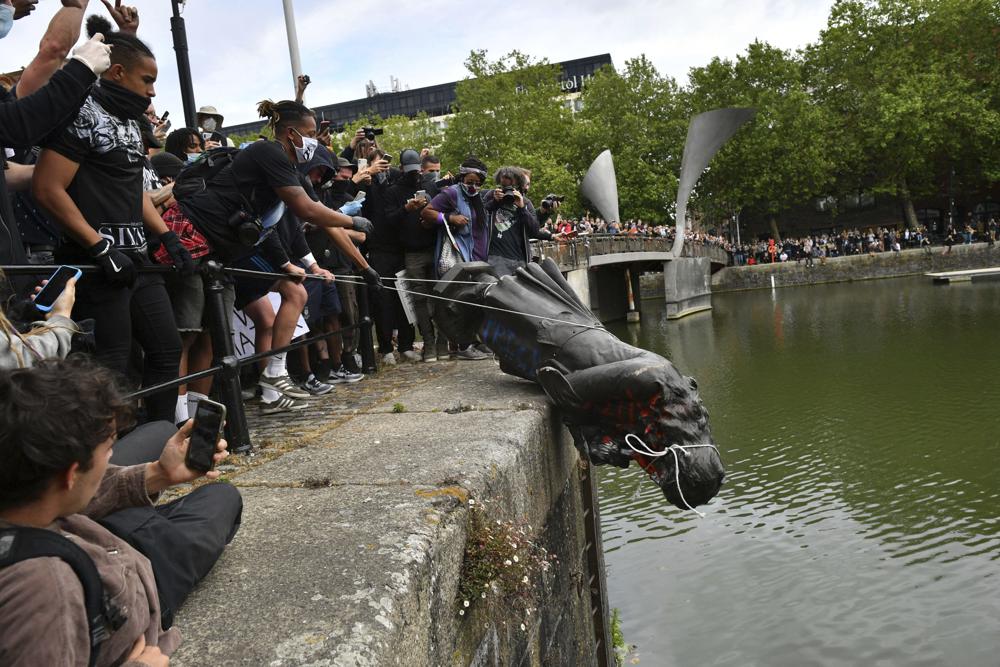
 Protesters throw a statue of Edward Colston into the Bristol harbour during a Black Lives Matter protest rally, Bristol, England, June 7, 2020. Four anti-racism demonstrators were cleared Wednesday Jan. 5, 2022, of criminal damage in the toppling of a statue of a 17th century slave trader during a Black Lives Matter protest in southwestern England 18 months ago.
 (Ben Birchall/PA via AP, File)


LONDON (AP) — Four anti-racism demonstrators were cleared Wednesday of criminal damage in the toppling of a statue of a 17th-century slave trader during a Black Lives Matter protest in southwestern England.

Protesters used ropes to pull down the bronze statue of Edward Colston and dump it in Bristol’s harbor on June 7, 2020. The demonstration and toppling were part of a worldwide reckoning with racism and slavery sparked by the death of a Black American man, George Floyd, at the hands of police in Minneapolis.

Loud cheers rang out from a packed public gallery at Bristol Crown Court as a jury acquitted Rhian Graham, 30, Milo Ponsford, 26, and Sage Willoughby, 22, and Jake Skuse, 33.

“This is a victory for Bristol, this is a victory for racial equality and it’s a victory for anybody who wants to be on the right side of history,” Willoughby said.

Graham, Ponsford and Willoughby were caught on closed-circuit television passing the ropes around the statue that were used to pull it down, while Skuse was accused of orchestrating a plan to roll it into the harbor.

All four had admitted their involvement but denied their actions were criminal, claiming the statue itself had been a hate crime against the people of Bristol.

They laughed with relief as the verdicts were read out and hugged the many supporters that were waiting outside of court when they were released.

The four had gotten got high profile help with their case. Elusive street artist Banksy designed a limited edition T-shirt, pledging the funds raised to their cause.

“The truth is that the defendants should never have been prosecuted,” Raj Chada, who represented Skuse, said in a statement following the verdict.

“It is shameful that Bristol City Council did not take down the statue of slaver Edward Colston that had caused such offence to people in Bristol, and equally shameful that they then supported the prosecution of these defendants,” Chada added.

Colston was a 17th-century trader who made a fortune transporting enslaved Africans across the Atlantic to the Americas on Bristol-based ships. His money funded schools and charities in Bristol, 120 miles (195 kilometers) southwest of London.

Bristol authorities fished the Colston statue out of the harbor and it was later put on display in a museum in the city, along with placards from the Black Lives Matter demonstration.

___

Follow all AP stories about racial injustice at https://apnews.com/hub/Racialinjustice
Man whose arrest led to ‘separate but equal’ is pardoned

By JANET McCONNAUGHEY

1 of 4

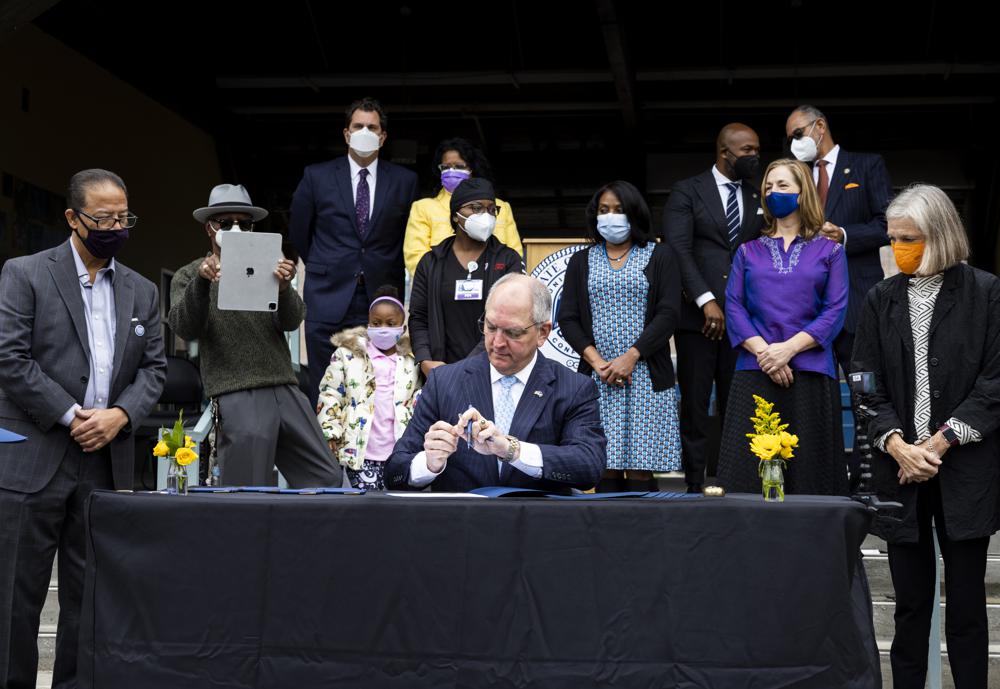
Gov. John Bel Edwards pardons Homer Plessy during the Posthumous Pardoning Ceremony for Homer Plessy at the New Orleans Center for Creative Arts in New Orleans, Wednesday, Jan. 5, 2022. Louisiana’s governor on Wednesday posthumously pardoned Plessy, the Black man whose arrest for refusing to leave a whites-only railroad car in 1892 led to the Supreme Court ruling that cemented “separate but equal” into U.S. law for half a century. (Sophia Germer/The Advocate via AP)

NEW ORLEANS (AP) — Louisiana’s governor on Wednesday posthumously pardoned Homer Plessy, the Black man whose arrest for refusing to leave a whites-only railroad car in 1892 led to the Supreme Court ruling that cemented “separate but equal” into U.S. law for half a century.

The state Board of Pardons last year recommended the pardon for Plessy, who boarded the rail car as a member of a small civil rights group hoping to overturn a state law segregating trains. Instead, the protest led to the 1896 ruling known as Plessy v. Ferguson, which solidified whites-only spaces in public accommodations such as transportation, hotels and schools for decades.

At a ceremony held near the spot near where Plessy was arrested, Gov. John Bel Edwards said he was “beyond grateful” to help restore Plessy’s “legacy of the rightness of his cause … undefiled by the wrongness of his conviction.”

Keith Plessy, whose great-great-grandfather was Plessy’s cousin, called the event “truly a blessed day for our ancestors … and for children not yet born.”

Since the pardon board vote in November, “I’ve had the feeling that my feet are not touching the ground because my ancestors are carrying me,” he said.

Justice Henry Billings Brown wrote in the 7-1 decision: “Legislation is powerless to eradicate racial instincts or to abolish distinctions based upon physical differences.”

Justice John Marshall Harlan was the only dissenting voice, writing that he believed the ruling “will, in time, prove to be quite as pernicious as the decision made by this tribunal in the Dred Scott Case” — an 1857 decision that said no Black person who had been enslaved or was descended from a slave could ever become a U.S. citizen.

The ceremony began with cellist Kate Dillingham — a descendant of the dissenting justice — playing “Lift Every Voice and Sing” while the audience sang along.

The Plessy v. Ferguson ruling allowing racial segregation across American life stood as the law of the land until the Supreme Court unanimously overruled it in 1954, in Brown v. the Board of Education. Both cases argued that segregation laws violated the 14th Amendment’s right to equal protection.

The Brown decision led to widespread public school desegregation and the eventual stripping away of Jim Crow laws that discriminated against Black Americans.

Plessy was a member of the Citizens Committee, a New Orleans group trying to overcome laws that rolled back post-Civil War advances in equality.

The 30-year-old shoemaker lacked the business, political and educational accomplishments of most of the other members, Keith Weldon Medley wrote in the book ”We As Freemen: Plessy v. Ferguson.” But his light skin — court papers described him as someone whose “one eighth African blood” was “not discernable” — positioned him for the train car protest.

“His one attribute was being white enough to gain access to the train and black enough to be arrested for doing so,” Medley wrote.

Eight months after the ruling in his case, Plessy pleaded guilty and was fined $25 at a time when 25 cents would buy a pound of round steak and 10 pounds of potatoes.

Keith Plessy said donations collected by the committee paid the fine and other legal costs. But Plessy returned to obscurity, and never returned to shoemaking.

He worked alternately as a laborer, warehouse worker and clerk before becoming a collector for the Black-owned People’s Life Insurance Company, Medley wrote. He died in 1925 with the conviction on his record.

Relatives of Plessy and John Howard Ferguson, the judge who oversaw his case in Orleans Parish Criminal District Court, became friends decades later and formed a nonprofit that advocates for civil rights education.

Also present at the pardon ceremony were descendants of the Citizens Committee and descendants of the local judge.

The purpose of the pardon “is not to erase what happened 125 years ago but to acknowledge the wrong that was done,” said Phoebe Ferguson, the judge’s great-great-granddaughter.

Other recent efforts have acknowledged Plessy’s role in history, including a 2018 vote by the New Orleans City Council to rename a section of the street where he tried to board the train in his honor.

The governor’s office described this as the first pardon under Louisiana’s 2006 Avery Alexander Act, which allows pardons for people convicted under laws that were intended to discriminate.

Former state Sen. Edwin Murray said he originally wrote the act to automatically pardon anyone convicted of breaking a law written to encode discrimination. He said he made it optional after people arrested for civil rights protests told him they considered the arrests a badge of honor.

Louisiana Governor to pardon Plessy, of ‘separate but equal’ ruling


Keith Plessy and Phoebe Ferguson, descendants of the principals in the Plessy V. Ferguson court case, pose for a photograph in front of a historical marker in New Orleans, on Tuesday, June 7, 2011. Homer Plessy, the namesake of the U.S. Supreme Court’s 1896 “separate but equal” ruling, is being considered for a posthumous pardon. The Creole man of color died with a conviction still on his record for refusing to leave a whites-only train car in New Orleans in 1892.
 (AP Photo/Bill Haber, File)


JANET McCONNAUGHEY
Tue, January 4, 2022,

NEW ORLEANS (AP) — Louisiana’s governor is slated to posthumously pardon Homer Plessy on Wednesday, more than a century after the Black man was arrested in an unsuccessful attempt to overthrow a Jim Crow law creating “whites-only” train cars.

The Plessy v Ferguson case went to the U.S. Supreme Court, which ushered in a half-century of laws calling for “separate but equal” accommodations that kept Black people in segregated schools, housing, theaters and other venues.

Gov. John Bel Edwards scheduled the pardon ceremony for a spot near where Plessy was arrested in 1892 for breaking a Louisiana law requiring Black people to ride in cars that the law described as “equal but separate” from those for white customers. The date is close to the 125th anniversary of Plessy’s guilty plea in New Orleans.

Relatives of both Plessy and the judge who convicted him are slated to be at the ceremony.

It spotlights New Orleans as the cradle of the civil rights movement, said Keith Plessy, whose great-great-grandfather was Plessy's cousin — Homer Plessy had no children.

"Hopefully, this will give some relief to generations who have suffered under discriminatory laws," said Phoebe Ferguson, the judge's great-great-granddaughter.

The state Board of Pardons recommended the pardon on Nov. 12 for Plessy, who was a 30-year-old shoemaker when he boarded the train car as a member of a small civil rights group hoping to overturn the law.

Instead, the 1896 ruling solidified whites-only spaces in public accommodations until a later Supreme Court unanimously overturned it in Brown v Board of Education in 1954. Both cases argued that segregation laws violated the 14th Amendment's right to equal protection.

In Plessy, Justice Henry Billings Brown wrote for the 7-1 majority: “Legislation is powerless to eradicate racial instincts or to abolish distinctions based upon physical differences.”

Justice John Harlan, the dissenter, wrote that he believed the ruling “will, in time, prove to be quite as pernicious as the decision made by this tribunal in the Dred Scott Case."

That 1857 decision said no Black person who had been enslaved or was descended from a slave could ever become a U.S. citizen. It was overturned by the 13th and 14th Amendments, passed in 1865 and 1866.

Plessy lacked the business, political and educational accomplishments of most other members of the group trying to strike down the segregation law, Keith Weldon Medley wrote in the book ”We As Freemen: Plessy v. Ferguson.” But his light skin — court papers described him as someone whose “one eighth African blood” was “not discernable” — positioned him for the train car protest.

“His one attribute was being white enough to gain access to the train and black enough to be arrested for doing so,” Medley wrote.

Five blocks of the street where he was arrested, renamed Homer Plessy Way in 2018, runs through the campus of the New Orleans Center for Creative Arts. The ceremony was scheduled at the campus, outdoors for COVID-19 safety.

Eight months after the ruling in his case, Plessy pleaded guilty on Jan. 11, 1897. He was fined $25 at a time when 25 cents would buy a pound of round steak and 10 pounds of potatoes. He died in 1925 with the conviction on his record.

Relatives of Plessy and John Howard Ferguson, the judge who oversaw his case in Orleans Parish Criminal District Court, became friends decades later and formed a nonprofit that advocates for civil rights education.

Other recent efforts have acknowledged Plessy’s role in history, including a 2018 vote by the New Orleans City Council to rename a section of the street where he tried to board the train in his honor.
Evergrande, Already $310 Billion in Debt, Told to Blow Up Chinese Resort Due to Problems

BY ERIN BRADY ON 1/4/22 

A Chinese real estate developer is being ordered to demolish one of its largest complexes.

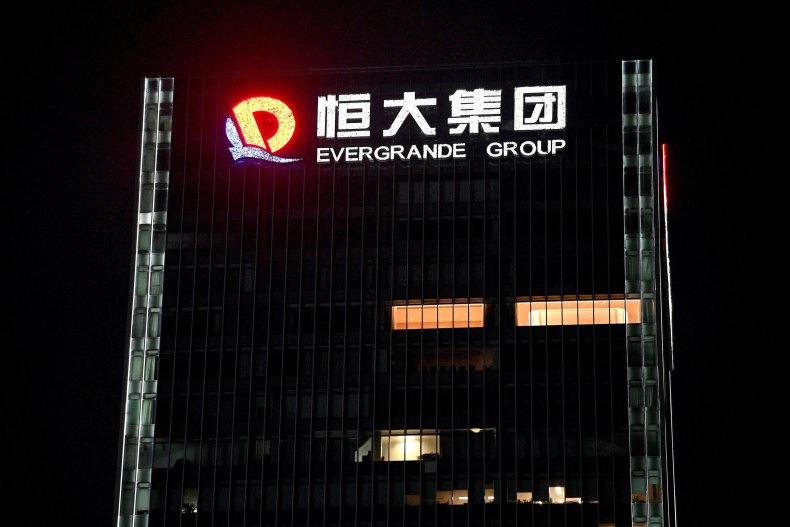
Evergrande Group was ordered to demolish a 39-building resort complex on Ocean Flower Island, an artificial archipelago off the coast of Danzhou. The developer did not release an explanation as to why the complex is being demolished, although Danzhou's government claimed that the complex violated urban planning law.

In 2021, Beijing began tightening restrictions on developers. The move was touted as one that would help rein in corporate debt and was implemented as part of the Chinese government's ongoing priority to reduce financial risk.


The Ocean Flower Island demolition is the newest headache that Evergrande has faced over the past few years. It has the dubious distinction of being the most indebted developer in the entire global real estate industry with around $310 billion in debt.

It is not immediately clear how much more debt the company will accumulate due to the demolition on Ocean Flower Island, nor has a timeline for the demolition been announced. Evergrande's buildings are the only ones being demolished on the island.

Evergrande Group was ordered to demolish a 39-building resort complex on Ocean Flower Island, an artificial archipelago off the coast of Danzhou, China. Above, Evergrande headquarters in Shenzhen, southeastern China, on September 14, 2021.
PHOTO BY NOEL CELIS/AFP VIA GETTY IMAGES

Evergrande's struggle to comply with tighter official restrictions on use of borrowed money by China's real estate industry have prompted fears of a possible default and financial crisis. Chinese regulators have tried to reassure investors that any potential impact on financial markets can be contained.

Economists say Beijing can keep Chinese lending markets functioning normally in the event of an Evergrande default, which looks increasingly likely. However, they say Chinese leaders want to avoid sending the wrong signal by arranging a bailout at a time when they are trying to force companies to reduce surging debt levels.

Evergrande asked Monday for trading of its shares in Hong Kong to be suspended. Trading resumed following Tuesday's announcement, gaining 7.6 percent.

Evergrande warned last month it might run out of cash to keep up with debt payments and other obligations.

The company says it has 2.3 trillion yuan ($350 billion) in assets and 2 trillion yuan ($310 billion in debt), but it has struggled to sell assets fast enough to keep up payments to bondholders. Construction of some projects was temporarily suspended after contractors complained they weren't being paid.

Tuesday's announcement said buyers in 20210 signed contracts to purchase property worth a total of 442 billion yuan ($70 billion).

The government will organize demolition if the company fails to act.

The Hainan government ordered an investigation last year of Ocean Flower Island, a complex of hotels, an amusement park and other facilities, according to news reports. They said some building permissions were revoked and fines of 215 million yuan ($34 million) were imposed for planning and construction violations.

The Associated Press contributed to this report.
Evergrande Group's $310 billion debt will grow due to the company being ordered to demolish a 39-building complex. Above, a worker pushes a cart in front of a sign showing Evergrande's China operation at a housing complex owned by the property developer in Beijing on December 8, 2021.
PHOTO BY NOEL CELIS/AFP VIA GETTY IMAGES


Check out the man-made island where Evergrande was ordered to tear down 39 buildings

Grace Kay
Tue, January 4, 2022

Getty


Evergrande was ordered to demolish 39 buildings on its man-made island.


The embattled real estate developer has poured nearly $13 billion into its Ocean Flower Island.


Take a look at the flower-shaped archipelago that has everything from theme parks to hot springs.

Evergrande, an embattled Chinese real estate developer, confirmed on Tuesday that it was ordered to tear down 39 buildings on its man-made island in China's southern Hainan province, according to a report from The Wall Street Journal.

Chinese authorities in the province have given the company 10 days to demolish the buildings, according to a notice that was obtained by The Journal and dated December 30. The developer has 60 days to file a potential appeal. The South China Morning Post cited media reports on Monday that an illegally obtained permit had been revoked by the provincial government which required the buildings to be dismantled.

An Evergrande spokesperson did not respond to a request for comment and Insider could not reach Hainan provincial authorities for comment.

Over the past 12 years, Evergrande has invested nearly $13 billion into the artificial archipelago or group of islands known as "Ocean Flower Island," The Journal reported. The potential demolition of its 39 buildings on the island represents one of many setbacks that the world's most indebted developer has faced over the past year. Evergrande is currently struggling to repay over $300 billion in liabilities.

The cluster of man-made islands were designed to emulate the shape of a peony and made up of three flower-shaped islets. The center of the cluster was constructed as a major business and tourism hub.

ShutterStoc

The project was over a decade in the making and opened in late 2020 as the world's largest man-made tourism island, spanning 1,980 acres. The Ocean Flower development is the largest project since Dubai opened its man-made archipelago, Palm Island, in 2009

Palm Island in DubaiShutterStock

The Ocean Flower project encompasses houses and hotels, as well as business and tourist opportunities, including a roughly 1.1 million square foot convention center built to resemble giant blooming peonies.

Getty

Ocean Flower Island, also known as "Haihua" in Chinese, has attracted over 5.5 million tourists since it opened, according to China's stateside publication, South China Morning Post. Last month, local Chinese government said the development was harming the marine environment, including causing mass damage to coral reefs.

The center of the archipelago has 28 major business hubs.

Getty

The complex offers an array of museums, as well as several amusement parks, including a fairy-tale world and water park.

ShutterStock

It also has several more relaxing options for tourists, including a botanical garden and hot springs.

Getty

While many of the tourist and business options are located at the center of the archipelago, housing makes up the outskirts of the structure. According to a 2019 construction plan from the Danzhou government that was obtained by South China Morning Post the maximum total population of the three islands was estimated at over 200,000.

The stateside publication reported that Evergrande told residents of the island where 60,567 apartments had been delivered to buyers that the demolition will not impact residential structures.
'Return our money!' Evergrande investors protest at office of Chinese developer


Protesters and police officers outside the Evergrande International
 Center in Guangzhou

Mon, January 3, 2022
By David Kirton

GUANGZHOU, China (Reuters) - Investors in financial products issued by China Evergrande Group protested outside the cash-strapped company's offices in Guangzhou on Tuesday, with many worried that their returns would be sacrificed to keep real estate projects afloat.

Members of the crowd of roughly 100 people shouted "Evergrande, return our money!", reprising a chant used by disgruntled investors and suppliers last autumn as the deterioration in its financial position became apparent.

On Friday, Evergrande announced a dial-back of plans to repay investors in its wealth management products, announcing that each could expect 8,000 yuan ($1,256) per month in principal payment for three months starting in January, irrespective of when their investment matures.

Once China's top selling developer but now reeling under more than $300 billion in liabilities, Evergrande had previously agreed to repay 10% by the end of the month when the product matured, without specifying an amount.

The change sparked investor fear that they won't get their money back.

"I think it's hopeless, and I'm scared, but if we don't fight for our rights, that's worse," said a retired woman surnamed Du who was among those outside Evergrande's offices in the southern Chinese metropolis and said she had invested one million yuan in Evergrande wealth management products.

"The economy's not good at the moment, these are ordinary people and they need this money for kids, for supporting their parents," she said.

China Evergrande did not respond to a request for comment on the protest or on the concerns of the investors.

By midday, about 60 of those protesting had been hemmed in by rows of security personnel. Videos circulating in WeChat groups showed several people being detained at the scene.

In the afternoon, a group of 20 remaining protesters were told to leave a street near Evergrande's offices, while security stopped and took the details of at least three people who tried to describe their experiences to a Reuters reporter.

HIGH YIELDS AND GUCCI BAGS

Lured by the promise of yields approaching 12%, gifts such as Dyson air purifiers and Gucci bags, and the guarantee of China's top-selling developer, tens of thousands of investors bought wealth management products through Evergrande. [L1N2QN2YG]

More than 80,000 people – including employees, their families and friends as well as owners of Evergrande properties - bought products that raised more than 100 billion yuan in the past five years, said a sales manager of Evergrande Wealth, launched in 2016 as a peer-to-peer (P2) online lending platform that originally was used to fund its property projects.

"We worry we will be sacrificed," said a 34-year-old protester who works in e-commerce and would only give her name as Sophie, for fear of reprisal from authorities.

"It's okay for younger people like me, we can still earn it back, but I’m worried about the older ones who put everything into this," she said.

Protesters and members of messaging groups of people owed money by Evergrande have said they had been told by police not to cause trouble, and had seen their chat groups blocked.

Sophie said police had taken her to the station four times since she joined protests at Evergrande's headquarters in the nearby city of Shenzhen in September.

"We don't know what happens to our money but we're expected to keep quiet, it's not right," she said.

($1 = 6.3718 Chinese yuan renminbi)

(Reporting by David Kirton; Editing by Tony Munroe, Raju Gopalakrishnan and Muralikumar Anantharaman)

Chile Tensions Over Lithium Contracts Show Scope of Clean-Energy Task


James Attwood
Tue, January 4, 2022

(Bloomberg) -- Mounting opposition to new lithium contracts in Chile is the latest indication of just how difficult it will be for the world to churn out the building blocks of the clean-energy transition.

In the final months of its term, the government of President Sebastian Pinera is about to award new production quotas in an effort to tap more of the world’s biggest reserves. It comes as surging electric-vehicle demand sends prices of the battery metal to record highs.

Previously, such efforts would have met with little resistance given the abundance of lithium hidden under Chilean salt flats and how clean and easy it is to produce compared with the hard-rock mining practiced in top producer Australia. After all, winners of the new contracts will still have to undertake exploration work and go through all the usual permitting before they can develop projects. But politics -- and environmental and social sensibilities -- have changed.

Pinera, 72, is about to hand over power to 35-year-old left-winger Gabriel Boric, whose team accuses the outgoing government of trying to rush through the new contracts at a time when the country is reassessing its stance on natural resources in a process to draft a new constitution.

This week, a group of opposition lower-house members filed an injunction to halt the bidding process, accusing authorities of bypassing community consultation obligations in a fragile desert ecosystem. An umbrella union of copper mining workers slammed the process as extemporaneous.

The crescendo of criticism underscores the enormous challenge of getting societies on board to crank up supply of metals like nickel, cobalt and lithium in the transition away from fossil fuels.

Chile, the largest producer of lithium after Australia, has seen its share of the market dwindle in recent years, producing about 18,000 metric tons last year. The country is offering five contracts to produce as much as 80,000 tons apiece over 20 years.
Sony reveals its EV market ambitions with the Vision-S 02 electric SUV

Mariella Moon
·Associate Editor
Wed, January 5, 2022, 12:13 AM·2 min read

At this year's CES, Sony has unveiled a follow up to the electric car it revealed at the same event two years ago. The new prototype is an SUV that the company is calling Vision-S 02. Sony took the sedan's EV and cloud platforms and put them in a new form factor to create the vehicle, which features a large interior that can seat seven.

The electric SUV has sensors all over its body, including CMOS image and LiDAR sensors for its driver assistance system. Sony says it's conducting tests in Europe as part of its efforts to release a Level 2+ driver assistance technology on public roads. Inside, there are Time-of-Flight sensors for driver authentication, as well as support for intuitive gesture and voice commands. The vehicle will also have 5G connectivity to enable over-the-air updates and remote operation, which Sony is currently working on with its partners.

While the Vision-S 02 is just a prototype at the moment, Sony has ambitions to become a player in the electric vehicle industry and sell its cars to the public. It will establish an operating company named "Sony Mobility Inc." this spring and will explore entry into the EV market. The company didn't reveal what other steps it's taking to achieve that goal, and it remains to be seen whether it'll truly be able to release its Vision-S vehicles. It's worth noting, however, that Sony has been testing its electric sedan on public roads in Europe since December 2020 and has also started verification tests of the safety and user experience of the vehicle's imaging and sensing technology.

Follow all of the latest news from CES 2022 right here!

Sony looks to electric cars for its next big hit

Tue, January 4, 2022
By Shinji Kitamura

(Reuters) - Japan's Sony Group Corp plans to launch a company this spring to examine entering the electric vehicle market, looking to harness its strengths in entertainment and sensors to play a bigger role in next-generation mobility.

The new company, Sony Mobility Inc, comes as the Japanese tech giant is "exploring a commercial launch" of electric vehicles, Sony chairman and president Kenichiro Yoshida told a news conference, speaking ahead of the CES technology trade fair in the United States.


"With our imaging and sensing, cloud, 5G and entertainment technologies combined with our contents mastery, we believe Sony is well positioned as a creative entertainment company to redefine mobility," he said.

Although its once-dominant position in consumer electronics has been eroded by Asian rivals like South Korea's Samsung Electronics Co, Sony still has an arsenal of sophisticated technology in areas such as sensors critical to autonomous driving.

It also remains one of the world's biggest entertainment companies, home to prominent video game and movie franchises. Audio and entertainment systems are increasingly a focus for next-generation vehicles.

Shares in Sony jumped 4.2% in Tokyo after the electric vehicle plans were announced, easily outpacing a flat Nikkei index.

Yoshida unveiled a prototype sport utility vehicle (SUV), the VISION-S 02, which uses the same electric vehicle platform as the previously announced VISION-S 01 coupe that began testing on public roads in Europe from December 2020.

He said the company saw mobility as an "entertainment space" where passengers could chose individual entertainment options and use 5G internet connection.

Wall Street is betting heavily on electric cars and the global auto industry has been upended by Tesla Inc, now the world's most valuable automaker. Many investors also expect Apple Inc to launch its own vehicle within the next few years.

Japan's Toyota Motor Corp in December committed $70 billion to electrify its automobiles by 2030.

(Reporting by Shinji Kitamura; Writing by David Dolan; Editing by Himani Sarkar and Kenneth Maxwell)

Federal judge refuses to toss University of Florida professors’ First Amendment lawsuit

Dara Kam
Tue, January 4, 2022

A federal judge on Monday refused to dismiss a lawsuit filed by University of Florida professors challenging a policy that gives the school discretion in blocking faculty members from testifying against the state in legal cases.

Political science professors Sharon Austin, Michael McDonald and Daniel Smith filed the lawsuit after university officials denied their requests to serve as plaintiffs’ witnesses in a legal battle about a new state elections law (SB 90) that will, in part, make it harder for Floridians to vote by mail.


Previous coverage:

Judge set to hear arguments in University of Florida faculty dispute


Academic freedom: UF Faculty Senate study finds broad fear of reprisal for criticism


UF board chairman defends administration in academic freedom controversy

The professors turned to the court after university officials told them that going against the executive branch of the government was “adverse” to the school’s interests. Three additional professors later joined as plaintiffs in the lawsuit.

The professors contend that the university’s conflict-of-interest policy violates First Amendment speech rights and discriminates based on viewpoint and content.

Amid a national spotlight on the policy, University of Florida President Kent Fuchs walked back the decision on the professors’ testimony in the elections case, saying they would be allowed to be paid as plaintiffs’ experts if they did so on their own time and did not use school resources. Fuchs also quickly assembled a task force to review the conflict-of-interest issue and signed off on recommended changes to the policy.

The revised policy says there is a “strong presumption” that the university will approve faculty or staff requests to testify as expert witnesses.

University leaders last month asked Chief U.S. District Judge Mark Walker to toss the lawsuit, arguing in part that the case is “moot” because administrators have changed the conflict-of-interest policy.

The defendants — Fuchs, UF Provost Joseph Glover, and the university’s board of trustees — also maintained that the professors lack “standing” as plaintiffs in the case because the university ultimately authorized their requests to serve as expert witnesses.
Judge rebuts defendants' claims that professors lack 'standing' and that changes in policy render case moot

But Walker on Monday refused to stop the case from advancing, finding that the professors face a “credible threat” that future requests will be denied.

Walker’s decision included lengthy excerpts of recent comments by UF Board of Trustees Chairman Morteza “Mori” Hosseini, which the judge said “leave this court with little doubt that the University of Florida intends to enforce its conflict-of-interest policy in the manner plaintiffs fear.”

During a board meeting last month, Hosseini said faculty members had “taken advantage of their positions” by using their university jobs “to improperly advocate personal political viewpoints to the exclusion of others.”


Mori Hosseini, chairman of the University of Florida Board of Trustees, address the board Friday during its session on the Gainesville campus.

“This will not stand,” Hosseini said. “It must stop, and it will stop.” Hosseini also said that state leaders are “fed up” with faculty “misusing their positions.”

“In short, plaintiffs’ activities anger Tallahassee, that threatens the university’s funding, and so the university must halt plaintiffs’ activities,” Walker wrote in Monday’s 23-page ruling.

Walker also rejected the defendants’ arguments that the case is moot because the school’s policy has been revised.

“This case is not about what has happened; this case is about what will happen,” he wrote. “Further, plaintiffs contend that the university reversed course on its earlier denials to try to ride out the firestorm of criticism those denials triggered.

“Once that storm is over, plaintiffs say, the university will pick up right where it left off. And that renewed application of the conflict-of-interest policy is what plaintiffs sue to prevent.”


University of Florida president Kent Fuchs delivers comments during the December meeting of the University of Florida Faculty Senate, at the chamber meeting room in the Reitz Union, in Gainesville Dec. 16, 2021. The faculty senate talked about academic freedoms for faculty members as well as other agenda items.

The university’s revamped policy also falls short, Walker wrote, because it does not set a time limit for administrators to respond to faculty requests. Plaintiffs argued that would allow the university to run out the clock before acting on requests.

“More to the point, the new policy does not repudiate the premise that the university may reject a request to testify not because testifying would interfere with the professor’s duties, but because the testimony the professor intends to deliver would so infuriate Florida’s political leaders that it would harm the university’s bottom line,” Walker wrote.

The chief judge’s ruling on the motion to dismiss came just days before a Friday hearing in the case. The hearing will focus on the plaintiffs’ request for a preliminary injunction to block the policy from being enforced.

University officials also argued that the case should be dismissed because the professors failed to follow proper grievance procedures required under their union’s collective bargaining agreement.

But Walker rejected those assertions as well, finding the agreement “explicitly specifies an exception … for ‘any alleged violation’ of a faculty member’s constitutional rights.”

©2022 The News Service of Florida. All rights reserved.

Want more news coverage? If you're already a subscriber, thank you! If not, please subscribe using the link at the top of the page and help keep the news you care about coming.

This article originally appeared on The Gainesville Sun: Judge refuses to dismiss UF professors’ free speech lawsuit