Sunday, January 09, 2022

One of the newest airlines in the US is tackling the pilot shortage by paying them more and hiring from Australia


Thomas Pallini
Sat, January 8, 2022

The inaugural flight of David Neeleman's Breeze Airways.
Thomas Pallini/Insider


Breeze Airways is one of many airlines bracing for the global shortage of pilots as air travel ramps up.


The startup airline is looking to fill about 280 open pilot spots as more aircraft are delivered.


Hourly pilot wages are being increased and Australian nationals can also fly for Breeze under the E-3 visa program.

The airline industry is returning to normal, and that means once again contending with a global shortage of pilots.


Airlines moved quickly to lean their pilot workforce's but hiring at many airlines has restarted and for others, it never ended. Regional airlines and new startups in particular have been feeling the crunch.

Breeze Airways, the startup airline launched by JetBlue Airways founder David Neeleman, has been steadily hiring pilots throughout the COVID-19 pandemic and is expanding its efforts as it grows its fleet of aircraft.

About 280 pilot spots need to be filled for Breeze's Embraer E190, Embraer E195, and Airbus A220 aircraft, and the airline is pulling out all the stops to attract talent.
Higher pay for all pilots

Breeze is raising pilot pay with new pay scales for pilots taking effect in January.

Pay scales on each aircraft are different with Airbus pilots earning slightly more than their Embraer counterparts given the "additional revenue-generating capability" of the aircraft, Christopher Owens, Breeze's vice president of flight operations, told Insider.

First-year pay for A220 first officers is $68 per flight hour, up by $13, while first-year pay for Embraer first officers is $61, up by $6.


Breeze Airways is raising pilot pay as of January 2022.Breeze Airways

"The reason for that was the overwhelming feedback that we received back from the pilots," Owens. "Their three top priorities were: pay rates, pay rates, and pay rates."

Embraer pilots fly what are known as "out and back" trips that will see them return to their home base every night. Airbus pilots will help induct Breeze's A220-300 fleet later this year and fly longer flights and multi-day trips comparable to traditional airline pilots.
Alternative solutions to the pilot shortage

Australian pilots will be able to work as Breeze pilots under the E-3 work visa program in a little-used but not unprecedented solution to the pilot shortage. Skilled Australian nationals can apply to legally work in the US and regional airlines including CommutAir and ExpressJet Airlines have used the program to recruit pilots from the country.

"It's an opportunity to give good, hardworking, well-qualified folks jobs who want to live in the US [and] want to be a pilot for a US airline," Owens said.

Breeze already has around 120 applicants for the program, with the majority of pilots living in Australia and some who are already in the US. Pilots from Down Under will, however, incur travel and visa costs before being able to fly for Breeze.

Other solutions include establishing a pipeline program with a major US flight school and Breeze may also join the likes of United Airlines in starting an ab initio program for would-be pilots with no flight time.

Breeze is also seeking airline pilots that retired during the pandemic but still have a few years left before reaching the Federal Aviation Administration's mandatory retirement age of 65. "Anybody who has three years left would be great because they bring in maturity, discipline, and lots of experience," Owens said.

Shaking off a reputation for low pay


The labor shortage also has a way of holding airlines accountable as pilots can seek opportunities elsewhere given that airlines across the country have been raising pay and lowering requirements to ensure a steady supply.

"We've been operating for seven months and we simply can't be as competitive as pilots would like us to be right now," Owens said. "Pilots just need to have a little bit of patience, see the forest through the trees, and see Breeze for what it can be."
Astronomers breathe a sigh of relief after Webb Telescope unfolds its mirror in space


Alan Boyle
Sat, January 8, 2022

NASA’s Bill Ochs and John Durning bump fists in celebration at the Space Telescope Science Institute after the James Webb Space Telescope’s deployment. (NASA Photo / Bill Ingalls)

Two weeks after its Christmas launch, NASA’s James Webb Space Telescope finished unwrapping itself today, delighting astronomers in the process.

The deployment of JWST’s 18-segment, 21.3-foot-wide primary mirror marked the end of the riskiest portion of the $10 billion telescope’s mission.

It’s still more than 300,000 miles from its destination, a gravitational balance point known as L2 that’s a million miles from Earth. It still has to fine-tune the orientation of the mirror’s gold-and-beryllium segments, and cool its instruments down to a temperature just a few degrees above absolute zero. But mission controllers at the Space Telescope Science Institute were able to tick off nearly 300 potential points of failure without a hitch.

“We have a fully deployed JWST observatory,” Northrop Grumman’s Paul Reynolds, who led the mission’s deployment operations team, declared during a widely watched webcast.

JWST is designed to be 100 times more sensitive than the 32-year-old Hubble Space Telescope, which is near the end of its longer-than-expected life. Once JWST begins science operations, as early as May, it should bring new revelations about mysteries ranging from the habitability of alien planets, to the nature of black holes and quasars, to the origins of the universe.

Today’s mirror deployment, coming after years of developmental delays and billions of dollars’ worth of cost overruns, was hailed as a signal success by astronomers in the field as well as NASA’s top officials.

“NASA is a place where the impossible becomes possible,” said Bill Nelson, the agency’s administrator.


Mark McCaughrean, senior adviser for science and exploration at the European Space Agency, harked back to Winston Churchill’s wartime aphorisms to describe the moment. “To quote Mr. Churchill, now this is not the end,” McCaughrean tweeted. “It is not even the beginning of the end. But it is, perhaps, the end of the beginning. Five months of cooling, aligning and commissioning remain, hard work for the teams involved, before science begins. But today is a big step.”

It took two weeks to unfold the primary mirror — and JWST’s other components, including a sunshield and the rigging for the secondary mirror — because the telescope was too big to fit in its fully deployed configuration inside the nose cone of the European Ariane 5 rocket on which it was launched.

The sunshield, consisting of five layers of ultra-thin coated plastic, had to be unfurled in space to protect the telescope from solar radiation, in what was considered the riskiest part of the deployment. Then the left and right sides of the telescope had to be drawn up and latched like the sides of a drop-leaf table. The left side was set in place on Friday, and the right side was taken care of today.

“This has been, arguably, the most challenging deployment program ever done by NASA,” NASA mission systems engineer Mike Menzel said during a post-deployment briefing at the Space Telescope Science Institute in Baltimore.

The mission team had made contingency plans for potential glitches, including a procedure for shimmying the spacecraft in space if necessary. But none of those plans had to be used.


“It was not as easy as it looks, but the easiness that you saw … is just a tribute to the folks,” said Bill Ochs, the mission’s project manager. “We went through what I feel now is the exact right amount of testing, the exact right amount of engineering audits, the exact right amount of tweaks to the design.”

Before launch, mission managers said JWST would face 344 potential single points of failure. And because the telescope was destined to operate far beyond Earth orbit, there’d be no opportunity to send out a repair team to fix any flaws — as was the case for Hubble.

Although the riskiest part of the mission is over, some risks remain. The spacecraft will have to fire its thrusters on Jan. 23 to settle into its orbit around the L2 gravitational balance point, and then settle into a routine for the years ahead.

“There are 49 single-point failures out of the original 344 that are not retired, and will not be retired for the duration of the mission,” Menzel said. “These 49 are typical of all missions — things like propulsion tanks.”

The good news is that things have gone surprisingly smoothly so far. So smoothly, in fact, that the telescope has enough surplus propellant to last much longer than its originally expected five to 10 years of operation.

“Roughly speaking, it’s around 20 years of propellant,” Menzel said..


Research points to missing piece of India's Covid puzzle: Millions of uncounted dead


Denise Chow
Fri, January 7, 2022

Several million Covid-19 deaths have most likely gone unreported in India, according to a series of recent studies that suggest the country's death toll from the virus is far higher than what has been officially tallied by the government.

A team of researchers in Canada, India and the United States estimated that roughly 3 million Covid deaths during the country's first and second waves of infection remain unaccounted for by Indian officials. The findings, released Thursday in the journal Science, appear to confirm long-held suspicions among epidemiologists that India's official record of 483,178 Covid deaths may have significantly undercounted the virus' true devastation.

"Earlier in the pandemic, we had this 'Indian paradox,' where there was widespread infection but not many deaths," said Dr. Prabhat Jha, a professor of epidemiology at the University of Toronto in Canada, who led the research. "It was a bit of a puzzle as to why that was happening, but when we started looking into it, there were obviously missing deaths."

India has confirmed more than 35 million cases of Covid-19 since the start of the pandemic, according to the country's Ministry of Health and Family Welfare.

Jha and his colleagues found that as many as 3.4 million Covid deaths were probably undercounted from June 2020 to July 2021. Many of those deaths occurred last spring, Jha said, when India was hit especially hard by the delta variant.

As such, cumulative deaths in the country as of September 2021 may be six or seven times higher than official reports, the scientists concluded.

India's Ministry of Health and Family Welfare did not immediately respond to requests for comment on the country's Covid death toll.

Image: Indian Covid-19 Death Toll (Abhishek Chinnappa / Getty Images file)

Jha, who is also director of the Centre for Global Health Research at St. Michael's Hospital in Toronto, said the discrepancy is largely because of the uneven reach of India's death registration systems. It's a problem that predates the pandemic, he added.

"If someone dies in North America, they usually die in a hospital or nursing home, or if they die at home, a coroner has to issue a death certificate," Jha said. "In India, especially in rural India, many deaths occur and they simply cremate the body in a field or bury them with no official registration of the death."

Indian officials also typically counted Covid deaths only in cases that were confirmed through lab testing, according to the study. This means that during the delta wave, in particular, when testing resources were in short supply and health care systems were overwhelmed, many suspected Covid deaths likely fell through the cracks.

Jha said roughly 10 million deaths occur on average each year in India, which provided a baseline to measure what's known as excess deaths, or the number of reported deaths higher than what would be expected over the same time period.

Relatives and volunteers carry the body of a Covid victim at a crematorium in Srinagar, Indian, controlled Kashmir, last May. (Dar Yasin / AP file)

The researchers used a nationally representative survey from CVoter, an Indian polling agency, to gauge how many Covid deaths were being overlooked by official counts. The survey included 140,000 randomly selected people who were contacted over a 15-month period about whether a Covid death had occurred in their household.

"Because almost all Indians have a cellphone, you actually get a good snapshot of the country," Jha said.

The researchers then compared the results to the number of deaths that would be expected in the country without the influence of Covid.

Jha said the survey revealed that during the spring delta wave, India's average death rate of 3 percent doubled over the course of only three months.

The researchers calculated that during the first two waves of infection, India experienced a 29 percent increase in excess deaths. The scientists used two other data sources — the government's own figures on hospitalizations up to June 2021 and records from civil registration systems in 10 Indian states — to confirm and refine their estimate.


The results are in line with other research that similarly suggests India's Covid death toll has been vastly undercounted.

A study published Dec. 22 in The Lancet Infectious Diseases found a 41 percent increase in deaths from all causes from March 2020 through June 2021 in the district of Chennai, on India's southeastern coast. During the delta wave, the number of deaths was roughly five times higher than normal rates of death in this region over that period of time in pre-pandemic years, said Joseph Lewnard, an assistant professor of epidemiology at the University of California, Berkeley, who led the research.

"This confirms that a substantial proportion of Covid infections are never ascertained to begin with, which means a cause of death then cannot be attributed," he said.

Lewnard added that Chennai has a more robust health care system compared to many other parts of India, which means the difference between actual Covid deaths and what has been officially reported could be even more pronounced elsewhere in the country.

A separate study published in July 2021 by researchers at the Center for Global Development found 3.4 million to nearly 5 million excess deaths may have occurred in India from the start of the pandemic through June 2021.


Lewnard said it's important for India and other countries to have an accurate tally of Covid deaths in order to understand the true cost of the pandemic.

"We make our decisions moving forward with Covid-19, as we do with other diseases, in part by understanding what burden they exact on our society," he said.

In that way, accurate Covid death tolls can indicate where resources and public health interventions were lacking, and how these tools could be better disseminated in the future. This kind of information may be especially useful now, as cases in India are spiking because of the omicron variant.

"It's about making sure the dead get their due respect and are not forgotten," Jha said. "But counting the dead actually helps the living, because it gives you a roadmap as to whether all the things that we're doing to fight Covid, and the trillions of dollars that we're spending, are actually having an effect."

Omicron: Natural immunity idea ‘not really panning out,’ doctor explains


·Senior Editor

The Omicron strain of the coronavirus is fueling a rapid surge in confirmed COVID-19 cases — including among vaccinated and even boosted Americans — and a new rise in hospitalizations among unvaccinated Americans is further weakening the notion that natural immunity alone provides adequate protection amid the evolving pandemic.

“This idea of natural immunity is not really panning out with this virus,” Dr. Hilary Fairbrother, an emergency medicine physician based in New York City, said on Yahoo Finance Live (video above). “I think part of that is because Omicron has so many mutations, and there’s really no way to know what the next variant will have.”

The U.S. is nearing 60 million confirmed cases and is averaging more than 500,000 new confirmed cases a day over the last week, raising new questions about whether the U.S. will be able to reach herd immunity.

“I think the problem with herd immunity is that is really taking into account that this virus won’t mutate significantly and we might not have a very significant variant roaming around that has nothing to do with omicron that really doesn’t see any natural immunity from people who have been sick with omicron,” Fairbrother said, adding that "that's kind of what we saw with" previous variants.

'Next to no immunity' with omicron

When it comes to natural immunity, relying on prior natural infection over vaccination can come at a cost — and it doesn't seem to work currently given the evasive capabilities of Omicron. 

Millions of Americans are suffering from long COVID (long-term effects of coronavirus), which can range from mild symptoms like loss of taste and smell to more serious problems like tachycardia and extreme fatigue, and unvaccinated Americans are 20 times as likely to die from the virus.

“For patients who had alpha or delta [strains of coronavirus], they seem to have next to no immunity when it comes to omicron,” Fairbrother said. “There is some evidence that there’s slightly less severity in disease, and other people have certainly seen patients who are very sick with omicron who have already had COVID. So the best protection that we have is vaccination.”

Currently, 62.4% of the U.S. population is fully vaccinated, 74% have received at least one dose, and 35.3% of the fully vaccinated have been boosted, according to CDC data.

'We're in a tough place'

Natural immunity, like immunity provided by vaccines, also wanes over time. 

That means a person can get reinfected and then spread the virus to others, further endangering those who are immunocompromised or not yet eligible for booster shots, such as children.

“Unfortunately for children under five, that’s not an option,” Fairbrother said. “So we’re really seeing this younger child group pay the price of continued coronavirus sweeping our country. Such a large volume of cases means that some of those children are going to get very sick and that they’re going to need hospitalization. That’s really tragic.”


A protester, who identified herself as a school teacher, demonstrates against the mandate that teachers and staff in the NYC Schools system be vaccinated against COVID, in New York City, October 4, 2021. REUTERS/Brendan McDermid

According to the American Academy of Pediatrics, nearly 7.9 million children have tested positive for COVID, with over 325,000 cases for the week ending Dec. 30., a 64% increase from the week prior.

“Since those children [under 5] aren’t eligible by age to be vaccinated yet, they really have no other protection except for all of us, hopefully protecting ourselves and decreasing the spread of this very contagious disease,” Fairbrother said.

And aside from protecting children from getting the virus, increasing vaccination uptake also means decreasing the risk of those children spreading it to others in schools, like teachers or other administrative employees.

“Certainly, I’ve heard of schools having to shut down because there aren’t enough teachers and administrators to keep them open,” Fairbrother said. “So I think we’re in a tough place. And there are some communities that really might have to go to virtual learning, which is terrible for everyone, and I think really should only be used as a last resort option when everything else has failed."

The “no-brainer” way to prevent this, she said, is to ensure that all students and teachers are masked up in schools. As of September 2021, 17 states mandate masks to be worn in schools while eight states have outright banned school mask mandates.

“If children aren’t wearing masks and we’re not doing everything with testing that we can do to mitigate any outbreaks that occur within our school systems, I don’t know how we can even expect there to be teachers or other staff to keep schools open, period,” Fairbrother said.

All things considered, according to Fairbrother, the best protection is to follow the core public health guidelines: get vaccinated, social distance, wash your hands, and wear a mask in public.

“Then from there, hopefully with the next variant, things will keep being mild,” she said.

Adriana Belmonte is a reporter and editor covering politics and health care policy for Yahoo Finance. You can follow her on Twitter @adrianambells and reach her at adriana@yahoofinance.com.

Saturday, January 08, 2022

Scientists see silver lining in fed’s latest efforts to avoid ‘dead pool’ at Lake Powell

Joan Meiners, St. George Spectrum & Daily News
Fri, January 7, 2022

A white band of newly exposed rock is shown along the canyon walls at Lake Powell at Antelope Point Marina on Friday, July 30, 2021, near Page, Ariz. It highlights the difference between today's lake level and the lake's high-water mark. This summer, the water levels hit a historic low amid a climate change-fueled megadrought engulfing the U.S. West. (AP Photo/Rick Bowmer)More

The U.S. Bureau of Reclamation announced Friday that it plans to adjust management protocols for the Colorado River in early 2022 to reduce monthly releases from Lake Powell in an effort to keep the reservoir from dropping further below 2021's historic lows.

As of Thursday, the nation's second-largest reservoir — part of a Colorado River system that provides drinking water to approximately 40 million people throughout the West — sat at an elevation of 3,536 feet. That's 27% of the reservoir's capacity, 164 feet below full and just 11 feet above the bureau's target elevation of 3,525 feet, designed to give a 35-foot buffer before "dead pool." Below 3,490 feet of elevation, Lake Powell dips into a zone where the generation of hydropower by water flowing through the Glen Canyon Dam becomes unreliable.

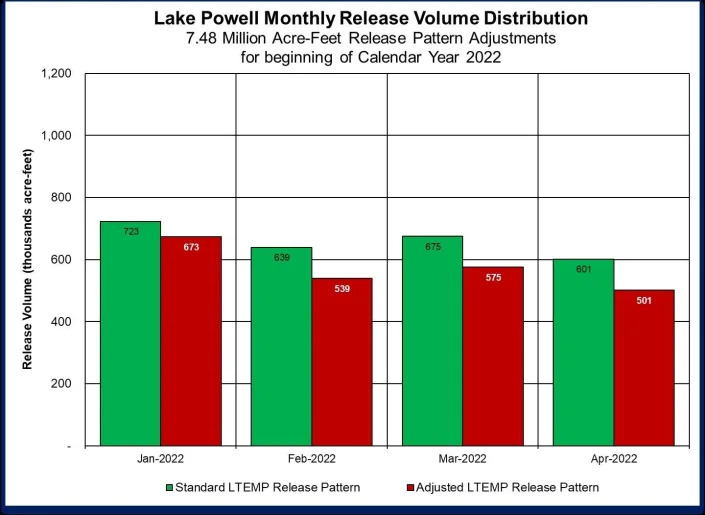
According to a bureau news release, the modified delivery schedule will not alter the total amount of water let through Glen Canyon Dam over the course of the year but will hold back a cumulative 350,000 acre-feet between January and April to help Lake Powell recover from lows that left many boat ramps unusable at the popular recreation site last summer.

Despite a wet October giving water managers hope that the region might make some progress towards recovery amidst a 22-year drought, this past November was the second-driest on record and inflows came up 1.5 million acre-feet short of the Bureau's projections from the previous month. When adjusted December projections anticipated Lake Powell dropping below 3,525 feet as soon as this February, the agency convened partners from the basin states, Tribes, federal agencies, non-governmental organizations and water managers to devise a new management scheme.

"The adjusted releases are designed to help protect critical elevations at Lake Powell until spring runoff materializes," the press release reads.

A graph shared by the U.S. Bureau of Reclamation on Jan. 7, 2022 depicts their new plan for reductions in scheduled releases of water from Lake Powell in an attempt to prevent the reservoir from falling below target levels.

Scientists, however, are not sure spring runoff will materialize. In the 22nd year of regional drought, the term "aridification" is gaining traction as the better way to describe what might be a long-term drying of the American West, influenced by climate change.

"We need to be extra vigilant and careful, because we do not know what lies ahead," said Jack Schmidt, director of Utah State University's Center for Colorado River Studies in response to Friday's announcement. "Looking into the future, none of us can know precisely what's going to happen this year. We have had times when we've looked great at the end of February, and then had an exceptionally dry March and the snowpack evaporated."

Schmidt was the senior author of a white paper published by a group of hydrologists last February that analyzed the future of Colorado River flows under various climate change and use scenarios. Their findings predicted that, given drying trends and a growing western population, projected basin-wide rates of water consumption could result in Lake Mead or Lake Powell running dry as soon as 2050, halting hydropower operations and negatively impacting the Grand Canyon ecosystem.

The Water Tap: Climate change and climate denial on the Colorado River

“The big take-home point is that, under the conditions of future drought or progressively decreasing runoff associated with a warming climate, the system tanks, the system is not sustainable," Schmidt explained at the time.

Figure ES-4 from the summary of the Center for Colorado River Studies' White Paper 6 (2021) shows how the combined water storage in Lakes Powell and Mead would decline under management paradigms that imposed various cuts (colored bands) compared to continuing on the current path (red line).

Wayne Pullan, regional director of the bureau's Upper Colorado Basin, agreed Friday that there is uncertainty in the system.

“Although the basin had substantial snowstorms in December, we don’t know what lies ahead and must do all we can now to protect Lake Powell’s elevation,” Pullan said in the press release.

In response to this, the agency plans to continue to monitor the basin’s hydrology and may make further adjustments to protect Lake Powell’s elevation. These could include sending additional water downstream to the reservoir from Colorado River Storage Project units at Flaming Gorge, Blue Mesa and Navajo reservoirs. Bureau officials will also continue to work with Upper Basin states on a Drought Response Operations Plan, due out in April 2022.

A deeper look: The Water Tap: Remembering a year of water, or lack thereof

Schmidt, meanwhile, sees three shades of a silver lining to Friday's doomsday-seeming announcement from the Bureau.

First, his team in February concluded that estimates of future consumptive use calculated by the Upper Colorado River Commission may be overinflated, giving the seven states that rely on this supply some additional wiggle room. If the western states learn to better live within their water means, their populations can grow without tanking the Colorado River system, they argue.

The second point, towards this end and also outlined in the February white paper, is that opportunities to stretch the supply further by improving water conservation efforts still abound. This is an argument often made by environmental groups critical of per capita water use rates in Utah's Washington County which, by many measures, far exceed those in other similar desert communities.

While Washington County officials push for a $2 billion, 140-mile pipeline project to transport water from Lake Powell to St. George, activists argue that the area first needs to consider conservation measures like turf removal and increased water rates. Cuts to Colorado River apportionments for Lower Basin states in 2022 that were announced by the Bureau in August caused some to speculate that "St. George is not going to get their pipeline." This latest announcement underscoring Lake Powell's limitations might further strain this project's prospects and finally push southwest Utah towards conservation.

"St. George is not going to get their pipeline": Some look to Utah amid Colorado River cuts

Schmidt's third note of positivity in reaction to Friday's announcement from the Bureau is that the modified release schedule for Lake Powell actually better mirrors the natural flows of the Colorado River. Ecologists are often critical of the impact dams have on riparian environments. If we're dealing with a situation of diminished overall flows, Schmidt says, it makes sense for artificial releases to be especially reduced in winter months when the river is lowest in its natural state.

“January is traditionally a high volume month used to produce hydropower. It is, to be honest with you, an unnaturally high release. So to withhold water in January, February and March is simply to make the river somewhat more natural because nature used to have low flows in those months," said Schmidt. "So I have no problem with that whatsoever. It makes perfect sense from a natural resource standpoint and it’s even a good thing for the environment."

Joan Meiners is the Environment Reporter for The Spectrum & Daily News through the Report for America initiative by The Ground Truth Project. Support her work by donating to these non-profit programs today. Follow Joan on Twitter at @beecycles or email her at jmeiners@thespectrum.com.

This article originally appeared on St. George Spectrum & Daily News: Feds to slow releases from Lake Powell at Glen Canyon Dam amid drought
Tensions rise again against Peru's Las Bambas mine, despite latest deal


Tensions rise again against Peru's Las Bambas mine, despite latest dealFILE PHOTO: Peru's Andean rural residents complain of negative effects of mining activity


Fri, January 7, 2022

LIMA (Reuters) - Peruvian Prime Minister Mirtha Vasquez said on Friday she would travel again next Friday to an area of frequent protests against MMG Ltd's Las Bambas copper mine as tensions with community protesters build up once again.

The trip will be Vasquez's third to the area since she was appointed in October, following repeated road blockades that have disrupted Las Bambas' operations.

The Chinese-owned copper mine, which has faced repeated protests since it opened in 2016, is one of the biggest mines in Peru, the world's second largest copper producer where mining is a key source of tax revenue.


In December, protesters from the Chumbivilcas province blocked the road for over a month, forcing it to suspend operations and causing a major problem for the leftist administration of President Pedro Castillo, who has promised to prioritize the demands of marginalized communities.

The Chumbivilcas communities - mostly indigenous citizens of Quechua descent - have repeatedly accused the Chinese company of failing to provide jobs and money to the region, one of the poorest in Peru, despite the vast mineral wealth.

Las Bambas just restarted copper output after Vasquez traveled to Chumbivilcas last month and brokered an agreement onsite to prevent further blockades.

But some Chumbivilcas communities have since said they reject that agreement and called on Vasquez for further negotiations, according to meeting minutes seen by Reuters dated Jan. 6.

Vasquez told reporters she hopes to hear concerns and resolve any social conflict through dialogue.

A group of four communities said they rejected part of the agreement, including a section that commits locals not to pursue further road blockades.

"Having analyzed the agreements, they do not address the proposals and demands of the communities ... and in that sense they do not represent the voice of the people," the meeting minutes said, which called on Vasquez and Castillo to meet with them in person next Friday.

It is unclear if Castillo will attend the meeting. He has generally deferred to Vasquez to handle issues related to Las Bambas.

"The masses also agree that if the President of the Republic does not come, there will be no dialogue and as a result we will launch a protest," the minutes said.

(Reporting by Marcelo Rochabrun; Editing by Sandra Maler)
SUSTAINABLE AIRPLANE FUEL
Highest Ever Vegetable Oil Prices Risk Even Faster Inflation


Megan Durisin
Fri, January 7, 2022

(Bloomberg) -- More bad weather for the world’s oilseed growers is pushing rapeseed and canola prices to fresh records and adding to food-inflation worries.

Futures have been on a tear for a while, after last year’s harvests in Canada and Europe were plagued by scorching drought and planting cutbacks, cutting global rapeseed stockpiles to a four-year low. Now, worries are mounting about supplies of rival vegetable oils, with hot and dry weather hurting South American soybean prospects and flooding hitting palm oil farms in Malaysia.

As the recent crude oil rally also aids demand for the crops to make biodiesel, Paris rapeseed futures and North American canola notched new all-time highs on Friday. Their oils are also used for everything from frying French fries to mixing salad dressings. Rapeseed prices have nearly doubled in the past year.

“The situation is really tight, and the buyers are still there,” said Arthur Portier, an analyst at Paris-based farm adviser Agritel.

Paris rapeseed futures surged as much as 5.9% on Friday, the biggest intraday gain since 2009, and North American canola gained as much as 1.5%.

The gains come as palm oil -- used in about half of all supermarket goods -- has rallied and near-record food prices squeeze household budgets. A United Nations index of food prices averaged 28% higher in 2021 than the prior year, led by a surge in vegetable oils.

Europe has become increasingly reliant on oilseed imports in recent years, after phasing out crop chemicals that rapeseed growers used to deter pests. That’s exacerbating local prices, as supplies shrink across key exporters, according to Michael Magdovitz, senior analyst at Rabobank in London.

The situation could improve later this year. France and Germany have both increased plantings, government data show. And Canadian farmers are also likely to plant more canola as wheat prices retreat, said Charlie Sernatinger, global head of grain futures at ED&F Man Capital Markets Inc. in Chicago.
Take a look inside the new driverless bullet train China just unveiled for the Olympics, which transports passengers at nearly 220 miles per hour


Cheryl Teh
Fri, January 7, 2022

Beijing has unveiled a driverless bullet train that will ferry passengers between its Olympic venues.Shi Jiamin/VCG via Getty Images


Beijing has unveiled a spanking new driverless bullet train called the Fuxing.


The train will ferry passengers to and from Olympic venues in Beijing and Zhangjiakou at speeds of 217 miles per hour.


The bullet train also has a fully-equipped broadcast studio on board for journalists to use.

China is pulling out all the stops for the Beijing Games, unveiling a new bullet train just for the Olympics.

The driverless Fuxing bullet train travels at speeds of 217 miles per hour and can carry 564 passengers per trip in its eight carriages. It is being put on the tracks just in time for the Beijing Games, to ferry passengers along the 108-mile journey between the Chinese capital and satellite venues in the city of Zhangjiakou,

According to the state-linked Xinhua News, the train was custom-made for the Beijing Games. It comes outfitted with a 5G-linked broadcast studio from which journalists can broadcast.


Xinhua reported that the train would take just 50 minutes to move its passengers from Beijing's downtown district to the Olympic venues in Zhangjiakou, down from three hours via a regular express train.

Construction on the railway began in 2018, per state-linked media outlet CGTN. The Beijing-Zhangjiakou connection was completed in 2019.

A separate Xinhua video tour of the train's interior also showed special lockers where athletes taking the train can stow their ski equipment.

The bullet train not only travels at 350 kilometers per hour, but also has a 5G streaming studio on board from which journalists can broadcast their reports.Lyu Biao/VCG via Getty Images

"To have so much advanced technology brought together on this train, and to present it in front of the world, this shows China's comprehensive strengths in terms of the train system," Zhu Yan, deputy director with at the train's maker, CRRC Changchun Railway Vehicles Co., told the state-linked Global Times on Thursday.

The Beijing Olympic Games are set to kick off on February 4, 2022. The country plans to implement a "closed-loop" bubble, where athletes, officials, broadcasters, and journalists alike will be able to move only within designated locales.
RPT-COLUMN-Europe's power crunch sparks aluminium smelter meltdown: Andy Home


Thu, January 6, 2022
By Andy Home

LONDON, Jan 6 (Reuters) - It's turning into a winter of discontent for Europe's aluminium smelters as they struggle to cope with rocketing power prices across the region.

Four operators have announced curtailments totalling over half a million tonnes of annual production capacity, with others flexing output to mitigate power-load price spikes.

European aluminium consumers are already paying the price. Physical premiums have surged, the CME's duty-paid spot contract jumping from $290 per tonne at the start of December to a current $423.

That's over and above the London Metal Exchange (LME) aluminium price, which has also opened 2022 with a bang, hitting a two-month high of $2,938.50 per tonne on Wednesday.

Aluminium was the second best performer among the core LME industrial metals last year as the market priced in power-related curtailments in China.

The market's power problems have now spread to Europe.

POWERING DOWN


Smelting aluminium is an energy-intensive process, power typically representing at least 30% of total production costs, albeit with significant variability depending on source, supplier structure and local energy market.

European power prices have hit multiple record highs over recent months and the regional energy crunch https://www.reuters.com/markets/commodities/weak-winds-worsened-europes-power-crunch-utilities-need-better-storage-2021-12-22 is now morphing into an aluminium smelter crisis.

"Exorbitant energy prices" were cited by U.S producer Alcoa as the reason for a two-year curtailment https://investors.alcoa.com/news-releases/news-release-details/2021/Alcoa-Reaches-Agreement-on-Future-of-San-CiprinSmelter/default.aspx of its 228,000-tonne per year San Ciprian smelter in Spain.

The plant will be out of action by the end of this month, returning in January 2024 with renewable power contracts https://www.reuters.com/business/energy/alcoa-signs-renewable-energy-deals-spanish-plant-2021-12-30

Another casualty is the KAP smelter in Montenegro, which began powering down https://seenews.com/news/montenegros-uniprom-to-shut-down-smelter-kap-by-dec-30-report-767241 its 120,000 tonnes of annual capacity in the middle of December.

The plant's owner Uniprom was facing a jump in its power bill from 45 euros ($50.89) to 120 euros per megawatt hour at the start of 2022.

The "exceptional situation on the energy and gas markets" is why Romanian producer Alro is reducing output https://www.alro.ro/en/article/communique-production-activity-primary-aluminum-will-be-reduced from five to two potlines at its Slatina smelter, it said.

The 265,000-tonne-per-year plant will be operating at around one-third capacity until further notice.

Norway's Hydro has also doubled down https://www.reuters.com/markets/commodities/norways-hydro-cut-slovakia-aluminium-output-due-power-cost-2021-12-30 on the amount of capacity it is idling at its Slovalco smelter in Slovakia, citing "very high energy prices (which) show no sign of improvement in the short term".

Production will be reduced to 60% of the plant's annual capacity of 175,000 tonnes per year.

All four operations will maintain remelt and cast house operations, but the combined annualised hit on primary metal production will be around 550,000 tonnes.

Other European smelters are navigating the power price crunch by tweaking amperage and run-rates, meaning there is considerable creep to any production loss estimate.

PREMIUM SPLIT

Europe is already a net importer of primary aluminium, with the regional supply deficit set to widen as the list of smelter casualties lengthens. The sharp jump in physical premiums attests to that changing dynamic.

The U.S. Midwest physical premium has leapt higher in sympathy, the CME spot contract up from $550 per tonne at the start of December to a current $666.


The United States is also a net importer of primary aluminium and is now facing increased competition from Europe for spare metal.

And both are in competition with China, which is importing significant volumes after a run of power-related curtailments across its huge smelter network.

China's imports of primary aluminium totalled 1.5 million tonnes in the first 11 months of 2021, up 60% year-on-year.

The world's largest aluminium producer turned net importer in 2020 and it seems set to stay that way.

That, ironically, has benefitted Japanese buyers, who have just negotiated a 20% reduction https://www.reuters.com/markets/commodities/japan-q1-aluminium-premium-falls-20-177t-sources-2022-01-05 to $177 per tonne in the premium for first-quarter deliveries.

One of the factors working in their favour has been the relocation of accessible stock to Asia to feed China's new-found hunger for imports.

LME warehouses held 926,800 tonnes of registered inventory as of Tuesday, with just 34,675 tonnes located in Europe and 19,425 tonnes in the United States. The balance 94% is in Asia.

Asian locations also accounted for 79% of the 449,000 tonnes of aluminium sitting in the LME's off-warrant shadows at the end of October.

That regional availability is cushioning Japanese buyers but exacerbating supply issues outside of Asia.

Europe's smelter problems are accentuating the growing regional divergence in global premiums.

ALUMINIUM PARADOX - EUROPEAN VERSION

The European Union has historically shielded its aluminium smelter sector through import tariffs, much to the annoyance of regional consumers.

The bloc is now also committed to what it terms "open strategic autonomy" in its green industrial plan, particularly when it comes to securing metals critical to the energy transition.

Those ambitions are now at risk, not just in aluminium but in other industrial metal sectors such as zinc.

The Achilles heel in the supply chain is the high energy intensity of the smelting process, exposing producers to the sort of power crunch now roiling Europe.

Power supply stresses will only become more acute as the continent tries to pivot away from coal in line with its carbon commitments.

China started grappling with the same metals-power conundrum last year.

Although China's power problems are in part down to natural causes - last year's drought in hydro-rich Yunnan province - they are also a consequence of energy efficiency goals aligned with a pledge to hit peak coal generation by 2025.

Power-hungry aluminium smelters have been easy targets for regional governments looking to improve their energy usage and efficiency targets.

China's production of primary aluminium has stalled as production lines have been closed and new projects have been deferred.

Such is the aluminium paradox.

It's a metal that is core to the energy transition, but can only be produced in virgin form using very large amounts of energy, which is increasingly at a premium due to decarbonisation.

The paradox has just extended from China to Europe.

($1 = 0.8843 euros)

(Editing by Jan Harvey)

Scientists looking at the first pregnant Egyptian mummy think they figured out why none were ever found before

A mummy previously thought to be a priest named Hor-Djehuty.
The mummy scientifically proved to have been pregnant when embalmed. She was previously thought to be a male priest named Hor-Djehuty.A. Leydo/Warsaw Mummy Project
  • Scientists who examined a pregnant mummy explained why they think no others had been found.

  • It might have to do with a chemical reaction that dissolves the bones of unborn children.

  • It makes them almost invisible to X-rays and could mean other pregnant mummies just weren't noticed.

Scientists working on mummified remains from Egypt recently made a huge discovery: a set of remains they thought was a man was actually a woman — and a woman who was pregnant.

Before the Warsaw Mummy Project analyzed the remains, no one had ever spotted a fetus in a mummified body before.

Wojciech Ejsmond, a Warsaw Mummy Project scientist who led the study, told Insider on Friday that this had always seemed weird.

"Women in reproductive age were maybe not constantly pregnant, but every few years they would have been pregnant," he said. So why was there no proof of pregnant women who died being mummified?

Fetal skeletons — the usual way to spot a developing baby in this kind of case — never appeared on X-ray scans. It took the scientists developing a technology that wasn't looking for bones.

"Radiologists were looking for bones, and our case shows that, actually, you shouldn't. You should look for the soft tissue with a unique shape," he said

In a letter published on December 30 in the peer-reviewed Journal of Archaeological Science, the researchers gave a hypothesis for why the fetus might have disappeared from scans. It essentially comes down to pickling.

A cross-section of the mummy shows the shape of the dead fetus in the mummy's body.
A cross-section of the mummy's body, with the soft tissue identified as the fetus highlighted in red.Warsaw Mummy Project

"It's like an experiment with an egg. You put an egg with an acid, the eggshell is dissolving, leaving only the inside of the egg," Ejsmond said.

"When the acid is evaporated, you have a pot with just an egg covered in minerals," he said.

Something similar probably happened in the mummy's body.

As the body decomposes, it starts naturally acidifying. "Formic acid is appearing in the blood, which makes the environment in the body more acid," Ejsmond said.

When that acidic environment hit the dead fetus, the bones almost all dissolved. The remnants of the chemical reaction, a bunch of minerals, were scattered in the water that was left in the uterus, the scientists hypothesized.

This made the little body virtually invisible to X-ray scanners.

"One way to explain it is that it pickled it, basically," Ejsmond said.

A shape in the form of a human fetus is shown in greyscale
A 3D reconstitution from the scan of the mummy shows the soft tissue thought to be a fetus inside the mummy.Warsaw Mummy Project

So why then did the mother's bones not dissolve?

That is because, during the mummification, the body is covered with natron salt to dry out the body. The act of drying it out captured the minerals in place, Ejsmond said, so the bones could still be spotted.

So far, the mummy studied by the Warsaw Mummy Project is the only one to be believed to have been mummified pregnant.

"But further research may show that it's more common than we think," Ejsmond said.