Thursday, March 17, 2022

NASA releases brilliant image of star from James Webb Space Telescope

NASA released the first image the James Webb Space Telescope has taken so far on Wednesday, March 16, 2022, using sharper focus, a brilliant blazing orange photo of a star in the constellation Ursa Major known as 2MASS J17554042+6551277. Photo courtesy of NASA


ORLANDO, Fla., March 16 (UPI) -- NASA on Wednesday released the first image from the James Webb Space Telescope after sharpening its focus, as the agency plans to start peering at the earliest galaxies in the universe.

The image shows a brilliant, blazing orange star know as 2MASS J17554042+6551277.

NASA officials said the telescope is working better than its minimum requirements, raising hopes for spectacular new astronomy discoveries.

"I'm happy to say that the optical performance of the telescope is absolutely phenomenal," Lee Feinberg, Webb optical telescope element manager, said at a press conference.

RELATEDJames Webb Telescope adjustments bring stars more into focus

"It is really working extremely well. We said that we would know the telescope is working properly when we have an image of a star that looks like a star, and now we have that and you're seeing that image," Feinberg said.

The new image of the star also reveals multiple galaxies in the background, Jane Rigby, Webb operations project scientist, said. NASA hasn't identified those galaxies yet, she said.

"Now, we took this image to characterize the sharpness, but you can't help but see those thousands of galaxies behind it; they're truly gorgeous," Rigby said. "There's no way that Webb can look for 2,000 seconds at any point in the sky and not so incredibly deeply. So this is going to be the future from now on. We're seeing back in time ... light as it looks billions of years ago without even really breaking a sweat."

RELATEDNASA releases first images from James Webb Space Telescope

She said the new image of the star is as sharp and crisp as the Hubble Space Telescope could achieve, while future images will be even sharper.

As a result, NASA officials are breathing a huge sigh of relief, Thomas Zurbuchen, NASA's associate administrator for science said.

"The sleepless nights I've had and the worries I've had -- they're all behind us now," Zurbuchen said, adding that additional challenges are ahead, but the majority of tasks to make Webb operational are achieved.

RELATED James Webb Space Telescope reaches final orbital destination

Previously, the agency released early images from the telescope as it was aligned. More alignment and focus is still scheduled for the observatory, which is in a unique orbit 1 million miles from Earth.

Earlier images showed 18 copies of a different star, one copy for each of the mirror's 18 segments. As scientists and engineers aligned those segments, NASA released another image showing a single, focused photo of the star that was fuzzier than the new image released Wednesday.


Webb was built over 20 years by an international partnership with the European and Canadian space agencies.

It launched Dec. 25 from Europe's Spaceport in Kourou, French Guiana.

NASA plans to release the first science images -- with even better focus -- this summer after it prepares and commissions all instruments on the observatory.

"Webb will explore every phase of cosmic history -- from within our solar system to the most distant observable galaxies in the early universe and everything in between," NASA said in a news release Tuesday. "Webb will reveal new and unexpected discoveries and help humanity understand the origins of the universe and our place in it."

Webb is more powerful than the Hubble Space Telescope, partly because it gathers infrared light, whereas Hubble uses visible light spectrums. The two telescopes may at times work in tandem to observe space objects and phenomena.

Wednesday, March 16, 2022

Quake hits Japan off Fukushima coast, leaving at least four dead and reviving painful memories

A powerful magnitude 7.4 earthquake has jolted Japan's north-east coast off Fukushima late on Wednesday, leaving at least four dead and nearly 100 injured, reviving memories of an earthquake and powerful tsunami that crippled the same region just over a decade earlier.

Key points:

The earthquake struck 57 kilometres off the coast of Honshu island, at a depth of 60km

Japan's Fire and Disaster Management Agency confirmed two deaths and injuries to 94 people


According to Prime Minister Fumio Kishida, there have been no abnormalities at nuclear power plants


Just before midnight, the quake hit off the coast of Fukushima prefecture at a depth of 56 kilometres, the Japan Meteorological Agency said.

Afterwards, there were some reports of fire, the government said.

Prime Minister Fumio Kishida said four people had died and the government would be on high alert for the possibility of further strong tremors over the next two to three days.

The quake severed transport links to the north-east, with Shinkansen bullet train service indefinitely suspended and at least one major highway to the region closed for safety checks.

The quake was felt in the capital, Tokyo, some 275km away, where the shaking of buildings was long and pronounced.

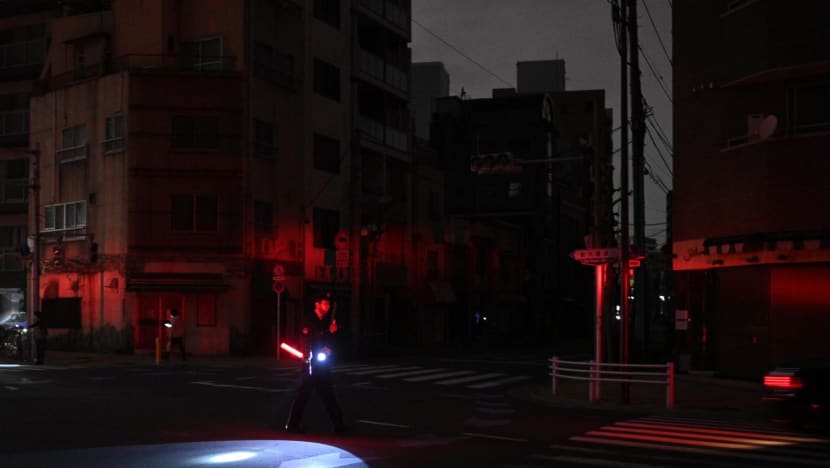
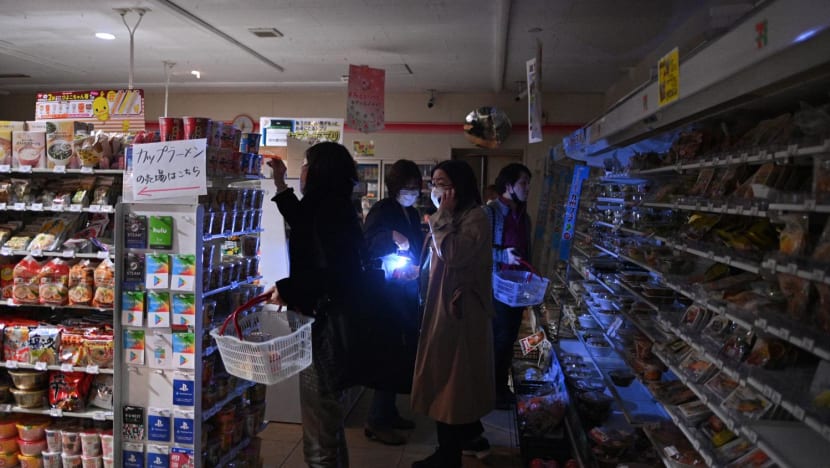
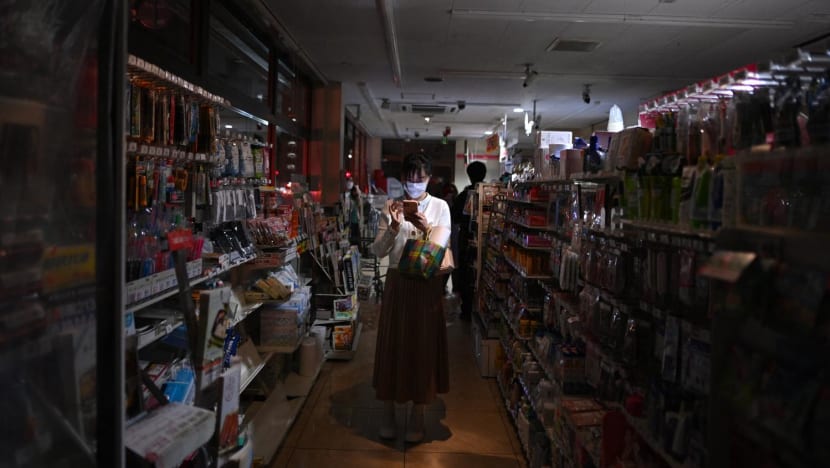
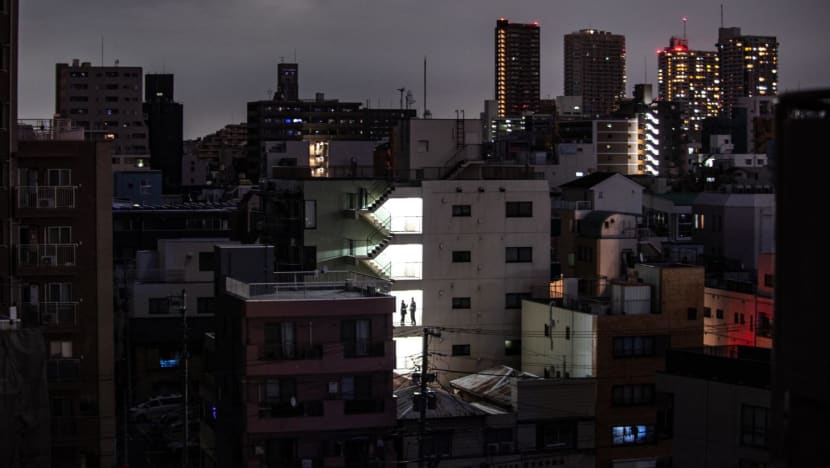
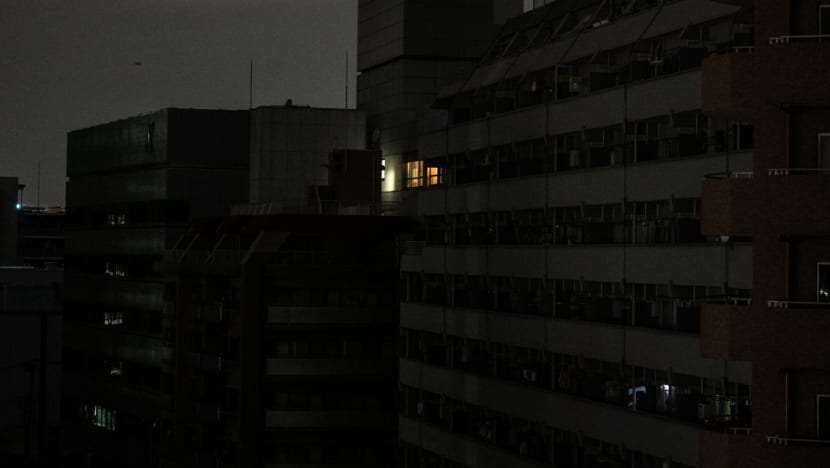
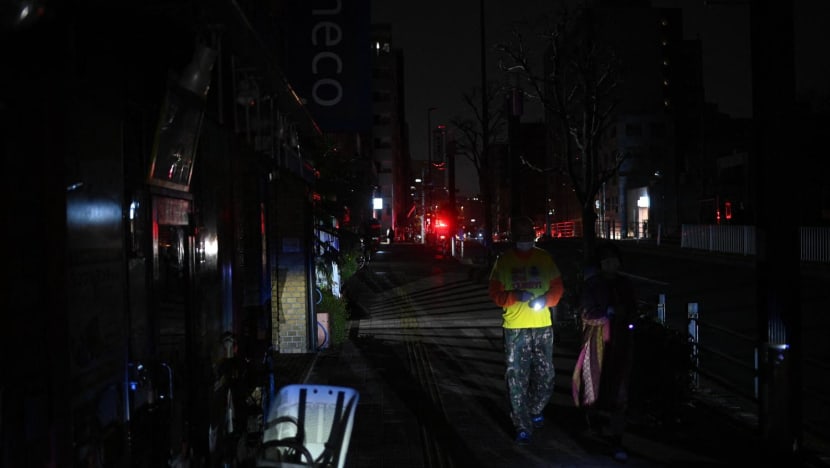
Hundreds of thousands of homes in the capital were plunged into darkness for an hour or more, although power was fully restored by the early hours of Thursday morning.


Early on Thursday, the Japan Meteorological Agency lifted its low-risk advisory for a tsunami along the coasts of Fukushima and Miyagi prefectures.

Some areas reported a rise in the sea level but no serious damage was immediately reported.

The agency upgraded the quake's strength to magnitude-7.4 from its initial magnitude-7.3 and the recalibrated its depth from 60km below the sea to 56km.Furniture and electrical appliances are scattered at an apartment in Fukushima, Japan, after the magnitude-7.3 quake. (AP: Kyodo News)

This quake comes just a week after the 11th anniversary of the devastating earthquake and tsunami that hit the same area in March 2011.

The 2011 disaster triggered a meltdown at the Daiichi nuclear plant in Fukushima, an incident Japan is still coming to grips with.

Mr Kishida told reporters there had been no abnormalities at the nation's nuclear power plants, although authorities had earlier said a fire alarm had been triggered at a turbine building at the crippled plant.

Separately, a Shinkansen bullet train derailed, with some 100 people on board, although there were no reports of injuries.

Utility Tokyo Electric Power Company said that initially around 2 million households lost power on Wednesday, including 700,000 in the capital.

Tohoku Electric Power said around 36,400 homes were still without power as of 9:00am local time on Thursday, although the firm said it expected most will have supply restored later in the day.
People walk along the streets in Toyko during a blackout after the earthquake plunged millions of homes into darkness for an hour or more. (AP: Kyodo News)

Strong quakes in Japan can disrupt manufacturing, particularly of sensitive electronic components such as semiconductors that are made using precision machinery.

The 2011 quake halted production for three months at a factory owned by Renesas Electronics Corp, which makes nearly a third of all micro controller chips used in cars.

A fire at the facility last year exacerbated a chip shortage that has forced auto companies to curb output.

Renesas said it was checking the condition of three of its plants — Naka, Yonezawa and Takasaki — and would afterwards provide a statement on whether production had been affected.

Meanwhile, Toyota Motor Corp said it had cancelled the day shift at two factories in north-east Japan after workers evacuated the plants during their evening shift on Wednesday.

The automaker said it would decide on the evening shift later.

In an attempt to cover the area affected by the Shinkansen outage, All Nippon Airways said it had added extra flights to the northern city of Sendai.

There were no forecasts of when regular rail service might be restored.

Japan's benchmark Nikkei stock average jumped, with no impact seen from the quake.

There have been reports of damage to buildings in Fukushima prefecture from the large earthquake that struck the region on Wednesday night.(AP: Kyodo News)

2 dead after 7.3-magnitude earthquake hits Japan's northeast coast


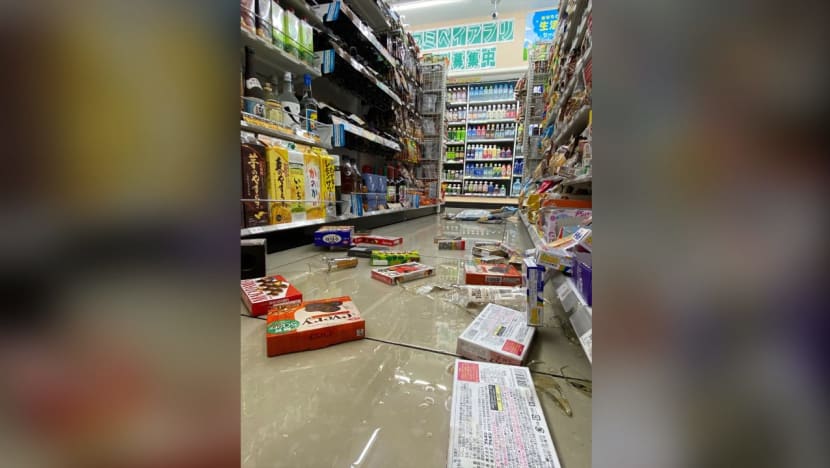
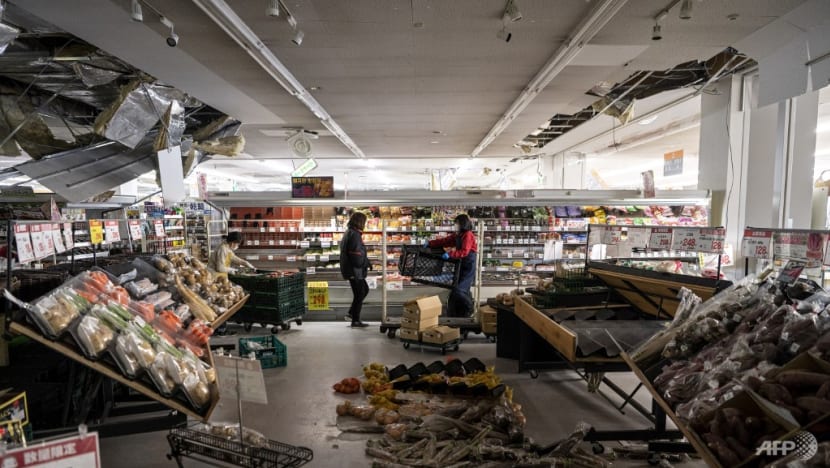
This picture shows scattered merchandise and damaged
 ceiling at a supermarket in Shiroishi, Miyagi prefecture on Mar 17, 2022 after a 7.3-magnitude earthquake jolted east  Japan the night before. (Photo: AFP/Charly Triballeau)


16 Mar 2022 11:03PM(Updated: 17 Mar 2022 07:59AM)


TOKYO: A powerful magnitude 7.3 earthquake jolted Japan's northeast coast off Fukushima late on Wednesday (Mar 16), leaving two dead and 94 injured and reviving memories of a quake and tsunami that crippled the same region just over a decade earlier.

There were some reports of fire, the government said. The Fire and Disaster Management Agency said on Thursday morning that there had been two confirmed deaths and 94 injured, including four seriously.

The quake was felt in Tokyo, about 275km away, where the shaking of buildings was long and pronounced. Hundreds of thousands of homes in the capital were plunged into darkness for an hour or more, although power was fully restored by the early hours of Thursday morning.

Authorities cancelled an earlier tsunami warning.

Just before midnight, the quake hit off the coast of Fukushima prefecture at a depth of 60 kilometres, the Japan Meteorological Agency said. It sparked memories of a devastating earthquake and tsunami in March 2011, a week after that disaster's 11th anniversary.

There were no abnormalities at nuclear power plants, Prime Minister Fumio Kishida told reporters. The 2011 disaster triggered a meltdown at the Daiichi nuclear plant in Fukushima, an incident Japan is still coming to grips with.

Authorities earlier said a fire alarm had been triggered at a turbine building at the crippled plant.

Separately, a Shinkansen bullet train derailed with about 100 people on board, although there were no reports of injuries.

Utility Tokyo Electric Power Company said that initially about 2 million households lost power on Wednesday, including 700,000 in the capital. Tohoku Electric Power said about 38,500 homes were still without power as of 7.40am local time on Thursday.

Strong quakes in Japan can disrupt manufacturing, particularly of sensitive electronic components such as semiconductors that are made using precision machinery.

The 2011 quake halted production for three months at a factory owned by Renesas Electronics, which makes nearly a third of all microcontroller chips used in cars. A fire at the facility last year exacerbated a chip shortage that has forced auto companies to curb output.

Renesas said it was checking the condition of three of its plants - Naka, Yonezawa and Takasaki - and would provide a statement on whether production has been affected later.

Sitting on the boundary of several tectonic plates, Japan experiences around a fifth of the world's earthquakes of magnitude 6 or greater.

CNA correspondent in Japan, Michiyo Ishida, said in a tweet that a big earthquake had hit the Tohoku area.

"Tokyo shakes too. It’s two separate tremors. The bigger one measured an M7.3 at past 11.30pm," she wrote. 

There were also blackouts due to the earthquake, she added.

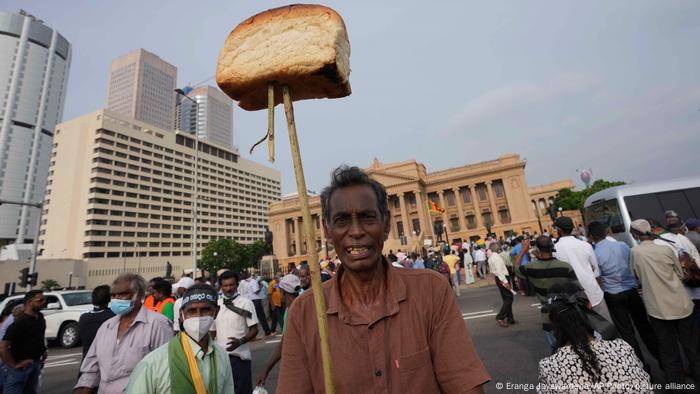
 BREAD RIOTS PRELUDE TO REVOLUTION

Sri Lanka seeks IMF bailout amid shortages, rising public anger

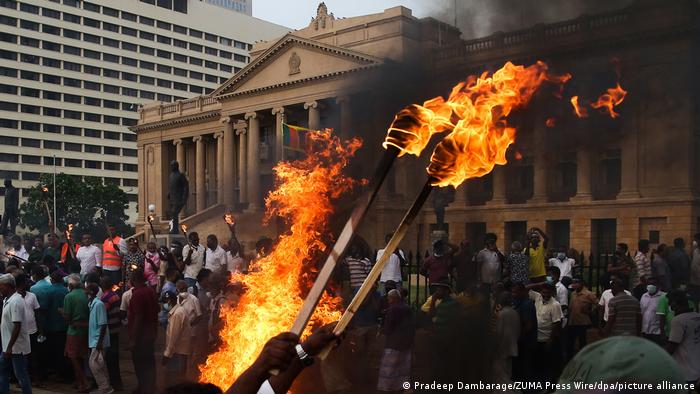
President Gotabaya Rajapaksa has called on Sri Lankans to use fuel and electricity sparingly. But citizens blame his government for the country's worst economic crisis since independence almost 75 years ago.


There has been widespread outrage over spiraling costs in Sri Lanka, including major

 protests in Colombo earlier this week

Sri Lanka will seek an International Monetary Fund (IMF) bailout, the country's president said on Wednesday, just 24 hours after a huge crowd stormed his office over runaway prices.

President Gotabaya Rajapaksa said his government was in discussions with the IMF, other agencies and countries on deferring loan repayments. He also asked citizens to help by limiting electricity and fuel consumption with the South East Asian nation in the throes of its worst economic crisis since it gained independence from Britain in 1948.

Although the issue dates back well beyond the conflict in Ukraine, rising fuel prices have exacerbated the situation in recent weeks.

President seeks understanding

"Subsequent to my discussions with the International Monetary Fund, I have decided to work with them," Rajapaksa said in an address to the nation.

"By limiting the use of fuel and electricity as much as possible, the citizens, too, can extend their support to the country at this time," Rajapaksa added.

"I hope that you will understand the responsibility lies with you at this challenging time," he added.

Mass protests

Political parties and citizen groups don't see it as their responsibility, though, launching mass protests across the country, blaming the government for the economic crunch. For critics of the influential Rajapaksa family, having the president's elder brother, Mahinda, as prime minister and his younger brother, Basil, as finance minister only deepens a sense of nepotism and mismanagement.

The main opposition party held a demonstration near the president's office on Tuesday demanding his resignation over the rising cost of food, medicine and other essential goods, causing serious hardship for Sri Lanka's 22 million people.


Rising food and fuel prices are hitting an already impoverished country hard

Sri Lanka is currently battling record inflation and unprecedented food and fuel shortages as the country struggles to finance imports.

Furthermore, the coronavirus pandemic has hit the island's tourism sector hard, while the amount of money sent home by Sri Lankans living abroad has also declined.

Philippines: Marcos Jr. election lead raises the stakes for democracy

Ferdinand Marcos Jr. is proving hugely popular with younger voters who do not remember the atrocities of his father. But what will it mean for liberal institutions if the son of a former dictator is in charge?


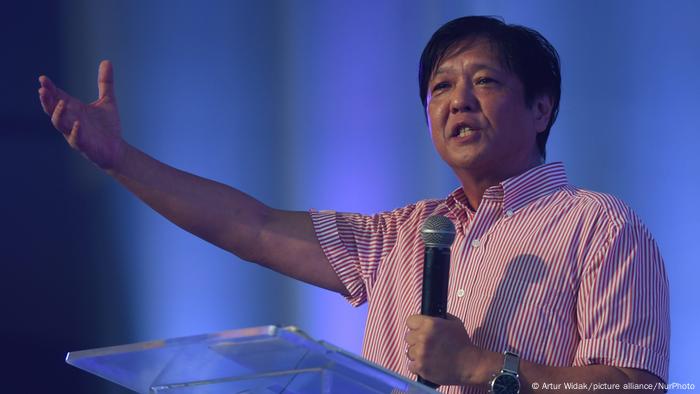
Bong Bong Marcos is polling well ahead of the competition

Nearly 50 years after his father and late president declared martial law in the Philippines, Ferdinand "Bong-Bong" Marcos Jr. is leading the race to become the country's next president in the May 2022 elections.

Pulse Asia, the first major opinion survey conducted since the presidential campaign started in February, showed that Marcos Jr. has maintained a sizable lead over his nine opponents.

Opposition leader and current Vice President Leni Robredo is the closest contender at 16% compared to Marcos Jr's 60%.

"Bong-Bong Marcos is in a position not just to win but to win bigger than any other predecessors in recent memory. There is a very high chance that he will take more than 50% of the votes. We're no longer talking about a plurality president but a majority president," Manila-based political analyst Richard Heydarian told DW.

A victory for Marcos Jr. would make for a stunning political comeback for his family, which has become synonymous with the massive accumulation of ill-gotten wealth and human rights violations. His late father, Ferdinand Marcos Sr., was toppled in a 1986 uprising after holding power with an iron fist for two decades.

"I really have a hard time seeing how this presidential race can be more competitive," said Heydarian.

Marcos Jr's vice-presidential running mate is Sara Duterte, daughter of incumbent president Rodrigo Duterte. Duterte has yet to endorse the candidacy of Marcos Jr. and his daughter. 

An historical election for the Philippines?

According to Heydarian, the Philippine electorate are no longer vested in the democratic political promises brought on by the 1986 revolution.

"We're looking at a counterrevolution. People are saying, 'let's just go back to the original when it comes to strongmen.'"

There is also concern that a Marcos victory would signal the end of the Philippines' liberal democracy.

"This is the battle of the heart and soul of the country," Nicole Curato, a sociologist and political analyst told DW.

"I don't mean to suggest that Marcos Jr. will impose martial law like his father did, but he will have the executive power to undermine institutions that were created in response to his father's abuse of power," she added.

Curato has been interviewing supporters of Marcos Jr, and believes many voters have responded to his populist calls for national unity, which have resonated among Filipinos continuing to suffer from the effects of the coronavirus pandemic.

"Unity is an appealing message because it is not antagonistic. Many view the opposition's calls for [government] accountability as political bickering that does little to uplift the lives of many Filipinos," Curato said.

"His message is simple: Division is what stands in the way for us to achieve our dreams. His message does not discuss the root of the problems which cause hurt and anger. It is, in many ways, a toxic form of positivity," she added.


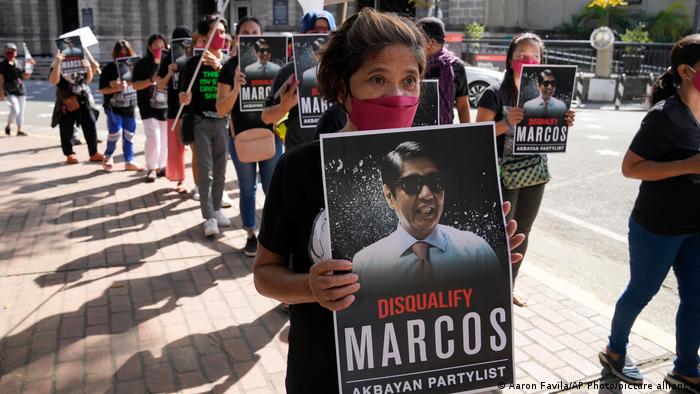
Protesters in December 2021 called for Marcos Jr. to be banned from running

Who is supporting Marcos Jr?

A breakdown by age demographic of Pulse Asia's February results shows that 63% of millennials, or those roughly between the ages of 25-34, want Marcos Jr. to be the next president.

Majie Cabatian, a 26-year-old homemaker with two children, supports Marcos Jr.

Cabatian is too young to remember the atrocities of the Marcos dictatorship, but insists that the infrastructure and highways around the country that still bear his name are testament to a legacy of progress.

"That's proof of all the good things he did for the country. We're still benefiting from all that. What have the other presidents done?" she told DW.

She added that the roads she attributes to Marcos era have given her husband a job. "My husband is a truck driver. More roads mean more jobs for him. Bong-Bong will be good for the country, just as his father was," she said.

Photographer Niccolo Cosme, on the other hand, is determined to do everything he can to prevent Marcos Jr. from coming into power.

Cosme is pouring his time and talent into being a volunteer for the Robredo campaign. "I have done photo shoots and social media campaigns for Robredo 2022 and I do not expect to be paid a single cent for it," he said.

Cosme told DW that his zeal comes from a place of deep regret. "I voted for Duterte in the last election. I campaigned for him and convinced friends to vote for him. I was blinded by his promise of change," he said.

He said his initial enthusiasm turned into horrified disillusionment at the changes Duterte brought to the Philippines after six years in office.

"All those people killed in the drug war. How he surrendered the West Philippine Sea to China. It's just too much. I feel responsible for that because I voted for him. This is the time for me to correct my past mistakes."

With barely two months until the elections, Cosme still holds out hope that Robredo will take the lead from Marcos, Jr. "She has to win. She simply has to," he said.

Viral protests: Russians continue to denounce war risking imprisonment

Despite censorship and the government's crackdown on anti-war protests, some Russians have come up with alternative ways to speak out against the invasion of Ukraine. Here are some instances that went viral.

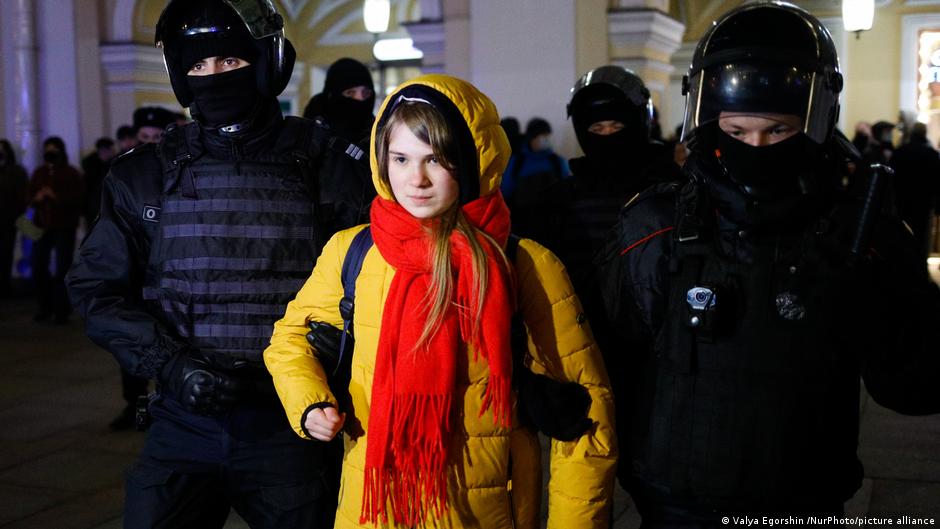
Thousands of Russian, including minors and the elderly, have been arrested for 

protesting against the war in Ukraine.

Since Russian President Vladimir Putin ordered his troops to invade Ukraine about three weeks ago, the police forces in Moscow and other cities have been cracking down on anti-war protests.

The Kremlin has restricted Russian citizens' access to Facebook, Instagram, and Twitter, to prevent the reports and images of war from reaching them. Media are banned from using the terms "Invasion" or "war" to describe what Putin is doing in Ukraine. Instead, they have been ordered to refer to it as a "special military operation."

Regardless of these measures, thousands of anti-war protesters have rallied across Russia since the war started, risking consequences such as fines, detention, and imprisonment.

On March 4, the government implemented a set of rules that criminalizes anti-war protests, and independent reporting on the war. According to Human Rights Watch, the laws make it illegal to spread "fake news" about the Russian armed forces, to call for an end to their deployment. Those who disobey can face up to 15 years in prison.

But as the authorities' tolerance for demonstrations and rallies shrinks, activists continue to protests against the war in Ukraine, in various forms.

"No to war" on TV screens

Marina Ovsyannikova, an employee of a Russian state TV station,  interrupted a live news program on Monday, chanting "Stop the war!" She held up a cardboard sign that featured the Russian and Ukrainian flags, shouted "Don't believe the propaganda. They're lying to you." Seconds later, the program was cut off.

In a video, recorded before her protest, Ovsyannikova urged Russians to join protests against the war and expressed regret for her part in spreading "Kremlin propaganda."

"Russia is the aggressor country and one person, Vladimir Putin, solely bears responsibility for that aggression," she said in the prerecorded video.

Ovsyannikova was arrested minutes after she stormed into the studio. She was released from custody on Tuesday and fined about 30,000 rubles (around $270). But she still awaits her trial, where she could receive a prison sentence.

'Two words'

A video went viral on social media last week, showing a woman being arrested by the Russian police for holding up a small piece of paper that reads "two words."

The phrase "two words" ("два слова" in Russian) seems to hint at the forbidden slogan "no to war" (or "нет войне" in Russian).

In the video, the woman asks the cameraman "If I just say 'two words,' will I be arrested for it?" She then shows a small piece of paper with the phrase "two words," written on it. Seconds later, heavily-armored security forces swoop in to arrest her. 

Another woman approaches the camera right after and tries to explain why she supports the war against Ukraine — but before she can finish her sentence, policemen grab her and pull her away too.

Blank signs

Russian police have arrested demonstrators who protest with blank signs. A video that receive millions of views on social media, showed a woman holding a blank sign among a group of people before police officers approached her and escorted her away from the crowd.

The incident was not an isolated one. According to OVD-Info, an independent media project that monitors human rights and political persecutions in Russia, another activist called Anastasia Nikolaeva spent eight days in detention for protesting with a blank sign in the southern Russian city Rostov-on-Don.

In-flight protest

In another viral post, a Russian pilot is seen denouncing his country's war on Ukraine during a flight. "I think sensible citizens will agree with me and will do everything to make it stop," the pilot addressed the passengers.

Children and elderly detained

On March 1, photographs emerged on social media showing primary school children behind bars. Novaya Gazeta, the Nobel prize-winning independent newspaper, confirmed the pictures and said the kids had been arrested along with their parents for laying flowers at the Ukrainian embassy and holding signs saying "No to war." They were reportedly released as the lawyers arrived.


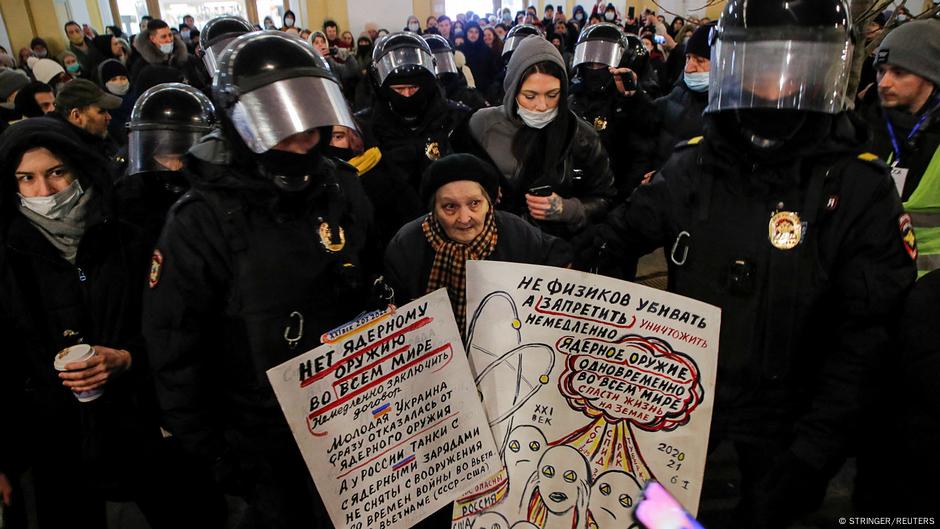
Yelena Osipova is an artist and political activist was arrested in a demonstration in St. Petersburg.

In another incident, Yelena Osipova a 77-year-old artist was seen among those arrested at an anti-war protest in St. Petersburg. People on social media began referring to her as the "grandmother for peace." 

There have been about 15,000 arrests related to anti-war actions since February 24 with dozens still remanded in custody., according to the OVD-Info website