Monday, March 21, 2022

LABOUR

Informal Workers Face Up to the Crisis in Latin America

Doris Martínez gets ready to start cooking at her food kiosk in Valles del Tuy, an area of small dormitory towns near Caracas. CREDIT: Humberto Márquez/IPS

Doris Martínez gets ready to start cooking at her food kiosk in Valles del Tuy, an area of small dormitory towns near Caracas. CREDIT: Humberto Márquez/IPS

CARACAS, Mar 18 2022 (IPS) - Doris Martínez was a cook in a Venezuelan restaurant that closed its doors; she emigrated to Colombia, got sick from working long hours standing in front of a stove, and returned to her country where, together with her husband and children, she runs a busy fast food kiosk on a road in Valles del Tuy, near the Venezuelan capital.

Johnny Paredes of Peru was a security guard and employee of a restaurant in Lima until he decided to become a self-employed street vendor selling fancy clothes in the mornings and food and beverages in the afternoons in the upscale neighborhood of Miraflores.

Mexican computer technician Jorge de la Teja works much longer hours in Mexico City than at his former job in a service company, but with forced telework increasing due to the COVID-19 pandemic, his clients and income have grown over the past two years.

In Latin America and the Caribbean, 140 million workers (51 percent of all employed people) work in the informal sector and have been strongly impacted by the pandemic. But, often working on the streets, they take the pulse of the crisis and take on new tasks or ventures to support their families.

Since the pandemic broke out in March 2020, 49.6 million jobs, both formal and informal, have been lost in the region, 23.6 million of which were held by women, according to data from the International Labor Organization’s (ILO) latest labor overview, published in February.

Informality “continues to be one of the most important characteristics of the region’s labor markets,” Roxana Maurizio, an Argentine labor economics specialist with the ILO, told IPS from the agency’s regional headquarters in Lima.

Studies by the Economic Commission for Latin America and the Caribbean (ECLAC) have shown that of the 51 percent of informal workers, up to 37 percent work in the informal sector of the economy, more than 10 percent in the formal sector and four percent in households.

In practice, one out of every two employed persons in the region is in informal employment, according to the ILO, and one third is self-employed, according to ECLAC.

The ILO considers informal employment to be all paid work (both self-employment and salaried employment) that is not registered, regulated or protected by legal or regulatory frameworks. For the workers who perform it, it adds, remuneration depends directly on the benefits derived from the goods or services produced.

Street vending is one of the expressions of labor informality that dominates many streets in the region's large cities, as in this open-air market in Lima. CREDIT: Courtesy of Johnny Paredes

Street vending is one of the expressions of labor informality that dominates many streets in the region’s large cities, as in this open-air market in Lima. CREDIT: Courtesy of Johnny Paredes

Faces behind the numbers

Paredes, 46, told IPS from Lima that “in my case it worked out better, because of the independence of having my own schedule and being able to shorten or lengthen it depending on how the workday turns out, and because on the street I earn between 25 and 35 dollars a day, double what I was paid in my previous jobs.”

De la Teja, 37, agrees and explains that in Mexico City he supports his family “comfortably, with regard to food and other day-to-day expenses, because I earn more than 2,000 dollars a month. But extra expenses, such as insurance, or traveling for vacation, are difficult.”

Martinez, a 50-year-old mother of two sons and three daughters and grandmother of three, works as a domestic and caregiver in the mornings and in the afternoons she helps run the family kiosk, the “Doris Burger”, with her husband and two sons.

At the kiosk she earns “about 30 or 35 dollars a day from Monday to Friday, and up to 50 on weekends. Much more than in the jobs I have had standing in front of a stove since I was young, and it’s also better because it brings in money for several members of the family.”

The situation is different for Wilmer Rosales, a 39-year-old “todero” or jack of all trades in Barquisimeto, a city 350 kilometers west of Caracas, who said that “here in the interior (of the country) there is almost nothing to do and when there is, the pay is very low – two, three, or five dollars for a day’s work, at the most.”
Home delivery of food and other products has become a source of informal sector work in Latin American cities, in a sector driven by the COVID pandemic. CREDIT: ILO

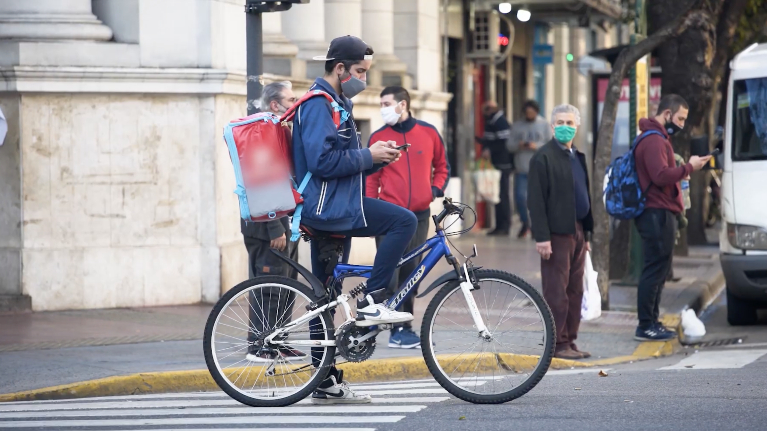
Home delivery of food and other products has become a source of informal sector work in Latin American cities, in a sector driven by the COVID pandemic. CREDIT: ILO

Recovery with fewer jobs

In its February report, the ILO showed that the region’s 6.2 percent economic growth in 2021 was insufficient for the labor market to recover, and the regional unemployment rate stood at 9.6 percent.

Of the 49 million jobs that were lost at the peak of the crisis, in the second quarter of 2020, 4.5 million have yet to be recovered, the vast majority of them jobs previously held by women. And in total there are some 28 million people looking for work.

After the onset of the pandemic, the crisis manifested atypically and instead of affecting more formal occupations, there was a greater loss of informal jobs, leaving millions of people without an income.

In Argentina, Mexico and Paraguay, for example, the reduction in informal sector jobs accounted for more than 75 percent of the fall in total employment during the first half of 2020. In Costa Rica and Peru the proportion was somewhat lower, 70 percent, while in Brazil and Chile it was around 50 percent.

The situation has now been reversed, and the countries with available data indicate that between 60 and 80 percent of the jobs recovered up to the third quarter of 2021 were in the informal sector.

Among the factors favoring recovery of the informal sector are the destruction of formal sector jobs due to the pandemic, the greater ease of interrupting an informal salaried relationship, its greater incidence in small businesses and enterprises, as in the case of Martinez, and the impossibility of many informal workers to do telework.

Women are lagging behind in this recovery, due to their greater presence in sectors strongly affected by the crisis that are rallying slowly, such as hotels and restaurants. In highly feminized sectors, such as domestic service work, the rate of informality exceeds 80 percent.

Nor is informality benign to young people, who face greater labor market intermittency, explained in part by the intense inflows and outflows of the labor force; and greater labor instability is associated with their prevalence in informal, precarious, low-skilled activities.

Telework is an informal work option that has thrived during the COVID-19 pandemic in Latin America and is a refuge for women, who were especially hard-hit by the abrupt drop in employment during the confinement and shutdown of non-essential activities at the beginning of the health crisis. CREDIT: ILO

Telework is an informal work option that has thrived during the COVID-19 pandemic in Latin America and is a refuge for women, who were especially hard-hit by the abrupt drop in employment during the confinement and shutdown of non-essential activities at the beginning of the health crisis. CREDIT: ILO

Leave no one behind, especially women

Against this backdrop, informality represents a challenge to the need and proposals in the region to produce, at the pace of the pandemic and as a way to overcome it, a sustainable and inclusive recovery, “leaving no one behind”, as the mantra already embedded in the discourse of various international organizations goes.

Maurizio is clearly committed to the formalization of employment. “Today, more than ever, the recovery needs to be people-centered; in particular, the creation of more and better jobs, formal jobs,” she said.

Informality “continues to be one of the most important characteristics of the region’s labor markets. Economic and social recovery will not be possible unless significant progress is made in reducing its incidence,” said the ILO specialist.

A necessary condition is “to advance in a process of economic growth with stability, reconstruction of the productive apparatus and persistent improvements in productivity.”

There must be, according to the expert, “a particular focus on the digital transition and young people; strengthening of labor institutions such as, for example, the minimum wage; care policies that allow women to return to and remain in the labor market; and support for small and medium-sized enterprises.”

Maurizio also called for the extension of unemployment insurance, social protection policies and “income guarantees for the population that continues to be strongly affected by the crisis.”

The gender perspective takes on “a central relevance in the recovery, taking into account the fact that of the 4.5 million jobs still to be recovered, 4.2 million are in traditionally female occupations.”

Among other measures, it is necessary to “facilitate the return of women to the labor market through a policy of investment in comprehensive care services with greater coverage, which at the same time should be a source of formal employment. Also, to support the recovery of economic sectors with a high female presence.”

Precarious working conditions have been a characteristic of informality associated with poverty in Latin America. CREDIT: Marcello Casal/Agência Brasil

Precarious working conditions have been a characteristic of informality associated with poverty in Latin America. CREDIT: Marcello Casal/Agência Brasil

Unions for a new working class

In the world of the trade unions, Brazilian Rafael Freire, secretary general of the Trade Union Confederation of the Americas (TUCA), added the challenge of “having a trade union for today’s working class, which in large part is precarious, outsourced, or working from applications.”

This workforce, “without job contracts, is increasingly part of the informal sector, in large proportions, for example 70 percent in Honduras and 80 percent in Guatemala,” said the leader of the 55 million-member central trade union from its headquarters in Montevideo.

Informality, which is structural in the Latin American social and labor panorama, is a major hurdle for economic recovery and social justice in the region, and while governments design strategies, define policies and take measures, millions of informal workers rely on their resilience to bring home food for their families.

Don’t Risk our Multi-Billion Dollar Pension Fund in Wall Street, Warn UN Staffers

UNITED NATIONS, Mar 18 2022 (IPS) - The United Nations Joint Staff Pension Fund (UNJSPF), which is expected to provide retirement, death, disability and related benefits for staff, upon cessation of their services– has a staggering portfolio amounting to over $81.5 billion ranking far, far ahead of the UN’s annual budget of $3.1 billion and its average peacekeeping budget of over $6.4 billion.

The thousands of UN retirees and their beneficiaries, numbering over 71,000 at last count, who depend on their pensions for economic survival, are relentlessly protective of the Fund—while protesting all attempts at risky investments.

The Coordinating Committee for International Staff Unions and Associations of the UN system (CCISUA), which represents over 60,000 staffers worldwide, is protesting a new proposed plan to “outsource a large part of the pension fund’s investments to Wall Street”.

In a letter to Pedro Guazo, Representative of the Secretary-General for the investment of UNJSPF assets, Prisca Chaoui, the CCISUA President warned last week that the proposed outsourcing “ultimately calls into question the nature of our pension fund.”

“Is it one that continues to be managed prudently by experts employed by the fund, who by being UN staff have a stake in its long-term health, a system that employs the fund’s economies of scale to keep down costs and that has by the fund’s own telling outperformed the private sector up to now?” she asked.

“Or is it one that is outsourced to Wall Street to be the victim of a short-term get-rich-quick bonus culture with little regard to the welfare of beneficiaries around the world?”

“Based on the information that has been shared with us”, says Chaoui, “we fail to understand the reasons behind the move to external management, given the unnecessary and costly duplication of internal capacity.”

“We also believe that your intention to “stop the bleeding” has been addressed by the management changes you have implemented in response to issues highlighted by the UN’s Office of Internal Oversight Services (OIOS), and through a new Strategic Asset Allocation that significantly reduces our exposure to risky assets”.


Credit: UN Joint Staff Pension Fund (UNJSPF)


Given that the pension fund has access to the same financial instruments as Wall Street, and employs equally experienced investment officers, she argues, there should be no reason for a lower performance.

“Indeed, the pension fund’s other portfolios have worked fine under internal management.”

“We stand today at a fork in the road that will decide the future of our fund. We ask that you reverse the outsourcing strategy and keep the management of our assets safely in-house,” she declared.

Meanwhile, a petition currently in circulation among retirees and UN staffers, says Secretary-General Antonio Guterres claims this is a temporary measure that will increase performance.

“However, the plans authorize an increase in outsourcing over a period of three years. And over the long term, our conservative, internally-managed UN pension fund has performed better than many externally-managed final salary funds that have since been forced to close. Indeed, our fund is in actuarial balance,” says the petition seeking signatures.

“Under the proposal, up to 75 percent of the fund’s fixed-income portfolio will be externally managed.”

The Secretary-General is proceeding with the outsourcing despite strong concerns expressed at the February meeting of the pension board, despite a letter of protest from CCISUA (https://www.staffcoordinatingcouncil.org/wp-content/uploads/2022/03/PF-protest-letter.pdf) and despite the UN’s own Board of Auditors noting that the fund is not able to effectively evaluate its external managers.

In 2007, one year before the global financial crisis and the collapse of many financial institutions, former Secretary-General Kofi Annan considered outsourcing to Wall Street. But he wisely changed course following staff protests and kept our fund safe, says the petition.

“By handing our pension fund to Wall Street in these financially turbulent times, it risks becoming the victim of a short-term, greed-is-good bonus culture that has little regard for the welfare of our staff and retirees around the world and little regard for the ethical values of the UN”, says the petition titled “Secretary-General Antonio Guterres: Don’t hand our UN pension fund to Wall Street.”

“By signing this petition, you call on the Secretary-General, to once again stop the outsourcing of our pension fund and keep its management in-house. Please share this with your colleagues across the UN and specialized agencies”.

Responding to the ongoing protests, Pedro Guazo, Representative of the Secretary-General for the investment of UNJSPF assets, said on 16 March the Fund is aware of additional concerns expressed on the temporary outsourcing of part of the fixed income portfolio.

“As presented at the last Pension Board meeting on 24-25 February 2022 (see here) and in my message of 12 March 2022, the investments of the UN Pension Fund are doing very well overall, given the current economic and geopolitical context.”

However, argued Guazo, the Fund can do better in the fixed income portfolio. For many years that portfolio has underperformed against its benchmark, as outlined on the Fund’s website here.

He pointed out that the Fixed Income Team of the Fund’s Office of Investment Management put a proposal to manage part of the portfolio internally (35%) and, temporarily, using an external advisor under the supervision and control by the same internal team (65%).

This 65% of the fixed income portfolio represents around 18% of the total portfolio managed by the Office of Investment Management.

“This proposal has been reviewed by the internal committee, by the Pension Board and the Fund’s Investments Committee, concurring this is a good temporary solution to raise the performance of the fixed income portfolio. The use of temporary external advisors is a best practice in the pension fund industry to address underperforming asset classes,” he noted.

The immediate benefit for the UN Pension Fund, he said, will be additional USD 60 million a year in profits and this solution is only temporary. When the team is ready in some months the Office of Investment Management will again manage the portfolio internally.

“I hope this clarifies the objective and the benefits of this operation, that will, again, be applied only for a limited time,” he added.

Meanwhile, Ian Richards, former President of the CCISUA, told IPS following the launch of the union petition, “I’ve been inundated with messages from staff.

They are looking at what’s happening on the markets right now and just don’t think it’s the time for Wall Street to be taking things over.

They’re asking why now when the pension fund leadership has for years, and as recently as last autumn at the General Assembly, vaunted the advantages of safe, conservative in-house management. A lot of questions, including ones I have raised on this, remain unanswered. ”

IPS UN Bureau Report

 OPINION

Planet Earth into Planet Plastics

Plastic pollution: Approximately 400,000,000 metric tons of plastics are produced worldwide annually. Those plastics amount to about 50 kilograms, or 110 pounds, every year for each of the 8 billion human inhabitants living on the unfolding planet Plastics

Today, plastics are ubiquitous, pervading all aspects of human activity and invading all dimensions of the environment, with the result being the emergence of planet Plastics. Credit: Albert Oppong-Ansah/IPS.

PORTLAND, USA, Mar 21 2022 (IPS) - Planet Earth is increasingly being transformed into planet Plastics. Approximately 400,000,000 metric tons of plastics are produced worldwide annually. Those plastics amount to about 50 kilograms, or 110 pounds, every year for each of the 8 billion human inhabitants living on the unfolding planet Plastics.

The Garden of Eden with all its wonderful flora and fauna did not contain plastics. None of the world’s sacred religious texts refer to or mention plastics. Also, in the great historical works of literature, drama, philosophy, mathematics, science, music, and art, one does not read, think, hear, see, or feel plastics.

Yet today, plastics are ubiquitous, pervading all aspects of human activity and invading all dimensions of the environment, with the result being the emergence of planet Plastics. From birth to death plastics have become an integral part of human daily life and infiltrated the planet’s environment. Without plastics, it is difficult to imagine how human populations would function.

Plastics can be found everywhere on the planet, including oceans, waterways, air, forests, plains, cities, towns, farms, highways, clothing, buildings, furniture, packaging, transport, factories, sewers, beaches, mountains, and animal life. Plastics have also made it to Earth’s upper atmospheres, the Moon, Mars and beyond.

Plastics first appeared on planet Earth at the start of the 20th century and with their discovery began the start of the Age of Plastics. The first fully synthetic plastic was invented by Belgian chemist Leo Baekeland in 1907. His plastic, which he named Bakelite, was a combination of two chemicals, formaldehyde and phenol, made under pressure and heat.

Facilitating the rapid growth of the plastics industries was the utilization of waste materials from the processing of crude oil and natural gas, including ethylene gas. Industrial experimentation lead to various forms of plastics, the most abundant being polyethylene. In brief, plastics are made mostly from fossil fuels, i.e., oil and natural gas, through a process that is energy intensive and emits greenhouse gases.

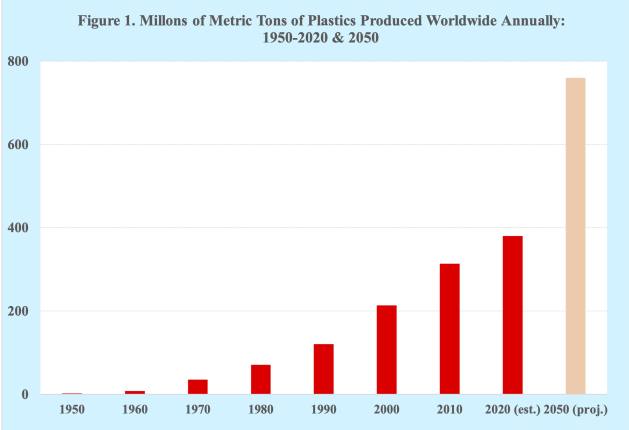
By the middle of the 20th century the annual production of plastics increased rapidly to about 2 million metric tons. Seventy years later the annual production of plastics worldwide reached approximately 400 million metric tons, or two hundred times the amount of plastics that was produced in1950. And by 2050 the annual production of plastics is projected to be twice the 2020 level (Figure 1).


Plastic pollution: Approximately 400,000,000 metric tons of plastics are produced worldwide annually. Those plastics amount to about 50 kilograms, or 110 pounds, every year for each of the 8 billion human inhabitants living on the unfolding planet Plastics

Source: Our World in Data.


Plastics have created an alarming global throw-away culture. It is estimated that single-use plastics represent about 40 percent of the annual production of plastics.

The recycling of plastics remains at a relatively low level worldwide. Recycling is estimated to account for less than 10 percent of all plastics produced every year, with more than 10 million metric tons of plastics being dumped in the oceans annually. Moreover, without needed action to address that dumping, the amount of plastic trash flowing into the oceans every year is expected to nearly triple by 2040.

The primary reason why less than a tenth of plastics produced annually are recycled is the cost. For the plastics industries the costs of recycling are far greater than the costs of producing new plastics.

Consequently, the cumulative worldwide amount of plastics is many times more than the annual production. Since the end of World War II, it is estimated that close to 10,000 million metric tons of plastics have been produced globally (Figure 2).


Plastic pollution: Approximately 400,000,000 metric tons of plastics are produced worldwide annually. Those plastics amount to about 50 kilograms, or 110 pounds, every year for each of the 8 billion human inhabitants living on the unfolding planet Plastics

Source: Our World in Data.


Most of those plastics were produced relatively recently. About two-thirds of all the plastics in the world today were manufactured since the start of the 21st century. In addition, by mid-century the cumulative amount of plastics produced is projected to nearly triple and be equivalent to the weight of all the fish in the oceans.

The consequences of plastics read like a science-fiction doomsday novel. In brief, the novel’s plot involves invisible aliens from outer space taking over planet Earth by encouraging humans to exterminate themselves through the exponential accumulation of plastics.

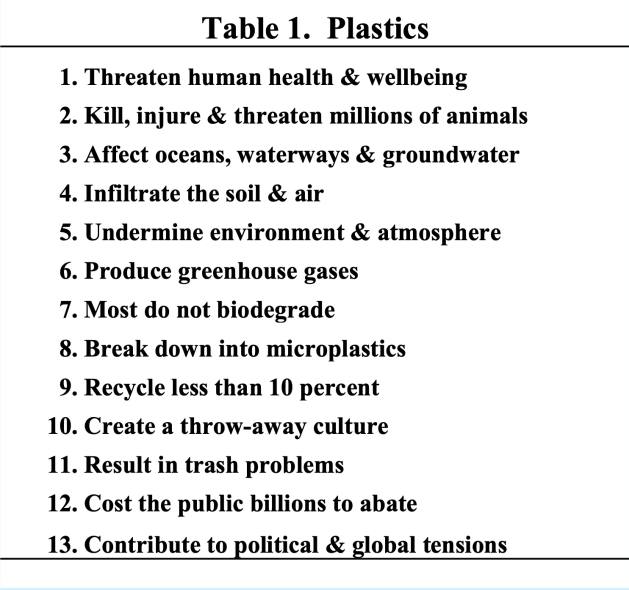
In addition to being a serious threat to human health and wellbeing, the increasing production and use of plastics are undermining the planet’s natural environment. Plastics are polluting the soil, air, oceans, and waterways, entering the food chain, killing and injuring wildlife and damaging habitats, producing greenhouse gases that contribute to global warming, and creating hazardous chemicals (Table 1).


Plastic pollution: Approximately 400,000,000 metric tons of plastics are produced worldwide annually. Those plastics amount to about 50 kilograms, or 110 pounds, every year for each of the 8 billion human inhabitants living on the unfolding planet Plastics

Source: Author’s compilation.


Most plastics do not biodegrade and therefore remain in the environment for many hundreds of years. Consequently, those plastics often break down into microplastics, which are small pieces of plastics, including fibers, microbeads, fragments, nurdles, and foam. The various forms of microplastics are contaminating the planet’s land, oceans, water, air, food and increasingly living organisms.

The low level of recycling plastics has also resulted in enormous global plastic trash problems that cost the public billions to abate. Attempts to deal with the plastics trash are also contributing to contentious political issues and tensions among nations.

A global agreement adopted by more than 180 countries in 2019 aims at restricting the exporting of plastics trash from wealthy countries to poor countries. However, some countries have been able to get around the restrictions and continue exporting plastics trash.

Also, in March representatives of 175 countries agreed to begin writing a legal binding global treaty aimed at addressing the exponential growth of plastic pollution as well as its impact on climate change and biodiversity loss. In addition to improving recycling efforts and cleaning up plastics trash, the treaty is to include curbs on the production of plastics and may even include a ban on single-use plastics.

At the country level, various actions are being taken to address some of the causes contributing to plastics pollution. Some countries, for example, have banned the use of plastic bags for bagging groceries. Others have also eliminated the use of bottles, cutlery, straws, and coffee stirrers made from plastics.

In addition to the actions and policies of governments, important steps can be taken by individuals to curb the emergence of planet Plastics. People can reduce their use of plastics, particularly disposable plastics, plastic water bottles, and plastic grocery bags and support policies and programs for recycling and reusing plastics.

Public information campaigns can also contribute to responsible behavior regarding the use, reuse, recycling, and disposal of plastics. Educational programs, especially in elementary schools, can be effective in creating awareness about the detrimental effects of plastics on the planet.

Furthermore, with the aim of reducing the growing accumulation of billions of metric tons of plastics and limiting the plastics pollution of the environment, the private sector can produce and use less plastics. And very importantly, the major industries that produce and those that extensively utilize plastics should take the lead in establishing, promoting, and facilitating worldwide programs for recycling and reusing plastics.

The available indicators on the production, consumption, recycling, reuse, and disposal of plastics all point to the same outcome, namely, a ruinous worldwide transformation of the environment. However, it is not too late to take actions to arrest the transformation of planet Earth into planet Plastics and by so doing contributing to an opportunity to return to a semblance of the original Garden of Eden.

Joseph Chamie is a consulting demographer, a former director of the United Nations Population Division and author of numerous publications on population issues, including his recent book, “Births, Deaths, Migrations and Other Important Population Matters.”

FOOD AND AGRICULTURE

Ethanol Not Enough to Heal Sugarcane’s Environmental Legacy in Colombia

One phase of Colombia's sugarcane agroindustrial production consists of burning bagasse to generate biofuels. In the picture, workers arrange sugarcane waste in a field in the municipality of El Cerrito, in the southwestern department of Valle del Cauca. CREDIT: Emilio Godoy/IPS

One phase of Colombia's sugarcane agroindustrial production consists of burning bagasse to generate biofuels. In the picture, workers arrange sugarcane waste in a field in the municipality of El Cerrito, in the southwestern department of Valle del Cauca. CREDIT: Emilio Godoy/IPS

BOGOTA, Mar 17 2022 (IPS) - As a visitor drives across the plains of the department of Valle del Cauca in southwestern Colombia, green carpets dominate the view: sugarcane fields that have been here since the area got its name.

The long tentacles of dirt roads draw the visitor into the thicket of golden-crested flowering green plants, which will be cut to ground level in a few months, the start of an industrial process and the restart of an annual agricultural cycle.

But this crop has left a lasting and damaging imprint on the soils, some of the most fertile in this South American nation of 51.7 million people.

Irene Vélez, an academic at the public University del Valle, said legislative changes and the opening of the market to imported sugar have led to the shift from sweetener to fuel.

“One of the consequences of this process is the expansion of the agricultural frontier to other regions of the country, because the land is cheaper and there is a different system of relations between landowners and the agro-industrial sector,” she told IPS from the Portuguese city of Coimbra, where she is doing post-doctoral studies.

Along with sugar and molasses for industrial consumption, sugarcane also provides ethanol or ethyl alcohol, which by law has been blended since 2005 in a volume of 10 percent per liter of gasoline in Colombia.

Proponents argue that this biofuel helps curb dependence on oil, and improves the octane rating of gasoline by oxygenating, which reduces urban pollution.

But in contrast, a vehicle consumes more blended fuel for the same trip due to its lower calorific value than gasoline and, the higher the mix, the higher the emission of the carcinogens formaldehyde and acetaldehyde and ozone, especially in winter, which cause respiratory problems, according to a 2007 study by researchers at Stanford University in the United States.

Colombia is the world’s 15th largest sugarcane producer, supplying 22.87 million tons of milled sugarcane per year, according to data from 2021, when it fell by a slight three percent compared to the previous year, according to data from the Sugarcane Association (Asocaña), which groups sugarcane producers.

In parallel, the country refined 396 million liters of ethanol in 2021, 0.5 percent less than the previous year. But domestic production does not meet demand, so last year it imported an additional 64 million liters, mostly from the United States, a drop of almost 400 percent compared to a year earlier, according to Asocaña.

Colombia is the third largest ethanol producer in the region, after Brazil and Argentina. This South American nation extracts ethanol from sugarcane and biodiesel from palm oil. The industry enjoys tax exemptions and subsidies, thanks to the Sugar Price Stabilization Fund, which has been in operation since 2000.

The expansion of sugarcane cultivation in Colombia has its epicenter in the Cauca River valley, in the southwest of the country, and has left a trail of water exploitation, reduction of biodiversity and pollution from the use of pesticides and synthetic fertilizers, which is not compensated by the use of part of the crop to produce biofuels. CREDIT: Emilio Godoy/IPS

The expansion of sugarcane cultivation in Colombia has its epicenter in the Cauca River valley, in the southwest of the country, and has left a trail of water exploitation, reduction of biodiversity and pollution from the use of pesticides and synthetic fertilizers, which is not compensated by the use of part of the crop to produce biofuels. CREDIT: Emilio Godoy/IPS

Problematic expansion

The appearance of ethanol on the energy scene extended the sugarcane frontier in Colombia and fortified the vertical integration of the industry.

In the Cauca River valley, where most of the country’s crop is concentrated, sugarcane covers more than 225,000 hectares, which “is close to the total area available for planting sugarcane” in the region, according to Asocaña.

There are 14 sugar mills operating in the area, which directly cultivate 25 percent of the fields, while buying the rest of the cane from some 2,750 producers. The average size of the 3,300 farms that supply the mills is 63 hectares. In addition, they operate 12 energy cogeneration facilities, powered by sugarcane bagasse.

But that expansion has left social, environmental, economic and cultural impacts on local communities, says the report “The Green Monster. Perspectives and Recommendations from the Black Communities of Northern Cauca, Colombia regarding the Sugar Sector in Colombia”, published in June 2021 by the non-governmental organizations Palenke Alto Cauca-PCN and the UK-based Forest Peoples Programme.

The main impacts include the effects on soil, rivers and groundwater due to the use of pesticides such as glyphosate, soil compaction caused by the intensive use of agricultural machinery, soil erosion, polluting emissions due to the practice of burning sugarcane fields before replanting, deforestation arising from the increase in the area planted, and the monopolization of water sources.

The expansion of large-scale sugarcane plantations in Valle del Cauca has resulted in loss of land, damage to water resources, health problems, displacement and violence.

Carlos Molina, director of the El Hatico nature reserve in the municipality of El Cerrito, in the southwestern Colombian department of Valle del Cauca, stands in the middle of a cut sugarcane field on his farm. He advocates the transition from conventional sugarcane to an organic crop that contributes to the use of biofuels for energy decarbonization. CREDIT: Emilio Godoy/IPS

Carlos Molina, director of the El Hatico nature reserve in the municipality of El Cerrito, in the southwestern Colombian department of Valle del Cauca, stands in the middle of a cut sugarcane field on his farm. He advocates the transition from conventional sugarcane to an organic crop that contributes to the use of biofuels for energy decarbonization. CREDIT: Emilio Godoy/IPS

Seeking more sustainable sugarcane production

Carlos Molina, legal representative and one of the owners of the El Hatico company, said it is possible to reverse the damage caused by sugarcane, as he gestured to the surrounding fields.

“If we don’t restore now, we are going to run out of fuel. If they don’t change things, producers are going to go bankrupt. The solution is to show the alternatives and offer incentives for transformation,” he told IPS during a tour of his farm’s sugarcane crop in the municipality of El Cerrito, in Valle del Cauca.

El Hatico is a 285-hectare farm, of which 110 hectares are used for organic sugarcane production and 76 hectares for 245 grazing dairy cows. Thanks to the farm’s sustainability, it has achieved nature reserve status.

Faced with the loss of income due to soil deterioration, in the early 1990s the owners began a shock therapy program to abandon irrigation, pesticides and synthetic fertilizers and introduce natural fertilizers and other agroecological practices.

“We made an abrupt transition and that cost us 30 percent of our production, then we recovered. Sustainable management and value-added improve yields,” said Molina, who belongs to the eighth generation of sugarcane growers in his family.

For example, a conventional hectare requires about 180 kilograms of nitrogen and 12 billion cubic meters of water per year, while an organic farm needs much less.

The legal framework for biofuels began in Colombia in 2001 with regulations on their use and the creation of incentives for their production, use, marketing and consumption. In 2004, another regulation expanded the conditions to stimulate the production and marketing of biofuels of plant and animal origin to obtain biodiesel.

Thus, the introduction of the blend began in 2005 with the E10 combination, while the production of biodiesel began in 2008, with the addition of five percent of this fuel.

That same year, the National Council for Economic and Social Policy, which brings together seven ministries and the governmental scientific sector, issued guidelines to promote the sustainable production of biofuels in the country, proposing strategies to this end.

As a result, sugarcane refineries for biofuels started up in 2006, six of which operate in Valle del Cauca and one in the central department of Meta.

In 2013, the blend of ethanol per liter of gasoline increased to 10 percent and that of biodiesel to 12 percent.

A sugarcane plantation in the municipality of El Cerrito, in the department of Valle del Cauca, in southwestern Colombia. Cutting, slashing and burning are the three steps of cultivation: cutting the sugarcane, harvesting the crop and setting fire to the residues, a practice that is harmful to the health of the soil and the air. CREDIT: Emilio Godoy/IPS

A sugarcane plantation in the municipality of El Cerrito, in the department of Valle del Cauca, in southwestern Colombia. Cutting, slashing and burning are the three steps of cultivation: cutting the sugarcane, harvesting the crop and setting fire to the residues, a practice that is harmful to the health of the soil and the air. CREDIT: Emilio Godoy/IPS

Pros and cons

The shift of sugarcane towards ethanol production is paradoxical, as the crop causes environmental impacts but the fuel reduces emissions of carbon dioxide (CO2), the gas generated by human activities that is responsible for global warming.

Sugarcane ethanol reduces 74 percent of polluting emissions, compared to corn and canola ethanol – 45 percent and 25 percent, respectively – according to the 2012 study “Life Cycle Assessment of the Biofuels Production Chain in Colombia“, sponsored by the Inter-American Development Bank and the national Ministry of Mines and Energy.

By law, ethanol emissions have had limits in the country since 2017. Data from the non-governmental Sugarcane Research Center for six mills indicate that the average in 2016 was 551 kilograms of CO2 per cubic meter of fuel and 558 in 2017.

These results were below the regulatory ceiling of 924 kilograms for 2017 and 889 for the following year. In 2021, the ceiling stood at 780 kilograms.

The sugarcane manufacturing process generates the greatest amount of pollution, with 249 kilos of CO2, followed by planting and harvesting (181 kilos), effluent treatment (89) and transportation to blending centers (39).

Biofuels, part of the NDC

In its 2020 Nationally Determined Contribution (NDC) update, Colombia pledged to reduce its emissions by 51 percent by 2030, down from 258 million tons of CO2 in 2015, the base year, to 169 million tons, mainly by combating deforestation.

Within this voluntary goal, Colombia pledged that at least 20 percent of its energy mix would be made up of biofuels by that year, subject to financial support from industrialized countries.

The independent Climate Action Tracker calls the NDC “highly insufficient”, as other approaches are needed, especially in energy and transportation. Although transportation accounts for 12 percent of the country’s total emissions, mitigation actions, such as the deployment of electric cars, are insufficient.

The Colombian government projects stable ethanol demand between 2022 and 2025, of about 60,000 barrels per day of the biofuel.

“The agroecological transition could be completed in three years, without any problem,” said Molina.

But Vélez disagreed. “It is associated with an agro-technological package that involves improved seeds that need pesticides, fertilizers and privatized seeds from transnational corporations. There is no point in switching from sugarcane to organic pineapple, for example. If land grabbing continues, we are not generating the necessary transition,” he said.