Monday, March 21, 2022

Volodymyr Zelenskyy has called on Israel to share its Iron Dome technology with Ukraine. But that's easier said than done
Israel's Iron Dome anti-missile system intercepts rockets launched from the Gaza Strip towards Israel in 2021. 
(Reuters: Amir Cohen)

In his latest appeal for help from abroad, Ukrainian President Volodymyr Zelenskyy has questioned Israel's reluctance to sell its Iron Dome missile defence system to the besieged nation.

Israel has condemned the Russian invasion but has been wary of straining relations with Moscow, a powerbroker in neighbouring Syria where Israeli forces frequently attack pro-Iranian militia.

"Everybody knows that your missile defence systems are the best … and that you can definitely help our people, save the lives of Ukrainians, of Ukrainian Jews," Mr Zelenskyy, who is Jewish himself, said while addressing the Israeli parliament by video link.

He mentioned Israel's Iron Dome system, often used to intercept rockets fired by Palestinian militants in Gaza.

So how likely is it the Iron Dome will be deployed in Ukraine?

What is Israel's Iron Dome?

An Israeli missile is launched from an Iron Dome defence missile system in 2019.
(AFP: Jack Guez )

Israel's Iron Dome system targets incoming rockets, firing interceptor missiles to destroy them in the air within seconds of them being launched.

Once an enemy rocket has been launched, a radar system detects it and tracks it before a control system estimates the impact point. A portable missile launcher then fires to intercept and destroy the rocket.

Israel began developing the state-of-the-art technology in 2007, and the first battery was deployed in southern Israel in 2011.

Israel now has 10 batteries deployed across the country, each with three to four launchers that can fire 20 interceptor missiles.

The Iron Dome was expensive to develop. However, manufacturers say it is cost-effective because the system ignores rockets it determines will land in uninhabited areas.

Would the Iron Dome work in Ukraine?

John Blaxland, a professor of international security and intelligence studies at the Australian National University, says Iron Dome is effective, but deploying it in Ukraine would be complex.

"The Iron Dome has proven effective against fairly rudimentary rocketry and against Soviet-era missiles, so it's been effective in the past and it is obviously something that Israel updates regularly," Dr Blaxland says.

"It is highly likely that it would be effective if it was deployed at the right locations in sufficient quantity. So there's a number of variables there.

Duration: 45 seconds45s
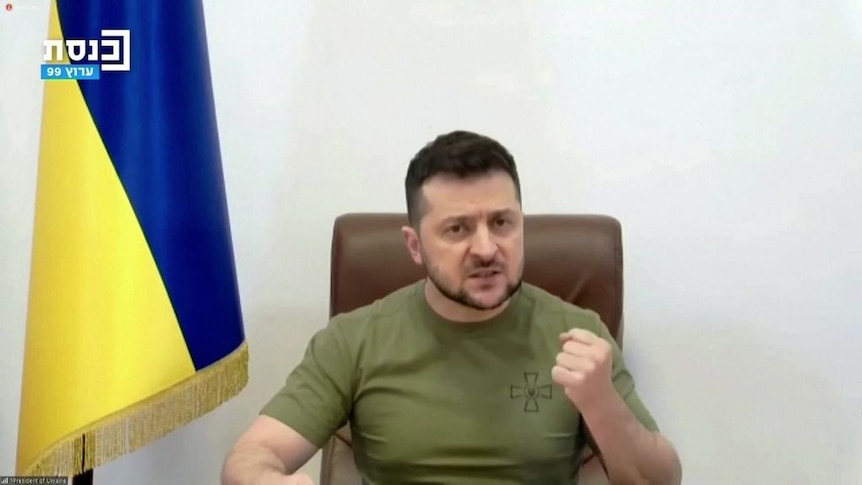
Zelenskyy criticises Israel's government for not doing enough to help Ukraine defend itself from Russia.

"It doesn't have complete coverage of the Earth. You effectively have to place the Iron Dome system close to where you anticipate the rockets coming from.

"When you've got a country as big as Ukraine, you may well be able to position them to defend Kyiv.

"But if you deploy them to somewhere like Mariupol, do you then risk them falling into Russian hands? And, by positioning them there, are they going to drive Russian initiatives elsewhere?


"There's not one solution to that challenge. It's multifaceted."
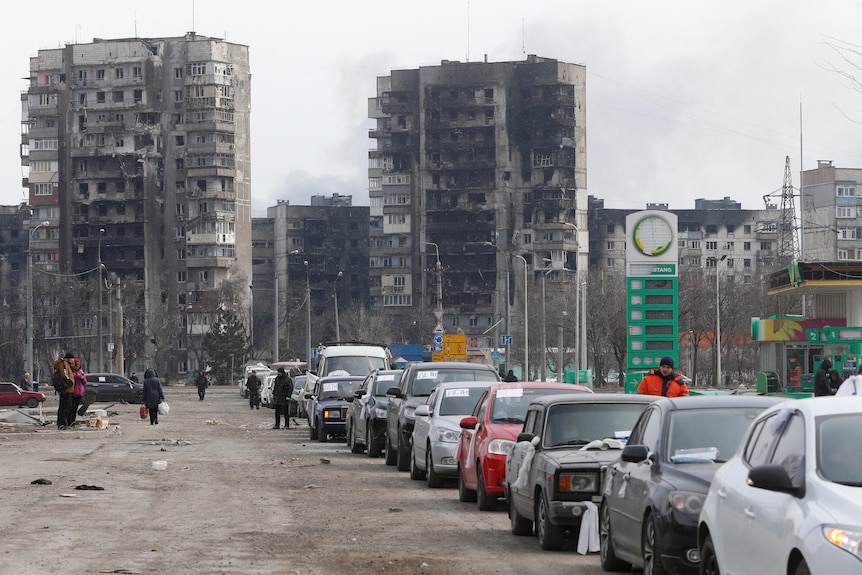
Greece's consul-general in Mariupol, Manolis Androulakis, says the area "will become part of a list of cities that were completely destroyed by war".
(Reuters: Alexander Ermochenko)

How likely is it to be deployed?

Dr Blaxland says even if the Iron Dome could be successful in Ukraine, it is unlikely Israel will give President Zelenskyy what he wants.

"It's a very tough call for Israel, and a sad one, but I'm not optimistic that that's going to happen," Dr Blaxland says.

"There is an understandable reluctance in Israel to share with Ukraine because Israel is deeply worried about the prospect of Russian vengeance manifested through proxies in Syria," Dr Blaxland says.

"This is the hard-nosed reality of it all. Israel is deeply worried that by providing Ukraine with this technology, Russia will then let slip its forces and its proxies and provide incentive for Hezbollah and Syrian anti-Israel groups to attack Israel and make life difficult for Israel.

Israeli's Iron Dome intercept rockets fired from Gaza Strip in 2021. 
(AP: Ariel Schalit)

Dr Blaxland says the United States' Terminal High Altitude Area Defense system could be an alternative to the Iron Dome, but getting it deployed in Ukraine would be no less complex.

"It's not the same as the Iron Dome but there is an overlap, there's a complementarity to them, which the United States could possibly deploy," he says.

"But the problem once again [would be] you've got the US seen to be confronting Russia in a way that would provide Putin with an excuse for escalating the conflict even further and taking it beyond the boundaries of Ukraine."

"The Israelis are thinking longer term about what happens after the conflict and what the repercussions might be and what Russia might be prepared to do to make life difficult for Israel."
Wine expert Tinashe Nyamudoka overcame cultural barriers to become one of the best
Now a well regarded sommelier, Mr Nyamudoka had little knowledge of wine in his early 20s.
(Supplied: Tinashe Nyamudoka & Jancis Robinson)

From the outside, the world of wine tasting can seem exclusive and inaccessible. Pretentious even.

Expert sommelier Tinashe Nyamudoka, who had almost no knowledge of wine when he moved from Zimbabwe to South Africa in 2008, flips that notion on its head.

Upon arriving in Cape Town, he began working in a restaurant. It was there he tasted wine for the first time and learnt about the existence of the wine industry.

Fast-forward 10 years and Mr Nyamudoka was competing among the best international palates at the world wine tasting championships.

He found his own path to wine appreciation and today he wants more people to be able to connect with wine too.
Mr Nyamudoka (right) and his teammates did well at the 2018 World Wine Tasting Championships.
(Supplied: Madman Films/Blind Ambition)

"There are a lot of people in the world who don't come from a wine culture, but wine is being drunk everywhere. But people are still drinking it in a pretentious way," he tells ABC RN's The Drawing Room.

Real wine culture, he argues, acknowledges that "no matter whether it's in South Africa [or] it's in Burgundy, France, [wine] has got a history to it. It's got people. It's got a place".

Mr Nyamudoka believes anyone should be able to appreciate that and "enjoy wine in their own comfort, in their own culture".

‘I'd never eaten a gooseberry'


Mr Nyamudoka grew up in Harare, Zimbabwe's capital city, but spent his holidays in the country on the eastern side of Zimbabwe, at his grandfather's farm.

"I've got really fond memories of that [time]," he says.

In many ways it was an idyllic upbringing, but when Mr Nyamudoka reached his early 20s, Zimbabwe entered a period of extraordinary high inflation.

"I was working in a supermarket back then and I saw first-hand the empty shelves and that nothing was coming. So you had money in your pocket, but you didn't have anything to buy with it," he says.

"It was really a difficult moment at that time. A lot of people were suffering."

In 2008, he moved to South Africa seeking better prospects and began working back-of-house in a restaurant.

Mr Nyamudoka joined a training program for people who'd never worked in the hospitality industry. Here he started to learn about wine, something initially he found "very intimidating".

Before he became an expert sommelier, Mr Nyamudoka found the world of wine intimidating.(Reuters)

The Eurocentric language surrounding wine didn't help.

"I was really learning quite a lot but the challenge was understanding this [taste] is gooseberries [or] this is blackcurrants — because I'd never eaten a gooseberry or blackcurrant," he says.

To learn how to find those associations in wine, Mr Nyamudoka would head to the supermarket in his spare time. In the vegetable section, he'd smell the black peppers, plums and blackberries, "just to familiarise myself with them".

"I was learning these cultures but all of them were foreign. I couldn't speak about wine in my local language … and I felt I wasn't the only one."

Four Zimbabweans take on the wine championships

Mr Nyamudoka wasn't the only one. He joined forces with three other Zimbabweans living in South Africa who were also becoming wine experts.

Together they formed the first team to compete for Zimbabwe in the World Wine Tasting Championships, in Europe in 2017. Their journey is the subject of a new film, Blind Ambition.


Mr Nyamudoka describes the competition as "very intense".

"The adrenaline is running. You're anticipating which wines they're going to pour for you," he says.

There were 23 nations competing at the championships where Mr Nyamudoka (left) and his team finished 14th.(Supplied: Madman Films)

Over 12 glasses, with seven minutes per glass, the men had to determine the type of wine, the country, the region, the year and even the vineyard that the wine came from.

The first year they finished second from last, but they re-entered the next year and fared much better, finishing 14th of 23 competing countries.

"It was just one of the best experiences I've ever had," Mr Nyamudoka says.
Wine that evokes ‘a sense of being yourself'

Now he creates his own wines in South Africa and hopes to return to Zimbabwe one day to plant his vineyard in his grandfather's land.

He's divided his wines into three kinds: one that is easy to drink, "where people don't have to think twice about blueberries and blackberries"; one that experiments with new varietals; and one that is "unapologetically … thought-provoking, that I put a bit of emotion into".

Mr Nyamudoka, pictured with his teammates, wants wine to be accessible to more people.
(Supplied: Madman films)

That emotion has helped him answer something he'd always wondered about wine.

The French term terroir, meaning "sense of place", is used to describe wine that tastes of the place where it was made.

"But what if you've never been there?," Mr Nyamudoka says.

"That was always my question. I'd never travelled the winelands of the world."

He learnt from reading the work of sommelier Jonathan Nossiter that terroir might also be used to describe where the wine is taking you or the memories the wine is giving you.

This resonated strongly with Mr Nyamudoka. He says he's transported to the fruits, mushrooms and mountains of "back home … with my grandfather" at the smell of his own wine.

"So I always feel terroir should be one of practical places — where the wine is being grown and the people, [but] also those memories that evoke a sense of being yourself."

Why no mass protests in Russia? Sociologist Greg Yudin Demonstrated Against the Invasion and Ended up in the Hospital. He Says We’re Living in a New Era.


This article originally appeared in Russian on Meduza on 3/1/2022.

On February 24, Russia began a war with Ukraine. On that same day, protests broke out all over Russia. It is difficult to call them mass demonstrations in any real sense, although ultimately almost 6,500 people were arrested (in Russia, street gatherings of this type are practically forbidden, with the authorities persecuting even individuals who picket alone). Sociologist Greg Yudin, too, was arrested and ended up hospitalized following an anti-war protest in Moscow. Meduza special correspondent Svetlana Reiter discussed with Yudin why it doesn’t make sense to call protests in Russia “small” — and why he thinks scholars have to take a principled stand.

When we were first arranging this interview, you objected to my statement that anti-war protests were small in number: “Not so small.” What made you say that?

We don’t live in Berlin, where participation in a protest gets you lots of pats on the back. You can end up with a concussion, or spend the night in jail, or be required to remove your underwear [for a cavity search], or [possibly] have a felony case opened against you. Given the current situation, we can’t exclude the possibility that protests will eventually be punishable by 20-year prison sentences or the death penalty. So, yeah, in my view, people are coming out in force.

At a recent protest, you were beaten to the point of sustaining a concussion. Can you give us some more details about that?

Honestly, I don’t really want to talk about it — ultimately, it’s insignificant against the background of the major disaster we’re confronting. But, yes, the evening ended with a concussion for me.

How are you feeling now?

So-so. I’m still recovering.

Has anyone been conducting sociological surveys in order to determine which segments of the population approve of the hostilities in Ukraine?

They’re in progress, but it’s too early to talk about results — there aren’t any numbers for us to rely on. I don’t have them, at any rate.

Is it possible that protests will escalate?

It’s possible, yes. The initial situation was largely unexpected, and in fact studies showed that people in Russia weren’t interested in the topic of Ukraine. Hence the certainty that there wouldn’t be any war.

The danger here is that, when you’re not interested in something, then after a shocking event you’re ready to accept any convenient interpretation on offer. Which is exactly what happened — many people are clinging to the most immediate explanation, courtesy of government propaganda. That’s the most comfortable choice: everyone wants to avoid problems, especially in wartime.

But already there’s a factor that introduces dissonance into the picture — it’s obvious that the blitzkrieg failed. It’s becoming harder and harder to pretend that all of this is happening somewhere far away and will soon be over — on the contrary, it’s already an obviously significant military conflict. Lots of people on the Russian side have already been killed or wounded, with many more to come. Russians have many relatives in Ukraine, and, according to numerous reports, the Russian air force has begun using cluster bombs, which means a lot of civilian deaths.

All of that is going to disturb the picture, and people will be forced to take a clear position. It will become impossible to bury yourself in everyday tasks. Plus, the reality we’re all used to is going to be destroyed by the consequences of economic collapse. Which is why I think that a rise in critical attitudes across different segments of society is likely.

But we’re not the only ones who have figured this out — and we should expect actions in the near future that seek to nip any kind of generalized protest in the bud.

What kinds of actions should we expect?

If the Russian leadership acknowledges all of these events, that is, if they admit that this is a war and not some warm and fuzzy mission to liberate [Ukraine], then martial law will go into effect — with consequences to match: general mobilization, wartime economy, liquidation of property. It’s possible that the destruction of the economy will be blamed on “internal Nazi agents,” we may see the return of the death penalty. Naturally, borders will be closed — after all, there’s a war on, we’re in a state of exception.

So, what can be done?

Life will be different in the possible future I’ve just sketched out, so strategies will change: we’ll see underground resistance and partisan battles with all the associated risks and consequences. The current situation is approaching a turning point — either the outcome will be what I described earlier, or there will be a surge of discontent from the ground up. We already see that discontent escalating…

Well, it’s escalating, but more slowly than the armed conflict.

Yes, it’s escalating too slowly, but it’s escalating, nonetheless. We’re seeing more and more public figures speaking out against [the war]: MPs; various associations; celebrities, who, even as they try to keep silent, are still coming out against the war in greater numbers than not. This may not be much, but it’s already something.

If the trend of speaking out jumps from sub-elite circles to elite ones, circles that are closer to the Russian leadership, the risks for Putin are obvious. The whole thing starts to look like an unhinged escapade with terrifying consequences and inescapable defeat on the horizon. Which is why we’re at a turning point: the world we’re living in right now won’t survive for very long at all…

Maybe an hour or two.

Yes, maybe even that little.

Granted, this is the first time Russia has found itself in this kind of situation. Even so, can you, as a sociologist, try to make some predictions? What are the chances that this turning point will produce a more favorable outcome, versus one that is less favorable? Do you have hopes for the talks that began on February 28? 

This is an unprecedented situation in world history — there has never been anything like it before. Right now, the whole world stands on the brink of a monstrous catastrophe, because there is no logical knowledge on which we can rely.

The whole world is already realizing that February 24 marked the end of an entire huge postwar period, and now we’re living in a new era. The German chancellor, Olaf Scholz, was right to say that this era will see a new Germany, one ready to assume new responsibilities.

Today we are on the brink of an immense war. Its potential participants possess nuclear weapons, which certain people are already threatening to use. Words like “Nazi” or “de-Nazification” are far from harmless — in current discourse, they have the potential for total dehumanization and set the stage of all kinds of “final solutions.” And we shouldn’t exclude the possibility that the response will be in a similar vein…

The closest analogy [to the present moment] is 1938–1939. However, at that time, the world was divided and doomed, whereas now it’s coming together. Not totally, of course, but with every passing day people realize more and more that the situation is really serious. Which is why I think we’re all standing at a fork in the road that will determine [our collective future] for decades to come. This goes especially for Belarusians, Russians, and Ukrainians — three peoples who have fallen hostage to those who point their weapons at them and try to pit them against one another.

It’s important to understand that this isn’t a war of Russia against Ukraine. This war is being waged by a faction that has amassed a bunch of weaponry, gotten into the habit of using it for purposes of intimidation, and which has now transitioned into open hostilities against all three of these peoples.

In this moment, do you feel like more of a human being or more of a scholar? Or is that the stupidest question ever? Let me rephrase: Do we analyze or flee?

No, it’s not stupid at all; it’s a pretty logical question [to ask] in a decisive historical moment. It’s important to understand that these two positions coexist within every researcher and must partly coincide. You have to know what you believe in and what you’re analyzing for: if you analyze to no specific end, just because you were ordered or asked to, you’ll end up like Elvira Nabiullina [the head of Russia’s Central Bank]. You risk becoming a war criminal.

You think Elvira Nabiullina is a war criminal?

Albert Speer was a war criminal.

She’s not a victim of circumstance?

In that case, wasn’t Adolf Eichmann also a victim of circumstance? I’m being totally serious right now — at some point you have to stop thinking of yourself as just a cog and find some foothold that can become the basis for a moral position. And from that point forward, your analytical capacities have to serve that position, but at the same time you also have to be able to gain some critical distance, figure out how to maintain your cold reason and not lose self-control. But it’s really important not to lose your moral position — especially in critical moments.

What would you yourself prefer right now — to leave or to stay?

There are some red lines for me. I know for absolute certain that I will under no circumstances go and fight in this insane war, the most pointless war in all of Russian history. It’s worse than the Crimean War and will end in either catastrophe for the entire world or just for my favorite country. Putin is acting against Russia’s interests, and I will under no circumstances wage war against Russia.

How much should we expect each person to find their foothold? And what has to happen to make Elvira Nabiullina or, say, Sergei Shoigu behave differently?

That’s between them and their God. You know, right now we’re in a moment that, for all its uniqueness, nonetheless recalls the events of the 20th century. Hannah Arendt, I think, very rightly said on this point that there are times when you have to accept your powerlessness to change the world as a whole and figure out what you’re personally responsible for — in such a way that afterwards you’re able to live with yourself, that you can stand to look at yourself in the mirror.

That’s the most important question each person has to answer for themselves, with the understanding that the situation could, and likely will, develop according to a worst-case scenario.

And how do you overcome your fear in that moment?

There are certain foolproof methods: small actions with a clearly measurable effect. That’s the best remedy for fear, and every single time it turns out that the devil’s not so black as he’s painted. If you take a principled position, if you don’t fail to rise to the moral challenge, if you don’t pretend that nothing is happening or that you’re powerless, but instead understand that you’re in a situation where the moral challenge is enormous, that everyone will be called to answer for, then you won’t be able to remain just a passenger. You have to believe that you can do something at the level of an act with some measurable effect.

Theodor Adorno, quoting the playwright Christian [Dietrich] Grabbe, once said that only despair can save us. Today, it’s common for Russians who are pained by what’s happening to feel self-recrimination and shame; they try to justify themselves or apologize. These are understandable and kind-hearted feelings, but they can’t lead to action. At the end of the day, this is not a war that the Russian people is waging against Ukraine. Russians will get nothing out of this war, they will lose in the most monstrous possible way, it will be an immense catastrophe for the country — all we’ll get is global hatred, a destroyed economy, a crushed society, and possibly a defeated army.

And finally, we will lose that unshakeable basis for respect that historically evinced reverence from people all over the world: we will lose our image as a liberator nation, a hero nation — the victor in the worst of all wars. And that is why we must stop this catastrophe, why we have to unite with Ukrainians and Belarusians. Circumstances are such that Ukrainians are resisting in their own way, whereas Belarusians and Russians have to find a different means. One that won’t prevent them from looking themselves in the eye afterwards.

Is there any way of knowing what will happen next?

Imagine the worst possible scenario, all possible sanctions and countersanctions. That will simplify things because there won’t be any nasty surprises. [Thinking that way] will prevent you from getting distracted by the ongoing avalanche of news, it will enable you to maintain that principled position you worked out in advance: What should I do in this or that situation, where is my moral responsibility.

Is that the principle you live by?

I do my best. That’s what makes principles principles — you can’t necessarily follow them to the letter. But they help keep you afloat.

But you teach. Have you had any problems stemming from your moral position — for example, after that protest where you got beaten up?

This isn’t the first day I’ve occupied this position, and I’ve been so lucky with the people around me, with my colleagues, that it hasn’t caused any problems. Which of course doesn’t give me any guarantees in this new world, where the old rules won’t apply.

They already don’t.

Quite possibly.

I’ve read many times that Russia has a problem with historical memory. Is that right?

There are problems with historical memory everywhere — that’s the gift the 20th century gave to nearly every society and culture. Everyone is still trying to overcome their memory problems somehow.

Is there any way of predicting what will happen to our collective memory when all of this is over?

That depends on how things end. At the moment, we’re kind of circling the drain — if we don’t end up liquidating the planet and manage to emerge, we might find ourselves in need of a total overhaul.

If we exclude the possibility that absolute evil will triumph — if we ever get past feelings of offense, anger, and vengefulness, past the certainty that only brute force matters — then afterwards, it will again turn out that many of us “didn’t know anything,” that “everything was decided for us,” that we were just “following orders,” that we weren’t “responsible” for anything, and so on.

But this isn’t just Russia’s problem, we shouldn’t fixate so much on Russia and fall into self-flagellation. The whole world is facing a challenge; that fact is beginning to dawn on everyone. Corrupt elites are the same the world over, they all think only of themselves. And yes, the current situation is that this challenge emanates from Russia, and we have a special role to play.

I know that this may be a strange question to ask you in particular, but in light of the events of February 27, how high is the likelihood of nuclear war?

There’s some likelihood of nuclear war. But judging by Putin’s statements, I wouldn’t consider it an immediate or imminent threat. For now, it’s just an act that occurred in parallel with the talks — talks that are unquestionably decorative and not real — but in any case, the declaration about nuclear weapons is more likely a form of blackmail meant to create a basis for negotiation.

But the very fact that this threat occurred, especially against a background where Putin and his team made clear that they’ll stop at nothing to get what they want, brings up the nuclear question in a real way. And finally, we shouldn’t forget the dangers of using tactical nuclear weapons.

I always thought that humans are motivated, above all, by survival instinct. But the decision to use nuclear weapons is suicidal — and that’s putting it lightly.

Human beings are pretty interesting creatures. Many thinkers defined humans precisely by their capacity for suicide. A person is capable of saying, for whatever reason, “I say ‘no’ to my physical being.” That reason could be a feeling that their continued existence is impossible, or it could be a desire for prestige and fame — historically, things like that have pushed people to suicide.

Of course, we didn’t used to have access to the nuclear button — but what does that change, at the end of the day? Those who commit nuclear suicide are, after all, still people, which means they’re capable of it.

Sorry, I have to go — I’m getting a call from my wife, who has almost certainly been arrested at an anti-war protest.

Interview by Svetlana Reiter

Translated by Maya Vinokour

“I heard screams and thought it was important to record”

Alexandra Kaluzhskikh, a Young Woman Who Secretly Recorded Audio of Officers Beating Her at a Moscow Police Station, Tells Her Story

"THE SCREAMS WERE FROM ME"

I Have No Mouth, and I Must Scream by Harlan Ellison


We at the Jordan Center stand with all the people of Ukraine, Russia, and the rest of the world who oppose the Russian invasion of Ukraine. See our statement here.

This article originally appeared in Russian on Meduza on 3/8/2022.

A viral audio recording from March 6 — a day that saw both anti-war protests break out across Russia and the arrests of 4,400 people — documented the cruel beating and verbal abuse police meted out to artist and feminist activist Alexandra Kaluzhskikh. The 26-year-old managed to smuggle an actively recording phone into the interrogation room. Soon after leaving policy custody, she released the audio online. Meduza contacted Alexandra and asked her to tell her story.

When I was arrested, I had been at the demonstration on Komsomolskaya Square for about 15 or 20 minutes. After that, the police started kettling the crowd [charging and hemming them in] and grabbing everyone they could, including my friend and me — even though we weren’t holding any posters. The arrest itself wasn’t harsh. There was already a line of people being searched in front of the police van. Inside the van were about 30 people — like a commuter train at rush hour. They arrested us at 3:30 p.m., and by 4:45 we were already at the Brateevo police station.

They took our passports and brought us to an auditorium, where we sat for around two hours. Afterward, they began taking people out into the hall in groups and sending them to get photographed. In my group, there were two of us (myself and another young woman) who refused to have our photos taken. The cops started referring to us as “special category” detainees and took us to a separate room, Room 103, if I’m not mistaken. This room looked how you’d expect from movies or cartoons — two tables across from each other and a couple of floodlights aimed at the door.

There were two young women sitting there, a brunette and a blonde. I remember their faces well. Closer to the door stood two men, one of whom didn’t say a word the entire time. The other man had mean little black eyes. He was the one who hit me.

They ordered me to sit down, and then the young women started asking questions. They wanted to know where I worked, where I studied, what my phone number was — that was for the summons. My behavior enraged them. They kept repeating that I was fucked in the head. When I refused to answer their questions and invoked Article 51 of the Russian Constitution [which enshrines the right against self-incrimination], the cop with the little black eyes would hit me in the face, head, and legs with a full water bottle. He pulled my hair and doused me with water. I tried not to react to the blows.

At some point they started saying they were going to tase me. But I don’t think they would do anything that leaves a real mark. I feel like we’ll get to that stage soon enough, but we’re not there yet.

I had two phones with me. One was an old and useless decoy, and the second one was in my pocket with the recorder on. Before I went into that room, I heard screams and thought that it was important to record whatever was going to happen in there. When I went inside, they took the decoy phone and, when they figured out it wasn’t recording, to their delight they hurled it against the wall as hard as they could. It was bouncing around the room like a ball. Luckily, they didn’t search me after that, which is why I was able to record everything that happened on my second phone.

I spent no more than maybe 10 minutes in that room. Afterward, they took me up the stairs to a different room where they tried to get me to sign an “explanatory letter” — a written promise to appear in court, as well as a police report. I just burst into tears. After getting beaten up like that, the cop just sitting there calling witnesses and signing papers seemed almost kind to me. But no one at the station really cared that I’d been beaten. The other cops just pretended that nothing was happening.

I didn’t see how they treated the other people they’d arrested. But my DMs [direct messages] are full of reports from other girls saying they’d also been tortured. One girl wrote that they’d splashed disinfectant in her eyes. Another girl had a clump of hair torn from her head; she sent photos.

When I was leaving the station, it was like I was in a fog. It was late evening already, like 10 or 11 p.m. My friend who I’d been arrested with was waiting for me outside, and another friend had come to support us. We ordered a volunteer taxi — these are people who drive people who have been arrested home for free. My friends insisted that I spend the night at one of their houses.

The day after the protest, I went to an urgent care clinic. They documented my injuries and referred me to a doctor. The paperwork says, “head injury, bruising, beaten up at the police station.” I even have a suspected concussion. The whole time, though, the doctor spoke to me coldly and acted like a cop himself. The first thing he did was tell me to put my phone away. I felt like I was back in that police station. Any sudden movement I make gives me a headache. My friends are watching over me right now — they’re on top of everything, they know where to take me and what I should do, and so on.

I’m going to be tried under Administrative Code Article 20.2, Part 5. The preliminary court date is March 10. We contacted OVD-Info [an independent human rights organization] about arranging my defense. I’m getting lots of messages from lawyers offering to help. In some sense, it’s actually a problem: I’m not the only victim here, it’s just that the other young women didn’t go public like me. I wish they could share in some of the support I’ve been receiving.

As a child, I experienced both verbal and physical abuse, so I feel like my brain knows what to do in these types of situations. What I went through at the police station has added another trauma to the list: fear of the police. But unlike when I was little, today I’m surrounded by lots of friends, volunteers, lawyers, and therapists.

I feel like I’m not alone.

Recorded by Alexey Slavin

Translated by Maya Vinokour


The War in Ukraine is Not Only about Putin—It’s Also about Russia


We at the Jordan Center stand with all the people of Ukraine, Russia, and the rest of the world who oppose the Russian invasion of Ukraine. See our statement here.

Anatoly Pinsky is a Visiting Fellow at the Aleksanteri Institute at the University of Helsinki.

Why has Vladimir Putin launched a full-scale invasion of Ukraine? Analysts argue that Putin has changed. The interpretation runs as follows. During the COVID pandemic, the Russian president was isolated and gradually lost touch with reality. Now he is trying to recreate the Soviet Union, or maybe the Russian empire. Putin has grown paranoid and might even be insane. Whatever his mental state, his power is unchecked and his autocracy has become a personalist regime. This picture, however, is problematic for two reasons. First, it overlooks continuities in Putin’s words and actions. And second, it focuses too much on Putin himself.

Let’s start with the change thesis—specifically, the idea that a new Putin has emerged as a result of pandemic-era isolation. Strong cases have been made for this argument, but one problem is that Putin’s increased personalism predates the pandemic. A referendum to change the constitution, to allow Putin to run for two more six-year terms, was announced in January 2020, before the first lockdown. Originally scheduled for April 2020, the referendum was postponed to June–July, when it passed. Another shortcoming of the argument is that repression of the Russian opposition intensified soon after lockdown began. For example, Alexei Navalny, the leader of the opposition, was poisoned in August 2020.

In hindsight, it now seems that Navalny’s poisoning and later arrest, as well as increased enforcement of the “foreign agent” law in late 2020, was a preemptive effort to dismantle any future opposition to a possible invasion of Ukraine. COVID-era isolation, then, did not produce a new, more despotic Putin. Instead, from the eve of the pandemic to the eve of the invasion, Putin appears to have been systematically destroying the very possibility of organized dissent—the final chapter of this process being the December 2021 shuttering of Memorial, a civic organization that chronicled Soviet repression. As regards the Russian president’s intentions in Ukraine, some observers see continuities with the preceding dozen or more years.

The change thesis includes the idea that Putin is now rebuilding the Soviet Union. But you don’t rebuild the Soviet Union by criticizing the country’s founder, Vladimir Lenin, as Putin did in his speech on February 21. Indeed, even Joseph Stalin relied on Lenin for legitimacy. Nor is Putin rebuilding the tsarist empire. Tsarist Russia was part of a community of empires; on February 24, the day of the all-out invasion, Putin made clear his antipathy for the entire Western order, governed by the United States and its “empire of lies.”

Putin, then, is neither a Soviet nor a tsarist throwback. But he has not exited Russian history or present-day Russian society. If Putin’s recent words and actions don’t mark a clean break with his past, neither can they be understood independently of his country’s past, or of the way that past shapes the Russian present.

There is no question that Putin bears ultimate responsibility for the catastrophe in Ukraine. Personality, historians like to say, can be very influential at certain moments in time. But there is a reason why Putin has emerged in Russia and not, say, in Sri Lanka. He is no less a creature of history than any other living person.

Some people do lose their minds, but Putin seems quite sane, even familiar. A flaw in the “Putin-is-mad” argument is that, if true, then millions of Russians are mad, too, because millions of Russians share Putin’s views. In his February 21 speech, Putin proved himself to be a terrible historian. But most people are terrible historians (and not only in Russia). Anyone who has lived in Russia has heard Putin’s ideas expressed by acquaintances and even close friends and family. My social media feed is peppered with similar voices—not bots, but friends of friends. Indeed, I have heard some of Putin’s ideas expressed by historians at the “liberal” Russian university where I worked for most of the past decade. True, it is difficult to measure Russians’ support for the invasion. And yes, it is difficult to say what Russians even understand by “invasion.” But we should not discount the extent to which Putin’s views are shared by his compatriots.

The question is, how could Russians believe such things? Here, a history lesson is in order. Russia is settled on the world’s largest plain; with few natural barriers, the country has endured numerous invasions in its history. Memory of the most recent invasion—Nazi Germany’s in June 1941—lies at the foundation of Putin’s state. Between 1941 and 1945, the Great Patriotic War—as the Second World War is called in Russia—took the lives of 27 million Soviet citizens. Today, many Russians are primed for a narrative of encirclement because of how their government has used memory of the war since 1945. In the postwar years, Soviet citizens commonly accepted stories in the state press about an aggressive West. These reports turned out to be quite convincing given the lack of alternative sources of information, and Soviet citizens’ recent catastrophic experience at the hands of a Western power.

The conventional narrative states that the Soviet Union changed significantly under Mikhail Gorbachev in the late 1980s. And it did—but not totally. In a classic article, the political scientist Donna Bahry argued that, under Gorbachev, popular support for reform was “in the aggregate” no different from under Stalin. According to Bahry, in launching his reforms of glasnost and perestroikaGorbachev staked his political fortunes on a different constituency—younger generations of professionals and intellectuals. In 1991, the Soviet Union collapsed; for many Russians, what followed was not freedom, but poverty, rampant crime, and the humiliation of a great power. In the early post-Soviet years, the pro-Western constituency suffered a serious setback.

Jump to contemporary Russia. Profoundly problematic ideas spread easily through societies that are structured by profoundly hierarchical institutions. For a moment, forget about Putin’s security council or his “inner circle.” Take other Russian institutions—universities, state bureaucracies, and so on. Many of these institutions are extraordinarily hierarchical; their leaders are involved in the most minute matters of their governance, in part because of the strictures of Russian law. At the university where I worked, the university president was required to sign off personally on everyone’s vacations. Once I witnessed him walking around trying to find an office for a professor who, for some reason, did not have one. These kinds of practices do not necessarily undermine individual initiative; indeed, you have a right to appeal directly to the university president should you have a mundane issue. But they do limit the experience of horizontal organization—crucial for formulating cogent alternative ideas, to say nothing of successful opposition—since the lesson is, to solve your problems, petition the tsar.

Russian thinkers have often claimed that their country has a unique mission. Putin appears to consider himself a thinker, and has spoken of Russia’s special duty to save Ukraine, and maybe the world, from an immoral West. Let’s accept part of Putin’s claim: today’s Russia does have a mission. Yet the mission should be to save Ukraine, as well as Russia, from Putin himself.

When and how the conflict ends depends on Russia—indeed, on ordinary Russian citizens. Ukrainians have fought valiantly, but they face a formidable foe. The West can only do so much to help Ukraine, since escalation could lead to nuclear war. Russia’s oligarchs appear beholden to Putin and his state. That leaves the Russian people.

Since the start of the invasion, thousands of Russian citizens have taken to the streets to protest the war. They have relied on alternative sources of information and have been shaped by other, more salutary threads of Russian history—as well as their own ideas and bravery. We can only wish them well. But we should be sober-minded, for nations rarely live up to their callings. And, in this regard, Russia is hardly alone.

Putin’s Claims Distort the Meaning of World War II; His War may Repeat its Destructiveness


We at the Jordan Center stand with all the people of Ukraine, Russia, and the rest of the world who oppose the Russian invasion of Ukraine. See our statement here.

This article originally appeared on History News Network on 3/27/2022.

Peter Rutland is professor of government and the Colin and Nancy Campbell Chair for Global Issues and Democratic Thought at Wesleyan University (Middletown, Conn.). An expert in contemporary Russian nationalism, politics, and economy, he has studied Russia and the former Soviet Union for over three decades.

The Russian invasion of Ukraine is a turning point in history. It is also an event shaped by history.

The war is primarily the result of the tangled emotions, fears and ambitions of one man – Vladimir Putin. Everyone is trying to figure out what is going on in Putin’s mind.

It can be argued that Putin is replaying the Great Patriotic War, the tragic legacy of which shaped his childhood in 1950s Leningrad.

As the invasion began in the early hours of February 24 in Kyiv, the Ukrainian ambassador Sergiy Kyslytsya memorably said to the United Nations Security Council that “There is no purgatory for war criminals. They go straight to hell.” The next day, Kyslytsya told the Security Council “Last night was the most horrific, just imagine, for Kyiv since 1941.”

Looking back to that year is a sobering comparison. In September 1941 after weeks of fierce fighting Nazi forces occupied Kyiv. Soviet saboteurs planted explosives which destroyed much of the city center. The Nazis swiftly killed 33,800 Jews in Babi Yar, a ravine on the outskirts of Kyiv. On March 1, a Russian missile hit the Kyiv television tower that is just yards away from the Babi Yar memorial museum.

World War II looms very large in this story, for both sides.

In his February 24 speech announcing the start of the “special military operation,” Putin argued that Russians in Ukraine were facing “genocide,” and pledged the “demilitarization and de-Nazification of Ukraine.” The same argument that Ukraine was in the hands of neo-Nazi nationalists had been used by Russian propagandists during the annexation of Crimea. More broadly, over the past decade Putin has been heavily invested in promoting a narrative of Russia’s heroic role in World War II as its central contribution to world civilization.

But for most people in the West, it is Russia’s own actions – bombing Ukrainian cities and sending tank columns across the border – that recall the horrors of World War II. And Putin’s claim to be defending the rights of ethnic Russians is eerily parallel to Adolf Hitler’s rhetoric about the Sudeten Germans in 1938. Putin’s description of the Ukrainian government as “gang of drug-addicts and neo-Nazis” on February 25 echoes Hitler’s dismissal of the Soviet Union as a “Judeo-Bolshevist” conspiracy.

Many argue that the formative development in Putin’s world view was the sense of loss that he felt with the collapse of the Soviet Union in 1991, and his own feeling of powerlessness in face of the protests that he witnessed in Dresden in 1989.

There can be no doubt that those experiences transformed Putin’s political outlook. But Putin was 37 years old when the Berlin Wall came down. The emotions which are driving his ruthless assault on Ukraine today – denying its very right to exist – may have deeper roots than the political turmoil he experienced in middle age.

Born in 1952, Putin’s world view was forged by the tremendous suffering which his native city of Leningrad experienced under the Nazi siege – during which his elder brother died. Many Europeans grew up in the 1950s in the shadow of the trauma of World War II. How much more true that was for the post-war generation in the Soviet Union.

In treating the Ukrainian government as “Nazis” Putin is replaying the titanic struggle of World War II. That is the source of his moral conviction.

The problem is that Putin’s replaying of history is obscenely divorced from reality. Ukrainian President Volodymyr Zelensky is Jewish, and lost family members in the Holocaust. There are no Nazis in the Ukrainian government, and there are no more neo-Nazis in Ukraine than there are in Russia.

The Ukrainians know what they are fighting for, but the Russian soldiers very likely do not. Judging by interviews of Russian soldiers taken captive that are surfacing on social media, they were told they were on maneuvers until just hours before being sent into Ukraine. The Kremlin still insists that Russia is not fighting a war. So it is not surprising that the assault on Ukraine has progressed more slowly than Putin anticipated.

The gap between Putin’s fantasy and 21st century reality will be closed on the battlefields of Ukrainian cities.

The Russian attack on Ukraine in 2014 was the first such military action in Europe since the invasion of Czechoslovakia in 1968. This month’s assault on Ukraine means a return to the politics of fear which dominated Europe in the 20 century: fear of the death and destruction of war; fear of repression under foreign occupation; and fear of nuclear Armageddon.

This is as momentous as the September 11 attacks in 2001, or the fall of the Berlin Wall in 1989. After 1989, everyone thought that Europe – and particularly Russia – had put its bellicose past to rest. We were wrong.

20 Migrants Drown Off Tunisian Coast — Outcome Of Europe's Discriminatory Policies

Geneva – Twenty migrants and asylum seekers have died after their boat sank off the Tunisian coast last Friday, Euro-Med Human Rights Monitor said Sunday in a statement expressing acute concern over the continuation of such drowning incidents in the Mediterranean Sea.

Tunisian authorities discovered the bodies of 20 migrants and asylum seekers, mostly Syrians, washed up on the shore of the northeastern province of Nabeul.

As the search continues in the area, the exact death toll remains unknown, especially because the total number of migrants and asylum seekers who were on the boat is still unclear, as is the boat's departure point.

Safe routes should be provided for migrants and asylum seekers, and official rescue missions should be launched to ensure a rapid response to drowning incidents in the Mediterranean and reduce these tragic deaths.

When it comes to non-Western migrants and asylum seekers, the European Union and its member states still exhibit unjustifiable rigidity in their refusal to grant unofficial rescue missions the ability to operate freely when dealing with drownings in the Med. The EU's position and behavior regarding the issue must change, especially after the display of unprecedented willingness to receive Ukrainian refugees and provide them with various facilities.

Youssef Salem, legal researcher at Euro-Med Monitor, says: "We are constantly witnessing an escalation in drowning cases in the Med, as a result of the absence of legal and humanitarian considerations in protecting migrants and asylum seekers. The EU countries spare no effort in repelling them and returning them without regard to their human dignity, while showing a particular keenness to provide safe corridors and decent living requirements for Ukrainian refugees.

"But in the case of migrants and asylum seekers crossing the Med, the EU's strict—and apparently discriminatory—policies do not only cause them moral damage, but affect their sacred right to life."

According to the International Organization for Migration, 234 migrants and asylum seekers, including three children, have drowned in the Med this year; this is in addition to over 23,300 others who have lost their lives trying to migrate to or seek refuge in Europe since 2014.

Since last year, the number of drowned migrants and asylum seekers as well as those managing to arrive safely in Europe has been on the rise, Euro-Med Monitor said in a previous report. Figures indicate the arrival of about 116,573 migrants and asylum seekers in Europe via the Med during the year 2021, an increase of more than 20% compared to 2020, which witnessed the arrival of 88,143 migrants and asylum seekers.

The same year also saw an increase in the number of deaths and missing persons in the Med, as the deaths or disappearances of about 1,864 people, including 64 children, were recorded—an increase of about 21% in 2021 compared to 2020, in which 1,401 people died.

The EU and its member states should adhere to the 1982 United Nations Convention on the Law of the Sea, which stipulates that people stranded at sea must be rescued and assisted, as well as the International Convention for Search and Rescue, which urges coastal states to coordinate with one another to rescue the distressed at sea.

EU countries must also adopt policies that take into account the humanitarian dimension in dealing with migrants and asylum seekers, and work with source countries to reduce drowning incidents by launching official rescue missions, instead of providing financial and logistic support to aid some source countries in the interception of asylum seekers and encourage dangerous pushback practices.

© Scoop Media