Monday, March 21, 2022

CRIMINAL CAPITALI$M
U.S. Designates Former Kenyan Official for Corruption
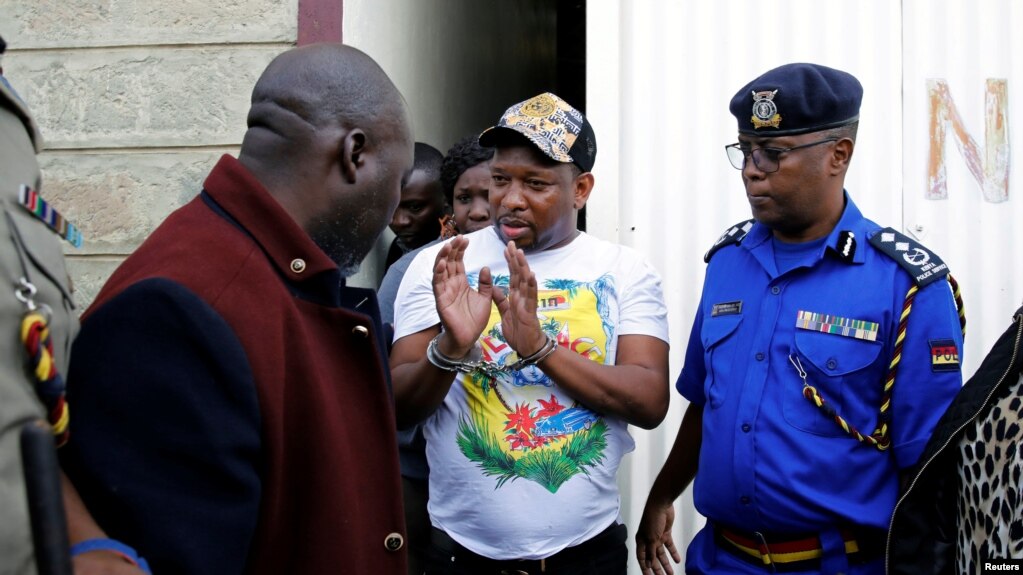

Nairobi's Governor Mike Sonko is escorted by police officers after his arrest, at airport in Nairobi, Kenya. (File)
Share

The United States has announced the designation of former Nairobi Governor Mike Sonko for involvement in significant corruption, including bribes and kickbacks.

The United States has announced the designation of former Nairobi Governor Mike Sonko for involvement in significant corruption, including bribes and kickbacks. State Department Spokesperson Ned Price said in a statement the illicit gains were in exchange for Sonko’s awarding government contracts to his associates. “His actions undermined the rule of law and the public’s faith in Kenya’s democratic institutions and public processes,” Spokesperson Price wrote.

Sonko’s immediate family members, including his wife, Primrose Mbuvi, daughters Saumu Mbuvi, and Salma Mbuvi were also designated, along with Sonko’s minor child. The designations were made under Section 7031(c) of the Department of State, Foreign Operation and Related Programs Appropriations Act, 2021 and render Sonko and his immediate family as ineligible for entry into the United States.

As the most recent State Department Human Rights report on Kenya maintains, serious acts of corruption remain a significant problem, as is “impunity at all levels of government.” Mike Sonko was charged with various corruption crimes in 2019 and removed as Governor of Nairobi in 2020 for gross misconduct and abuse of office. He has yet to stand trial.

According to Transparency International, Kenya ranks 128 out of 180 countries in the world for corruption, and “Kenyans are still frustrated by the slow turn of the wheels of justice as corruption cases have dragged in the courts.”

President Joe Biden has made countering corruption a core component of U.S. foreign policy. The White House made clear why. “Corruption is a cancer within the
the body of societies – a disease that eats at public trust and the ability of governments to deliver for their citizens,” said the White House in a statement. “It exacerbates social, political and economic inequality and polarization…[It] degrades the business environment and economic opportunity; drives conflict and undermines faith in government. Those that abuse positions of power for private gain steal not just material wealth, but human dignity and welfare.”

As Spokesperson Price said, the designations of former Nairobi governor Mike Sonko and his immediate family “reaffirm the commitment of the United States to combatting corruption and supporting the rule of law while strengthening democratic institutions in Kenya. We will continue to use all available tools to promote accountability for corrupt actors in this region and globally.”
OPINION
Evacuations: Sometimes the real disaster is what happens after


Jane McAdam
Scientia Professor of Law
 Director of Kaldor Centre for International Refugee Law at UNSW Sydney

March 22, 2022 — 

The devastation caused by the recent floods in NSW and Queensland may seem a world away from the violent conflict in Ukraine, but there is a common element: the displacement of people from their homes.

In the past three weeks, more than three million people have fled Ukraine; close to two million more are displaced inside the country. Meanwhile, on Australia’s east coast, thousands of people have been left homeless as a result of the floods.


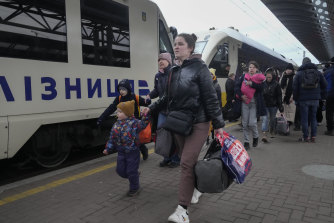
Parents accompany children and teenagers as they board a train after leaving Kyiv’s Central Children’s Hospital, following its evacuation.CREDIT:AP PHOTO

In such situations, evacuations can be a life-saving tool. Russia and Ukraine have agreed to create humanitarian corridors to enable civilians to be evacuated to safety. Whole towns in NSW and Queensland were ordered to evacuate as floodwaters rose. Though two very different contexts, the objective of evacuation is the same: to save lives and avert further harm.

Evacuations are now a major component of national and local disaster risk reduction strategies, and figures suggest that this has resulted in fewer lives being lost. In conflict, humanitarian evacuations are a life-saving measure for people facing an immediate threat of harm. Rescuing countries may initiate evacuation flights, and safe humanitarian corridors, agreed to by parties to a conflict, can enable civilians to leave as safely as possible.

In all cases, evacuations are envisaged as a temporary measure, with return home usually the ultimate goal. But far too often, situations do not resolve as anticipated. This is particularly concerning given that there were eight million evacuations from disasters globally in 2019 – a figure set to increase with the impacts of climate change.

If thought is not given to what comes next, then prolonged displacement – with its attendant economic, social and psychological impacts – may ensue. For instance, during the Second World War, 3500 British women and children were evacuated from Hong Kong to Australia, where they found themselves simply “dumped”.

Indeed, without careful planning, organisation and oversight, evacuations can themselves displace people and create other risks, including risks to life. There is mounting evidence that significant numbers of people end up displaced for long periods of time. Two years after the Australia’s 2019-20 bushfires, for instance, some people are still living in caravans, waiting to rebuild.

“People can’t move forward – they keep facing obstacles, red tape thrown up, lack of trades”, said one bushfire relief volunteer. Commonly, as the urgency of the crisis recedes, so does public awareness of their plight. In practical terms, this may mean that there insufficient support for those who are displaced, and a lack of accountability among government authorities.
Advertisement

Furthermore, even if evacuations are carried out with the best of intentions, governments must still ensure that people’s human rights are safeguarded. In Australia, current domestic frameworks pay insufficient attention to this issue. While Australian law safeguards the right to life in the emergency phase, it is otherwise silent on evacuees’ protection needs.


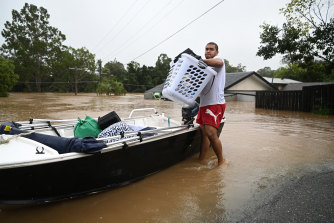
A man carries his belongings as people evacuate homes inundated by floodwater at Goodna in Brisbane’s west.
CREDIT:GETTY

In a different context, there are myriad historical examples of long-term evacuations of children who were “rescued” then adopted out, with little regard for their right to family life (eg. British “child rescue” schemes in the 19-20th centuries; the Kindertransport in the Second World War, and Operation Babylift from Vietnam in 1975). If evacuations are seen as an end in themselves, human rights violations may be glossed over or obscured.

Despite the widespread use of evacuations in multiple contexts, there is little comparative analysis of their implementation or legal bases – a gap that my own research is starting to address.

RELATED ARTICLE

Updated
Russia-Ukraine war
Civilians flee Mariupol, Putin’s forces fire on Kyiv

Evacuations encompass an array of measures ranging across diverse international law sub-fields, including refugee law, human rights law, disaster law, humanitarian law, international criminal law, trafficking, inter-country adoption and consular protection. This wide scope means that multiple government departments and international agencies are engaged, yet typically lack co-ordination, despite common objectives and challenges.

As events in Afghanistan last year showed, evacuations can create serious security and protection concerns – both for evacuees, and for those left behind.

It is therefore imperative that protection principles, derived from international refugee, human rights and humanitarian law, are incorporated into the conception, planning and implementation of evacuations to help safeguard against such risks.

Nigerian journalist Agba Jalingo acquitted of all charges 30 months after arrest

 
 CrossRiverWatch journalist Agba Jalingo (right) is seen exiting the federal high court in Calabar, Nigeria. The court recently acquitted Jalingo on all charges. 
(CrossRiverWatch/Jonathan Abang-Ugbal)

New York, March 21, 2022 — In response to news reports that a federal court on Monday acquitted Nigerian journalist Agba Jalingo on all charges, including anti-state and defamation, the Committee to Protect Journalists issued the following statement:

“Today’s acquittal of journalist Agba Jalingo on trumped-up charges is welcome, but he should never have been arrested, detained for nearly six months, and prosecuted for his work in the first place,” said Angela Quintal, CPJ’s Africa program coordinator. “Nigerian authorities should compensate Jalingo for his mistreatment, in compliance with a 2021 regional court decision, and ensure that journalism is not criminalized and the media can report freely.”

Jalingo was arrested on August 22, 2019, and charged for his writing and social media posts about Cross River state Governor Benedict Ayade, according to CPJ documentation and media reports. “At every point in time, I knew I was innocent,” Jalingo, publisher of the privately owned news website CrossRiverWatch, told CPJ by phone. “I have always known this day will come.”

In July 2021, the ECOWAS Court of Justice, a West African regional court, ordered the Nigerian government to compensate Jalingo for his prolonged detention and mistreatment in custody, according to media reports and CPJ calls for compliance. As of Monday, Jalingo has not been paid, he told CPJ.

What is deforestation? Deforestation causes, why it's bad and links to climate change and global warming


As the International Day of Forests rolls around again for another year, here’s what deforestation is and why its causes are more important to take note of than ever
© What is deforestation? Deforestation causes, why it's bad and links to climate change and global war...


Liv McMahon 
THE SCOTSMAN

Marked every year since 2012, the United Nations (UN) International Day of Forests theme for 2022 is "forests and sustainable production and consumption.”

As fears over the future of the planet continue to grow, scientists warn that deforestation, and the rise of its causes, is helping to exacerbate the worst effects of climate change.

© There are both natural and human causes of deforestation, with forest fires known to clear entire ar...
Read more: Climate change: UN's IPCC climate report is 'direst' warning yet on mankind's path to destruction of the planet

According to the UN, the world had lost a net area of 178 million hectares of forest between 1990 and 2020 – an area approximately the size of Libya.

And with forests home to roughly 80% of the world’s terrestrial biodiversity and more than 60,000 tree species, sustaining them has perhaps never been so important.

Here’s what deforestation is, what causes it and its role in climate change.

What is deforestation?


Deforestation is the term used to describe the intentional clearing of forests through human or natural means.

The process has typically been used to clear woodland and forests to make way for grazing areas for livestock or for urbanisation and the expansion of housing developments.

But deforestation can also occur naturally through events such as forest fires, which can burst into life and rage across dry forests and landscapes during times of extreme heat, drought or lightning.

However, further causes and purposes for deforestation emerged and accelerated in the latter half of the 20th century with the growth of mining and logging – with the percentage of the world’s publicly owned forest environments declining since 1990.

While the rate of deforestation has reportedly slowed in recent years, some highly valuable areas of forest and rainforest, such as the Amazon, have seen deforestation continue apace.

As global leaders attended COP26 in Glasgow in November 2021 and pledged to put an end to deforestation by 2030, a report by Brazilian space research agency Inpe measured a 22% increase in deforestation in the Amazon between 2020 and 2021.

What are the causes of deforestation?

One of the biggest causes of deforestation is the expansion of agricultural production in order to provide more space for lucrative crops and allow livestock to graze.

In the Amazon and other areas of dense rainforest, habitats have been felled and large areas of forest cleared in order to allow space for palm oil production.

Further causes also include mining, illegal logging and wood extraction, and urbanisation – with many areas of forests cleared to provide space for growing populations and infrastructure.
Read more: Scotland's global carbon footprint increasing, latest figures show

How is deforestation linked to climate change and global warming?

The impact of deforestation on the planet and its longevity has alarmed scientists and climate experts for decades, with forests forming a key part of ensuring the earth’s survival by absorbing both carbon dioxide and greenhouse gases.

But when forests and trees are cleared or burnt, the carbon they store can be released back into the atmosphere as carbon dioxide – which a reduced amount of trees and forests will struggle to absorb while carbon dioxide production grows.

This will only increase the greenhouse gas effect and process of global warming, which is in turn speeding up climate change.

The World Resources Institute has previously determined that the contribution of deforestation in tropical countries would see it ranked third behind China and the United States for its carbon-dioxide emissions.

Australia: Extreme Heat Threatens Lives

Photo Essay Highlights Urgent Need for Reduced Emissions, Heat Management Plans


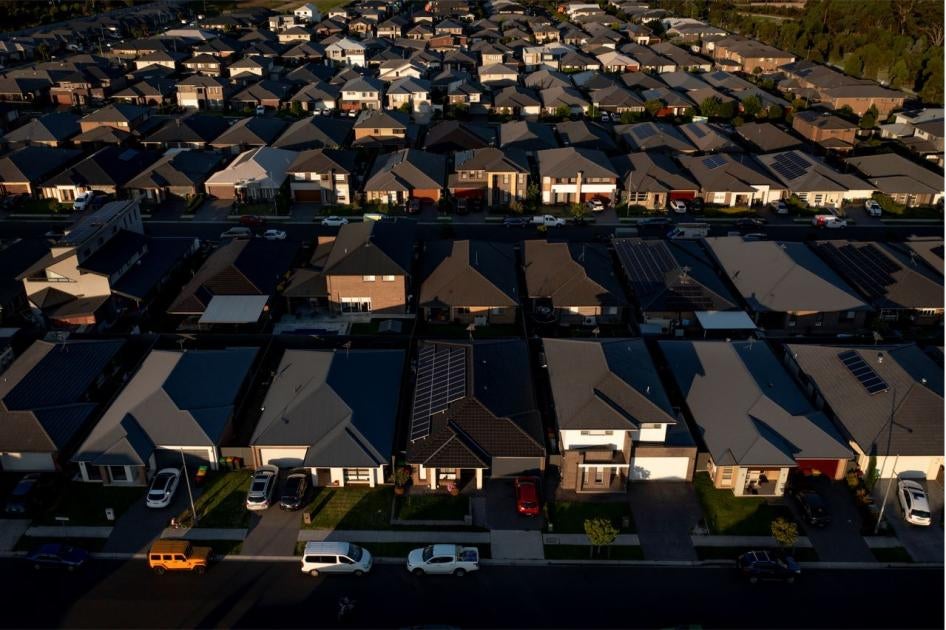
Denham Court Housing Estate in Western Sydney. Housing estates with homes crammed close together capture and store heat that radiates from one neighbor to the next. January 28, 2022. 
© 2022 Matthew Abbott for Human Rights Watch

(Sydney) – Australian local, state, and federal governments should act to protect their populations from the foreseeable harms of heatwaves exacerbated by climate change, Human Rights Watch said today in a new photo essay on the struggles of living with extreme heat.

The photographs show life in Greater Western Sydney, where geography and flawed urban design exacerbate climate change-driven heat, providing an alarming insight into what the future may hold and why urgent government action is needed.

“Australians are paying the price of government inaction on climate. Our leaders are not taking the critical steps needed to reduce carbon emissions and help prevent the most catastrophic climate outcomes, including an increase in extreme heatwaves,” said Sophie McNeill, Australia researcher at Human Rights Watch. “Local and state governments need to develop heatwave mitigation and emergency response plans, ensure the public is informed of imminent risks, and provide access to cool environments.”

Heatwaves have caused more deaths in Australia in the past 200 years than any other natural hazard. Those most at risk of heat stress are children, older people, pregnant people, and people with disabilities. Extreme heat can also exacerbate existing health conditions and chronic illnesses including diabetes, kidney disease, and heart disease.

The latest Intergovernmental Panel on Climate Change (IPCC) report predicts significant climate-related health impacts for people in Australia if urgent action is not taken to reduce emissions, including excess heat-related deaths in Australian cities quadrupling between 2031 and 2080 compared with 1971-2020.

Extreme weather events, which are intensifying in Australia due to climate change, have disrupted the lives of millions of Australians this summer. Parts of Western Australia have experienced their hottest summer on record, while towns and cities in southeast Queensland, northern New South Wales, and in Sydney flooded under record levels of rain, resulting in the deaths of 22 people and the destruction of thousands of homes.

“The Australian government should rapidly reduce emissions, stop subsidizing fossil fuels, and increase its support for clean, renewable energy,” McNeill said. “The government has a human rights obligation to prevent foreseeable climate harms, of which this summer’s extreme heat and flooding is a sign of things to come.”

Saudi Arabia and China: New best friends?

The Middle Eastern nation is making overtures to China that threaten to upend its long-running relationship with the United States. How serious is the rift?


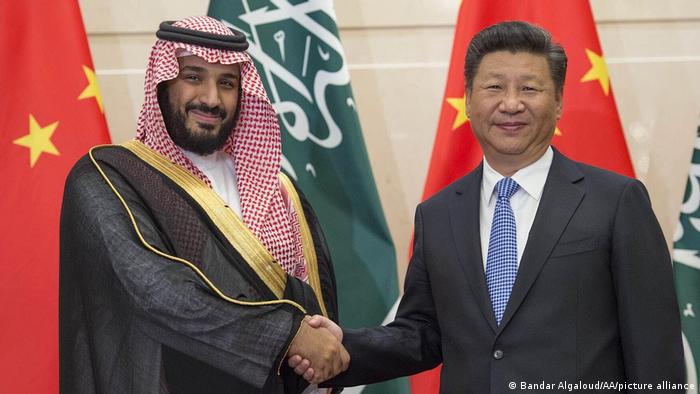
Chinese President Xi Jinping (right) could soon be making a trip to Saudi Arabia

Following a report by the The Wall Street Journal that Chinese leader Xi Jinping could accept an invitation to visit Saudi Arabia as soon as May, the world's largest oil producer also said it might allow China to pay for its oil in its own currency, the yuan, rather than US dollars.

Saudi Arabia sells around a quarter of all its oil exports to China. In the first two months of this year, it overtook Russia as the country sending the most oil there.

Amid geopolitical tensions surrounding Russia's ongoing invasion of Ukraine, and as the world lines up on either side of the conflict, the news has sparked fears that Saudi Arabia could end up on Russia's side.

Allowing oil payments in yuan could help create a parallel system for international payments where the Chinese yuan becomes as important as the US dollar. This, in turn, would help Russia bypass sanctions, as the invading nation might then also use yuan. Publicly, China has remained neutral in the conflict, but is widely suspected of being quietly supportive of Russia.

Will the Saudis really allow yuan payments?

The announcement by the Saudi leadership has mostly been seen as a way of putting pressure on their Western allies, experts said.

In fact, as the European Council of Foreign Relations, or ECFR, wrote in a 2019 policy brief called China's Great Game in the Middle East, the Saudis have done this before.

China is often used as a "bargaining chip," the ECFR analysts pointed out.

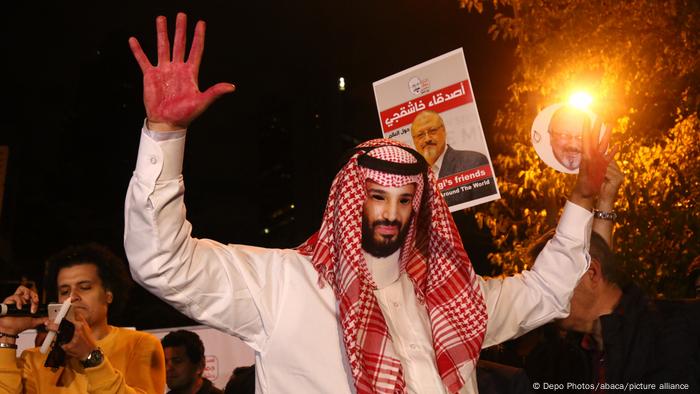
"For instance," they wrote, "only a few months after the killing of Saudi journalist Jamal Khashoggi, Saudi Crown Prince Mohammed bin Salman appeared to use his tour of Asia to affect debates in the US and European countries on arms sales to his country."


Saudi Arabia faced international condemnation over the brutal murder of Jamal Khashoggi in 2018

What about pressure on Saudi Arabia?

There have been attempts by the US and Europe to shore up Saudi support. American security adviser Brett McGurk traveled to the Gulf state last week, as did UK Prime Minister Boris Johnson.

Up until now, though, US and European officials have tried and failed to get Saudi Arabia to pump more oil , in an effort to alleviate oil prices. Along with the United Arab Emirates, Saudi Arabia is one of the only oil producing countries with spare capacity. If more oil was on the global market, this might help relieve oil prices, which have risen to record-breaking highs thanks to disruptions in oil supply from Russia.

It was not reported as to whether the recent talks with Saudi officials involved oil payments in yuan.

But, "even if Western diplomacy did succeed in bringing these countries on board, their [Saudi officials] worry is that the Middle East is destined to become less — not more — important," Cinzia Bianco, a visiting fellow at the Berlin office of the European Council on Foreign Relations, told DW, referring to the US pivot toward the Asia-Pacific region and away from fossil fuel.


British Prime Minister Boris Johnson (left) paid his respects to the Saudi crown prince last week

"They [the Gulf states] believe Washington has less to offer and less to threaten than it once did," Bianco, an expert on the Gulf region, explained further in a briefing published last week.

"Gulf monarchies' refusal to side with the US and Europe against Russia is not about Russia. It is about navigating the new multipolar world order, taking a transactional approach to protecting national interests," she wrote.

How is China involved?

This is where China comes into it. Ties between Saudi Arabia and China have been deepening for several years already. In 2020, Saudi Arabia was China's largest trading partner in the region, with imports and exports worth over $67 billion (€60.6 billion).

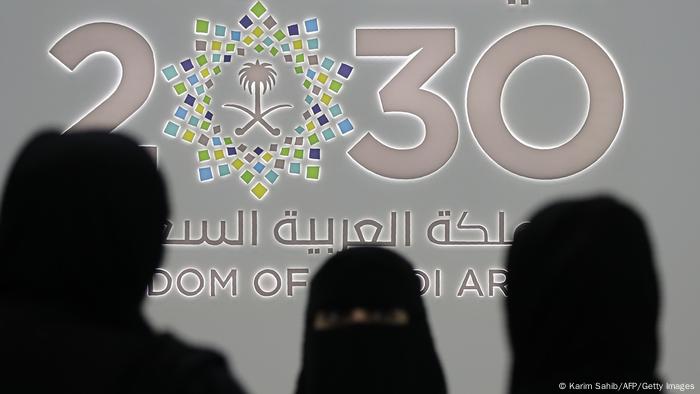
Mostly, these ties have been based on a mutually beneficial economic relationship, one that highlights synergies between China's trillion-dollar, trade-boosting Belt and Road Initiative and Saudi Arabia's own modernization project, Vision 2030.

There are obvious advantages to dealing with a country that will be a long-term buyer of gas and oil, while European customers are increasingly looking into solar and wind power.

Part of Vision 2030 is about preparing Saudi Arabia for a future when oil is less important, and one aspect is to boost Saudi Arabia's potential as a logistics hub in the Middle East. The Belt and Road Initiative fits into this, and China and Saudi Arabia have what is known as a "comprehensive strategic partnership" — although experts like Bianco caution against calling the two nations "allies."

Some analysts have recently suggested that a new era is beginning in Chinese-Middle East relations.

In January, Roie Yellinek, a non-resident scholar at the Washington-based Middle East Institute, observed that a number of foreign ministers from the region had traveled to China that month.


Vision 2030 has liberalized some parts of Saudi life but other aspects, such as in human rights, remain unchanged

"The fact that it was foreign ministers travelling to China, rather than their counterparts with the ministries of trade or economy, suggests a shift in focus," Yellinek argued in an article on the institute's website. "After years of economic-oriented ties … recent events have made it clear that a new era has begun with a greater focus on geopolitics."

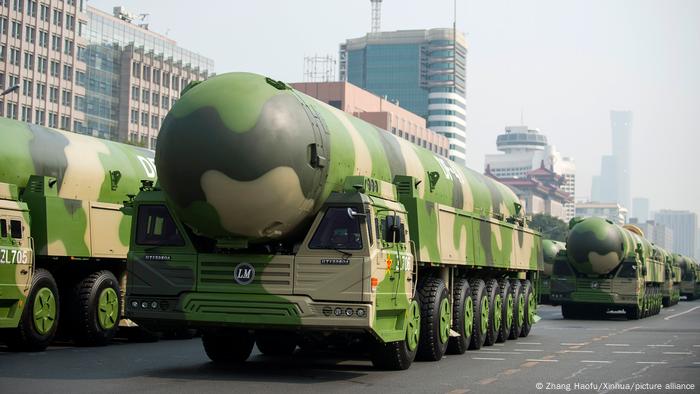
This includes a growing military component to the China-Saudi relationship. Between 2016 and 2020, Chinese arms transfers to Saudi Arabia increased 386%, according to the German Institute for International and Security Affairs in a February research paper.

First China sold ballistic missiles to the Saudis, then it began to assist them with their production inside Saudi Arabia.

Also worth noting: The Chinese will deal with leaders the Americans won't. As analysts at the ECFR explained in their 2019 policy briefing, "the Chinese model of authoritarian capitalism already fascinates many Middle Eastern regimes, which see cooperation with China as a means to resist Western pressure to pursue governance reforms and human rights accountability."


China maintains the largest and most diverse missile arsenal in the world

Is this the end for the US dollar?

The Saudis first suggested the Chinese pay for their oil in yuan about four years ago. But even if this happens, there is unlikely to be any impact on foreign exchange markets in the short, and even medium, term, economic experts have said. Most oil is priced in dollars and it would be a long, complicated process to disengage from that.

Analysts have also pointed out that even if all Saudi and Chinese trade was paid for in yuan, this would only equal around $320 million (€289 million) per working day. Meanwhile all trade in US dollars around the world is equal to roughly $6.6 trillion (€6 trillion) every working day.

In the long term, though, there are fears that a parallel global system of foreign currency exchange could eventually emerge, using China's yuan as an alternative currency. India is reportedly also considering using the yuan for oil purchases from Russia, to avoid international sanctions.

This is seen by some analysts as a way for China to guard against a day when it might potentially become a victim of Western sanctions, the way Russia is being sanctioned now.

SOHR: Commander says some Syrian veterans are ready to fight Ukraine

Some Syrian paramilitary fighters say they are ready to deploy to Ukraine to fight in support of their ally Russia but have not yet received instructions to go, two of their commanders reported.

Nabil Abdallah, a commander in the paramilitary National Defense Forces (NDF), said he was ready to use expertise in urban combat gained during the Syrian war to aid Russia, speaking by phone from the Syrian town of Suqaylabiyah.

“Once we get instructions from the Syrian and Russian leadership, we will fight this righteous war,” Abdallah said on March 14, four days after Russian President Vladimir Putin gave a green light for 16,000 volunteers from the Middle East to deploy in Ukraine.

“We don’t fear this war and are ready for it once instructions come to go and join. We will show them what they never saw… We will wage street wars and (apply) tactics we acquired during our battles that defeated the terrorists in Syria,” he added.

The Kremlin referred requests for comment to the Russian Defense Ministry. The ministry did not respond to a request for comment on whether Russia intended to issue instructions for NDF fighters to deploy or whether any NDF fighters had been recruited so far.

No response was received to to questions sent to the Syrian information ministry and the army via the information ministry on whether Syria intended to issue instructions for NDF fighters to deploy or whether any NDF fighters had been recruited so far.

Syria is Russia’s closest ally in the Middle East, and Moscow’s intervention in the Syrian war in 2015 proved decisive in helping President Bashar Assad defeat rebel forces in enclaves across much of the country.

The NDF emerged from pro-Assad militias early in the Syrian war and fought in offensives that captured some of the rebel held enclaves, with Russian air support.

Now largely demobilized, the NDF numbers in the tens of thousands, experts on Syria say, a potentially large pool of recruits for Russia if the Ukraine war drags on.

‘A just war’

A second NDF commander, Simon Wakeel from the nearby town of Mharda, also said “a lot of our people want to enlist to join our Russian brothers (and) allies, but we have not received any instructions from the leadership.”

“We are auxiliary forces that fought alongside the army and with our Russian allies. We crushed the terrorists who waged the war in Syria,” added Wakeel, who has been decorated by Russia and whose Facebook page includes images of church gatherings, men in military fatigues, and Assad.

On March 11, Putin told a meeting of Russia’s Security Council that if people from the Middle East wanted to come to Ukraine of their own accord, and not for money, then Russia should help them “get to the conflict zone.”

Putin’s remarks came after Ukraine announced on March 3 that more than 16,000 foreigners had volunteered to fight on its side against Russia. Ukraine has established an “international legion” for people from abroad.

In Washington, U.S. Marine Gen. Frank McKenzie, head of Central Command, which oversees U.S. forces in the Middle East, told a Senate hearing on March 15 the numbers of Syrians trying to head to Ukraine appeared to be a “trickle.”

“We believe that out of Syria there are perhaps small, small — very small — groups of people trying to make their way to Ukraine,” he said. “Right now it’s a very small, trickle.”

Two senior regional officials with close ties to the Syrian government and three sources close to the Syrian army have said that Russia has been seeking to tap Syrians with combat experience for Ukraine.

The effort is being run out of a Russian air base at Hmeimein in Syria’s Latakia province, they said, speaking on the condition of anonymity due to the sensitivity of the matter.

The Russian defense ministry did not respond to questions on whether the sources’ accounts were accurate, on who was conducting the recruitment, or how it was progressing. The Syrian information ministry did not respond to requests for the government’s assessment of the Russian recruitment drive.

Ukrainian military intelligence said 150 mercenaries were sent from Russia’s Hmeimein air base in Syria to Russia on March 15 to take part in military actions against Ukraine, the Chief Directorate of Intelligence of the Ministry of Defense of Ukraine said in response to questions.

It said more than 30 fighters had returned to Hmeimein from Russia “after being wounded in fighting with Ukrainian defenders.”

Ukrainian military intelligence said the recruits had been promised they would be used strictly in a policing role to maintain order in occupied territories, but recently information has begun to circulate among mercenaries about taking part directly in military actions against the Ukrainian army.

The Russian defense ministry and the Syrian information ministry didn’t comment on the account from Ukrainian intelligence.

‘The worst decision’

In a video released on March 11, Ukrainian President Volodymyr Zelenskyy said Ukraine had “information that Russian forces are bringing in mercenaries from different countries,” warning “anyone who tries to join forces with the occupier in our Ukrainian lands — this will be the worst decision of your life.”

The senior regional officials said the salary on offer to an ordinary recruit was around $1,000 a month, some 30 times more than a Syrian soldier’s pay. Experienced fighters could get $2,000.

The Syrian Observatory for Human Rights, a U.K.-based organization that reports on Syria using sources on all sides of the conflict, said a monthly salary of €1,000 ($1,105) is on offer, along with compensation of €7,000 for the wounded and €15,000 paid to the families of fighters who die. It cited Syrian military sources for the information.

No contracts had been issued, it said.

When asked about reports of money being offered or paid to go to Ukraine, NDF commander Wakeel denied this and said “we are volunteers in a righteous case.”

The compensation details reported by the Observatory and the regional officials have not been independently verified.

At the March 11 meeting of the Russian Security Council, Defense Minister Sergei Shoigu said the volunteers from the Middle East were ready to fight alongside Russian-backed forces in the breakaway Donbass region of eastern Ukraine.

“Many of them we know — they helped in the struggle with (Islamic State) in the most difficult time, in the past 10 years,” said Shoigu, in an apparent reference to the Syria conflict.

Source: BaduNews

SCAB Staff replacing sacked P&O Ferries workers face ‘poverty pay’, union claims

ALAN JONES, PA INDUSTRIAL CORRESPONDENT
20 March 2022

New crew on P&O ships will be paid at rates well below the minimum wage, a union has claimed amid continued anger over the sacking of 800 workers by the ferry giant.

The Rail, Maritime and Transport union (RMT) said it had discovered another “shocking twist” to the scandal because replacement crews on P&O ships will be on “poverty pay”.

More demonstrations will be held in the next few days, with growing pressure on the company to reverse its decision and the Government to take action.

The RMT said P&O ships on the Liverpool-Dublin route have now been crewed with Filipino ratings on contracts which pay below the minimum wage.

Shipping companies which are registered in other countries and operating routes from UK ports to Europe can pay below the minimum wage because they are exempt from legislation.

RMT general secretary Mick Lynch said: “The weakness in UK employment law has not only allowed the mass dismissing of UK seafarers it has also incentivised this barbaric behaviour because employers know there may be no effective sanction to stop them doing so, and on top of that they can get away with paying below the minimum wage.

“P&O may pay more than the minimum wage at first to agency staff but they will eventually move to rates below this simply because there is nothing to stop them from doing so.

“We fear poverty pay will be accompanied by seafarers being chained to 12-hour day, seven-day week contracts that operate continuously for six months, with no pension.”

The union has called for a boycott of P&O services and is urging the Government to look at legal options to reinstate the sacked workers.

Mr Lynch added: “We need new employment legislation to protect UK seafarers. The reason P&O have not been able to sack seafarers on Dutch and French contracts is because they have far stronger national employment laws.”

A demonstration will be held outside Parliament on Monday and at the P&O ferry terminal in Cairnryan, southern Scotland, on Wednesday.

Ahead of the Parliament protest, a demonstration will also be held outside the London offices of P&O owners, DP World.

TUC general secretary Frances O’Grady said: “There was no attempt to challenge P&O on these unconscionable tactics or even question whether these actions were legal.

To view this content, you'll need to update your privacy settings.Please click here to do so.

“Ministers, from the Prime Minister down, have serious questions to answer.

“This a national scandal. It has to be a catalyst for change on workers’ rights.

“It’s time for the Government to urgently bring forward an employment Bill to stop workers from being treated like disposable labour and make sure what happened at P&O never happens again.

“P&O has acted appallingly. The company must immediate reinstate all sacked staff with no loss of pay.”

A spokesperson for P&O Ferries said: “We know that for our staff this redundancy came without warning or prior consultation, and we fully understand that this has caused distress for them and their families.

“We took this difficult decision as a last resort and only after full consideration of all other options, but, ultimately, we concluded that the business wouldn’t survive without fundamentally changed crewing arrangements, which in turn would inevitably result in redundancies.

“We also took the view, in good faith, that reaching agreement on the way forward would be impossible and, against this background, that the process itself would be highly disruptive, not just for the business but for UK trade and tourism.

Protests have already been staged at P&O offices and ports, with more planned (PA)

“We have offered enhanced severance terms to those affected to properly and promptly compensate them for the lack of warning and consultation.

“The changes we’ve made bring us into line with standard industry practice.

“All affected crew who were working (at the time) were notified face-to-face and in-person on board their vessels.

“For crew who were off, P&O Ferries made all efforts to notify them personally: they were individually called on the phone, as well as via email and text.

“Virtual meetings were also held but only 261 of our 800 affected staff were on those calls.

“To try to minimise disruption for our customers, we contacted everyone we could reach.

“If any passengers have any queries about travelling with us, we encourage them to get in touch with our customer services team.

“The teams escorting the seafarers off our vessels were totally professional in handling this difficult task with all appropriate sensitivity.

“Contrary to rumours, none of our people wore balaclavas nor were they directed to use handcuffs nor force.”

UK government faces emergency vote on P&O Ferries sackings

Sixty Irish workers among the 800 summarily dismissed by Dubai-owned shipping group


Britain’s Labour party will force an emergency vote in the UK parliament on Monday over the sacking of 800 P&O Ferries workers. Photograph: Sam Boal / RollingNews.ie.


Britain’s Labour party will force an emergency vote in the UK parliament on Monday over the sacking of 800 P&O Ferries workers. The party will demand that the Government takes action to outlaw the so-called fire and rehire of staff.

Labour said weekend reports suggest the British government was made aware of the sackings before they were announced, and of the plan to use “exploitative” practices to take on cheaper employees.

At least 60 employees who lost their jobs when P&O Ferries sacked them on Thursday are from Ireland, their trade union has stated. Maritime union, Nautilus International, estimated that 25 workers from the Republic and 35 from the North are among the 800 who were dismissed without notice on Thursday.

Nautilus official Mickey Smyth said most work on the European Causeway vessel which sails between Larne and Cairnryan in Scotland.

The union says it feels the actions of P&O Ferries copied the example of Irish Ferries which in 2005 sacked 543 workers back in 2005 and replaced them with cheaper foreign workers.

Tánaiste Leo Varadkar said such a mass sacking would not happen under current Irish/EU law as there is a transfer of undertakings in Ireland which means new workers have to get the same terms and conditions as the old ones.

Minimum wage

The RailMaritime and Transport union has claimed that replacement crews are being paid less than the minimum wage.

Shadow transport secretary Louise Haigh has described the sackings as “a line in the sand” ahead of a vote in parliament demanding the government outlaws fire and rehire, strengthens workers’ rights, and takes action to force the company to think again.

Labour will call on the government to suspend contracts with P&O owners DP World until the matter is resolved and remove it from its transport advisory group.

Ms Haigh said: “Labour will fight every step of the way for the jobs and livelihoods of these loyal workers.

“This scandalous action must be a line in the sand. If P&O Ferries can get away with this, it will give the green light to other exploitative employers.

“It is the consequence of the Tory assault on workers’ rights.

A Department for Transport spokesperson said: “Ministers and officials have expressed their outrage and frustration at P&O Ferries on their decision and handling of their announcement, and are closely considering the department’s relationship with the company.

Government review

“The transport secretary has instructed a total examination of any contract in place with P&O Ferries and DP World across government, and the department is working closely with unions, the department for work and pensions and industry bodies to ensure that workers are supported and signposted to the most relevant support.

“We have serious concerns that their handling may not have followed the correct and legal processes, and strongly urge P&O Ferries to pause the changes announced, and speak with workers to repair the damage caused.”

Union representatives are also set to brief a Stormont committee on its plans to launch a legal challenge against ferry giant P&O after the sacking of the 800 workers.

The ferry operator, bought by Dubai-based logistics giant DP World in 2019, has insisted the decision to cut jobs was “very difficult but necessary” as it was “not a viable business” in its current state. The move has been met with concern in Northern Ireland and across the UK.

P&O Ferries, which transports passengers and freight, operates four routes: Dover to CalaisHull to Rotterdam; Liverpool to Dublin; and Cairnryan to Larne. It has 2,200 employees remaining in the UK and began operating ferries in the 1960s. – PA


CRIMINAL CAPITALI$M 
P&O Ferries’ owner to benefit from at least £50m of UK freeport scheme

Dubai-based DP World runs shipping terminals at Southampton and London Gateway

   
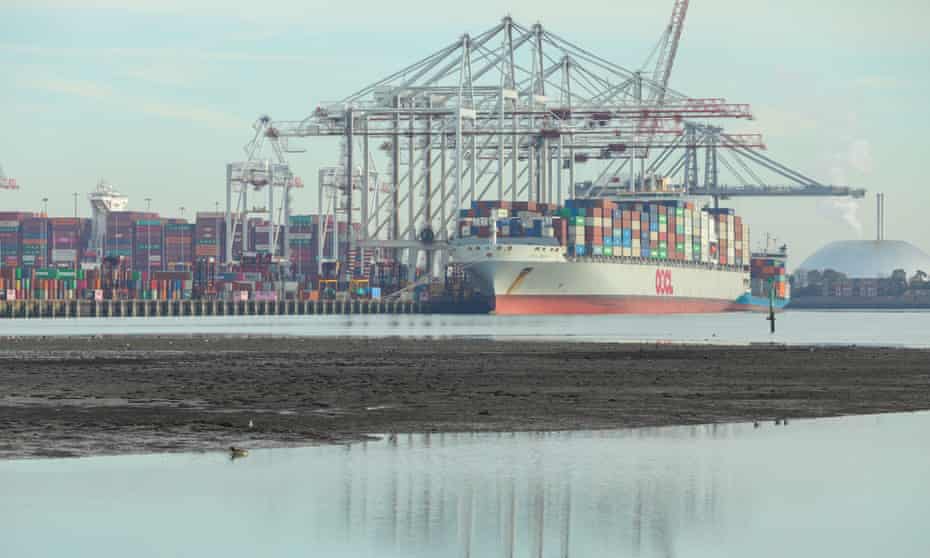
Shipping containers and a ship at Southampton port.   
 Photograph: Xinhua/REX/Shutterstock

Richard Partington and Gwyn Topham
THE GUARDIAN
Mon 21 Mar 2022 

The Dubai-based owner of P&O Ferries is set to benefit from at least £50m of UK taxpayer support as part of the government’s freeport programme, raising questions over its role in the scheme after the sacking of 800 workers.

DP World, the Emirati logistics giant behind P&O, runs the UK’s second and third-biggest shipping terminals at Southampton and London Gateway – locations among the first 12 freeports in the UK to be picked by the government last year as a flagship part of its levelling up agenda.

Under the plans, each site will receive £25m of seed capital funding from the public purse to upgrade infrastructure, as part of the scheme championed by the chancellor, Rishi Sunak. Each location also benefits from tax breaks designed to encourage business investment, economic growth and job creation, with an upfront cost to taxpayers’ worth £500m over five years for all 12 freeports.

However, trade union leaders and opposition MPs questioned whether DP World should play a role in the programme after the sacking without notice of 800 P&O seafarers last week.


Mick Lynch, the general secretary of the RMT trade union, said: “It’s beyond belief that a company which has treated British workers in such a brutal and callous fashion could still be in the frame for a £50m windfall from the British taxpayer. The government should be banning and sanctioning this bunch of corporate oligarchs in the strongest possible fashion until they reinstate the sacked workforce.”


Under the freeport programme in Scotland and Wales, operators are required to demonstrate plans for high quality employment and fair work practices – including the payment of the real living wage, as part of measures imposed by the devolved governments.

However, the UK government did not pursue similar rules for English freeports, leading to criticisms of the scheme. The government insists UK employment laws apply across the country, including in freeports.

“People are horrified with what they’ve seen at P&O,” said Andy McDonald, the Labour MP for Middlesbrough who counts the Teesside freeport within his constituency. “There’s no conditionality about this whatsoever [at freeports]. It guarantees corporate profit. It’s corporate welfare on an industrial scale.”

The former shadow employment rights secretary said the government needed to reconsider who it does business with.

“All they [freeport operators] want is to extract value out of freeports and it’s not going to make a jot of difference to poverty, health, life expectancy or anything else. They’re going to take the money and run,” he said.

As well as the benefits accruing from the freeports, DP World is set for significant UK government support for its African expansion plans.

The UK will be the minority partner in a joint venture in three African ports – in Senegal, Egypt and Somaliland – that will be run by DP World, with an initial $320m (£242m) investment – the largest single investment that the UK’s investment arm has ever made.

The sovereign wealth fund – known as CDC Group, shortly to be renamed British International Investments or BII – said last October it would be investing up to a further $400m in DP World ports and logistics operations in Africa.

BII told the Financial Times last year that it had “a shared vision with DP World … Our investment allows them to stretch their dollar further, to do more”.

A spokesperson for BII said the ports were “three of about 170 different businesses in which DP World has an interest. They are entirely separate, both operationally and financially, from the P&O Ferries business.”

Last autumn DP World’s chair and chief executive, Sultan Ahmed Bin Sulayem, announced a £300m investment in its London Gateway port at an event marking the commercial launch of the Thames freeport. DP World is also investing £40m at the port of Southampton.

With posed photographs alongside the chancellor, Rishi Sunak, and the transport secretary, Grant Shapps, at the Savoy hotel in London, Bin Sulayem said the firm planned to be “at the heart of Britain’s trading future” and that its investment would boost economic growth, jobs and living standards. Sunak said at the time he was “thrilled” with the investment.

A government spokesperson said: “The government has been clear that we are appalled by the way P&O have behaved towards their employees and Department for Transport ministers have raised this directly with P&O company chiefs.

“We are working urgently to establish the facts of what has happened in this case, and whether P&O or DP World are in breach of any of the requirements on them as partners in the Thames and Solent freeports.”

A spokesperson for DP World in the UK said: “Our operation at DP World Southampton will not directly receive any public funds as part of Solent freeport.

“The £11m of infrastructure funding, for which we have applied at DP World London Gateway should be seen alongside the £300m we are investing in a new fourth berth at the site, and the further £1bn which has been earmarked for investment in the UK over the next 10 years.”