Sunday, November 13, 2022

Corruption exposed: US meddled in Ecuador’s election, using Julian Assange as bargaining chip

A former minister of Ecuador testified that the US government conspired with a right-wing political party to run a disinformation campaign against the leftist Correísta movement, backing a millionaire banker for president in exchange for giving up journalist Julian Assange, who had asylum in the Ecuadorian embassy.


By Ben Norton
Nov 10, 2022
Ecuador's former President Rafael Correa, journalist Julian Assange, ex energy minister Carlos Pareja Yannuzzelli, and current President Guillermo Lasso (from left to right)


Ecuador’s former energy minister testified that the US government conspired with a right-wing political party to run a disinformation campaign against the leftist Correísta movement of ex President Rafael Correa.

He said that US “federal agents” pledged to help “influence” the 2017 presidential elections and support the candidacy of conservative millionaire banker Guillermo Lasso in exchange for the promise to turn over journalist Julian Assange, who had been given asylum by Correa and was stuck living for years in Ecuador’s embassy in London.


The former energy minister, Carlos Pareja Yannuzzelli, had fled a corruption investigation in Ecuador and was living as a fugitive from justice in the United States in late 2016 when he was offered large sums of money and US government protection in return for reading a carefully prepared “script” that made false accusations of corruption against Correa and his Vice President Jorge Glas, who was later imprisoned on highly dubious charges.

Pareja testified that the federal agents also coerced him into making false accusations against a US citizen, so they could justify their involvement in the Ecuadorian case. This led to the US citizen being arrested and imprisoned for three-and-a-half years.

Lasso ended up losing the 2017 election (before going on to win the 2021 election), but his victorious opponent, Lenín Moreno, later betrayed Assange anyway, letting British authorities raid the embassy, imprison the WikiLeaks journalist, and prepare to extradite him to the United States.


Ecuador’s former energy minister, Carlos Pareja Yannuzzelli, in 2016

The revelation of this extraordinary example of Washington meddling in another country’s election came from one of the top officials in Ecuador’s oil industry.

Carlos Pareja Yannuzzelli had served as head of the state-owned oil company Petroecuador, and later became Correa’s minister of hydrocarbons.

In 2016, Pareja was named in the Panama Papers leak of offshore bank accounts, and he was forced to step down as energy minister. In 2017, he was sentenced to several years in prison on charges that he used his position in the state oil industry to enrich himself and his friends.

The name Carlos Pareja Yannuzzelli has become practically synonymous with corruption in Ecuador, so much so that he is commonly referred to as “Capaya” (an abbreviation of his name).

On November 9, 2022, Correa published on Twitter a written testimony that Pareja had provided from prison in May 2019. The affidavit, which is signed by Pareja and includes his thumbprint, exposes the scandalous US government-backed plot to meddle in Ecuador’s 2017 presidential elections to hurt the left wing.


US intelligence-linked right-wing Ecuadorian politician uses corrupt US asset to accuse Correa of corruption

Rafael Correa shared the scandalous 2019 testimony in response to evidence-free accusations of corruption that Pareja Yannuzzelli made against the former president in a politicized hearing organized by the National Assembly’s auditing committee on November 9, 2022.

This committee is run by Fernando Villavicencio, a notorious right-wing Ecuadorian political operative who is closely linked to US intelligence agencies.

Today Villavicencio is a member of the National Assembly, but he first made his name as a high-profile opposition activist during Correa’s two presidential terms from 2007 to 2017.

Villavicencio was a key figure in the lawfare (judicial warfare) campaign against Correa. He ran a viciously anti-Correísta media outlet, which – with funding from the US government – consistently spread thinly sourced rumors of corruption about the leftist president.

In 2010, Villavicencio even played an important role in a failed coup attempt against Correa.

Villavicencio enjoyed a brief moment in the limelight in 2018, when he collaborated with British newspaper The Guardian in co-authoring a highly dubious smear piece against Julian Assange.

WikiLeaks adamantly insisted the article was false and created a legal fund to sue The Guardian.

In the tweet below, Villavicencio (on the right, with the glasses) boasts of working with The Guardian reporters Luke Harding and Dan Collins on the allegedly fake story:

By sharing Pareja’s incriminating 2019 affidavit on Twitter, Correa was highlighting Villavicencio’s hand behind the November 9, 2022 hearing, which clearly aimed to demonize the leftist former president and disparage Correísmo, which still remains the most popular political movement in Ecuador.
Ecuador’s ex energy minister details US-backed campaign to help the right wing in the 2017 elections

The devastating May 2019 affidavit demonstrates that Carlos Pareja Yannuzzelli (Capaya), who is still in prison on corruption charges, is a hired gun who will happily spread false claims to undermine Correísmo.

Capaya became a household name in Ecuador back in 2016, when he was serving as minister of hydrocarbons. In April of that year, international media outlets published the Panama Papers, a massive leak of information about offshore bank accounts.

Pareja Yannuzzelli’s name appeared in the Panama Papers, setting off a scandal in Ecuador. Correa was still president at the time, and in May, Capaya was forced to resign and was replaced with a new energy minister.

The Correa government immediately began investigating Capaya’s web of corruption, and found his family had stashed millions of dollars in bank accounts in Panama.

Yet while he was being investigated, Capaya managed to flee Ecuador in September.

Capaya opened his testimony noting that, by December 2016, he “was in the United States in a complicated situation.”

While in Miami, Florida, the Ecuadorian fugitive from justice was contacted by César Monge Ortega, the president of the right-wing political party CREO.

Ecuador’s current president, the conservative multimillionaire banker Guillermo Lasso, is a leader of CREO. Monge was one of Lasso’s closest allies, referred to in the Ecuadorian media as “the right hand of Guillermo Lasso.” He served as the president’s minister of government until Monge died from cancer in July 2021.


Ecuador’s minister of government and former CREO leader, César Monge Ortega, before his death in May 2021

Back in 2016, Monge asked Capaya to join a smear campaign against the presidential candidate who would represent the leftist Alianza País party in the upcoming 2017 elections, Correa’s former Vice President Lenín Moreno.

“He offered me an important sum of money and federal North American protection,” Capaya wrote.

At the time it was widely assumed, even by Correa himself, that Moreno would continue his socialist political program.

Moreno did run on a left-wing presidential campaign, but after entering office, he did a political 180. Moreno turned hard to the right, repressing, imprisoning, and exiling Correísta politicians.

He also stabbed Julian Assange in the back, reversing Correa’s pledge to protect the WikiLeaks publisher and renouncing the Ecuadorian citizenship that had been given to the journalist. In order to arrest Assange, Moreno even let British authorities violate his own country’s sovereignty by storming the embassy, which constitutes Ecuadorian territory under the Vienna Convention in international law.

Correísta politicians have alleged that Moreno was bribed and/or blackmailed by the US government, as he obediently fulfilled all of Washington’s foreign-policy goals, collaborating closely with the Donald Trump administration, removing Ecuador from the Bolivarian Alliance (ALBA) and Union of South American Nations (UNASUR), and even recognizing US-appointed coup leader Juan Guaidó in Venezuela.
Few people would have expected back during Ecuador’s presidential election in 2017 that Moreno would go on to govern like this. The country’s right-wing opposition was concerned that Lenín Moreno (who, after all, was named after the Russian revolutionary) would continue Correa’s leftist program.

So in December 2016, César Monge Ortega, the leader of Lasso’s right-wing CREO party, tried to recruit Carlos Pareja Yannuzzelli (Capaya) for the disinformation campaign against Correa, Moreno, and their Alianza País party.

Capaya wrote in his 2019 testimony that he initially declined the offer, but that Monge was persistent.

“Monge insisted to me that I could contact North American federal agents that were working with CREO for a long time, and they would provide me with protection and stability in the United States,” Capaya said.

“He assured me that the American Democratic Party was committed to backing Lasso’s presidential candidacy in exchange for Julian Assange, to expose his link with the current president of the United States,” Capaya continued.

This comment suggests that Democratic Party leadership had been convinced that US President Donald Trump was somehow connected to Assange, a baseless conspiracy theory that was fueled by Fernando Villavicencio’s extremely questionable report in The Guardian.

Capaya went on: “Finally, one day Monge visited me with [US] federal agents and together they guaranteed me protection in the United States in exchange for my participation in the smear campaign against Alianza País in order to influence the presidential elections in Ecuador in 2017.”


Ecuador’s current president, Guillermo Lasso

Capaya said that, after this in-person meeting with the US federal agents, he accepted their offer.

His role was to make outlandish accusations Correa (who was still president at the time), his government, and his party.

“They gave me a script created and prepared by Fernando Villavicencio, who according to Monge had been contracted by the party CREO,” Capaya said.

He continued: “They told me that in order for there to be an agreement, I had to follow the script to a T. To this end, we met various times in Miami between December 2016 and January 2017. These videos subsequently were made public on social media after February 2017.”

Capaya stressed that “a big part of the script” was dedicated to accusing Correa and his other Vice President Jorge Glas of corruption.

“They made me name third parties that I don’t know,” Capaya recalled. He wrote that the US “federal agents” heavily pressured him to name people such as Frank Roberto Chatburn Ripalda, a Miami-based financial advisor with dual US and Ecuadorian citizenship.

“Despite that I told them on more than one occasion that I never had any relation with him and that he was not being investigated or processed in Ecuador, they expressly told me that in order for there to be an agreement it was required to mention Chatburn, because he had US nationality and with that the federal agents could justify their participation and initiate actions against him in the United States,” Capaya said.

The US Justice Department subsequently charged Chatburn with money laundering and imprisoned him for three-and-a-half years.

Chatburn was not the only one who ended up burned by Washington.

Capaya concluded his testimony lamenting that Monge, his CREO party, and the US federal agents later abandoned him when Moreno won the presidential election.

They failed to fulfill their side of the promise. Capaya was later captured in Ecuador, and put behind bars, where he remains today.

Corrupt Ecuadorian official conspired with Miami-based oligarchs who stole millions from their people

Yet the scandal goes even deeper. Monge was not the only right-wing opposition figures whom Capaya was conspiring with.

As a fugitive from justice living in Miami in late 2016 and early 2017, Capaya also met with right-wing multimillionaire bankers from Ecuador’s notorious Isaías family.

The Isaías Brothers, William and Roberto, are ferociously anti-Correa oligarchs who fled their country of birth and moved to the United States, with millions of dollars of stolen money, during Ecuador’s economic crash of 1998 and 1999.

This massive crisis, known as the infamous “feriado bancario,” bankrupted millions of working-class Ecuadorians, depleting their savings by devaluing the national currency, the sucre, with runaway hyperinflation.

The banker who helped cause this meltdown had been affectionately known as Ecuador’s “super minister of the economy,” and had been lauded by the international financial press: none other than Guillermo Lasso, an ardent neoliberal Chicago Boy who now serves as president.

Lasso and his banker friends, who had held their illicit wealth in dollars, became millionaires thanks to the feriado bancario. Meanwhile, the sucre became so worthless that Ecuador surrendered its monetary sovereignty and adopted the US dollar as its official currency. This remains the case today.

From Miami, the Isaías Brothers have also used their stolen money to fund the campaigns of US politicians – both Republicans and Democrats – including Senators Marco Rubio and Bob Menendez, Congresswoman Ileana Ros-Lehtinen, and even former President Barack Obama.
IMF warns of ‘wave of debt crises’ coming in Global South, with war, interest rate hikes, overvalued dollar

The IMF said a “wave of debt crises” may be coming in the Global South, and “the global economy is headed for stormy waters,” due to war, rising US interest rates, and many currencies depreciating against the dollar.


By Ben Norton


The International Monetary Fund (IMF) has said a “wave of debt crises” may be coming in the Global South, and “the global economy is headed for stormy waters,” as the world faces a “geopolitical realignment” that will be “permanent.”

The US-dominated financial institution warned “the worst is yet to come,” as the depreciation of most currencies against the dollar and rising interest rates make it hard for both governments and companies to service their dollar-denominated debt.

The director of the IMF’s research department, Pierre‑Olivier Gourinchas, made these comments in a press briefing on October 11.

Countries comprising a third of the entire global economy are expected to contract in 2022 or 2023, he prognosticated.

“In short, the worst is yet to come; and for many people, 2023 will feel like a recession,” he said.

Gourinchas explained that “the energy crisis, especially in Europe, is not a transitory shock. The geopolitical realignment of energy supplies in the wake of the war is both broad and permanent.”

Furthermore, the rallying of the US dollar against most other currencies could fuel a global economic crisis, he warned.

“The strength of the dollar is also a major challenge. The dollar is now at its strongest since the early 2000s, mostly against advanced economies but also against emerging markets,” the top IMF researcher said.

He advised Global South nations to conserve “valuable foreign exchange reserves for when financial conditions really worsen,” cautioning, “as the global economy is headed for stormy waters, now is the time for emerging market policymakers to batten down the hatches.”

“Too many low‑income countries are close to or are already in debt distress. Progress toward orderly debt restructuring,” he said, “is urgently needed to avert a wave of sovereign debt crises. Time may soon run out.”

He acknowledged, “there is, effectively, a serious issue of debt restructuring that is needed for a number of especially low‑income countries.”

With the significant appreciation of the US dollar against many currencies, someone at the press conference asked the director of the IMF’s research department, “is it necessary or possible for us to have another Plaza Accord sometime down the road?”

The 1985 Plaza Accord was an agreement between the United States, Britain, France, Germany, and Japan to depreciate the dollar against their currencies. This led to an overvalued Japanese yen, fueling an asset bubble that popped in the 1990s. Japan’s economy has never really recovered from this crisis.


Gourinchas responded to the question stating:

The strength of the dollar is certainly putting a lot of strain on a number of countries. I mean, it works through two channels.

One, it is making the price of imported goods, which often are invoiced in dollars, higher. So that is increasing inflation pressures in other countries.

And then it is also tightening financial conditions. A lot of corporates or governments have dollar debt, and that becomes more expensive to service as the dollar appreciates.

Explaining why the dollar is rallying so much, Gourinchas identified the “fundamental forces” as Fed interest rates and the “energy crisis.”

“It is really the fact that the Federal Reserve has increased interest rates quite aggressively in 2022 so far — is expected to do more — compared to other countries,” he said.

“And it is also reflecting the energy crisis, that a lot of energy importers are impoverished by the high price of energy, and that is reflected in a weaker currency for them,” he added.

In the same press conference, the division chief of the IMF research department, Daniel Leigh, noted that, in Africa, “the higher interest rates, low growth means that two‑thirds of the countries in the region are facing stress or debt distress.”

Leigh warned that they must “avoid the debt crisis from spreading.”

The mainstream financial press has been sounding similar alarm bells.

A market analyst for Reuters, John Kemp, wrote that the “risks to other economies from inflation and rising interest rates in the core have been understood by policymakers and investors for decades.”

He added, “But as long as the Fed’s mandate requires it to focus exclusively on domestic inflation and employment, ignoring international spillovers, and the dollar remains the main reserve currency, rising rates in the United States will continue triggering instability elsewhere.”
Geopolitical economist Radhika Desai argues today is not like the Volcker shock of the 1980s

Multipolarista editor Ben Norton discussed the comments made in this IMF press conference with geopolitical economist Radhika Desai.

She argued the global economic and political situation today is not like the “Volcker Shock” of the 1980s, when persistent stagflation in the United States led Federal Reserve chair Paul Volcker to substantially raise interest rates, resulting in a highly overvalued dollar.

“I think we are a very long way away from a 1980s-style crisis,” Desai said.

“Some countries will definitely face a a financial crises,” she argued, but “the situation is very different, and the context is very different.”

In the Volcker shock, Fed interest rates went to nearly 20%, Desai pointed out, but today many economists do not expect it to surpass 5%.

Desai also stressed that, despite interest rate hikes up to roughly 4% as of November 2022, the real Fed rate is still technically negative, because inflation is larger than the federal funds rate.


“We are not there. And the reason that can be summed up in a single word… financialization,” she said.

“When Paul Volcker did what he did, he didn’t have to worry about the huge mountain of debt, and speculative asset markets, and so on, which were all reliant on a long regime of low interest rates,” Desai argued.

She also noted that today’s Fed interest rate still “remain short of the peak that they reached in the early 2000s, the peak at which they burst the housing and mortgage credit bubbles.”

Current Federal Reserve chair Jerome Powell knows that “he cannot take interest rates above a certain amount, because it would bring the entire [financial] house of cards crashing down,” Desai said.

She argued:


The Federal Reserve always uses inflation rates and unemployment rates to justify its policy decisions as though it is making policy in the interest of ordinary Americans, and even the world.

But in reality, the main thing that the Federal Reserve, in a long string of chair people of the Federal Reserve, going back to at least Alan Greenspan, what they have been primarily concerned about is the vast quantity of elite wealth that rests on said house of cards.

They will not bring it down, because who pays the piper calls the tune.

And we extol it [the Fed] as an “independent” central bank. In reality, it is only independent of ordinary people’s interests. It is completely dependent on the elites. And so they are not going to do anything to destabilize elite wealth.

And already we are seeing the Federal Reserve basically making noises about how they cannot allow interest rates to go very high.

Desai continued:

There will probably be a lot of debt crises, because some countries are far more vulnerable than others. But in this context we will also see something else.

We will see increasing contestations between the Western world and China, where the Western world will constantly accuse China of being responsible for the developing countries’ debt crisis. And there will be a tug of war between the Western powers in China, as to, if there is a debt crisis, who will be paid back first.

So we are going to see all of these shenanigans. But underlying all of them, what we will also see is increasingly a move away, for all the countries which can do it, will try to move away from borrowing from what Michael Hudson and I have called the dollar creditocracy.

Because it is precisely this dollar creditocracy which is subject to such volatility, that you cannot borrow with any security that you will be paying back only what you agreed to pay back, rather than some insane amounts, simply because the Federal Reserve decides to raise interest rates, or simply because speculators decide to leave your currency and your country and go somewhere else.

So the world needs a more secure financial system. And for the last 70 years and more, the world has been prevented from having the international financial system it really needs, that would really promote development, because the United States has wanted to impose its own will and its own currency on the rest of the world.


Is it time to bring back COVID-19 mask rules? Provinces lag, but chances of infection 'really high right now,' experts say

Abhya Adlakha
·Editor, Yahoo News Canada
November 2, 2022·

In the wake of a new COVID-19 surge and a shocking flu season, many are wondering and debating whether it is time to bring back mask mandates. However, misinformation online and the lack of a coordinated public health response has left people confused about the right course of action.

Alberta’s Premier Danielle Smith said last week that she will not permit any further masking mandates of children in schools following a court ruling on the government’s decision to drop and block those mandates.

Despite a recent Canada-wide surge in respiratory viruses, flu, and COVID-19, Smith said that masking has a “detrimental effect” on the mental health of children.


"The detrimental effects of masking on the mental health, development and education of children in classroom settings is well understood, and we must turn the page on what has been an extremely difficult time for children, along with their parents and teachers."

But many public health experts in provinces such as Ontario and British Columbia are still maintaining their position that masking in indoor spaces with huge crowds provides vital protection from COVID-19.

What the experts and provinces are saying

The former head of Ontario’s COVID-19 science advisory, Dr. Fahad Razak, recently said that it’s time to bring back mask mandates as Ontario is seeing a surge in the new BQ.1 and BQ1.1 Omicron subvariants in the province.


Dr. Razak, an internist at St. Michael’s Hospital, also said that the health system is under immense strain that’s normally seen at the peak of a bad flu season.

“Personally, I would say that the criteria to require something like a mask mandate is clearly here,” said Razak, an internist at St. Michael's Hospital.

“For anyone who says, 'Let's not do that,' I would ask, 'What is the alternative at this point? How do we keep the system that has so little capacity, how do we get it to continue to run over the winter?”


Ontario health staffing crisis goes beyond nurses, doctors, says union

There's a staffing crisis for all health professionals — not just nurses and doctors — in Ontario, says Sara Labelle, chair of the hospital professionals division of the Ontario Public Service Employees Union.

According to UofT Associate Professor Dr. Tara Moriarty, the Canadian COVID Hazard Index released last Friday shows that traces of COVID in wastewater across Canada has increased nearly three-fold in the last two weeks.

Moriarty says this data shows that the number of people in Canada infected currently is 18 times higher than people infected last year at the same time.

"It means that about 1 in every 24 to 1 in every 34 people in Canada are currently infected," she said.


"This is why it's so important not just to wear masks, but also to avoid crowded indoor settings....for everyone. Your chances of picking up COVID are really high right now," she writes in her latest tweet. "Also, even if you're not worried about catching COVID yourself, about half of people in Canada are medically at higher risk from COVID, due to age or underlying health conditions. Or they live with someone who is," she added

University of Toronto Associate Professor and an expert in paediatrics and expert diseases Anna Banerji agrees that due to the high cases of respiratory viruses and hospitals being overwhelmed, it would be the right course of action to bring masks back.

"Yes, definitely yes," she wrote in an email to Yahoo News Canada.

All experts unanimously agree that masking combined with bivalent booster shots can help bring the cases down and relieve the pressure on hospitals.

Public health advisory on the official on the City of Toronto website also advised that staying up to vaccines and wearing a high quality, well-fitted mask can decrease the spread of COVID-19 and the flu.

'Respiratory Spread Guide' notice sent by the city:

We can layer our protection against COVID-19 and respiratory viruses with some simple steps:

Stay up-to-date with your vaccinations including a fall COVID-19 booster and flu vaccine when eligible for the best protection against getting very sick from COVID-19 and influenza.

Socialize outdoors when possible – outdoors is lower risk than indoors.

Wear a high quality, well-fitting mask, especially indoors, and based on the setting and situation. Masks are strongly recommended in indoor public settings, and especially if you are around people who are at higher risk or have a health condition.

Stay home if you are sick or have symptoms, even if they are mild.

If you have symptoms, get tested for COVID-19 and treatment if you are eligible.

Wash or sanitize your hands often, etc.

The Ontario healthcare system under immense pressure

According to latest reports, emergency rooms across the province have had to close for hours due to pressure. Doctors believe that the recent increase in COVID-19 admissions and flu admissions have created the "perfect storm" in hospitals—with wait times up to 20 hours or more.

According to the official Health Canada website, more than 21,000 cases of COVID-19 were reported last week across the country.

The Canada COVID Hazard Index also states around 7,000 people were admitted to hospitals with COVID in the last week across Canada. The data shows that in an already-overwhelmed system, 12 per cent of hospital beds are unavailable due to COVID-19 patients.

Moriarty also pointed out that although we hear COVID is getting better, the statistics say otherwise.

"COVID hospitalizations last week were 6,962. However, the average weekly COVID hospitalizations in Canada since COVID started has been 3,032. This data clearly shows that there were twice the number of COVID hospitalizations this week in Canada than there have been during all of the epidemic in Canada to date," she said.

"Even if you draw the distinction between patients who got admitted who had COVID already (the "with" cases) and patients who got admitted because of COVID (the "from" cases), we still get a number that is 1.7 times higher than what we've seen before," she adds.


Leaked report shows Ontario emergency room wait times are worsening


The Ford government is facing new questions about the state of Ontario’s health care system after a leaked report shows emergency room wait times are worsening, leaving more people being treated in the hallways of provincial hospitals. Colin D’Mello reports

Many ER's are reporting high patient volumes and long wait times, with children's hospitals in particular reporting high demand.

University of Toronto professor and epidemiologist Dr. David Fisman recently posted a memo sent out by McMaster Children's Hospital (MCH) on Twitter.


The memo clearly states that inpatient occupancy is nearing 135 per cent and that the critical care and emergency department are facing "extreme challenges".

As a result, MCH is adopting various mitigation measures—effective Nov. 4—such as reducing the number of pedriatric surgical same-day admits to only one case per day.

The hospital is asking for volunteers across all MCH programs to assist teams at the hospital and they're looking into examining the transfer of youth and adolescents to other hospitals under Hamilton Health Sciences (HHS).

Two days ago, Fisman released another crucial UHN memo on Twitter that mentioned that the Toronto General Hospital is under Critical Care Bed Alert, which means that the CVICU, CICU, and MSICU have all reached their total bed capacity.

The memo also mentioned that the hospital has limited people to safely keep all the physical critical care beds open and running.

UHN told its staff to "avoid" accepting admissions from another hospitals that require a critical bed and to stop sending patients to the emergency department.


Recently, officials with CHEO, eastern Ontario's children's hospital in Ottawa, painted a stark picture of its emergency room as they said the last few months have been the busiest in the hospital's history.

The hospital is functioning well over-capacity with pediatric units seeing 134 per cent occupancy while pediatric intensive care sits at 124 per cent. The emergency department averages 229 patient visits a day while it's built for 150, said CHEO President and CEO Alex Munter.

Moreover, earlier last week, Toronto's Hospital for Sick Children reported wait times of up to 12 hours due to unseasonably high patient volumes.

Experts try to raise awareness and battle misinformation online

With files from The Canadian Press
Canada’s winter forecast: It’s been 20 years since meteorologists have seen a weather pattern like this

CANADA-WEATHER/
One person shovels snow away from a vehicle while another crosses an empty street as a snowstorm arrives in Winnipeg, Manitoba, Canada April 13, 2022


A lone man walks through falling snow as a snowstorm arrives in Winnipeg, Manitoba, Canada April 13, 2022. 


A woman shovels snow from an empty street as a snowstorm enters its second day in Winnipeg, Manitoba, Canada April 14, 2022. 


Little girl looks out the window during a snow day in the winter
Cavan Images via Getty Images

Snowy mountains over field and icy roads
Jacobs Stock Photography Ltd via Getty Images

Strong Winds Caused Blizzard Like Conditions In Toronto
Strong wind gusts of 80km to 90km per hour caused blowing snow and blizzard like conditions in Toronto, Ontario, Canada, on February 19, 2022.

 (Photo by Creative Touch Imaging Ltd./NurPhoto via Getty Images)

Elisabetta Bianchini
Thu, November 3, 2022 

For the third year in a row, Canada's winter weather forecast is being dominated by the La Niña phenomenon, where some Canadians will see a stormy weather pattern, while others will likely be saving some money on their heating bill this winter, according to AccuWeather.

“Cold concentrated in the Prairies, mild in the East, stormy in the West,” Brett Anderson, senior meteorologist with AccuWeather told Yahoo Canada.

“We're looking at the third straight La Niña winter, it's been over 20 years since that's happened, so this is quite unusual to have three in a row like this. La Niña is the abnormal cooling of the surface water in the Pacific Ocean, along the equator, and when we have that, it alters the jet stream pattern across North America.”

AccuWeather's Canada Winter Forecast 2022-2023

Stormy weather in British Columbia, coldest temperatures in the Prairies


The main story for people in British Columbia this winter is to expect a stormy season in some areas of the province.

“Typically when we have a lot of La Niña, usually we have one main storm track coming in off the Pacific Ocean, typically directed into British Columbia, thus we usually predict above normal rain and snow across western Canada, particularly British Columbia,” Anderson explained. “Then what typically happens is the jet stream turns southward into the central United States, so that allows most of the cold air from the Arctic to dump southward through the Prairie region.”

“I think we're going to be dealing with numerous storms into the Canadian Rockies, even the coastal mountains of British Columbia. I think those areas are going to see a good amount of snowfall this winter, which is great for skiers and snowboarders… We are going with the idea of a colder winter across much of the Prairies and then the jet stream usually comes back up across the Great Lakes, and again the jet stream is typically the path where we see most of our storm.”


AccuWeather's Canada Winter Forecast 2022-2023

Ontario gets a break from the cold temperatures

Looking at Ontario and Quebec, a significant part of the area will see a notable amount of rain and snow, with a mix of mild temperatures.

“We are predicting above normal rain and snow for a good part of Ontario and northern Quebec this winter,” Anderson said. “I don't think it's a cold winter, I think temperatures are going to be above normal much of the winter.”

“You're going to still get some cold air, no question about it, but it's not going to be the type of cold where it's going to lock in for an extended period of time... There'll be opportunities for natural snow [but] with a lack of sustained cold and higher humidity, probably not a great season for snowmaking, but we're going to be more dependent on the natural snow.”

Anderson also identified that it is going to be a cloudier winter for the area.

“With the storm track nearby, the temperatures will be mostly above normal during the nighttime hours, because when you have more clouds, clouds act as a blanket, traps heat close to the ground,” Anderson said. "The nights are not going to be nearly as cold as what they typically can be during the wintertime."

"With more clouds during the day, daytime temperatures will probably be averaging closer normal, if not a little bit above normal, but we'll see the greatest departures certainly during the nighttime hours with more clouds expected.”


AccuWeather's Canada Winter Forecast 2022-2023

Atlantic Canada should 'keep their guard' for second half of the winter season


The AccuWeather winter forecast paints a picture that looks like Canadians in Atlantic Canada will likely save some money on their heating bills this year, but that doesn't mean snow is out of the question.

“We're going above normal temperatures across much of the East for this winter, however that doesn't mean there can't be snow," Anderson said. "Through the interior maritimes, especially later in the winter, I think they'll see their opportunities, probably mostly in February and March across Atlantic Canada.”

“That type of flow pattern with the jet coming in from the southwest, that kind of cuts off most of the Arctic invasions,...that opens the door to milder intrusions across much of eastern Canada and also Atlantic Canada.”

AccuWeather is urging Canadians in Atlantic Canada to "keep their guard up" for the second half of the winter season for possible storms.
UN climate talks reach halftime with key issues unresolved


Sat, November 12, 2022 


SHARM EL-SHEIKH, Egypt (AP) — It's half-way time at the U.N. climate talks in Egypt, with negotiators still working on draft agreements before ministers arrive next week to push for a substantial deal to fight climate change.

The two-week meeting in Sharm el-Sheikh started with strong appeals from world leaders for greater efforts to curb greenhouse gas emissions and help poor nations cope with global warming.

Scientists say the amount of greenhouse gases being pumped into the atmosphere needs to be halved by 2030 to meet the goals of the Paris climate accord. The 2015 pact set a target of ideally limiting temperature rise to 1.5 degrees Celsius (2.7 degrees Fahrenheit) by the end of the century, but left it up to countries to decide how they want to do so.

Here is a look at the main issues on the table at the COP27 talks:

WHAT ABOUT THE U.S. AND CHINA?

The top U.S. negotiator suggested that a planned meeting Monday between U.S. President Joe Biden and President Xi Jinping of China on the sideline of the Group of 20 meeting in Bali could also provide an important signal for the climate talks as they go into the home stretch.

With impacts from climate change already felt across the globe, there's been a push for rich polluters to stump up more cash to help developing countries shift to clean energy and adapt to global warming; increasingly there are also calls for compensation to pay for climate-related losses.

China is the biggest polluter by far right now, but the U.S. has the most historical pollution over time.

KEEPING COOL

A group of major emerging countries that includes oil-and-gas exporting nations has pushed back against explicit references to keeping the target of limiting global warming to under 1.5 degrees Celsius. Egypt, which is chairing the talks, convened a three-hour meeting Saturday in which the issue was raised several times.

“1.5 is a substantive issue,” said Wael Aboulmagd, a senior Egyptian negotiator, adding that it was “not just China” which had raised questions about the language used to refer to the target. Still, he was hopeful of finding a way of securing a “maximum possible advance” on reducing emissions by the meeting's close.

CUTTING EMISSIONS

Negotiators are trying to put together a mitigation program that would capture the different measures countries have committed to in order to reduce emissions, including for specific sectors like energy and transport. Many of these pledges are not formally part of the U.N. process, meaning they cannot easily be scrutinized at the annual meeting. A draft agreement circulated early Saturday had more than 200 square brackets, meaning large sections were still unresolved. Some countries want the plan to be valid only for one year, while others say a longer-term roadmap is needed. Expect fireworks in the days ahead.

US-CHINA RELATIONS

While all countries are equal at the U.N. meeting, in practice little gets done without the approval of the world's two biggest emitters, China and the United States. Beijing canceled formal dialogue on climate following Speaker Nancy Pelosi's visit to Taiwan and relations have been frosty since. U.S. climate envoy John Kerry said Saturday that he had only held informal discussions with his Chinese counterpart Xie Zhenhua lately. “I think we’re both waiting to see how things go with the G-20 and hopefully we can return,” he told reporters.

SHUNNING FOSSIL FUELS

Last year's meeting almost collapsed over a demand for the final agreement to state that coal should be phased out. In the end, countries agreed on several loopholes, and there are concerns among climate activists that negotiators from nations which are heavily dependent on fossil fuels might try to roll back previous commitments.

MONEY MATTERS

Rich countries have fallen short on a pledge to mobilize $100 billion a year by 2020 in climate financing for poor nations. This has opened up a rift of distrust that negotiators are hoping to close with fresh pledges. But needs are growing and a new, higher target needs to be set from 2025 onward.

Aminath Shauna, the environment minister of the Maldives, said her island nation conservatively estimates that it will need $8 billion for coastal adaptation. And even that may not be enough, if sea levels rise too much. “It is very disheartening to see that it may be too late for the Maldives, but we still need to address (the issue of finance),” she said.

COMPENSATION

The subject of climate compensation was once considered taboo, due to concerns from rich countries that they might be on the hook for vast sums. But intense pressure from developing countries forced the issue of “loss and damage” onto the formal agenda at the talks for the first time this year. Whether there will be a deal to promote further technical work or the creation of an actual fund remains to be seen.

John Kerry said the United States is hopeful of getting an agreement “before 2024” but suggested this might not come to pass in Egypt. But he made it clear where the U.S. red line lies for Washington: ”The United States and many other countries will not establish some ... legal structure that is a tied to compensation or liability." That doesn't mean money won't flow, eventually. But it might be branded as aid, tied into existing funds and require contributions from all major emitters if it's to pass.

MORE DONORS

One way to raise additional cash and resolve the thorny issue of polluter payment would be for those countries that have seen an economic boom in the past three decades to step up. The focus is chiefly on China, the world’s biggest emitter, but others could be asked to open their purses too.

SIDE DEALS

Last year's meeting saw a raft of agreements signed which weren't formally part of the talks. Some have also been unveiled in Egypt, though hopes for a series of announcements on Just Transition Partnerships — where developed countries help poorer nations wean themselves off fossil fuels — aren't likely to bear fruit until after COP27.

HOPE TILL THE END

Jennifer Morgan, a former head of Greenpeace who recently became Germany's climate envoy, called the talks this year “challenging.”

“But I can promise you we will be working until the very last second to ensure that we can reach an ambitious and equitable outcome,” she said. “We are reaching for the stars while keeping our feet on the ground.”

___

Follow AP’s climate and environment coverage at https://apnews.com/hub/climate-and-environment

___

Associated Press climate and environmental coverage receives support from several private foundations. See more about AP’s climate initiative here. The AP is solely responsible for all content.

Frank Jordans, The Associated Press
Unmanned, solar-powered US space plane back after 908 days

Sat, November 12, 2022 


CAPE CANAVERAL, Fla. (AP) — An unmanned U.S. military space plane landed early Saturday after spending a record 908 days in orbit for its sixth mission and conducting science experiments.

The solar-powered vehicle, which looks like a miniature space shuttle, landed at NASA’s Kennedy Space Center. Its previous mission lasted 780 days.

“Since the X-37B’s first launch in 2010, it has shattered records and provided our nation with an unrivaled capability to rapidly test and integrate new space technologies,” said Jim Chilton, a senior vice president for Boeing, its developer.

For the first time, the space plane hosted a service module that carried experiments for the Naval Research Laboratory, U.S. Air Force Academy and others. The module separated from the vehicle before de-orbiting to ensure a safe landing.

Among the experiments was a satellite dubbed the FalconSat-8 that was designed and built by academy cadets in partnership with the Air Force Research Laboratory. It was deployed in October 2021 and still remains in orbit.

Another experiment evaluated the effects of long-duration space exposure on seeds.

“This mission highlights the Space Force’s focus on collaboration in space exploration and expanding low-cost access to space for our partners, within and outside of the Department of the Air Force,” said Gen. Chance Saltzman, Chief of Space Operations.

The X-37Be has now flown over 1.3 billion miles and spent a total of 3,774 days in space.

The Associated Press


Sonic boom rips across Florida as Space Force plane X-37B returns 

OLIVIA GEORGE TAMPA BAY TIMES UPDATED NOVEMBER 13, 2022 

It was just after 5 a.m. when her house rumbled awake. Her hens squawked. Her cats scattered. Her dogs hid under the covers.

 And Nancy Planeta sat straight up in bed, wondering: What was that sound?

 People across Florida were awoken early Saturday morning to the sound of the X-37B returning to Earth after a record-breaking 908 days in orbit. 

Reports of a sonic boom were widespread, from Titusville to Tampa, as the U.S. Space Force autonomous vehicle touched down at NASA’s Kennedy Space Center in Brevard County at 5:22 a.m.

 Planeta, who is 52 and lives in northern Pasco County, scoured Facebook and local news sites for answers in an early morning haze. Garbage dumpster collection? Gunshots? Exercises at MacDill? Her father worked with the Air Force, she said, so once she had recovered from the initial shock, she was quick to recognize the boom as sonic. Her animals took longer to gather themselves. “They’re used to calm country life,” she said Sunday morning.

 In a statement, Boeing, which built the X-37B, said the craft has now flown more than 1.3 billion miles, spending 3,774 days in space while conducting experiments for the government and its partners. 

One experiment, in partnership with the U.S. Naval Research Laboratory, involved converting solar power into microwave energy. Another aimed to test the durability of certain materials exposed to space conditions to ultimately improve the precision of space environment models. 

“This mission highlights the Space Force’s focus on collaboration in space exploration and expanding low-cost access to space for our partners, within and outside of the Department of the Air Force,” U.S Space Force General and Chief of Space Operations Chance Saltzman said in a statement. 

The X-37B was developed by NASA as a test-bed for future spacecraft. Today, it is jointly operated by the Space Force and the Air Force Rapid Capabilities Office. The U.S. Space Force is thought to own two X-37B vehicles, which measure 29 feet from nose to tail, falling somewhere between a pickup truck and a school bus in length. 

The X-37B launched into orbit from Cape Canaveral Space Force Station on May 17, 2020, when Donald Trump was president — about two months after the World Heath Organization had declared COVID-19 a pandemic.

 Its sixth mission was four months longer than any previous X-37B flight. “This return further underscores the capabilities of Space Florida’s Launch and Landing Facility that are ideal for both Department of Defense and commercial missions alike,” Frank DiBello, president and CEO of Space Florida, the state’s aerospace finance and development authority, said in a statement. 

In Bithlo, located in Orange County about 30 miles west of the Kennedy Space Center, Carlos and Johana Alfonso captured the boom on their doorbell camera. “The walls shook, the glass shook, the whole house shook,” said Johana, 55. They ventured outside after being jolted awake and said a strange, sulfur-smelling fog hung in the air. 

On the Gulf Coast, Peter Anderson also woke to the strange sound rumbling through the still-dark sky. “Was I imagining it?” the 37-year-old Sarasota resident recalled thinking. Unable to fall back asleep, he said he pulled out his phone, opened Twitter and scrolled through online chatter about the X-37B. He follows space developments loosely, so had heard of the plane, but had no idea its nearly 30-month-long orbit was coming to a close. “It would be nice if we were made aware of these things,” he said

 ©2022 Tampa Bay Times. Visit tampabay.com. Distributed by Tribune Content Agency, LLC.


'The Metaverse will be our slow death': Meta employees hit out at Mark Zuckerberg in Blind reviews


Jyoti Mann
Sat, November 12, 2022 

Mark Zuckerberg apologized on Wednesday for making 11,000 job cuts.
Drew Angerer/Getty Images

Meta employees are posting negative comments about Mark Zuckerberg on anonymous forum Blind.


A software developer said Meta's CEO will "single-handedly kill" the company with the metaverse.


The reviews were posted on the day that Meta axed 13% of its workforce and on the following day.


Meta employees are taking aim at Mark Zuckerberg in employee reviews on Blind, the anonymous forum.

Some reviews, posted on Wednesday – the day Meta laid off 13% of its workforce – are negative, although others are more positive. One user likened the layoffs to the "hunger games" and another said the Facebook owner had an "uncertain future."

Insider surveyed the workplace community app, where staff can air their grievances in posts and reviews, to see what was being said about Meta and its CEO. Some 44 employee reviews of Meta were posted on Blind on Wednesday and Thursday this week.

"The Metaverse will be our slow death," one user, who called themselves a senior software developer, posted on Wednesday. They added: "Mark Zuckerberg will single-handedly kill a company with the meta-verse."

Zuckerberg apologized to staff for the need to cut 11,000 jobs, admitting that he "got this wrong".

Blind users must provide their work email email address, job title and employer when joining the platform so the company can "gauge the professional status" of posters, according to its website.

A user's employment is not officially verified, however. Blind said it occasionally sent prompts to users to "re-verify" their accounts.

Rick Chen, head of public relations at Blind, told Insider: "Nearly all of the reviews posted have been written by current employees of the respective companies at the time of writing, as people generally cannot access Blind after they are laid off or resign."

He added: "The loss of access after an employment change is not immediate."

Meta employees have posted almost 6,000 reviews of the company on Blind since 2020 and it has a rating of 4 out of 5 stars.

A self-described engineer, who gave the company five stars, listed "extremely smart and talented coworkers" as well as "great culture" in a list of "pros". Posting on the day the layoffs were made, they added that "Zuck is leading this company in the wrong direction" in their list of "cons".

A user who says they are a data scientist said Meta is in "need of layoffs in executive level," adding: "Leadership is having no clue, they mistake motion for a progress."

One person, who said they worked in talent acquisition, gave Meta a four-star rating on Wednesday. They said it was an "overall great place to experience" adding that "Mark is not afraid to take risks (which is a good and bad thing)."

A poster, who says they are a senior technical program manager, wrote on Thursday: "Poor leadership is on track to sink this ship." They went on to list "good pay" perks, benefits and talented peers as "pros". The "cons" included: "No accountability at and above Director level. VPs and Directors are here to just milk the company without adding any value."

They added: "I thought it was a data-driven company but actually it is one man's gut feeling and emotions-driven. Nobody can overwrite his decision."

Not all Meta employees share the negative view of Zuckerberg, however. One former staff member who was laid off Wednesday told Insider that they felt the CEO handled the layoffs "with humanity".

Another engineer gave the company just one star on Wednesday and described the mass cuts as the "worst layoff in history." They said: "With the layoff, I wouldn't recommend anyone to work there until the stock price fully recovers."

Meta did not respond to a request for comment from Insider.
The $24 Trillion Treasury World Suddenly Looks Less Dangerous


Liz Capo McCormick and Anchalee Worrachate
Sat, November 12, 2022 


(Bloomberg) -- The historic bond selloff has wreaked havoc across global markets all year, while fueling a crisis of confidence in everything from the 60-40 portfolio complex to the world of Big Tech investing.

Now, heading into a possible economic downturn, the near-$24 trillion Treasury market is looking less dangerous all of a sudden.

The latest US consumer price data suggest inflation may be cooling at long last, driving investors back to the asset class in droves on Thursday as traders pared bets on the Federal Reserve’s hawkishness. Another reason why this once-reliable safe haven appears safer than it has in a while: Even rising interest rates have less power to crush bond portfolios like they have over the past two years.

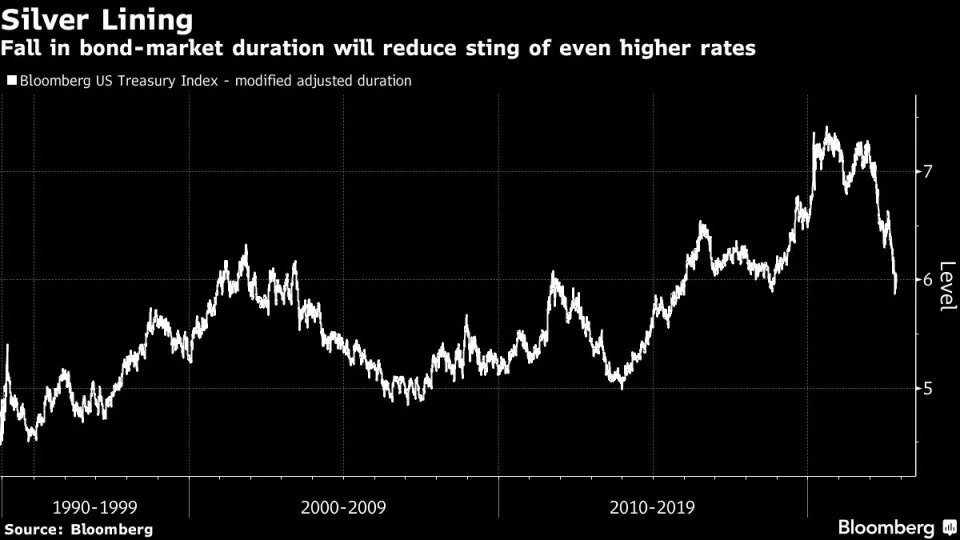
Just look at duration, which measures the sensitivity of bond prices to changes in yields. It’s a tried-and-tested gauge of risk and reward that guides all flavors of fixed-income investing -- and it’s fallen sharply this year.

With the Fed’s aggressive policy-tightening campaign this year pushing Treasury yields to around decade-highs, the margin of safety for anyone buying US debt right now has improved notably compared with the low-rate era, before the bull market collapsed in the inflationary aftermath of the pandemic.

Thanks to higher yields and coupon payments, simple bond math shows duration risk is lower, meaning a fresh selloff from here would inflict less pain for money managers. That’s a merciful prospect after two years of gut-wrenching losses on a scale largely unseen in the modern Wall Street era.

“Bonds are getting a bit less risky,” said Christian Mueller-Glissmann, head of asset allocation strategy at Goldman Sachs Group Inc., who shifted from underweight positions in bonds to neutral at the end of September. “The total volatility of bonds is likely to fall because you don’t have the same amount of duration, and that’s healthy. Net-net, bonds are becoming more investible.”

Consider the two-year Treasury note. Its yield would need to rise a whopping 233 basis points from before holders would actually incur a total-return loss over the coming year, primarily thanks to the cushion provided by beefy interest payments, according to analysis conducted by Bloomberg Intelligence strategist Ira Jersey.

With higher yields, the amount an investor is compensated for each unit of duration risk has risen. And it’s increased the bar before a further rise in yields creates a capital loss. Higher coupon payments and shorter maturities can also serve to reduce interest-rate risk.

“The simple bond math of yields going up brings duration down,” said Dave Plecha, global head of fixed income at Dimensional Fund Advisors.

And take the Sherman ratio, an alternative measure of interest-rate risk named after DoubleLine Capital Deputy Chief Investment Officer Jeffrey Sherman. On the Bloomberg USAgg Index, it’s increased from 0.25 a year ago to 0.76 today. That means it would take an 76 basis-point rise in interest rates over one year to offset the yield of a bond. A year ago it would have taken just 25 basis points -- equivalent to a single regular-sized hike from the Fed.

All told a key measure of duration on the Bloomberg US Treasury index, which tracks roughly $10 trillion, has fallen from a record 7.4 to 6.1. That’s the least since around 2019. While a 50 basis-point rise in yields inflicted a more than $350 billion loss at the end of last year, today that same hit is a more modest $300 billion.

That’s far from the all-clear, but it does reduce the downside risk for those wading back into Treasuries attracted to the income -- and the prospect that lower inflation or slowing growth will increase bond prices ahead.

After all, cooling US consumer prices for October offer hope that the biggest inflation shock in decades is easing, in what would be a welcome prospect for the US central bank when it meets next month to deliver a likely 50 basis-point increase in benchmark rates.

Two-year Treasury yields surged this month to as high as 4.8% -- the most since 2007 -- yet plunged 25 basis points Thursday on the CPI report. The 10-year note yield, which now hovers around 3.81%, up from 1.51% at the end of 2021, also slid 35 basis points over the past week, which was shortened due to Friday’s Veteran’s Day holiday.

The counterpoint is that buying bonds is far from a slam-dunk trade given the continued uncertainty over the inflation trajectory while the Fed is threatening further aggressive rate increases. But the math does suggests investors are now somewhat better compensated for the risks across the curve. That, along with the darkening economic backdrop, is giving some managers the conviction to slowly rebuild their exposures from multi-year lows.

“We’ve been covering duration underweights,” said Iain Stealey, CIO for fixed income at JPMorgan Asset Management. “I don’t think we are completely out of the woods yet, but we are definitely closer to the peak in yields. We are significantly less underweight than we were.”

And of course the recent rally suggests an asset class that’s fallen sharply out of favor over the past two years is finally turning the corner.

The defining narrative of 2023 will be “a worsening labor market, a low growth environment and moderating wages,” BMO strategist Benjamin Jeffery said on the firm’s Macro Horizons podcast. “All of that will reinforce this safe-haven dip-buying that we argue has started to materialize over the past few weeks.” 

Global debt levels rose 'substantially' in 2021 - World Bank's Malpass

Andrea Shalal
Sat, November 12, 2022

World Bank President David Malpass holds a news conference at the headquarters of the International Monetary Fund

WASHINGTON (Reuters) - Debt levels among low- and middle-income countries rose sharply in 2021, with China accounting for 66% of lending by official bilateral creditors, World Bank President David Malpass said, underscoring the need to reduce the debt of poorer countries.

The World Bank's annual report on global debt statistics, due out next month, makes clear that private sector creditors also needed to participate in debt reductions, Malpass told Reuters in an interview on Friday.

The Group of 20 major economies and the Paris Club of official creditors created a common framework for debt treatments in late 2020 to help countries weather the fallout of the COVID-19 pandemic, but its implementation has been halting.

The creditors of Chad reached the first agreement negotiated under the framework this week, but it leaves the country's longer-term debt sustainability in question because it does not include actual debt reduction, Malpass warned on Friday.

The World Bank, the International Monetary Fund and Western officials have become increasingly vocal about their frustration with China, now the world's biggest official bilateral creditor, and private sector lenders for not moving forward more quickly.

Preliminary data released by the World Bank in June showed the external debt stock of low- and middle-income countries rose, on average, 6.9% in 2021 to $9.3 trillion, outpacing the 5.3% growth seen in 2020.

Malpass said the bank's forthcoming International Debt Statistics report was troubling, but gave no specific numbers.

"It shows that the amount of debt grew substantially ... and the amount owed to China is some 66% of the total for the official bilateral creditors," he said, adding that Chinese entities were also big commercial creditors.

"The report makes clear that debt reduction needs to extend broadly to include the private sector and China," Malpass said, adding that the overall debt issue would be a big topic at the upcoming meeting of G20 leaders.

"There will be a recognition of the severity of the problem," Malpass said, although he said there had been "little uptake" of his push for an immediate freeze in debt payments when countries sought relief under the G20 common framework and other reforms aimed at speeding up debt restructuring efforts.

IMF and World Bank officials say 25% of emerging market and developing economies are in or near debt distress, and the number rises to 60% for low- and middle-income countries. Climate shocks, interest rate increases and inflation had heightened pressures on economies still recovering from COVID.

Malpass said China had been a reluctant player in the slow-moving process to date. "They're mostly an observer," he said.

Malpass also called for faster work on a debt restructuring for Zambia, which first requested help under the common framework in early 2021.

"There's an urgency to getting it done so that the debt reduction can occur and Zambia can begin attracting the new investment that's needed," he said.

For both Chad and Zambia, it was critical to speed up the process and enact real debt reductions, he said. "The longer the process goes on, the harder it is for the for the country and the people in the country to get back on their feet."

(Reporting by Andrea Shalal, Editing by Franklin Paul)