Monday, November 14, 2022

In Canada's boreal forest, one man works to save caribou

"When humans disappear from the Earth, the planet will be even more beautiful -- it will reclaim itself," he says.


Diane Desobeau and Marion Thibaut
Sun, November 13, 2022 


Even though he lives in the middle of Canada's boreal forest, Jean-Luc Kanape can sometimes go weeks without seeing a single caribou. But for as long as he can remember, the animals have been part of his life.

For centuries, "our ancestors survived thanks to the caribous -- using its meat, pelts and tools made from its bones," says Kanape, a member of the Innu Indigenous group.

"Now, it's our turn to help them."

The caribou is a symbol of the power of the subarctic boreal forest, but also the beating heart of Canada's Indigenous culture.

But the broad-snouted deer is "at risk," Kanape says, notably because of the loss of its natural habitat.

In Quebec province, the animal's future is threatened by the lumber industry, which is crucial in some areas, providing 60,000 jobs, but which also contributes to mass deforestation.


Governments "are supposed to protect all living beings in their territory" but "do nothing" for the caribous, says Kanape, who helps the community identify and tag the remaining herds.

All around the 47-year-old's cabin, located not far from the St Lawrence River but a two-hour drive from the nearest village, there is evidence of deforestation -- the once lush mass of spruces and poplars has been hacked up.

As seen from above, the woods look like a jigsaw puzzle that has been taken apart. In some areas, trees line the ground -- they will be chopped up and taken away. for the most part, they are pulped to make paper or used in construction.
- Predators -

Recent data suggests that caribous, which are called reindeer in Europe, have a better chance of survival if at least 65 percent of their living habitat is preserved.

But in this part of Canada, roughly 80 percent of their habitat has been disturbed in some way. Tree harvesting helps renew the forest, but that also brings about changes in the native flora and fauna.

Moose have arrived en masse -- which also means the animals that prey on them have arrived too, notably wolves, whose migration has been facilitated by paths cut in the wilderness by the lumber companies.

When new trees sprout up, the tiny fruit bushes that crop up alongside them also bring bears -- another hunter of caribous -- to the area.

When Kanape heads out to track caribou herds, he uses both ancestral teachings and surveillance data collected by drones.


Whether traveling by boat along the river, in his pickup truck or on foot, he scours the ground for hoof prints. Each autumn, those hoofs adapt, their edges sharpening to allow the caribous to break through the ice to get at a major food source: lichen.

In recent weeks, Kanape was tracking a female caribou and her calf, who were living in a partially deforested area -- putting them at risk.

"How can I make them understand that they'd be better off in more wooded areas?" says Kanape. "She came here because she knows the area, which is totally normal."

He sometimes chases away the wolves to give the caribous a better chance to survive through the summer.

As things stands now, a precipitous fall in the calf population of the region's caribous makes their long-term survival not very likely, experts from Quebec's forests ministry warn.

- Growth -

From the Canadian Rockies in the west to Quebec's forests in the east, the caribou has seen its territory dwindle over the last 150 years, and the population has declined -- a shift that nothing seems to reverse.

Since 2003, the caribou has been listed as a species at risk of extinction, and is one of the most studied animals in North America.

In Canada, its survival will depend on the expansion of the oil, lumber and mining industries. The country has struggled to implement viable plans to protect the species, researchers say.


Overall, experts are concerned that the fate of the caribou is a "tipping point" -- and thus that the animal should be considered an "umbrella species" worthy of protecting, so that other animals in their habitat are indirectly saved.

"Dozens of species that don't get the same attention also need ancestral forests -- it's a natural habitat that is vital for many," explains Martin-Hugues Saint-Laurent, a biologist at the University of Quebec in Rimouski.

Canada's boreal forest is home to 85 species of mammals, 130 species of fish and 300 different bird species, many of them migratory.

"The forest is not just about the trees," says Louis De Grandpre, a scientist who has been researching the issue for 30 years.

"We are just barely starting to understand the scope of what's happening under our feet in the forest subsoil, where bacteria, mushrooms and a myriad of microorganisms are all at work."


The Innu people, who believe they are just as much a part of the forest ecosystem as all other living creatures, advocate for the creation of a protected forest zone.

Kanape has a far-reaching, philosophical outlook -- the animal kingdom will ultimately triumph.

"When humans disappear from the Earth, the planet will be even more beautiful -- it will reclaim itself," he says.


The Secret Wars Of The US Imperium – OpEd


By 

To get to where they are, imperial powers will deceive, dissimulate and distort. The US imperium, that most awesome of devilish powers, has tentacled itself across the globe, often unbeknownst to its own citizens.  

In a report released by the New York University School of Law’s Brennan Center of Justice titled Secret War: How the US Uses Partnerships and Proxy Forces to Wage War Under the Radar, there is little to shock, though much to be concerned about.  The author of the report contends that the list of countries supplied by the Pentagon on US military partnerships is a savagely clipped one.  The list is so wrong that 17 countries have been omitted.

Katherine Yon Ebright, counsel in the Brennan Center’s Liberty and National Security Program, betrays a charmless naivete in remarking that the “proliferation of secret war is a relatively recent phenomenon”, something she regards as “undemocratic and dangerous”.  She is certainly right about the last two points, but distinctly wrong about the novelty.  

The United States, since its inception, has schemed, through purchase, conspiracy and force of arms, to spread its power and embrace an empire without declaring it.  Along with that embrace came the perceived need to wage secret war.

The illegal, covert engagement by US forces in Laos was one of the most brutal examples of a clandestine conflict waged unawares to many politicians back home.  It was, as the dark title of Joshua Kurlantzick’s book on the subject suggests, a great place to have war.  

It began with a Central Intelligence Agency outfit training and arming members of the Hmong ethnic minority who would, some 14 years later, partake in full scale engagements with Communist allies of the North Vietnamese.

This development was accompanied by an aerial campaign that saw more bombs dropped by the US than used by its air force in the entirety of World War II.  Between 1964 and 1973, more than 2.5 million tons of ordnance from over 580,000 bombing sorties was dropped.

US lawmakers tend to express much surprise that US forces should mysteriously appear in countries they can barely find on the map.  But to a large extent, the circumstances arose with their own connivance.  The authorising backdrop to such engagements centre on a number of instruments that have proliferated since September 11, 2001: the US Title 10 authorities, the 2001 Authorization for the Use of Military Force (AUMF), deployment notifications under the War Powers Resolution, and the souped up idea of the right to self-defence.  

Of concern here is the broad umbrella of “security cooperation” programs that are authorised by Congress under the AUMF against designated terrorist groups.  Codified as 10 U.S.C.§ 333, the provision permits the DoD to train and equip foreign forces in any part of the globe.  

Section 127e, or 10 U.S.C. §127e, stands out, as it authorises the DoD to “provide support to foreign forces, irregular forces, groups or individuals engaged in supporting or facilitating ongoing military operations by United States special operations forces to combat terrorism.”

The 2001 AUMF has become an instrument of vast elasticity, stretched by every administration since its inception to cover a list of terrorist groups that remains secret to the public.  The executive had long withheld the list from Congress, something it was bound to do given its cavalier interpretation as to what “associated forces” in the context of terrorist groups are.  

The DoD has also kept quiet on the specific circumstances US forces operate under these authorities.  As Ebright puts it, the reasoning at play is “that the incident was too minor to trigger statutory reporting requirements.” Confrontations deemed “episodic” and part and parcel of “irregular” warfare do not amount to “hostilities”.

Another accretion of secrecy, and one aided by its important premise of deniability, is the Presidential Approval and Reporting of Covert Actions, 50 U.S.C. § 3093 (1991).  Again, the 9/11 terrorist bogey has featured in targeted killings and assassinations, despite assertions to the contrary.  

Perhaps the most startling nature to such cooperation programs is the scope granted by Section 1202 of the National Defense Authorization Act of 2018.  While it mirrors Section 127e in some respects, the focus here is not on counterterrorism but supporting “irregular warfare operations” against “rogue states”.  Ebright strikes a bleak note.  “Far beyond the bounds of the war on terror, §1202 may be used to engage in low-level conflict with powerful, even nuclear, states.”

Every now and then, the veil of secrecy on such operations has been pierced.  In 2017, four members of the US Army Green Berets, along with four soldiers from Niger, were killed in an ambush outside the village of Tongo Tongo.  It was the highest loss of life for US military personnel since 1993, when 18 Army Rangers perished in the Somalian Black Hawk Down incident.

What was head shakingly odd about the whole affair was not merely the surprise shown by members of Congress by this engagement, but the nonplussed way the Joint Chiefs of Staff chairman, General Joseph Dunford, called for an investigation.  His sole objectives were to ascertain whether US forces had “adequate intelligence, equipment and training” and whether there was “a pre-mission assessment of the threat in the area” of appropriate accuracy.  Surely the more relevant question would have been what these modern kitted-up Roman legionnaires were doing without broader awareness back home?

The findings of the summary report, and those of Pentagon officials, was that militants in the area had “superior firepower”.  For every US and Nigerien soldier came three attackers.  Again, this misses the overall point about clandestine operations that even some in the upper echelons of Washington know little about. 

Despite a number of public statements claiming that the US military role in theatres such as Africa are confined to “advising and assisting” local militaries, the operational reality has occasionally intruded. 

In 2018, the now retired General Donald Bolduc, who commanded US special forces in Africa till 2017, had enough boastful candour to reveal that the army had “guys in Kenya, Chad, Cameroon, Niger [and] Tunisia who are doing the same kinds of things as the guys in Somalia, exposing themselves to the same king of danger not just on 127 echoes.  We’ve had guys wounded in all the types of missions that we do.”

Ebright recommends that mere reform of “outdated and overstretched AUMFs” will not do.  “Congress should repeal or reform the Department of Defense’s security cooperation authorities.  Until it does so, the nation will continue to be at war – without, in some cases, the consent or even knowledge of its people.”  

That’s hardly going to happen.  The security establishment in Washington and a coterie of amnesiacs are keen on keeping a lid on the fact that the US has been a garrison, warring state since 1941.  And the next big conflict is just around the corner.  Appearances must be kept. 


Binoy Kampmark
was a Commonwealth Scholar at Selwyn College, Cambridge. He lectures at RMIT University, Melbourne. Email: bkampmark@gmail.com

Sunday, November 13, 2022

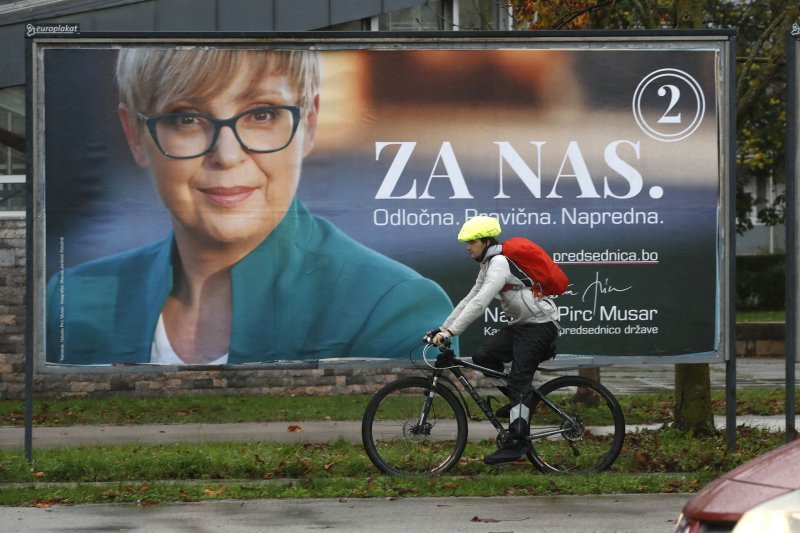
Slovenia elects first female president Nataša Pirc Musar

Musar's election is a second significant victory for the Slovenian left, following Golob's victory in April.

By Joe Fisher

A man passes near a huge pre-election poster of presidential candidate Natasa Pirc Musar in downtown Ljubljana, Slovenia, November, 10, 2022. File Photo by Antonio Bat/EPA-EFE

Nov. 13 (UPI) -- Slovenia elected its first female president Nataša Pirc Musar on Sunday following a run-off election.

Pirc Musar, a liberal lawyer and former journalist, defeated right-wing candidate Anze Logar, carrying more than 53% of the vote. She vowed to be more vocal than her predecessor, Borut Pahor, who served two five-year terms as president and was colloquially referred to as an "Instagram president."

"I have never been quiet when it was necessary to speak up, especially not in the last two years", she said in September while campaigning, according to The Guardian.

"After the last Janez Janša government took over I spoke out, because the rule of law was falling apart before our very eyes."

Janša was succeeded by Robert Golob as Prime Minister this summer. Golob is a member of the Freedom Movement, which is a socially liberal progressive party.

Both candidates ran as independents, but Logar is part of the right-wing Slovenian Democratic Party. Musar does not align with a party. She was a human rights expert serving the Council of Europe for 15 years and served as head of Slovenia's data protection authority.

The new president was a television journalist for Pop TV in Slovenia for five years. She was an attorney for Melania Trump, focusing on protecting her name and likeness from misuse while U.S. President Donald Trump was in office.

Musar's election is a second significant victory for the Slovenian left, following Golob's victory in April.
RIP
Keith Levene, founding member of the Clash, dies at 65

Innovative post-punk musician was an original member of the Clash before founding PiL with John Lydon and Jah Wobble


Keith Levene, left, with John Lydon in 1981. Photograph: Mirrorpix/Getty Images


Vanessa Thorpe and Dave Simpson
Sat 12 Nov 2022 

Keith Levene, the innovative guitarist who was a founder member of both the Clash and Public Image Ltd, has died at the age of 65.

Levene, who had liver cancer, died at his home in Norfolk , leaving a lasting legacy of influence on British rock music.

His influence on the post-punk music scene was hailed by musicians as news of his death broke. Among his fans is Red Hot Chili Peppers guitarist John Frusciante, who once described his style as “spectacular”, saying “he explored the possibilities of what you can do with the guitar”.

Forming the Clash with guitarist Mick Jones and bassist Paul Simonon when he was only 18, it was Levene, alongside the band’s manager, Bernard Rhodes, who asked Joe Strummer, frontman with the 101ers at the time, to join them. Luckily for the Clash, Strummer had just seen the Sex Pistols play at the Nashville Rooms in London and had become convinced that punk was the way forward.
Advertisement

Levene, who was born Julian Levene in Muswell Hill, north London, remained in the Clash long enough to appear in early gigs and to contribute to songs, including What’s My Name on their 1977 debut album. But he grew apart from the Clash’s increasingly political direction and went on to greater success with PiL.

When the Sex Pistols disbanded in January 1978, singer John Lydon (previously known as Johnny Rotten) and Levene formed the new band with bass player John Wardle (known as Jah Wobble). “John made a wise choice getting Keith,” Wobble said in 2012.

Their first album, Public Image: First Issue, reached No 22 in 1978 and was preceded by the classic single Public Image, which reached the Top 10. Their second album, 1979’s Metal Box, is regarded as a post-punk classic. With various drummers, the lineup took inventive new forms of post-punk, dub, freeform jazz and classical music into the Top 20.

Levene said in 2012: “People thought I was classically trained, which was bollocks. I knew the E chord, and ventured into E minor. We laid the music out on a plate for Lydon. He was very hip at the time and did really good work.” He played synthesiser on 1981’s The Flowers Of Romance, which was his last released work with PiL, but he played with Wobble again in subsequent years.
Advertisement

In 2021, the website the Quietus described him as “one of the architects of the post-punk sound, his guitar style occupying a space between angular abrasion and pop opulence”.

Levene enjoyed building guitars and had been working on a book about PiL with writer Adam Hammond. His partner, Kate Ransford, who, with his sister, Jill Bennett, and her husband were with him in his final hours, said he had died “peacefully, settled, cosy and loved”. The family have asked for privacy.

The death is the second high profile loss to rock music to have been announced in 24 hours. A spokesperson revealed on Friday that Nik Turner, the co-founder of the British space-rock band Hawkwind, had died at 82.

Announcing the death of the Oxford-born multi-instrumentalist, a statement released on social media said that “the Mighty Thunder Rider” had “passed away peacefully at home,” adding: “He has moved onto the next phase of his cosmic journey, guided by the love of his family, friends, and fans.”

When Turner was 13, his family moved to Margate, Kent, the town where he was first exposed to rock music. After a period in the merchant navy, he travelled and worked around Europe, studying the saxophone in his early 20s.

In Berlin, he was introduced to free jazz and, became convinced that self-expression in music was more important than technique. “I decided that what I wanted to do was play free jazz in a rock band. What I was trying to do in Hawkwind, basically,” he told Mojo magazine in 1999.
HOW COME WE CAN'T HAVE THIS
AUSTRALIA
NSW to launch year of free childcare

The $5.9 billion 10-year investment in universal pre-kindergarten was the centrepiece of the NSW 2022-23 budget. 
Photo: TND

Maureen Dettre12:59pm, Nov 14

A landmark program introducing universal free childcare the year before NSW children start school will be rolled out in 2023, with “childcare deserts” the first to benefit.

Premier Dominic Perrottet said families in Mount Druitt in Sydney’s west, Wagga Wagga in the Riverina, Kempsey and Nambucca in the north, Bourke in the far west, and Cobar and Coonamble the central west would be first to get on board with the program.

Early childhood services in the seven locations will begin rolling out the first stage of the universal pre-kindergarten policy early next year, with interested providers urged to register now.

The $5.9 billion 10-year investment in universal pre-kindergarten was the centrepiece of the NSW 2022-23 budget, and was touted as a way to get women back into the workforce and tackle the gender pay gap.

The government promised places would be created in Sydney’s west, south-west and regional NSW, where there is less than one childcare placement for every three children.

Mr Perrottet said more locations would be added ahead of the state-wide implementation of a full new year of education for children by 2030.

The scale of the program was unprecedented in Australia and would “benefit our youngest learners’ physical, cognitive, social and emotional development”, he said on Monday.

“This is a life-changing investment that the NSW government is delivering to ensure our children benefit from a full year of quality preschool education at no cost to parents,” Mr Perrottet said.

Education Minister Sarah Mitchell said families and services in the first stage would help shape the rollout of the initiative across the state.

“This first stage of universal pre-kindergarten will allow us to gather crucial information ahead of implementation of the program across the NSW,” Ms Mitchell said.

“We are continuing to work collaboratively with families, peak bodies, service providers and schools to develop the best model of universal pre-Kindergarten for NSW.”


Workshops for eligible providers will be held in pilot regions during November and expressions of interest will close on December 16.

– with AAP
Alan Kohler: Crypto and the end of the beginning

Will FTX’s collapse mean the end of crypto, asks Alan Kohler.

On Friday, a day after Elon Musk warned that bankruptcy was not out of the question for Twitter, Sam (‘SBF’) Bankman-Fried’s FTX actually did go into Chapter 11 bankruptcy.

Never heard of FTX or SBF? That’s understandable.

FTX is, or was, a crypto exchange, buying and selling cryptocurrencies, and 14 years and one month after the invention of Bitcoin, crypto remains in the shadows of finance.

When FTX ran out of money a couple of weeks ago, SBF had to turn to his competitor, Changpeng Zhao, founder of Binance (and known as CZ of course), because there was no appetite among mainstream financiers to bail out a crypto exchange.

Last week, CZ walked away. SBF tried to raise $US8 billion but failed because no one outside crypto-land wanted to touch it. So he put the company into Chapter 11, quit as CEO, called in the guy who handled the Enron collapse, and said goodbye to his own $US24 billion personal (paper) fortune. It’s probably the largest money bonfire in history.

Meanwhile, the world of big tech has also had a rocky couple of weeks.
Rocky road: The share price of Meta dropped 25 per cent in one day.

In late October, the share prices of Meta (owner of Facebook and Instagram), Alphabet (owner of Google) and Amazon all fell 20 to 25 per cent in a few days (Meta did it one day), as disappointing quarterly earnings were announced.

Then last Thursday, after US inflation fell and lowered expectations about interest rates, they all zoomed higher and propelled the US stockmarket to its best day in two years.

Actually, these stocks have been falling for exactly 12 months, in tandem with Bitcoin and the other cryptos.

The so-called FAANG index, which includes Alphabet, Meta, Amazon, Netflix and Apple, peaked on November 12, 2021, and has since declined 41 per cent. Meta has fallen 75 per cent because of CEO Mark Zuckerberg’s so-far ill-fated adventure in the metaverse.
World’s third/fourth industrial revolution

The decline has been partly due to rising interest rates, but it’s also due to the fact that we’re at the end of the beginning of the fourth industrial revolution.

The question of which is third and which is the fourth is a bit messy.

The third industrial revolution (digital) tends to merge into the fourth (automation), so it might be better to talk about them as one thing.
Whatever – we’re now moving from its second price bubble into something more boring and normal.

The first bubble was the late 1990s, ending in the March 2000 bust.
But over the following decade, the arrival of smartphones, social media, online shopping, video streaming and above all, Google’s internet search tools, kindled a new bubble, this time of real earnings, not just valuations (although valuations did take off as well because central banks slashed interest rates after the GFC and then took them to zero in the pandemic).

But the companies did make colossal fortunes because they had great products.

Apple’s iPhone, introduced by Steve Jobs at the Macworld conference of 2007, is the greatest consumer product of all time – even greater, I submit, than the car. Everybody now has a smartphone and uses it for everything. We simply can’t do without it.

Google is a daily miracle. You type anything into the search field and either it, or Wikipedia with its 6.5 million articles, gives you the answer or where to find it. I am constantly amazed by Google, never get tired of it.

Online shopping (Amazon) and video streaming (Netflix) are incredibly disruptive and have really only just begun to transform the way we live, and work, with Zoom and Microsoft Teams.

Microsoft’s programs have been with us for so long we take them for granted, but Word and Excel are also a little bit miraculous.

Social media is more troubling, which is a whole other subject, but it’s still a great product, just as disruptive and just as much a part of the third/fourth industrial revolution.

The number of social media users (Facebook, Instagram, Twitter, WhatsApp, TikTok) add up to the population of the planet (7.5 billion), although there is plenty of double counting since most people are using more than one.

All of these businesses are now settling into becoming regulated utilities, making regulated utility profits.

In other words, it’s the end of the beginning of this industrial revolution, and investors are seeing that.

In his wonderful book The Great Transformation, published in 1944, Karl Polanyi wrote: “At the heart of the Industrial Revolution of the eighteenth century there was an almost miraculous improvement in the tools of production, which was accompanied by a catastrophic dislocation of the lives of the common people.”

Something similar is happening this time – definitely miraculous improvement in tools, but perhaps not “catastrophic dislocation”, although the impact of social media, and the Chinese government-owned TikTok in particular, is close to being catastrophic, in my view.

The dislocation in the 18th century that Polanyi wrote about led to Marxism and what we now call industrial relations, or labour regulation – that is, controlling how companies pay and treat their employees.

And the colossal profits of early steam, electricity, railway and steel businesses were eventually competed and regulated away.

That is now starting to happen with the businesses behind the third/fourth industrial revolution.

The big money is no longer available, because the “common people” have the vote (they didn’t in the first industrial revolution), and they won’t stand for it.
The future of crypto

Back to crypto: Is it a scam? Well, some of it is.

Here’s what SBF said in an interview with Bloomberg in April: “And now all of a sudden everyone’s like, wow, people just decide to put $200 million in the box. This is a pretty cool box, right? Like this is a valuable box as demonstrated by all the money that people have apparently decided should be in the box.”

A box that has value because people put money in it is the definition of a Ponzi scheme.

Will FTX’s collapse mean the end of crypto? Well, some of the 3000 or so cryptocurrencies, or at least it should.

Bitcoin has had another 75 per cent bust over 12 months like it did in 2017; it recovered then and might again, but it’s becoming clear now that Bitcoin will probably never become a form of money – that is, a widely accepted medium of exchange – at least not for anyone except criminals and hackers.

Its only legitimate use, and the reason it still costs more than $US16,000 to buy one, is as a store of value, brought about by the strict limit on the number that can ever be created.

But that’s undermined by the way it can be divided into an apparently limitless number of bits, and anyway to succeed it needs another use, not just store of value. The world might discover at some point that Bitcoin has no use, or value, at all.

It’s possible that the second-biggest crypto, Ethereum, will last because it is the platform for decentralised finance, or defi, which have a permanent place in finance generally, but it will be a smaller place than its promoters claimed and its enthusiasts think, a bit like buy now, pay later. It’s a real business, but not much of one, and not enough of one for all those crowding into it.

For a while it looked like crypto and Bitcoin would kick the whole tech party along and, along with the metaverse, extend the third/fourth industrial revolution into a fifth including blockchain and virtual reality.

Maybe that will still happen eventually, but that future is looking less likely today after the misfortunes of SBF, and the 75 per cent crashes in the prices of Meta and Bitcoin.

Alan Kohler writes twice a week for The New Daily. He is also founder of Eureka Report and finance presenter on ABC news

AUSTRALIA
Inquest told army helicopter started 2020 Canberra bushfires

The crew on an army helicopter that started Canberra’s devastating 2020 bushfires were landing for a toilet break when they inadvertently ignited the monster blaze.


The 2020 Orroral Valley bushfires were among a series of severe bushfires Australia has endured in recent years. Photo: AAP

Alex Mitchell Nov 14, 2022

An inquest began at the ACT Coroners Court on Monday with evidence from the man in command of the helicopter that started the fire.

An MRH-90 Taipan helicopter – codenamed ANGEL21 – was scouting remote helipads that could be used by outside firefighting teams on January 27, when its searchlight ignited the blaze in the Orroral Valley.

The inquest is focusing on the 45 minutes it took for the helicopter’s crew to alert the ACT Emergency Service Agency to the fire’s location.

The court was played a recording of communications on board the helicopter, which included the army major in charge – who cannot be named for legal reasons – asking if the crew could land to use the bathroom.

“Are we authorised to land in some of these areas for the guys to get out and have a piss?” he said.

They then landed at 1.38pm on a remote helipad that did not form part of their reconnaissance plans for the day.

The major admitted he hadn’t turned off the search light before landing, which the court heard can be as hot as 550 degrees Celsius.

He denied even knowing the light would be hot, telling the court he’d only ever been inside the helicopter when it was on.

The on-board tape recording continued and heard one passenger – another army member – yell, “Come up, come up, we’ve started a fire, turn the searchlight off”.

The helicopter was only stationary for around one minute.

It was heard one of the pilots made the decision to return to Canberra Airport and contacted them with a “pan-pan” distress call, which indicates urgency but no immediate threat to life.

Counsel assisting Kylie Nomchong told the court there’d been regular communications between ANGEL21 and air traffic control on the 17-minute flight to the airport, but added “at no time did anyone on board notify anyone of the fact they had ignited the fire or the location of the fire”.

She said one live issue of the inquiry was when or if the army advised emergency services they’d ignited the fire, the manner of the fire and co-ordinates of the fire.

The fire, which burned for five weeks, was declared out of control after 6pm when more than 1000 hectares were alight and would eventually grow to burn 87,923 hectares throughout the ACT.

ACT Chief Coroner Lorraine Walker opened proceedings by reminding the court the hearings were about learning how similar situations could be efficiently handled moving forward.

“We’re not here to crucify any individual or decision made in the heat of moment, or to undermine the vital relationship between the military and civilian authorities,” she said.

“We’re here to explore how we can learn from it with a view to enhancing everyone’s safety in the future.”

The inquiry is set to run until Friday.

– with AAP
CRIMINAL CAPITALI$M
Major banks to pay $126 million after dodgy insurance sales to customers

Major banks have been forced to cough up millions after selling customers insurance they didn't want.
 
Photo: TND

 Nov 14, 2022 


Up to one million ANZ, Westpac and Commonwealth Bank customers will share in settlements worth $126 million after being sold consumer credit insurance of little use.

Without admitting any wrongdoing over the sale of insurance when customers took out credit cards or personal loans, CBA has agreed to pay $50 million, ANZ $42 million and Westpac $29 million.

A $5 million payment is being made by QBE Insurance regarding policies sold in relation to ANZ products.

The settlements remain subject to court approval and follow similar action against National Australia Bank in 2019 which netted 50,000 customers $49.5 million.

Lawyers Slater and Gordon said many of the banks’ customers were unlikely to be able to make a claim because they were already unemployed or had pre-existing health conditions or disabilities.

Some never provided their consent to purchase the policies, were not informed that the insurance was optional, or were not told they would be charged for it.

Lead CBA plaintiff Kristy Fordham, from Queensland, was sold loan protection without requesting it despite not working at the time and suffering from serious health conditions, making her ineligible to claim.

“I believe the bank knew full well that we couldn’t benefit from their products, but they deliberately sold them to us anyway,” she said.

“We were all so vulnerable or else we wouldn’t have needed loans from them in the first place, yet they took advantage of that, in my opinion.”

Lead ANZ plaintiff Tracey Reilly, from Queensland, was sold ANZ Credit Card Protection policies without consenting, but when she came to make a claim was told she was ineligible because she had pre-existing symptoms that were later diagnosed as cancer.

“I’m glad this has been completed with a great result,” she said.

“Now at least people can have a portion of what they paid returned to them, as some people are going through a rough financial time, so every dollar will help.”

Lead Westpac plaintiff Roger Kemp, from Western Australia, could not recall taking out his Flexi Loan Repayment Protection insurance but was also ineligible when the opportunity came to make a claim.

Slater and Gordon said customers eligible for a share in the settlements would be contacted directly.

“Taking on the big banks was never going to be easy but we are pleased that we have been able to resolve these group proceedings and that eligible customers will benefit,” class actions senior associate Alex Blennerhassett said.


“Class actions are one way people can take on big corporations, including Australia’s Big Four banks.”

In statements the ANZ, the CBA and Westpac noted the settlements.

The ANZ stressed in a statement that the settlement was without admission of liability.

CBA said the case related to insurance sold between January 2010 and March 2018.

Westpac said the settlement was announced in its financial results this year and related to insurance sold before 2019.

– with AAP
AUSTRALIA
Medibank hackers release more data on dark web


Russian hackers have leaked more Medibank customers' sensitive information online. Photo: TND

Nov 14, 2022

Hackers behind the Medibank cyber attack have released more sensitive customer data, this time relating to mental health treatment.

The file was posted on the dark web on Monday, where the hackers have previously published data from Australia’s largest private health insurer.

It includes 500 records for people who have had diagnoses of mental illness, among other medical conditions.

The Russian criminals said they don’t plan to post more information until Friday, and will be watching Wednesday’s Medibank shareholder meeting closely.

“There is some more records for everybody to know,” they wrote in an update.

“We’ll announce, that next portion of data we’ll publish at Friday, bypassing this week completely in a hope something meaningful happened on Wednesday.”

Medibank chief executive David Koczkar apologised for the release of the sensitive information.

“We will continue to support all people who have been impacted by this crime through our Cyber Response Support Program,” he said.

“This includes mental health and wellbeing support, identity protection and financial hardship measures.”

A number of health and community organisations have called on major social media outlets to pull down posts that share the sensitive information.

Meanwhile, Medibank could face legal action over the data breach.

Law firm Maurice Blackburn confirmed it was reviewing whether customers affected by the hack could be entitled to compensation.

The firm’s principal lawyer Andrew Watson said the breach of data was one of the most serious seen in Australia.

“Companies that hold their customers’ sensitive health information have an important obligation to make sure that information is safeguarded, commensurate with the sensitivity of that data,” he said.

“Medibank have a heightened responsibility to put in place greater safeguards to secure the personal and health claim information it collected from its customers.”

Data including names, phones numbers, Medicare numbers and sensitive health information was taken by the hackers during the breach.

As the government looks for solutions to improve cyber security laws, Home Affairs Minister Clare O’Neil has flagged it could soon be illegal for companies to pay ransom demands to hackers should they be subject to a data breach.

“The way we’re thinking about the reform task … is a bunch of quick wins, things that we can do fast, and the standing up for the new police operation is one of those,” Ms O’Neil told the ABC’s Insiders on Sunday.

Federal police confirmed last week Russian hackers were behind the attack.

A 100 officer-strong, standing cybercrime operation targeting hackers will be led by the AFP and Australian Signals Directorate.

“We are offensively going to find these people, hunt them down and debilitate them before they can attack our country,” Ms O’Neil said.

– with AAP
Thousands of Mexicans take to the streets in protest over electoral reform plan


Mexico's president is facing backlash over his plans for the country's electoral agency. Photo: AAP

Tens of thousands have taken to the streets in Mexico to protest President Andres Manuel Lopez Obrador’s plan to overhaul the country’s electoral commission INE, fearing it will concentrate power in the hands of the government.

Mr Lopez Obrador, who put the plan forward in April, has long criticised the country’s electoral authorities, including accusing them of helping engineer his defeats when he ran for the presidency in 2006 and 2012.

He has said the reform would let citizens elect electoral authorities and reduce the influence of economic interests in politics.

It would also cut financing for political parties and limit advertising time.

Congress last week started discussing the plan.

It sparked widespread concerns the changes could foreshadow a power grab because it gives the president more control over the electoral systems.

In the past, Mr Lopez Obrador pursued contentious policies by pitching referendums – including on the cancellation of a part-built airport – to claim popular mandates for his objectives.

Protesters in Mexico City, many holding placards and banners or wearing t-shirts with slogans defending the INE, started at the Angel of Independence monument.

It gathered momentum during the day as protesters moved on Reforma Avenue towards the Monument to the Revolution.

A Reuters witness estimated tens of thousands of protesters had taken part while a police officer on Reforma who witnessed the march estimated 50,000.

Organisers put the number at hundreds of thousands but some political allies of Mr Lopez Obrador gave far lower estimates.

It is one of the biggest marches against Mr Lopez Obrador’s policies so far.

“Democracy in Mexico is in danger,” said Ana Lilia Moreno, an economist who attended the march.

“I hope that many young people – and even those who are normally not interested in politics – will attend, that they will value our institutions and will defend what our parents and grandparents built to mature politically.”

Protesters shared images from other cities on social media.

Mr Lopez Obrador posted a video message on his Twitter as he celebrated his 69th birthday – but did not address the protests.

His ruling Morena party and its allies would need a two-thirds majority in Congress to make changes to the constitution.

Currently, the party is short of that majority.