Monday, November 14, 2022


Israel’s Religious Terrorists

 
NOVEMBER 14, 2022
Facebook

The Threat to Human Rights

No one should be surprised to find Benjamin Netanyahu back as prime minister of Israel, with decisive support from far-right religious extremists. With the recent election, the religious bloc called Religious Zionism put Netanyahu’s Likud party comfortably over the top in the Knesset and now, as a leading member of the governing coalition, it is strongly positioned to pursue its volatile agenda aimed at reclaiming Israel as a Jewish state.

Among things that might follow, based on their leaders’ public statements, are the deportation of “disloyal” Palestinian citizens, legal challenges to Palestinian-owned buildings in the West Bank, restrictions on access to Al-Aqsa–the Temple Mount in Jerusalem sacred to both Jews and Palestinians–and massive changes in Israel’s legal system pertaining to the selection of judges and the authority of the Supreme Court to overrule laws on constitutional grounds.

This is obviously a very troubling development for US policymakers and more generally, for human rights advocates everywhere. Regrettably, the initial US response, which came from the State Department’s spokesman, avoided direct comment on the extremists’ takeover:

“We hope that all Israeli government officials will continue to share the values of an open, democratic society including tolerance and respect for all in civil society, particularly for minority groups. You’ve heard us speak to the commitment we have to a future two-state solution and to equal measures of security, freedom, justice and prosperity for Israelis and Palestinians alike.”

Two years ago, Lehava, the virulent Israeli citizen’s group at the epicenter of armed attacks, race-mongering, and incitement of terror against Palestinians, was inextricably bound-up and politically enabled by Otzma Yehudit (translated as “Jewish Power”), an extremist right-wing political party that became a key player within Benjamin Netanyahu’s governing coalition. Otzma represents one of the factional players Netanyahu needed most to assure his political survival and as important, to support a vote in the Knesset that would effectively eliminate pending legal charges against him in his trial on charges of breach of public trust and corruption.

US Policy Options

The voters of Israel have now spoken and the Netanyahu government and Knesset will predictably veer to the extreme right at least for the immediate future.

Senator Robert Menendez, chair of the Senate Foreign Relations Committee and one of Israel’s most ardent and important political supporters, had reportedly warned Netanyahu about the adverse consequences for congressional support of bringing the extremist Religious Zionism bloc into the government. His candid pre-election cautions apparently evoked the ire of Netanyahu (“pissed him off”) but they doubtless hit the mark.

Menendez’s comments also resonated with Khaled Elgindy, a senior fellow at Washington’s Middle East Institute, who wrote in Foreign Policy magazine:

“The most important thing Washington could do would be to stop giving Israeli leaders a pass. Washington’s reluctance to hold Israel accountable for any excesses—whether in terms of human rights abuses against Palestinians, continued settlement expansion, home demolitions, evictions, or other violations—while continuing to shield Israel from the costs and consequences of its own actions in the international arena has fueled the sense of impunity and triumphalism of Israeli leaders and the far-right extremists they have empowered.”

When these far-right groups first appeared in Netanyahu’s governing coalition, the newly formed Biden administration was besieged with increasing fervor by voices on all sides of the unfolding tragedy.

At that time we argued that the President could take an executive action to undermine Israeli extremism without the risk of fracturing his base or reputation at home or around the world. He could ask the State Department to consider whether Lehava and Otzma Yehudit should be added to the State Department’s Foreign Terrorist Organization (FTO) list. It had been widely reported, both in Israel and the United States, that these organizations and their leaders had received support from US donors through a cryptic network of religious and service organizations designed to provide cover as charitable institutions.

T’ruah, a leading American human rights organization representing two thousand rabbis and cantors, filed a series of official complaints with the IRS documenting the abuse of the US tax laws for so-called “charitable contributions” that ultimately went to support Lehava and Otzma.

Although Biden knows far better than to be seen meddling directly in another government’s internal politics, putting an Israeli political organization on a US-sponsored list geared to eliminating a tax exemption for the support of terrorist activity could be highly influential and well within the bounds of propriety. There is historic precedent for doing so. The legislation authorizing that move in 1996 was drafted by Ron Klain, then a lawyer serving in the Department of Justice, with support from then-Senator Biden. The President should consider taking this action now.

While it is far from clear precisely how US policymakers will express their opposition to Israeli extremism—whether indirectly, through the FTO list as we have suggested, or more directly through diplomatic or legislative means—most important is that the US government deter terrorism sponsored by entities close to the heart of the incoming Israeli government.

Those who rightly decry Palestinian terrorism need to take a hard look at what Israelis have just voted in—a coalition that has prominent advocates of violence against innocent Arab citizens. Doing so would give substance to US support of human rights, not only in Israel but in the Middle East generally.

“Subpoenas” Served on U.S. Weapons


Manufacturers


NOVEMBER 14, 2022Facebook

What is it like to be so ashamed of the company for whom you work that you cannot bring yourself to admit you work there? Ashamed of the products they manufacture, the innocent people those products kill, the hundreds of billions of dollars of public taxpayer money squandered in a gluttonous pursuit of profits?

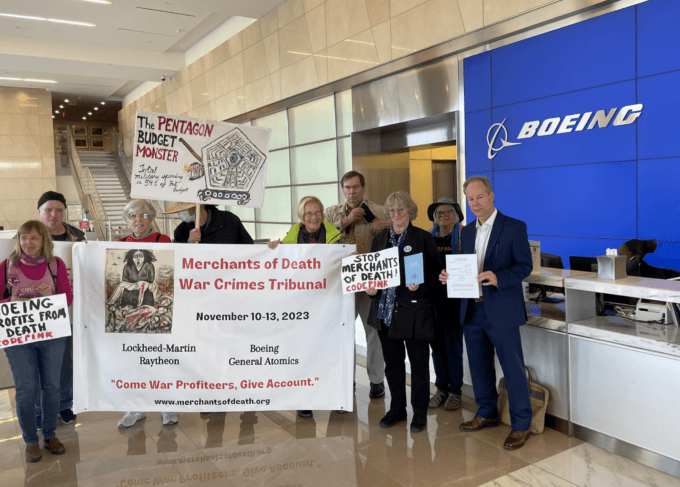
This is life as seen on November 10th, 2022, at Raytheon Technologies in Arlington, VA. Members and supporters of the Merchants of Death War Crimes Tribunal, a public tribunal, served “subpoenas” on four United States weapons manufacturers charging them with War Crimes, Crimes Against Humanity, Theft, and Bribery.

The other three corporations served that same day were Lockheed Martin, Boeing, and General Atomics. These four corporations are representative of the modern-day piracy that is the U.S. war industry, a corporate capture of U.S. foreign policy, the Congress, the Departments of Defense and State, and the U.S. economic system.

Raytheon Technologies occupies a towering office building in Arlington, a stone’s throw from the Pentagon and Arlington National Cemetery, two sites commemorating death and the utter failure of war. Though the Raytheon building has its corporate logo plastered in blood-red letters at the top, once inside no sign exists evidencing this corporate war profiteer. No name, no logo, no receptionist. A sad attempt to hide their dealings in the black art of war.

When asked, security guards refused to acknowledge Raytheon was in the building. Of the dozens of employees who passed, none would admit they worked at Raytheon, averting their eyes as they hurried away. When police arrived to escort the Tribunal members and supporters off premises, the police would not acknowledge Raytheon was headquartered there. Just like the employees, they had their orders. Keep quiet, admit nothing.

It was silent as a tomb except for the voices of the Tribunal members speaking the truth about the trail of suffering and death Raytheon and its corporate brethren have left across Iraq, Afghanistan, Pakistan, Syria, Somalia, and the Palestinian Occupied Territory. Meanwhile, these Merchants of Death have left the United States financially, morally, and spiritually bankrupt.

Raytheon Technologies has a market capitalization of $96 billion. According to Macrotrends, Raytheon Technologies revenue for the quarter ending September 30, 2022 was $16.951B, a 4.55% increase year-over-year. For 2021 it was $64.388B, a 13.79% increase from 2020, for 2020 was $56.587B, a 24.78% increase from 2019, and for 2019 was $45.349B, a 30.68% increase from 2018. In four years, they have garnered almost a 70% increase in revenue. Marketing death is good for profits if you can live with yourself. Apparently, given their silence, many Raytheon employees struggle with this very issue.

Raytheon builds some of the most destabilizing, destructive, and expensive weapons on earth. The Hypersonic Missile which travels in excess of five times the speed of sound — Mach 5 — covering vast distances in minutes. It is “hard to stop and flies nimbly to avoid detection and dodge defensive countermeasures.” All these are attributes which make the missile so destabilizing to a foreign leader who has only minutes to determine whether they are being attacked with a nuclear weapon.

Raytheon makes the Peregrine Air-to-Air Missile which they claim “increases firepower, penetrates bad weather, and goes the distance.” Add to that their plans to use “high power microwaves” in war and we see the epitome of a Merchant of Death.

Boeing, General Atomics, and Lockheed Martin are the same. They too revel in blood money as they build for war and drain the U.S. economy. In fact, some $8 trillion in U.S. taxpayer money has been given to U.S. defense contractors over the last twenty years.

The U.S. War Industry plays a key role in fomenting war with their congressional lobbying, not just pushing for weapons contracts but influencing military strategy, thereby exacerbating and prolonging the anguish of civilians bearing the brunt of these wars of choice. On the issue of war in particular, Congress must be answerable to its citizens, not a handful of corporations.

With their silence on November 10, these weapons manufacturers revealed their shame. Their corporate mission statement is “War Begets Profit.”  For the Merchants of Death War Crimes Tribunal, the mission statement is “Come War Profiteers, Give Account.”  Stand before a Tribunal and be judged.

And so, what is it like to give your talents to a corporation which hides its very existence, to give all your efforts and education and experience in the creation of weapons which kill indiscriminately? Their loss of words, their averting eyes, the damning silence offered in their corporate crypt, is the devastating answer.

Brad Wolf is a former prosecutor, professor, and college dean.  He is the Executive Director of Peace Action Network of Lancaster and writes for numerous publications.

Ten Amazon workers injured in violent workplace incident at JKF8 warehouse in New York

Tom Carter, Erik Schrieber
Amazon's JFK 8 facility on New York City's Staten Island on the evening of October 4, 2022
 [Photo: WSWS]

In the early morning hours on Friday, a disgruntled Amazon worker reportedly pulled a fire alarm inside the JFK8 Amazon warehouse in Staten Island, New York, and began attacking coworkers and spraying them with fire extinguishers.

According to fire department officials, ten workers were injured in the attack, which resulted in the temporary evacuation of the warehouse. Two workers were transported by ambulance to the hospital.

This violent incident occurred amid extremely high tensions at the JFK8 warehouse, which employs around 4,000 workers. Workers at JFK8 warehouse voted in the spring to unionize as the Amazon Labor Union (ALU) won by a decisive margin, but as the end of the year approaches, management continues to refuse to acknowledge the result.

Tensions in the JFK8 warehouse are particularly sharp around the issue of fires and fire safety. Last month, around 80 workers at the warehouse were suspended for staging a workplace demonstration and refusing to work in the aftermath of a fire, with the smell of potentially toxic fumes still lingering in the air.

No motive has been established so far for the attack that took place Friday. “A disgruntled worker who was also partially unclothed attacked several workers with a fire extinguisher inside of JFK8,” ALU executive secretary Michelle Valentin Nieves tweeted Friday morning. “They were sprayed in the face and had to be taken to the hospital via ambulance,” she wrote, describing how the spray from the fire extinguisher had entered the victims’ noses and mouths.

When the fire alarm sounded, the reaction of workers was conditioned by the fact that workers were “already livid,” as one worker put it, over the fire incident that took place last month, which resulted in a bitter confrontation with management and subsequent retaliation against dozens of workers who protested.

The fire broke out in a trash compactor inside the warehouse, releasing noxious fumes throughout the workplace. Several workers complained of trouble breathing, and one person was transported to the hospital. In that incident, management initially instructed workers to remain at their stations before eventually allowing them to leave.

When workers on the subsequent shift were instructed to begin working with the smell of fumes still in the air, as many as a hundred marched on management’s office and refused to work. Amazon responded to this protest over unsafe conditions—one of the most significant workplace actions by Amazon workers to date—by imposing retaliatory suspensions against dozens of the workers involved.

Meanwhile, three fires were reported at Amazon warehouses in the US in October, including at the ALB1 facility in Albany, New York, where workers have also attempted to organize.

In this highly charged context, the issue of workplace safety in relation to fires in the warehouse is sensitive, so any fire alarm—even a false alarm—triggers legitimate fear, stress, and anger on the part of many workers.

When the alarms initially sounded on Friday, according to ALU vice president Derrick Palmer, management told workers to remain at their stations. “Workers were eventually evacuated,” he tweeted Friday morning, “but were originally told by management to stay inside as the fire alarms went off.”

Management’s instructions for workers to stay at their stations during the fire alarm were seen by many workers as a repeat of the incident that took place last month, causing many workers to simply erupt with anger.

On one video posted to social media, a worker reacts to a manager’s evidently callous reaction to the alarm. “Close the f— laptop and help people get the f— out of the building,” she says. The worker goes on to describe how Amazon employs people who wear “safety” badges, but who are unresponsive when it comes to the genuine safety concerns being raised by workers while a fire alarm is going off.

In a statement on social media, Valentin called the incident Friday “another emergency situation mishandled by management putting workers under stress and in danger.”

One JFK8 worker who spoke to the International Amazon Workers Voice after the incident Friday recounted arriving at work shortly after the alarm had been pulled. By that time, the warehouse had been evacuated, and police and firefighters were on the scene. The evacuated night shift workers and the workers on the following day shift had been told to wait outside. Some workers on the day shift got tired of waiting and used voluntary time off (VTO) to go home.

Finally, management dismissed the day shift with pay but did not provide any further information. “They just said, ‘Go home.’ That’s it,” she said. “I don’t know whether those who used VTO will get paid.” Although ALU officials were on the scene, they were not able to provide members any information on that score.

According to the worker, management’s response to the false alarm was likely influenced by the defiant protests that erupted after the fire last month. “They didn’t want to take that risk again, and they sent us home,” she said.

Despite the fact that workers at JFK8 voted by a decisive margin of around ten percent to unionize in March, the highly profitable trillion-dollar international conglomerate has refused to acknowledge the union, instead stringing out frivolous legal proceedings before the National Labor Relations Board (NLRB) with endless red tape.

The ALU was able to attract support among militant Amazon workers at JFK8 by positioning itself as nominally “independent” of the established labor bureaucracy and both political parties, winning an election during the same period that the Retail, Wholesale and Department Store Union (RWDSU) union was defeated in Bessemer, Alabama. However, since winning the vote at JFK8, the fledgling union has openly courted the support of the Democratic Party and the AFL–CIO establishment, diminishing its claims to “independence.” It has also lost subsequent votes as it sought to expand its base to other warehouses.

There have not been any changes to the unsafe and unjust working conditions that drove workers to attempt to organize in the first place, and workers’ essential demands have still not been met. These demands include an end to the oppressive “rate” system, massive pay increases to meet inflation and an end to management surveillance and harassment.

The militant mood at the JFK8 warehouse reflects a rising tide of opposition among Amazon workers across the country and around the world, which parallels similar patterns among autoworkers, rail workers, and teachers. Last week, a Pittsburgh Amazon driver issued an important statement calling for fellow workers to form a committee to organize a struggle against the company. “It is time for all of us to unite together and stand up to these companies,” he wrote.

Amazon workers at the ONT8 warehouse in Ontario, California, where ALU is also attempting to organize, recently described low pay and aggressive exploitation by management in interviews with the IAWV. “Everyone is underpaid,” one worker said. Another worker described working 11- to 12-hour shifts: “Workers are not going to go back to the 1930s. Workers are not going to sit around and stay quiet. Bosses cannot do what they got away with back in the day, and workers aren’t going to let that happen, either.”

Despite having voted decisively to unionize in March, it is November and workers at JFK8 are still working without a contract
U.S. president unveils investments in Indonesia carbon capture, transport


Illustration shows ExxonMobil logo and natural gas pipeline

Sun, November 13, 2022 

NUSA DUA, Indonesia (Reuters) - U.S. President Joe Biden on Monday announced a number of investments in Indonesia spanning areas like climate and food security, including a $2.5 billion agreement between ExxonMobil and state-owned energy company Pertamina on carbon capture.

ExxonMobil and Pertamina's agreement will further assess development of a regional carbon capture and sequestration hub in Indonesia, the White House said in a statement.

The partnership "will enable key industry sectors to decarbonise" the statement said, citing the refining, chemicals, cement, and steel sectors. It said this would lower carbon emissions, ensure economic opportunities for Indonesian workers and help Indonesia achieve its net-zero ambitions in 2060 or sooner.

A joint study by Pertamina and Exxonmobil had found a potential carbon storage capacity of 1 billion tonnes in Pertamina's oil and gas fields, which could permanently store Indonesia's emissions for the next 16 years, Pertamina said in a separate statement on Sunday.

Biden is visiting Indonesia to take part in a G20 summit this week in Bali and announced the investments in a meeting with Indonesian President Joko Widodo, where he described the Southeast Asian country as a "critical partner".

The U.S. president also said the two countries would collaborate to "protect our people" from COVID-19.

The United States and Indonesia also agreed to launch a $698 million Millennium Challenge Corporation (MCC) compact to help support development of climate-conscious transportation infrastructure in five Indonesian provinces and 'other development goals', the White House statement said.

The funds include $649 million from the United States and $49 million from Indonesia.

(Reporting by Nandita Bose; Writng by Ed Davies; Editing by Kanupriya Kapoor)

Trump is Still the Demon King of US Politics


 NOVEMBER 14, 2022
Facebook

Art by Nick Roney

People who detest Donald Trump as the demon king of American politics are hoping that the feeble Republican performance in the midterm elections will weaken or dethrone him.

Democrats successfully characterised the “Make America Great Again” (Maga), Trump-dominated Republicans as a threat to democracy in the eyes of many voters. Not for nothing did the Democratic Party funnel money in some cases to the primary campaigns of extreme Maga supporters to ensure that they became the Republican candidates. But they could probably have saved themselves the money, because the Trumpian version of the Republican Party has put down deep roots.

The Republicans may have the worst of all possible worlds: a Trump too powerful to displace as party leader because he has the support of party activists; but, come election day, a leader who alienates more voters than he attracts, and is becoming an in-house political Jonah, ensuring the Republicans’ continued under-performance in future elections.

Control of the Senate

Republican leaders are understandably on tenterhooks to see whether Trump’s promised “big announcement” on 15 November will be to declare his candidacy for the Republican presidential nomination in 2024. Many counsel delay, arguing that Trump as a candidate will damage their chances in the crucial run-off for a Georgia Senate seaton 6 December, which may decide control of the Senate.

Possibly, Trump will not want to risk being labelled an election loser once again, but a delay would be a tacit admission that he is an electoral liability. A delay would also undermine his tried-and-tested method of dealing with failure or defeat, which is simply to deny that they have taken place. Brazenly preparing the ground for this tactic prior to the election, he said: “I think if [the Republicans] win, I should get all the credit. And if they lose, I should not be blamed.”

He may well get away with this among his core supporters, since he long ago persuaded them – despite a complete lack of evidence – that he was robbed of the presidency by electoral fraud in 2020.

Trump is not entirely wrong

Yet Trump is not entirely wrong in denying responsibility for the failure of the “Red Wave” to rise above a ripple. Abortion, not Trump, was the main issue for 27 per cent of voters and these broke three-to-one in favour of the Democrats, according to the exit poll. Sixty per cent of voters believe abortion should be legal, but 89 per cent of those who want it to be illegal are Republicans. More than half of Americans believe immigrants help the country, but 83 per cent of those who do not are Republicans. Similar deep divisions exist over gun control and climate change.

In other words, Trump expresses the views of a large majority of Republican voters – but a minority of voters in America as a whole.

The glee with which Trump’s enemies have focused on his latest discomfiture is partially the result of wishful thinking. His track record is of surviving setbacks and scandals that would have sunk any other politician. Many Democrats in 2016 waited for him to self-destruct and instead saw him win the White House. His verbal complicity in the 6 January Capitol riot damaged him, but largely among Americans who would not have voted for him anyway.

Covert enemies

As regards Trump’s survivability, I am reminded of the words of Conor Cruise O’Brien about Charles Haughey, an Irish political leader notorious for rising from what had been billed as his political grave: “If I saw Mr Haughey buried at midnight at a crossroad, with a stake driven through his heart – politically speaking – I should continue to wear a clove of garlic round my neck, just in case.”

Republicans and Democrats are nowhere near writing Trump’s political obituary, since his electoral wounds are not mortal. His many covert enemies among Republican Party leaders will be nervous of putting their heads above the parapet and will most likely wait until next year before seeking the nomination. Trump has already shown that he will ferociously attack any would-be rival, such as Florida governor Ron DeSantis, who cruised to re-election by a 20 per cent margin this week, and about whom Trump says that he knows dark secrets.

His Republican rivals know that opposing Trump unsuccessfully might terminate their careers, as critics of his role in the Capitol Hill riot have learnt to their cost.

A ‘cunning nutter’

The sigh of relief in London and most other European capitals over the underwhelming performance of the Republicans last week may therefore be premature. Non-Americans have tended to underestimate Trump as a politician since they became aware of him in 2016. Crazed and bizarre he may appear to be, but, says one former aide, he is a “cunning nutter.”

The midterms did not go the way Trump wanted, but they have once again made him the centre of media attention. The questions of whether he will or won’t stand again for the presidency is now being asked on every television screen in America and around the world.

Even Republicans unsympathetic to Trump think that reports of his political decline are premature. “All of these Republican power brokers and donors and thinkers and talkers, for seven years they’ve wanted to be rid of Trump, but they never do, and they’ve never said anything,” former Illinois Congressman Joe Walsh, who unsuccessfully challenged Trump for the Republican presidential nomination in 2020, told the online magazine Politico. “Now they’re hoping, ‘Oh, my God, a miserable midterm and Ron DeSantis had a great night, this will finally take him out.’ It’s wishful thinking, it’s bullshit.”

Only time will tell, since one of the problems of American election reporting is that it often takes days, even weeks, for the most crucial races to be decided.

Clutch their clove of garlic

One veteran American political expert said last Tuesday that she would be watching a film and not the first election returns because all the important news would come later. We still do not know for certainty at the time of writing who will control Congress, with the Senate tipping towards the Democrats and the House tipping rather more decisively towards the Republicans.

Supposing these expectations are fulfilled, what does the future hold for American politics? Gridlock on legislation and furious Republican inquiries into supposed Democratic crimes, certainly. If Trump stands for the presidency – and that is not a certainty – then Democrats can look forward to Republican fratricidal strife.

Even with a Republican majority in the House, they will be vulnerable to a mutinous far-right faction – a situation not so different from the Tory Party in the House of Commons.

As for Trump, he certainly has been hurt by the outcome of the midterm elections, but even those Republicans who think this damage is serious and permanent would be wise to clutch their clove of garlic for safety’s sake.

Cockburn’s Picks

Media outlets have been publishing lists of winners and losers in the midterm elections. Most of their picks are obvious, but almost nobody has pointed to one embattled group that will have been watching the results with special attention: the American wolf population.

Republican Congresswoman Lauren Boebert, who sought to delist wolves as an endangered species requiring federal protection, was at one point poised to lose a knife-edge election in Colorado. In one much watched video earlier this year, she jokes with an audience about shooting wolf puppies with her Glock firearm to make fur hats out of them. Sadly, she had regained a narrow lead at the time of writing. Howl.


Patrick Cockburn is the author of War in the Age of Trump (Verso).


Democrats Didn’t Win, They Simply Held the


Line


NOVEMBER 14, 2022
Facebook

Photograph Source: Photo by Derick McKinney

Americans invested in the idea of living in a democracy heaved a collective sigh of relief the day after the 2022 midterm elections when it became clear that the dire predictions of a Republican sweep were overblown. Democrats made greater gains than expected, winning races in both the Senate and the House that they didn’t expect to.

It happened because masses of people cast ballots, defying long-standing historical trends of low midterm turnout. Voters almost matched the high turnout of the 2018 elections when outrage over Donald Trump’s first two years in office pushed Congress into the hands of Democrats. Stung by their opposition’s showing and by Trump’s reelection loss two years later, Republicans ramped up voter suppression efforts, hoping to blunt the impact of an increasingly young, diverse, and enthusiastic electorate.

Liberal-leaning voters showed up to the polls during this latest midterm election largely in response to the overturning of abortion rights, but also to stave off right-wing extremism.

Although the worst did not come to pass during the midterms, simply holding the line against a descent into fascism is not enough. Republicans are wresting control of the nation’s steering wheel as hard as they can and forcing it as far right as possible. Their party has divested itself from democratic norms and thrown its weight behind Trump and his lies. They have invested in stripping people of their bodily autonomy and fashioning a dangerous world ruled by force and a riotous mob mentality. Much more is needed in the face of such hubris: Fascists need to be placed on the defensive, and a split Congress is not enough to do so.

Three major factors explain why Democrats didn’t win outright control of both congressional chambers: First, Republicans have aggressively reduced the impact of Democratic votes; second, Democrats were unable or unwilling to articulate a clear message of why their agenda is better than that of the Republicans; and third, the corporate media refused to center people’s well-being in their framing of election-related issues.

Republicans have played the long game on suppressing democracy, redrawing district maps for years in order to favor their candidates and appointing conservative, partisan judges into federal courts to affirm those maps. They have done so in tandem with a slew of voter suppression laws in states they control—which is the majority. Analilia Mejia, co-executive director of the Center for Popular Democracy Action, says in an interview that such efforts are “a strategy utilized to negate the power of a rising Black and Brown electorate.”

The GOP is also terrified (or should be) of young people voting. Recall in the 2016 presidential race when Hillary Clinton’s loss to Donald Trump was blamed, in part, on younger voters who weren’t motivated to show up to the polls. Two years later, that trend was reversed in the first midterms of Trump’s presidency. Now, four years after that, young voters have realized the dangers of apathy and showed up to the polls in force, casting a majority of their ballots for Democrats.

Mejia says “the policies that really motivate people” to vote are “the policies that we know will essentially save humanity and the planet and stop climate change; the policies that we know will ensure that our children, that our elders, that those most vulnerable in our communities have the resources that they need to not only survive but thrive—[these] are policies that are supported by the vast majority of people.”

This—including the overturning of abortion rights at the Supreme Court—was precisely what motivated so many young people and people of color to vote in the 2022 midterms. Varshini Prakash, executive director and co-founder of the Sunrise Movement, a youth climate justice organization, told Common Dreams, “For us, it’s never been just about defeating Donald Trump… We turn out to fight for the issues our generation faces every day, like the impending climate crisis, protecting our reproductive freedoms, and ending gun violence in our schools.”

And yet, climate justice, economic justice, and racial justice were largely missing from the story that Democrats told in order to motivate people to go to the polls.

Rather than tout how his administration and his party would ensure a just transition to renewable fuels, President Joe Biden was fixated on gas prices and how to lower them. Instead of showcasing how the 2021 American Rescue Plan was a good example of federal government action on inequality, candidates running for office were on the defensive against Republicans’ and the media’s hammering of inflation as a central election issue. In contrast to their 2020 promises to tackle racist police brutality and mass incarceration, Democrats decided to pass a bill to increase police fundingand stave off GOP accusations of being “soft on crime.”

Voters showed up in spite of this. But they may have shown up to elect Democrats in even higher numbers had climate, economic, and racial justice been front and center ahead of the midterms. “These are popular ideas,” says Mejia.

Not only did Democrats refuse to fully articulate these popular ideas, but the corporate media also shaped its coverage to suit the GOP’s agenda. Outlets aggressively played up the Republican Party’s line that inflation was the central issue of the election—one for which, they alleged, Democrats bore sole blame.

Take one New York Times article published on Election Day. “Inflation is almost certainly the issue pushing the economy to its current prominence,” wrote the Times’ economic reporter Jeanna Smialek in a story headlined, “Inflation Plagues Democrats in Polling. Will It Crush Them at the Ballot Box?” Just hours after it was published, such a confident claim fell apart as the Democrats were most certainly not “crushed” at the ballot box.

Mainstream U.S. corporate news media outlets could have taken a page out of their British counterpart’s book, the Guardian, which publishes analyses like that of former U.S. labor secretary Robert Reich. “Corporations are using rising costs as an excuse to increase their prices even higher, resulting in record profits,” wrote Reich, offering an explanation for inflation largely missing from U.S. outlets.

One Wall Street Journal article went as far as explaining quite convincingly that rather than being sparked by Democrats’ policies, inflation was triggered by the COVID-19 pandemic, and that the U.S. was in line with other nations and with historical trends. Yet the Journal couldn’t resist framing the piece with the misleading headline: “Midterm Election Could Make Democrats Latest Governing Party to Pay Price for Inflation.”

Most U.S. newspapers have spent the past year banging the drum of inflation and exaggerating its impact. They have accepted the dogma that higher wages, lower unemployment, and government assistance are the source of rising prices rather than corporate greed.

Mejia is aghast at the consensus that is emerging to tackle inflation through increasing interest rates and slashing benefits. She finds it “unbelievable that the way we dig ourselves… out of an economic crisis is by inflicting strategic targeted and sustained pain to those who are most vulnerable.”

She says that “the only way out of here, out of this moment, is through investment in people, in civic participation, and increasing our political power and voice.”

Perhaps if the Democratic Party had centered its midterm platform on such an approach, and perhaps if the corporate media had not distorted the truth, victory would not have been defined by simply holding the line against a fascist GOP; it would have been—and could have been—an outright defeat of authoritarianism and injustice. Too much is at stake, and our standards of success cannot be low.

This article was produced by Economy for All, a project of the Independent Media Institute.

Sonali Kolhatkar is the founder, host and executive producer of “Rising Up With Sonali,” a television and radio show that airs on Free Speech TV (Dish Network, DirecTV, Roku) and Pacifica stations KPFK, KPFA, and affiliates.