It’s possible that I shall make an ass of myself. But in that case one can always get out of it with a little dialectic. I have, of course, so worded my proposition as to be right either way (K.Marx, Letter to F.Engels on the Indian Mutiny)
Friday, April 14, 2023
Taiwan’s extraordinary 111-year-old forest railway gets a makeover
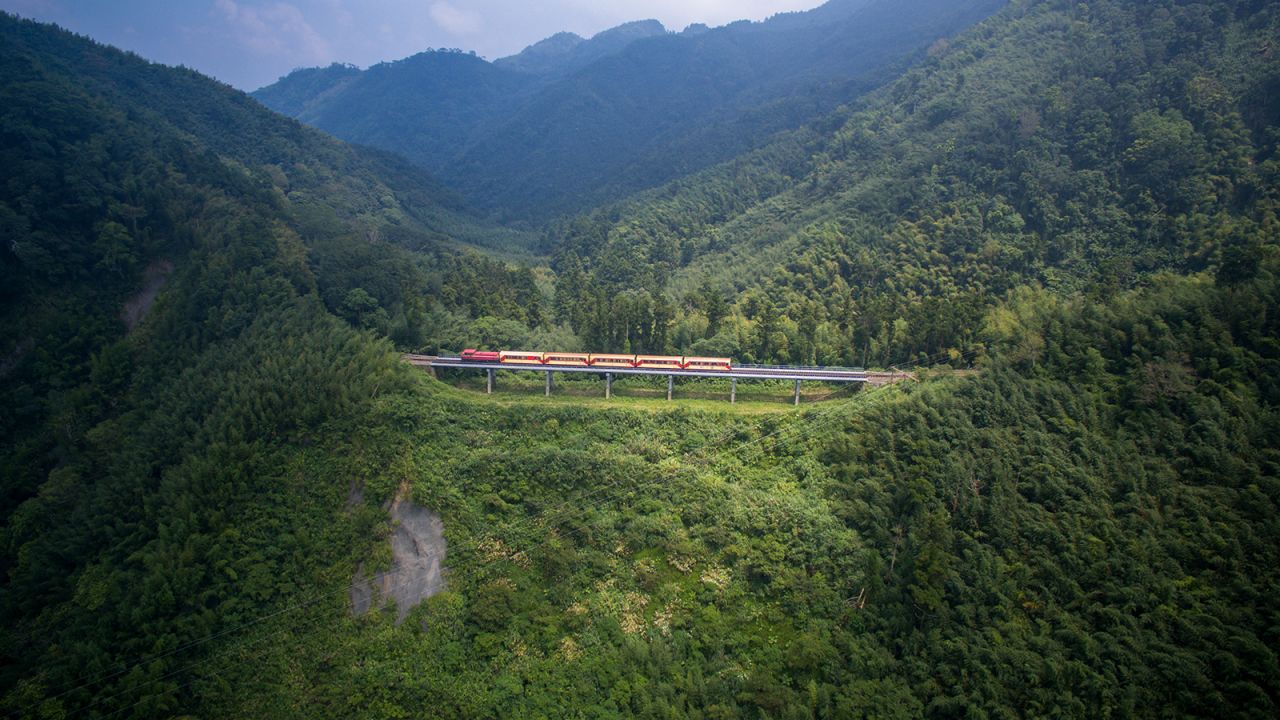
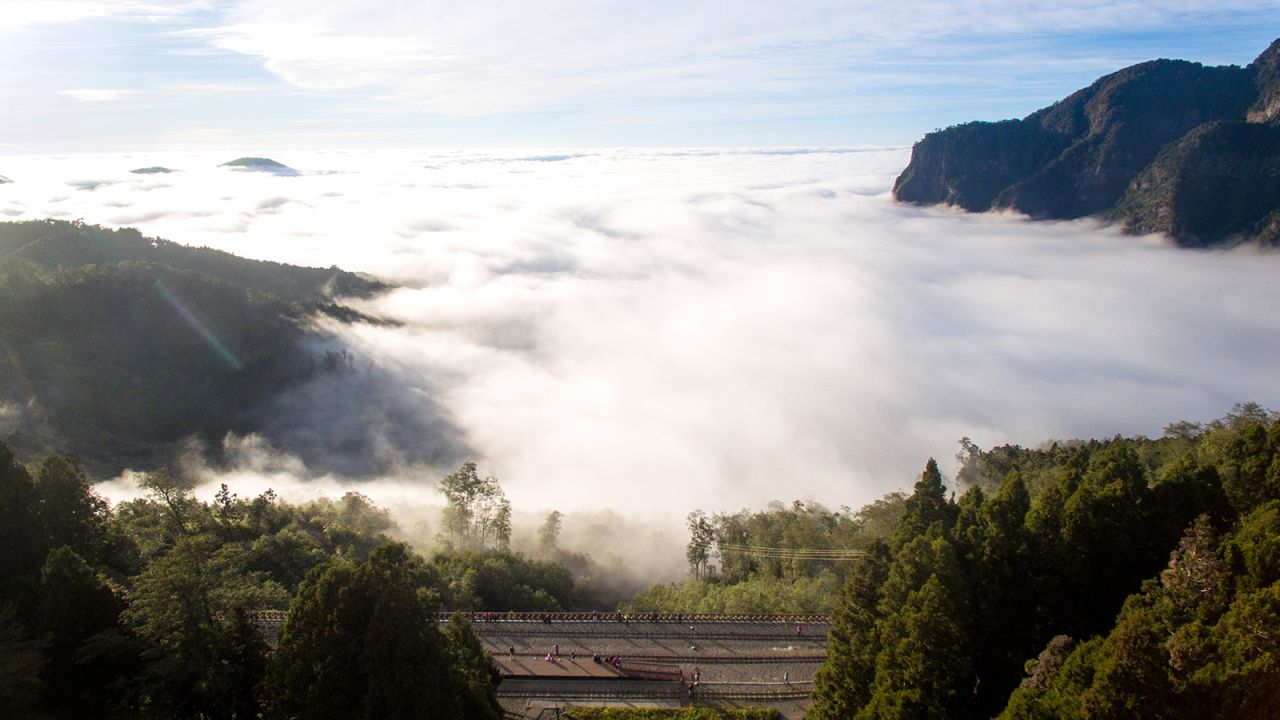
Snaking through the dense forests of Alishan, one of the tallest mountain ranges in Taiwan, the 111-year-old Alishan Forest Railway has long been a popular attraction for train fans.
And now, the train’s operators are freshening up its historic fleet by adding six sleek new rail cars.
Collectively named Formosensis, the new carriages are the product of two years and nine months of planning and construction. Test drives kicked off in March, with the company hoping to wrap things up by June.
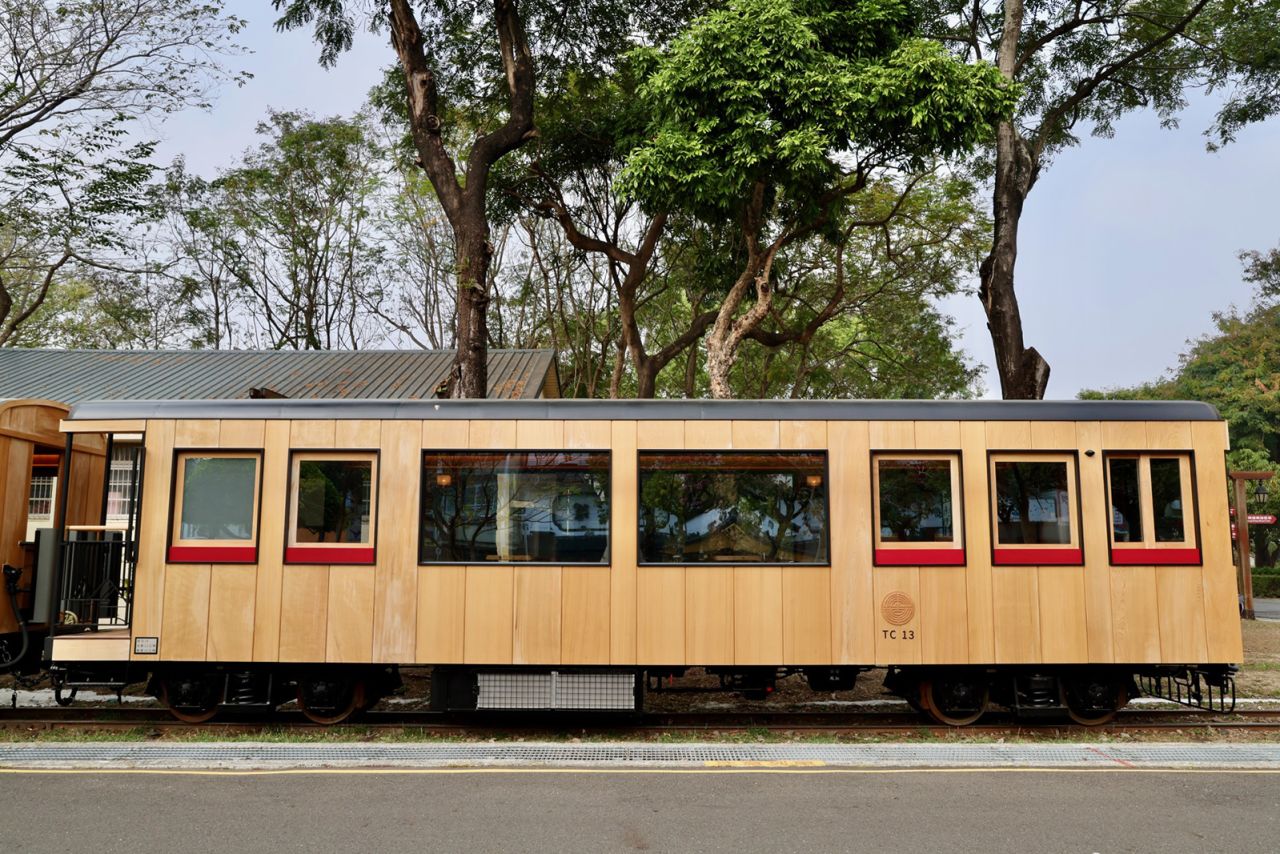
Both the livery and interiors of the six new cars are lined with two types of cypresses native to the island – Taiwan red cypress (or Chamaecyparis formosensis – which inspired the name) and Taiwan cypress (Chamaecyparis Taiwanensis).
“Taiwan red cypress and Taiwan cypress are fine and uniform wood materials,” say Alishan Forest Railway officials in a statement. “They’re durable, resistant to erosion and insects. The essential oils it contains exudes a unique phytoncide scent (the scent of the forest), which is both energizing and cleansing. Passengers could enjoy a refreshing forest bathing experience.”
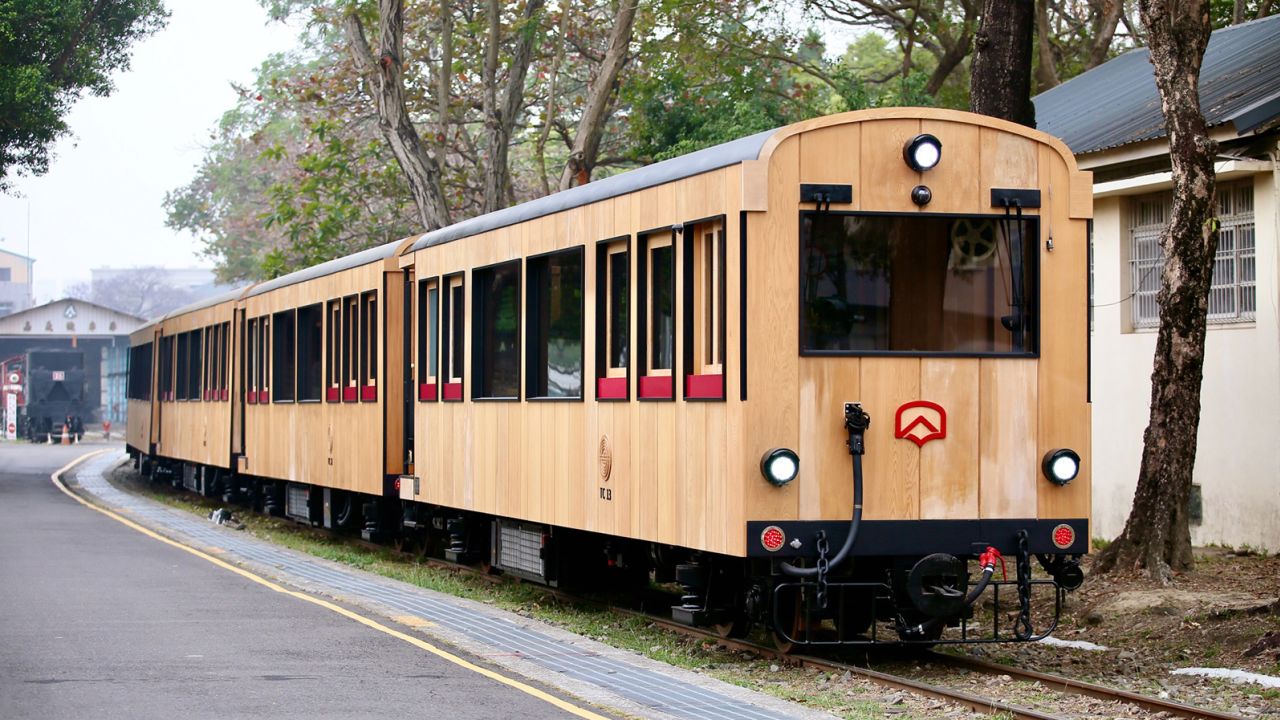
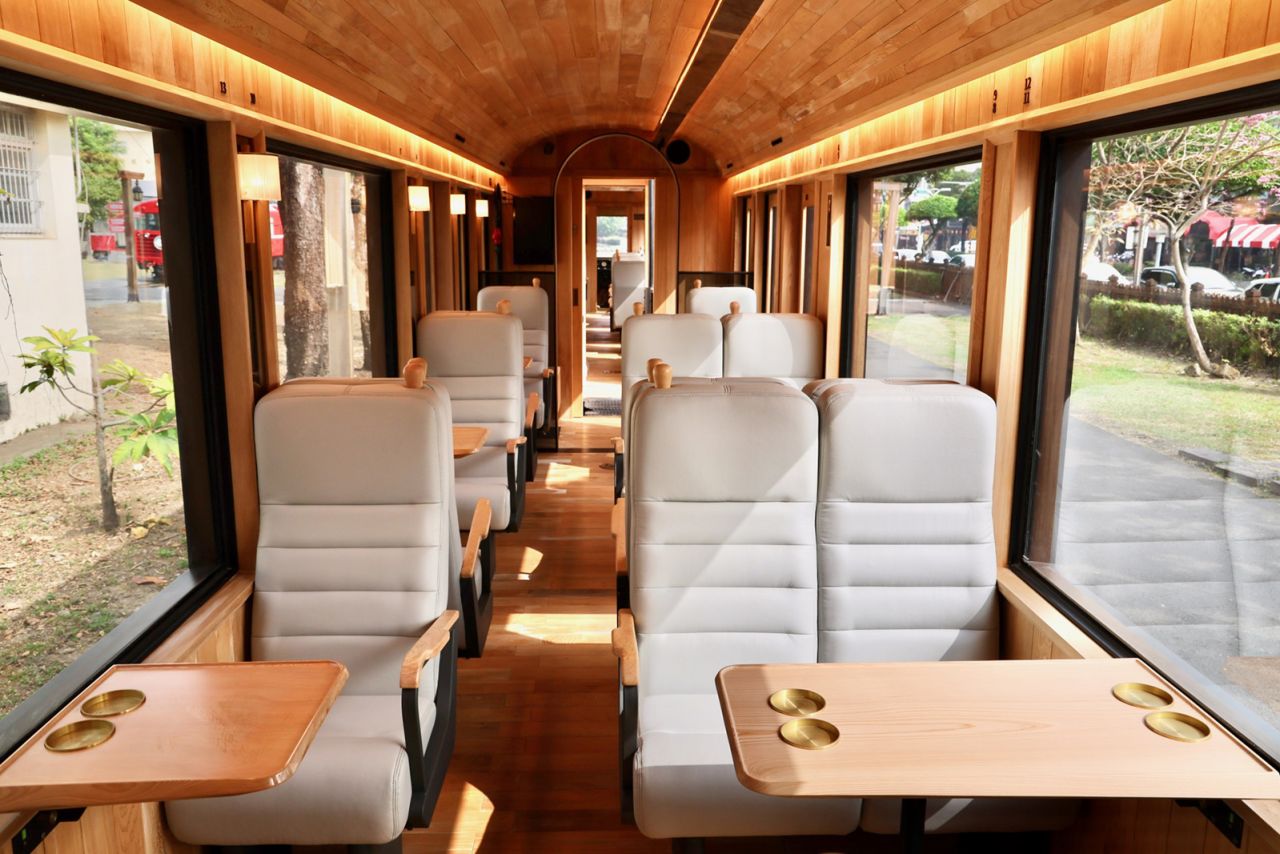
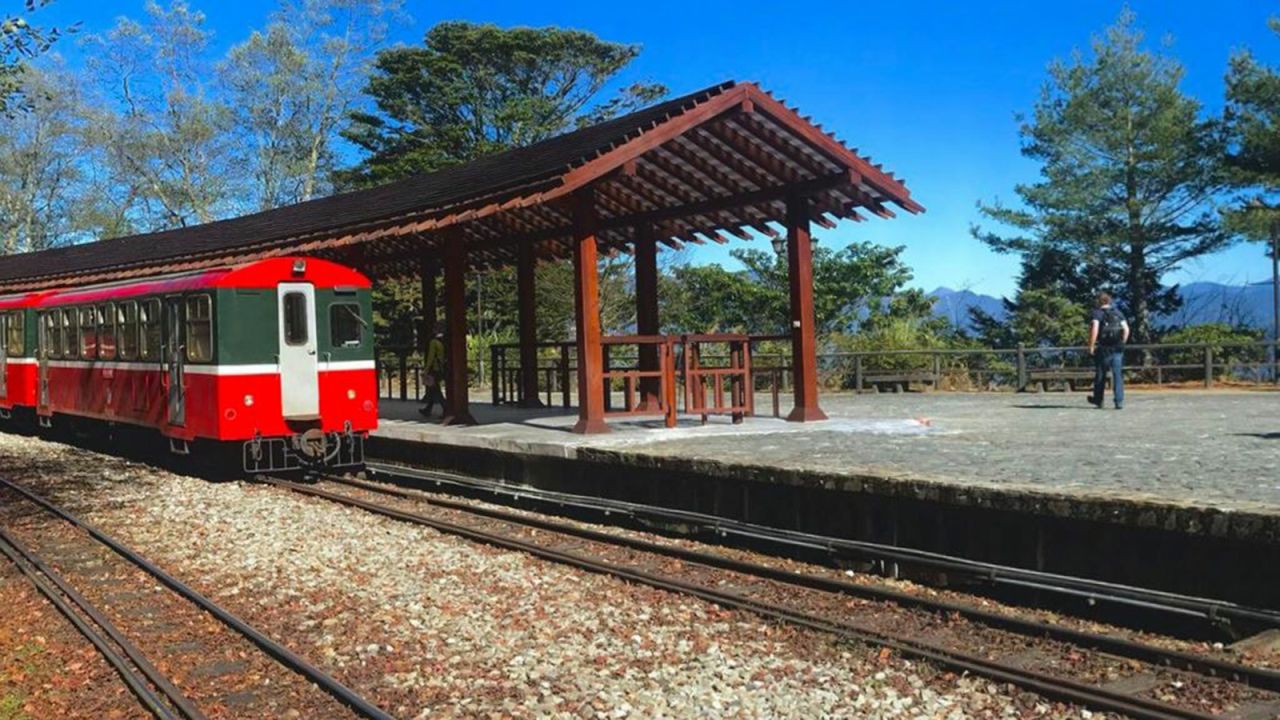
Taiwan's historic Alishan Forest Railway will soon welcome new, more comfortable train carriages.
Courtesy Alishan Forest Railway and Cultural Heritage Office
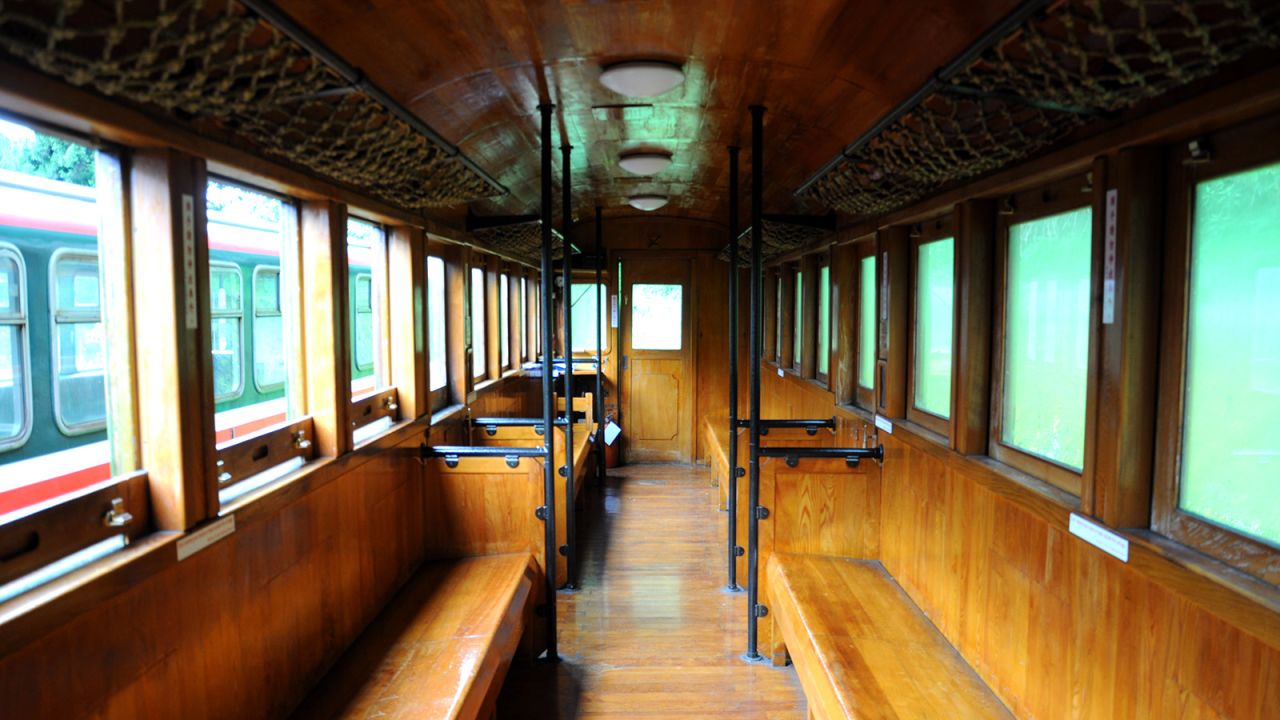
Formosensis will elevate the experience for travelers in several ways. For one, the current cypress-themed train doesn’t have air-conditioning or soft seating.
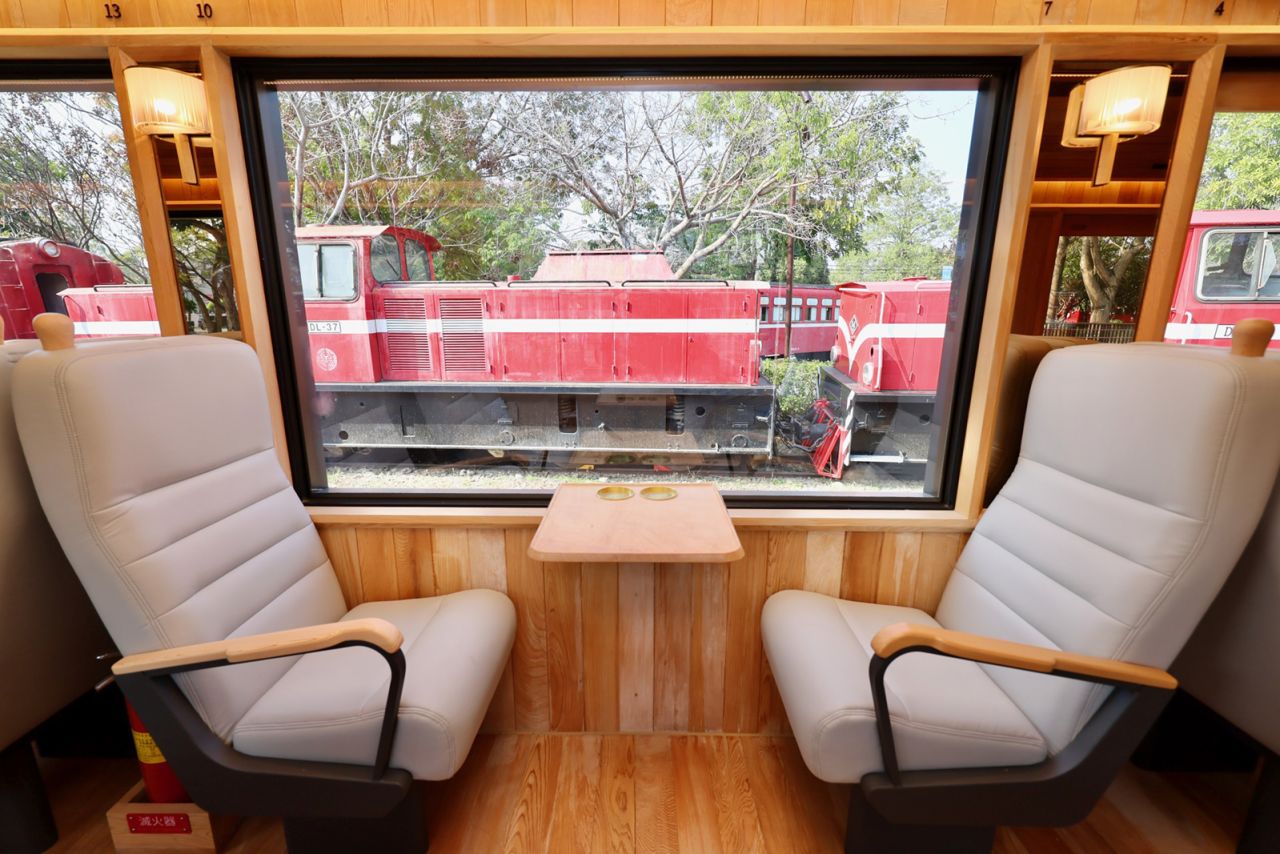
Each new car will be fitted with 18 leather seats, including two four-seat booths and two two-seat booths. They will also feature bigger windows and warmer lights compared to older models, all to enhance the viewing experience.
But travelers will have to wait a bit longer before they can climb aboard. Details of the routes and launch date have yet to be confirmed, according to the train office’s spokesperson. Asia’s highest narrow-gauge mountain railway
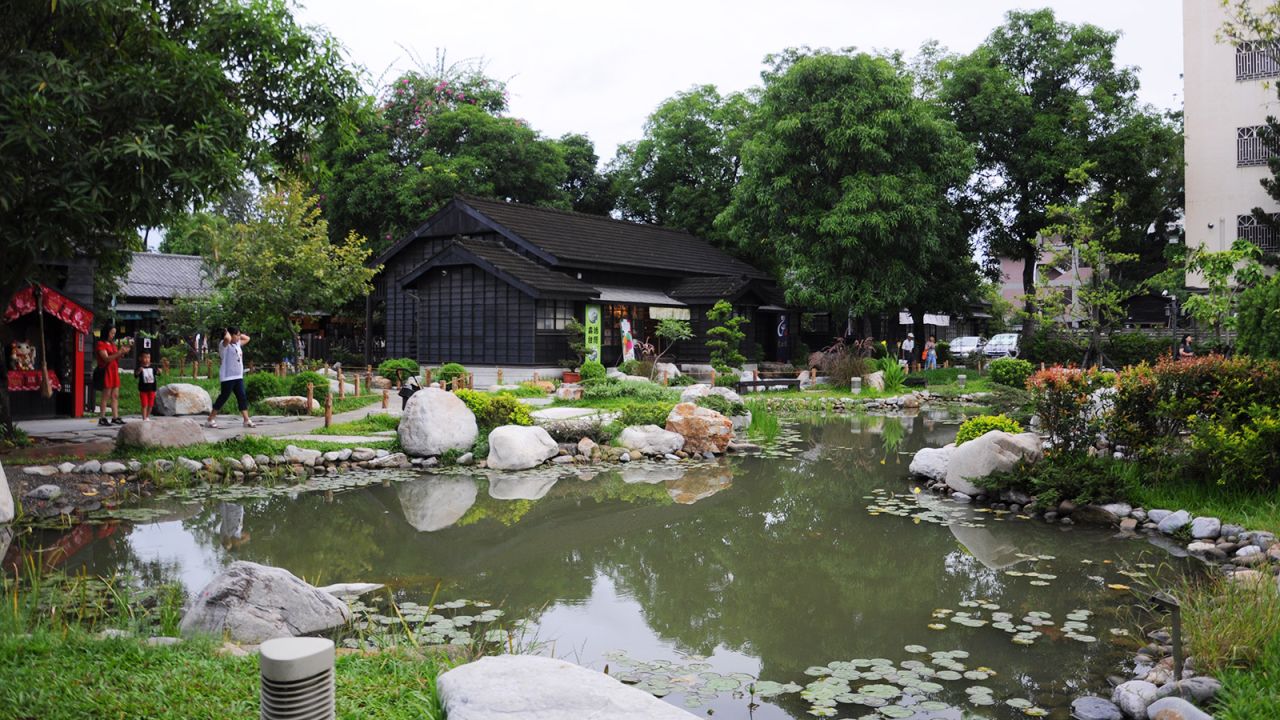
The existing Alishan Railway Route runs from Chiayi city station to the Loco Shed Park, a garage-turned-park where visitors can see preserved old train engines and trains that served the Alishan Forest Railway.
Completed in 1912 under the Japanese occupation, the railway was once used to transport now-endangered Taiwan cypress trees from Alishan. After logging was banned, it became the only passenger train to ride up the mountains.
It’s believed to be the highest narrow-gauge mountain railway in Asia, climbing from 30 meters to 2,216 meters above sea level – some 16 meters higher than the famed Darjeeling Himalayan Railway, which ascends from 100 meters to 2,200 meters.
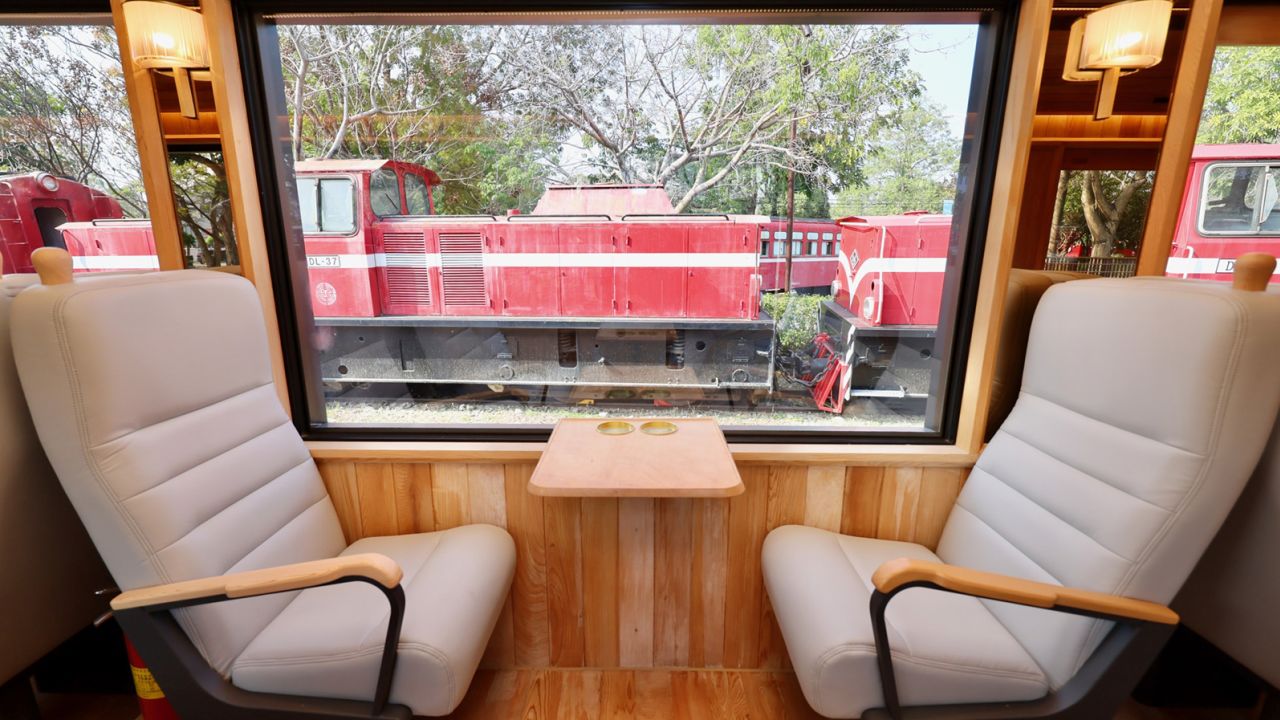
The new cars will be fitted with leather seats, bigger windows and warmer lights.
Courtesy Alishan Forest Railway and Cultural Heritage Office
The Formosensis carriages will be the latest addition to Alishan Forest Railway’s historic fleet, which includes restored steam locomotives.
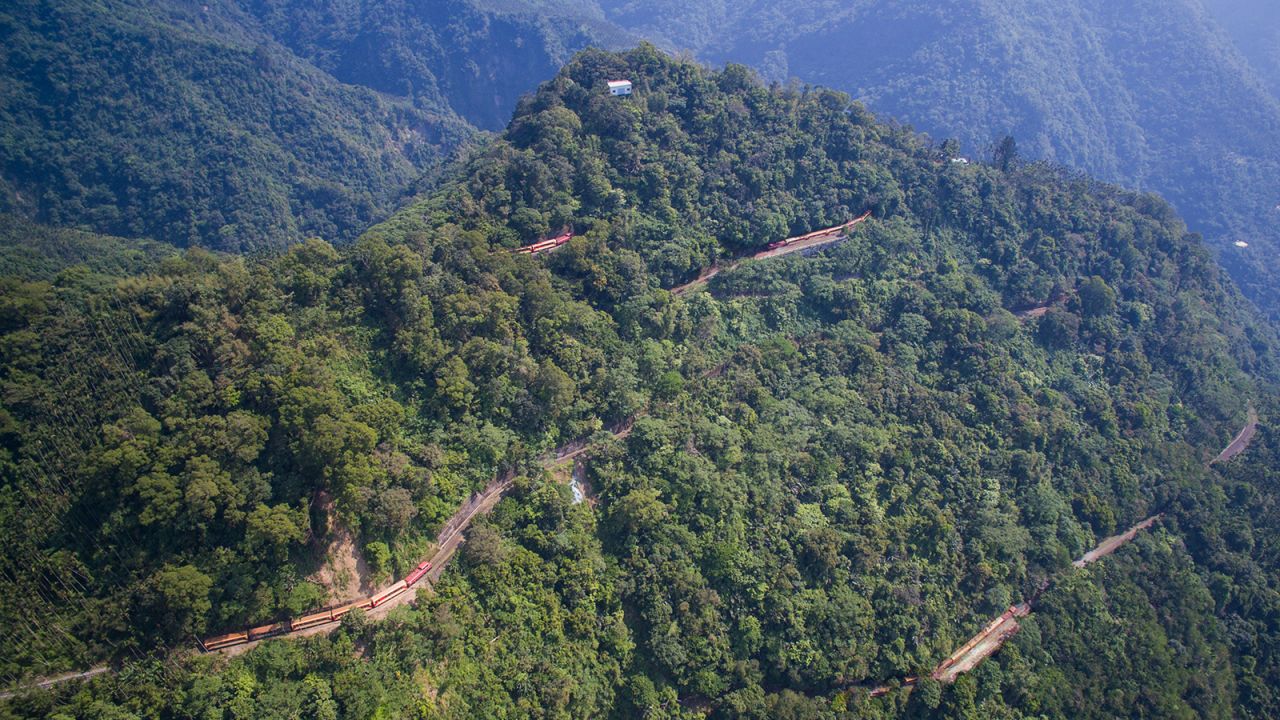
Train lovers can experience some of the 71.6-kilometer railway’s original features – including the many spiral and horseshoe bends along the tracks. (You can see the aerial photos of some of the tracks in the above photo gallery.)
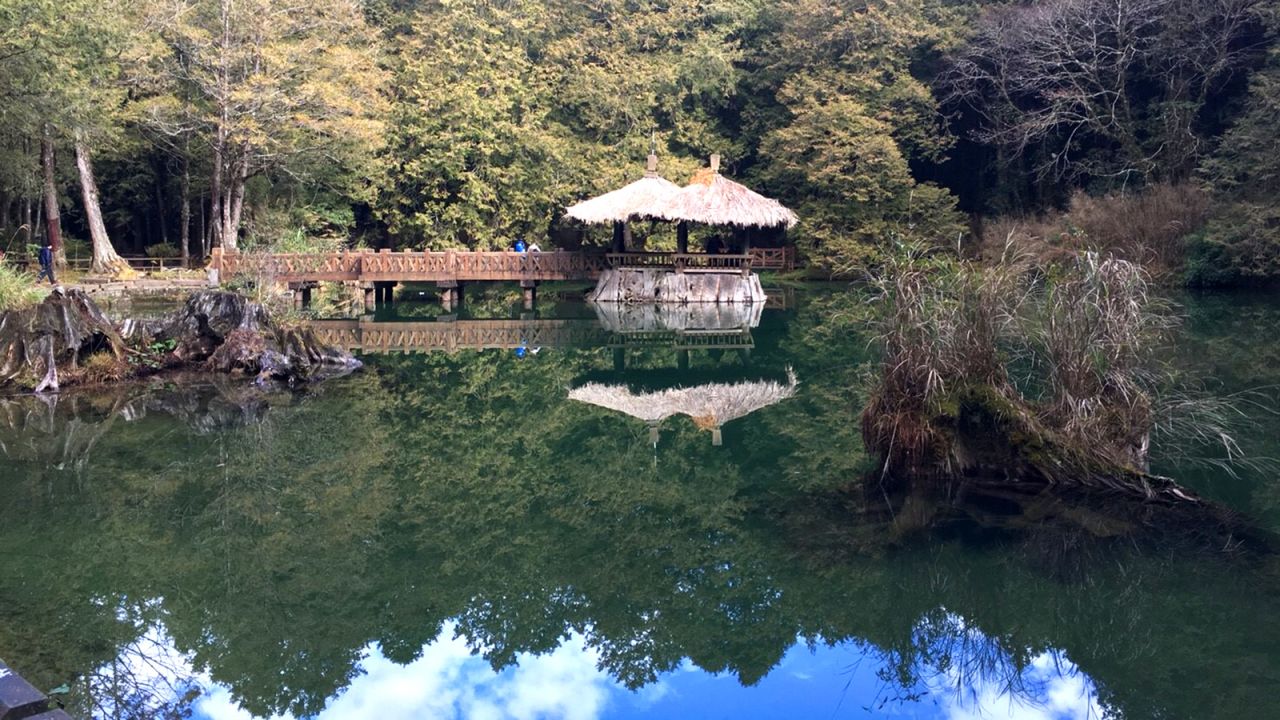
The journey also offers a glimpse into Taiwan’s diverse natural beauty, as the train goes through a tropical forest, then a subtropical forest and finally a temperate forest during its ascent to the top of Alishan.
In addition to developing more modern trains for the route, Alishan Forest Railway has also been restoring some of its older trains, as well as historical attractions along the line.
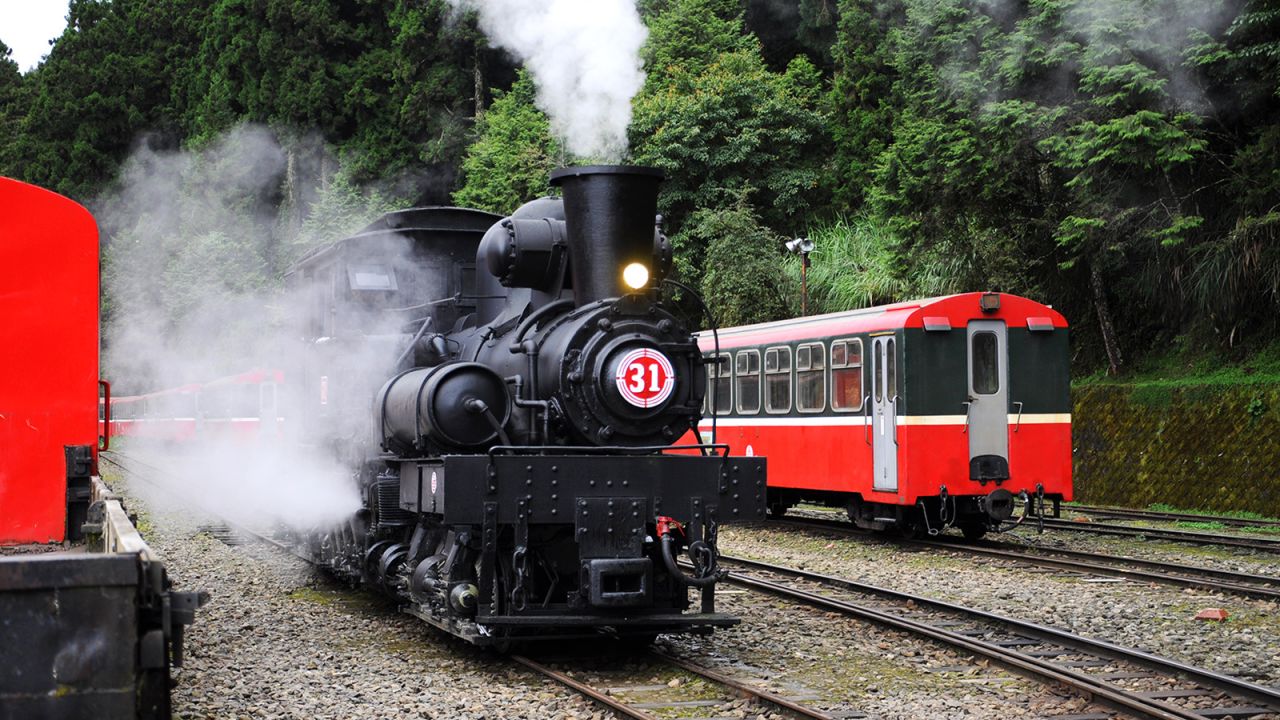
In 2021, the Alishan Forestry Railway and Cultural Heritage Office completed restorations of the century-old Shay 21 steam locomotive. It’s Alishan’s first 28-ton steam train, imported from the United States in 1912, and is powered by its original coal-burning engine.
Meanwhile, a Shay 31 locomotive makes occasional appearances during the flower blossoming season, from March to May. Getting to Alishan
The Alishan Forest Railway isn’t a continuous line – one section of track between Shizilu Station and Alishan Station was damaged in a typhoon.
Travelers can take the main line from Chiayi Station to Fenqihu Station (2 hours, 20 minutes) and continue the journey by bus from Fenqihu Station to Alishan Station.
Only one train departs daily from Chiayi, at 9 a.m on weekdays. Two more trains (at 8:30 a.m. and 9:30 a.m.) are added at weekends. (Find the schedule on this website).
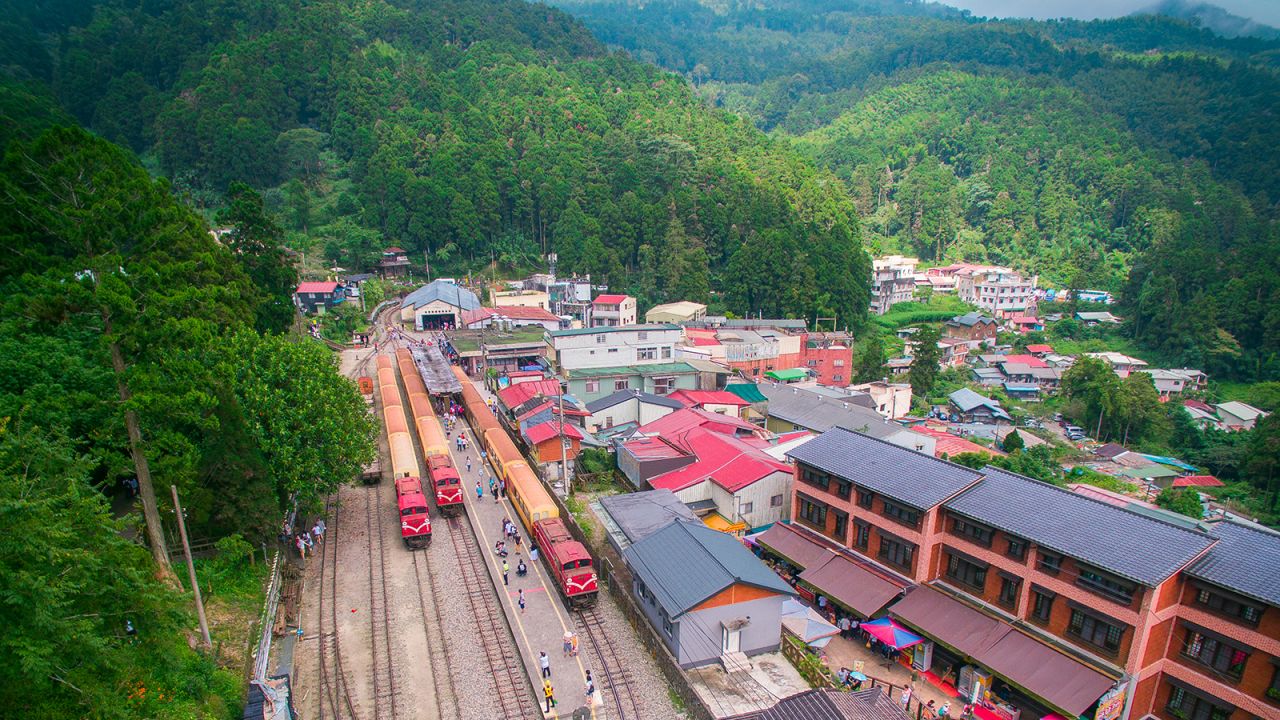
From Alishan Station, there are a few branch lines that ferry passengers to the attractions around the Alishan Scenic Area.
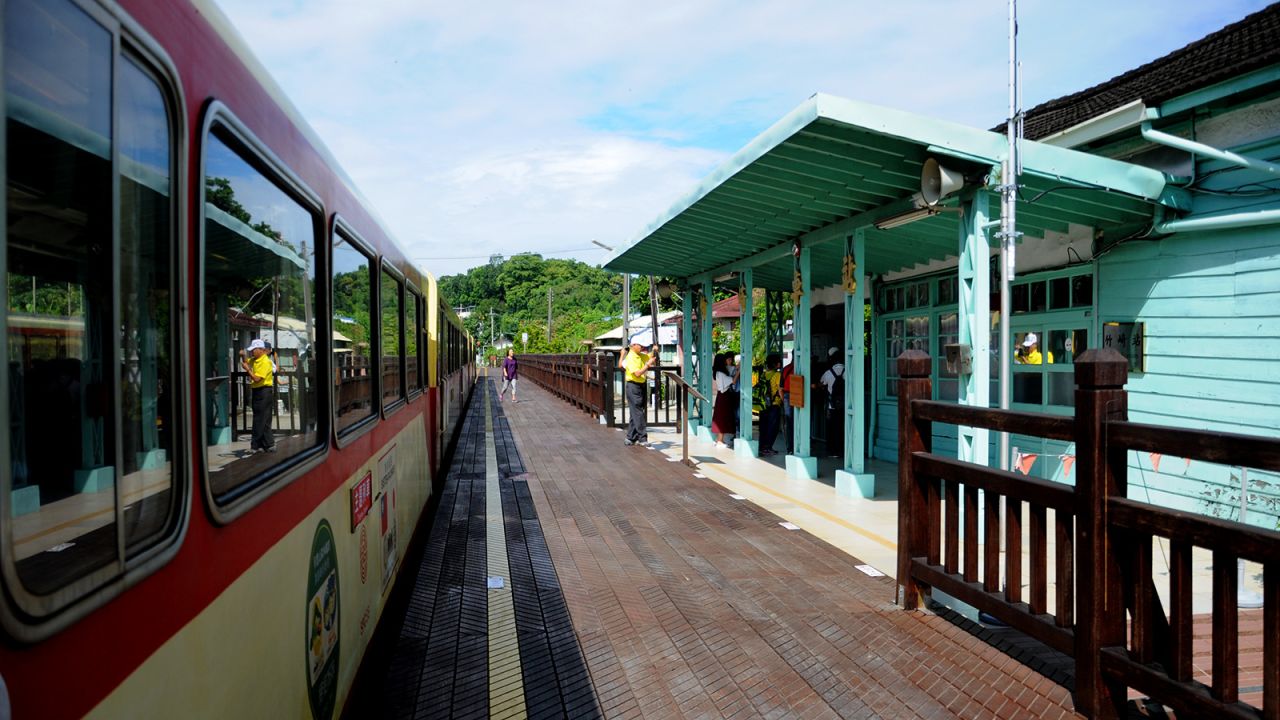
Visiting Alishan: Built more than 100 years ago, the Alishan Forest Railway is perhaps the best way to explore Alishan, one of Taiwan's most important mountain ranges. Lai Guo-hua, an aerial photographer who lives next to the railway, spent a few years documenting it.courtesy Lai Guo-hua
Taiwan's stunning 111-year-old mountain railway 1 of 18
Afro Ecuadorians: Remembrances of the past and present
Black community in Cuajara, in the ancestral territory El Chota
- La Concepción and Salinas. (Photos by Dr. Edzón León Castro)
As in other countries in the Americas, the Republic of Ecuador saw the kidnapping and enslavement of thousands of Africans during its colonial period. It is today the South American nation with the fourth largest presence of people of African descent––after Brazil, Colombia, and Venezuela.
Ecuador’s national census counted Afro Ecuadorian as 7.2% of the population in 2010, but local activists and the London, England-based human rights organization Minority Rights Group International (MRG) have estimated that Afro Ecuadorians are more likely 10% of the population.
The Republic of Ecuador was created in 1830. Its birth was based on the racist-colonial ideology of mestizaje or race-mixing, say Afro Ecuadorian leaders Katherine Chalá Mosquera and José “Pepe” Chalá Cruz. This meant that the population of African descent and the native Indigenous population––because they were considered inferior to the white European and mestizo Creole (ruling elite)––were excluded from the model of the national identity. Each was barred from the enjoyment of citizenship rights, which has forced them to continually struggle between poverty and extreme poverty.
Former deputy of the National Assembly, José “Pepe” Chalá Cruz, argues that “The results of the Census’ Survey on Living Conditions from the year 2006, make it clear that the conditions of poverty in the Afro Ecuadorian and Indigenous population are marked by structural racism. According to the data, the levels of poverty in 2006 reached 38.3% of the population. But the self-identified white population (33.2%) and mestizo (34.9%), were registering at a lower rate than the national average. Afro-Ecuadorian people registered at 41.2% and the Indigenous population registered at 70%.
“Because of the struggles upheld by the Afro Ecuadorian social movement, for the first time we are recognized in the constitution of the Republic of Ecuador as a Black or Afro Ecuadorian people, ‘part of the Ecuadorian state, unique and indivisible,’ holders of collective rights. It’s with a problematic caveat that specified ‘in all that is applicable to them.’ (Political Constitution; 1998: 50 – 51). Still, and in spite of these constitutional recognitions, the Afro Ecuadorian population struggles between poverty, illiteracy, and state neglect.”
Chalá, who also has a degree in applied anthropology, saw a glimmer of hope with the arrival of Rafael Correa to the nation’s presidency.
Rafael Correa Delgado served as constitutional president from 2007 to 2017. One of his first actions was to convene a national constituent assembly, which resulted in the 2008 constitution for Ecuador. One of the important achievements reached by the Afro Ecuadorian and Indigenous social movements was to be recognized by the state. Article 1 mentions that: “Ecuador is a constitutional state of rights and justice, social, democratic, sovereign, independent, unitary, intercultural, plurinational and secular’ (Constitution; 2008: 21).”
In the same 2008 constitution, explains Katherine Chalá Mosquera, a professor at the Latin American Faculty of Social Sciences, “We are recognized as Afro Ecuadorian people, with 21 collective rights. We are recognized as having the right ‘not to be subjected to racism and any form of discrimination (…);’ we also have the right to ‘recognition, reparations and redress to the communities affected by racism and other related forms of intolerance and discrimination.’”
Before and after Correa
According to the last population census conducted in 2010, the Ecuadorian state has a total population of 14,483,499 inhabitants, of which 71.9% of people self-identify as mestizo, 7.4% as montubia (mestizo who reside in the countryside of coastal Ecuador), 7.2% as Afro Ecuadorian (1,041,559 people), 7% as Indigenous and 6.1% as white.
Official data from the last census conducted post-pandemic 2022 are not yet known, so we have to rely on the data from 2010.
President Correa made a social investment never seen before in Ecuador: he increased access to public education, with the Afro Ecuadorian population making up average enrollment and attendance. Girls and boys received from the central government textbooks, school meals, and uniforms. Modern educational units were built with well-equipped laboratories, there was internet service, more teaching staff and improved remuneration.
Similarly, in terms of public secondary education, the Afro Ecuadorian population between 2007 and 2017 was very close to the national average in terms of enrollment and class attendance.
In the case of third-level university education (bachelor’s degrees, engineering, etc.), and fourth level (master’s degrees and doctorates), the gaps in terms of the national average were extended by the structural difficulties that have been carried since the colonial and republican-neoliberal exclusionary era.
President Correa’s government initiated a scholarship program at the national and international level, many of which were accessed by Afro Ecuadorian youth. We await the qualitative and quantitative results of the 2022 census to officially know the status of Afro Ecuadorians with respect to undergraduate and graduate university education.
Regarding public health coverage, the Correa government made a very significant investment in this area by building hospitals, and sending equipment and medical provisions to the population free of charge.
In regard to home ownership, according to the 2010 census, the national percentage suggests that 63.6% of heads of household stated that they live in their own residence, while 164,421 heads of household identified as Afro Ecuadorian have their own homes, that is, 42.9%. Now, of that 42.9% of fully paid residences, 93.3% have access to electricity, 71% have potable water and 47% have public sewage service. Also, 21 out of every 100 Afro-Ecuadorian homes have access to telephone service (CODAE 2014).
Despite the formidable investment by the government of President Correa, Afro Ecuadorians were still below the national average.
The Lenin Moreno Garcés administration governed Ecuador from May 2017 – 2021. Moreno had been supported by the political movement founded by Rafael Correa, but Correa was betrayed by Moreno. The latter assumed the neoliberal government plan of the losing candidate in those elections, Guillermo Lasso, who became Moreno’s successor. The country was changed with reforms, social investment in education and health was paralyzed, housing programs decreased, and there was zero investment in roads and educational infrastructure—all significantly affecting the Afro Ecuadorian population.
Guillermo Lasso became president of Ecuador in 2021. He has made no investment in state social services, decreased the budgets in education, health, and housing, and instead of creating new jobs his administration has closed them due to its ideology of “reducing the size of the State,” that is, having fewer teachers, less doctors, a reduction of the public force, elimination of national and international student scholarships, and deinstitutionalization of the country.
The political and legal crisis that Lasso has led Ecuador to is unprecedented in the country’s modern history, barely 09% approve of his management. The crisis is aggravated by permanent corruption scandals in his government that have led the National Assembly call for his impeachment.
In the last regional elections on February 5, the Citizen Revolution, the new political party of Rafael Correa, won important victories in the nation’s provinces and districts. This raises the expectation that in 2025, the Citizen Revolution, with popular support, will be able to take over the government of Ecuador.
Broken promises: Malaysian gov’t condemned by watchdog groups for reneging on repeal of repressive laws
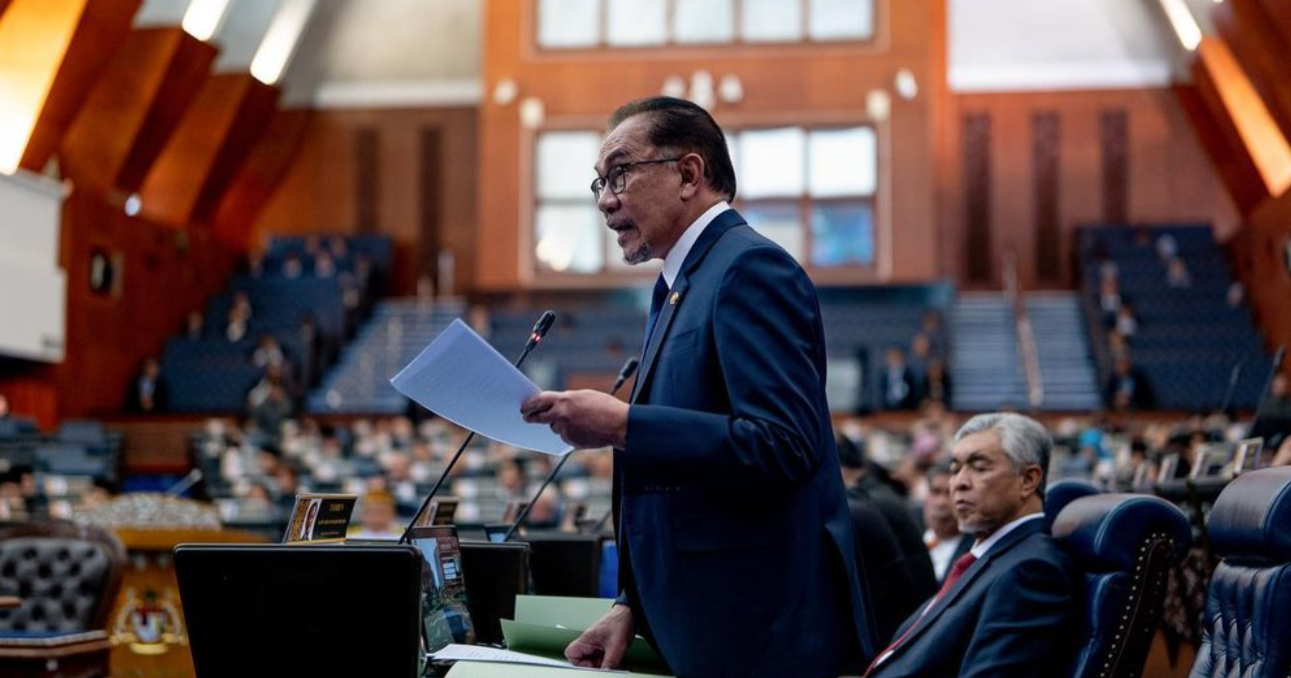
Prime Minister Anwar Ibrahim speaking in parliament on Dec 20, 2022.
Despite those promises, Home Minister Saifuddin Nasution Ismail disclosed yesterday that the government has no plans to revoke the PPPA, as it remains “essential for preserving public peace.”
The PPPA gives the home minister the “absolute discretion” to grant, revoke or suspend permits “to any person to print and publish a newspaper in Malaysia”. Critics argue the law gives the government the ability to restrict political discourse and silence its political opponents.
However, Saiffuddin asserted that the most recent evaluation of the law found that it is still pertinent to uphold public security and peace “at present.”
In the meantime, The Coalition for Clean and Fair Election (Bersih) has urged the coalition government to reconsider its stance on refraining from reviewing laws that restrict freedom of expression at this critical moment.
Bersih’s executive director, Ooi Kok Hin, told Coconuts that legislative amendments take time and any process to review the multiple laws that restrict freedom of expression ought to commence immediately due to the lengthy process required to change them.
He noted that Saifuddin and Deputy Minister in the Prime Minister’s Department (Law and Institutional Reform) Ramkarpal Singh are both leaders from the PH coalition, which promised in their election manifesto to review and repeal the PPPA, as well as Sedition Act 1948, and Communications and Multimedia Act (CMA) 1998.
“This is a long-term commitment by Pakatan leaders to their supporters and campaign volunteers, many of which have suffered consequences such as being harassed, remanded, or even charged because of these repressive laws.”
“They must not squander the opportunity to implement reforms to these colonial relics again – if the failures to amend or repeal those laws during PH’s 22 months in power were allegedly attributed to an unsympathetic Prime Minister and then Home Minister from Bersatu back then, what is the excuse now that the reformists are in power?” he added.
The Centre for Independent Journalism echoed the same opinion as Bersih.
“There should be no more delays for this government to demonstrate their commitment to institutional reforms, strengthen free speech and significantly improve both the responsiveness and responsibility of the media in upholding public interest,” Executive Director Wathshlah Naidu told Coconuts.
She argued that PPPA gives wide powers to the authorities to act, at times unilaterally, with regard to curtailing news content, including the threat to revoke newspaper licenses on insubstantial grounds.
“The law doesn’t just cover the news media, but every kind of publication. What kind of threats to national security and peace are the government envisioning exactly by keeping this law in place?”
In its report, CIVICUS said that, despite Malaysia being a member of the Human Rights Council, the government continues to fall short in terms of domestic human rights protections. It noted that the aforementione laws continue to be used to silence dissent. For example, authorities have used the CMA to question and arrest several people in 2023, including two students who made a Tik Tok video criticising the history paper in a national examination.
The report details a number of other instances in which members of the public have been charged under some of these laws. You can read about more of them in CIVICUS’s full report.
Sartre and Huston: The collaboration tormented by an absolute aspiration
John Huston and Jean-Paul Sartre came together to create a film based on the life of Sigmund Freud, but the project was scuppered by irreconcilable creative differences
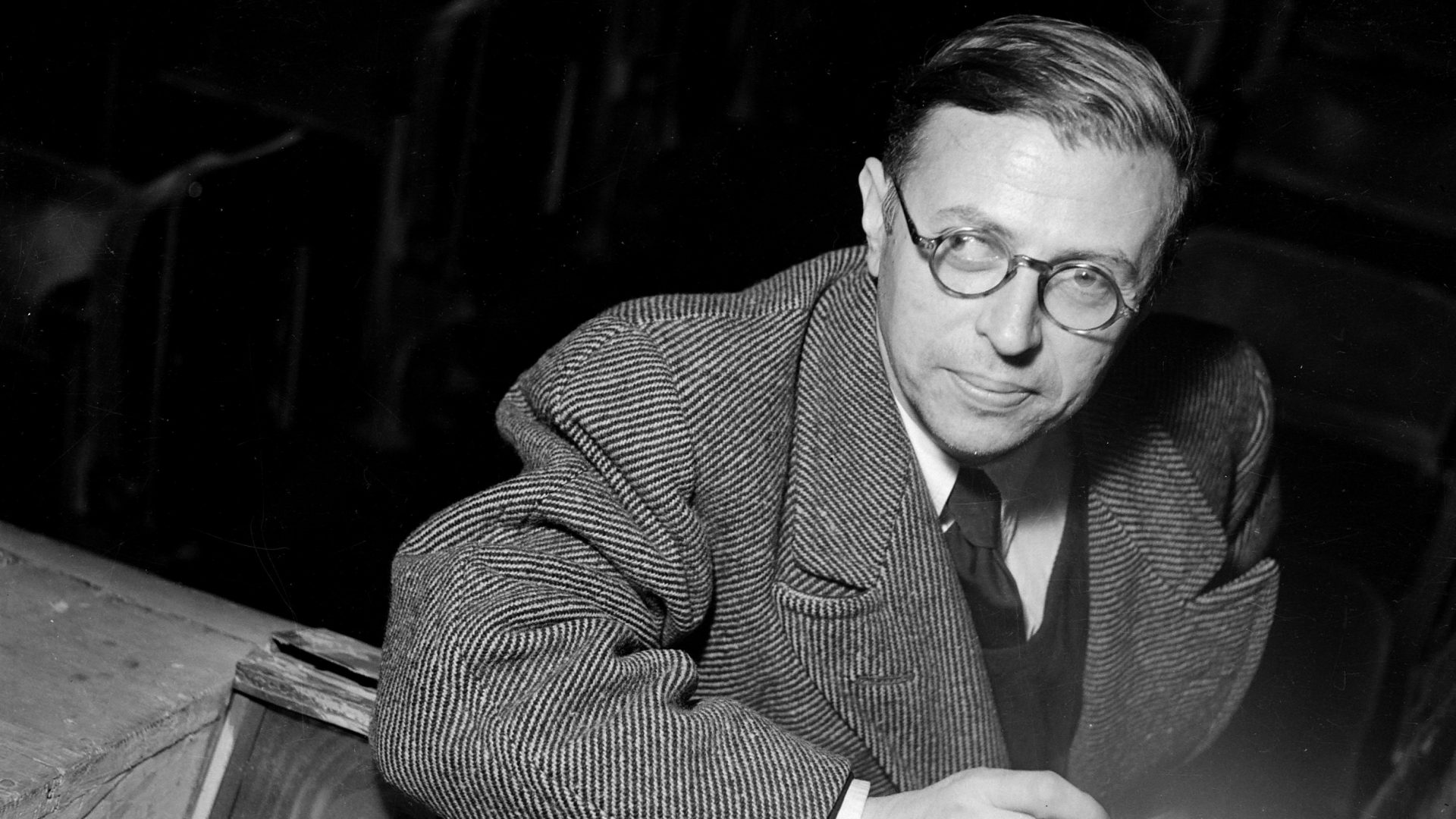
Jean-Paul Sartre during a rehearsal of his play La P... respectueuse in Paris, 1946.
Photo: Roger Viollet/Getty
When people speak of great creative pairings, among the Lennons and McCartneys and Powells and Pressburgers the names John Huston and Jean-Paul Sartre are never mentioned. There is a good reason for that.
A landmark in 20th-century culture beckoned when, in 1958, the American director of The Maltese Falcon and The African Queen invited the world’s foremost public intellectual and father of existentialism to write a screenplay based on the life of Sigmund Freud.
It should have worked. The men were the same age, of similar political persuasions and already admired each other. Cinema would be a new medium for Sartre, but he had written a string of successful works for the theatre, so he possessed both the transplantable skills and necessary philosophical insight. Huston’s offer of $25,000 sealed the deal, and Sartre threw himself into the commission.
The first sign of trouble was when the first draft whumped on to Huston’s doormat. Never less than thorough, Sartre had produced an intricately researched and detailed screenplay running to 300 pages which, Huston quickly calculated, would result in a film roughly five and a half hours long.
The director invited Sartre to his mansion in the west of Ireland to pare down the script, where the giant of Hollywood and giant of European thought struggled to find common ground, each unimpressed by the other. “Sartre was a little barrel of a man, and as ugly as a human being can be,” wrote Huston of their 1960 encounter. “His face was both bloated and pitted, his teeth were yellow and he was wall-eyed.”
“Huston isn’t even sad, he is empty,” Sartre wrote in a letter home to his partner, the writer and philosopher Simone de Beauvoir. “His emptiness is purer than death. He refuses to think because it saddens him.”
Over the course of a week that would have made a terrific screenplay in itself – Sartre proving impervious to Huston’s attempts at hypnotising him, Huston driving Sartre around Galway city searching for a dentist so Sartre could have a tooth extracted – the director suggested a series of cuts and Sartre returned home to rework his screenplay.
A few weeks later a package arrived at Huston’s door. Sartre’s revised script now ran to 700 pages; the film would be nearly 12 hours long. Freud: The Secret Passion was eventually made, but by then Sartre had long withdrawn from the project.
If the failure of the film collaboration was a loss to modern culture, Sartre remained emphatically in credit elsewhere. The possessor of one of the busiest and most analytically gifted minds of the modern age, he wrote plays, novels, articles for newspapers and magazines on subjects from jazz to architecture. He was also responsible for a string of philosophical texts, all seeking an answer to the ultimate question to which he dedicated his life: do we determine ourselves or are we made by external factors beyond our control?
To wrestle with that conundrum he chose not to cosset himself away in the protective cocoon of academia. Indeed, Sartre never completed a doctorate, and spent a large part of his adult life as a schoolteacher while disseminating his ideas and questions in more accessible realms.
He wrote and held court in cafes, notably holing up with de Beauvoir in the Café de Flore and Les Deux Magots on the Left Bank in Paris, and published his work not through stuffy, niche academic presses but the prestigious literary imprint Gallimard.
From his first novel La Nausée in 1938 Sartre frequently presented his philosophical ideas and arguments in forms designed to draw in the man in the street. Arguably his finest play, Huis Clos, was a philosophical conundrum requested by three actors who asked for a play in which all the characters shared equal status, had the same number of lines and all remained on stage throughout the performance.
While his popularity waned in his later years, and his work has swayed in and out of fashion since his death, in a Europe seeking answers to bewildering questions in the aftermath of the second world war, Sartre became a celebrity on a level hard to comprehend today.
Iris Murdoch met him in Brussels in 1945 and later recalled, “his presence in the city was like that of a pop star”.
In its obituary, the French newspaper Le Matin wrote, “You really needed to be 20 in 1954 to know what it could mean to a whole generation to have this man who dared all on his own to insist that the only important action was justice for the oppressed, that the violence of the colonised against the coloniser was justified, that a man could be right even against his country in the name of a superior ideal, which is man himself.”
The roots of his quest to discover the path to absolute human freedom lay in his childhood. His father died when Sartre was a baby, of which he later wrote, “Had my father lived he would have lain on me at full length and crushed me. As luck had it, he died young.”
With his mother, he moved to the house of his grandfather, a professor of German at the Sorbonne, and later developed a deep resentment of his mother’s new husband, “always the person I wrote against, all my life”.
When war broke out, Sartre was assigned to a meteorological station in Alsace where he raised daily weather balloons – “my vertical dimension, a vertical prolongation of myself, and also an abode beyond my reach”, before being captured as a prisoner of war in 1940. He passed his year in the camp giving inspiring lectures on philosophy and, unusually for a committed atheist, writing a nativity play performed by inmates whose call for social equality was so profound that one fellow prisoner was inspired to spend his life living and working among the poor.
After his release from the camp, the 1943 publication of his existentialist classic L’Être et le Néant (Being and Nothingness), was the catalyst for his extraordinary postwar fame. He seemed to be everywhere, “a rebel with a thousand causes” the New York Times called him, supporting a host of radical campaigns and turning down the 1964 Nobel Prize for Literature on the grounds that he never accepted accolades, “be it a sack of potatoes or the Nobel Prize”.
He became a reduced figure in his later years, his ideas out of fashion and a lifelong dedication to intense thought taking its toll. Edward Said recalled attending a seminar a few months before Sartre’s death where “he sat across from me, looking disconsolate and remaining totally uncommunicative, egg and mayonnaise streaming haplessly down his face”.
His exhaustion was understandable. For Murdoch, Sartre “described very exactly the situation of a being who, deprived of general truths, is tormented by an absolute aspiration”.
Perhaps the most telling analysis came in a passing comment from Sartre himself in a letter home to de Beauvoir from Huston’s Galway mansion in 1958. “I am not bored,” he wrote, “but I cannot work out why.”
Daily Hate: The Mail’s century-long quest to demonise migrants
It is arguably Britain’s most influential paper – which makes its long and ongoing history of vilifying refugees and asylum seekers even more troubling
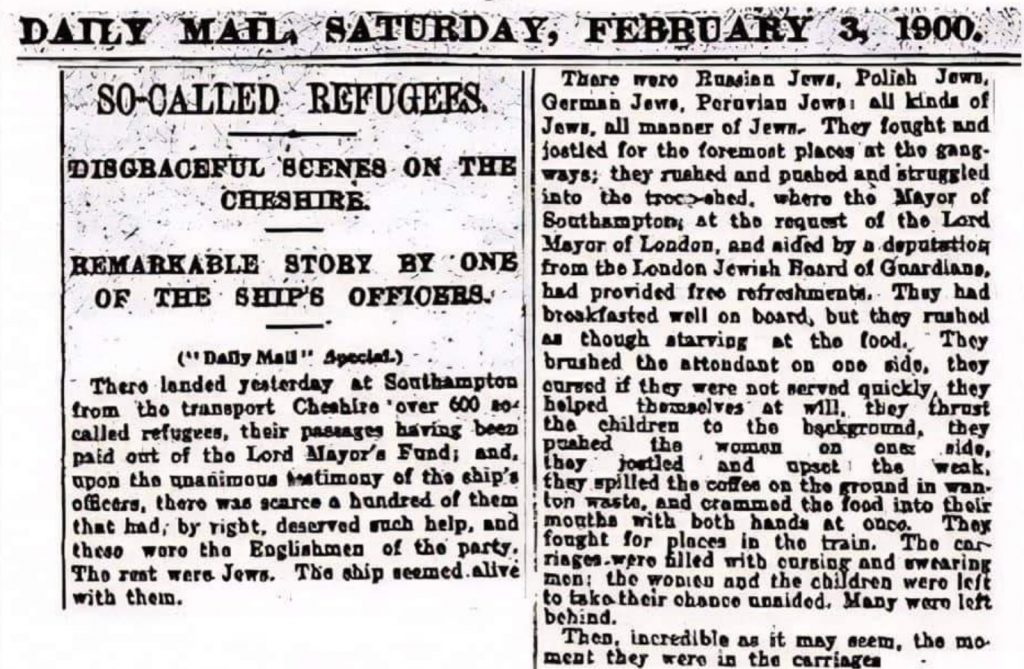
At first, it was the Jews – “Russian Jews, Polish Jews, German Jews, Peruvian Jews; all kinds of Jews, all manner of Jews”. Now it is the Albanians. In between, there were Austrians, Poles, Italians, West Indians, Somalis, Chinese, Irish, Sri Lankans, Kosovans, Bangladeshis, Eritreans, Sudanese, Poles (again), Romanians, Bulgarians, Afghans and Syrians (I’ve doubtless missed a few). All coming here without legitimate reason to benefit from the Great British way of life, take our jobs, sponge off our welfare state and mug, rape and murder our citizens.
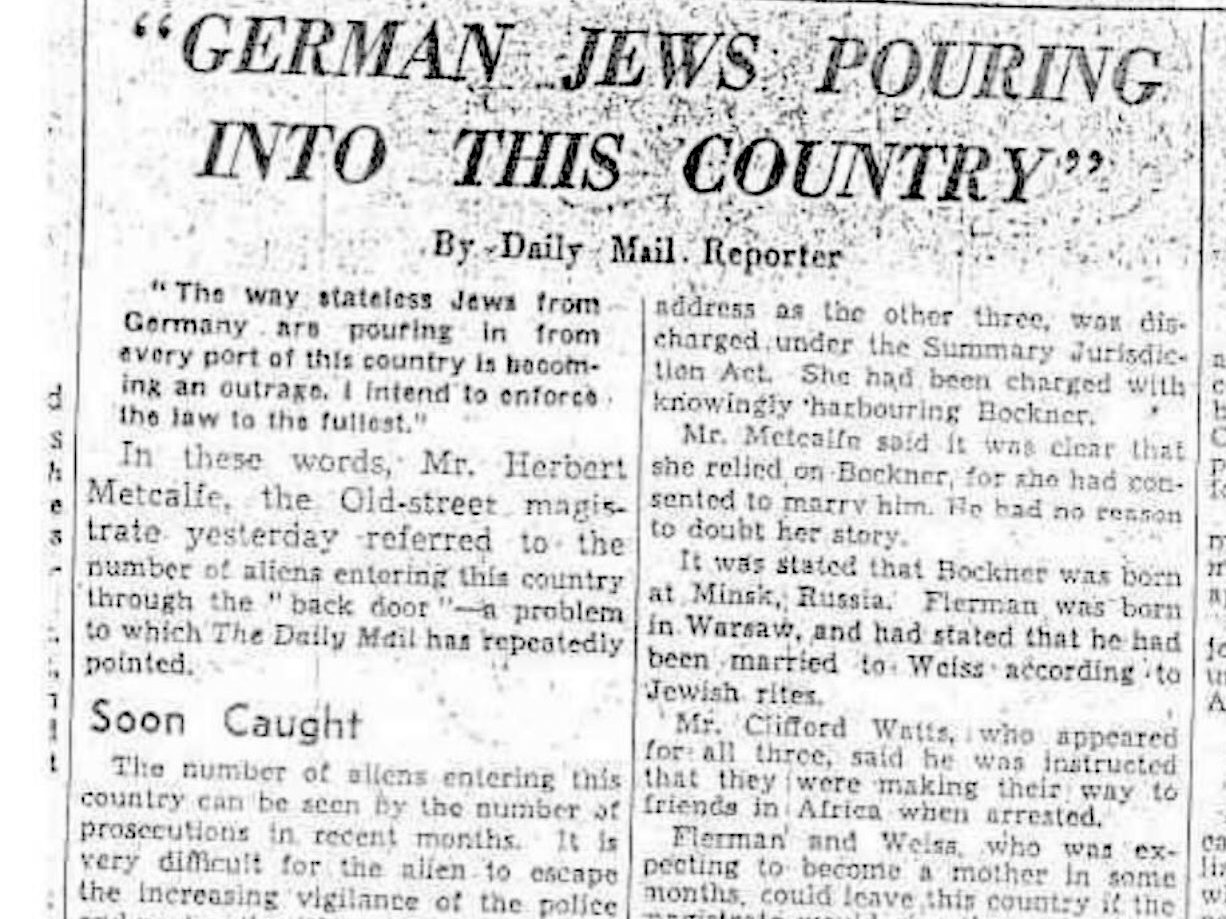
Such has been the history of refugees/asylum seekers/migrants as viewed by the Daily Mail over the past 120-odd years. As Prof Tony Kushner of Southampton University’s Parkes Institute put it more than 20 years ago: “The Daily Mail has been an anti-alien newspaper since the 1900s. There’s great continuity.” The nomenclature has changed (instead of “undesirable aliens” and “bogus asylum seekers” we now have “illegal migrants”), as has the provenance of those so-called, but the attitude has not: Britain is a generous host to the “deserving” displaced, but is regarded as a soft touch by those deemed not to warrant our hospitality.
That “Daily Mail special” report of a post-Boer war evacuation from February 3 1900 was headlined “So-called refugees” and began: “There landed yesterday at Southampton from the transport Cheshire over 600 so-called refugees, their passage having been paid out of the Lord Mayor’s Fund; and, upon the unanimous testimony of the ship’s officers, there was scarce 100 of them that had, by right, deserved such help, and these were the Englishmen of the party. The rest were Jews. The ship seemed alive with them.” It went on to describe in shocked tones the jostling, greedy, ill-mannered, foul-mouthed passengers.
The paper would never publish anything like that about Jewish people today – rather it accuses Jeremy Corbyn and Labour of antisemitism and Gary Lineker of insulting victims of the Holocaust – but it has used similar language this century in reporting “running battles” involving “mobs” of migrants (“Africans”, “Eritreans”, “Sudanese”, “Syrians”) “desperate to get to Britain” from the “squalid camp” in Calais – including two spreads on the day before the Brexit referendum. It is equally at home reporting similar disturbances in Germany, Sweden and elsewhere, with the incomers always the problem, rather than the often right wing locals going after them.
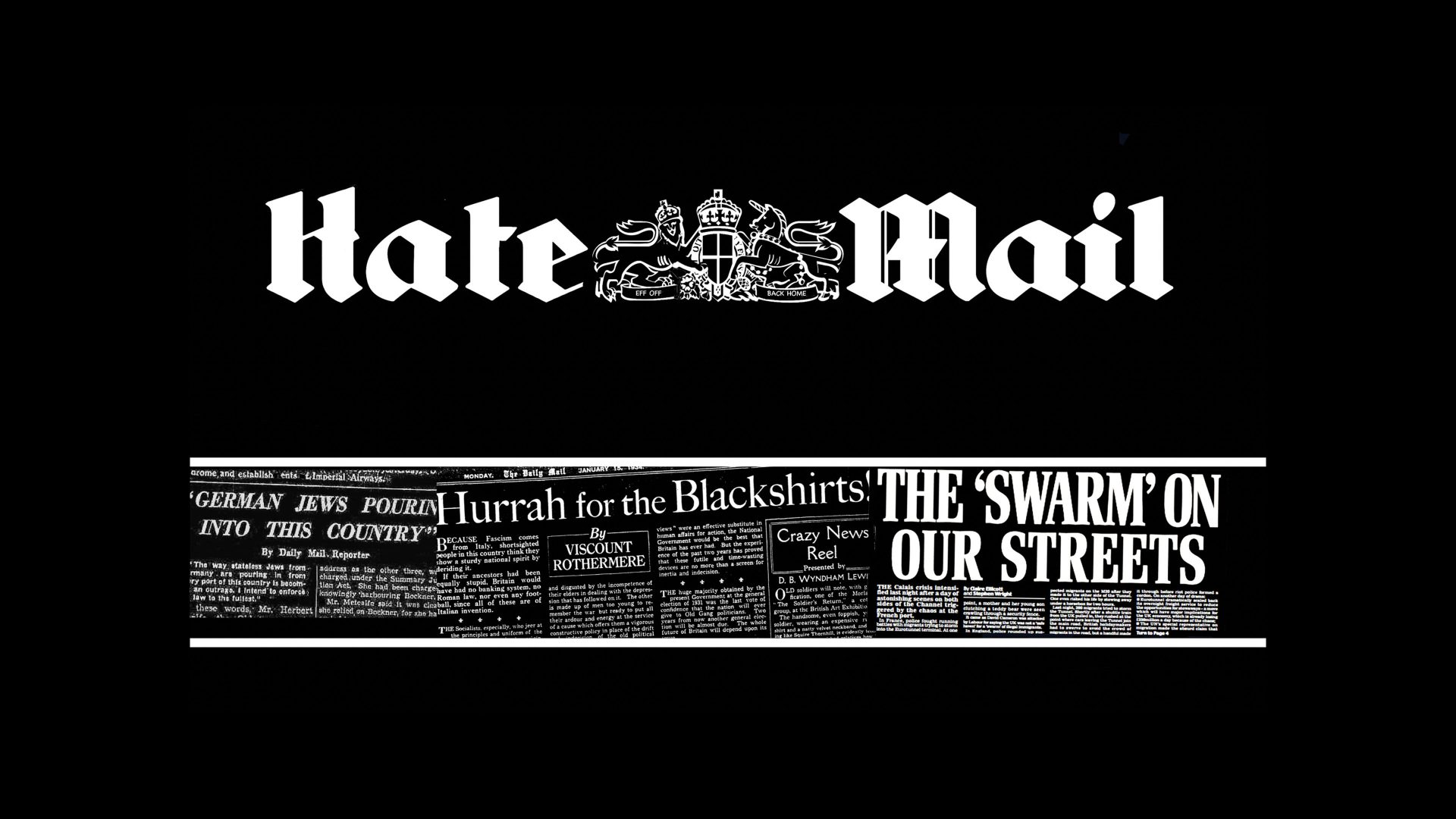
The Mail has a long history of anti-foreigner rhetoric stretching back to the 1900s
So it was in February after a Knowsley hotel accommodating asylum seekers was besieged by protesters. Unlike other papers, the Mail did not report the disturbances at the time, but it sent Sue Reid to investigate 10 days later. She identified the spark point as an Egyptian man accosting a 15-year-old girl and asking for her phone number, an incident filmed and shared on social media.
The ensuing protests, she continued, involved disgruntled locals, “pro-migrant groups” including “activists” from the Care4Calais charity, and members of the Communist Party. Late in the story, she said that left wingers, including the Guardian, had accused the far right of fomenting the disorder, but she declined to endorse or investigate the claim. She did, however, say that the far right Patriotic Alternative had set its sights on Skegness, where migrants and refugees had also been accommodated in hotels.
High in the piece, Reid reported that “ordinary” mothers, fathers and grandparents feared that the influx of young men posed a threat to their children, claiming they were “making a nuisance of themselves, chasing girls, hanging around in parks and abusing Britain’s generous hospitality”.
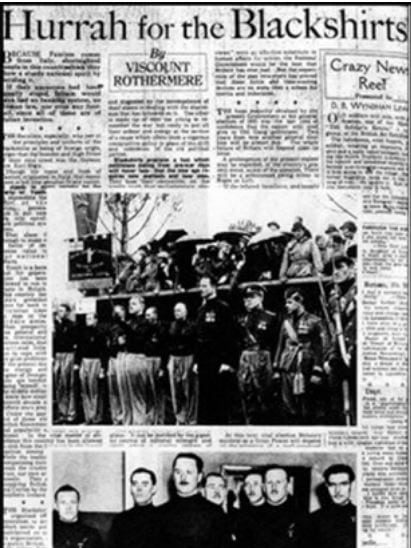
During the 1930s, the Daily Mail ran many headlines and editorials in support of fascist regimes
It is, of course, natural for people to be concerned when a large number of strangers are imposed on their community, but one of the reasons this is happening is that the bureaucracy of processing applications (not people) isn’t working. This is not the asylum seekers’ fault. It is quite legitimate for a reporter such as Reid to examine the impact on local life, but the Mail shows scant, if any, interest in talking to the people waiting for their fates to be decided. Rather, Reid was happy to suggest that it was unreasonable for destitute people whose “home” is a hotel room and who are forbidden to work – as asylum seekers are – to spend their time “hanging around” in parks. Isn’t that the most obvious thing for them to do? It’s free.
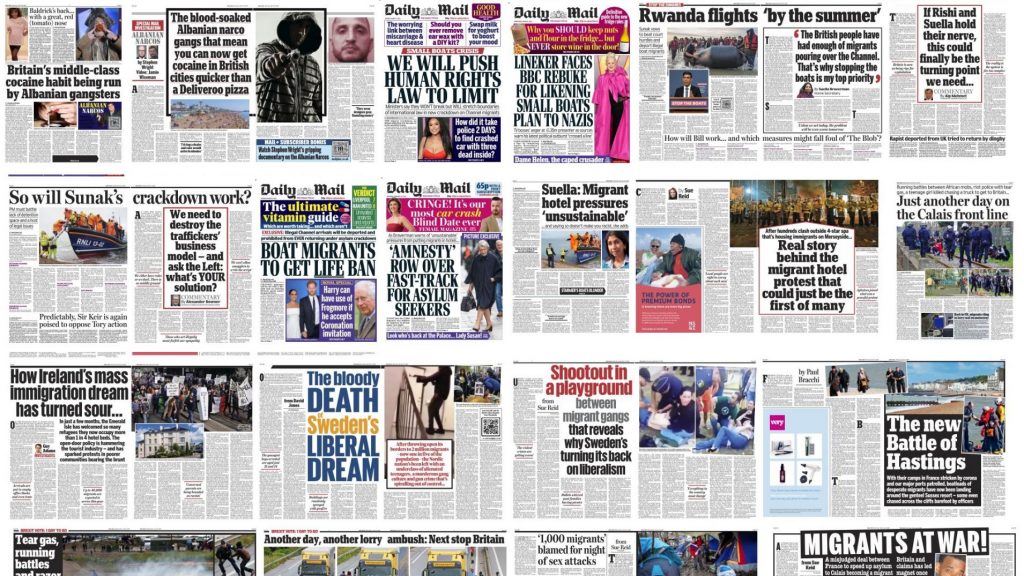
Four months earlier, Reid reported on a “playground shootout” between migrant gangs that explained “why Sweden is turning its back on liberalism”, and on the day after the Knowsley riot, David Jones produced a spread on “The bloody death of Sweden’s liberal dream”. The following week Guy Adams investigated “How Ireland’s mass immigration dream has turned sour”. You might say there’s a theme here.
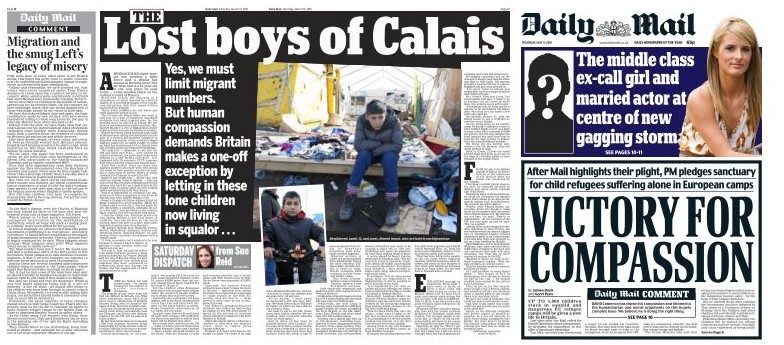
It doesn’t have to be this way. Early in 2016, a Reid report was instrumental in convincing her paper that Britain should rescue lone children from the Calais Jungle. The Mail put pressure on then-prime minister David Cameron, who had previously ruled out accepting 3,000 migrants, and was soon splashing on its “Victory for compassion”. (Eventually, though, Theresa May’s government abandoned the scheme and the Mail forgot its campaign, reporting the decision at the foot of page 6.)
The Mail presents itself as being in tune with public sentiment, and it seems it was at the time of that Cheshire report in 1900, since a public backlash against the arrival of up to 150,000 of 2.5 million Jews fleeing pogroms in eastern Europe led to the 1905 Aliens Act, which pulled down the shutters. Today it thinks it is again reflecting the views of the “British people” in demanding action to “control our borders” and “stop the boats”, and in chiding Sir Keir Starmer for not supporting the Illegal Migration bill that will deny anyone arriving here by unconventional means the right to put their case for sanctuary.
Whether it is right this time is open to debate. The latest Ipsos survey of “issues that matter” to voters had immigration fifth on the list – behind the economy, the cost of living and the NHS – being mentioned by only 12% of those interviewed (down from 13% the previous month). People were more concerned about a lack of faith in politicians.
The Mail’s report on the Cheshire in 1900. Today it thinks it is again reflecting the views of the “British people” in demanding action to “stop the boats”
If passed, the Illegal Migration bill will be the 166th adjustment to the laws relating to immigrants since the Conservatives took office in 2010, quite apart from more than 40 initiatives designed to stop the small boats since 2019. These, as documented by the Guardian, include multiple attempts to “work with France”, using border force ships, jet skis and the navy to send the boats back, lining up third countries to take their unwanted passengers, buying ads on Facebook and banning social media posts “glamourising the crossings”.
Most, if not all, of these have been enthusiastically supported by the Mail (and the Sun, Express and Telegraph), which seemed almost to see it as a badge of honour that the latest effort would “push human rights law to the limit”. There have been frequent “this is the turning point” headlines and guest columns by the minister in charge.
Eleven months ago, Priti Patel wrote that anyone could see the asylum system was broken but her New Plan for Immigration, including sending people to Rwanda, would provide a firm but fair system to meet the people’s priorities. More recently Suella Braverman – who took journalists from favoured outlets, including the Mail and GB News, on a misfiring photo-opportunity trip to Rwanda – was the byline-of-the-moment, along with the headline “The British people have had enough of migrants pouring over the Channel. That’s why stopping the small boats is my top priority.” In this piece, she expanded on her Commons statement that “100 million people could qualify for asylum – and let’s be clear, they are coming here” to add that, on top of the 100 million, there were “likely billions more eager to come here if possible”.
Fact-checking ministers’ pronouncements is not always a priority for the Mail – nor is contextualising. So it did not point out that while there are 100 million displaced people around the world, about half of them are in their own countries and showing no desire to move abroad; nor did it question where the “likely billions” notion came from. Nor did it tell readers that “generous” Britain stands 18th when included in a league table of EU+ countries (the 27 plus Switzerland and Norway), in taking in refugees, at nine per 10,000 population, against an EU average of 14.
Or that we aren’t the automatic country of choice. According to the UNHCR, 44,190 people sought asylum here in the year to September 2022, 8% of the total number of applications to the EU+ and the UK. Germany had 127,730 applications and France 95,510. And all of these numbers are dwarfed by Turkey, whose population of 80-odd million includes nearly 4 million refugees. In November last year, 231,597 refugees lived in our islands, whose total population is 67.5 million.
The Daily Mail in 1938. It still has the same message against asylum seekers today
The Mail did, however, report that the number of asylum seekers awaiting a decision had reached 166,000 and, indeed, that when cases are considered, three-quarters of applicants are allowed to stay. It keeps a tally on the thousands of people landing in small boats, but puts them in the context of the total number of people heading to the country only when official migration statistics are published. As Gary Lineker so controversially tweeted, there is no “huge influx”. A million people came to live in the UK in the year to last June (and half a million left), while in 2022, just under 46,000 arrived in small boats. And the government has recently admitted that there is no evidence to support an assertion by Patel that “70% of individuals on small boats are single men who are effectively economic migrants”.
Nor is the Mail interested in the individuals making that dangerous crossing. It focuses on Albanians – it recently ran a “special” on the Albanian drugs mafia feeding our “middle-class cocaine habit” – and looks away from the Afghans and Syrians desperate to escape the Taliban or Bashar al-Assad’s regime.
The Imix organisation tries to tell these people’s stories – to “give voice to the scapegoats” – by working with the media, but it reaches only the usual suspects: the Guardian, Independent and Metro, “never the Mail, Sun or Telegraph”. The Express, however, did approach it after seeing readers’ response to the Ukraine exodus, setting up its own help scheme before the official one was up and running.
Does any of this matter? Aren’t newspapers a dying commodity? Yes, but their output not only sets the news agenda for broadcasters, and influences politicians, but also is shared widely on social media – Imix’s chief executive, Jenni Regan, cites research showing that the Mail is the top content provider thrown up by searches for “migrants”.
Kushner at Southampton University, who thinks the Sun is worse than the Mail on this, says: “The Mail has been not totally hostile to Ukrainian refugees – white, European, Christian – as against those who come from the developing world who are non-white, often Muslim and therefore not ‘civilised’. Yet even with the Ukrainians, they seem keen to highlight the problems that have inevitably happened with a scheme that was pretty much unregulated.
“What has changed is the context: in the 1900s it was pro-empire and trying to attract a lower middle-class/upper working-class, newly literate audience to tell them what to think about the nation. The context now is post-imperial, post-EU, and the insular nationalism that has emerged. In both cases the alien ‘other’ can be blamed for all sorts of real problems, but not ones that the newcomers have caused.”
A report last autumn by the campaign group Stop Funding Hate (SFH) welcomed a reduction in “vitriolic and unequivocally hateful” coverage of migration and a significant reduction in international alarm at our press compared with the Brexit referendum period. But it still warned that “subtle” anti-migrant narratives, such as linking migrants to child abuse and crime, and the use of words such as “surge”, could have a greater impact on public perceptions than the “more obviously problematic” headlines. The cumulative effect was to give readers “permission” to hold or act on prejudiced views. Its founder, Richard Wilson, also pointed to the arrival of GB News. Its audience might be small, but the press amplified its messages and the channel was “retoxifying” public discourse.
Another campaign group, Hope Not Hate, has meanwhile highlighted what it sees as a growing symmetry between mainstream politicians and newspapers, with their “anti-woke agenda”, and the far right in focusing on the same issues and using the same “divisive narrative” in phrases such as “invasion” and “activist lawyers”. In a report last month, entitled “State of hate 2023: Rhetoric, racism and resentment”, it said: “While the organised far right is the most committed and vocal when it comes to the issue of cross-Channel migration and asylum-seeker accommodation, its position and even its rhetoric have been dangerously mirrored by the mainstream.”
Many people, it says, are angry, scared, detached and disillusioned as well as increasingly poor, a “dangerous mix” that it thinks the far right is seeking to exploit. “The danger of this potent mixture of far right agitation and local anger, fostered by irresponsible behaviour from mainstream politicians and some journalists” was, it continues, made plain by the petrol-bomb attack on an asylum centre in Dover last October, and the recent disturbances in Knowsley.
These were at least reported (eventually, in the case of Knowsley) across the press. But these incidents are becoming more common. Hope Not Hate logged 253 activist “visits” to accommodation housing immigrants and asylum seekers last year – twice as many as the previous year.
As Kushner notes, the Mail has become the shorthand for the entire right wing press because of its circulation, its influence with politicians – “both Tories and Labour being frightened of it or what it says” – and its infamous flirtation with fascism in the 1930s. Indeed, the Sun and Telegraph and, to a lesser extent, the Express and Times are saying much the same thing, giving “Suella” a platform and a microphone while trying to silence critics.
Remember, Braverman was confronted to her face about her use of the word “invasion” by an actual Holocaust survivor, and refused to apologise. Yet she demanded that Lineker say sorry over his language likening her rhetoric to 1930s Germany. The logical extension of that is that the Holocaust survivor should have been the one to apologise to Braverman, not the other way around.
The Mail did campaign in favour of bringing lone children in the Calais Jungle to Britain, but its campaign was dropped when Theresa May’s government abandoned the scheme
If politicians and their newspaper supporters cared about the people on those boats, it would be one thing. But they don’t. They talk about stopping the traffickers who put them in peril; but that is window dressing. The real objective is not to stop the trade in misery, but to stop the poor souls who are paying the ferrymen.
There’s an irony to this. The big complaint is that the people on the boats are overwhelmingly young men. We have an ageing population and an acute labour shortage; the government is trying to entice young parents and the over-50s back to the workplace. The Mail rails about seven million “idlers” who got a taste for a life of leisure during the pandemic.
We need people to work and pay taxes, yet we are busting a gut to exclude healthy young people willing to do both without needing education or hip replacements. Isn’t it worth finding out who some of these people are and what they have to offer? Of course not. They are all criminals. Let’s put on the blinkers and send them somewhere else.
Liz Gerard is a former Times executive who now writes about print journalism. Her book Trussed Up, about the Mail and the Tory leadership, published by Bite-Sized Books, is available from Amazon
Jacobus Vrel: Searching for the father of Vermeer
The genius of a mysterious and overlooked painter is revealed at a new exhibition in The Hague
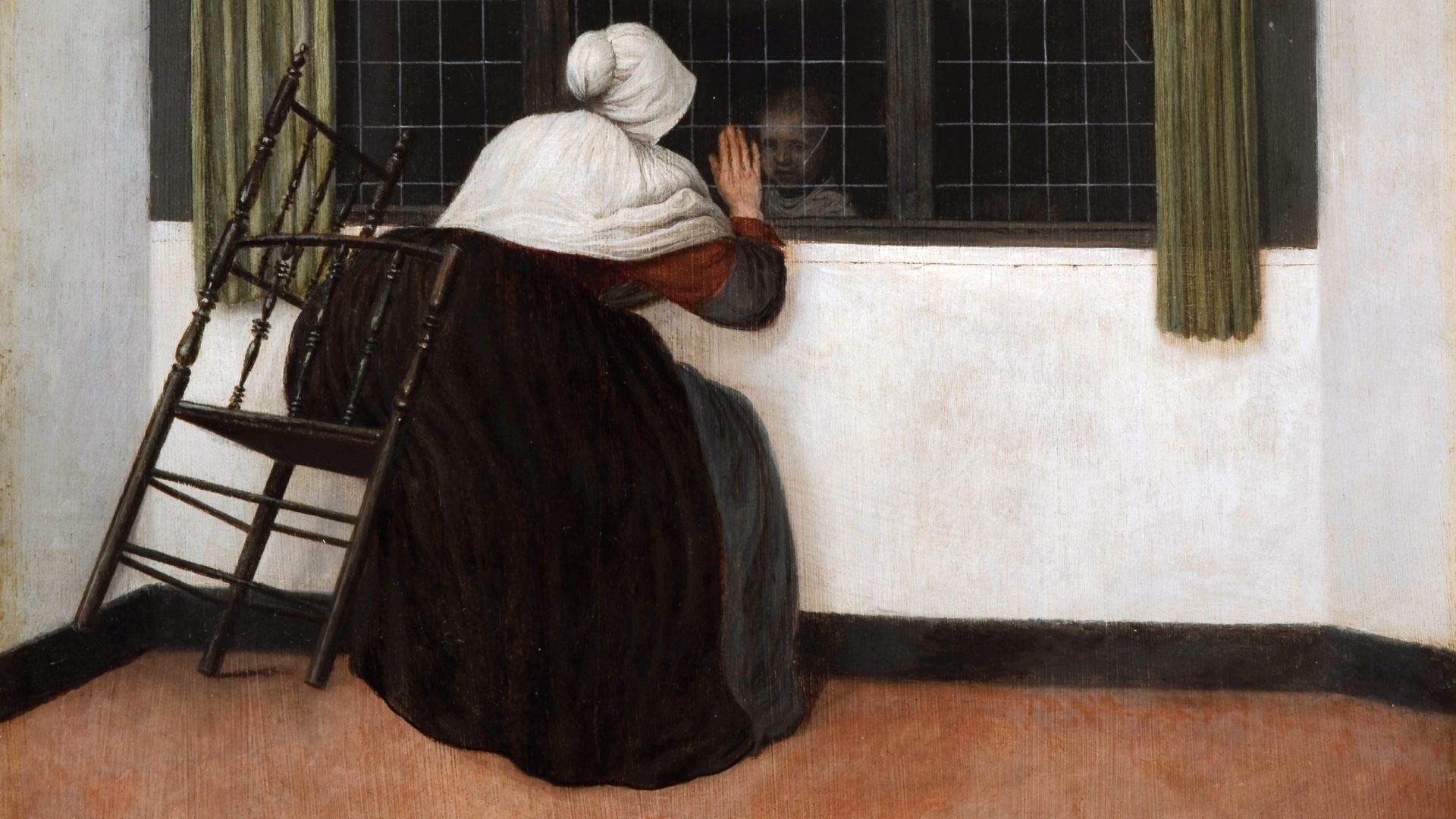
Jacobus Vrel’s Woman at a Window, Waving at a Girl c.1654-1662. Photo: Fondation Custodian
Johannes Vermeer has never been hotter. More than 200,000 people bought tickets to the Amsterdam “family reunion” exhibition which collects together 28 of his greatest works, and they will continue to walk in wonder through the Rijksmuseum until June. But the real intrigue lies an hour away, in The Hague.
At the Mauritshuis, Vrel, Vorgänger von Vermeer (Vrel, Forerunner of Vermeer) is a chance to see 13 paintings by one of the finest Dutch artists of the 17th century. Jacobus Vrel (active from the 1630s-60s) produced exquisite paintings of street scenes and domestic interiors before Vermeer, many of whose greatest works were created in the decade before his death in 1675.
For many years, 25 of Vrel’s 49 known paintings were lauded by art critics, dealers, and collectors as the work of Vermeer. Then, in the late 19th century, a keen-eyed art dealer spotted differences in signatures. He researched further and discovered that Vrel was the originator. Delving further, it was found that paintings by Vrel had been credited to major Dutch painters to be sold for greater amounts.
The Mauritshuis exhibition seeks to reset Vrel’s place within the golden age of Dutch art. It is a collaboration of years of joint research by the Bayerische Staatsgemäldesammlungen in Munich, the Fondation Custodia, Frits Lugt Collection in Paris and the Mauritshuis, and the painstaking work pays off spectacularly.
Jacobus Vrel is an enigma. His identity is a mystery. There are no letters, no will, no records of baptism, marriage or death or guild memberships, to discover who he was. His epitaph is written in less than 50 paintings and one drawing of a street scene, authenticated to be his work. Without specific records, the researchers have focused on signed paintings, and one official document listing three artworks in the collection of Archduke Leopold Wilhelm of Habsburg (1614–1662).
From 1647 to 1656 the Archduke, stadtholder of Brussels, governed the region known as the Southern Netherlands. A voracious collector of art, he acquired many works during his stay, obtained under the guidance of the keeper of his gallery, David Teniers the Younger (1610-90). The collection was sent to Vienna when the Archduke left Brussels. Vrel’s paintings were listed in a 1659 inventory of this collection that became the foundation of the Picture Gallery at the Kunsthistorisches Museum, Vienna.
Vrel’s inclusion in the catalogue of over 1,400 works, which contained Italian and northern European paintings by notable artists, gives an indication that he was collectable and recognised. Nevertheless, the charming Landscape with Two Men and a Woman Conversing (Kunsthistorisches Museum, Vienna) created before 1656, and listed as one of the three paintings in the Vienna collection, was attributed for years to the German artist Johannes Lingelbach (1622-74), a painter from Frankfurt who died in Amsterdam.
It was not until 2016 that Vrel was acknowledged as the originator. It had been listed as an original work by “Jakob Fröll” in the 1659 record. It is his only known landscape. The painting was cleaned for this presentation and the removal of a thick layer of deeply-yellowed varnish revealed the bright blue sky, and foreground colours. It is a stunning painting.
The setting of people meeting one another is a regular feature of Vrel’s street scenes, on this occasion transferred to the countryside. The two other paintings listed in the 1659 inventory were Woman Leaning out of an Open Window, 1654 (Kunsthistorisches Museum, Vienna) and Interior with a Woman Sleeping by the Fireplace, before 1656 (The Leiden Collection, New York).
Researchers have used dendrochronological analysis to study the tree rings in the wood panel paintings. Their findings suggest the works to be older than first thought: around 1635-40 for street scenes and 1650s for interiors. They have looked more closely at the clothing worn by Vrel’s subjects, and the architecture of the street buildings, to attempt to identify dates and locations. And while Jacobus Vrel continues to elude the most specialist researchers of Dutch art, his paintings are accepted as the work of one of the finest Dutch painters of the 17th century.
And yet, he disappeared from view in the late 1600s, and is not mentioned by art biographers, or recorded in art auctions or catalogues for nearly two centuries. His works were attributed to other painters including Vermeer, Pieter de Hooch (1629-84), Isaac Koedijck (1617–c.1668), and Lingelbach. It was only after an art dealer handling Dutch paintings looked more closely at the signatures – Vrel had quite a few variations including J.V., Jacobüs Vreel, Jakob, J., Frëll , Frel and Fröll – to discover that Vrel was a forerunner to Vermeer. This is significant because Vrel, like Vermeer and de Hooch after him, created remarkable works of domestic interiors and street scenes.
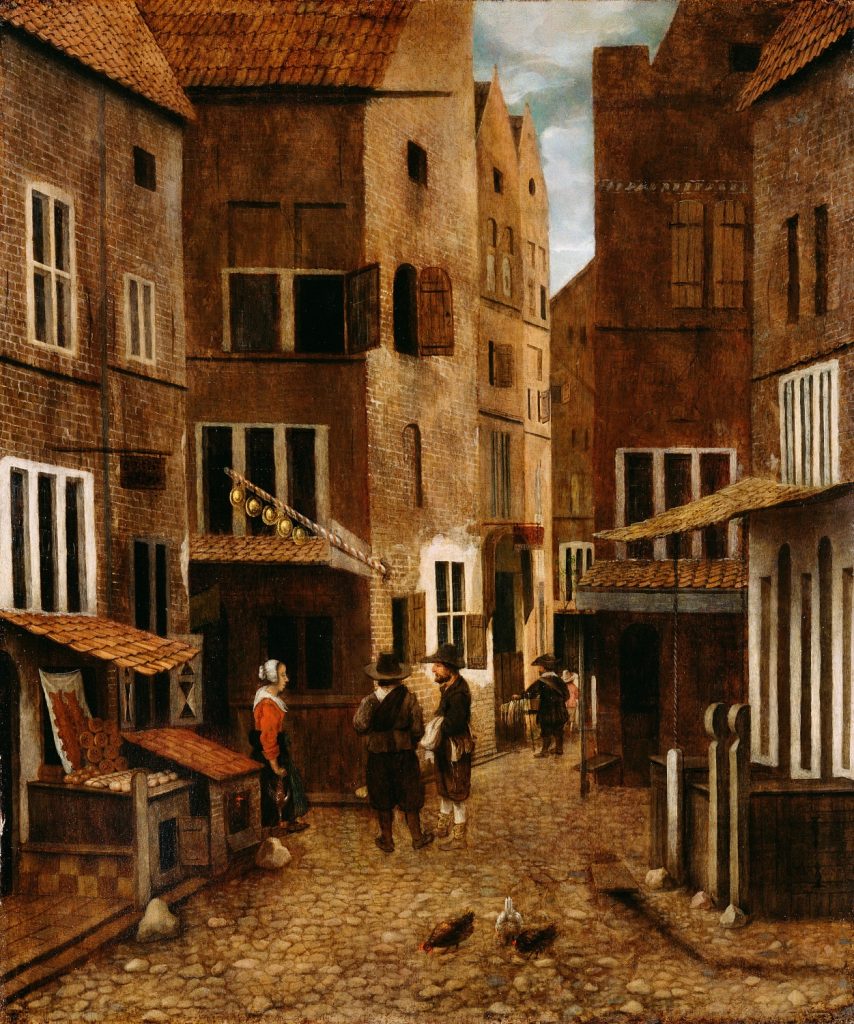
But where did Vrel work? Two oil-on-panel paintings, Street Scene with a Bakery by the Town Wall, presumably the Waterstraat in Zwolle, after 1646 (Private Collection) and Street Scene with a Woman Seated on a Bench, after 1650 (Rijksmuseum) are in the exhibition. The reference to Zwolle, a city located in north-east Netherlands is determined from the town wall and the buildings’ architectural features.
It would place Vrel in that location, particularly as two further versions with alterations to architectural detail were painted later by Vrel around 1653. Of equal interest is his use of a portrait, not landscape format, which brings the buildings closer together, creating a community atmosphere with people on the narrow streets.
Street Scene, Jacobus Vrel, c.1654-1662. Photo: Sepia Times/Universal Images Group/Getty
All were created prior to Vermeer’s View of Houses in Delft (The Little Street), 1658-59 (Rijksmuseum), and Pieter de Hooch’s many paintings with a street location. This is not to say that other artists copied Vrel. The content of works of this period are saturated with public and domestic interiors – Jan Steen (1626-79) was a master of this genre – as cityscapes, topographic views and street scenes were popular and sold on stalls in marketplaces, and by art dealers in galleries and varied locations including bakeries and inns. Residents, from small cottages to large mansions, had artworks on their walls.
Domestic interiors painted by Vrel have immense empathy with Dutch life. The paint-palette is near monochromatic in its use of browns, greys, white, off-white, black and yellow. He captures both the private and public lives of ordinary people in simple settings.
Woman Leaning out of the Window, 1654 (Kunsthistorisches Museum, Vienna) depicts a plain room softly lit with natural light. A matronly woman leans out of a window as sunlight and air filter into the room. The woman’s cap and shawl is bright white, drawing attention to her and what she is doing. She is perhaps talking to an unseen person, bringing together the inside and outside environment.
Vrel places the viewer in the room to witness a typical moment in her day. On the right is a fireplace and a low wooden chair, and at the centre a table with sewing placed on it. A perforated box, the footwarmer is between the table and chair. Has she put down her work to chat to someone? Vrel draws the viewer in.
On the left, there is a cupboard with a hat and coat hanging up. And here below the coat is a signature and date: “J. Frel 1654”. This is the only known painting to be dated by Vrel. His signed-only paintings included a trademark trompe-l’oeil piece of paper recording his name. A scrap of white paper signed “J Vrel” is on the wooden floor in one of the most exquisite works, A Seated Woman Looking at a Child through a Window, after 1656 (Fondation Custodia, Paris).
The mature woman appears again, tending the fire in Woman at the Hearth, 1654-62 (Rijksmuseum, Amsterdam). The fireplace, chair and footwarmer appear, which places the artist in the same location. Was this his home, or lodgings? The woman bends to stoke the fire under a copper pot in the fireplace. Vrel has used warmer colours, a hint of red for her sleeve and warmer-yellow tiles on the mantelpiece.
Its ledge has Dutch plates. There is a fire-screen by the chair. These are subtle cinematic scene-setters, so simple yet atmospheric and compelling. The faces are unseen, possibly to market the works as typical but anonymous domestic settings. Some do show facial features, as in Interior with a Woman Combing a Girl’s Hair, and a Boy at a Dutch door, after 1649 (Detroit Institute of Arts, Michigan); and An Old Woman Reading, with a Boy behind the Window, after 1655 (The Orsay Collection).
A major starting point for researchers is to attempt to find where Jacobus Vrel was born. The various signatures he used included umlauts, indicating possible German origins, but this was in an era when names were often changed depending on where people lived. Vrel may have travelled between countries to work. Albrecht Dürer’s father altered his Hungarian surname when living in Nuremberg.
Since Vrel’s rediscovery in the 19th century, scholars have attempted to unearth his origins. Without archival documentation, theories have surfaced to suggest his birthplace to have been from as far as the Baltic Sea to the United Northern Provinces and the Southern Netherlands, or possibly Westphalia in Germany. No evidence has materialised after years of research. He remains an enigma. The paintings alone mark Vrel’s place in history.
Vrel, Forerunner of Vermeer is at the Mauritshuis, The Hague until May 29 and then at Fondation Custodia, Paris from June 17 – September 17
Thailand discovers new rare plant species
A new species of flowering plant has been discovered by a group of researchers at Thailand's Chiang Mai University's Faculty of Science.
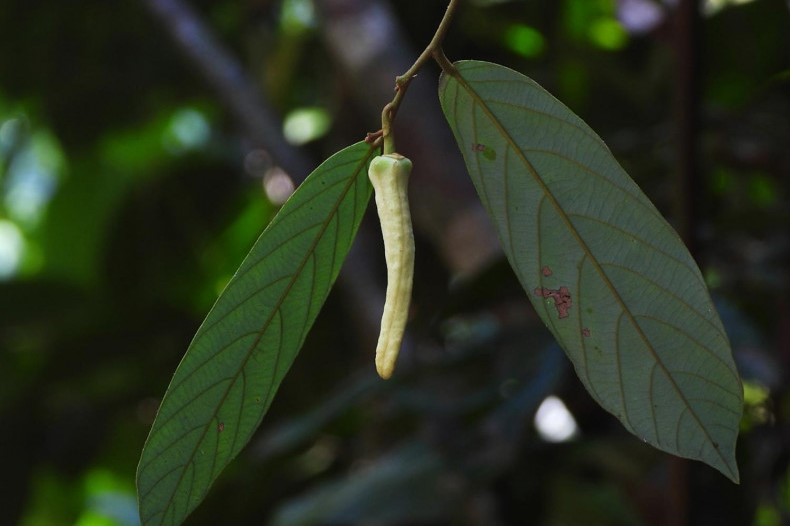
A newly discovered flowering plant has been called 'bunga lalisa' in Thai. It is named in honour of Lalisa 'Lisa' Manoban of the K-pop band Blackpink.
(Photo: Biodiversity CHM Thailand)
Bangkok (VNA) - A new species of flowering plant has been discovered by a group of researchers at Thailand's Chiang Mai University's Faculty of Science.
The species was found in Narathiwat province, one of the southern localilties of the country and shares a border with Malaysia.
The plant has been named in honour of the Thai-born K-pop singer Lalisa "Lisa" Manoban, who is a member of the Republic of Korean girl group, Blackpink. One of the members of the research team was inspired by Lisa to pursue her doctorate degree.
The plant, which belongs to the Annonaceae family, is fragrant. Due to its extreme rarity, it is at one of the highest risks of extinction.
The project is aimed at studying the taxonomy and evolution of rare and unknown plants in the Annonaceae family in Thailand for conservation, with support from the Thailand Science Research and Innovation./.