Monday, June 12, 2023

UN backs idea of creating global AI watchdog to tackle misinformation

UN Secretary-General Antonio Guterres says such a model could be "very interesting" but notes that "only member states can create it, not the Secretariat of the United Nations".


REUTERS

Generative AI technology that can spin authoritative prose from text prompts has captivated the public since ChatGPT launched six months ago and became the fastest growing app of all time. 


UN Secretary-General Antonio Guterres has backed a proposal by some artificial intelligence executives for the creation of an international AI watchdog body like the International Atomic Energy Agency (IAEA).

"Alarm bells over the latest form of artificial intelligence – generative AI – are deafening. And they are loudest from the developers who designed it," Guterres told reporters on Monday. "We must take those warnings seriously."

He has announced plans to start work by the end of the year on a high-level AI advisory body to regularly review AI governance arrangements and offer recommendations on how they can align with human rights, the rule of law and the common good.


But he added: "I would be favourable to the idea that we could have an artificial intelligence agency ... inspired by what the international agency of atomic energy is today."

Guterres said such a model could be "very interesting" but noted that "only member states can create it, not the Secretariat of the United Nations".

The Vienna-based IAEA was created in 1957 and promotes the safe, secure and peaceful use of nuclear technologies while watching for possible violations of the Non-Proliferation Treaty (NPT). It has 176 member states.

Generative AI technology that can spin authoritative prose from text prompts has captivated the public since ChatGPT launched six months ago and became the fastest-growing app of all time.

AI has also become a focus of concern over its ability to create deepfake pictures and other misinformation.


Summit on AI safety regulation

ChatGPT's creator OpenAI said last month that a body like the IAEA could place restrictions on deployment, vet compliance with safety standards and track usage of computing power.

British Prime Minister Rishi Sunak has also supported the idea and said he wants Britain to be home to global AI safety regulation.

Britain is due to host a summit later this year on how coordinated international action can tackle the risks of AI.

Guterres said he supported the plan for a summit in Britain, but said it should be preceded by "serious work".

He said he plans to appoint in the coming days a scientific advisory board of AI experts and chief scientists from UN agencies.


SOURCE: TRTWORLD AND AGENCIES


Homework will ‘never be the same’ says ChatGPT founder

ByAFP
June 12, 2023

ChatGPT burst into the spotlight late last year, sparking huge investment but also widespread criticism - Copyright AFP/File Marco BERTORELLO

Artificial intelligence tools will revolutionise education like calculators did, but will not supplant learning, ChatGPT’s founder Sam Altman told students in Tokyo on Monday, defending the new technology.

“Probably take-home essays are never going to be quite the same again,” the OpenAI chief said in remarks at Keio University.

“We have a new tool in education. Sort of like a calculator for words,” he said. “And the way we teach people is going to have to change and the way we evaluate students is going to have to change.”

ChatGPT has captured the world’s imagination with its capacity to generate human-like conversations, writing and translations in seconds.

But it has raised concern across many sectors, including in education, where some worry students will abuse the tool or turn to it rather than producing original work.

Altman was in the Japanese capital as part of a world tour where he is meeting business and political leaders to discuss possibilities and regulations for AI.

He has regularly urged politicians to draft regulations for AI, warning “if this technology goes wrong, it can go quite wrong”.

“The tools we have are still extremely primitive relative to tools we are going to have in a couple of years,” he said Monday, again urging safety measures and regulation.

He said he felt “positive” about new regulatory frameworks for AI after meeting world leaders, without offering details, but reiterated his fears.

“We will feel super responsible, no matter how it goes wrong,” he said.

He also repeated previous attempts to calm fears that AI could make many existing jobs obsolete, though he conceded that “some jobs will go away”.

“I don’t think it is going to quite have the employment impact that people expect,” he added, insisting that “new classes of jobs” will emerge.

“Almost all of the predictions are wrong,” he said.


CRIMINAL CAPITALI$M
Can you trust your ears? AI voice scams rattle US

By AFP
June 12, 2023

Can you trust your ears? AI voice scams rattle US - 
Copyright AFP Chris Delmas

Anuj Chopra and Alex Pigman

The voice on the phone seemed frighteningly real — an American mother heard her daughter sobbing before a man took over and demanded a ransom. But the girl was an AI clone and the abduction was fake.

The biggest peril of Artificial Intelligence, experts say, is its ability to demolish the boundaries between reality and fiction, handing cybercriminals a cheap and effective technology to propagate disinformation.

In a new breed of scams that has rattled US authorities, fraudsters are using strikingly convincing AI voice cloning tools — widely available online — to steal from people by impersonating family members.

“Help me, mom, please help me,” Jennifer DeStefano, an Arizona-based mother, heard a voice saying on the other end of the line.

DeStefano was “100 percent” convinced it was her 15-year-old daughter in deep distress while away on a skiing trip.

“It was never a question of who is this? It was completely her voice… it was the way she would have cried,” DeStefano told a local television station in April.

“I never doubted for one second it was her.”

The scammer who took over the call, which came from a number unfamiliar to DeStefano, demanded up to $1 million.

The AI-powered ruse was over within minutes when DeStefano established contact with her daughter. But the terrifying case, now under police investigation, underscored the potential for cybercriminals to misuse AI clones.

– Grandparent scam –


“AI voice cloning, now almost indistinguishable from human speech, allows threat actors like scammers to extract information and funds from victims more effectively,” Wasim Khaled, chief executive of Blackbird.AI, told AFP.

A simple internet search yields a wide array of apps, many available for free, to create AI voices with a small sample — sometimes only a few seconds — of a person’s real voice that can be easily stolen from content posted online.

“With a small audio sample, an AI voice clone can be used to leave voicemails and voice texts. It can even be used as a live voice changer on phone calls,” Khaled said.

“Scammers can employ different accents, genders, or even mimic the speech patterns of loved ones. [The technology] allows for the creation of convincing deep fakes.”

In a global survey of 7,000 people from nine countries, including the United States, one in four people said they had experienced an AI voice cloning scam or knew someone who had.

Seventy percent of the respondents said they were not confident they could “tell the difference between a cloned voice and the real thing,” said the survey, published last month by the US-based McAfee Labs.

American officials have warned of a rise in what is popularly known as the “grandparent scam” -– where an imposter poses as a grandchild in urgent need of money in a distressful situation.

“You get a call. There’s a panicked voice on the line. It’s your grandson. He says he’s in deep trouble —- he wrecked the car and landed in jail. But you can help by sending money,” the US Federal Trade Commission said in a warning in March.

“It sounds just like him. How could it be a scam? Voice cloning, that’s how.”

In the comments beneath the FTC’s warning were multiple testimonies of elderly people who had been duped that way.

– ‘Malicious’ –


That also mirrors the experience of Eddie, a 19-year-old in Chicago whose grandfather received a call from someone who sounded just like him, claiming he needed money after a car accident.

The ruse, reported by McAfee Labs, was so convincing that his grandfather urgently started scrounging together money and even considered re-mortgaging his house, before the lie was discovered.

“Because it is now easy to generate highly realistic voice clones… nearly anyone with any online presence is vulnerable to an attack,” Hany Farid, a professor at the UC Berkeley School of Information, told AFP.

“These scams are gaining traction and spreading.”

Earlier this year, AI startup ElevenLabs admitted that its voice cloning tool could be misused for “malicious purposes” after users posted a deepfake audio purporting to be actor Emma Watson reading Adolf Hitler’s biography “Mein Kampf.”

“We’re fast approaching the point where you can’t trust the things that you see on the internet,” Gal Tal-Hochberg, group chief technology officer at the venture capital firm Team8, told AFP.

“We are going to need new technology to know if the person you think you’re talking to is actually the person you’re talking to,” he said.


AI does not understand traditional borders, needs regulation: Rishi Sunak

ByVishal Mathur
Jun 12, 2023 10:46 PM IST

AI is one of the big themes at this year’s London Tech Week, alongside virtual reality, augmented reality, climate tech, and fintech

London: Artificial intelligence (AI) regulation, a topic that has been much debated, is poised to see decisive progress in the UK. Prime Minister Rishi Sunak, while inaugurating the tenth edition of the London Tech Week on Monday, said the UK will take the lead in regulating AI. This is one of the three big missions Sunak listed, including focus on researching and building AI safeguards as well as deploying AI solutions including a £900 million investment in compute technology and £2.5 billion in quantum  

.
Britain's Prime Minister Rishi Sunak (left) speaks during the London Technology Week at the QEII Centre in London, on Monday. (AP)

“AI doesn’t respect traditional national borders. So, we need global cooperation between nations and labs,” said Sunak. The UK will also host the first-ever summit on global AI safety, later this year. “I want to make the UK not just the intellectual home, but the geographical home of global AI safety regulation,” Sunak added.

AI companies are already making the first moves towards safeguards and regulation. “AI will play a critical role in shaping the future of our economy and society,” said Demis Hassabis, CEO and co-founder, Google Deepmind.

This definitive call for global regulation for AI comes at a time when more and more consumers facing as well as enterprise solutions rely on machine learning and generative AI. For consumers, the most exciting development has been the rise in AI chatbots, which now see millions of active users globally — examples include OpenAI’s ChatGPT, Microsoft’s Bing AI chatbot with Google’s Bard being the latest arrival.

AI is one of the big themes at this year’s London Tech Week, alongside virtual reality, augmented reality, climate tech, and fintech. India will play a big role, something the UK too would require, in the formation of AI regulations globally. The official figures peg the import of tech from India at £20.8 billion at the end of Q4 2022, an increase of 35%, or £5.4 billion, compared with 2021.

An illustration of the interest in AI, is the fact that Bing AI chatbot clocked 100 million users within the first week, when Microsoft released it earlier this year.

“Realising the potential of world-leading digital hubs like the UK and India, we can together create a culture of innovation, pave the way for next generation of technological advancement and global challenges together,” Harjinder Kang, UK’s Trade Commissioner for South Asia, told HT.

It is history that Sunak is taking inspiration from, referencing a letter written by Charles Babbage in the 1830s to the then Chancellor, thanking him for funding the difference engine, which is how the journey of the modern computers started.

Sunak hopes AI companies and the academia will work together to develop AI standards and safeguards. “We’re going to do cutting edge safety research here in the UK,” he said. The estimated investment earmarked for an AI task force is £100 million. Even within Europe, UK attracts more tech investment than France and Germany combined, a position the country wants to leverage.

“We’re dedicating more funding to AI safety than any other government,” said Sunak.

AI companies are already making progress, with confirmation that AI companies Frontier Labs, Google DeepMind, OpenAI and Anthropic, will give priority access to models for research and safety purposes, for evaluations and to better understand the risks of these systems.

“Now it is essential for both the public and private sectors to tackle this monumental challenge,” said Joanna Shields, CEO of Benevolent AI, talking about the need for regulation as well as safeguards for AI.

Any and all regulation, as well as the development of safeguards for AI, will cover not just chatbots but the larger generative AI space, including text to image tools, including the likes of Midjourney, Stability Diffusion and the recently announced Adobe Firefly integration within the popular Photoshop tool.

According to the latest estimates by Precedence Research, the generative AI market will be worth $118.06 billion globally, by the year 2032. This, up from an estimated $13.71 billion in 2023

However, generative AI-based solutions have been in the focus lately, for allowing users the tools to create fake images. Further pushing the case for regulation have also been the struggles of conversational AI, which often generates misinformation as part of search results.

Netherlands and Canada lodge joint UN complaint against Syria over alleged widespread torture of civilians

Allegations against Syrian regime include torture, murder, poison gas attacks
Netherlands and Canada have collaborated to submit a joint complaint to the highest judicial body of the United Nations against Syria.
 
Both countries assert that Syria has engaged in numerous breaches of international law and seek provisional measures from the International Court of Justice.
Despite the lack of success in international endeavors, several national courts have managed to convict numerous officials from the regime within their respective jurisdictions.

The Netherlands and Canada jointly filed a complaint against Syria on Monday before the United Nations’ highest judicial body, alleging the regime of Bashar Assad has tortured thousands of civilians, in violation of a U.N. convention.

The pair say Syria has "committed countless violations of international law" and want the International Court of Justice to issue provisional measures ordering Damascus to halt an alleged widespread torture program against anyone opposed to the government during the country’s long-running civil war.

The Dutch first announced three years ago a plan to hold Syria accountable for what it called "horrific crimes," asking Assad’s government via diplomatic note to enter into negotiations under the United Nations Convention against Torture and Other Cruel, Inhuman or Degrading Treatment or Punishment. Canada joined the process in 2021.

The 1984 treaty requires parties to enter into mediation before bringing the dispute to The Hague-based court. The complaint says that the process has failed.

The Netherlands and Canada say there is ample evidence that the regime has engaged in systemic gross human rights violations against its own people since 2011. "Syrian civilians have been tortured, murdered, disappeared, attacked with poison gas or lost everything when they fled for their lives," Foreign Affairs Minister Wopke Hoekstra said in a statement.

EU GIVES NETHERLANDS GREEN LIGHT IN FARM BUYOUT SCHEME AIMED AT CUTTING NITROGEN EMISSIONS

The complaint cites the findings of the International Impartial and Independent Mechanism on Syria, the United Nations body tasked with investigating crimes during the conflict. Attempts to create a special tribunal to prosecute those crimes, however, have been blocked by Russia. President Vladimir Putin has backed Assad during more than a decade of violence and Russian mercenaries have been accused of indiscriminately bombing civilians.

The pressure has mounted on the international community to do something to bring Syria to account as the country moves to normalize diplomatic relations. Last month, the Arab League reinstated Syria, ending a 12-year suspension from the regional union.

"We’ve been looking creatively at ways to bring justice to the victims," Toby Cadman, an international human rights lawyer who is working on the case for the Netherlands, told The Associated Press.

While international efforts have so far been unsuccessful, national courts have convicted a number of regime officials in their own courts. Invoking the principle of universal jurisdiction, Germany has convicted several former regime officials for torture, crimes against humanity and war crimes. All of the men had applied for asylum in Germany.

Last month, French judges cleared the way for three former senior members of the regime to stand trial for crimes against humanity for killing two Syrian-French dual nationals. The trio are not in French custody.

The Dutch and Canadian complaint is only the second time a case alleging violations of the 1984 convention has been brought at The Hague-based court. In 2009, Belgium filed a complaint against Senegal, arguing that by refusing to prosecute the exiled former president of Chad, Hissene Habre, the West African country was failing to meet its obligations under the treaty.

Three years later, the ICJ ordered Senegal to prosecute Habre without delay. He died of COVID-19 in 2021 while serving a life sentence for crimes against humanity for the deaths of some 40,000 people.
Libya green group battles to save remaining forests

June 12, 2023


QASR AL-QARAHBULLI, LIBYA (AFP) – War-ravaged Libya is better known for its oil wealth than its forests, but environmentalists hope to save its remaining green spaces from logging, development and the impacts of climate change.

The “Friends of the Tree” group works to raise awareness about green areas around the capital Tripoli that are quickly disappearing because of drought, human activity and desertification.

“Man has destroyed forests” and much of the vegetation, said the group’s leader Khalifa Ramadan, who has been working in agriculture and gardening for 40 years.

At his farm in Tajura, an eastern suburb of Tripoli, Ramadan has planted eucalyptus, palm and laurel trees, which the group plans to replant around the capital.

The group meets weekly to launch media campaigns and carry out activities to confront “the dangers facing Tripoli and other coastal cities”, said Ramadan.

Rainfall is scarce in the largely desert country, which is only starting to recover from the years of bloody conflict that followed the 2011 uprising which toppled dictator Moamer Kadhafi.

The group, which includes dozens of agronomists, horticulturists and volunteers, ultimately would like to revive a “green belt” project from the 1950s and ’60s that has withered during decades of dictatorship, war and turmoil. Back then, Libyan authorities dipped into the country’s wealth to plant forests across an area stretching from Tripoli to the port city of Misrata, 200 kilometres to the east.

Strict laws at the time aimed to control urban expansion and soil erosion and to stop the desert from sweeping into Tripoli, while also opening new areas for agriculture.

Today Libyan state institutions, weakened by rivalries and continued insecurity, have struggled to bring stable governance, including on protecting the environment.

In recent years, at least 1,700 criminal cases have been identified involving activities such as unauthorised logging and illegal construction, says the agricultural police.

In Garabulli, a coastal area east of Tripoli – famed for its pristine white sands and its centuries-old eucalyptus trees, acacias and wild mimosas – tree trunks litter the ground next to some illegal constructions, recently demolished on judicial instruction.

“The green belt has become the target of numerous violations over the past few years,” said spokesman for the agriculture police General Fawzi Abugualia.

The police unit is ill-equipped to deal with all these challenges, but has nevertheless managed to score some points, he said.

With help from other security services, the agriculture police “have put a stop to these criminal acts”, he said, referring to the destruction at Garabulli.
James Cameron feels he ‘walked into an ambush’ in Argentine lithium dispute

June 11, 2023

BUENOS AIRES, Argentina (AP) – Movie director James Cameron says he feels he “walked into an ambush” this week during a visit to Argentina in which he believes there was an attempt to use his image as an environmentalist to give a positive spin to lithium mining operations despite Indigenous opposition.

Cameron, the director of “Avatar” and “Titanic,” said Friday he would now devote attention and money from his Avatar Alliance Foundation to support Indigenous communities opposing lithium operations in South America.

“Ironically, the outcome of this is that I am now aware of the problem and we will now assist through my foundation with the issue of Indigenous rights with respect to lithium extraction,” Cameron told a group of journalists gathered in his hotel room in the capital of Buenos Aires Friday evening.

Cameron came to Argentina this week to speak at a sustainability conference in Buenos Aires on Friday.

“I believed that I was coming here to make a kind of motivational speech about environmental causes,” Cameron said.

As part of the visit, Cameron travelled to northern Jujuy province Thursday to visit a large solar power plant with Governor Gerardo Morales and says he was never told lithium would be part of the discussion.


Director James Cameron walks in Purmamarca, Jujuy province, Argentina on Thursday. PHOTO: AP

After Cameron’s visit, Morales wrote a message on social media thanking Cameron for the visit, writing that the province was looking to “transform the energy matrix” through projects such as the solar power plant and “lithium extraction.”

The director received a letter that a group of 33 Indigenous communities from the area had written to him a few days earlier asking him to either cancel his trip or meet with them so they could explain their long-held opposition to lithium mining projects they say affect their land rights and negatively impact the environment.

“I feel like I walked into an ambush,” Cameron told journalists after meeting with local environmentalists, saying he was unaware of controversy involving lithium projects. “I feel like I was put into an optic that had meaning that I wasn’t aware of.”

Although Cameron says he “doesn’t know the exact architecture” of how the “ambush” happened, he feels there was an effort to use his image not just because of his support for environmental causes but also because of the overarching message of “Avatar.”

“‘Avatar’ is the highest grossing film in history. It is about the conflict between an extraction industry and the rights of Indigenous people,” Cameron said. “If you could generate an optic where I appear to be approving of lithium mining, then you have a mandate of some sort or an approval of some sort.”

In their letter to Cameron, representatives of the Indigenous communities made a direct reference to “Avatar” to appeal for the director’s support.

“Jujuy is Pandora, and it is under the threat of the greed of the mining industry, and we are the Na’vi,” reads the letter, referring to the fictional world where “Avatar” takes place and its inhabitants who battle against colonizing miners.

Before leaving Argentina, Cameron met with Verónica Chávez, the representative of one of the Indigenous communities from Jujuy.

Argentina is the fourth-largest producer of lithium and is part of what is known as the “lithium triangle,” an area that contains a large share of the world’s proven reserves of the metal and also includes neighbouring Chile and Bolivia. Demand for lithium is soaring amid the transition to renewable energy around the world and the growth in electric vehicles that are powered by lithium batteries.

LONGEST HONORIFIC

His Majesty Sultan Haji Hassanal Bolkiah Mu’izzaddin Waddaulah ibni Al-Marhum Sultan Haji Omar ‘Ali Saifuddien Sa’adul Khairi Waddien, Sultan and Yang Di-Pertuan of Brunei Darussalam


A bear-y good rescue: Bornean sun bear cub Tenom avoids life as a pet

June 11, 2023

ANN/THE STAR – A three-month-old sun bear cub named Tenom has avoided a life of being reared as a pet, and is now at the Bornean Sun Bear Conservation Centre (BSBCC) in Sabah, Malaysia for rehabilitation.

BSBCC founder Dr Wong Siew Te said that the four-kilogramme cub was bought for MYR500 from a village in the Beaufort-Sipitang border on May 29.


Tenom, a rescued sun bear cub. PHOTO: THE STAR


He said after Tenom was rescued by wildlife rangers, it was surrendered to the Wildlife Department and then transferred to the Lok Kawi Wildlife Park.

“She arrived at the wildlife park on June 2, bright and alert, but with some old scabs on her head and body,” he said when contacted.

Wong said his team of conservationists only transferred Tenom to the BSBCC on Saturday.

“It was a long journey, but worthwhile for this cub. Tenom is an active and feisty bear. When we first met her, she was already climbing up and down in her cage,” he said.

“She is vocal when unhappy and definitely makes sure she’s heard. She has such a loud bark for a small body,” added Wong.

Wong said Tenom was very curious of her new surroundings when she was allowed out of her cage upon arrival at the BSBCC and did not stop climbing and exploring her new enclosure.

He said Tenom did not appear scared or nervous, adding that she enjoyed the dried leaves and furniture that was in the cage.

“Her caretakers seem to be the ones nervous and scared seeing her climbing and hanging upside down,” he said.

At night, they observed her getting comfortable and sleeping on her pile of dried leaves, said Wong.

“Tenom is playful, curious, and full of energy. We are happy that Tenom did not end up being someone’s pet at home and living in a tiny cage,” he said.

He said his team will continue to do their best to give Tenom the best “bear experience” and hope that one day, she can be returned to the forest.

“Nevertheless, it is sad to wonder about what happened to Tenom’s mother. In an ideal world, Tenom would be living happily with her mum in the forest learning the bare necessities naturally,” said Wong.

He said bear cubs are adorable but they are definitely not meant to be pets, adding that it is illegal to possess a sun bear or any parts of the animal.

He said that the public should report such incidents to the Sabah Wildlife Department for action.

Wong said poaching still exists and remains active in Sabah, and hopes that all offenders are arrested and prosecuted.

On May 12, it was reported that a protected sun bear was shot dead after the animal attacked an elderly man in the Telupid district, some 220-kilometre from Kota Kinabalu.

The bear was also kept as a pet before it escaped its cage.

“We have been trying to stop this madness in Sabah for the past 15 years. We have used up so much resources, time and effort for rehabilitation and this kind of rescue work should come to an end, but yet, this is still happening,” Wong said.
Korean firm offer incentives for workers to have more children

By Park Jeong-sik & Kim Tae-gyu, UPI News Korea

South Korean President Yook Suk-yeol (C) speaks during a committee meeting to encourage more childbirths in Seoul in March. 
Photo courtesy of South Korean Presidential Office

SEOUL, June 12 (UPI) -- South Korean construction management company HanmiGlobal said any employee with three or more children would receive an immediate promotion as part of the firm's effort to encourage workers to have more children.

Friday's announcement comes on the heel of recent findings that Korea, as a society, lags the world in its fertility rate, which has been worsening in recent years.

HanmiGlobal, which has over 1,000 employees, said it will also allot extra points to job applicants with children.

For current employees, maternal or paternal leave has been extended for up to two years. It will also pay a $3,900 bonus to any employee who has a third child and $6,700 for a fourth child.

The Seoul-based company said the new incentive structure was designed to encourage more childbirths.

"We are considering other ideas also, such as constructing new apartments and lower interest rate loans for our employees with children," HanmiGlobal human resources team leader Park Jung-wook said in a statement.

"Our hope is that such efforts can help encourage and facilitate our average employee family growing to two-children household within 10 years," he said.

Since 2013, South Korea has remained at the bottom of the world's fertility rate, with the total population dropping 0.8% in the past three years.

The average number of children born to a woman in South Korea in her reproductive period was 0.78 last year, far lower than the 2.1 necessary to maintain the country's 51.4 million population.

The number of marriages has also been on the decline. Statistics Korea noted that only 192,000 couples tied the knot there in 2022, the lowest since 1970.

The South Korean government has spent billions over the past few decades to encourage marriages and childbirth with little effect.
Minnesota becomes 23rd state to legalize adult-use marijuana


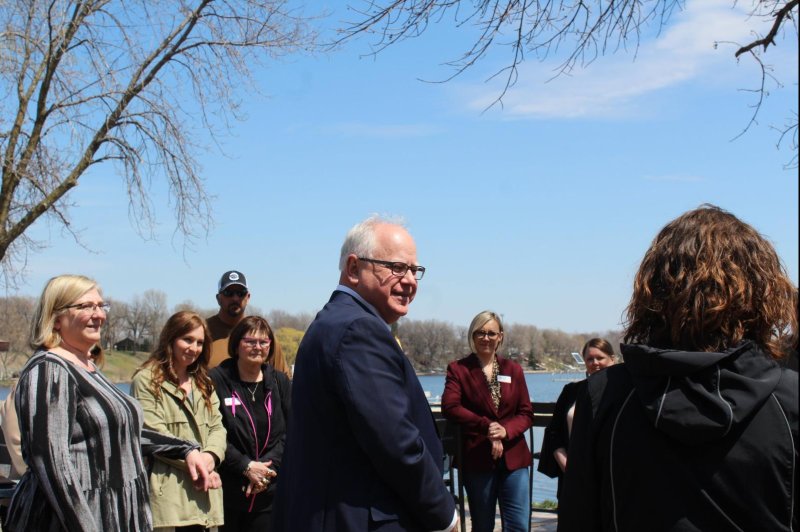
Minnesota Gov. Tim Walz signed legislation legalizing recreational marijuana. 
Photo Courtesy of Tim Walz/Twitter

May 30 (UPI) -- Minnesota Gov. Tim Walz signed legislation Tuesday legalizing recreational marijuana.

The legislation passed the state Senate and House earlier this month, largely along party lines.

"Minnesota just became the 23rd state in the nation to legalize adult-use cannabis," Walz tweeted Tuesday.

"What we know right now is prohibition does not work. We've criminalized a lot of folks. We're going to start the expungement process on those records. We have a situation where buying cannabis on the streets is dangerous," Walz said at a signing ceremony for the legislation Tuesday.

"I assure Minnesotans that a lot of thought has gone into this. A lot of the things we've learned in other states are incorporated into how we do this," he said.

Former Minn. Gov. Jesse Ventura, who has long advocated marijuana legalization, was in attendance at the signing ceremony with his wife, Terry.

"This is a huge day in our family's life," said Ventura.

People over 21 will now be able to carry up to 2 ounces of marijuana in public and have up to 2 pounds at their residence. The bill adds a 10% tax on marijuana sales, which is added to the existing sales tax. People will also be allowed to cultivate marijuana at home under the new legislation.

The legislation also automatically expunges low-level marijuana-related convictions.

In addition to legalizing cannabis, the legislation will create a new body to oversee the expungement process of higher-level marijuana convictions. The bill also creates the Office of Cannabis Management, which will oversee sales regulation.


The law takes effect on Aug. 1, but the licensing and establishment of recreational dispensaries is expected to take some time.

The Teamsters union in the state issued a statement lauding the legalization on Tuesday, calling it a "pro-worker" piece of legislation.

"We would like to thank the governor, Rep. Zack Stephenson, and all of our allies at the state capitol for having the courage to pass this pro-worker, pro-justice policy into law," said Tom Erickson, Teamsters central region international vice president and president of Teamsters joint council 32 in Minneapolis. "There are hundreds of thousands of jobs to be created in this new industry, and we look forward to bringing Teamster representation to even more cannabis workers."
One year after decriminalization, Thailand's cannabis future looks hazy

Thailand decriminalized cannabis one year ago, but a cloud of uncertainty remains over the industry.
Photo by Thomas Maresca/UPI

BANGKOK, June 9 (UPI) -- Dispensaries can be found on seemingly every corner of this bustling capital city, their neon-lit marijuana leaves beckoning customers as Thailand marks the one-year anniversary of becoming the first country in Asia to decriminalize cannabis.

More than 1.1 million citizens have registered to grow cannabis and nearly 5,000 shops, with names such as Four Twenty and Best Buds, have opened their doors throughout the country over the past year. But the industry remains under a cloud of uncertainty about its future -- a future that has grown even hazier in the wake of last month's election.

The progressive Move Forward Party, which won a stunning victory on May 14, already has proposed reclassifying cannabis as a narcotic in a move that has alienated some supporters and alarmed industry insiders.

"[Cannabis] is being used as a weapon in politics," said Chokwan "Kitty" Chopaka, a longtime legalization advocate and entrepreneur.

"Maybe I was bamboozled into thinking that [Move Forward] actually cared," Chokwan told UPI at her dispensary, Chopaka, near Bangkok's busy Asok intersection. "Unfortunately, as soon as they felt like they could gain older voters or the conservatives, it all changed. I'm actually more scared since the election."

Move Forward, under the leadership of 42-year-old Pita Limjaroenrat, galvanized a younger generation of voters with an ambitious agenda that promised to rewrite the constitution, end military conscription and reform the lese-majeste law that makes it a crime to insult the king.

Since the election, however, the party has had to make concessions to draw support from more conservative factions as it attempts to form a government with Pita as prime minister.

Move Forward's largest coalition partner, the populist Pheu Thai party, campaigned on a strong anti-cannabis stance and promised to ban the recreational use of marijuana. The party traces its roots to former Prime Minister Thaksin Shinawatra, who led a brutal war on drugs before he was ousted in a 2006 coup.

"If [Move Forward] can form the government, I think it's a given that they will relist cannabis," Henning Glaser, a law professor at Thammasat University in Bangkok, told UPI. "Their coalition partners support it, and Pheu Thai is very conservative on this issue."

When cannabis was decriminalized last year, Thai Health Minister Anutin Charnvirakul focused on its medical benefits and touted it as a shot in the arm for the agricultural sector.

Thai authorities also picked up on it as a major tourism boost, particularly in the wake of the COVID-19 pandemic, and have eagerly marketed luxury spas offering cannabis oil massages and organic farm visits.

Lawmakers, however, failed to pass a proposed Cannabis Act to regulate the industry after decriminalization, leaving businesses to operate in a legal vacuum.

Alongside high-end cannabis lounges and carefully curated shops such as Chopaka, a huge number of street stalls and underground businesses have sprung up, creating a Wild West atmosphere that is helping to fuel opposition.

"The situation is not healthy because we didn't pass the cannabis bill in the parliament," Rattapon "Guide" Sanrak, another longtime activist and the co-founder of the pioneering dispensary Highland, told UPI.

"It's too easy to open and the regulation is very weak," he said. "There is oversupply and authorities cannot enforce the law."

The market has also been flooded with illegal imports, mainly from the United States, business owners say, causing prices to plunge and threatening growers' livelihoods.

"It's a huge amount and the quality is so low," Rattapon said. "It's hurting the growers, who invested a lot of money into equipment and electricity. When they finished their crops, they could not sell at the price that they expected."

The Move Forward Party has framed its position as a necessary move to stabilize the industry. The coalition's platform said it would "reclassify marijuana as a controlled substance" and implement new laws regulating and supporting its beneficial uses.

"The benefit of cannabis will always outweigh the disadvantage of having cannabis," party leader Pita said at a press conference last month. "For the shop owners, if you have followed the rules, if you did everything correctly, there will not be any impact on you. But we have a strong legal mandate to be able to control and slowly adjust Thai society, especially schoolchildren ... to the explosion of cannabis."

At the same time, there are questions about how much the government is going to be able to roll back the progress already made in an industry that is projected by some to be worth $9.6 billion by 2030.

Health Minister Anutin, who leads the election's third-largest vote-getter, the Bhumjaithai Party, remains the industry's biggest political cheerleader and has vowed that his party will not back down on pushing ahead with his signature policy.

Anutin, after casting his ballot while wearing a shirt decorated with marijuana leaves, picked up 71 seats in last month's election -- far more than anticipated and giving him some leverage in the Move Forward coalition's quest to control the 376 seats needed to form a government.

In the meantime, cannabis advocates around Thailand marked the one-year anniversary of decriminalization Friday by holding rallies against relisting cannabis as a narcotic and meeting with Move Forward Party officials to discuss policy options going forward.

"We don't want to see people going to jail for having one gram of cannabis," Rattapon said. "We will fight to have a balanced regulation -- not overregulated and not too weak."

Chokwan is working with advocates to draft a "people's version" of the Cannabis Act, which she said they will present to lawmakers when a new government is seated.

"That way, it can be said that it's not being used as a political weapon," she said. "It's not for one party or the other."

"But it takes time," Chokwan added, "I realized that being in this fight for cannabis is never-ending. And it always takes time to get people to understand."


Chokwan “Kitty” Chopaka, a longtime legalization advocate and entrepreneur, holds a jar of marijuana buds in her Bangkok shop Chopaka. 

Staff at work in Highland, a pioneering cafe, bar and dispensary in the Lat Phrao area of Bangkok.
 
Almost 5,000 dispensaries have opened in Thailand since cannabis was decriminalized. 

Strains on display at Chopaka. 

Marijuana plants grow inside The Dispensary, a high-end shop on Bangkok's Sukhumvit Road.

Kush House sells a wide range of cannabis flowers, oils and edibles on Sukhumvit Road in Bangkok

.

Cannabis was decriminalized in Thailand on June 9, 2022.


Dispensary Four Twenty displays cannabis flowers and paraphernalia in Bangkok


Photos by Thomas Maresca/UPI
Use of hallucinogens like mushrooms, PCP doubles among young adults, study finds

By Cara Murez, HealthDay News

Researchers found that between 2018 and 2021, U.S. adults aged 19 to 30 increased their use of mescaline, peyote, psilocybin ("magic mushrooms") and PCP, though not LSD. 
Photo by Hans/Pixabay

Young American adults have doubled their use of non-LSD hallucinogens in just a few years, a new report warns.

Researchers found that between 2018 and 2021, U.S. adults aged 19 to 30 increased their use of mescaline, peyote, psilocybin ("magic mushrooms") and PCP, though not LSD

The prevalence of young adults' past-year use of these drugs was 3.4% in 2018, but it hit 6.6% in 2021.

"However, the prevalence of LSD did not see this dramatic increase, and was around 4% in 2018 and 2021," said study co-author Megan Patrick. She is a research professor at the University of Michigan Institute for Social Research in Ann Arbor and co-principal investigator of the Monitoring the Future study, which focuses on substance use and health.

The study found that use of these non-LSD hallucinogens was greater for males. White young adults used these drugs at a higher rate than Black people of the same age.

Use of these drugs was also greater for those whose parents had a college education, which researchers used as a proxy for socioeconomic status.

The Monitoring the Future study does not identify why young adults used these drugs, whether it might be recreational or because they thought there would be therapeutic benefit. Non-medical hallucinogen use is associated with risks of substance use disorders, injury including self-harm and anxiety, the study authors noted in a university news release.

"The use of psychedelic and hallucinogenic drugs for a range of therapeutic uses is increasing, given accumulating yet still preliminary data from randomized trials on clinical effectiveness," said lead study author Katherine Keyes. She is a professor of epidemiology at Columbia Mailman School of Public Health in New York City.

"With increased visibility for medical and therapeutic use, however, potentially comes diversion and unregulated product availability, as well as a lack of understanding among the public of potential risks," Keyes added.

Young adults surveyed were asked "How often in the past 12 months have you used LSD ('acid')?" They were also asked if they had used hallucinogens other than LSD. Responses ranged from none to 40 or more.

The findings were published recently in the journal Addiction. The study was funded by the U.S. National Institute on Drug Abuse.

The increase in usage of psilocybin in young adults is a rising concern, the researchers said.

"We will continue to track these trends to see if the increases continue. We need additional research, including about the motives for hallucinogen use and how young adults are using these substances, in order to be able to mitigate the associated negative consequences," Patrick concluded.

More information

The U.S. National Institute on Drug Abuse has more on psychedelic and dissociative drugs.

Copyright © 2023 HealthDay. All rights reserved.