It’s possible that I shall make an ass of myself. But in that case one can always get out of it with a little dialectic. I have, of course, so worded my proposition as to be right either way (K.Marx, Letter to F.Engels on the Indian Mutiny)
Tuesday, July 25, 2023
SPACE
Older evolved stars passing through a star-forming region could have heated an early Earth
An artist’s impression of an interloping AGB star in a young star-forming region. Credit: Mark Garlick
Researchers from the University of Sheffield and Imperial College London have spotted a "retired" asymptotic giant branch (AGB) star passing through a young star-forming region, something which was previously thought not to happen.
The researchers identified this interaction occurred in one of the places where they think stars like our sun must form, using the Gaia satellite, a 740m € mission to map the positions of billions of stars in our galaxy.
The most recent release of data from Gaia, Data Release 3, means that the research team can accurately pinpoint interloping stars. These interlopers are stars that did not form in the region, but are just passing through. The team has previously found young interloping stars, but now has found a much older, evolved star, known as an AGB, passing through a region.
Previous research has shown that these retired AGB stars produce large quantities of radioactively unstable chemical elements, Aluminum-26 and Iron-60. Aluminum-26 and Iron-60 were delivered to our young solar system at the epoch of planet formation, and are thought to dominate the early internal heating of Earth.
Ultimately, Aluminum-26 and Iron-60 may even have indirectly contributed to plate tectonics on our planet, which helps sustain a breathable atmosphere on Earth. The research team has calculated how much Aluminum-26 and Iron-60 from the AGB could be captured by a star like our sun as it formed its planets.
Dr. Richard Parker, a lecturer in Astrophysics in Department of Physics and Astronomy at the University of Sheffield, and the lead author of the study published in The Astrophysical Journal Letters, said, "Until now, researchers have been skeptical that these old, evolved stars could ever meet young stars that are forming planets, so this discovery reveals much more about the dynamics, relationships and journeys of stars.
"By showing that AGB stars can meet young planetary systems, we have shown that other sources of Aluminum-26 and Iron-60, such as the winds and supernovae of very massive stars, may not be required to explain the origin of these chemical elements in our solar system."
Dr. Christina Schoettler, an Astrophysics research associate in the Department of Physics at Imperial College London, identified the AGB star in the Gaia DR3 data. She says, "Gaia is revolutionizing our ideas about how stars form, and then subsequently move in the galaxy. This discovery of an old, evolved star in close proximity to young planet-forming stars is a wonderful example of the power of serendipity in scientific research."
The next step of this research is to search for other evolved stars in young star-forming regions to establish how common these retired interlopers are.
More information: Richard J. Parker et al, Isotopic Enrichment of Planetary Systems from Asymptotic Giant Branch Stars, The Astrophysical Journal Letters (2023). DOI: 10.3847/2041-8213/ace24a
Hydrogen peroxide found on Jupiter's moon Ganymede in higher latitudes
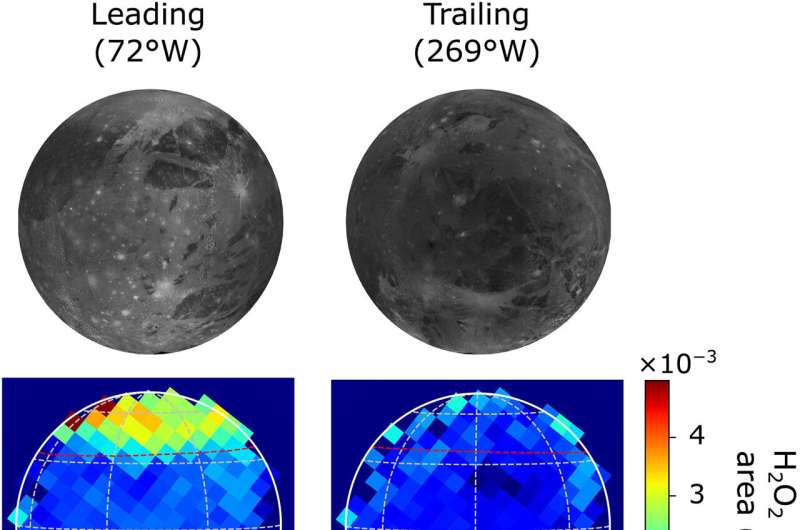
Maps of Ganymede’s 3.5 μm H2O2 absorption compared to those of the 3.1 μm Fresnel peaks of water ice and corresponding projections of the U.S. Geological Survey Voyager-Galileo imaging mosaic. H2O2 appears constrained to the upper latitudes, particularly on the leading hemisphere, which exhibits sharp boundaries at approximately ±30° to 35° latitude. These boundaries are roughly coincident with the onset of Ganymede’s polar frost caps and with the latitudes at which most of the impinging Jovian magnetospheric particles can access the surface. Maps of the Fresnel reflection peak of water ice, which generally track the distribution of ice deduced from shorter-wavelength water bands, also show the areas of greatest H2O2 on the leading hemisphere to be enriched in water ice. The trailing hemisphere shows comparatively weak Fresnel reflections and, overall, less-icy spectra. This hemispheric dichotomy in water ice may help explain the leading/trailing contrast in H2O2, while the overall polar H2O2 distribution may reflect a combination of precursor water availability and temperature and/or radiation intensity effects. The approximate average boundary between open and closed field lines from are included as red dashed lines. The 60°S, 30°S, 0°N, 30°N, and 60°N parallels are also included in gray for both hemispheres. The leading-hemisphere map includes the 45°W, 90°W, and 135°W meridians, while the trailing-hemisphere map shows those for 225°W, 270°W, and 315°W. Credit: Science Advances (2023). DOI: 10.1126/sciadv.adg3724
An international team of space scientists has found evidence that hydrogen peroxide on Ganymede, Jupiter's largest moon, exists only on its higher latitudes. For their research, reported in the journal Science Advances, the group studied data from the James Webb Space Telescope (JWST).
For many years, researchers theorized that hydrogen peroxide existed on Ganymede, but it took a prior team studying data from the JWST to find it. In this new effort, the research team analyzed new data sent back by the telescope to learn more about the surface of the moon and its hydrogen peroxide.
Ganymede is the largest moon in the solar system, but it has not received nearly the attention given to another of Jupiter's moons, Europa, whose features and characteristics make it far more likely to have harbored life at some point in time. But prior research has shown that the influence of Jupiter's magnetic field on many of its moons could indicate a strong probability of hydrogen peroxide on Ganymede. This is because of its likely impact on the water-ice irradiation process on its surface.
Prior research has shown that both Ganymede and Europa are impacted by radiation from Jupiter's magnetosphere—it bombards the surface of both moons, converting water ice into other compounds such as oxygen, ozone and hydrogen peroxide. In this new effort, the researchers studied data from the JWST NIRSpec Integral Field Unit.
The team found a 3.5-micrometer absorption band showing the presence of hydrogen peroxide in the northern parts of the moon, mostly on the side facing directional orbit. They also observed oxygen mostly seen in lower latitudes and on the opposite side of the moon. The findings show a stark contrast between Ganymede and Europa—on Europa, most of its hydrogen peroxide is located near its equator.
The team notes that their findings are part of a larger process geared toward better understanding how Ganymede's magnetic field influences its own surface chemistry.
More information: Samantha K. Trumbo et al, Hydrogen peroxide at the poles of Ganymede, Science Advances (2023). DOI: 10.1126/sciadv.adg3724
IMAGE: THIS ARTIST’S CONCEPT PORTRAYS THE STAR PDS 70 AND ITS INNER PROTOPLANETARY DISK. NEW MEASUREMENTS BY NASA’S JAMES WEBB SPACE TELESCOPE HAVE DETECTED WATER VAPOR AT DISTANCES OF LESS THAN 100 MILLION MILES FROM THE STAR – THE REGION WHERE ROCKY, TERRESTRIAL PLANETS MAY BE FORMING. THIS IS THE FIRST DETECTION OF WATER IN THE TERRESTRIAL REGION OF A DISK ALREADY KNOWN TO HOST TWO OR MORE PROTOPLANETS, ONE OF WHICH IS SHOWN AT UPPER RIGHT.view more
CREDIT: CREDITS: NASA, ESA, CSA, J. OLMSTED (STSCI) DOWNLOAD THE FULL-RESOLUTION VERSION FROM THE SPACE TELESCOPE SCIENCE INSTITUTE.
Water is essential for life as we know it. However, scientists debate how it reached the Earth and whether the same processes could seed rocky exoplanets orbiting distant stars. New insights may come from the planetary system PDS 70, located 370 light-years away. The star hosts both an inner disk and outer disk of gas and dust, separated by a 5 billion-mile-wide (8 billion kilometer) gap, and within that gap are two known gas-giant planets.
New measurements by NASA’s James Webb Space Telescope’s MIRI (Mid-Infrared Instrument) have detected water vapor in the system’s inner disk, at distances of less than 100 million miles (160 million kilometers) from the star – the region where rocky, terrestrial planets may be forming. (The Earth orbits 93 million miles from our Sun.) This is the first detection of water in the terrestrial region of a disk already known to host two or more protoplanets.
“We’ve seen water in other disks, but not so close in and in a system where planets are currently assembling. We couldn’t make this type of measurement before Webb,” said lead author Giulia Perotti of the Max Planck Institute for Astronomy (MPIA) in Heidelberg, Germany.
“This discovery is extremely exciting, as it probes the region where rocky planets similar to Earth typically form,” added MPIA director Thomas Henning, a co-author on the paper. Henning is co-principal investigator of Webb’s MIRI (Mid-Infrared Instrument), which made the detection, and the principal investigator of the MINDS (MIRI Mid-Infrared Disk Survey) program that took the data.
A Steamy Environment for Forming Planets
PDS 70 is a K-type star, cooler than our Sun, and is estimated to be 5.4 million years old. This is relatively old in terms of stars with planet-forming disks, which made the discovery of water vapor surprising.
Over time, the gas and dust content of planet-forming disks declines. Either the central star’s radiation and winds blow out such material, or the dust grows into larger objects that eventually form planets. As previous studies failed to detect water in the central regions of similarly aged disks, astronomers suspected it might not survive the harsh stellar radiation, leading to a dry environment for the formation of any rocky planets.
Astronomers haven’t yet detected any planets forming within the inner disk of PDS 70. However, they do see the raw materials for building rocky worlds in the form of silicates. The detection of water vapor implies that if rocky planets are forming there, they will have water available to them from the beginning.
“We find a relatively high amount of small dust grains. Combined with our detection of water vapor, the inner disk is a very exciting place,” said co-author Rens Waters of Radboud University in The Netherlands.
What is the Water’s Origin?
The discovery raises the question of where the water came from. The MINDS team considered two different scenarios to explain their finding.
One possibility is that water molecules are forming in place, where we detect them, as hydrogen and oxygen atoms combine. A second possibility is that ice-coated dust particles are being transported from the cool outer disk to the hot inner disk, where the water ice sublimates and turns into vapor. Such a transport system would be surprising, since the dust would have to cross the large gap carved out by the two giant planets.
Another question raised by the discovery is how water could survive so close to the star, when the star’s ultraviolet light should break apart any water molecules. Most likely, surrounding material such as dust and other water molecules serves as a protective shield. As a result, the water detected in the inner disk of PDS 70 could survive destruction.
Ultimately, the team will use two more of Webb’s instruments, NIRCam (Near-Infrared Camera) and NIRSpec (Near-Infrared Spectrograph) to study the PDS 70 system in an effort to glean an even greater understanding.
These observations were taken as part of Guaranteed Time Observation program 1282. This finding has been published in the journal Nature.
A spectrum of the protoplanetary disk of PDS 70, obtained with Webb’s MIRI (Mid-Infrared Instrument), displays a number of emission lines from water vapor. Scientists determined that the water is in the system’s inner disk, at distances of less than 100 million miles from the star – the region where rocky, terrestrial planets may be forming. Download the full-resolution version from the Space Telescope Science Institute.
CREDIT
Credits: NASA, ESA, CSA, J. Olmsted (STScI) Download the full-resolution version from the Space Telescope Science Institute.
The James Webb Space Telescope is the world’s premier space science observatory. Webb is solving mysteries in our solar system, looking beyond to distant worlds around other stars, and probing the mysterious structures and origins of our universe and our place in it. Webb is an international program led by NASA with its partners, ESA (European Space Agency) and the Canadian Space Agency.
New images from the James Webb Space Telescope (JWST) have revealed, for the first time, starlight from two massive galaxies hosting actively growing black holes – quasars – seen less than a billion years after the Big Bang. The black holes have masses close to a billion times that of the Sun, and the host galaxy masses are almost one hundred times larger, a ratio similar to what is found in the more recent universe. A powerful combination of the wide-field survey of the Subaru Telescope and the JWST has paved a new path to study the distant universe, reports a new study in Nature.
Observations of giant black holes have attracted attention of astronomers in recent years. The Event Horizon Telescope (EHT) has started to image the “shadow” of black holes at the galaxy centers. The 2020 Novel Prize in Physics was awarded to stellar motion observations at the heart of the Milky Way. Whilst the existence of such giant black holes has become solid, no one knows their origin. Astronomers have reported that there exist billion-solar-mass black holes within the first billion years of the universe -- How could these black holes grow to be so large when the universe was so young? Even more puzzling, observations in the local universe show a clear relation between the mass of supermassive black holes and the much larger galaxies in which they reside. The galaxies and the black holes have completely different sizes, so which came first: the black holes or the galaxies? This is a “chicken-or-egg” problem on a cosmic scale.
An international team of researchers led by Masafusa Onoue (尾上匡房), a Kavli Astrophysics Fellow at the Kavli Institute for Astronomy and Astrophysics (KIAA) in Peking University, Xuheng Ding (丁旭恒), a research fellow at the Kavli Institute for the Physics and Mathematics of the Universe (Kavli IPMU) , and John Silverman, a professor at Kavli IPMU have started to answer this question with the James Webb Space Telescope (JWST), a 6.5-meter space telescope developed by an international collaboration among NASA, the European Space Agency (ESA), and the Canadian Space Agency (CSA), and launched in December 2021.
Quasars are luminous, while their host galaxies are faint, which has made it challenging for researchers to detect the dim light of the galaxy in the glare of the quasar, especially at great distances. “Finding the host galaxies of quasars at redshift 6 is like trying to spot fireflies in a breathtaking firework show while wearing foggy glasses. The host galaxies are incredibly faint, and image resolution has been very limited, even with the Hubble Space Telescope, making it a real challenge to uncover their hidden beauty.”, says Xuheng Ding.
The team observed two quasars with the JWST, HSC J2236+0032 and HSC J2255+0251, at redshifts 6.40 and 6.34 when the Universe was approximately 860 million years old **. These two quasars were originally discovered by a wide-field survey of the 8.2m-Subaru Telescope, with which the research team has identified more than 160 quasars up to date . The relatively low luminosities of these quasars made them prime targets for measurement of the host galaxy properties, and the successful detection of the hosts represents the earliest epoch to date at which starlight has been detected in a quasar.
The images of the two quasars were taken at infrared wavelengths of 3.56 and 1.50 micron with JWST’s NIRCam instrument, and the host galaxies became apparent after carefully modeling and subtracting glare from the accreting black holes. The stellar signature of the host galaxy was also seen in a spectrum taken by JWST’s NIRSpec for J2236+0032, further supporting the detection of the host galaxy. "I have been deeply involved in the Subaru survey of high-redshift quasars since my PhD years at National Astronomical Observatory of Japan. I am extremely proud of the successful starlight detection from the HSC quasars that we found with Subaru." says Masafusa Onoue.
From the observations, the team found that the ratio of the black hole mass to host galaxy mass is similar to those seen in the more recent Universe. The result suggests that the relationship between black holes and their hosts was already in place within the first billion years after the Big Bang. The team will continue this study with a larger sample of distant quasars, aiming at further constraining the coevolutionary growth history of black holes and their parent galaxies over the cosmic time. These observations will constrain models for the coevolution of black holes and their host galaxies.
More details are available in a press release by Kavli IPMU.
These results appeared as Ding, Onoue, Silverman et al. "Detection of stellar light from quasar host galaxies at z > 6" in Nature on June 28, 2023.
** Cosmology parameters from the Planck satellite is assumed to calculate the distance and age of the universe at a given redshift (Reference: https://www.nao.ac.jp/en/astro/glossary/expressing-distance.html)
More details are available in a press release by Kavli IPMU: www.ipmu.jp/ja/20230629-JWST
Observers investigate a short-period X-ray binary system
by Tomasz Nowakowski , Phys.org
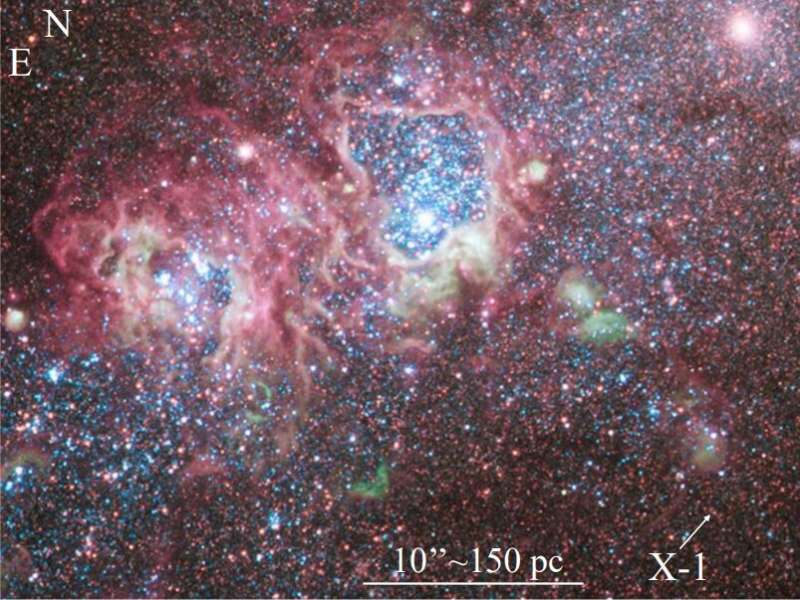
Details of the central region of NGC 4214, adapted from an HST/WFC3 image processed and published by the Hubble Heritage Team. The optical counterpart of X-1 is marked by an arrow near the bottom right of the image. It is at the outskirts of the current starburst region. Credit: NASA, ESA, and the Hubble Heritage (STScI/AURA)-ESA/ Hubble Collaboration.
Using the Hubble Space Telescope (HST) and the Chandra X-ray Observatory, astronomers have taken a closer look at a short-period high-mass X-ray binary known as CXOU J121538.2+361921. Results of the observational campaign, presented July 13 on the preprint server arXiv, shed more light on the properties of this system.
X-ray binaries are composed of a normal star or a white dwarf transferring mass onto a compact neutron star or a black hole. Based on the mass of the companion star, astronomers divide them into low-mass X-ray binaries (LMXBs) and high-mass X-ray binaries (HMXBs).
Located some 9.8 million light years in the galaxy NGC 4214, CXOU J121538.2+361921 (or NGC 4214 X-1) is a luminous HMXB, showcasing X-ray eclipses with a period of 3.62 hours. The eclipse period is, most likely, also the orbital period, which makes NGC 4214 X-1 the shortest-period HMXB system known to date. However, although many studies of this system have been conducted, its properties are not well understood.
That is why a team of astronomers led by Zikun Lin of the University of Chinese Academy of Sciences in Beijing, China, decided to investigate NGC 4214 X-1 with Hubble and Chandra telescopes.
"We combined new and archival Chandra and HST data for a study of the short-period, eclipsing X-ray binary NGC 4214 X-1," the researchers wrote in the paper.
The observations confirmed that NGC 4214 X-1 is still active and still showcasing eclipses, with an out-of-eclipse luminosity at a level of about one duodecillion erg/s. The eclipse period and the average eclipse duration time were confirmed to be approximately 3.6 and 0.57 hours, respectively.
The eclipse fraction was calculated to be about 0.16, which allowed the researchers to estimate the minimum mass ratio of the system—approximately 2.0. This finding further confirms the HMXB nature of NGC 4214 X-1.
The stellar density of the donor star was calculated to be approximately 5.9 g/cm3. This result, together with the mass ratio and short binary period, suggest that the donor is a Wolf-Rayet (WR) star or an intermediate-mass stripped helium star.
Moreover, based on HST observations, Lin's team found an optical counterpart to NGC 4214 X-1, with an apparent brightness of 24 mag. The optical source consists of two clearly distinct components: a blue emitter (with a temperature of about 60,000–80,000 K and characteristic radius of 2.0 solar radii) and a red emitter (with a temperature of about 2,500–3,000 K and characteristic radius of some 400 solar radii).
The authors of the paper concluded that the blue component further supports the WR scenario for the donor star in NGC 4214 X-1. They added that the red component may be an irradiated circumbinary disk.
More information: Zikun Lin et al, On the Short-Period Eclipsing High-Mass X-ray Binary in NGC 4214, arXiv (2023). DOI: 10.48550/arxiv.2307.06993
We’ve detected a star barely hotter than a pizza oven – the coldest ever found to emit radio waves The Conversation July 14, 2023 The Universe (Shutterstock)
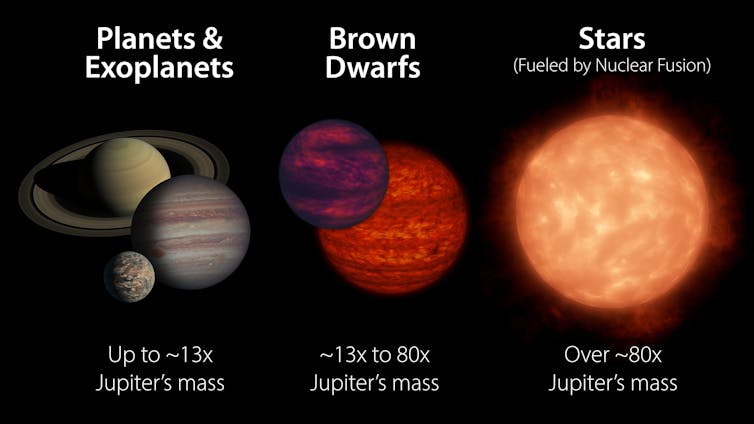
We have identified the coldest star ever found to produce radio waves – a brown dwarf too small to be a regular star and too massive to be a planet.
Our findings, published today in the Astrophysical Journal Letters, detail the detection of pulsed radio emission from this star, called WISE J0623.
Despite being roughly the same size as Jupiter, this dwarf star has a magnetic field much more powerful than our Sun’s. It’s joining the ranks of just a small handful of known ultra-cool dwarfs that generate repeating radio bursts.
Making waves with radio stars
With over 100 billion stars in our Milky Way galaxy, it might surprise you astronomers have detected radio waves from fewer than 1,000 of them. One reason is because radio waves and optical light are generated by different physical processes.
Unlike the thermal (heat) radiation coming from the hot outer layer of a star, radio emission is the result of particles called electrons speeding up and interacting with magnetised gas around the star.
Because of this we can use the radio emission to learn about the atmospheres and magnetic fields of stars, which ultimately could tell us more about the potential for life to survive on any planets that orbit them.
Another factor is the sensitivity of radio telescopes which, historically, could only detect sources that were very bright.
Most of the detections of stars with radio telescopes over the past few decades have been flares from highly active stars or energetic bursts from the interaction of binary (two) star systems. But with the improved sensitivity and coverage of new radio telescopes, we can detect less luminous stars such as cool brown dwarfs.
Mass comparison of stars, brown dwarfs and planets (not to scale). NASA/JPL-Caltech
WISE J0623 has a temperature of around 700 Kelvin. That’s equivalent to 420℃ or about the same temperature as a commercial pizza oven – pretty hot by human standards, but quite cold for a star.
These cool brown dwarfs can’t sustain the levels of atmospheric activity that generates radio emission in hotter stars, making stars like WISE J0623 harder for radio astronomers to find.
How did we find the coolest radio star?
This is where the new Australian SKA Pathfinder radio telescope comes in. This is located at Inyarrimanha Ilgari Bundara, the CSIRO Murchison Radio-astronomy Observatory in Western Australia, and has an array of 36 antennas, each 12 metres in diameter.
The telescope can see large regions of the sky in a single observation and has already surveyed nearly 90% of it. From this survey we have identified close to three million radio sources, most of which are active galactic nuclei – black holes at the centres of distant galaxies.
So how do we tell which of these millions of sources are radio stars? One way is to look for something called “circularly polarised radio emission”.
Radio waves, like other electromagnetic radiation, oscillate as they move through space. Circular polarization occurs when the electric field of the wave rotates in a spiralling or corkscrew motion as it propagates.
For our search we used the fact that the only astronomical objects known to emit a significant fraction of circularly polarized light are stars and pulsars (rotating neutron stars).
By selecting only highly circularly polarized radio sources from an earlier survey of the sky, we found WISE J0623. You can see using the slider in the figure above that once you switch to polarized light, there is only one object visible.
What does this discovery mean?
Was the radio emission from this star some rare one-off event that happened during our 15 minute observation? Or could we detect it again?
Previous research has shown that radio emission detected from other cool brown dwarfs was tied to their magnetic fields and generally repeated at the same rate as the star rotates.
To investigate this we did follow-up observations with CSIRO’s Australian Telescope Compact Array, and with the MeerKAT telescope operated by the South African Radio Astronomy Observatory.
The bottom panel shows the brightness of polarized light over time. The top panel shows emission at different radio frequencies. Author Provided.
These new observations showed that every 1.9 hours there were two bright, circularly polarized bursts from WISE J0623 followed by a half an hour delay before the next pair of bursts.
WISE J0623 is the coolest brown dwarf detected via radio waves and is the first case of persistent radio pulsations. Using this same search method, we expect future surveys to detect even cooler brown dwarfs.
Studying these missing link dwarf stars will help improve our understanding of stellar evolution and how giant exoplanets (planets in other solar systems) develop magnetic fields.
We acknowledge the Wajarri Yamatji as the traditional owners of the Murchison Radio-astronomy Observatory site where Australian SKA Pathfinder is located, and the Gomeroi people as the traditional owners of the Australian Telescope Compact Array site.
AIDS can be ended by 2030 with investments in prevention and treatment, UN says
GENEVA (Reuters) - It is possible to end AIDS by 2030 if countries demonstrate the political will to invest in prevention and treatment and adopt non-discriminatory laws, the United Nations said on Thursday.
In 2022, an estimated 39 million people around the world were living with HIV, according to UNAIDS, the United Nations AIDS program. HIV can progress to AIDS if left untreated.
"We have a solution if we follow the leadership of countries that have forged strong political commitment to put people first and invest in evidence-based HIV prevention and treatment programmes," UNAIDS said in a report published on Thursday.
It said an effective response to HIV also meant adopting non-discriminatory laws and empowering community networks, among other initiatives. People living with HIV or AIDS in many countries face stigma, discrimination and violence.
"Progress has been strongest in the countries and regions that have the most financial investments, such as in eastern and southern Africa, where new HIV infections have been reduced by 57% since 2010," the report said.
It added, however, that there has been a steep increase in new infections in eastern Europe and central Asia, as well as in the Middle East and North Africa.
"These trends are due primarily to a lack of HIV prevention services for marginalized and key populations and the barriers posed by punitive laws and social discrimination," it said.
Last year, 1.3 million people became newly infected with HIV and 630,000 died from AIDS-related illnesses, according to UNAIDS.
FIRST READING: Canadians love nuclear power, even though greens still hate it
More than half of Canadians want more nuclear plants, and more than a third wouldn't mind one in their neighbourhood
David Suzuki dubbed nuclear a distraction from solar and wind technology, writing “pursuing nuclear at the expense of renewables is costly, dangerous and unnecessary.”
The Pickering Nuclear Generating Station. According to an Angus Reid Institute poll, most Canadians want more of these.
PHOTO BY THE CANADIAN PRESS/FRANK GUNN
First Reading is a daily newsletter keeping you posted on the travails of Canadian politicos, all curated by the National Post’s own Tristin Hopper
Although nuclear power continues to be resolutely opposed by much of the mainstream Canadian green movement, a series of illuminating new polls by the Angus Reid Institute show that Canadians are increasingly comfortable with an atomic future.
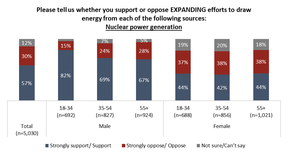
Fifty-seven per cent of Canadians now support “further development” of nuclear power plants, and a not-insubstantial number are even fine with that nuclear plant being built in their own city. Of respondents, 43 per cent said they were comfortable with a nuclear generating station being constructed within 50 kilometres of their home.
“As the world pushes towards net-zero emissions targets, and away from the war-influenced roller coaster of fossil fuel prices, many countries — including Canada — are putting the nuclear option back on the table,” wrote the Institute in a statement.
The poll also revealed a weird gender gap in nuclear opinions that has been showing up pretty consistently since the 1970s. Basically, men love nuclear while women hate it. The above chart shows near-universal support for nuclear power among male Canadians under the age of 34, while only 44 per cent of women in the same age group were similarly enthusiastic for the technology.
PHOTO BY ANGUS REID INSTITUTE
Opinions on nuclear energy have already begun to shift at the federal level. In recent years, the Trudeau government has begun openly talking up nuclear energy as a viable means to kick fossil fuels.
The most recent federal budget included $120.6 million for Canada to start figuring out a way to pepper the country with “small modular reactors.”
Dubbing the technology a “promising pathway to support Canada’s low-carbon energy transition,” the budget hinted that house-sized nuclear reactors could eventually be keeping the lights on everywhere from remote work camps to rural corners of New Brunswick.
After Russia’s Feb. 24 invasion of Ukraine, Ottawa has even suggested that exported Canadian reactor technology could be used to wean Europe off its dependence on Russian oil and gas. “Nuclear energy must be part of such a sustainable future. And Canada is here to help make that happen,” natural resources minister Jonathan Wilkinson said in October at a Washington, D.C., conference of the International Atomic Energy Agency.
Although international polls have shown mixed support for nuclear energy as recently as 2020, many of those fears have been cast aside amid the current global energy crunch.
Japan instantly shut down almost its entire nuclear sector after the 2011 ccident at its Fukushima Daiichi Nuclear Power Plant. Now, the country is scrambling the reactivation of as many as nine reactors to help cover for a sudden drop in Russian gas imports.
Germany had originally planned to complete a total phaseout of its nuclear power sector in 2022. But there, too, the sudden disappearance of Russian energy supplies forced German Chancellor Olaf Scholz to order the country’s three remaining nuclear plants to stay open.
In Canada, the shift towards nuclear seems to be similarly motivated largely by practicality. With climate policies increasingly driving fossil fuel plants into obsolescence, nuclear has been pitched as a relatively shovel-ready workaround. While jurisdictions such as B.C. and Quebec can safely source almost all their electricity from hydroelectric power, in large swaths of the country renewables are still not a realistic replacement for the baseload power currently provided by diesel or natural gas.
In Nunavut, for instance, virtually all electricity generation is generated by diesel imported into the territory by tanker during the ice-free summer months. As of last count, both Saskatchewan and Alberta are still relying on coal for more than a third of their power generation.
In a 2021 poll, Saskatchewanians were found to be widely supportive of using nuclear to phase out coal and oil. Wrote pollsters: “public support for the use of (small modular reactors) in Saskatchewan is much greater than opposition, with strong positive opinion outweighing strong negative opinion by a factor of three.”
The majority Canadians still don’t want a nuclear plant within 50 kilometres of their house, but Canada routinely elects majority governments with levels of support well below 42 per cent.
PHOTO BY ANGUS REID INSTITUTE
Overhanging all of this, meanwhile, is the raw fact that Canada is going to need a massive expansion of new electricity sources if it holds fast to sweeping national promises to electrify cars, industry and home heating. By 2050, the Canadian Energy Regulator has forecast that electricity demand could be as much as 85 per cent higher than what it was in 2019.
While there is a rising pro-nuclear faction within the Canadian green movement, the technology remains opposed by many of the usual standard-bearers for environmental causes. The Green Party of Canada continues to oppose all nuclear energy, calling it “dangerous and dirty.”
In a 2021 post to his foundation’s website, environmentalist David Suzuki dubbed nuclear a distraction from solar and wind technology, writing “pursuing nuclear at the expense of renewables is costly, dangerous and unnecessary.”
As we move towards a net-zero future, opportunities to increase the generation of emission-free electricity and industrial heat are becoming a key part of energy planning in Canada, particularly when it comes to the deployment of small modular reactors (SMRs).
Ontario is planning to build four of them at its Darlington site, while Saskatchewan, New Brunswick and Alberta have all indicated intentions to develop their own projects. But while Canada is well positioned to become a leader in the development and deployment of SMRs, the extent to which they will receive support from Indigenous communities remains to be seen.
SMRs are advanced nuclear reactors that generate up to 300 megawatts per unit, about one-third that of traditional nuclear reactors. They promise to be smaller, easier to site, cheaper to finance and faster to build than conventional reactors, and their modular design permits on-site assembly at a lower cost than conventional reactors. Moreover, the passive safety mechanisms built into various SMR models significantly reduce the risk of accidents, and some models will have the potential to reduce nuclear waste by reusing spent fuel to generate electricity.
Despite these benefits, Indigenous support is far from guaranteed, especially for First Nations with strong cultural values focused on protecting the land for future generations. Many First Nations live with the uncompensated impacts of past infrastructure projects and possess intimate familiarity with the harm that imposed development can cause. Limited access to financial and technical supports to evaluate new projects hinders First Nations participation and can lead to uncertainty and a lack of confidence.
Where the past experiences of Indigenous communities have been poor, the deployment of new reactors may be perceived as risk without reward. If direct and tangible efforts are not made to strengthen First Nations confidence in the deployment of new nuclear reactors, the impacts on project development and regulatory timelines will be significant.
Fortunately, respect for Indigenous rights has increased since Canada’s last era of nuclear reactor construction in the 1970s and ’80s. With the new wave of SMRs on the horizon, governments, Indigenous communities and proponents of clean power generation have the opportunity to harness not only the extraordinary potential of nuclear energy, but also the power of Indigenous consent to get projects built on budget and on time.
Related video: Environment minister lays roadmap to ending fossil fuel subsidies in Canada (cbc.ca) Duration 2:06 View on Watch
It starts with ensuring that First Nations have the capacity to engage effectively and confirm for themselves whether a proposed project warrants their support. Governments, regulators and project developers need to ensure that First Nations have the ability to make free, prior and informed decisions about SMR deployments within their territories.
The good news is that many successful models for industry-Indigenous engagement have been developed over the past two decades, and the lessons are being applied to nuclear energy. Indigenous experts are actively participating in policy development for the nuclear sector and helping shape Canada’s approach to the next generation of nuclear facilities. Regulators have prioritized financial support for Indigenous participants in regulatory processes, and SMR developers are proactively engaging with Indigenous partners.
As shared decision-making models are being written into project planning documents, Indigenous knowledge is being embraced as a foundational part of project design. New entrants are building on the decades-long history of robust Indigenous involvement in uranium mining in northern Saskatchewan, to create more space for Indigenous participation throughout the nuclear supply chain.
Workforce participation, construction contracts, component manufacturing and Indigenous ownership in the form of equity participation are just some of the options being explored with Indigenous businesses today. Good things are happening and it is paving the way for partnerships based on respect, co-operation and mutual benefit.
Not every Indigenous community will conclude that new nuclear deployments are the right option for them and many will express concerns about nuclear waste management and safety — important issues that need to be addressed. But for others, SMRs represent an exciting opportunity to advance their social, environmental and economic interests for the betterment of their communities.
Canada’s nuclear industry is getting a second chance to make a first impression. The pathway to prosperity and a net-zero future is through strong Indigenous partnerships grounded in culture, capacity and consent. Canada has the potential to be a world leader in the safe and effective deployment of SMRs. Embracing that opportunity begins with recognizing the right of Indigenous nations to be part of the process. National Post
Heather Exner-Pirot is a senior fellow at the Macdonald-Laurier Institute. Jesse McCormick is senior vice-president of research, innovation and legal affairs at the First Nations Major Projects Coalition.
ISRAEL IS A JEWISH STATE
Powerful right-wing radicals are testing democratic checks and balance in both Israel and the US
Story by Stephen Collinson • CNN - Yesterday
White House criticism of Israel after its right-wing coalition embarked on a plan to target judicial power is bringing a new kind of turbulence to one of America’s oldest friendships.
On Monday, the Israeli parliament passed a controversial law stripping the Supreme Court of its power to block government decisions, sparking protests. The move – distinct from spats over settlement building or Iran that often rattle the US-Israeli alliance and which the Biden administration repeatedly spoke out against – is the first stage of a wider judicial reform driven by Prime Minister Benjamin Netanyahu’s government that critics fear could hand him unfettered power. It shows that Israel, like the United States, is experiencing an era of right-wing politicians seeking to aggressively flex power and test enshrined democratic constraints.
The drama is likely to further worsen the long-standing but increasingly brittle relationship between President Joe Biden and Netanyahu. The US leader has made safeguarding democracy in the US and abroad a core value of his presidency. The Israeli prime minister, by comparison, is instinctively and politically closer to the ideology of ex-President Donald Trump, Biden’s once and possibly future rival for the White House who has subjected America’s own democratic institutions to their toughest challenge in generations.
But opponents of Netanyahu’s reforms warn that weakening the power of Israel’s Supreme Court will compromise checks on the authority of the most right-wing government in the country’s history, which would pave the way to extremist policies, raise questions about the fair conduct of future elections and ultimately erode its democracy. Similar fears that democratic guardrails are crumbling have shaped American politics ever since Trump swept into power in 2016, then used his station to try to overturn an election he lost in 2020. Now, Trump is targeting a return to the White House and promising “retribution” against judicial and political institutions that tempered his wish to wield strongman power. Like Trump, Netanyahu insists his actions are rooted in a desire to return power to citizens, arguing Monday that his efforts were “a necessary democratic move.” Netanyahu’s actions send shockwaves to Washington
Netanyahu’s judicial reforms have widened a split between Republicans who largely back the Israeli prime minister and the Democratic-run White House, underscoring increasing political polarization buffeting US-Israel relations.
Still, there’s no sense that the US alliance with Israel is under threat. Biden has long regarded it as unbreakable and has been far less interested in pressuring the Israeli government over dormant peace efforts with the Palestinians than his most recent Democratic predecessors. There is overwhelming support in Congress for US security assistance to Israel worth billions of dollars a year. While there is some debate in foreign policy circles over whether Israel should seek to satisfy more of its own defense needs, this view has nowhere near critical mass on Capitol Hill.
Yet there is deep concern in the White House about the implications of any successful attempt to subvert checks and balances in Israel. This might lead to increasingly extreme policies on the scope of settlement building in the West Bank that contradict US foreign policy goals and could ignite conflict and destabilize the region, causing issues for other US allies like Jordan. If the right-wing coalition in Israel finds it easier to implement policies curtailing the rights of LGBTQ people, Arab citizens or secular Israelis, it could trigger new tensions in US-Israeli relations and cause a political backlash in the US for Biden. And Washington’s national security interests could be harmed by chaos in Israeli society or any conditions that might create a political incentive for Netanyahu to embrace more aggressive policies abroad – possibly over Iran – that could trigger foreign policy crises.
Martin Indyk, a former US ambassador to Israel, voiced the fears of many longtime US supporters in Israel over an apparent crack in Israeli democracy.
“It’s a very dark day for Israel,” Indyk told Lynda Kinkade on CNN International. “In its 75-year history, it hasn’t faced this kind of threat to its unity caused by an extremist government that’s pushing an anti-democratic legislative agenda that’s generating huge opposition … It’s very dangerous not only for Israel’s internal cohesion, but for the message it sends its enemies.” Biden’s advice was ignored by Netanyahu
The Biden administration has made no secret of its concern over Netanyahu’s renewed effort to push through judicial reforms, worries rendered more acute since the Israeli parliament, the Knesset, lacks an upper House – a constitutional device that many nations use as a way of checking the power of a radical executive. Biden raised the issue in a phone call with Netanyahu last week. He invited New York Times foreign affairs writer Thomas Friedman to the Oval Office to discuss the matter, which led to a strongly worded column. He also issued an unusually frank statement on Sunday, arguing that “given the range of threats and challenges confronting Israel right now, it doesn’t make sense for Israeli leaders to rush this – the focus should be on pulling people together and finding consensus.” Biden’s press secretary Karine Jean-Pierre said that Monday’s Knesset vote was “unfortunate” and called for “consensus.”
So far, there are no signs that there will be any sanctions against Netanyahu’s government. However, a firm date for a visit to the White House by the Israeli prime minister – something yet to happen in Biden’s term – may remain elusive. This omission is especially glaring since the US leader invited Israeli President Isaac Herzog to the Oval Office last week in a visit that allowed him to celebrate US-Israeli relations. But Biden has little to gain diplomatically or politically from open antagonism, however troubling he finds the behavior of his long-time acquaintance and the extreme forces in the coalition keeping him in power.
“The president is trying to navigate a very fine line,” Aaron David Miller, a long-time negotiator for both Democratic and Republican presidents, told Isa Soares on CNN International on Monday. “American presidents don’t like to fight and have open breaches with Israeli prime ministers. It’s annoying, it’s distracting, it’s messy and politically problematic. … (Biden) has no desire, it seems to me, to impose any cost or consequences not just on the issue of Israeli internal politics, but on what the Israeli government is doing.”
A political backlash for Biden as the 2024 campaign heats up
It is a measure of the increased politicization of the diplomatic relationship between Israeli and US leaders that criticisms of Netanyahu by a president who is as pro-Israel as Biden are causing an internal political storm.
Republican Senate Minority Leader Mitch McConnell said last week, “Mr. President, nobody here in Congress seems to like it when foreign politicians weigh in on American domestic politics and tell us how to do our job, so I try to stay out of the domestic politics of fellow democracies.”
The Trump-era Republican Party shares a temperamental and ideological outlook that mirrors Netanyahu’s strongman brand of conservatism. And the GOP empathizes with harder line policies toward the Palestinians perpetrated by the Netanyahu coalition. The Israeli leader, meanwhile, often seems to model some of his response to his own legal problems on the scandal response playbook of the scandal-prone former US president. Republican warnings for Biden to stay out of Israeli internal politics are ironic, however, given the Israeli leader’s use of his own influence in the US to play politics in Washington. Netanyahu was viewed with great suspicion in the Obama administration for his efforts to undermine an Iran nuclear deal in Congress. And Netanyahu appeared to align himself politically with Trump while he was in the White House. As he seeks another term, Trump bills himself as the most pro-Israel president in history, noting especially his transfer of the US embassy from Tel Aviv to Jerusalem.
Israel is also increasingly drawn into US presidential elections, since support for the kind of foreign and domestic policies pursued by Netanyahu’s Likud Party and his deeply conservative coalition align with the views of many evangelical Christians and some top donors who are important in GOP primary elections. Former Vice President Mike Pence was quick to rally to Netanyahu’s side Monday, saying on the Hugh Hewitt radio show that Democrats should stop “trying to micromanage what’s happening in the domestic politics in Israel,” adding “we ought to let Israel be Israel.” Florida Gov. Ron DeSantis, another Republican seeking the votes of evangelical voters, also lashed out at the president last week, saying, “Biden needs to butt out” and “let Israel govern itself.”
Continuing political acrimony in Israel also subjects Biden to political irritants form the left of his own party. Earlier this month, Congressional Progressive Caucus Chair Pramila Jayapal, a Washington state Democrat, blasted Israel as a “racist state.” She later apologized for the remark made to pro-Palestinian protestors, saying she didn’t believe Israel as a nation was racist but that Netanyahu’s government had promoted racist policies.
Like the entire issue of Israeli judicial reform, the flap over Jayapal created a headache for the White House that it would prefer to avoid as Biden embarks on a reelection bid.