Tuesday, August 08, 2023

Decades Later, the US Government Called Hiroshima and Nagasaki ‘Nuclear Tests’

In 1980, when I asked the press office at the U.S. Department of Energy to send me a listing of nuclear bomb test explosions, the agency mailed me an official booklet with the title “Announced United States Nuclear Tests, July 1945 Through December 1979.” As you’d expect, the Trinity test in New Mexico was at the top of the list. Second on the list was Hiroshima. Third was Nagasaki.

So, 35 years after the atomic bombings of those Japanese cities in August 1945, the Energy Department – the agency in charge of nuclear weaponry – was categorizing them as “tests.”

Later on, the classification changed, apparently in an effort to avert a potential P.R. problem. By 1994, a new edition of the same document explained that the bombings of Hiroshima and Nagasaki “were not ‘tests’ in the sense that they were conducted to prove that the weapon would work as designed . . . or to advance weapon design, to determine weapons effects, or to verify weapon safety.”

But the atomic bombings of Hiroshima and Nagasaki actually were tests, in more ways than one.

Take it from the Manhattan Project’s director, Gen. Leslie Groves, who recalled: “To enable us to assess accurately the effects of the bomb, the targets should not have been previously damaged by air raids. It was also desirable that the first target be of such size that the damage would be confined within it, so that we could more definitely determine the power of the bomb.”

A physicist with the Manhattan Project, David H. Frisch, remembered that U.S. military strategists were eager “to use the bomb first where its effects would not only be politically effective but also technically measurable.”

For good measure, after the Trinity bomb test  in the New Mexico desert used plutonium as its fission source on July 16, 1945, in early August the military was able to test both a uranium-fueled bomb on Hiroshima and a second plutonium bomb on Nagasaki to gauge their effects on big cities.

Public discussion of the nuclear era began when President Harry Truman issued a statement that announced the atomic bombing of Hiroshima – which he described only as “an important Japanese Army base.” It was a flagrant lie. A leading researcher of the atomic bombings of Japan, journalist Greg Mitchell, has pointed out: “Hiroshima was not an ‘army base’ but a city of 350,000. It did contain one important military headquarters, but the bomb had been aimed at the very center of a city – and far from its industrial area.”

Mitchell added: “Perhaps 10,000 military personnel lost their lives in the bomb but the vast majority of the 125,000 dead in Hiroshima would be women and children.” Three days later, when an atomic bomb fell on Nagasaki, “it was officially described as a ‘naval base’ yet less than 200 of the 90,000 dead were military personnel.”

Since then, presidents have routinely offered rhetorical camouflage for reckless nuclear policies, rolling the dice for global catastrophe. In recent years, the most insidious lies from leaders in Washington have come with silence – refusing to acknowledge, let alone address with genuine diplomacy, the worsening dangers of nuclear war. Those dangers have pushed the hands of the Doomsday Clock from the Bulletin of the Atomic Scientists to an unprecedented mere 90 seconds to cataclysmic Midnight.

The ruthless Russian invasion of Ukraine in February 2022 quickly escalated the chances of nuclear war. President Biden’s response was to pretend otherwise, beginning with his State of the Union address that came just days after the invasion; the long speech did not include a single word about nuclear weapons, the risks of nuclear war or any other such concern.

Today, in some elite circles of Russia and the United States, normalized talk of using “tactical” nuclear weapons has upped the madness ante. It can be shocking to read wildly irresponsible comments coming from top Russian officials about perhaps using nuclear weaponry in the Ukraine war. We might forget that they are giving voice to Russia’s strategic doctrine that is basically the same as ongoing U.S. strategic doctrine – avowedly retaining the option of first use of nuclear weapons if losing too much ground in a military conflict.

Daniel Ellsberg wrote near the close of his vital book The Doomsday Machine: “What is missing – what is foregone — in the typical discussion and analysis of historical or current nuclear policies is the recognition that what is being discussed is dizzyingly insane and immoral: in its almost-incalculable and inconceivable destructiveness and deliberate murderousness, its disproportionality of risked and planned destructiveness to either declared or unacknowledged objectives, the infeasibility of its secretly pursued aims (damage limitation to the United States and allies, “victory” in two-sided nuclear war), its criminality (to a degree that explodes ordinary visions of law, justice, crime), its lack of wisdom or compassion, its sinfulness and evil.”

Dan dedicated the book “to those who struggle for a human future.”

A similar message came from Albert Einstein in 1947 when he wrote about “the release of atomic energy,” warning against “the outmoded concept of narrow nationalisms” and declaring: “For there is no secret and there is no defense; there is no possibility of control except through the aroused understanding and insistence of the peoples of the world.”

Norman Solomon is the national director of RootsAction.org and executive director of the Institute for Public Accuracy. He is the author of a dozen books including War Made Easy. His latest book, War Made Invisible: How America Hides the Human Toll of Its Military Machine, was published in June 2023 by The New Press.

Korean Armistice at 70: Redefining Atrocities as Victory


 AUGUST 4, 2023
Facebook

Last week was the 70th anniversary of the armistice that ended the fighting between North and South Korea.  In a low-key commemoration, the White House Press Office issued a statement from President Biden calling to “renew our commitment to the democratic values for which [American troops] served and sacrificed.”  In reality, almost 40,000 American soldiers died pointlessly in that conflict to buttress the principle that presidents could deceive the nation and intervene wherever they damn well chose.

If politicians and policymakers were honest and prudent, the Korean War would have vaccinated America against the folly and evil of foreign intervention. Instead, the war was retroactively redefined. As Barack Obama declared in 2013, “That war was no tie. Korea was a victory.”

The war began with what Harry Truman claimed was a surprise invasion on June 25, 1950, by the North Korean army across the dividing line with South Korea that was devised after World War Two. But the U.S. government had ample warnings of the pending invasion. According to the late Justin Raimondo, founder of antiwar.com, the conflict actually started with a series of attacks by South Korean forces, aided by the U.S. military: “From 1945-1948, American forces aided [South Korean President Syngman] Rhee in a killing spree that claimed tens of thousands of victims: the counterinsurgency campaign took a high toll in Kwangju, and on the island of Cheju-do — where as many as 60,000 people were murdered by Rhee’s US-backed forces.”

The North Korean army quickly routed both South Korean and U.S. forces. A complete debacle was averted after Gen. Douglas MacArthur masterminded a landing of U.S. troops at Inchon. After he routed the North Korean forces, MacArthur was determined to continue pushing northward regardless of the danger of provoking a much broader war.  By the time the U.S. forces drove the North Korean army back across the border between the two Koreas, roughly 5,000 American troops had been killed. The Pentagon had plenty of warning that the Chinese would intervene if the U.S. Army pushed too close to the Chinese border. But the euphoria that erupted after Inchon blew away all common sense and drowned out the military voices who warned of a catastrophe. One U.S. Army colonel responded to a briefing on the Korea situation in Tokyo in 1950 by storming out and declaring, “They’re living in a goddamn dream land.”

The Chinese military attack resulted in the longest retreat in the history of America’s armed forces — a debacle that was valorized in the 1986 Clint Eastwood movie, Heartbreak Ridge. By 1951, the Korean War had become intensely unpopular in the United States — more unpopular than the Vietnam War ever was. Truman insisted on mislabeling the war as a “police action,” but it destroyed his presidency regardless.  When the ceasefire was signed in 1953, the borders were nearly the same as at the start of the war.

While the Friends of Leviathan paint Truman as the epitome of an honest politician, he was as demagogic on Korea as Lyndon Johnson was on Vietnam. When Republicans criticized the Korean war as useless, President Harry Truman condemned “reckless and irresponsible Republican extremists” and “the false version of history that has been copyrighted by the extremists in the Republican Party.”

Perhaps the biggest disaster of the Korean war was that intellectuals and foreign-policy experts succeeded in redefining the Korean conflict as an American victory. As Georgetown University professor Derek Leebaert noted in his book Magic and Mayhem, “What had been regarded as a bloody stalemate transformed itself in Washington’s eyes; ten years later it had become an example of a successful limited war. Already by the mid-1950s, elite opinion began to surmise that it had been a victory.” Leebaert explained, “Images of victory in Korea shaped the decision to escalate in 1964-65 helping to explain why America pursued a war of attrition.” Even worse, the notion that “‘America has never lost a war’ remained part of the national myth, and the notion of having ‘prevailed’ in Korea became a justification for going big in Vietnam.” But as Leebaert noted, “in Vietnam, [the U.S. Army] had forgotten everything it had learned about counterinsurgency in Korea as well.”

On last year’s armistice anniversary, President Biden proclaimed, “During the Korean War, nearly 1.8 million Americans answered the call to serve and defend the freedoms and universal values that the people of South Korea enjoy today.”  The “call to serve” mostly came from summons from draft boards for military conscription.  American media commemorations of the Korean War have almost entirely ignored perhaps the war’s most important lesson: the U.S. government has almost unlimited sway to hide its own war crimes.

During the war, Americans were deluged with official pronouncements that the U.S. military was taking all possible steps to protect innocent Korean civilians. Because the evils of communism were self-evident, few questions arose about how the United States was thwarting Red aggression. When a U.S. Senate subcommittee appointed in 1953 by Sen. Joseph McCarthy investigated Korean War atrocities, the committee explicitly declared that “war crimes were defined as those acts committed by enemy nations.”  This same standard prevailed in Vietnam, Iraq, Afghanistan, and practically any other place where the U.S. militarily intervened.

In 1999, forty-six years after the cease fire in Korea, the Associated Press exposed a 1950 massacre of Korean refugees at No Gun Ri. U.S. troops drove Koreans out of their village and forced them to remain on a railroad embankment. Beginning on July 25, 1950, the refugees were strafed by U.S. planes and machine guns over the following three days. Hundreds of people, mostly women and children, were killed. The 1999 AP story was widely denounced by American politicians and some media outlets as a slander on American troops.

The Pentagon promised an exhaustive investigation. In January 2001, the Pentagon released a 300-page report purporting to prove that the No Gun Ri killings were merely “an unfortunate tragedy” caused by trigger-happy soldiers frightened by approaching refugees.

President Bill Clinton announced his “regret that Korean civilians lost their lives at No Gun Ri.” In an interview, he was asked why he used “regret” instead of “apology.” He declared, “I believe that the people who looked into it could not conclude that there was a deliberate act, decided at a high-enough level in the military hierarchy, to acknowledge that, in effect, the Government had participated in something that was terrible.” Clinton specified that there was no evidence of “wrongdoing high-enough in the chain of command in the Army to say that, in effect, the Government was responsible.”

But the atrocities against civilians had been common knowledge among U.S. troops 50 years earlier. As Charles Hanley, Sang-Hun Choe, and Martha Mendoza noted in their 2001 book, The Bridge at No Gun Ri, the Pentagon in 1952 “withdrew official endorsement from RKO’s One Minute to Zero, a Korean War movie in which an Army colonel played by actor Robert Mitchum orders artillery fire on a column of refugees.” The Pentagon fretted that “this sequence could be utilized for anti-American propaganda” and banned the film from being shown on U.S. military bases.

In 2005, Sahr Conway-Lanz, a Harvard University doctoral student, discovered a letter in the National Archives from the U.S. ambassador to Korea, John Muccio, sent to Assistant Secretary of State Dean Rusk on the day the No Gun Ri massacre commenced. Muccio summarized a new policy from a meeting between U.S. military and South Korean officials: “If refugees do appear from north of U.S. lines they will receive warning shots, and if they then persist in advancing they will be shot.” The new policy was radioed to Army units around Korea on the morning the No Gun Ri massacre began. The U.S. military feared that North Korean troops might be hiding amidst the refugees.  The Pentagon initially claimed that its investigators had never seen Muccio’s letter.  Louis Caldera, who was Army secretary in 2001, declared, “Millions of pages of files were reviewed and it is certainly possible they may have simply missed it.”  But Muccio’s letter was in the specific research file used for the official exoneration report.

Conway-Lanz’s 2006 book Collateral Damage: Americans, Noncombatant Immunity, and Atrocity after World War II quoted an official U.S. Navy history of the first six months of the Korean War stating that the policy of strafing civilians was “wholly defensible.” An official Army history noted, “Eventually, it was decided to shoot anyone who moved at night.” A report for the aircraft carrier USS Valley Forge justified attacking civilians because the Army insisted that “groups of more than eight to ten people were to be considered troops, and were to be attacked.”

In 2007, the Army recited its original denial: “No policy purporting to authorize soldiers to shoot refugees was ever promulgated to soldiers in the field.” But the Associated Press exposed more dirt from the U.S. archives: “More than a dozen documents — in which high-ranking U.S. officers tell troops that refugees are ‘fair game,’ for example, and order them to ‘shoot all refugees coming across river’ — were found by the AP in the investigators’ own archived files after the 2001 inquiry. None of those documents was disclosed in the Army’s 300-page public report.” A former Air Force pilot told investigators that his plane and three others strafed refugees at the same time of the No Gun Ri massacre; the official report claimed that “all pilots interviewed … knew nothing about such orders.” Evidence also surfaced of massacres like No Gun Ri. On September 1, 1950, the destroyer USS DeHaven, at the Army’s insistence, “fired on a seaside refugee encampment at Pohang, South Korea. Survivors say 100 to 200 people were killed.”

Slaughtering civilians en masse became routine procedure after the Chinese army intervened in the Korean war in late 1950. MacArthur spoke of turning North Korean-held territory into a “desert.” The U.S. military eventually “expanded its definition of a military target to any structure that could shelter enemy troops or supplies.” Gen. Curtis LeMay summarized the achievements: “We burned down every town in North Korea … and some in South Korea, too.”  Yet, despite the hit-anything-still-standing bombing policy, most Americans believed the U.S. military  acted humanely in Korea.   Historian Conway-Lanz noted: “The issue of intention, and not the question of whose weapons literally killed civilians or destroyed their homes, became the morally significant one for many Americans.”

A million civilians may have been killed during the war. A South Korean government Truth and Reconciliation Commission uncovered many previously unreported atrocities and concluded that “American troops killed groups of South Korean civilians on 138 separate occasions during the Korean War,” the New York Times reported.

Truth delayed is truth defused. The Pentagon strategy on Korean War atrocities succeeded because it left facts to the historians, not the policymakers. The truth about No Gun Ri finally slipped out — ten presidencies later. Even more damaging, the Rules of Engagement for killing Korean civilians were covered up for four more U.S. wars. If U.S. policy for slaying Korean refugees (or anyone who “moved at night”) had been exposed during that war, it might have curtailed similar killings in Vietnam (many of which were not revealed until decades after the war).

Former congressman and decorated Korean War veteran Pete McCloskey (R-Calif.) warned, “The government will always lie about embarrassing matters.” The same shenanigans permeate other U.S. wars. The secrecy and deceit surrounding U.S. warring has had catastrophic consequences in this century. The Bush administration exploited the 9/11 attacks to justify attacking Iraq in 2003, and it was not until 2016 that the U.S. government revealed documents exposing the Saudi government’s role in financing the 9/11 hijackers (15 of 19 whom were Saudi citizens). The Pentagon covered up the vast majority of U.S. killings of Iraqi civilians until Bradley Manning and WikiLeaks exposed them in 2010.

When politicians or generals appear itching to pull the United States into another foreign war, remember that truth is routinely the first casualty.  Governments that recklessly slay masses of civilians won’t honestly investigate and announce their guilt to the world. Self-government is a mirage if Americans do not receive enough information to judge killings committed in their name.

This piece was original published by the Libertarian Institute.

James Bovard is the author of Attention Deficit DemocracyThe Bush BetrayalTerrorism and Tyranny, and other books. Bovard is on the USA Today Board of Contributors. He is on Twitter at @jimbovard. His website is at www.jimbovard.com  This essay was originally published by Future of Freedom Foundation.

Should There be a Supreme Court? 


Its Role Has Always Been Anti-Democratic


COUNTERPUNCH
Facebook

“Brown, J., an’ Harlan, J., is discussin’ th’ condition in th’ Roman Impire befure th’ fire …” Political cartoon by Frederick Opper, 1890. Library of Congress.

Vested interests create “checks and balances” primarily to make political systems non-responsive to demands for social reform. Historically, therefore, the checks are politically unbalanced in practice. Instead of producing a happy medium, their effect often has been to check the power of the people to assert their interests at the expense of the more powerful. Real reform requires a revolution – often repeated attempts. The Roman Republic suffered five centuries of fighting to redistribute land and cancel debts, all of which failed as the oligarchy’s “checks” imposed deepening economic dependency and imbalance.

The Supreme Court is America’s most distinctive check. Its deepening bias since its takeover by “conservatives” claiming to be “originalist” interpreters of the constitution, has led to the most widespread protests since Franklin Roosevelt threatened to pack the court in the 1930s by expanding its membership to create a more democratic majority. Although appointed by presidents and consented to by Congress, the judges’ lifetime tenure imposes the ideology of past elections on the present.

So why are they needed at all? Why not permit Congress to make laws that reflect the needs of the time? The Court’s judges themselves have pointed out that if Congress doesn’t like their rulings, it should pass its own laws, or even a constitutional amendment, to provide a new point of reference.

That is not a practical solution in today’s world. The most obvious reason is that Congress is locked in a stalemate, unable to take a firm progressive step because of how far the U.S. political as well as judicial system has long been dominated by corporate and financial interests. wielding enormous sums of money to corrupt the election process since the Citizens United ruling in 2010 even at the nomination stage to determine the candidates. The Federalist Society has embarked on a five-decade lobbying effort to groom and promote judges to serve the vested interests.[1] When today’s Supreme Court act as mediums to ask what the original drafters of the Constitution wanted or meant, they simply are using these ghostly spirits as proxies for today’s ruling elites.

Long before the U.S. Supreme Court’s “originalist” seances rejecting as unconstitutional laws that most Americans want – on the excuse that they are not what the wealthy New England merchants and southern slave-owners who drafted the Constitution would have intended – classical Greek and Roman oligarchies created their own judicial checks against the prospect of Sparta’s kings, Athenian popular assemblies and Roman consuls enacting laws at the expense of the vested interests.

Sparta had two kings instead of just one, requiring their joint agreement on any new rules. And just in case they might join together to limit the wealth of the oligarchs, they were made subject to a council of ephors to “advise” them. A kindred Roman spirit called for two consuls to head the Senate. To ward against their joining to cancel debts or redistribute land – the constant demand of Romans throughout the Republic’s five centuries, 509-27 BC – the Senate’s meetings could be suspended if religious authorities found omens from the flight of birds or other airy phenomena. These always seemed to occur when a challenge to the oligarchy seemed likely to pass.

The historian Theodor Mommsen called this tactic “political astrology.” The most blatant attempt occurred in 59 BC when Julius Caesar was elected consul and proposed an agrarian law to settle some of Pompey’s veterans as well as urban plebs on public land in Italy. Additional land was to be bought from private owners, using funds from Pompey’s campaign in Asia Minor.
 Cato the Younger led the Roman Senate’s Optimates who feared Caesar’s (or anyone’s) popularity. Opposing any change in the status quo, he started one of his famous all-day speeches. Caesar ordered him led away, but many senators followed Cato out, preventing a vote from being taken. Caesar then simply bypassed the Senate to put the measure before the Centuriate Assembly, composed largely of army veterans. That was a tactic that the reformer Tiberius Gracchus had perfected after 133 to promote his own land redistribution (for which he was assassinated, the oligarchy’s traditional fallback defense in all epochs).[2]

When Caesar’s opponents threatened violence to block the popular vote, Pompey threatened to use his own force. And when the time came for the Senate to ratify the law, Caesar and Pompey filled the Forum with their soldiers, and a large crowd gathered. Cato’s son-in-law, M. Calpurnius Bibulus was Caesar’s annoying co-consul, and tried to suspend the voting by claiming to see bad omens, making public business illegal.

Caesar overruled Bibulus, based on his own higher authority as pontifex maximus, leading Bibulus to declare the rest of the year a sacred period in which no assemblies could be held or votes taken. But the crowd drove him away and broke his insignia of consulship, the ceremonial fasces carried by his lictors, and beat the tribunes allied with him. Cato likewise was pushed away when he tried to force his way to the platform to block the vote. He and Bibulus fled, and Caesar’s bill was passed, including a clause requiring all senators to take an oath to adhere to it. Bibulus went home and sulked, insisting that the entire year’s laws be nullified because they were passed under threat of violence. It was the oligarchy, however, that settled matters by assassinating Caesar and other advocates of land and debt reform.

Athens, which turned oligarchic in the 4th century BC after losing the Peloponnesian War with Sparta, used a tactic closer to today’s Supreme Court by trying to subject laws to conformity with an alleged “ancestral constitution” that presumably should never be changed – at least in a way that would favor democracy. Claiming to restore the supposed constitution of Solon, the Thirty Tyrants installed by Sparta’s oligarchy in 404 BC downgraded the Athenian boule’s governing five hundred citizens into a merely “advisory” group whose views had no official weight.[3]

The great watershed in Athenian history had been Solon’s seisachtheia – literally “shedding of [debt] burdens” in 594 BC, cancelling personal debts that bound debtors in near bondage. New demands for debt cancellation and land redistribution remained the primary democratic demands for the next four centuries. Androtion (ca. 344 BC), a follower of the oligarchic Isocrates, sought to claim the authority of Solon while denying that he had actually cancelled debts, claiming that he merely revalued the coinage, weights and measures to make debts more easily payable.[4] But there was no coinage in Solon’s time, so this attempt to rewrite history was anachronistic. That often happens when mediums claim to channel the spirit of the dead who cannot speak.

In a similar tradition, the authors of America’s constitution created the Supreme Court to provide a check on the danger that political evolution might lead Congress to pass laws threatening oligarchic rule. There no longer is a pontifex to block democratic lawmaking by claiming to read auspices in the flight of birds or other airy phenomena. Instead, there is a more secular subordination of new laws to the principle that they must not be changed from what was intended by the authors of the Constitution – as interpreted by their counterpart elites in today’s world. This approach fails to take into account how the world is evolving and how the legal system needs to be modernized to cope with such change.

I have found it to be an axiom of the history of legal philosophy that if the popular political spirit is for democratic reform – especially supporting taxes and other laws to prevent the polarization of wealth between the vested interests and the economy at large – the line of resistance to such progress is to insist on blocking any change from “original” constitutional principles that supported the power of vested interests in the first place.

The U.S. political system has become distorted by the power given to the Supreme Court enabling it to block reforms that the majority of Americans are reported to support. The problem is not only the Supreme Court, to be sure. Most voters oppose wars, support public healthcare for all and higher taxes on the wealthy. But Congress, itself captured by the oligarch donor class, routinely raises military spending, privatizes healthcare in the hands of predatory monopolies and cuts taxes for the financial rent-seeking class while pretending that spending money on government social programs would force taxes to rise for wage-earners.

The effect of the corporate capture of Congress as well as the Supreme Court as the ultimate oligarchic backstop is to block Congressional politics as a vehicle to update laws, taxes and public regulation in keeping with what voters recognize to be modern needs. The Supreme Court imposes the straitjacket of what America’s 18th-century slaveowners and other property owners are supposed to have wanted at the time they wrote the Constitution.

James Madison and his fellow Federalists were explicit about their aim. They wanted to block what they feared was the threat of democracy by populists, abolitionists and other reformers threatening to check their property “rights” as if these were natural and inherent. The subsequent 19th century’s flowering of classical political economists explaining the logic for checking rentier oligarchies was far beyond what they wanted. Yet today’s Supreme Court’s point of reference is still, “What would the authors of the U.S. Constitution, slaveowners fearful of democracy, have intended?” That logic is applied anachronistically to limit every democratic modernization from the right of unionized labor to go on strike, to abortion rights for women, cancellation of student debt and the right of government to tax wealth.

Even if Congress were not too divided and stalemated to write laws reflecting what most voters want, the Supreme Court would reject them, just as it sought for many decades to declare a national income tax unconstitutional under the theory of “takings.” The Supreme Court can be expected to block any law threatening the victory of the Thatcherite and Reaganomics doctrine of privatization, “small” government unable to challenge the power of wealth (but big enough to crush any attempts by labor, women or minorities to promote their own interests), a state of affairs that is an anomaly for a nation claiming to be a democracy.

A nation’s constitution should have the flexibility to modernize laws, taxes and government regulatory power to remove barriers to broadly-based progress, living standards and productivity. But these barriers have been supported by oligarchies through the ages. That was why the Supreme Court was created in the first place. The aim was to leave the economy in the control of property holders and the wealthiest families. That anachronistic judicial philosophy is helping turn the United States into a failed state by empowering a wealthy minority to reduce the rest of the population to economic dependency.

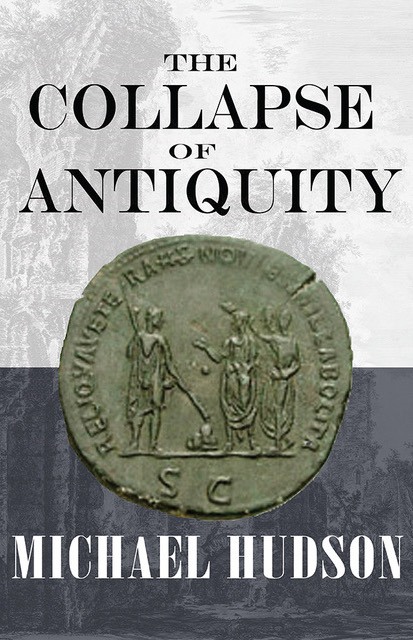
We are repeating the economic polarization of ancient Greece and Rome that I have described in my recent book The Collapse of Antiquity. The 7th– and 6th-century BC crisis of personal debt and land concentration led to social revolution by reformers (“tyrants,” not originally a term of invective) in Corinth, Sparta and other Greek-speaking city-states and Aegean islands. Solon was appointed archon to resolve the crisis in Athens. Unlike reformers in other Greek cities, he did not redistribute the land, but he did cancel the debts and removed the land’s crop-payment stones. The ensuing 6th century saw Solon’s successors lay the groundwork for Athenian democracy.

But the next three centuries saw the rise of creditor oligarchies throughout Greece and Italy, using debt as a lever to monopolize land and reduce citizens to bondage. These increasingly aggressive oligarchies fought, with more and more overt violence, against new reformers seeking to cancel debts and redistribute the land to prevent the economy falling into austerity, clientage and reliance on the dole. Their oligarchic ideology was much like that of today’s right-wing Supreme Court in its approach to constitutional law. The common denominator is an age-old drive to prevent democratic change, above all by using wealth as a means of controlling the political process. That is the philosophy outlined in the Powell Memo, and in the Supreme Court’s Citizens United ruling permitting the political campaign system to be financialized and, in effect, privatized in the hands of the Donor Class.

As in classical antiquity, the exponential rise in debt has polarized wealth ownership. Personal debt bondage no longer exists, but most home buyers and wage earners are obliged to take on a working-lifetime debt burden to obtain a home of their own, an education to get a job to qualify for mortgage loans to buy their home, and credit-card debt simply to make ends meet. The result is debt deflation as labor is obliged to spend an increasing proportion of its income on debt service instead of goods and services. That slows the economy, while creditors use their rising accumulation of wealth to finance the inflation of housing prices, along with stock and bond prices – with yet more debt financing.

The conflict between creditors and debtors is a red thread running throughout American history, from the Whiskey Rebellion of the 1790s to the monetary deflation of the 1880s as “hard money” creditor interests rolled back prices and incomes to be paid in gold, increasing the control of bondholders over labor. Today, U.S. debt and tax policy is passing out of the Congress to the Supreme Court, whose members are groomed and vetted to make sure that they will favor financial and other rentier wealth by leading the Court to impose the founders’ pre-democratic philosophy of constitutional law despite the past few centuries of political reforms that, at least nominally, have endorsed democracy over oligarchy.

The victory of rentier wealth has led to the deindustrialization of America and the resulting predatory diplomacy as its economy seeks to extract from foreign countries the products that it no longer is producing at home. This is why foreign countries are moving to pursue a philosophy rejecting debt deflation, privatization and the shift of economic planning from elected governments to financial centers from Wall Street to the City of London, the Paris Bourse and Japan.

Any resilient society’s constitution should be responsive to the evolution of economic, technological, environmental and geopolitical dynamics. U.S. legal philosophy reflects mainstream economics in trying to lock in a set of principles written by creditors and other rentiers fearful of making the financial system, tax system and distribution of wealth more conducive to prosperity than to austerity and economic polarization. While there no longer is an attempt to roll back the clock to impose the outright slavery that most framers of the Constitution endorsed, the spread of debt deflation and debt dependency has become a form of economic bondage that is the modern “conservative” counterpart to the racial slavery of old. It is what the “original” power elite are thought to have wanted if we choose to go back in a time machine and ask them, instead of looking toward a less oligarchic future.

Notes.

[1] The Lewis Powell memo to the U.S. Chamber of Commerce on August 23, 1971 laid out this plan. https://www.greenpeace.org/usa/democracy/the-lewis-powell-memo-a-corporate-blueprint-to-dominate-democracy/. For a review of how this almost conspiratorial propaganda and censorship attack was financed see Lewis H. Lapham, “Tentacles of Rage: The Republican propaganda mill, a brief history,” Harpers, September, 2004. Available at: http://www.mindfully.org/Reform/2004/Republican-Propaganda1sep04.htm.

[2] See Cassius Dio, Roman History 38.2.2. I discuss this affair in The Collapse of Antiquity, chapter 18.

[3] AthÄ“naion Politeia 35.2 and Xenophon, Hellenica 2.3.2 and 11.

[4] Plutarch, Solon 15.2.

Michael Hudson’s new book, The Destiny of Civilization, will be published by CounterPunch Books next month.

Monday, August 07, 2023

Washington’s Undemocratic Military Offspring

The military takeover in Niger is the latest example of U.S.-trained officers overthrowing a democratic government.  Brig. Gen. Moussa Salaou Barmou, the chief of Niger’s Special Operations Forces and one of the leaders of the coup, received training at both Fort Benning, Georgia, and the National Defense University in Washington, D.C.  The events in Niger are not an isolated incident.  Analysts at the Intercept confirm that U.S.-trained officers have taken part in 11 coups just in West Africa since 2008.

Moreover, the Nigerian military was a prominent U.S. client overall.  Since 2012, Washington has spent more than $500 million in Niger – one of the largest U.S, security assistance programs in Africa.  The New York Times notes that “Until this past week, Niger was the cornerstone of the Pentagon’s regional strategy.  At least 1,100 American troops are stationed in the country, where the U.S. military built multiple drone bases to attack radical Islamist factions.

For decades, U.S. leaders have contended that Washington’s training of and close ties with militaries in foreign countries have helped strengthen support for civilian rule and democratic values in those client states.  In 2022, Maj. Gen. Andrew M. Rohling, the commander of U.S. Army Southern European Task Force, Africa, insisted that the Pentagon’s objective always has been to “showcase a way, the American way, that we train and build leaders not only in their tactical tasks, but in the ethos of the United States Army.”

Even if strengthening democratic values among foreign officers has been the intent of the U.S. military – and there are ample reasons to doubt that claim – the record indicates that the effort has failed.  The latest cases of officers who had received U.S. military training going on to stage an epidemic of coups in Africa is reminiscent of the long, odious history of the School of the Americas (SOA).  The U.S. Army established that training center in 1946 at Fort Benning, not only to provide instruction in state-of-the-art military tactics, but to educate officers from countries in Latin America about the importance of democratic values and civilian control of the military.

The results were appallingly bad. A December 2000 ABC News story by investigative reporter Barbara Starr noted that “The list of graduates from the School of the Americas is a who’s who of Latin American despots.”  Alumni “included Manuel Noriega and Omar Torrijos of Panama, Leopoldo Galtieri of Argentina, and Hugo Banzer Suarez of Bolivia.”

There is one other troubling similarity between the developments in Latin America during the Cold War and the current stance of the U.S. military regarding Africa.   In the former case, U.S. military leaders were so concerned about the communist threat that they were willing to look the other way as their Hemispheric partners unseated democratic governments and committed human rights abuses.  Fear regarding the strength of Islamic extremism in Africa now appears to have reached the point that the Pentagon seems content to do the same.  The apparent indifference of the U.S. military hierarchy to rogue behavior by African alumni of U.S. training programs is more than a little troubling.

The posture of the U.S. military leadership also is symptomatic of the overall attitude of Washington’s policymaking elites.  Despite the abundance of U.S. rhetorical support for democracy around the world over the decades, U.S. conduct tells a very different story.  Frequently, the choice has been between interacting with friendly autocrats or unpredictable (perhaps even uncooperative) democratic factions.  U.S. administrations have consistently preferred to deal with friendly autocrats.

That tendency was especially pronounced during the Cold War, but it has not disappeared during the post-Cold War era.  Washington’s reaction to developments in Egypt during Barack Obama’s administration confirmed the trend.  In 2011, demonstrators overthrew the dictatorship of longtime U.S. client (and former general) Hosni Mubarak.  The first free elections in Egypt’s history followed, leading to victory by the Muslim Brotherhood and its leader, Mohamed Morsi, who became prime minister in June 2012.  Barely a year later, Gen. Abdul Fattah al-Sisi led a coup that ousted Morsi.

Washington’s reaction to Sisi’s extinguishing a fledgling democracy that showed signs of being unfriendly to the U.S. foreign policy agenda was quite revealing.  After a brief pause, the Obama administration lavished billions of dollars in both economic and outright military aid on the new regime.  True, there have been perfunctory criticisms of the horrible human rights record that Sisi and his colleagues soon amassed, but the aid has continued to flow over the past decade.  Average annual economic assistance has been $300 million, while annual military aid has been $1.3 billion.  This largesse from U.S. taxpayers persists despite the reality that some 60,000 political prisoners languish in Gen. Sisi’s prisons and thousands more have been executed.

Given Washington’s chronic fondness for friendly military autocrats, we should not be surprised at the prominent role that graduates of U.S. military programs are playing in the wave of coups taking place across Africa.  Those developments are entirely consistent with an amoral track record going back decades.

Ted Galen Carpenter is a senior fellow at the Randolph Bourne Institute and a senior fellow at the Libertarian Institute.  He also served in various senior policy positions during a 37-year career at the Cato Institute.  Dr. Carpenter is the author of 13 books and more than 1,200 articles on international affairs.

ANTIWAR.COM


‘Stigmatised’: Sex workers join criticism of UK banks

By AFP
August 8, 2023

Workers in professions associated with criminalisation -- such as sex work -- often complain that banks discriminate against them despite their income being legal - 
Copyright AFP Geoffroy VAN DER HASSELT

Akshata KAPOOR

London-based sex worker Marin Scarlett and right-wing populist Nigel Farage might initially appear unlikely campaigning allies, but when it comes to the pitfalls of banking in Britain they share a common cause.

“It’s ridiculous that financial institutions can act like moral arbiters,” Scarlett told AFP, echoing Farage’s exact same criticism last month after a scandal erupted around his treatment by British banks.

Farage’s complaints about the closure of his account with the upmarket Coutts, a subsidiary of NatWest used by the late Queen Elizabeth II, dominated the news for days, prompted questions in parliament and cost top executives their jobs.

For Scarlett, who is in her thirties and started out as a sex worker 15 years ago, the sudden uproar was galling, given arbitrary account closures have plagued her profession for a “long time”.

She accuses UK banks of applying “absurd, undue scrutiny” to those in the industry.

“Even though I knew everything I was doing was legal, you feel shamed and stigmatised,” she said of the closures, which began in 2018 when a leading payment processor banned her.

The campaigner for the European Sex Workers’ Rights Alliance was told her account would be frozen for six months before an evaluation.

“What do you mean by an evaluation? That’s my money!” she recalled thinking.

Scarlett argues losing access to funds puts sex workers in a particularly vulnerable position.

“You have to do more work in the meantime and rush to accept more bookings which could put you in a weird situation,” she said.

– ‘Layers of insecurity’ –

UK bank account closures have increased yearly since 2016-17, with over 1,000 shuttered each day in 2021-22, according to data compiled by the Financial Conduct Authority watchdog.

Farage, a former leader of the Brexit Party and anti-immigration party UKIP, complained that Coutts removed him as a client over his right-wing political views.

“Banks should be banks, they should not be moral arbiters,” he said last month.

However, most terminations do not impact high-profile figures, with workers in professions associated with criminalisation — such as sex work — often targeted, according to campaigners.

“Financial discrimination against sex workers is an endemic problem in the UK banking industry”, Audrey Caradonna, a spokesperson for Sex Workers Union (SWU), told AFP.

She said denying them new accounts and closing existing ones had been “increasing”, with more and more SWU members “talking about having their accounts frozen”.

Some have become embroiled in legal disputes with bank and payment processors over service denials, Caradonna noted.

An adult content creator on subscription service OnlyFans said one online bank had recently closed both her personal and business accounts without explanation.

“Total discrimination”, the woman, who wished to remain anonymous, told AFP.

While UK regulations grant everyone the right to hold an account, banks can turn down those who could harm their reputations.

Sex work is legal in Britain but related activities, including solicitation and running brothels, are not.

That creates a grey area in which banks choose not to “risk” having sex worker customers, according to Caradonna.

“There are layers of insecurity around sex workers’ access to banking”, she said.

– ‘More vulnerable’ –


Following the furore around Farage, the UK government has proposed changes that would require banks to give longer notice periods and clearer explanations for closures, stating the need for “protecting freedom of expression”.

Scarlett welcomed the new spotlight on the issue but questioned its timing.

“It’s pretty gross that the conversation has to be triggered by this happening to a person that society deems important, powerful or rich enough,” she said.

She recalled ending up “with a load of cash in a shoebox under my bed” after fearing the repercussions of depositing her earnings.

The risk of being shut out of banking “forces you to break rules that you otherwise would not break”, Scarlett added.

Rosie Hodsdon, from National Ugly Mugs, a charity fighting violence against sex workers, agreed that they are often pushed towards the cash economy and made “more vulnerable to robberies” and domestic abuse.

Caradonna fears the ongoing impact of so-called de-banking, as more people turn to sex work amid the UK’s cost-of-living crisis to avoid homelessness and pay bills.

The risk of bank accounts being closed is leaving the most vulnerable sex workers — those on state benefits — “terrified that they are going to wake up one day without access to their finances,” she added.

“They will be forced to work in riskier ways to try and survive,” the advocate warned.


China's industry minister urges BRICS economies to collaborate in building open, inclusive digital economy

(Global Times11:12, August 08, 2023

China's Minister of Industry and Information Technology Jin Zhuanglong on Monday emphasized the need for BRICS economies to work together to create an open, inclusive and fair environment for the development of the digital economy.

Jin made the remarks at the 7th BRICS Industry Ministers Meeting held via video conference. The meeting centers on promoting the upgrading of manufacturing industry and establishing a sustainable industrial chain and supply chain.

Jin noted that facing challenges and new opportunities in manufacturing transformation and upgrading, BRICS economies should open their doors for development and embrace cooperation with the spirit of openness, inclusiveness, and win-win cooperation.

He called for the BRICS economies to grab the opportunity of the digital era and work together to promote the digital transformation of manufacturing through key means such as industrial internet.

Jin said that BRICS economies should together build an open, inclusive, fair, just and non-discriminatory environment for the development of the digital economy, while creating a safe, stable, efficient, inclusive, and mutually beneficial global industrial supply chain system.

He suggested BRICS economies should focus on demand for talent in key areas such as industrial internet, blockchain, artificial intelligence, and big data, while jointly promoting capacity building in the field of the new industrial revolution among BRICS economies.

Jin said that the Chinese government is actively promoting new industrialization, focusing on supply-side structural reform, intelligent manufacturing and digital technology innovation and application.

The aim is to accelerate the transformation and upgrading of traditional industries, advance the high-end, intelligent, and green development of the manufacturing industry, and promote the deep integration of the digital economy and the real economy, Jin noted.

The meeting reached an important consensus on topics such as the digital transformation of BRICS economies, cooperation among small and medium-sized enterprises, and the enhancement of industrial supply chain resilience.

(Web editor: Zhong Wenxing, Liang Jun)

GEORGIA 

Glacier melting, erosion, heavy rains causes of Shovi resort landslide - National Environmental Agency preliminary report

 8 August 2023 
Glacier melting, erosion, heavy rains causes of Shovi resort landslide - National Environmental Agency preliminary report

The landslide in the western Georgian municipality of Oni that killed at least 18 people in the Shovi resort on August 3 was caused by intense melting of glaciers, collapse of rock formations in their headwaters, heavy rains, erosive processes and a glacier runoff, a preliminary report by the National Environmental Agency said on Monday, Azernews reports, citing Agenda.

The Agency said a collapse of a rocky mass on the western side of the Buba glacier had led to its collision with the glacier after coming into motion and caused a collapse of a part of the glacier. The body said the development may have caused an overflow of subglacial waters, with the resulting flow directed through the valley bed at a high speed in the locality.

The report said “erosion centres of different scales” were formed in “practically all tributaries” of the local Bubistskali river, with a solid flow forming in the upper part of the valley and supplemented with landslide masses washed along the river bed as well as debris moved from the tributaries.

A powerful mud and rock flow moved downstream from the bed and, in about 15 hours and 15 minutes, spread over about 26 hectares in the area of Shovi (the so-called ‘Cottage District’), where it covered buildings and caused human casualties”, it added.

The report also said the approximate volume of solid material that had come into motion in the river valley was about five million cubic metres, most of which entered the beds of Chanchakhi and Rioni rivers, with about 1.5 million cubic metres accumulated in the epicentre of the disaster and in the transit zone of the valley.

The report noted an analysis of the data of the existing hydrological station on the Chanchakhi river had shown no long-term stagnation of water in the valley, either before or during the development of the natural disaster.

It should also be emphasised that until August 3, 2023 there had been no significant flood flows in the bed of the Bubisskali River over the past 100 years”, the report pointed out.

The report also advised against carrying out “any kind of capital protective measures” in the area of the flood formation and transit zone in the river valley due to its “hydromorphological parameters”, and said it was “practically impossible to predict exact times of formation of these types of events in locations across the world”.