Fascism is the Western Answer to Class
Struggle
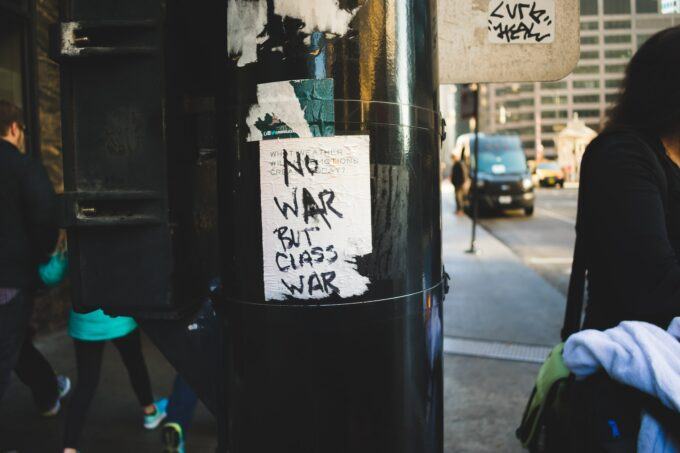
Photo by Kayle Kaupanger
Setting aside culture war animosities for the moment to consider the direction of politics in the US— to the extent that doing so is psychologically and / or economically possible for dedicated culture warriors, recent revelations that the FBI and CIA were active participants in the 2016 and 2020 national elections run headlong into longer history. While ‘American democracy’ has always been tenuous and abstract (‘representative’), the US has now returned to a pre- and inter-War melding of state with commercial interests. The American political ‘system’ now fits the Marxist-Leninist conception of the capitalist state.
How is this working for ‘the people?’ Well, which people? The US has the largest military budget in the world by a factor of ten. But it is nevertheless apparently incapable of producing usable weapons and bullets. The US spends multiples of what the rest of the rich world does per person on healthcare while it has active genocide levels of people dying (graph below) who wouldn’t be in a functioning society. The end of the agreement between capital and the state to forego predatory pricing (‘greedflation’) on food and other necessities is increasing food insecurity for vast swaths of the West. And nuclear war with Russia is once again an implied possibility.
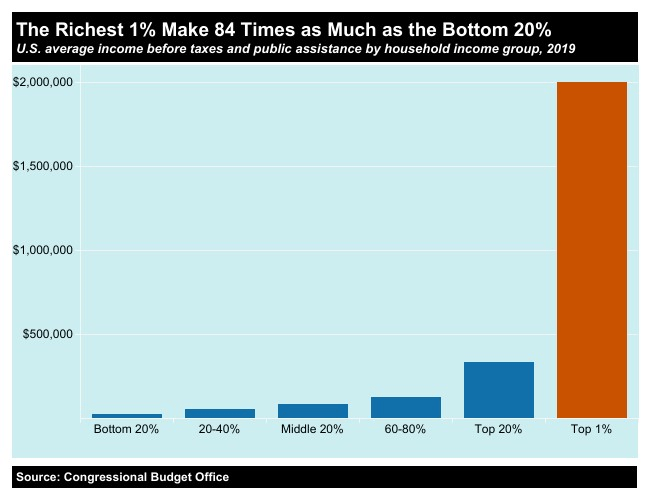
Graph: while ‘inequality’ has received lip service of late, most Americans imagine ‘rich’ to be the neighbor down the street who just bought a new car. In fact, the concentration of income in the US in recent years is beyond the imagination of most Americans. The graph illustrates the general case that the richest one percent of wage earners earns 84 times what the poorest quintile earns. In terms of ‘dollar democracy,’ this means that the rich have 84 times as much political influence as the poor have. Source: inequality.org.
The recent shift from the soft power of trade agreements (NAFTA, TPP) to the hard power of military imperialism ties to the economic backdrop of a (US) corporate-state that exists to grab resources and market power for ‘American’ capital. In opposition to capitalist free-trade logic, American liberals have chosen the path of economic nationalism in a low-probability effort to regain political legitimacy for the American state. As temporarily disgraced American idiot-prince George W. Bush put it, ‘war is good for the economy.’ Of course, his war wasn’t good for the million Iraqis that died in it, nor for the wider Middle East that was lit on fire by it, nor for the European and Scandinavian nations that faced the ‘inexplicable’ surge in refugees that it produced. But for the titans of war, the benjamins are flowing again.
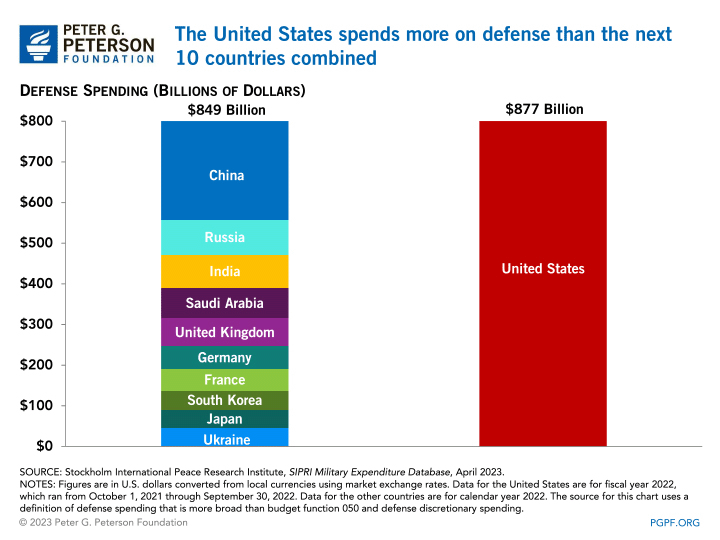
Graph: while it is well understood that the US military budget dwarfs those of other nations, the question of what ‘we’ get for the money is never asked. That the Biden administration is pleading poverty with respect to supplying Ukraine with American weapons should bring this question to the fore. How can the US spend 10X as much as the rest of the world and not have the weapons and materiel to show for it? In fact, the neoliberal nature of military spending in the US has meant that the process is too corrupt to produce anything of value. Source: pgpf.org.
For analytical purposes— again with culture war flashpoints set to the side, current US President Joe Biden was the prominent liberal advocate for ‘conservative’ George W. Bush’s resource-grab-war in Iraq. Mr. Biden’s central selling point for that war, Iraqi WMDs, was a fabrication. It may have been Mr. Bush’s fabrication, but Biden went beyond ordinary bipartisan warmongering to sell the American war against Iraq. This likely has bearing on FBI / CIA ‘meddling’ in US elections for the benefit of national-security-state Democrats. Biden has been a consistent proponent of American empire since he entered Congress several centuries (five decades) ago.
The binaries used in American political discourse imply a distribution of political views that are mutually exclusive. Democrats versus Republicans is one such binary. Left versus Right is another. Racist versus anti-racist is another. Fascist versus anti-fascist is another. Analytically, this is to impose theoretical divisions onto American society, not to ‘report’ them. They are assumed to describe the ideological motivations that lead ‘us’ to act. But where do these binaries leave economic motives, the limits of what ‘we’ know, and the point at which we exist in history?
To bring this down to earth, the practical distinction in the twentieth century was between political movements defined in terms of national boundaries, not individual beliefs. This left imperial competition— global resource grabs to supply burgeoning industrialization, as the source of national competition. Like now, the sense was imparted that the first nation to control global industrial inputs would control the world. Industrialization was the perceived path to global domination via military production. The logical circle— military production is needed to fuel imperialism because imperialism is needed to fuel military production, was created.
But this formulation is incomplete. Wars based on national competition end when a nation or group of nations capitulates to a foreign power. Wars based on ideological competition end only when an ideology is ended (as in never). This incongruity led to the Cold War practice in the US of anti-authoritarian authoritarianism, of using the techniques of authoritarianism to crush authoritarianism abroad, only done ‘at home.’ But of course, the use of authoritarian techniques is by definition authoritarianism. The same is true in the present when politicians use propaganda and censorship to crush views that they find politically inconvenient.
American politics has long been premised in the conceit that this class collaboration via ‘national interests’ preempts the class divisions created through capitalist exploitation. Jeff Bezos and Bill Gates may have made ‘their’ fortunes via Federal contracts, labor exploitation, and legal privileges denied to others, but when the US attacked Iraq in 2003, ‘we’ were united in being American, goes the logic. Never mind Orwell’s ‘All animals are equal, but some animals are more equal than others.’ Through NAFTA, the American state helped Bezos and Gates lower the wages of ‘their’ workers.
Making a few people obscenely rich— and then maintaining that wealth, has taken precedence over providing workers with a living wage for most of the history of the US. From slavery through Joe Biden suppressing a railway strike after reneging on his promise to raise the minimum wage, the American ‘perspective’ has always been the wish-list of the oligarchs. However, it is untrue that this bias has the consent of the governed. To paraphrase political writer Thomas Frank, ‘every culture war in recent history has been a stealth class war.’ If the political and oligarch classes lived in the same country that the rest of us do, they would know this. But class divisions define the ‘American’ experience. A different class means a different experience.
Public discourse in the US over recent years has been of a relatively stable political system that rests atop changing economic relations. This stability was proved in the eyes of urban liberals when Joe Biden won the 2020 presidential election following the manufactured turmoil of the Trump years. Missing from this analysis to date has been the impact of changing economic relations on the stability of the political system. The shift from the New Deal to neoliberalism in the 1970s didn’t just impact economic relations. It replaced the logic of a public realm with public support for ‘private’ economic production.
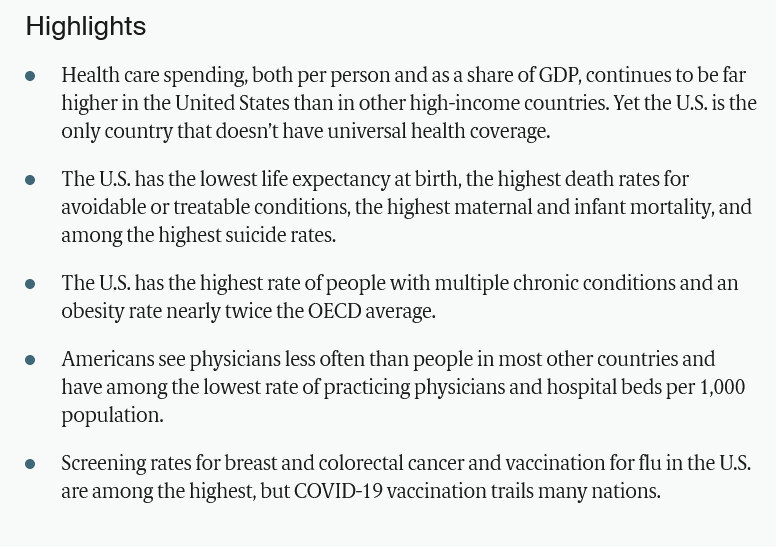
Chart: having followed the healthcare impact of the ACA (Affordable Care Act), Obamacare, since the program was first introduced, the reporting has shifted from speculative— based on the imagined healthcare benefits of insurance expansion, to stunned incredulity that any healthcare system could produce such relentlessly bad outcomes. The Commonwealth Fund (above) is interesting because it employed Liz Fowler, the health insurance lobbyist who wrote the ACA. The evolution of its coverage has shifted from quiet despair to absolute horror at how little the program has actually accomplished. As a bonus, its neoliberal logic is now being used to gut Medicare. Source: Commonwealth Fund.
This difference is fundamental. The New Deal featured programs to ameliorate capitalism’s tendency to produce too few jobs, insufficient public goods, and to create market power for connected capitalists. Its conception of the public realm was premised in social tension between state and ‘private’ interests. In this formulation, the state balanced the provision of public goods like national defense, education, and healthcare, against the rent-seeking tendencies of private interests.
In a way that is conceptually analogous to the saw that science is good for analyzing everything except what is important in life, the missing ‘public goods’ from capitalist production beg the question of the purpose of ‘the economy.’ Another way to put this is that while capitalism can occasionally produce what some people want, it is incapable of producing what all people need. Ironically, having the Federal government pay capitalists to produce ‘public’ goods makes them private goods. Their serial failures as ‘public goods’ demonstrate this point (graph above).
The neoliberal turn ended the very conception of a public realm through private provision of all goods and services. Given the economists’ fantasy that capitalist production is efficient, local productive efficiency was imagined to be superior to the public production of public goods. In other words, while the government may no longer produce national defense, education, or healthcare, the additional profits earned by private producers for producing them could in theory be applied to producing more public goods. But they never are.
If this ‘economics’ reads like a cynical farce, you may be onto something. The facts of the US in 2023 are of private military contractors setting US foreign policy, an education system set up to earn private profits for trade school type employment training, and a healthcare system that is the worst in the ‘developed’ world. Given the American capitalist practice of playing legal games like patent scamming when doing so is more profitable than producing quality goods and services, why would the architects of the US healthcare system and military production not expect the same game-playing from these?
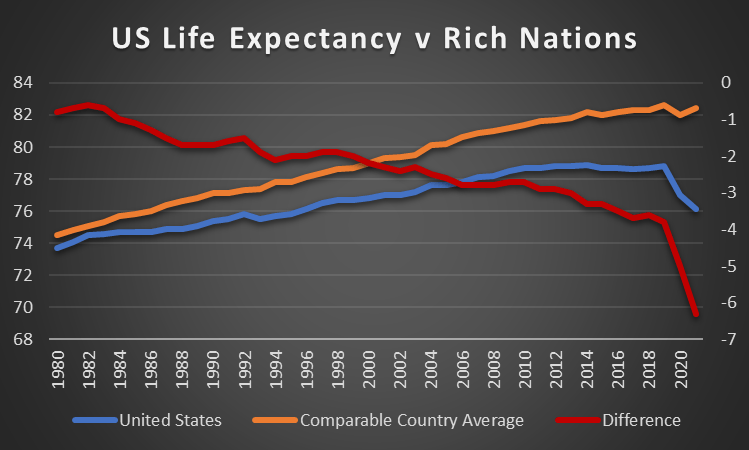
Graph: following from the Commonwealth chart above, child and maternal mortality, gun violence, suicide, and the health impact of the industrial food system, have now accumulated to have Americans live 6.2 years less than the citizens of functioning nations. This approximates the drop in life expectancy that took place during the dissolution of the Soviet Union. At the time, it was considered amongst the greatest tragedies in human history. American liberals elected Joe Biden to toss another trillion dollars into it. This is genocide. Source: OECD; World Bank.
Again, while GDP (Gross Domestic Product) measures P x Q (P = price and Q = quantity), it doesn’t measure the social costs of production, the quality of what is produced, or the social utility (or lack thereof) derived from it. In this respect, ‘the economy’ can rise while the economic circumstances of most people who exist within it decline. This has resulted in serial assertions that political dysfunction is the result of the ‘little people’ being too stupid to know how good they have it. This was the liberal chide against the American Left in the 1960s and 1970s, as well as the implied Left charge against Donald Trump’s supporters from 2016 forward.
Consider, the Great Recession wasn’t a fantasy dreamt up by Right-wing malcontents. From the 1970s forward American oligarchs worked with their toadies in the political class to create the world imagined by what became the Reagan-Right. By 2016 Wall Street had been deregulated, ‘private’ healthcare had been funded at public expense, and privately sourced ‘public’ education was training children to sit down, shut up, and do what they are told for the benefit of their future employers. In other words, there is a material basis for widespread discontent.
In contrast to the fantasies of economists, the architects of the New Deal understood capitalism. The New Deal was based on knowledge of what capitalism does well, and what it doesn’t do well. In contrast, the neoliberal turn was based on the forgotten history of the Great Depression. In other words, neoliberalism was / is a forgetting—purposeful or not, of why capitalism doesn’t produce public goods without socially given reasons, like Federal programs, for doing so. In this sense, neoliberalism is the elimination of a public purpose to benefit private actors.
I recently spoke with a former analyst for a large and well-recognized agency of the Federal government who had participated in a project to ‘rationalize’ Federal defense spending along neoliberal lines. However, s/he had no idea the project as it was conceived was neoliberal. The goal had been to make government as ‘efficient’ as the so-called private sector. Missing from the analysis was any cognizance that the central point of post-WWII Federal defense spending had been to employ lots of people in stable industries at decent wages. It wasn’t to turn defense contractors into oligarchs on the public dime.
Back in the day, the employment benefit of Federal defense spending was well understood. No capitalist enterprise had a direct interest in providing national defense, so theory had it that ‘we,’ as in the people, must fund it collectively. As a consequence, between the end of WWII and today, American imperialism— from Krugmanite trade twaddle to arming Ukraine to fight Russia, has been funded on the public dime. Additionally, Americans were employed to produce the munitions and materiel used to destroy Korea, Vietnam, Laos, Cambodia, Nicaragua, El Salvador, Iraq, Afghanistan, Libya, Syria, Yemen, etc.
A few readers may recall that it was private equity’s foray into national defense spending that placed former US President George H.W. Bush in a meeting with the Bin Laden family in Washington, DC on September 11, 2001. The purchase and control of national defense infrastructure by private equity changed the logic of the MIC from the quasi-public production of public goods to the private production of nominally public goods by rent-seeking corporations. The employment aspect of the public production of public goods was discarded in favor of private profits.
Now for the trillion-dollar question: given that the US spends more each year on its military than the next ten nations combined (graph above), why has it run out of weapons and materiel to supply to Ukraine in its (US) proxy war with Russia? To be clear, there is no suggestion here that doing so would either be a laudable goal or good public policy. But still, if Russia can fund its military at eight cents / dollar relative to the US and still field an army in Ukraine, why isn’t the US, given its military expenditures, loaded to the rafters with weapons and materiel to sell to Ukraine?
A similar question faces the American healthcare industry. The US spends far more per person on healthcare than other ‘rich’ nations, and yet has the worst healthcare outcomes amongst them (graph, chart, above). Excluding bonuses and stock options, the healthcare ‘industry’ has the highest paid workers in the US who are producing the worst outcomes in the developed world. Like the defense industry, capitalists flipped the public purpose of the healthcare system on its head. The goal is now to extract maximum public payments while providing minimum goods and services in return.
With respect to both ‘industries,’ American liberals continue to conflate public payments to private interests with a public purpose. There is no such confusion present when the Federal government purchases writing pens and paper. The goal is clear: to support private profits by contracting with private corporations to produce writing pens and paper. The Federal government could create a federal institution to produce these. Or it could pay extra to ‘private’ contractors, as has been common with cost-plus Federal contracts, to pay higher wages to workers. But doing so would counter the neoliberal logic of economic rationalization.
Being American, with an internet now openly being ‘managed’ by the FBI and the CIA, actual history is getting harder to find unless you know before-hand where to look for it. In this regard, Daniel Guerin’s 1939 materialist classic ‘Fascism and Big Business’ provides detailed descriptions of the economic drivers of the rise of European fascism. To save the suspense, these details are eerily reminiscent of the US in recent decades. No, this isn’t to revisit the liberal fantasy that Trump = Hitler. History is more interesting than that. The link between then and now can be found in the exigencies of capitalism, which Guerin details.
As the willingness of American liberals to subvert the ‘freedoms’ that allegedly distinguish the US from authoritarian states grows, the Cold War irony of anti-authoritarian authoritarianism grows with it. As is illustrated through the public response to the official lies related to Hunter Biden’s now infamous laptop, censorship undertaken ‘in the public interest’ was more precisely to undermine the integrity of the 2020 election for the benefit of the Democrats. In so doing, the stated purpose of state propaganda and censorship was proved a lie. The revealed purpose has been to silence political opponents, not to protect the public.
Divested of its ideological and organizational paraphernalia, fascism is nothing more than a final solution to the class struggle, the totalistic submergence and exploitation of democratic forces for the benefit and profit of higher financial circles. – Michael Parenti
The sense has been imparted via the urban, bourgeois, press that ‘normalcy’ was restored in the US through the election of Joe Biden in 2020, even though Biden has been consistently less popular with the American people than the relentlessly demonized Donald Trump. With recent revelations that the CIA and FBI actively interfered in the 2020 election on behalf of Democrats by putting forward the false allegation that Hunter Biden’s computer contained ‘Russian disinformation,’ what normalcy has been restored— that the CIA runs American politics?
The question isn’t rhetorical. There is an answer. From the House Judiciary Committee in April, 2023:
Former CIA Deputy Director Michael Morrell testified before the House Judiciary and Intelligence Committees and revealed that (now current Biden Secretary of State Antony) Blinken was “the impetus” of the public statement signed in October 2020 that implied the laptop belonging to Hunter Biden was disinformation. A = inserted by Urie for clarity.
Mr. Blinken was acting as Joe Biden’s campaign manager when he ‘inspired’ former CIA Director Morrell to publicly mischaracterize the content of Hunter Biden’s laptop as ‘Russian disinformation.’ He also got fifty of his fellow spooks to do the same. And, lest you have forgotten, the public statement issued by Morrell and his fellow election fraudsters was reviewed by the current CIA and given a green light to be disseminated. Question: why haven’t these people been arrested for election interference and conducting dirty ops domestically?
Whatever, your political allegiances, getting the CIA to publicly lie in order to elevate Joe Biden’s chances of being elected is as anti-democratic— dirty, manipulative, dishonest, and corrupt, as any of the allegations yet made regarding the ‘fascistic’ tendencies of other politicians and parties. Fighting fascism with fascism leaves fascism as the only possible result. It is therefore ironic that ‘liberal fascism’ and ‘left fascism,’ have since entered the lexicon to denote political repression undertaken to counter political repression.
Dan Guerin’s (above) central insight is that big business— multinational corporations and Wall Street, is the central proponent of fascism in the same way that it is a central proponent of imperialism. It was the leaders of large industrial enterprises in the US that supported the rise of European fascism from afar. The only attempted fascist coup in the US, the ‘business plot’ of 1933, was carried out by Wall Street in league with leading industrialists. Had the plotters not chosen the wrong General to lead the coup— socialist gadfly Smedley Butler, it may well have succeeded.
Why might American industrialists and financiers favor fascism in the present? Well, the ‘private’ provision of necessities like healthcare, education, and collective defense, isn’t going that well for the ‘consumers’ of these products. Why the rush to censor the internet? A bipartisan consortium of human snakes, lizards, and anal warts (apologies to snakes and lizards) has ‘brokered’ the delivery of decidedly low-quality public goods and would find it distinctly inconvenient to have their names associated with their political products by the public. In fact, the goods are so low-quality that liberal largesse looks a lot like looting.
Amongst the largest contributors to Barack Obama’s 2008 campaign were Wall Street and health insurers. ‘We’ got consequence-free bailouts for Wall Street and four million ‘excess deaths’ from a healthcare system that has gotten worse since the ACA was implemented. Health insurers were amongst the largest contributors to Joe Biden’s 2020 presidential campaign as well, and he doubled down on Obamacare by shoveling another trillion dollars into it. Where is the accountability that requires that every mother in New Jersey piss in a jar (get a drug test) to get $15 per month in food assistance?
So again, the answer to the question is implied in the widespread failure of ‘private’ contractors to produce functioning public goods. In the first, these producers are raking in profits and bonuses as things stand, so why should they change tactics? In the second, the Federal oversight ‘process’ features future employees negotiating with current employees of ‘revolving-door’ corporations. What incentive do they have to stir the pot? In the third, there is no not-corrupt political party in the US to compete with the two conspicuously corrupt parties of the present. With voting as the sole ‘legitimate’ mode of changing politics, what choice is there?
My regulatory acquaintance mentioned above is a dedicated liberal Democrat. Their take on the neoliberal economic project that they were engaged in (‘rationalizing’ defense spending in terms favorable to capital) is that it was ‘liberal’ because it featured government spending. In fact, the same claim could be made when fascist Italy and fascist Germany geared up war spending in anticipation of WWII. While I don’t dispute that this spending could be considered ‘liberal,’ few Americans liberals who took the time to think about it would likely agree.
Daniel Guerin’s book ‘Fascism and Big Business’ (link above) should be required reading in public schools in the US. That they aren’t suggests why profit-seeking charter schools are such a bad idea. What is the incentive for committed capitalists to risk their profits by teaching political theory that is threatening to their business interests? Did the lightbulb just go off? ‘Capitalism’ is no more ideologically neutral than any other economic system. That American liberals can’t differentiate between their beliefs and fascist logic of the twentieth century should be telling.


