Tuesday, August 08, 2023

Fans line streets for Sinead O'Connor's funeral in Ireland


The singer, best known for her 1990 single Nothing Compares 2 U, died at her London h
ome in July

Sinead O'Connor at Dublin Castle. PA Wire

Gillian Duncan
Aug 08, 2023

Fans have lined the streets of Sinead O'Connor's hometown in Ireland as her funeral takes place on Tuesday.

The cortege was expected to pass through Bray, Co Wicklow, before a private burial service is held later in the day..

The acclaimed singer, best known for her 1990 single Nothing Compares 2 U, died at her home in London last month, aged 56.
READ MORE
Sinead O’Connor's music streams jump 2,885% in the US in the wake of her death

Shaykh Dr Umar Al Qadri, chief imam at the Islamic Centre of Ireland, who met O’Connor in 2018, said he was “incredibly grateful for the opportunity to lead the Muslim funeral prayer for the daughter of Ireland, Sinead O’Connor aka Shuhada Sadaqat”. The singer had changed her name to Shuhada' Sadaqat in October 2018.

In Strand Road in Bray, a vehicle equipped with loudspeakers played music from her long career. There was a murmur of appreciation as Nothing Compares 2 U was played, with many singing along.


A statement from the Gardai (Irish police) on Tuesday said: "In keeping with her family's wishes, following a private service, members of the public will be able to pay their respects and are asked to gather at the Strand Road/Promenade area between 11.30am and 12.30pm.

"It is expected the funeral procession will stop briefly in this area at some stage between these times."

A London coroner did not find a medical cause of death and suggested that the postmortem results may take several weeks. The singer's death is not being treated as suspicious.


Handwritten notes were left outside O'Connor's home in Bray thanking her for sharing her voice and her music, with one saying: “You are forever in my heart.”

A pink chair was placed outside the pink-framed conservatory of the seafront house, with pink flowers, candles and a photo of the singer in front of it.

Flowers and candles are left outside singer Sinead O'Connor's former home in Bray, Co Wicklow. Reuters

One sign left by the wall of the property listed causes the singer had championed, including welcoming refugees, saying: “Where words fail, music speaks.”

A neighbour was also seen putting candles on the wall between the two properties.


O'Connor's family have asked people who wish to say a “last goodbye” to stand along the Bray seafront as the cortege passes.

The midmorning procession was due to start at the Harbour Bar end of the Strand Road and continue past her former home, Montebello, where she lived for 15 years.

Since her death on July 26, people have been leaving flowers and paying their respects at the house, which the singer sold in 2021 and which now lies empty.

“Sinead loved living in Bray and the people in it,” a statement from her family said.


People gather outside Sinead O'Connor's former home in Bray, before a private burial later on Tuesday. Reuters


“With this procession, her family would like to acknowledge the outpouring of love for her from the people of Co Wicklow and beyond, since she left last week to go to another place.”

The Irish Grammy-winning singer was found unresponsive by police at her south-east London home.

A host of tributes have flooded in from fans and famous artists across the world, including Russell Crowe, Annie Lennox, Cyndi Lauper and Bob Geldof.

A councillor for Bray East said fans are “grateful” to the family for allowing them the opportunity to “say goodbye” to O'Connor.

Erika Doyle told BBC Breakfast: “I was a lifelong fan of Sinead. We met quite by chance when she moved to Bray … Sinead, although she was attached to Bray and very Irish, she was a global superstar. That is easy for us to forget here in Bray – she touched lives across the world.”
Sinead O'Connor dies at 56 – in pictures


She added: “Sinead's legacy is still being written and I think it will for some time … we are very grateful to Sinead's family for allowing the opportunity to say goodbye …

“People are taking the opportunity to connect with her in some way.

“I always said about Sinead she was actually quite quiet, but she was never silent.


“We need to mourn the Sinead of Nothing Compares, but [also] the Sinead who shone a light on difficult areas.

“She was controversial, but in the way when people say things that people aren't ready for … speaking truth to power.”

Several gatherings were held in the days after O'Connor's death in Dublin, Belfast and London, where members of the public paid tribute to her legacy as a musician and activist.

O'Connor, who was born in Dublin in December 1966, released her first album The Lion And The Cobra in 1987.

Her second studio album, I Do Not Want What I Haven't Got, followed in 1990 and contained the hit single Nothing Compares 2 U, which saw O'Connor top the charts around the world.

The track earned her multiple Grammy Award nominations including for the prestigious record of the year category, best female pop vocal performance and best music video.

In 1991, she was named artist of the year by Rolling Stone magazine and took home the Brit Award for international female solo artist.

She released a further eight studio albums, the latest being 2014's I'm Not Bossy, I'm The Boss.

Following her death, her music management company 67 Management said she had been finishing a new album, reviewing tour dates for next year and was also considering “opportunities” around a movie of her book.

Updated: August 08, 2023, 4:22 AM


Sinead O’Connor ‘gave us strength’, says Magdalene laundry survivor
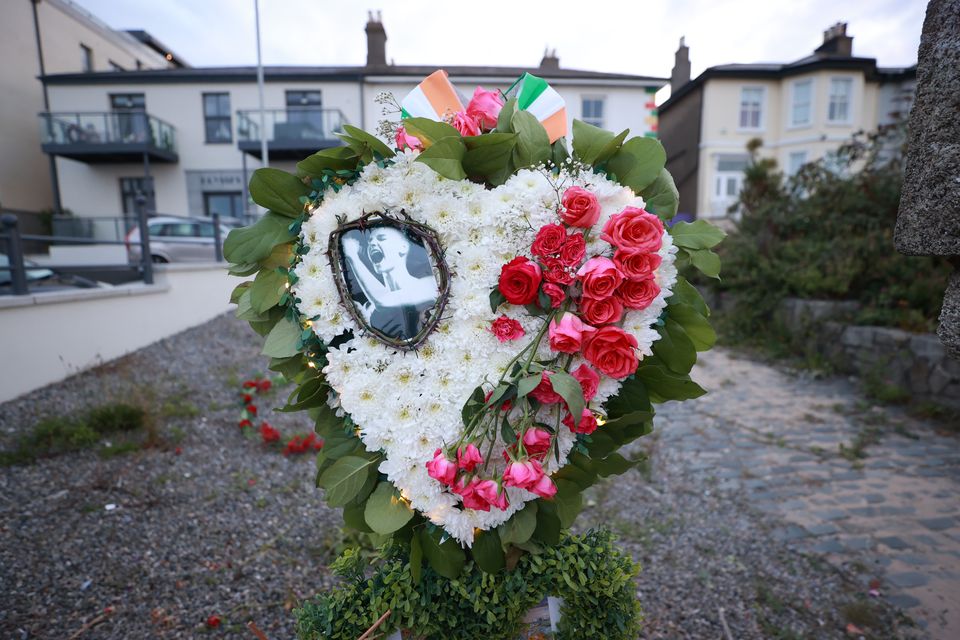
A floral wreath designed by Karen Kehoe, on behalf of victims of abuse in Ireland, placed outside Sinead O’Connor’s former home in Bray, Co Wicklow (Liam McBurney/PA)

By Claudia Savage, PA

A woman who suffered abuse in one of the same institutions as Sinead O’Connor said the singer “made Ireland a different place” by speaking out on church and state exploitation.

O’Connor spoke openly about abuse she faced in a Magdalene laundry as a teenager, where she spent more than a year.

A guard of honour was made for the late singer by survivors as her funeral procession passed by her former Irish home.

Magdalene laundries were institutions established by the Catholic Church in Ireland to house “fallen women”.


An estimated 30,000 women were confined in Magdalene laundries and revelations about the widespread abuse of women and girls in the laundries eventually led to a formal state apology in 2013.

Maureen Sullivan, who came to see the funeral procession of O’Connor pass through Bray, Co Wicklow, said she was one of the thousands of women incarcerated in the secretive institutions.


She said she was put into the laundry at age 12 after being abused by a family member.

“I’m a survivor of the Magdalene laundry … and I done four years in these places, trafficked from one to the other,” she said.

“My name changed, my education was taken from me and I wasn’t allowed to play with other children in case I told them what happened to me.”

In 2022, a Journey Stone was unveiled by survivors of the Magdalene Laundries at St Stephen’s Green in Dublin.
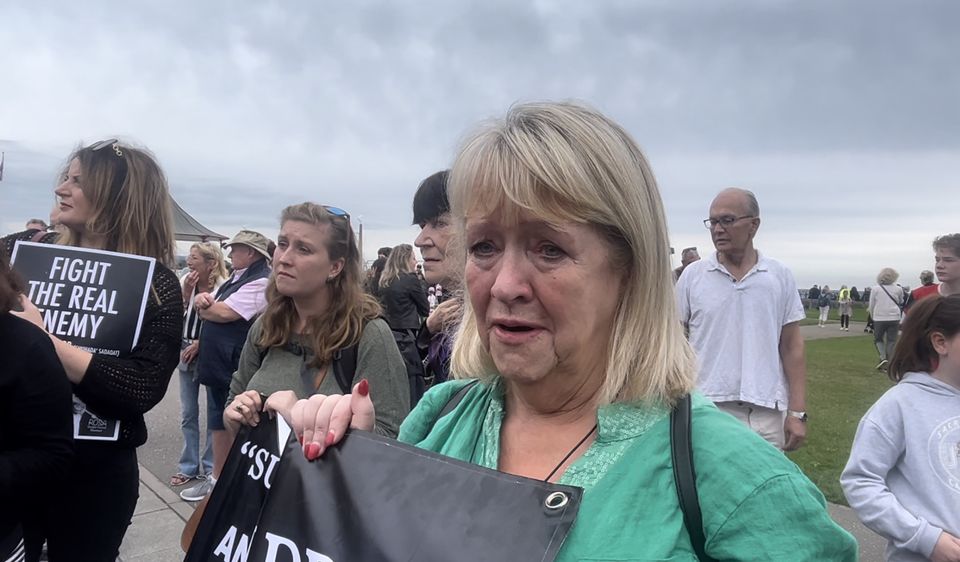
Maureen Sullivan was one of the thousands of women incarcerated in Magdalene laundries (Claudia Savage/PA).

The Journey Stone memorial was designed to commemorate the suffering of the women who were incarcerated in Magdalene laundries and similar institutions.

Ms Sullivan said O’Connor was integral to bringing the memorial to fruition.

She said: “Sinead came along, she done a charity single for us so we could get a monument. So, the monument was just thrown on the side, so I decided that I’d turn it into a Journey Stone, and it’s in the little museum in St Stephen’s Green.

“Sinead’s name never comes up much on that, but only for Sinead that Journey Stone wouldn’t be there today.

“It was for all survivors and she was very happy about that.”

It gave us all courage, it gave us all strength. She gave strength to so many women

Maureen Sullivan

Some of those gathered at the funeral held signs highlighting the exploitation that many children faced in church and state institutions in Ireland.

O’Connor ignited vitriol when she tore up a picture of Pope John Paul II on Saturday Night Live in 1992, in protest against sexual and physical abuse in the Catholic Church.

Years following the performance, Pope John Paul II would acknowledge that abuse had been happening in Catholic institutions across the world.

Ms Sullivan said O’Connor highlighting the problem so publicly in the face of such intense backlash gave survivors strength.

“It gave us all courage, it gave us all strength. She gave strength to so many women,” she said.

“And the only thing I feel so sad about was the way she was treated in Ireland, I think that people should have supported her more.”
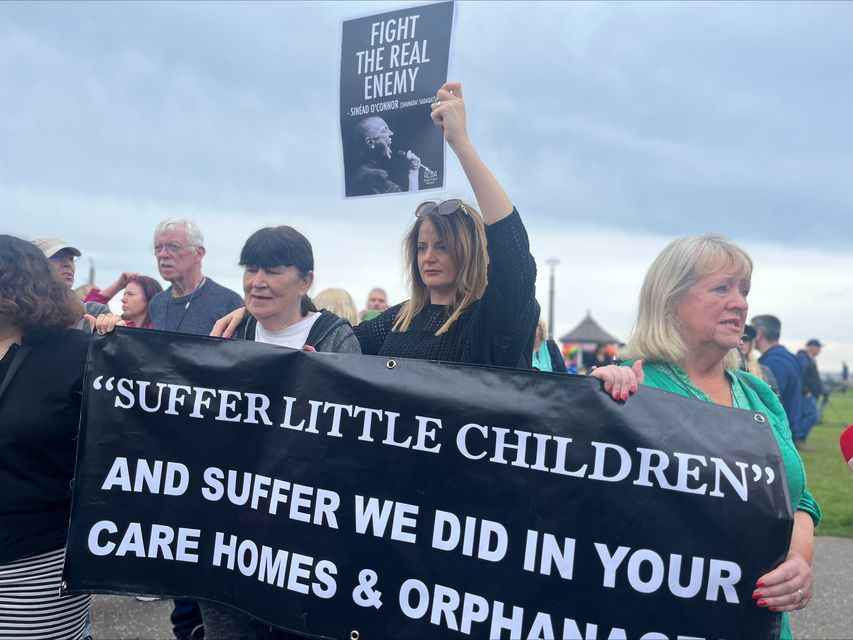
Mourners lined the streets to see the funeral procession of Sinead O’Connor in Bray, Co Wicklow (Claudia Savage/PA).

She added: “They’re supporting her now when she’s dead, but what support did she get when she was living? That’s the sad side of it.

“So my hope for her is that she has gone into the light, and I hope she’s in a better place because she deserves it.

“She made Ireland a different place. She spoke out when nobody else would. She was before her time.”

Ms Sullivan said O’Connor was a once-in-a-generation performer and activist.

“One in a million, I don’t think we’ll ever meet anything like her again,” she said.

She added: “I’ll miss her terribly, I wish somebody would have reached out to her and helped her.”

Mother and Baby home advocate Laura Murphy said she estimated about 100 people who had been affected by the Catholic Church had travelled to honour O’Connor on Tuesday in Bray.

Ms Murphy, 43, from Laois, talked about how the late singer was “not afraid” to speak of her own trauma and had to endure a “horrendous” time after ripping up the picture of the pope.

She said: “So we, in Ireland, the activist movement in Ireland, in general, looks up to Sinead O’Connor as our queen.

“We will honour her from this moment forth in every, every piece of activism we do, every word of truth that we speak, we will be honouring her and we will be emboldened by her, and we will be very cognizant to ensure that her legacy continues.”


Nothing Compares to Sinéad O’Connor

 
 AUGUST 4, 2023
Facebook

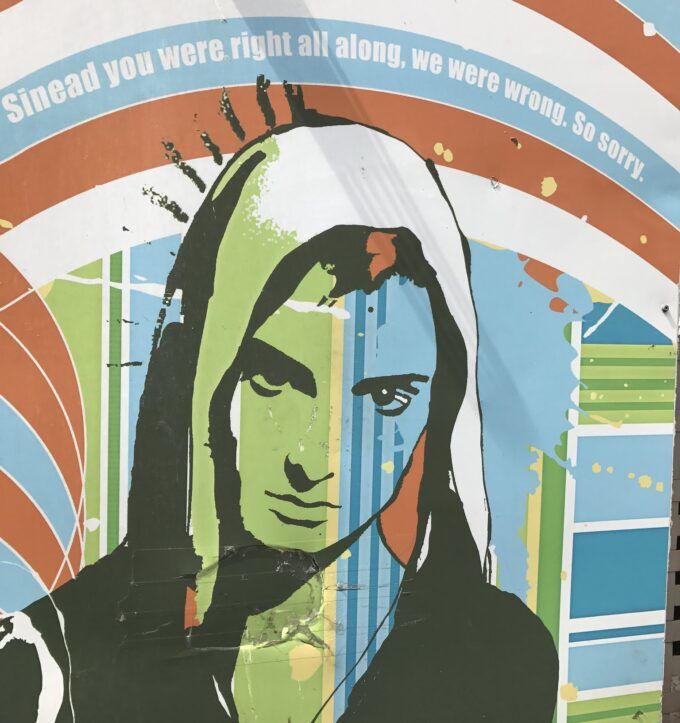
Photograph Source: Steve Terrell – CC BY 2.0

I first became aware of the incomparable Sinéad O’Connor in 1990 when I heard her sing “Nothing Compares 2 U,” a song by Prince that Sinéad made her own—without Prince’s blessing—but with eyes that saw right through you and a voice of silvery gold.

That voice reminded me of Joan Baez singing like an angel crying out against the wars, but more tormented because Sinéad was tortured, abused, probably by a priest or a nun or her mother. Most definitely by our world.

Her delivery was so intense, haunting, accusatory and yet so vulnerable, that as soon as I heard it, like millions around the world, I fell in love with her.

So did my husband Max. And as we fell in love with Sinéad, we fell in love with each other. We were already bonding through our opposition to war in general and Desert Storm (when it was still Desert Shield) in particular, and together we made a cassette tape (remember those?), Desert Susan, in the spirit of Tokyo Rose with a pinch of Scheherazade. We sent a few hundred cassettes to the troops and officers of Desert Shield and Storm to persuade them to “make love not war.” I talk about the wisdom of the much-maligned “Vietnam Syndrome,” the folly of war and the beauty of love in between musical interludes, and the first song on the tape is Sinéad O’Connor’s “Nothing Compares 2 U.”

To whom was she singing in that song? Her lover who left her? Maybe they broke up, or he died, or perhaps he went off to war, and she yearns for him to return in peace.

We yearned for all of them to return in peace, but they didn’t, though when they thought they “won,” they held a big parade. Then one Gulf War led to another, with terrible sanctions in between, and the Perma Warscontinued and continue. At least, over the years, Max and I have heard how those Desert Susan tapes featuring Sinéad turned some of those troops and officers to turn their swords into plowshares—or maybe floggers—and make love, not war. We’ve even met a few of them.

Then in 1992, the year Max and I got married, Sinéad O’Connor went on Saturday Night Live, sang out like a seer in that precious metal voice, and then she ripped up the Pope—actually her mother’s photo of Pope John Paul II—telling us to “Fight the Real Enemy.” In that moment, she was incandescent, a Joan of Arc for our times, and I fell even harder in love with her, as the fires burned around her.

Some claim now that nobody knew then that Catholic priests were molesting altar boys and girls en masse, but a lot of us knew, though many didn’t want to know, and poor Sinéad, like Joan, burned and suffered on the stake of society’s willful sexual ignorance.

The pope-ripping caused Sinéad to get canceled before cancelling was a thing. A few days later, she was booed at a concert by seemingly everyone but Kris Kristofferson, and it seemed that her brilliant career had been flushed down the Vicar’s drain.

But Sinéad was never sorry for what she did. She admitted she struggled with bipolar disorder and PTSD all her life, but in that moment, she was the sanest person on the planet. It was what she was destined for, to tell that truth about Catholic priests abusing the most vulnerable members of their flock when it was unpopular to say so, and I loved her for that. Now everyone loves her for that (well, almost everyone).

Then, almost two decades later, in 2013, I felt the pain of seeing someone I love do something I despise—as dramatically as she did the things I loved. Sinéad O’Connor wrote a scolding, slut-shaming open letter to Miley Cyrus about being too sexual and too “naked” in her Wrecking Ball video. She wrote that Hollywood was making a “prostitute” out of Miley, and not in a good way—whether Miley’s outfits and dance moves were Miley’s idea or not. When Sinéad slut-shamed Miley so fiercely and publicly, she slut-shamed me, and all of us who choose to wear erotic outfits or nothing at all—and I hated her for that… perhaps especially because I had loved her so much before.

Another Counterpunch writer, Ruth Fowler, wrote an article at the time that expressed my feelings about that awful letter much more eloquently and humorously than I ever could. Apparently, Sinéad read Ruth’s article and freaked out, called CP editor Jeffrey St. Clair and “unloaded” on him for 40 minutes, demanding that he fire Ruth. He didn’t fire Ruth, but he did suggest Sinéad write a piece for CounterPunch, which she did—and I loved her for that.

She took a few other important and unpopular positions, like supporting the Palestinians, turning down a Grammy as too “commercial,” and opposing all the wars. Though I’m still repelled by her slut-shaming, there was a lot to love about Sinéad O’Connor.

Her youngest son died by suicide a year ago, and I can’t even conceive of the immense pain and harrowing loneliness she went through over that, though I sometimes imagine her singing Prince’s song to her lost boy. Through all of her suffering, she gave us so many gifts of love, until she couldn’t anymore, and now at the young age of 56, she’s gone.

Thank you for everything, Sinéad O’Connor. Nothing compares to you.

Susan Block, Ph.D., a.k.a. “Dr. Suzy,” is a world renowned LA sex therapist, author of The Bonobo Way: The Evolution of Peace through Pleasure and horny housewife, occasionally seen on HBO and other channels. For information and speaking engagements, call 626-461-5950. Email her at drsusanblock@gmail.com  


Acclaimed Irish singer Sinead O’Connor has died at the age of 56, her family said. AP


Individualism is Killing the Planet


 AUGUST 8, 2023
Facebook

On Sunday, June 25th I awoke to the smell of a smoldering campfire, a scent most people associate with our earliest, often happiest, experiences out in the natural world. Upon going outside, I found the entire city of Montreal was blanketed by a smoky haze and realized that the wildfires raging throughout the northeast, producing public health warnings across borders, had come home to roost.

Summer wildfires had already become a fact of life in the west in recent years, even reducing the town of Paradise, California to rubble in late 2018, its population losing everything. While some coverage has begun to improve, most major news outlets have given this new summer reality the usual breathless disaster treatment, often avoiding the root cause of these catastrophes as they have so many others from massive floods to dangerous heat waves, treating them as acts of God rather than a human-produced climate emergency.

In the wake of these unnatural disasters we are often told it’s “too soon” to discuss how industrialized, carbon-fueled society is fracturing the natural world.

It’s time to treat this desperate problem with serious corrective measures.

One of the most striking things about this emergency is the ability of those most responsible for it to deflect attention away from themselves. This usually comes in the form of friendly corporate news outlets and rightwing think tanks using their platforms to deny the problem exists at all. They often insist that “once a century” disasters occurring at an accelerating pace are the result of natural processes.

Fossil fuel companies like Exxon were aware of the coming problem in the 1970s but have spent the decades since funding climate denialism while at the same time engaging in greenwashing campaigns portraying themselves as stewards of the natural world rather than destroyers of it. Most of them reported record profits last year.

The more paranoid on the far right insist, just as they did during the crisis provoked by Covid 19, that climate change is a cynical ‘hoax’ to take away the freedoms enjoyed by citizens of richer countries. Even anodyne ideas that would at the very least make the lives of poorer people living in food deserts better, like ‘15 minute’ cities, are presented by these voices as an attack on… liberty.

Taking selfishness to an extreme and calling it individualism allows those on the political right to ignore issues that require collective action, at least until they are impacted by them and arrive hat in hand to demand bailouts from everyone else.

For the clear majority of people who still believe in science, individual actions like eating less (or no) meat, avoiding air travel and using public transit or electric vehicles are good in and of themselves but simply not enough to confront a problem of global scale. The idea that altering our consumer behavior without widespread political activism will be enough to address the problem is clearly (and intentionally) delusional. Beginning in the 1980s, Big Oil began to support rightwing politicians who were overtly anti-science, starting with Ronald Reagan.

There is also the widely held belief that some kind of technological fix is just around the corner, that an individual genius will come along to save us all. What is not asked for or expected is for all of us, especially the wealthy and the corporations that are still driving future generations into an abyss, to make the sacrifices needed to address this existential issue. Barring this, as we might expect, those least responsible for this crisis, especially in the global south, are likely to pay the highest price in the years ahead.

Ironically, each of us, as individuals, can make a difference, but in the end only enough to matter if we do so in concert with massive numbers of other individuals.

Derek Royden is a writer based in Montreal, Canada


January 6th Indictment One Step Short of the Full Case Against Trump


 Facebook
 AUGUST 7, 2023
Image of man in Donald Trump mask.

Image by Darren Halstead.

On August 1, 2023, a federal grand jury indicted former President Donald J. Trump for conspiring to prevent Vice President Mike Pence, through a blizzard of knowing “Stop the Steal” lies, threats, intimidation, and mob violence, from counting judicially vetted state certified electoral votes as stipulated by the Electoral Count Act and the Twelfth Amendment to the United States Constitution.

The January 6th indictment is solid as granite. All the incriminating testimony and evidence is from the former President’s appointees or political supporters, for example, former Attorney General William Barr and former White House Counsel Pat Cipollone. Democrats are nowhere to be seen. Even lavishly compensated private investigators, hired by Mr. Trump himself to unearth electoral fraud, came up empty handed.

The knockout is from former Vice President Pence. He testified in various formulations that on January 6, 2021, Mr. Trump demanded that he “choose between [Trump] and the Constitution.”  Mr. Trump’s demand showed his knowledge that he was haranguing the Vice President to do something contrary to the Constitution. Mr. Trump was not presenting legal arguments in favor of an alternative constitutional understanding. Mr. Trump, a few days earlier, had similarly assailed Pence for being “too honest” in denying any constitutional foundation for a lawsuit claiming the Vice President possessed the authority to reject state-certified electoral votes.

The uniform advice Mr. Trump received from his own lawyers was that the Vice President’s constitutional role in “counting” state-certified electoral votes was ministerial. He was not empowered to question their validity. That had been the universal understanding for more than two centuries since the Twelfth Amendment was ratified in 1804. Even one of Trump’s co-conspirators, lawyer John Eastman, conceded Trump’s zany reading of the Amendment would not command a single vote in the United States Supreme Court. J. Michael Luttig, former United States Court of Appeals Judge for the Fourth Circuit, a conservative jurist in the mold of the late Justice Antonin Scalia, scoffed at the idea of any role for the Vice President in counting state-certified electoral votes other than a ministerial one.

Trump’s private lawyers like Rudy Guliani, Sidney Powell, Jenna Ellis, and John Eastman face professional or court discipline for their “Stop the Steal” lies. Ms. Powell maintained in a defamation lawsuit that “no reasonable person” would have believed her lies were facts.

Historical practice and the Twelfth Amendment’s plain text are reinforced by the four-centuries-old Anglo-American axiom that a man cannot be a judge in his own case. Thus, Vice President Al Gore lacked power to second-guess the state-certified electoral votes for Republican George Bush in the 2000 presidential election in which Mr. Gore was Mr. Bush’s Democratic opponent. Vice President Pence, who was Trump’s running mate, would have faced a similar political conflict if he decided on the validity of state-certified electoral votes cast in 2020.

Mr. Trump’s incorrigibly criminal, extraconstitutional state of mind was betrayed by his alarming proclamation on July 23, 2019, hoping to undo the American Revolution: “Then I have Article 2, where I have the right to do anything I want as president,” That is, the rule of law is no longer king, the king is law. Willful ignorance or stupidity is no defense to criminal action.

Any free speech defense mounted by Mr. Trump would be DOA. There is no First Amendment right to unleash a tsunami of “Stop the Steal” lies with the ulterior criminal motive of shipwrecking the peaceful transfer of presidential power under the Twelfth Amendment by intimidating the Vice President from counting state-certified electoral votes that had survived 61 judicial challenges. Mr. Trump nearly succeeded. The indictment states that on January 6, 2021, “at 2: 25 p.m., the United States Secret Service was forced to evacuate the Vice President to a secure location [in the Capitol]. [There], throughout the afternoon, members of the crowd chanted, ‘Hang Mike Pence!’; ‘Where is Pence? Bring him out!’; and ‘Traitor Pence!’”

Free speech icon Justice Louis D. Brandies confirmed in a concurring opinion in Whitney v. California (1927) that the First Amendment is undisturbed by the prosecution of speech calculated to occasion imminent serious harm. It is difficult to conceive of any greater injury to a democracy founded on the consent of the governed than frustrating the peaceful transfer of presidential power in accord with judicially vetted and politically certified popular votes.

The probability that Mr. Trump will testify on his own behalf is zero – too great a risk of perjury.  A former Trump lawyer, John Dowd, reportedly was convinced that his client was an inveterate liar.

Even if Mr. Trump is convicted of January 6th offenses alleged in the indictment before presidential balloting in November 2024, he could still be a candidate for the presidency. Socialist Eugene Debs, while imprisoned for making anti-war speeches and allegedly violating the Espionage Act, ran for president in 1920 and attracted one million votes. Debs’ sentence was commuted by President Warren G. Harding, who invited him to the White House saying, “I have heard so damned much about you, Mr. Debs, that I am now very glad to meet you personally.”

The sole criminal prohibition that would disqualify Mr. Trump from the ballot, under Section 3 of the Fourteenth Amendment, is “insurrection,” made criminal by 18 United States Code Section 2383.

Section 3 categorically disqualifies from public office at any level of government any official who, after having taken an oath to support the Constitution of the United States, engages in “insurrection” against it. Among other things, insurrection means seeking by force, violence, or otherwise to frustrate the ability of the United States to enforce the Constitution or laws. The narrative of the January 6th indictment makes clear that Mr. Trump conspired and directly engaged in insurrection against the Constitution on January 6th by attempting to obstruct the enforcement of the Twelfth Amendment and Electoral Count Act.

The House Select Committee to Investigate the January 6th Attack on the United States Capitol made a criminal referral to the Department of Justice recommending prosecution of Trump for assisting or aiding the January 6th insurrection. Mr. Trump was impeached by the U.S. House of Representatives for inciting insurrection and a majority of U.S. Senators voted to convict (but short of the two-thirds majority constitutionally required). The Department of Justice has secured multiple convictions against Trump’s January 6th mob for “seditious conspiracy” under 18 U.S.C. 2384, whose elements of proof are virtually indistinguishable from insurrection.

Why then did the indictment omit an insurrection count to disqualify Trump for 2024? And was Special Counsel Jack Smith or Attorney General Merrick Garland the de facto or de jure decider? Under Department of Justice special counsel regulations, the latter is empowered to overrule the former in narrow circumstances.

Without exhausting all the hypotheses, Democrats might wish to see Mr. Trump nominated as the Republican presidential candidate in 2024 because they believe he is a sure loser against President Joe Biden and would convulse the Republican Party. Placing that political calculation above the Constitution, i.e., Section 3 of the Fourteenth Amendment, we submit, would be too dismaying for words.

Alternatively, Democrats could believe that disqualifying Mr. Trump from the 2024 campaign would taint the outcome in the minds of the considerable number of his deceived supporters and compound political polarization. But to bow to such political calculations would erode the rule of law. The sole loyalty of federal officials from the highest to the lowest is to the Constitution, period.

Perhaps Garland and Smith had non-political legal rationales for their omission. If so, they have not explained it publicly – even though nothing forbids them from candor.

We urge Special Counsel Jack Smith to unilaterally, or with the approval of Attorney General Garland, return to the federal grand jury in Washington, D.C., and ask for a superseding indictment adding a count for insurrection in violation of Section 2383. Not a single word in the factual narrative of the preceding indictment need be changed.

The future of our Republic is too important to be left to shortchanging the fullest legal case against Trump.

Ralph Nader is a consumer advocate, lawyer and author of Only the Super-Rich Can Save Us! 

Kirk and Spock’s Response to Racism in Star Trek’s “Balance of Terror”

 
 AUGUST 7, 2023
Facebook

Photograph Source: NBC Television – Public Domain

One of my all-time favorite episodes of Star Trek is “Balance of Terror” from season 1, and I have used it from time to time in my Star Trek class at Kyung Hee University over the years. It is very much a product of its time, and it is similar to World War II films like “The Enemy Below”. In this episode we first meet the Romulans, who fought a war with Earth a century before, and they have returned to their old ways, attacking Federation outposts along the neutral zone that separates the Federation and the Romulan Empire. The combat scenes between the Enterprise and the Romulan Bird of Prey are exciting and well done, but there is more to this episode that just tactics, weapons, and destruction.

When they intercept a Romulan message, the bridge crew of the Enterprise sees that the Romulan commander looks very much like Mr. Spock, a Vulcan, who later theorizes that the Romulans may be related to Vulcans. According to Professor Jose-Antonio Orosco, “On the bridge of the Enterprise is Lt. Stiles, a navigator who had family members die in the war long ago. He still bears a grudge against the Romulans. It turns out the Romulans bear a striking resemblance to the Vulcans, and Stiles immediately raises suspicions that Mr. Spock may be a Romulan spy. During one tense moment, Stiles mutters a remark about Spock’s loyalty and Kirk quickly reprimands him: ‘Leave any bigotry in your quarters. There’s no room for it on the bridge.’” (p. 112)

Here we see a good example of Star Trek’s approach to dealing with racism, with Kirk chewing out Stiles for his idiotic belief that since Romulans and Vulcans look alike they must be the same, but the Vulcans are peaceful and highly evolved citizens of the Federation, and the Romulans are warlike, like the Vulcans were in the distant past before the philosopher Surak led his people to a way of life based on logic, stoicism and utilitarianism. Again, in the words of Professor Orosco, “When Kirk gets after Stiles for his xenophobia toward Spock in ‘Balance of Terror,’ he is clearly demonstrating the Colorblind Ideal as a standard for the organizational operation of a starship. Kirk recognizes that Stiles is a bigot and that he, as Captain, has no control over what goes on in his officer’s heart and mind. But he can make it clear that those beliefs, and any actions that might result from those beliefs, are subject to official sanction if they are found to affect the cooperative efforts of the institution. Kirk is sending the message to his bridge officers that when they are on duty what matters is not their racial or humanoid differences but their ‘unifying organization identity’ as Starfleet personnel and their ability to conduct their work with one another.” (p. 114)

Later on in the episode, Stiles makes an offensive comment to Spock in the forward phaser room when Spock asks if they need any help. Spock is not fazed and simply leaves, but seconds later Stiles notices a phaser coolant leak that is filling the compartment with poisonous gas. When Stiles does not respond to Kirk’s commands to fire on the intercom, Spock rushes back into the phaser room, risks his own life, fires the phasers, and manages to save Stiles while one other officer lies dead on the deck. Later in sickbay Stiles expresses surprise that Spock would save him after what he said, and Spock replies that it was his duty to save a fellow crewmember and that he is not capable of an emotional response. Once again the Vulcan’s stoicism leads to ethical action which will hopefully help Stiles overcome his prejudice. I wonder how many of us would risk our lives to save the life of a bigot who hates us? I am afraid the answer is “not too many”. Like many episodes of Gene Roddenberry’s classic, it gives us something to think about. This episode truly impresses me and my students.

Star Trek author Marc Cushman speaks highly of this story as well. As he put it: “‘Balance of Terror’ offers thought-provoking entertainment, and two milestones for the series. This is our introduction to the Romulans, one of two recurring opponents of the Earth-led Federation (conceived to correspond to the enemies of 1966 America). This is also the first episode to deal directly with the issue of racial bigotry. In doing so, we learn more about Spock’s background. Spock himself shares this information, saying, ‘If Romulans are an offshoot of my Vulcan blood, and I think this likely, then attack is even more imperative. Vulcan, like Earth, had its aggressive, colonizing period. Savage, even by Earth standards. If the Romulans retain this martial philosophy, then weakness is something we dare not show.’ This episode provides a strong reminder of Roddenberry’s inspiration for Kirk’s character. [Associate Producer] Robert Justman said, ‘Captain Kirk was Hamlet, the flawed hero. Gene told me that, early on, he modeled him on Captain Horatio Hornblower and he had characteristics of Hamlet, who knows what he has to do but agonizes over it, feels — as Hornblower did — that he had to put on a brave front for the sake of his crew…. He wasn’t strong enough, and yet he had to be strong because otherwise, they would have no one to protect them.’”(p. 234)

I loved this episode as a child for all the action and suspense, but now, in my final days teaching Star Trek, I love it for a much deeper reason, namely, the way it deals with bigotry.

Notes

José-Antonio Orosco. Star Trek’s Philosophy of Peace and Justice: A Global, Anti-Racist Approach. Bloomsbury Publishing. Kindle Edition.

Marc Cushman; Susan Osborn. These Are The Voyages, TOS, Season One (These Are The Voyages series Book 1). Kindle Edition.

Roger Thompson is a research fellow at Dalhousie University’s Centre for the Study of Security and Development, the author of Lessons Not Learned: The US Navy’s Status Quo Culture, a former researcher at Canada’s National Defence Headquarters and Korea’s first Star Trek professor.