Monday, August 21, 2023

END FUR FARMING
Animal rights activists released 3,000 minks from a Wisconsin farm during a late-night heist

Story by khawkinson@insider.com (Katie Hawkinson ) 

Vasily Fedosenko/Reuters© Provided by INSIDER

Animal rights activists broke in to a Wisconsin farm and released 3,000 minks into the wild.

They took responsibility via anonymous message on a site run by the Animal Liberation Front.

Police told a local outlet that 90% of the minks had been recovered in five days.

Thousands of minks ran wild in western Wisconsin after animal rights activists held a late-night heist to bust them out of a fur farm.


The activists released 3,000 minks from Olsen Fur Farm in Independence, Wisconsin, last week by cutting a hole in a chain-link fence and opening cages, The Star Tribune reported. The owner did not discover the damage until the next morning, the paper reported.

While the Trempealeau County Sheriff's Office has not released information on any suspects, an anonymous group took responsibility for the act by sending a message to the North American Animal Liberation Press Office, a site run by the Animal Liberation Front, which the FBI has previously labeled as an extremist group


"It's operational for now, but maybe releasing several hundred mink has a chance to close it for good," the message reads. "We hope many of the mink enjoy their freedom in the wild and that this farm will be unable to breed thousands upon thousands of them in future years.

Challis Hobbs, president of the Fur Commission USA, said the break-in may have done more harm than good for the mink.

"They basically just die because there's nothing to eat, and they don't have burrows to find security from predator attacks," Hobbs told the Star Tribune. "It messes with the ecosystem."

Around 90% of the minks have been recovered as of Wednesday, a spokesperson for the Trempealeau County Sheriff's Office told the Star Tribune. The escapees constituted three quarters of the farm's 4,000 mink population.

When contacted for updates by Insider, the Trempealeau County Sheriff's Office said they could not give comment outside of business hours.

MINK ARE WEASELS
FRANK ZAPPA WEASELS RIPPED MY FLESH 1970


Pollution in Venezuela's Lake Maracaibo threatens life in one of the world's oldest lakes


Pollution in Venezuela's Lake Maracaibo threatens life in one of the world's oldest lakes
© Provided by The Canadian Press

MARACAIBO, Venezuela (AP) — The fishermen of Lake Maracaibo say they face their worst nightmare everyday as fish stocks decline and pollution degrades the health of this great freshwater lake, one of the oldest — and largest — in the world.

Lake Maracaibo, which once was at the heart of Venezuela's oil boom, has turned into a polluted wasteland, according to environmentalists.

The pollution of the lake, located about 600 kilometers (372 miles) west of the capital, Caracas, is the result of decades of excessive oil exploitation, poor maintenance of the obsolete infrastructure and a lack of waste treatment plants in the area. Tens of thousands of kilometers of pipes lie at its bottom, where crude oil leaks and system failures are frequent.

The lake, which collects rainwater from more than a hundred tributaries, has also become the wastewater deposit for the western states of Zulia, Mérida and Trujillo, where 5.3 million people live. Waste from the Colombian department of Norte de Santander also ends up in it.

Fertilizers, sewage and other chemicals are discharged into Lake Maracaibo, causing high concentrations of nitrogen and phosphorus that have led to the growth of cyanobacteria such as microcystin that produces 95% of what is locally called “verdin,” a greenish, toxic microalgae that occupies much of the lake's waters, according to Beltrán Briceño, a professor at the University of Zulia and head of the microbiology laboratory of the Institute of Agricultural Research in Maracaibo.

The proliferation of cyanobacteria can cause serious damage to both aquatic animals and human beings due to the toxins they generate, he said. Cyanobacteria can cause massive fish deaths


The fish no longer come near the shores of the lake because the microalgae “drowns them,” said José Aular, a 61-year-old fisherman who says he developed a skin rash because of the lake's contamination.

Environmentalists say oil pollution in Lake Maracaibo began at the beginning of the 20th century but worsened in the early 1930s, when a canal was excavated at the northern end of the lake to allow large oil tankers to navigate and connect the lake with the open sea. Seawater flowed in, killing freshwater wildlife, such as some plants and fish.

Before, “you would go out fishing and catch 700 kilos (about 1,500 pounds) of shrimp” almost all the time, said Yordi Vicuña, a 33-year-old fisherman. Now, he says, fishermen spend days at sea only to come back with about eight kilos (17 pounds) of shrimp.

Fishermen can't cast their nets anywhere because they will get damaged. Crude oil spilled into the lake smears fishing boats, clogs outboard motors and stains nets, said Vicuña.

The pollution of Lake Maracaibo is decades old, but now it's being felt on its coast with its bad smells, oil spills and microalgae, said Briceño, the professor at the University of Zulia.

"There is no magic formula” to rescue the lake if it continues to be used as a “septic tank,” he warns.

___

Associated Press writer Jorge Rueda contributed to this story from Caracas, Venezuela.

Ariana Cubillos And Juan Pablo Arráez, The Associated Press
Maui water is unsafe even with filters, one of the lessons learned from fires in California

Story by The Canadian Press •1d

The language is stark: People in torched areas of Maui should not try to filter their own drinking water because there is no "way to make it safe,” Maui County posted on its Instagram account this week.

The message reached Anne Rillero and her husband Arnie in Kula, who were eating yet another meal of frozen pizza. The couple feels incredibly lucky they and their home survived the fires that raced across Maui in recent days, wiping most of Lahaina off the map. The number of confirmed fatalities was raised on Friday to 114 people.

When a neighborhood organization alerted them not to drink their water and to air out the house even if they run the tap, the couple decided to eat off paper plates to avoid exposure. No washing dishes.

“It’s alarming that it may be in the water system for awhile,” said Rillero, a retired conservation communication specialist who has lived on the island for 22 years.

Brita filters, devices connected to refrigerators or sinks and even robust, whole-home systems are unlikely to address the “extreme contamination” that can happen after a fire.

“They will remove some of it, but levels that will be acutely and immediately toxic will get through,” said Andrew Whelton, a Purdue University researcher and expert in water contamination after wildfires in urban areas.

The Maui fires damaged hundreds of drinking water pipes, resulting in a loss of pressure that can allow toxic chemicals along with metals and bacteria into water lines.

“You can pull in contaminated or dirty water from the outside, even when those lines are underground,” said David Cwiertny, a civil and environmental engineering professor at the University of Iowa.

Hundreds of families could be in the same situation as the Rilleros in the Lahaina and Upper Kula areas, where people have been told to minimize any contact with county water including showers. In Lahaina alone, aerial imagery and damage assessment data generated by Vexcel Data show 460 buildings apparently undamaged by the fires. These are places where people are returning.

For now, the county has told people to use bottled water for all their needs or to fill jugs at tankers called water buffalos, which have been brought in near the burns.

The state health department's environmental health division told Maui County, which operates water delivery systems for most residents, to test for 23 chemicals. Those are just the ones for which the federal government has set limits for drinking water.

These warnings reflect new science and are intended to avoid the whiplash of conflicting information received by people impacted by the 2018 Camp Fire in California, who received messages from four different agencies.

Until a few years ago, wildfire was only known to contaminate drinking water at the source, such as when ash runs into a river or reservoir. California’s Tubbs Fire in 2017 and the Camp Fire “are the first known wildfires where widespread drinking water chemical contamination was discovered in the water distribution network,” according to a recent study published by several researchers including Whelton with the American Water Works Association.

After the Camp Fire destroyed Paradise, California, officials didn't initially understand that smoke and chemicals had leached into the water through broken and melted water pipes. So they did what was standard after other fires: they told people to boil water before use.

Concerned about benzene contamination, the Paradise Irrigation District water utility then changed the order and told people to avoid the water, district Assistant District Manager Mickey Rich said.

Four days later, the California State Water Resources Control Board announced people could drink it as long as it didn't smell. Two and a half weeks later, that agency announced there was benzene in the water.

Two months after that, a third agency, a county health department, told the public the water was unsafe and not to attempt to treat it on their own.

“There were a lot of unknowns,” Rich said. “When the scientists came six months into the recovery, they really answered a lot of questions that we wish we would have had at the beginning.”

New contaminants also have been discovered recently. The chemicals that Hawaii's state government told Maui County to test for are called volatile because they tend to become airborne, like gasoline that turns to vapor when it drips from the pump onto your car.

But Whelton’s new research on the Marshall Fire in Boulder County Colorado, shows a group of heavier compounds, called “semi-volatile,” can contaminate damaged water lines as well, even when benzene and other better-known chemicals are not there.

“We found SVOCs leaching from damaged water meters into drinking water,” Whelton said. “You can’t use VOCs to predict whether SVOCs are present.”

For people on Maui who get their water from private wells, now would be a good time to get it tested, said Steve Wilson, a groundwater hydrologist at the University of Illinois, Urbana-Champaign.

If fire burns near a well, it can damage the cap, which keeps out debris. Plastic in the lining can even melt, releasing hazardous fumes into the well.

“In the case of a fire, it may look fine, but it’s hard to know,” Wilson said. “It might have affected something on the inside."

Experts caution complete restoration of safe water will take a long time.

“I would implore anybody not to make a decision about lifting the water safety order until you have repeated validation that there is no contamination that poses a health risk,” Whelton said.

___

Christopher Keller contributed from Albuquerque, New Mexico, and Mary Katherine Wildeman from Hartford, Connecticut.

___

The Associated Press receives support from the Walton Family Foundation for coverage of water and environmental policy. The AP is solely responsible for all content. For all of AP’s environmental coverage, visit https://apnews.com/hub/climate-and-environment

Brittany Peterson, The Associated Press
Ecuador candidate backed by Correa will face banana heir in second round

ALEXANDRA VALENCIA AND JULIA SYMMES COBB
August 21, 2023 


QUITO (Reuters) - Two former lawmakers, leftist Luisa Gonzalez and business scion Daniel Noboa, will battle for Ecuador's presidency in an October run-off, after coming top in a first round of voting over the weekend.

Gonzalez, a protege of former President Rafael Correa who has promised to revive his social programs, won 33% support, while Noboa, son of prominent banana businessman and former presidential candidate Alvaro Noboa, was a surprise second-place with 24% of the vote.

The contest was darkened by the assassination of anti-corruption candidate Fernando Villavicencio earlier this month. The crime is still under investigation, but Villavicencio, who was replaced as a candidate by his friend and fellow investigative journalist Christian Zurita, came third with 16%. Villavicencio's name appeared on the ballot papers because they were printed before his murder.

Sharp increases in crime, which the current government blames on drug gangs, and the struggling economy, whose woes have caused a rise in unemployment and migration, were the top concerns among votes as they headed to the polls on Sunday.

Gonzalez has promised to free up $2.5 billion from international reserves to bolster Ecuador's economy and bring back million-dollar social initiatives implemented by Correa - who has since been convicted of corruption - during his decade in power.

Noboa seemingly gained support after performing well in the only televised debate of the campaign.

A lawmaker until current President Guillermo Lasso dissolved the national assembly and called early elections, Noboa has focused his campaign on job creation, tax incentives for new businesses and jail sentences for serious tax evasion.

Though Noboa is likely to look for alliances with candidates who have been knocked out of the race, any potential victory will depend on how well he articulates policy proposals, said political analyst Alfredo Espinosa.

"Noboa has tried to sell himself as a businessman and a young technocrat. He showed it when he talked about how to manage hydroelectric dams (during the televised debate)," said Espinosa. "If he can do that same exercise with the proposals of the (other) candidates that will give his rhetoric much more meaning."

"Politics is not comparable to managing a private business, it means generating consensus, generating spaces for dialogue," Espinosa said.

Gonzalez, backed by Correa's political machine, which has devoted loyalists, especially in working class sectors, is in a strong position as the "second round will be plagued with ideological content," the political analyst said.

Also on Sunday's ballot were two environmental referendums that could block mining in a forest near Quito and development of an oil block in the Amazon.

An effort to bar development of an oil block in the Yasuni reserve in the Amazon was winning 59% support, with about 37% of ballot boxes counted, while a ban on mining in the Choco Andino forest near Quito was also winning with 67% support.

Correa's Citizens' Revolution party was leading the count for seats in the national assembly, with about 40% support, while Villavicencio's Construye party tallied 22%, with about 57% of ballot boxes counted.

(Reporting by Alexandra Valencia and Julia Symmes Cobb; Editing by Simon Cameron-Moore)

Ecuador elections headed for run-off with leftist Gonzalez in lead

Ecuador’s presidential election appears headed to run-off vote in October between leftist candidate Luisa Gonzalez and business scion Daniel Noboa, according to partial results.

With 85 percent of the votes counted, Gonzalez, a protege of former President Rafael Correa who has promised to revive his social programmes, won 33 percent support, while Noboa, son of prominent banana businessman and former presidential candidate Alvaro Noboa, was a surprise second-place with 24 percent of the vote.

“Thank you, dear Ecuador, for this civic victory! We continue in this struggle, in which you have already given us a first victory and there will be a great and definitive second victory,” Gonzalez said.

Sharp increases in crime, which the current government blames on drug gangs, and the struggling economy, whose woes have caused a rise in unemployment and migration, were the top concerns among votes as they headed to the polls on Sunday.

President of the National Electoral Council Diana Atamaint said results showed no candidate had hit the threshold to win outright, after a tense day of voting under heavy security.

“We are heading to a second round election on October 15,” she told journalists on Monday.

Voting appeared to have been peaceful despite the crisis of insecurity, drug-related violence, and corruption in the country.

If no presidential candidate wins an absolute majority or at least 40 percent of the vote and a 10-percentage-point lead over the runner-up, a run-off is required.

Eight candidates were running for the highest office in Sunday’s snap elections, taking place as the country remains shaken by a wave of violence, including the assassination of anticorruption candidate Fernando Villavicencio earlier this month. The crime is still under investigation. Villavicencio’s replacement, investigative journalist Christian Zurita, came third with 16 percent.

Incumbent President Guillermo Lasso had called the snap election after he dissolved the opposition-dominated Congress in May to avoid an impeachment trial just two years after his election. Voters will also elect members of the 137-seat parliament.
Defender of Correa’s socialist legacy

According to Al Jazeera’s Latin America Editor Lucia Newman, the result would have surprised the 45-year-old Gonzalez, who is from the left-wing Citizen Revolution Movement party.

“Gonzalez did come in first as predicted, but by a far smaller margin than she would have hoped for as nine points behind her was Noboa – a 35-year-old businessman and the son of one of the richest men in the country, a banana magnate,” Newman, reporting from the capital Quito, said.


Left-wing presidential candidate Luisa Gonzalez, of the Citizen Revolution Political Movement, speaks to supporters after the polls closed in Quito
 [Carlos Noriega/AP]© Provided by Al Jazeera

Related video: Ecuador Elections 2023 | Ecuadorians Vote In Presidential Election | Equador News | N18V (News18)   Duration 3:18   View on Watch


“Noboa has been a congressman in the past but is still seen as an anti-politician,” she said, adding that most of the candidates who did not make it past the first hurdle are expected to vote for Noboa in the second round of voting.

“It puts the candidate in the leftwing party in a very difficult position for the runoff,” Newman said.

Despite the close contest, Gonzalez hailed her “triumph” in the first round.

Gonzalez, who sees herself as a defender of Correa’s socialist legacy, had long been leading opinion polls, with Villavicencio second until his murder. She has said that former President Rafael Correa will be a close advisor if she is elected.

Correa was sentenced to eight years in jail after an investigation by Villavicencio into corruption and fled to Belgium where he has been living in exile for six years.

Villavicencio was replaced at the last minute by a close friend and another journalist, Christian Zurita, who came in third with 16 percent of votes.

Hours ahead of the vote, Zurita said he was receiving death threats on social media.
‘Noboa appeals to the youth’

Meanwhile, Noboa said the “youth” had chosen him to beat Correa’s party.

His father, Alvaro Noboa, ran unsuccessfully for the presidency five times.

Political analyst Javier Farje said Noboa seems to have appealed to the young “disenfranchised” voters in the country, who are unhappy with the country’s current political system.

“Noboa is a young entrepreneur but he is also prepared to talk to Jan Topic, the hardline candidate who wants to implement harsh policies in relation to crime, to talk about security,” Javier told Al Jazeera.


Daniel Noboa, centre, his wife Lavinia Valbonesi and his team celebrate during a press conference in Guayaquil, Ecuador 
[AP Photo]© Provided by Al Jazeera

‘We are afraid’


According to Farje, Noboa has appealed to young voters and people who are concerned about the way crime has risen in the country, with the increased presence of guns that could “work for Mexican drug cartels”.

The small South American country has in recent years become a playground for foreign drug mafias seeking to export cocaine from its shores, stirring up a brutal war between local gangs.

In one of the world’s most biodiverse countries, a historic referendum also took place on whether to keep drilling for oil in an Amazon reserve that is home to three of the world’s last uncontacted Indigenous populations.

With only 30 percent of votes counted, the “yes” vote to halt drilling was leading with 58 percent of support.

The small country straddles the Andes and the Amazon and was best known as the world’s top exporter of bananas.

Al Jazeera


GOOD NEWS!  ¡qué buena noticia! 
Ecuador votes against drilling oil in protected area of Amazon rainforest

Yasuni National Park is home to 610 species of birds, 139 species of amphibians, and 121 species of reptiles

Associated Press
Published August 21, 2023 

Ecuadorians voted against drilling for oil in a protected area of the Amazon, an important decision that will require the state oil company to end its operations in a region that’s home to two uncontacted tribes and is a hotspot of biodiversity.

Yasuni National Park is inhabited by the Tagaeri and Taromenani, who live in self-isolation. In 1989, it was designated a world biosphere reserve by the United Nations Educational, Scientific and Cultural Organization, also known as UNESCO. Encompassing a surface area of over 2.5 million acres, it boasts 610 species of birds, 139 species of amphibians, and 121 species of reptiles. At least three species are endemic.

With over 90% of the ballots counted by early Monday, around six in 10 Ecuadorians rejected the oil exploration in Block 43, situated within Yasuni.


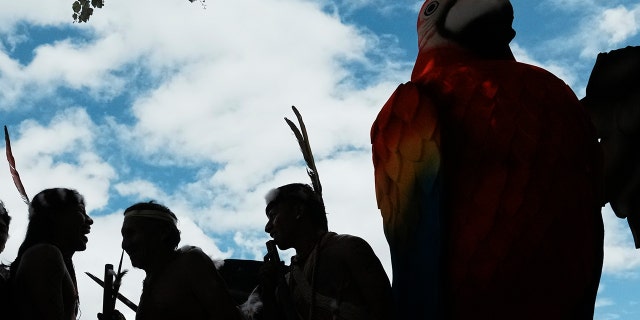
Waorani Indigenous people attend an event promoting a "yes" vote in a referendum on not extracting oil in Quito, Ecuador, on Aug. 14, 2023. (AP Photo/Dolores Ochoa))

The outcome represents a significant blow to Ecuadorian President Guillermo Lasso, who advocated for oil drilling, asserting that its revenues are crucial to the country’s economy. State oil company Petroecuador will be required to dismantle its operations in the coming months.

The referendum took place alongside the presidential election, which will be decided in a runoff between leftist candidate Luisa González and right-wing contender Daniel Noboa. The country is experiencing political turmoil following the assassination of one of the candidates, Fernando Villavicencio.

Ecuador votes to stop oil drilling in Amazon reserve

August 22, 2023
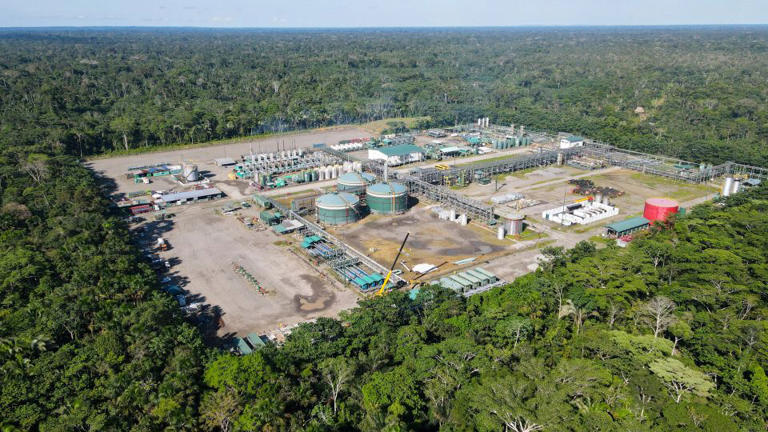
A Petroecuador oil platform is seen in Yasuni National Park in June 2023

Ecuadorans have voted to stop an oil drilling project in an Amazon reserve, according to the results Monday of a referendum hailed as a historic example of climate democracy.

The "Yes" vote to halt exploitation of an oil block in the Yasuni National Park, one of the most diverse biospheres in the world, won by 59 percent, with 98 percent of votes tallied.

"Today Ecuador takes a giant step to protect life, biodiversity, and indigenous people," the country's two main indigenous organizations, Confeniae and Conaie, posted on social media.

After years of demands for a referendum, the country's highest court authorized the vote in May to decide the fate of "block 43," which contributes 12 percent of the 466,000 barrels of oil per day produced by Ecuador.

The block is situated in a reserve which stretches over one million hectares and is home to three of the world's last uncontacted Indigenous populations and a bounty of plant and animal species.

Drilling began in 2016 after years of fraught debate and failed efforts by then president Rafael Correa to persuade the international community to pay cash-strapped Ecuador $3.6 billion not to drill there.

The government of outgoing President Guillermo Lasso has estimated a loss of $16 billion over the next 20 years if drilling is halted.

The reserve is home to the Waorani and Kichwa tribes, as well as the Tagaeri, Taromenane and Dugakaeri, who choose to live isolated from the modern world.

National oil company Petroecuador had permission to exploit 300 hectares, but says it is only using 80 hectares.

The Amazon basin -- which stretches across eight nations -- is a vital carbon sink.

Scientists warn its destruction is pushing the world's biggest rainforest close to a tipping point, beyond which trees would die off and release carbon rather than absorb it, with catastrophic consequences for the climate.

The fate of the reserve has drawn the attention of celebrities such as Hollywood star and environmental activist Leonardo DiCaprio.

"With this first-of-its-kind referendum worldwide, Ecuador could become an example in democratizing climate politics, offering voters the chance to vote not just for the forest but also for Indigenous rights, our climate, and the well-being of our planet," he wrote on Instagram this month.

Swedish climate campaigner Greta Thunberg also hailed the "historic referendum."

The NGO Amazon Frontlines said the vote was a "demonstration of climate democracy, where people, not corporations, get to decide on resource extraction and its limits."

Locals in Yasuni were divided, with some supporting the oil companies and the benefits that economic growth have brought to their villages.

sp/fb/bgs

Ecuador votes in historic referendum on oil extraction in the Amazon

Story by By Hannah Holland •

The people of Ecuador are heading to the polls – but they’re voting for more than just a new president. For the first time in history, the people will decide the fate of oil extraction in the Ecuadorian Amazon.

The referendum will give voters the chance to decide whether oil companies can continue to drill in one of the most biodiverse places on the planet, the Yasuní National Park, home to the last uncontacted indigenous communities in Ecuador.


Among the species found in the Yasuní National Park, is the harpy eagle, the second largest bird of prey in the world.
- Carl De Souza/AFP/Getty Images© Provided by CNN

The park encompasses around one million hectares at the meeting point of the Amazon, the Andes and the Equator. Just one hectare of Yasuní land supposedly contains more animal species than the whole of Europe and more tree species than exist in all of North America.

But underneath the land lies Ecuador’s largest reserve of crude oil.

“We are leading the world in tackling climate change by bypassing politicians and democratizing environmental decisions,” said Pedro Bermo, the spokesman for Yasunidos, an environmental collective who pushed for the referendum.

It’s been a decade-long battle that began when former President Rafael Correa boldly proposed that the international community give Ecuador $3.6 billion to leave Yasuní undisturbed. But the world wasn’t as generous as Correa expected. In 2016, the Ecuadorian state oil company began drilling in Block 43 – around 0.01% of the National Park – which today produces more than 55,000 barrels a day, amounting to around 12% of Ecuador’s oil production.


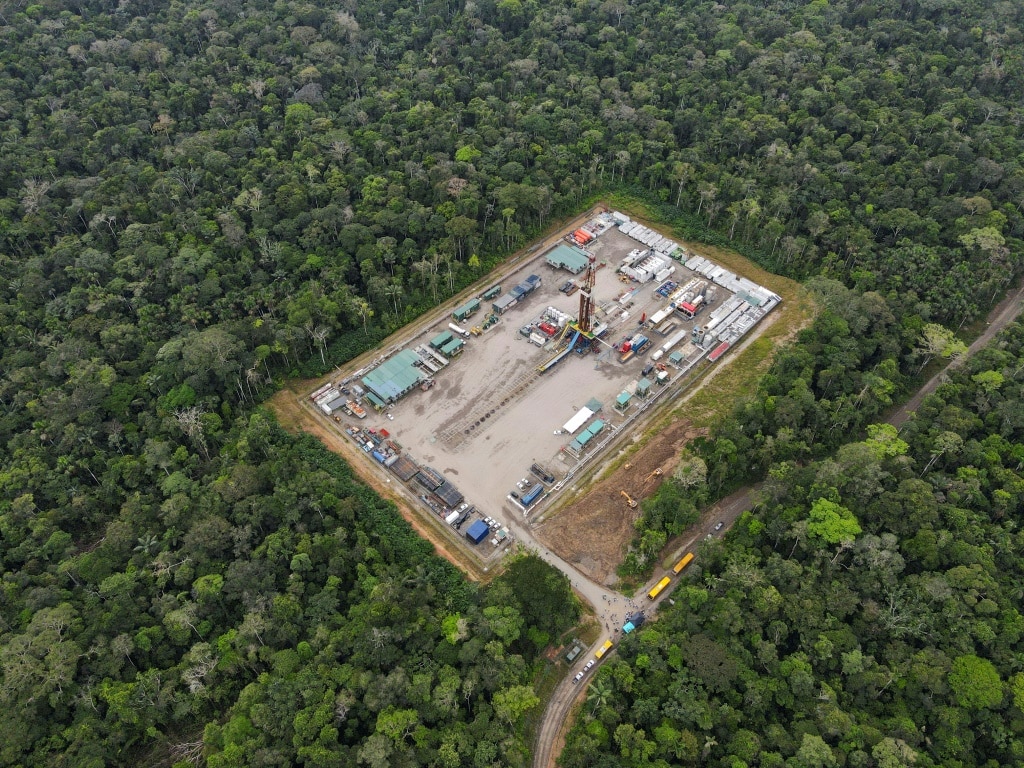
Aerial picture of the Tiputini Processing Center of state-owned Petroecuador in Yasuni National Park, June 21, 2023.
 - Rodrigo Buendia/AFP/Getty Images© Provided by CNN

A continuous crusade of relentless campaigning and a successful petition eventually made its mark – in May, the country’s constitutional court authorized the vote to be included on the ballot of the upcoming election.

It’s a decision that will likely be instrumental to the future of Ecuador’s economy. Supporters who want to continue drilling believe the loss of employment opportunities would be disastrous.

“The backers of the request for crude to remain underground made it ten years ago when there wasn’t anything. 10 years later we find ourselves with 55,000 barrels per day, that’s 20 million barrels per year,” Energy Minister Fernando Santos told local radio.

“At $60 a barrel that’s $1.2 billion,” he added. “It could cause huge damage to the country,” he said, referring to economic damage and denying there has been environmental harm.


Alberto Acosta-Burneo, an economist and editor of the Weekly Analysis bulletin, said Ecuador would be “shooting itself in the foot” if it shut down drilling. In a video posted on X, formerly known as Twitter, he said that without cutting consumption all it would mean is another country selling Ecuador fuel.

But ‘yes’ campaigners have ideas to fill the gap, from the promotion of eco-tourism and the electrification of public transport to eliminating tax exemptions. They claim that cutting the subsidies to the richest 10% of the country would generate four times more than what is obtained extracting oil from Yasuní.

“This election has two faces,” explained Bermo.


“On one hand we have the violence, the candidates, parties, and the same political mafias that governed Ecuador without significant changes.

“On the other hand, the referendum is the contrary – a citizen campaign full of hope, joy, art, activism and a lot of collective work to save this place. We are very optimistic.”

Among those campaigning to stop the drilling is Helena Gualinga, an indigenous rights advocate who hails from a remote village in the Ecuadorian Amazon – home of the Kichwa Sarayaku community.


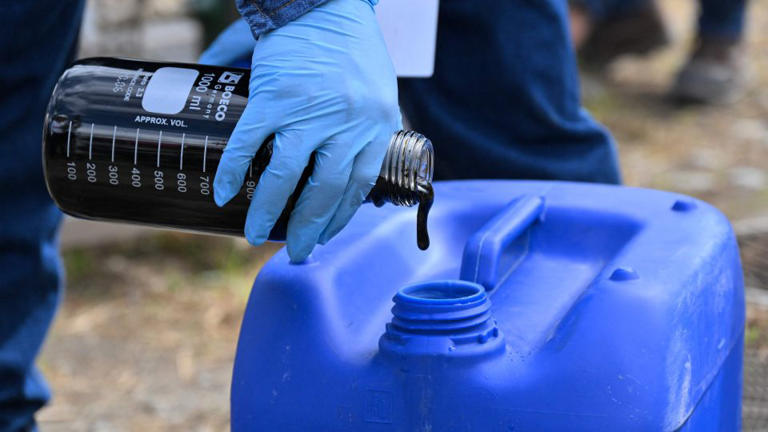
A crude oil sample taken from an oil well in Yasuní National Park, where the referendum vote could mean leaving the crude oil in the ground indefinitely.
 - Rodrigo Buendia/AFP/Getty Images© Provided by CNN

“This referendum presents a huge opportunity for us to create change in a tangible way,” she told CNN.

For Gualinga, the most crucial part of the referendum is that if Yasunidos wins, the state oil company will have a one-year deadline to wrap up its operations in Block 43.

She explained that some oil companies have left areas in the Amazon without properly shutting down operations and restoring the area.

“This sentence would mean they have to do that.”

Those who wish to continue drilling in the area argue that meeting the one-year deadline to dismantle operations would be impossible.

The referendum comes as the world faces blistering temperatures, with scientists declaring July as the hottest month on record, and the Amazon approaching what studies are suggesting is a critical tipping point that could have severe implications in the fight to tackle climate change.

And according to Antonia Juhasz, a Senior Researcher on Fossil Fuels at Human RIghts Watch, it’s time for Ecuador to transition to a post-oil era. Ecuador’s GDP from oil has dropped significantly from around 18% in 2008, to just over 6% in 2021.

She believes the benefits of protecting the Amazon outweigh the benefits of maintaining dependence on oil, particularly considering the cost of regular oil spills and the consequences of worsening the climate crisis.

“The Amazon is worth more intact than in pieces, as are its people,” she said.

 CNN 
ALTERNATE CANDIDATE
Ecuador's Perez to review mining contracts suspected of polluting if elected

Story by By Alexandra Valencia • AUG. 17, 2023

Ecuadorean presidential candidate Perez during his closing campaign rally, in Quito© Thomson Reuters

QUITO (Reuters) - Ecuadorean Indigenous presidential candidate Yaku Perez would revise mining concessions that do not comply with environmental and social rules and would ask creditors for breathing room amid spiking violence, he told Reuters in an interview.


Ecuadorean presidential candidate Perez during his closing campaign rally, in Quito© Thomson Reuters

More than 13 million Ecuadoreans are eligible to head to polls on Sunday in a contest that has been marred by the murder of anti-corruption candidate Fernando Villavicencio, highlighting sharply deteriorated security which the current government blames on drug traffickers.


Ecuadorean presidential candidate Perez during his closing campaign rally, in Quito© Thomson Reuters

Candidates have pledged to fight crime and improve the struggling economy, amid unemployment woes which have increased migration.

Mining is a top contributor to Ecuador's economy, but Perez, an erstwhile water activist, said late on Thursday he would ask the country's comptroller to review contracts suspected of polluting, to define their continuity under Ecuadorean law.

Ecuador has abundant mineral reserves, but has lagged behind regional neighbors like Peru and Chile in developing large-scale projects because of resistance from Indigenous communities and judicial decisions that have stymied development.

"If there are audits that say they are contaminating the environment, that they are poisoning water, that they haven't done prior consultations (with communities)...they will need to be revised," Perez said. "If they have complied with social and environmental licenses they will continue."

"We are not going to premeditatedly pursue (miners), but there must be responsibility," he said. "I respect legal guarantees."

He would also push a constitutional reform to bar mining in areas with lakes, rivers and other water sources, first by sending it to the national assembly, and then, in case of failure, to voters via a referendum.

Perez supports two environmental efforts also on the ballot on Sunday - one to shutter an oil block in a megadiverse part of the Amazon and a local bid to bar mining in a forest near Quito.

Perez, who was polling in the top five of eight candidates, said he would trace corrupt funds through an expert commission backed by the United Nations, which will review contracts from the last 20 years.

"If we correct the distortions, the corruption, if we charge taxes to the defaulters we won't need new loans," said Perez, who came a surprise third in elections in 2021.

He would approach Ecuador's multilateral creditors and bondholders to ask for payment extensions because of the difficult economic and security situation, he said.

"We have to tell them that this is a very difficult time to pay foreign debt, that we recognize them and will pay...but first allow me to get the country started on economic growth and a reduction in poverty."

Ecuador has leaned on international financing since its economy was battered by the COVID pandemic. The country concluded a credit agreement for $6.5 billion with the International Monetary Fund at the end of last year.

"We are in a spiral of violence: there is no work, there is no education, people are fleeing the country," he said. "Hopefully they will understand."

Perez pledged to make agriculture - not oil, the country's top source of income - Ecuador's economic driver, creating 500,000 jobs.

Better social programs and data-based security programs are also on his agenda if elected, he said.

"We must get back control of the borders where drugs come through, get back control of the Ecuadorean coasts where drugs leave and get back control of the prisons from which crimes are ordered," he said.

(Reporting by Alexandra Valencia; Writing by Julia Symmes Cobb; Editing by Sharon Singleton)
ANARCHO CAPITALI$TS ARE FASCISTS
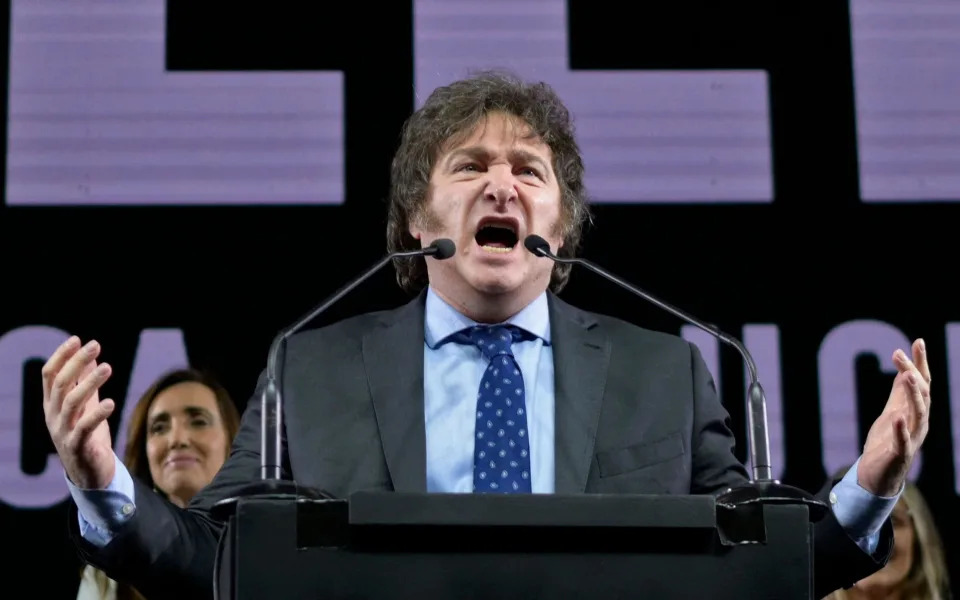
The Trump-loving economist vowing to shake-up Argentina's financial system

Tim Wallace
Thu, 17 August 2023 

The former tantric sex coach is the surprise frontrunner in the race to become Argentina’s next 
president 

Milton Friedman was not renowned for being soft and cuddly. The father of monetarist economics inspired tough central bank crackdowns on inflation that triggered recessions and provided the intellectual ballast for Margaret Thatcher, the Iron Lady.

However, for Javier Milei, Milton Friedman is a good name for a dog.

The surprise frontrunner in the race to become Argentina’s next president has named one of his five English Mastiffs after the Nobel prize-winning. Other pets are named after Robert Lucas, another Nobel economics laureate, and Murray Rothbard, an economist of libertarian leanings.


Milei thanked his dogs alongside his supporters over the weekend in the wake of his surprise victory in the primary round of the election.

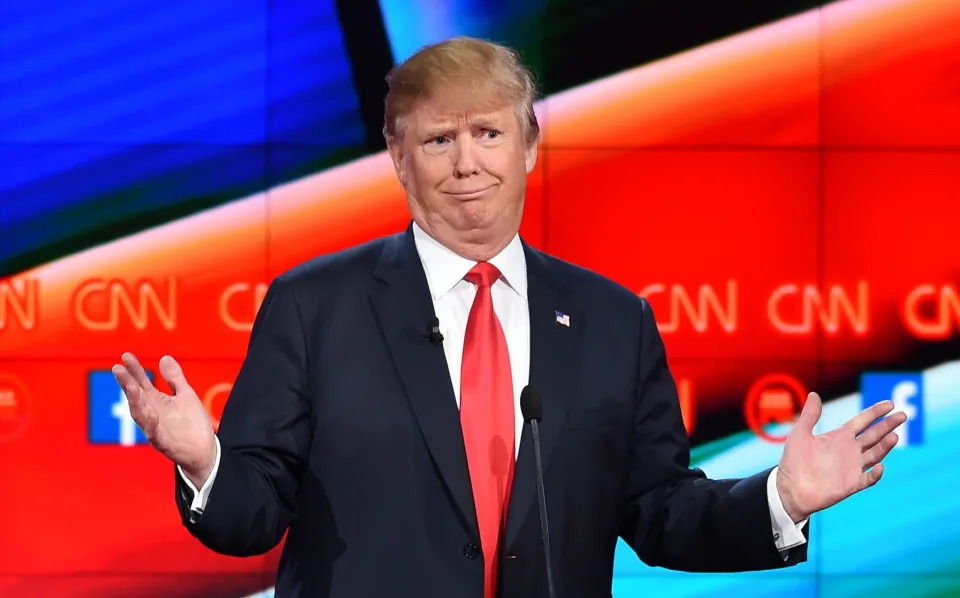
The one-time rock star and former tantric sex coach has been dubbed a Latin American Donald Trump and Milei is said to be an admirer of the former president.

His success has alarmed not only the political establishment but also investors and the economic mainstream.

A self-described “anarcho-capitalist”, Milei has proposed abolishing the central bank and claimed he would “burn down” the institution.

He has proposed moving Argentina from its plunging peso onto the US dollar and wants to balance the books by taking a “chainsaw” to public spending.

He also wants to cut taxes, including on workers and agricultural exports, and shrink the public sector by encouraging people to retire rather than laying off staff.


Milei has been dubbed a Latin American Donald Trump and is said to be an admirer of the former US president - ROBYN BECK/AFP

The radical package has sent investors fleeing from Argentina, with the peso plunging this week.

Yet his proposals have struck a chord with voters. Inflation is running at over 110pc in the country, one of the highest rates in the world, and surging prices have tipped around 40pc of the population below the poverty line.

“Remember, a different Argentina is impossible with the same people as always, with the same people that have always failed,” Milei told supporters after the votes came in over the weekend.

“Today we have stood up to say enough to the model of decadence. Today we took the first step for the reconstruction of Argentina.”

Despite his eye-catching appearance and colourful background, Milei’s proposals are addressing some of Argentina’s most pressing problems.

The country has racked up debt steadily over the past 30 years, with the exception of six years of surpluses before the financial crisis.

“The concept of reducing the fiscal deficit is definitely a good one,” says Sergi Lanau at Oxford Economics.

When it comes to addressing the inflation plaguing the nation, Milei’s plan to dollarise the economy also has merits.

“If you look at other emerging markets that have curbed inflation, pegging to the dollar is often a part of the process,” says William Jackson at Capital Economics.

Adopting a currency issued by the Fed removes the temptation for politicians to print money to pay for their policies, which fuels inflation.

Jackson says: “It removes the problem of deficit monetisation and the political influence over the central bank.”

This may be where the scheme to scrap the central bank comes in. Adopting the dollar would remove the central bank’s control over monetary policy and potentially leave it responsible for topics such as bank regulation instead.

Yet, in echoes of the market reaction to Liz Truss’s reformist budget in Britain, investors have baulked at Milei’s electoral success.

The peso went into freefall after the first round presidential primary results were announced, in which Milei gained more than 30pc of the vote.

A devaluation took the peso down almost 18pc on Monday. One US dollar now buys 350 pesos at official exchange rates, up from 135 a year ago and 60 just before the pandemic.

The Central Bank of Argentina was forced to take emergency action to defend the economy, raising its headline interest rate from 97pc to 118pc.

Investors are worried that Milei’s shock therapy risks crippling Argentina’s already weak economy and putting it at risk of defaulting on its international debts.

There are also questions about just how credible the policies are when looked at in detail.

Lanau says: ”When his advisers say they will bring the deficit down to zero in a few months while not getting rid of civil servants and not slashing social spending, it is not possible.”

The practicalities of adopting the dollar are also challenging.

“Essentially the government or central bank needs to hold dollar assets at least equivalent to the monetary base, so it can cover all of the cash in circulation and all of the banks’ reserves at the central bank,” says Jackson.

The state has been running down its supplies of foreign currency in the hope of propping up the peso. Without many physical dollars, it is hard to seek to replace the currency. Few are willing to lend to the country.

Then comes calculating the exchange rate at which to make the shift. Too low and households feel hard done by, replacing their hard-earned pesos with a very small stack of greenbacks. But too high and the economy can be hamstrung with an uncompetitive rate, making exports unaffordable and undermining growth.

Milei’s team has indicated it could let individuals choose which currency to use, in a more free-floating manner, though the details are unclear.

Lanau says more announcements on the plan could push Argentinians to buy dollars as soon as possible, effectively dumping the peso and pushing it down further.

“Depending on what he says in the campaign, people could freak out even more,” he says.

Further falls in the peso would mean higher inflation, adding to the already bleak economic outlook. Argentina’s economy has contracted for five of the past 10 years and is expected to shrink again this year before, at best, stagnating in 2024.

It is far and away the biggest borrower from the International Monetary Fund, with a loan scheme worth $44bn rearranged last year. Buenos Aires only agreed a new deal at the end of last month to avoid the country falling behind on its debt repayments to the Fund.

Jackson says: “It is fair to say Argentina is in a pretty dire crisis. There is enormous pressure on the currency. It is really only keeping its head above water because it is receiving funding from the IMF.”

Milei’s team has indicated it could let individuals choose which currency to use - Natacha Pisarenko/AP

Milei said officials from the IMF have approached him to discuss the situation following his success in the weekend’s polls. The Fund itself says it regularly meets politicians.

A spokesman said: “In the case of presidential candidates, these engagements also allow staff to better understand key aspects of future potential economic policies.”

Argentina has defaulted on its debts nine times in its history, including failures to pay creditors in 2020 and in 2014. The recent collapse of the peso puts the country at risk of yet another default.

Major falls in currencies against the dollar have led to debt defaults around 50pc of the time over the past three decades, according to Capital Economics, and a recession in 80pc of cases. “Argentina is unlikely to be an exception,” analysts there say.

A dependence on the IMF may yet be turned into a strength, suggests Juan Grigera at King’s College London.

“Argentina is the biggest debtor to the IMF, for the IMF it represents about 34pc of all it lent,” he says. “This was a leverage of sorts in negotiating a restructuring of the debt in 2019 and during Covid.”

Grigera, who teaches international development and earned his PhD in Buenos Aires, points out that all three leading presidential candidates are also committed to continuing debt payments.

However, Lanau warns that rising debt repayments in 2025 mean “it will be impossible not to default” by the end of that year.

“The only way you can refinance without defaulting is issuing new bonds, but [Argentina] is very far from being able to borrow money from anyone other than the IMF,” he says.

“There is virtually a 100pc chance that by late 2025, they will run out of dollars, even if there is someone in charge who is trying to fix things.”
International community cheers Guatemala anti-graft candidate's landslide victory


Mon, 21 August 2023
By Kylie Madry

(Reuters) - International leaders celebrated the overwhelming victory on Sunday of Guatemalan presidential aspirant Bernardo Arevalo, a win which had long seemed out of reach for the anti-graft candidate in an elections process shaken by accusations of government intervention.

"A salute to the people and government of Guatemala for an exemplary election day, a true civic celebration," said Organization of American States (OAS) chief Luis Almagro on X, the social media network formerly known as Twitter.

Arevalo, a 64-year-old former diplomat and son of Guatemala's first democratically elected president, nabbed 58% of votes versus former first lady Sandra Torres' 37%, with nearly all votes counted late Sunday.

"The outcome of the vote is already very clear," European Union's foreign policy chief Josep Borrell said in a statement. "It is crucial for all state institutions and all sectors of society to support and join in this effort in the interests of the country."

Arevalo, who ran on a campaign of fighting corruption, faced an uphill battle at the polls. He came in a surprise second place in a first-round vote earlier this year, triggering a run-off. A number of other opposition candidates had been barred from running.

His competitor Torres alleged irregularities in the first round of voting and Arevalo's party, Semilla, was briefly suspended at the request of a top prosecutor.

By Monday morning, Torres had yet to accept her loss publicly. In a press conference Sunday afternoon, the candidate, an ally to outgoing President Alejandro Giammattei, said she was "worried" about the integrity of the vote.

Her UNE party said in a statement late Sunday it would take a position once the elections results were put out "with total transparency."

An OAS representative, with a team of 86 election observers in Guatemala, said voting had gone smoothly and the election "fulfilled all the demanding obligations."

An EU mission will put out a preliminary statement with its findings on Tuesday.

The EU, as well as governments such as Brazil and Norway said they expected a peaceful transition of power.

However, the attacks on Arevalo are likely to continue, said Risa Grais-Targow, analyst at political risk consultancy firm Eurasia Group.

"The ruling pact will likely continue to target electoral officials and Arevalo's Semilla party with investigations ahead of January's change in government," she said.

President Giammattei has vowed to ensure an orderly transition of power. He said on X he had congratulated Arevalo, and invited him to meet "the day after election results were finalized."

Arevalo will face challenges once in office, as Guatemala is roiled by violence and food insecurity. Guatemalans now represent the largest number of Central Americans seeking to enter the United States.

Arevalo said he had already spoken with Mexican President Andres Manuel Lopez Obrador and Salvadoran President Nayib Bukele on Guatemala's agenda with its neighbors.

Honduran President Xiomara Castro said on X she was sure that following Arevalo's win, "We will unify the people of Central America."

(Reporting by Kylie Madry; Editing by Chizu Nomiyama)
In rural Zimbabwe, a group of grandmothers counters alleged election intimidation, bias on WhatsApp

Sat, August 19, 2023 


DOMBOSHAVA, Zimbabwe (AP) — Four grandmothers wearing bright yellow headscarves, T-shirts and skirts huddled around a cellphone in Zimbabwe’s rural Domboshava area. They cackled at a video showing a troop of mischievous baboons ripping up ruling party election posters with the face of the president on them.

With a swish and a click, 64-year-old Elizabeth Mutandwa posted the video on a couple of community WhatsApp groups, and followed it up with some election campaign information from the party she supports in next week's election — the main opposition Citizens Coalition for Change.

The grandmothers say they and their fellow opposition supporters are facing intimidation from followers of the long-ruling ZANU-PF party and a biased state-run media that restricts their options. But they have found a way to counter that with the use of WhatsApp group chats.

“Let’s share this one with our own people. It’s good content,” said Mutandwa of the baboon video, once her giggles had subsided.

She then got up and walked several kilometers (miles) wearing the yellow colors of her party to a rally addressed by opposition leader Nelson Chamisa, the man she hopes will finally bring change to Zimbabwe after 43 years.

The ruling ZANU-PF party has been in government ever since the southern African nation won independence from white minority rule in 1980, and Mutandwa was a young woman in her early 20s.

A couple of hundred others attended the Domboshava opposition rally alongside Mutandwa to hear presidential candidate Chamisa speak.

But with national elections just days away, many more stayed at home, afraid of being threatened, intimidated, or maybe even attacked by ruling party activists for daring to show support for Chamisa and his party, Mutandwa said. Others hadn't even heard about the rally because the state-run TV and radio channels they mostly rely on for information rarely cover opposition events.

President Emmerson Mnangagwa, who came to power in a coup in 2017, is seeking re-election Wednesday. Chamisa will challenge him again, having lost to Mnangagwa in a very close and disputed contest in 2018.

The 80-year-old leader has warned his supporters against engaging in violence in the buildup to the Aug. 23 vote. That plea came days after an opposition party supporter was killed, allegedly at the hands of ruling party activists, in the first deadly violence of the election buildup.

Even though Mnangagwa replaced long-ruling autocrat Robert Mugabe in that popular coup, he's been accused of weaponizing the police and the courts to stifle opposition in the same way Mugabe did. Chamisa and international rights groups claim opposition party figures and supporters are often targeted with harassment, violence and intimidation.

Some rural folks like Mutandwa have found a way to combat the threats and the media bias they also see, but which often go unnoticed deep in the rural areas where the majority of the country's 15 million people live, and where the opposition's reach is limited.

“Everyone around here knows we are opposition activists, so some people are too afraid to openly associate with us," said Mutandwa. “But it’s not a problem anymore. We talk to them through WhatsApp and they can participate in the campaign from the safety of their homes.”

The way Mutandwa and her group of grannies are using cellphones and the internet to cut through the propaganda ahead of elections represents a shift from past rural election campaigns, said Rejoice Ngwenya, a strategic communications specialist in Zimbabwe. While cellphone and internet access was widespread in the cities, opposition parties previously could only use rallies, community meetings, or sometimes even funerals, to reach rural voters and share their message.

Mutandwa now gets Citizens Coalition for Change information straight to her smartphone. And she spreads the word, too, among the 10 or so WhatsApp groups the four grandmothers in Domboshava administer. She needed a couple of lessons from one of her grandsons to get going on WhatsApp, she said.

WhatsApp and other messaging apps are having a “high impact” in rural areas in the buildup to these elections, according to Ngwenya.

“Everybody has a cellphone,” he said. "They are not necessarily state of the art, but that they can be used to send a message is an appeal.”


The four grandmothers are going up against a ruling party machine, though.

European Union observers compiled a report on the use of state media — the domninant outlets — following the last general election in Zimbabwe five years ago. It said that state-controlled public television dedicated 85% of its coverage to Mnangagwa's ZANU-PF during the election period. Just over 80% of coverage went to the governing party on one popular public radio station monitored by the mission.

During this election campaign, Mnangagwa and his party have dominated TV and radio again, and have also been sending bulk text messages to millions of people with campaign information and notifications of ZANU-PF rallies that Chamisa's opposition party, and the grannies, simply can't match.

Their hope for long-awaited change in their country lies more in word of mouth — or word of message — with Mutandwa hoping, but not really knowing for sure, that her WhatsApp posts are re-posted and shared multiple times. She said people are yearning for change, even in rural areas once ZANU-PF's strongholds, but are still afraid.

“We are not afraid, but we know that others are," she said as she tossed some grain to her chickens in her dusty yard. “At least we are able to communicate with some of them and the ones we reach can spread the word to others.”

___

Associated Press Africa news: https://apnews.com/hub/africa

Farai Mutsaka, The Associated Press
‘It’s Europe or death’: Why no amount of EU money has stopped migrants fleeing Tunisia

Stephen Quillen
Sun, 20 August 2023

Operation carried out by coastguards teams of the Tunisian National Guard against migrants off the city of Sfax - Anadolu Agency

Felix looks on in despair at the hundreds of sub-Saharan migrants strewn on makeshift cardboard mattresses and dirt-stained blankets in the streets of Sfax, a coastal Tunisian city just 75 miles from Italy.

“There are babies, children, and pregnant women sleeping on the ground,” the 36-year-old from Nigeria, said. “This is dehumanising. This is torture for us.”

Samuel, a 27-year-old migrant who has been on the move for eight years, added: “I lost so many of my friends and brothers to the civil war in South Sudan. I went to Sudan and then Libya before coming here ... Still I have no good place to lay my head.”


Hundreds of sub-Saharan migrants of all ages have been sleeping rough in Sfax’s parks and alleyways for nearly two months. Many were forced from their homes in racist pogroms that swept the city earlier this summer.

The violent crackdown has added urgency to migrants’ plans to set sail for Italy, and the EU, in spite of the millions of euros Brussels and Rome have spent trying to control the flow of people across the Mediterranean.

Luis, a 40-year-old migrant from Cameroon, put it bluntly: “For us, it’s Europe or die. We don’t have any fear anymore.”

Those who make it to Tunisia live as second-class citizens, unable to rent homes, find reliable jobs, or take public transport without harassment.

“The racism is intense,” said Felix, who like many others, travelled to Sfax, a hub for people-smuggling, to catch a boat to Italy. “We don’t have homes or jobs. We don’t even have anywhere to bathe ... I see myself as a slave in this country.”

So far this year, more than 60,000 irregular migrants, the majority from sub-Saharan countries, have reached Italy from Tunisia. Of these, more than half have made the trip since the start of June, when mass violence broke out against black migrants.

Tensions had long been brewing between migrants and locals fearful the city is being overrun by people desperate to reach Europe.

So far this year, more than 60,000 irregular migrants, the majority from sub-Saharan countries, have reached Italy from Tunisia - Anadolu Agency

In February, President Kaid Saied branded the estimated 20,000-50,000 sub-Saharans in Tunisia, who make up just 0.4 per cent of the population, a “demographic threat”.

There were waves of mob violence and forced evictions of sub-Saharans after a local man was killed in a clash with several Cameroon migrants in early June.

Moussa, a 25-year-old migrant from Guinea, described the raids that left him penniless on the streets. “A group of guys broke into my house, beat me and took everything I had, even my clothes. I’ve been sleeping here ever since,” he said in a city centre park.

Tunisian authorities were active participants in abuses against migrants. During the unrest, they arbitrarily arrested and expelled around 1,200 migrants to desert areas at the Libyan and Algerian borders, leaving them to suffer with no food or water in the sweltering heat.
‘Threw me into the desert three times’

“They threw me into the desert three times, beating me and taking everything I had,” Mel, a south Sudanese migrant, who fled his country due to its civil war, said. “They told me not to return.”

After weeks of pressure from rights groups, activists, and the United Nations, Tunisia said on Aug 10 that it had brought back the last group of migrants it had abandoned in the desert, but not before dozens had died there.

“I never in my life thought I’d see such events in my own country,” Selim Kharrat, the president of Al Bawsala, a Tunisian human rights organisation and watchdog, told The Telegraph. “It is inhuman.”

The European Union has tried to quell activity along the thriving Mediterranean migration route with little success.

Migrants who want to reach Europe illegally via the Mediterranean Sea, off the city of Sfax in Tunisia - Anadolu Agency

On June 11, it announced it would provide Tunisia with €100 million (£85.5 million) for border management, overlooking reports of abuses committed by Tunisia’s coast guard towards migrants at sea.

Since then, there has been an increase in pullbacks of Italy-bound vessels, migrants and activists say, but the overall number of boats reaching Europe has hardly changed.

“It doesn’t matter if you double the number of police officers or double the number of control operations. There will still be migrants seeking a better life,” said Kharrat, from Al Bawsala.

Adrian, a Cameroon migrant whose boat was intercepted by Tunisia’s coast guard en route to Italy on Wednesday, told The Telegraph that “nothing can stop” migrants like him from reaching Europe.

“We will try again and again,” he said. “We have no other choice.”
Cramped metal boat

To reserve a seat on a cramped metal boat, migrants must pay anywhere from £376 to £877 to Tunisian smugglers, who supply the vessels and organise the trips.

For many, the cost amounts to their life savings - and they get no refund if something goes wrong.

Adrian said he lost all his money when national guardsmen ripped out his boat’s engine and left him and other passengers adrift at sea.

While he was lucky to be brought back to shore by a passing fisherman, he must now find a way to raise more funds for his next attempt to cross. The EU has tried to quell activity along the thriving Mediterranean migration route with little success.

On June 11, it announced it would give Tunisia €100 million (£85.5 million) for border management.

In recent weeks, at least 46 migrants drowned after departing Sfax for the Italian island of Lampedusa, with several bodies washing ashore at a crowded beach.

Back in Sfax, news of these drownings has become routine, eliciting little surprise from migrants intent on escaping “hellish” conditions in Tunisia for Europe.

“The risk is high ... but I have no choice but to keep going,” said Felix, who has already tried twice to reach Italy by sea, each time being turned back by Tunisia’s coastguard. “There is no future for us here.”