Monday, August 21, 2023

Opinion

The terrible power of the state to ruin lives was exposed by the case of Andrew Malkinson

Sonia Sodha
Sun, 20 August 2023 

Photograph: Jordan Pettitt/PA

We like to think that our criminal justice system locks up criminals and exonerates the innocent. A comforting working assumption; but the reality is more complex. High-profile miscarriages of justice – and the years some spend wrongfully in prison – are signs that the system sometimes gets it dreadfully wrong. One way of designing out wrongful convictions is through a demanding evidentiary threshold: to convict someone, juries need to be “sure” that a defendant is guilty. The flipside of this is that the probably-guilty have to be allowed to walk free.

But jury deliberations are only one part of the process and are certainly not sufficient to prevent serious miscarriages of justice, as the horrific treatment of Andrew Malkinson has shown. Malkinson last month had his rape conviction overturned by the court of appeal after 17 years in prison. His case has been plagued by serious failings at every turn. Greater Manchester police failed to disclose key evidence undermining the prosecution’s case against him to his defence team at the time of his trial, including key witnesses’ criminal convictions and important photographic evidence. This only came to light 15 years later, as a result of extensive legal action by the charity Appeal.

Three years after his 2004 conviction, the DNA of another man was found in a “crime specific” spot on the victim’s clothing by a nationwide forensic review. The police and the Crown Prosecution Service were notified, but a CPS lawyer said there was no need for further work unless the case was brought to appeal, and then his focus would be on “bolstering” the case against Malkinson.


Malkinson applied twice to the Criminal Cases Review Commission (CCRC) – the body charged with reviewing whether potentially unsafe convictions should be referred to the court of appeal – citing this new evidence, but the CCRC did not use its considerable investigatory powers to look at the original police file or request new DNA tests, and rejected his applications. It was only after the Appeal charity commissioned its own tests and uncovered the disclosure failures that Malkinson’s third application to the CCRC was successful, which resulted in the court of appeal overturning his conviction.

The issue starts with the way crimes are investigated and prosecuted

No one can give Malkinson back those 17 years. It is a reminder of the awesome power the state has to ruin people’s lives through corruption or incompetence. And it cannot be written off as a terrible but exceptional mistake. That such clear DNA evidence emerged makes Malkinson’s case unusual, but the fact that it still took him more than a decade to clear his name – with considerable time and resources invested by a campaigning charity – points to something seriously amiss in our justice system and the way it can produce, then fail to rectify, wrongful convictions.

The issue starts with the way crimes are investigated and prosecuted. The police’s role is to independently investigate crimes without prejudice; the CPS’s to make independent decisions about whether there is a strong enough case for the state to prosecute. They are not supposed to be “for” or “against” a defendant; they are statutorily obliged to disclose to the defence evidence that undermines their own investigation or case.

Yet even the most well-meaning police officers and CPS lawyers are human beings: it would take almost superhuman faculties not to become invested in a case against someone you really think did it. They operate in a system with shrinking resources, despite the greater volume of digital evidence involved in modern police work, and in a context of political pressure to increase conviction rates.

In our adversarial legal system, the main check on the independence of the police and the CPS is the defendant’s legal team. Yet deep cuts to legal aid mean that defence lawyers are operating on shoestring budgets, and there are serious questions about the quality of defence that people can access.

If a defendant has been wrongfully convicted, the appeals process is stacked against them. It can be difficult to find someone to represent you on legal aid in the first place. Some experienced lawyers and academics think that the court of appeal is itself too reluctant to quash wrongful convictions.

The CCRC was set up as an independent body to assess whether potentially unsafe convictions should be referred to the court of appeal, but it has been rendered unfit for purpose through funding cuts; worrying evidence hints at political interference. There is a lack of accountability over its decisions: the only potential challenge is through judicial review, an extremely expensive process. Malkinson is far from the only person turned down by the CCRC who went on to overturn their conviction. Victor Nealon’s application to appeal was rejected twice; his rape conviction was, like Malkinson’s, eventually overturned on the basis of DNA tests commissioned by his own legal team.

Ultimately, we have a justice system that embeds a naively optimistic view of human psychology

All this has led one former senior judge to argue that it has become harder than ever to challenge wrongful convictions; a damning assessment in light of the high-profile miscarriages of justice such as the Guildford Four and the Birmingham Six that led to the establishment of the CCRC in the first place.

Ultimately, we have a justice system that embeds a naively optimistic view of human psychology – it relies on the independence of the police, CPS lawyers and judges while real-world pressures and biases tug against that – while significant reductions in resourcing have eroded some of the checks and balance on their decision-making. Add a political desire to improve conviction rates and you have a recipe for more miscarriages of justice.

The penalties are severe, most obviously for the person wrongfully convicted. The government may have now changed the rules around financial compensation, so that someone no longer has it docked because of “savings” they made on housing as a result of being unjustly convicted, but people must actively prove their innocence in order to get any compensation at all; Nealon did not qualify. But there are also penalties for the victim, who has to learnthat her attacker has gone unpunished, and for society at large, because the real perpetrator remains free to reoffend.

While it is poor, minoritised and overpoliced communities who disproportionately suffer the consequences, miscarriages of justice can affect anyone. Making sure that those who stand accused of terrible crimes get due process may not be a popular cause, but it is fundamental not just to the rule of law but to public faith in the justice system.

• Sonia Sodha is an Observer columnist


Lights, camera and almost no action — Hamilton film workers struggle as Hollywood strikes

Story by Cara Nickerson •


They have the lights and the cameras, but there's not much action for Hamilton's film productions right now, as unionized writers and actors in the U.S. continue striking.

Last year the province hit record highs for film and TV production, with around $3.15 billion contributed to Ontario's economy in 2022 — but Zach Zohr, owner of Hamilton Film Studios, told CBC Hamilton business has slowed to a trickle.

"I would say last year at this time, I would average 10 orders per day — and I'm seeing not even 5 per week right now."

Zohr's company offers studio space and film supplies to productions. Everything from gaffer tape to camera bags, make up to lighting rigs, for some of Hamilton's biggest TV series like The Handmaid's Tale, Umbrella Academy and The Boys.

"This is peak summer time. This is supposed to be film's busiest time," he said.
Canadian and American film productions are tied together

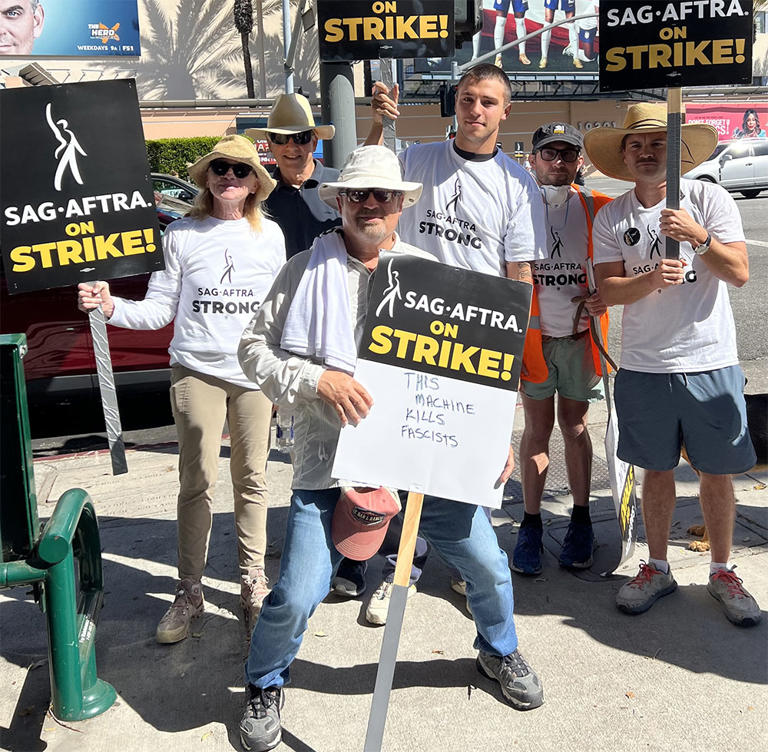
The Writer's Guild of America (WGA) has been on strike since May 2, while the Screen Actors Guild — American Federation of Television and Radio Artists (SAG-AFTRA) has been on strike since July 14. At issue in the dispute is base and residual pay, which actors say has been undercut by inflation and the streaming ecosystem, benefits, and the threat of unregulated use of artificial intelligence.

"Employers make Wall Street and greed their priority and they forget about the essential contributors that make the machine run," SAG-AFTRA president Fran Drescher said. "Shame on them. They are on the wrong side of history."

While both organizations are based in the United States, Ontario's film industry is heavily tied to American productions.

Jennifer Pountney, communications manager with OntarioCreates, told CBC Hamilton in an email, that Ontario's film and television industry created "45,891 high-value full-time equivalent direct and spin-off jobs" in 2022.


The Netflix series The Umbrella Academy films in southern Ontario, including in Hamilton and in Scarborough, where this photo was taken. (Christos Kalohordis/Netflix)© Provided by cbc.ca

She said Canadian-based productions account for 38 per cent of production spending in Ontario.

Leah Kline has worked as a set designer on films and TV shows in Hamilton and Toronto for the past eight years. She said in her experience, American-based shows that film in Ontario are required to hire Canadian crew members.

In the past four years, Kline said she has seen a boom in film and television jobs in Hamilton, but said this summer the work has dried up.

"This time last summer the work was just off the chain, like there would be jobs opportunities every two weeks to work on different things," she said.

"This year (I) have only gotten that like once, maybe twice."


Leah Kline, a set designer based in Hamilton said film work in Hamilton has slowed down dramatically during the WGA and SAG strikes in the United States. (Submitted by Leah Kline )© Provided by cbc.ca

She said productions are only allowed to have a certain percentage of American employees.


"I'm not sure what the percentage is, but the majority needs to be local, like Ontario residents who are working on projects that are filmed in Ontario," she said.

A lot of the time, Kline said, higher up positions like directors, producers, writers and actors will be American and crew members are Canadian.

"There's a lot of people in this industry right now talking about switching careers again and that's a downer for sure," Zohr said.
More reality TV, Canadian content might get made

Canadian writers and actors are not on strike and filming is going ahead with Canadian projects, but Zohr said there isn't enough work to go around.

"The way Toronto and Hamilton has been booming for the last few years, now it's set up where we need all the American shows going just to keep everyone working. There's just not enough Canadian work to keep all the Canadian workers going," he said.

But Kline said she hopes the strikes will present an opportunity for more Canadian content to get made.

"Canadian writers are not on strike, right?" she said. "There's a possibility that more creative things are going to come out of this."

Kline said she believes people will notice reality shows like Blown Away — which is filmed at The Cotton Factory in Hamilton — and the CBC's Race Against the Tide now that there will be fewer programs hitting TV screens.

"This is an opportunity for some Canadian writers to get noticed, which wouldn't be bad," she said.
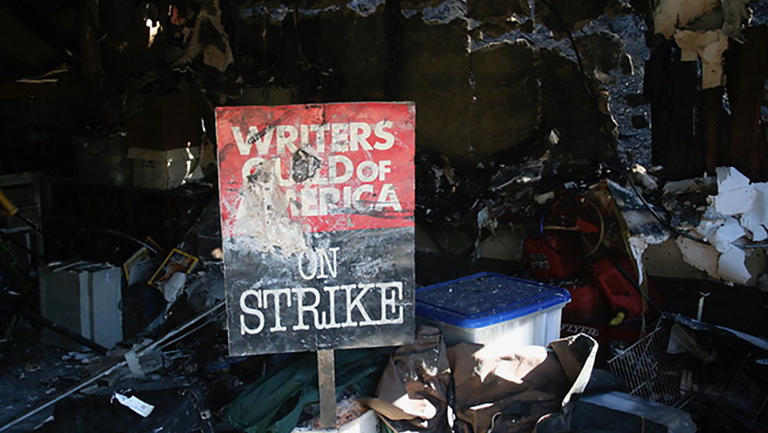
“Things We Lost in the Fire”: A View from the Writers Strike Line

Story by Todd Robinson •2d

“Things We Lost in the Fire”: A View from the Writers Strike Line© Provided by Hollywood Reporter

An Emmy-winning writer, producer and director, Todd Robinson has worked in film and television for nearly four decades — penning screenplays for White Squall, Lonely Hearts and The Last Full Measure. Prior to the current WGA strike, the second since he joined the guild, he’d been working on his next features Eldorado and Neponsit Circle, slated for production in 2024.

November 24, 2007, I was asleep in my childhood bedroom in my hometown of Media, Pennsylvania. Crushed after a brutal red-eye, followed by my 30th high school reunion, I was wasted.

In L.A., it was day 18 of the 2007-08 writer’s strike where I’d been picketing right up until Thanksgiving. It was a relief to get away from the sunburn, signs and honking cars. Back home, the gloom of a painful work stoppage seemed far away.

The strike had brought much into focus for my wife Elizabeth and me. I was a director and writer and she a literary agent turned manager. Our careers flowed in contrapuntal sign-waves, one of us up while the other was down. But now, because Liz represented writers, we suddenly had zero income. We had a mortgage to pay and the costs of having a young family. A strike was something we’d never experienced before and it was scary. We understood the stakes were enormously high. Then, as now, we were the visible face of American labor in a David-and-Goliath fight pitting worker bees against Africanized corporate hornets.

Cost-cutting from the bottom up always seems to be management’s first instinct rather than rewarding successful creators with a livable wage, which they can easily afford to do. For example, Netflix recently reported massive second-quarter profits of 8 billion dollars. A handsome gratuity for punishing account sharing and selling a lesser service, replete with advertising. On the other hand, we who generate the actual product are forbidden to share meaningfully in the fruits of our successes. Diabolical.


Back in 2007, sleeping off jet lag and a long night out, I was awakened by my mom. I tried to process as she held a phone out to me and said, “It’s Liz, honey. There’s a fire.”

Gathering myself, I took the phone. Liz explained that a wildfire was racing down the hills, surrounding our home on three sides. It was 4 a.m. in L.A., and the flames were raging. My son had a sleepover pal, there was my daughter, my visiting 85-year-old mother-in-law, two dogs, and two hamsters, all of whom had to be evacuated.

My wife is unflappable in a crisis. We’d been through family emergencies and fires before. But this was different. Not unlike in Lahaina, 70 mile-per-hour winds were driving 100-foot flames across the Santa Monica Mountains. For the first time since I’d met my wife, I heard fear in her voice.

My family only had minutes to flee. Nearly everything but our wedding album was left behind. Liz’s parting words to me were, “We’re going, I’m sorry. I don’t know if the house will be here when you get home.”


What’s happening in entertainment today, and in the broader labor force in general, feels a lot like that approaching firestorm, — an existential killing machine intent on carpet bombing workers, intimidating unions and guilds, while attempting to incinerate collective bargaining altogether.

For those outside of Hollywood, let me break down what getting paid as a writer actually looks like.

Let’s say you manage to earn $150,000 a year. Most don’t, but we’ll take that number. Ten percent goes to your agent. If you have a manager (many do), 10 percent more. Five percent goes to your lawyer and another 2.5 percent to union dues.

At 150K, your effective federal and state tax bill could be as high as $51,229. Subtract $41,250 in commissions and $42,000 for rent (at $3,500 a month, average for a two bedroom in L.A.) and your final net income is $15,521. Car payment? Insurance? Groceries? Utilities? Suffice it to say, you basically can’t afford to go to the very movie you wrote.

Add in a year or two of inflation, a decade of eroding residuals (or as in the Netflix model, none at all), and as a rank-and-file member of the guild you’re practically paying to make your art. Want kids, a house, a dog, two cars, daycare, God forbid a vacation? It’s just not happening. That isn’t a career, folks. It’s a hobby.


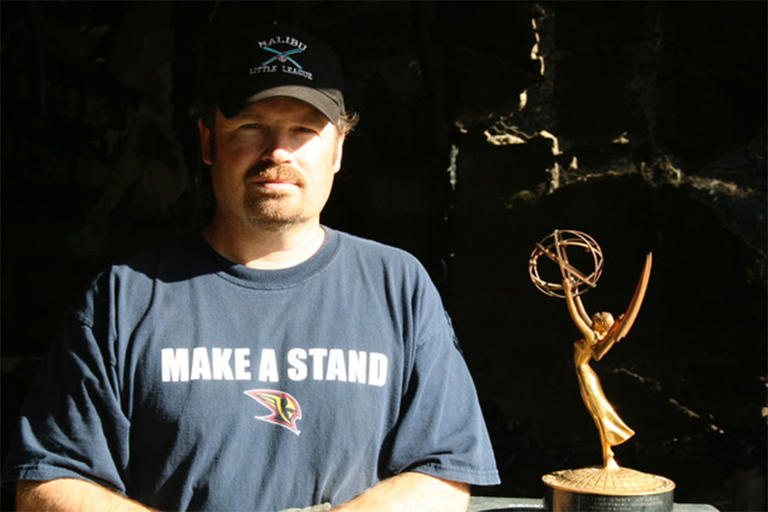
Robinson in 2007, with his Emmy in the wreckage of his home.© Provided by Hollywood Reporter

In David Leonhardt’s recent piece in The New York Times, he wrote about the “fracturing of work” in America: “Screenwriters — who are unionized — have gone on strike in an attempt to use their collective leverage to avoid becoming Hollywood’s equivalent of adjunct professors…” where pay, prestige, benefits, and job security are reserved for the “made” women and men of the tenured class.

This is what Noam Scheiber describes as “a tiered work force of esteemed versus lesser workers” reinforced by the “let-them-eat-cake” executives pulling down tens of millions a year while telling writers and actors they’re being unaccommodating.

To emphasize this animus, last month Universal Studios cut away the sidewalk shade trees. Some have alleged that this was to take advantage of the stifling heat of July to keep the picketing rabble at home. An anonymous insider quoted someone from the AMPTP of having famously said they wouldn’t return to the table “… until writers have lost their houses and apartments.” Really?


Bleary-eyed, I raced to the Philadelphia airport. As I sat in the terminal, I watched a CNN news blast on an overhead television. The banner read “LOS ANGELES BURNS”. The image showed an aerial assault on the blazing coastline of Southern California. The smoke, driven out to sea by the satanic Santa Ana winds, could be seen from the International Space Station. I knew somewhere in the middle of that inferno was… my home.

By 6 p.m. on Nov. 24, 2007, I’d returned to L.A. and was in the truck of a friend who’d tried to get to my house during the height of the fire. Conjuring images of the last day of Herculaneum and Pompeii, he’d been forced back by what he described as a pyroclastic plume.

When we arrived, the neighborhood was in ashes. The Technicolor vibrance of the flowers, topiary, and Sycamores was reduced to a monochromatic wasteland. Miraculously, our house was still there. Though severely damaged, it had been saved by multiple helicopter drops of water that preserved the structure but destroyed the roof.

The exterior stairs to my second-story office above the garage were gone, having burned into the walls, disintegrating the studs. Without support, the floor now sagged dangerously. Water ran freely through gaping holes cut into the ceiling by firefighters.

Pretty much everything from a 27-year career was gone. Signed movie posters, awards, photographs and decades of research and files. It would all be demolished within days. Inside the rest of the house, our clothes, bedding, draperies, carpets and furniture, even the kid’s toys, were lost to water and smoke damage. That canyon fire destroyed over 80 structures, including 49 homes. It was hot, fast, and explosive. In the end, we were fortunate. Many families lost all they had.


Like the destructive power of that blaze, the Hollywood work stoppage was taking its toll too. Writers were losing jobs, deals and some, yes, their homes. Like today, the strike was impacting the entire industry, including hundreds of vendors who support film and television production. Los Angeles is a company town and the strike, like an unchecked wildfire, was consuming money and property. For me it was difficult to separate the two events. Everything, it seemed, was going up in smoke.

In the carnage of our home was my 2007 strike sign. Somehow it had survived. It struck me that through the shared sacrifice of suspending that which defines and sustains us, or the mutual suffering of a community initiated in common loss, the outcome was an opportunity for understanding, esprit de corps, and solidarity.

As if to drive the point, someone got word to the Writer’s Guild that my family had been swept up in the fire, and 30 or so striking writers left the picket lines and showed up unannounced at what was left of our home with shovels, buckets and brooms. Not only did they help clean up our property, they went up and down the street assisting our grateful neighbors. Out of the ashes of the things we lost in the fire, and the smoldering strike, good people emerged, enduring their own struggles and understanding that the most useful thing they could do was to be of service to others.

A small thing perhaps, but something the 1 percent of the 1 percent might consider: In the end, we all need to be accountable to ideals bigger and more significant than stock prices. We need to be responsible to and for each other. Natural disasters and unfair work practices alike cause disruption, stress and trauma. There’s the physical displacement but more devastating is the emotional destabilization where nothing seems certain or secure anymore.


Robinson (center) on the Fox lot picket line in 2023.© Provided by Hollywood Reporter

Some felt we should have held out for more during the 2007 strike. It took years to recover from the sacrifices of that time just as it took nearly a decade to rebuild our home. As the Treaty of Versailles failed to create a lasting peace, the results of the 2007 strike were unsuccessful in protecting us from a rapidly changing system of producing and distributing our work. We got the message last time out. There are more wildfires coming. Which is why our resolve today is unbreakable. We don’t want to be back here three to six years from now in the same position.

To the CEOs, stockholders, and anyone who consumes entertainment, I quote Peter Matthiessen from his powerful book Men’s Lives on the disappearing way of life of Long Island fishermen: “It’s not fish you’re buying, it’s men’s lives.” When you go to a movie or watch television, you are supporting thousands of middle-class workers. It’s not tickets or subscriptions you’re buying, it’s the lives of the people who work endlessly to bring their art to you.

On the east end of Long Island, corporate fishing concerns, powerful sportsman’s clubs, and developers invaded the quaint villages and fisheries because they could. Today, the Bonackers and baymen are all but gone. Run off by the gilded transactionalists and Wall Street, yacht-cruising, day-trading class. They got their McMansions and jet skis, but their seafood is now flash-frozen and imported. If we’re not careful, creatives could suffer the same fate as those fishermen. Without potent guardrails, in short order we could become the equivalent of literary and thespian Neanderthals.

If it sounds like I’m a grumpy filmmaker, I’m not. I have nothing but gratitude for the opportunities I’ve had, the amazing people I’ve met and worked with. I’m supporting this effort so that I might help leave this business healthier than it is now for the younger people coming up.

I’m aware that the executives of our entertainment institutions are up against complex issues. The process of creating film and television is challenging. They answer to stockholders and corporate boards. I understand that. But they seem to view labor with a certain dismissive antipathy. Perhaps they need reminding that the creative force that serves them is made up of some of the most passionate, talented, dedicated workers on the planet. We love this business and we want it to survive and thrive. We are their partners. We want them to succeed. But not entirely at our expense.

As negotiators get back to the table and hope glimmers, we might remind them that we’re in this together. We want to create great movies and television. We want to tell great stories. We just need management to show up with some shovels and hoses and help us get it under control before this wildfire takes too much from too many.

We’re real people trying to live normal lives, doing what we’ve always dreamed of doing… and we do it better than anyone in the world. There is nothing more American than Hollywood. Show us a little flexibility, humanity, and some empathy. Take a little less, give a little more, and we’ll return to work with all the passion and solidarity we’ve taken to the streets… and deliver.

The Hollywood Reporter

THE WAR OVER THERE COMES HOME

  
Riot act read in Edmonton after anti-Eritrea clashes in Edmonton

The political tensions of northeastern Africa spilled over at several locations in Edmonton Saturday, prompting the riot act being read and tactical teams responding in order to break up fights at a cultural gathering, soccer tournament and musical event. Slav Kornik explains what happened

 
 EPS respond to a riot at event promoting world peace

Edmonton Journal Aug 19, 2023 Soccer for peace event cancelled, two groups clash on field, Edmonton tactical unit responds. 
UCP IS THE PC PARTY OF THE PAST
'A failure of due diligence': Alberta premier says Dynalife lab deal should have raised flags

Story by Lisa Johnson •1d

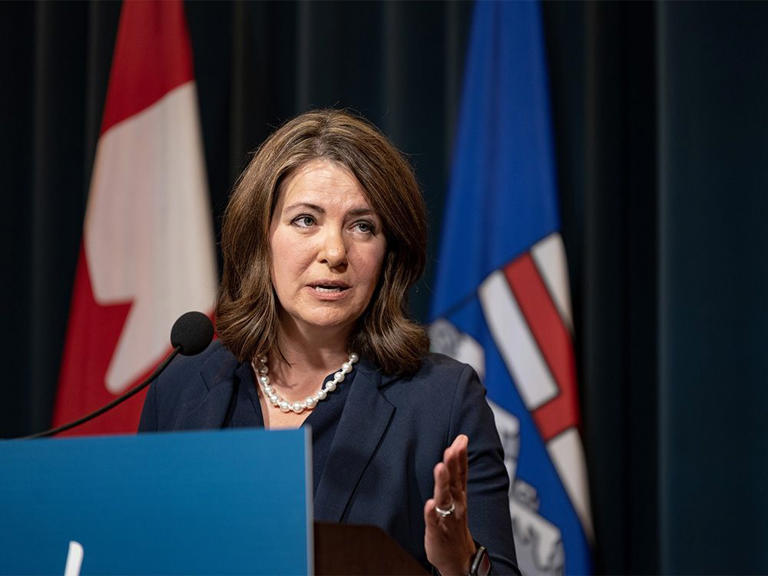
Alberta Premier Danielle Smith speaks at a news conference in McDougall Centre in Calgary on Aug. 14, 2023.© Provided by Edmonton Journal

Alberta Premier Danielle Smith says while she wasn’t responsible for a 25-year UCP deal to deliver medical lab services cut short after just over a year, it should have raised red flags from the start.

Appearing on her Saturday radio call-in show for the first time since the government announced it will take over lab services from Dynalife, Smith was asked if the province had failed to properly vet the agreement to expand the private lab testing company’s contracted services into Calgary and the southern region.

“There was a failure of due diligence somewhere and we have to figure out what went wrong in the contracting process,” said Smith.

Dynalife had already been providing lab services in northern and central Alberta, including Edmonton. Health Minister Adriana LaGrange announced Friday all Dynalife’s equipment, staff and facilities in the province will be nationalized and transferred to Alberta Precision Laboratories (APL), which is part of Alberta Health Services (AHS), by the end of this year.


“We had every reason to believe that Dynalife would be able to expand their services because they were already performing very well,” said Smith.

Public health care advocates have long argued private delivery can hurt public services, but Smith said the lesson to be learned is that having “a single source of any contract in government” is problematic, and that having only a single bid from Dynalife to do the work was an early warning sign.

“If you only have one bidder, that could be a sign that there’s something not quite economic about it,” she said.

“I didn’t make the decision,” she said, reiterating that the government was forced to take action Friday. It came after months of long wait times for things like blood tests, and a scramble by APL to cover new appointments.

“Dynalife has made the determination that they want to exit this market, and so we came to a mutual agreement that APL will take that over … for now,” said Smith.

Related

NDP calls on UCP to publish performance metrics in Dynalife contract

How much the contract reversal will cost taxpayers has yet to be disclosed.

A July 29, 2022, document available on the government’s public procurement website gives notice to all contracted providers that AHS and APL had entered into a 25-year agreement with Dynalife, beginning a transition on Dec. 5, 2022, but it does not disclose financial details.

Last year, the UCP promised the deal would save taxpayers between $18 million and $36 million.


“Why did (Dynalife) think they could make it work and be able to save money and then when it turned out, when they were actually operating it, those savings just disappeared?” asked Smith, who admitted sunk capital costs will come back to haunt taxpayers.

“We have to buy back some of the assets that we ended up transferring over to Dynalife. That’s going to cost money, and they’ve done some investments in capital and machinery. That’s going to cost money,” said Smith.

The move to expand private delivery is something the Opposition NDP has called a “reckless experiment in privatization” that illustrates the UCP’s incompetence on the health file.

On Friday, David Shepherd, the NDP’s health critic for primary and rural care, reiterated in a social media thread calls for a full accounting of the impact of the deal.

“We need answers,” he wrote.


While on Friday LaGrange argued centralizing all lab services under one APL umbrella will stabilize the system and provide “more oversight” and faster access for patients, Smith on Saturday reiterated her belief that AHS needs to be restructured.

“We’re already in the process of looking at AHS and seeing how problematic it’s been to concentrate everything into a single health super board and we’re working on decentralization,” said Smith.

lijohnson@postmedia.com

twitter.com/reportrix

Renewables companies hit brakes on Alberta projects after govt delays approvals

UCP CUTS NOSE TO SPITE FACE

SECOND PROVINCE AFTER ONTARIO 
FOR RENEWABLES

Rod Nickel
Mon, August 21, 2023

A wind farm generates electricity near bales of hay in the foothills of the Rocky Mountains


By Rod Nickel

WINNIPEG, Manitoba (Reuters) - Alberta's seven-month pause on approving new renewable power projects in the Canadian province has caused four major international companies at various development stages to stop work on their plans, an industry official said.

Alberta's surprise move this month has also prompted some domestic companies to consider whether to refocus investment on other provinces and the U.S.

Wind and solar energy producers have criticized Premier Danielle Smith for creating business uncertainty and jeopardizing billions in potential investments.

Alberta, the country's main oil and gas producing province, paused approvals on Aug. 3 of new renewable electricity generation projects over one megawatt until Feb. 29, chilling investment in the fast-growing industry. The pause is necessary to address concerns about renewables' reliability and land use, said a spokesperson for Alberta's utilities minister.

The move has increased tensions between Smith and Prime Minister Justin Trudeau's Liberal government, which is drafting regulations to force provinces to eliminate greenhouse gas emissions from their grids on a net basis by 2035.

One of the international companies that has paused its work had applied to build a renewable power project in the province, said Jorden Dye, acting director of the Business Renewables Centre, a Calgary-based organization that matches renewable developers and buyers.

A second company has paused design work on its first Alberta project, Dye added.

A third company delayed plans to secure Calgary office space, while a fourth was making preliminary inquiries about investing in Alberta before deciding to wait, he added.

"Those investment decisions ... are not going to move forward until the government clears this up," Dye said.

He said he could not name the companies because plans are confidential.

THE ALBERTA WAY

Alberta has led the country in building renewable capacity and is on track to eliminating combustion of coal for power next year, six years ahead of plan.

Along with domestic firms, foreign companies like Berkshire Hathaway's BHE Canada, EDF Renewables and Enel Green Power generate renewable power in Alberta. Companies have invested nearly C$5 billion ($3.7 billion) since 2019, according to the Pembina Institute.

The pause directly affects 15 projects in the approvals queue, the government spokesperson said. But Pembina said the freeze puts at risk a total of 91 projects at early development stages.

Calgary-based BluEarth Renewables is reviewing the 400 megawatts' worth of early-stage wind and solar projects it was considering for the province, although it has no projects currently in Alberta's approval queue, said CEO Grant Arnold.

"Without certainty as to what the outcome of this pause will be, we will prioritize investment into other jurisdictions," Arnold said. BluEarth also operates in three other provinces and the U.S.

Alberta Utilities Commission is deliberating whether to stop receiving applications during the pause period, rather than just halting approvals, a move that would suggest it may freeze development even longer, Dye said.

"You could see a scenario where an investor says, 'Alberta is now a risky place to invest so I need a higher return to justify the political risk,'" said Dan Balaban, CEO of Greengate Power, which built Canada's biggest solar farm in southern Alberta with fund manager Copenhagen Infrastructure Partners, producing power for Amazon.com.

"We need to get back to the Alberta way, which is very pro-business."

($1 = 1.3550 Canadian dollars)

(Reporting by Rod Nickel in Winnipeg, Manitoba; additional reporting by Steve Scherer in Ottawa; Editing by Denny Thomas and Marguerita Choy)
Peregrine falcon chicks hatched in Edmonton now learning to hunt prey in the wild

CBC
Sun, August 20, 2023

The peregrine falcon family, two parents and three fledglings, at the Cabrini Centre nesting box before the young ones got their flying feathers. (Submitted by Janice Hurlburt - image credit)

Three peregrine falcon chicks who have been residing on top of a hospital building in west Edmonton have spread their wings.

Two of the fledglings, a male and a female, had to be rescued and are currently at a site overlooking the Pembina River where they will learn how to hunt prey.

The fledglings were hatched at a nesting site on top of the Cabrini Centre, a building on the Misericordia Hospital grounds near West Edmonton Mall.

They were taken to the Pembina River location, known as a hacking site, earlier this month. That's where they are taking their early flights in nature, surrounded by trees and water.

"It's much safer for them and it also imprints them out in the rural area as opposed to the city so that they're going to migrate south for the winter," said Janice Hurlburt, a volunteer for Falcon Watch, a group dedicated to monitoring nesting peregrine falcons in the Edmonton region.

The third fledgling, a male, came out of the nest on July 29 and ended up falling nine metres down a boiler chimney which is part of the Misericordia emergency department construction, according to Hurlburt.

The male fledging wasn't seen for five days before he was rescued and checked by WildNorth animal shelter in Edmonton.

Janice Hurlburt holding a three week old Peregrine falcon chick. She has been volunteering for Falcon Watch for eight years.

Janice Hurlburt holding a three-week-old peregrine falcon chick. Hurlburt has been volunteering for Falcon Watch for eight years. (Submitted by Janice Hurlburt)

Since then, he has fledged — grown his flying feathers — and is now flying around with his parents.

"Right from the start I referred to that male as No. 1," said Hurlburt. "He just seemed more outgoing and stronger. He was the first one to fledge, he fledged pretty well and then now he's doing super well."

Last month, volunteers from Falcon Watch put up notices at the Misericordia, the Cabrini Centre, West Edmonton Mall and surrounding areas asking people who encounter the birds at ground level to not touch them and to call someone on the volunteer team.

The volunteers took shifts, sometimes lasting up to 12 hours, to watch the fledglings.

There are a number of nesting boxes under video surveillance in the Edmonton area, including the University of Alberta, the Bell Tower downtown, and the Shell Scotford site near Fort Saskatchewan.

On the left, the female fledgling after being rescued in the Cabrini parking lot. On the right, out at the hack site on the Pembina River.

On the left, the female fledgling after being rescued in the Cabrini Centre parking lot. On the right, the same bird at the hacking site on the Pembina River. (Submitted by Janice Hurlburt)

While the nesting box at the Cabrini Centre isn't video monitored, dedicated volunteers watch and rescue the birds.

"These birds really don't go any length of time at all without somebody knowing what's going on," said Dale Gienow, WildNorth's executive director.

Falcons are natural cliff-dwellers and do well on tall buildings in urban environments because they simulate the rock ledges. But urban locations can be dangerous for peregrine falcon chicks.

"They're inexperienced flyers and they can sometimes collide with buildings or get into trouble and end up in places that aren't really great," Gienow said.

Dale Gienow is the executive director of WildNorth rescue and rehabilitation center in Edmonton.

Dale Gienow is the executive director of WildNorth rescue and rehabilitation centre in Edmonton. (David Bajer/CBC)

In the 1970s, peregrine falcons were on the brink of extinction in most provinces because of pollution from DDT, an insecticide developed to protect crops and prevent the spread of disease.

Thanks to the likes of local volunteers and conservation groups, the peregrine population in Alberta has gone from one productive pair in 1970 to an estimated 80 pairs today, according to the Alberta Conservation Association.

For people who come across an injured peregrine falcon, the best route would be to contact a wildlife conservation group or a local veterinarian who then could take the bird to WildNorth, said Gienow.

"We would assess them and then we connect them with the folks from Alberta Environment and protected areas and get them back out into the wild where they belong."
Tropical moisture seeps into Canada, but little help for B.C. fires

Digital Writers
Sun, August 20, 2023 

Tropical moisture seeps into Canada, but little help for B.C. fires

Flash flood warnings cover tens of millions of people in the southwestern United States—including Los Angeles—as Tropical Storm Hilary leaves a historic mark on the region.

The storm’s prolific moisture will flow north into Canada through the week, fuelling rain chances from British Columbia to Quebec.

Unfortunately, the rain won’t be enough to stifle the fires raging throughout B.C., which have forced thousands to flee their homes and sent air quality plummeting to dangerous levels.

BCAQ

RELATED: Canada next in line for Hilary’s rains after historic U.S. impacts

Thick wildfire smoke hugging the surface throughout southern British Columbia won’t improve much heading into Monday.

Significant fires burning near Kelowna and Kamloops have contributed to atrocious air quality readings throughout the region, forcing residents to stay inside or wear quality masks to avoid harm from the air pollution. We'll see these hazardous conditions persist through Monday.

BCSmoke
Looking ahead at Hilary’s remnants

We’ve seen some clouds and rain push into Western Canada during the day Sunday as the far-reaching outflow from Tropical Storm Hilary vents over the region.

A strong jet stream swooping over the western half of North America is giving the storm a boost, helping extend its reach from Mexico to Alberta and beyond.

Heat Dome Hilary

The storm’s tropical moisture will continue flowing north long after the system itself falls apart over California on Monday. This plume of moisture aloft will meet with a disturbance over Western Canada by the middle of the week, bringing a chance for thunderstorms and steady rainfall to portions of central B.C. and Alberta.

BCPrecip

While some areas will see 20-40 mm of rain through the coming week, the bulk of the rain will miss communities where crews are struggling to get a leg up on out-of-control fires burning through B.C.’s Interior.

Stay tuned for the latest forecast update for Western Canada.
WATCH: The best time to prepare for a hurricane is well before one forms

Click here to view the video
Two large wildfires merge to form one huge blaze in Canada as thousands more evacuated

Stuti Mishra
The Independent
Mon, 21 August 2023 

Smoke from wildfires fills the air as motorists travel on a road on the side of a mountain, in Kelowna, British Columbia (AP)

Two large wildfires raging in western Canada have combined to form one huge blaze that destroyed houses and vast swathes of land, and prompted the evacuations of thousands in the area.

British Columbia declared a state of emergency and imposed a ban on non-essential travel to free up accommodations for evacuees and firefighters, as 35,000 people were ordered to evacuate over the weekend with hundreds of wildfires continuing to burn in the state.

Government officials urged residents in evacuation order zones to leave immediately to save their lives and prevent firefighters from dying trying to rescue them.


On Sunday, prime minister Justin Trudeau announced that his government has cleared the request of the provincial government to deploy the military to tackle fast-spreading infernos.

Mr Trudeau said in a tweet that the federal government will offer support from the Canadian military “to help with evacuations, staging” and other logistical tasks, in response to a request from the British Columbia government.

At least 400 fires continue to burn in the province as strong northern winds continued to fan the flames and hundreds of firefighters struggled to control them for weeks.


In some cities in British Columbia, smoke from the wildfires plunged the air quality index (AQI) to “hazardous” levels, showed IQAir, a real-time air-quality information platform.

At midnight (0400 GMT), Salmon Arm was recording the nation’s worst air quality index, with an AQI reading of 470. Among other cities, Kelowna College and Sicamous both had the AQI at 423.

West Kelowna fire chief Jason Brolund said he saw some hope after battling “epic” fires for the past four days as he said conditions have improved, helping firefighters to put “boots on the ground” and dump water on flames that threatened the town of 150,000.

“We are finally feeling like we are moving forward rather than moving backwards, and that’s a great feeling,” Mr Brolund told the Canadian Broadcasting Corp.

A map of the wildfires currently raging in British Columbia, Canada
 (The Independent/Datawrapper)

The Pacific coast province could get some rains this week from the moisture of tropical Storm Hilary, which made its historic arrival in California on Sunday, bringing some relief to the province which is in the grip of a severe drought.

Forest fires are not uncommon in Canada but this year, the country has seen its worst wildfire season on record, on the heels of record-shattering global temperatures driven by the climate crisis.

About 140,000 square km (54,054 square miles) of land, roughly the size of New York state, has been scorched nationwide, with smoky haze extending as far as the US East Coast.

Government officials project the fire season could stretch into autumn because of widespread drought-like conditions.

Additional reporting by agencies

Firefighters curb blazes threatening 2 cities in western Canada but are 'not out of the woods yet'


Evacuations have begun in the city of Yellowknife, located in the Canadian Northwest Territories. The fire had moved to within 9 miles from the city as of August 18, 2023. 
(AP Digital Embed)


DAVID SHARP, JIM MORRIS and MARTHA BELLISLE
Updated Sun, August 20, 2023

VANCOUVER, British Columbia (AP) — Firefighters kept wildfires at bay near the capital of Canada's Northwest Territories as well as a threatened city in British Columbia, though no one claimed victory as forecasters warned that drier and windier weather was coming.

For Saturday at least, the weather was milder, providing some help for fire teams battling to contain the flames of Canada's worst fire season on record that destroyed structures, fouled the air with thick smoke and prompted evacuation orders for tens of thousands of residents.

Officials said a huge wildfire again had been kept from advancing closer than 15 kilometers (9 miles) to Yellowknife, the capital of the Northwest Territories that was left virtually empty when nearly all of its 20,000 residents fled for safety.

“We’re by no means out of the woods yet,” Mike Westwick, wildfire information officer for the city, told The Associated Press. “We still have a serious situation. It’s not safe to return.”

To the south, in British Columbia, raging flames were also kept away from Kelowna, a city of some 150,000 people about 150 kilometers (90 miles) north of the United States border.

The Kelowna fire is among more than 380 blazes across the province, with 150 burning out of control. The blaze near Yellowknife is one of 237 wildfires burning in the Northwest Territories.

At a Saturday evening news conference, Shane Thompson, the minister of environment and climate change for the Northwest Territories, said the fires near Yellowknife had not grown very much in the past few days thanks to breaks in the weather.

“But I want to be clear, a little bit of rain doesn’t mean it’s safe to come back home,” he said. Others warned that incoming hot weather would make the battle more challenging.

Yellowknife Mayor Rebecca Alty encouraged residents to stay away to ensure their safety and help with firefighting efforts. She assured people that patrols were monitoring streets and homes to protect against looting.

The city has become a virtual ghost town since residents fled following an evacuation order issued Wednesday evening. Long caravans of cars choked the main highway and people lined up for emergency flights to escape the blaze. The last 39 hospital patients were flown out Friday night on a Canadian Forces plane, officials said.

On Saturday, officials said the escape route out of Yellowknife was safe, for the time being. About 2,600 people remained in town, including emergency teams, firefighters, utility workers and police officers, along with some residents who refused to leave.

Charlotte Morritt was among those who left Thursday, reaching that decision because of the unbearable smoke that she feared would be unhealthy for her 4-month-old son.

Morritt, a journalist with the Aboriginal Peoples Television Network, and her son took an evacuation flight some 1,500 kilometers (950 miles) west to safety in Whitehorse, Yukon, while her partner stayed behind to monitor their property and help create firebreaks and fight fires.

“We knew it was only a matter of time,” said Morritt, who had been following media updates and satellite images of the approaching wildfires.

Air tankers dropped water and fire retardant to keep the flames from Yellowknife. A 10-kilometer (6-mile) fire line was dug, and firefighters deployed 20 kilometers (12 miles) of hose and a plethora of pumps.

Canada has seen a record number of wildfires this year that have caused choking smoke in parts of the U.S. All told, there have been more than 5,700 fires, which have burned more than 137,000 square kilometers (53,000 square miles) from one end of Canada to the other, according to the Canadian Interagency Forest Fire Centre.

All of British Columbia was under a state of emergency Saturday. About 35,000 people had been ordered to evacuate wildfire zones across the province and an additional 30,000 people were under an evacuation alert, meaning they should be prepared to leave, Premier David Eby announced.

Eby told reporters Saturday that the situation was “grim” and warned that the “situation changes very quickly.”

He said he was restricting non-essential travel to fire-affected areas to free up accommodations such as hotels, motels and campgrounds for displaced residents and firefighters.

Ian Stewart and his wife made the “anxiety-producing” decision Friday to evacuate Kelowna with their 4-year-old border collie and drive 335 kilometers (210 miles) to the British Columbia town of Clearwater.

“The smoke was really oppressive and there were big chunks of ash falling everywhere,” he said Saturday. They packed a couple of suitcases, passports, laptop computers and dog food, and drove in bumper-to-bumper traffic to escape.

A shift in the wind carried smoke and haze from British Columbia into the Seattle area on Saturday, said Dustin Guy, a meteorologist with the National Weather Service. The Puget Sound region was just recovering from record heat, and air quality could reach unhealthy levels Saturday night through Monday, Guy said.

___

Sharp reported from Portland, Maine, and Bellisle reported from Seattle. Associated Press journalist Andrea Thomas in Chicago contributed to this report.

A front-row seat to devastation on the shores of Lake Okanagan

The Canadian Press
Sat, August 19, 2023 


KELOWNA — The eerie calm on the Kelowna waterfront Saturday morning was broken by the faint percussive chops of helicopter blades in the distance.

There were semblances of normality — people walking their dogs or cycling down the path along the lakefront.

But hanging over Okanagan Lake was a pall of putrid wildfire smoke, and the threat posed by fires on both sides of the lake.

Dale Simpson and Steve Smith were out walking their dogs near a marina, where dozens of boats and jet skis sat idle on the docks, the water mostly free of boats due to aerial firefighting craft needing a wide berth to do their work.

Simpson, along with hundreds of others, had gone up a hillside on Thursday night to watch the McDougall Creek wildfire across the lake when embers began blowing across the lake, sparking a spot fire nearby.

The crowd had a “front-row seat” to the devastation unfolding across the water.

“You saw fire going up hundreds of feet in the air,” he said. “The whole massive mountainside hillside was ablaze.”

But when the spot fire broke out, Simpson said, people had to flee their vantage point and get in their cars, causing a “big traffic jam getting out of there.”

Evacuee Claire Blaker came out to the Kelowna waterfront on Saturday morning, shading her eyes as she squinted through the smoke in hopes of seeing if her house was still standing.

She lives in West Kelowna and watched her neighbourhood burning on Friday night as house after house went “candling” up in flames.

She thought the part she lives in might still be OK, but she was “waiting for the smoke to lift.”

Waking up Saturday morning was “pretty tough,” she said, but she feels lucky that she had the time to pack up and get out of her home before things took a turn for the worse.

“People in Maui and Lahaina had no time,” she said, referencing victims of the deadly wildfire that devastated parts of Hawaii last week. “At least we did get that time, so I'm appreciative of that.”

For Dan Teahan, going for a walk on the waterfront gave him a bit of exercise. He was offering masks to people amid the smoke.

Teahan uses a walker and has chronic obstructive pulmonary disease, so he was slowing his usual pace to get some relief from the smoke.

He said he watched the fire on Thursday night. He pointed across the water, struggling to see the faint hillside through the haze.

“As far as you could see was a wall of flames on that hillside, and it was just candling,” he said. “It was like end of times, man. You know, the apocalypse is coming or something, right? It just kept going and going.”

Teahen said he has lived in Kelowna for more than 20 years and is currently worried about the city’s less fortunate rather than those at the Kelowna Yacht Club nearby.

“Those guys can take care of themselves,” he said. “They got plenty of dough.”

But Teahan said the city had been through fire crises before, and it brought out the best in people.

“The community spirit really shows in a crisis in this town. People really pull together,” he said. “There's a bunch of people here with really, really big hearts that step up to the plate when there's trouble like this.”

This report by The Canadian Press was first published Aug. 19, 2023.

Darryl Greer, The Canadian Press


Worms that secrete a dangerous paralyzing toxin spreading in Montreal

The Canadian Press
Sat, August 19, 2023


MONTREAL — An invasive worm species from Asia that secretes a dangerous, paralyzing toxin has been spotted in the Montreal area.

Lisa Osterland, a retired teacher, found some twenty hammerhead flatworms earlier this week while removing slugs that were eating flowers in her garden in Westmount, Que., a municipality on Montreal Island.

She didn’t recognize the invertebrate until she came across a CNN report a few days later indicating that hammerhead flatworms were spreading across the state of New York.

"The shape of the worm was the same as what I saw" in the garden, Osterland told The Canadian Press.

The retiree said she collected the worms at night, when they seemed to be most active, and then handed them over to a team of entomologists at the Université de Montréal. Among them was Étienne Normandin, who said the team received about 20 specimens from Osterland.

"There's a rule among biologists that when you find a specimen of an invasive species, you can multiply it by 100 to estimate the population," he said. "We're up to around forty specimens observed in recent years in Quebec, if not more. So we can estimate that the hammerhead flatworm population is in good health."

A few sightings of hammerhead flatworms have been recorded in Gatineau and Montreal in recent years, but this is the first time that so many individuals have been reported in Quebec.

Normandin described their proliferation as a cause for concern, not least because they secrete a paralyzing toxin, tetrodotoxin, "one of the most powerful molecules in the biological world" and "the same molecule produced by pufferfish."

"If a young child puts soil in his mouth and ingests a flatworm or two or more, there's a real risk of damage,” he warned. “If ingested, it's a toxin that will first attack the perioral region, i.e. the face, the tongue and everything in the esophagus."

"In such a case, the child needs to be hospitalized very quickly.”

Hammerhead flatworms are also a danger to birds, dogs and other animals that frequent gardens, as well as to soil biodiversity.

The invasive species has no local predator and preys on slugs, snails and millipedes, Normandin explained — species that, he said, "provide a very important service, which is the recycling of organic matter." The worm can therefore threaten ecological balance.

Its "negative impact on soil invertebrate communities" has already been observed in France, the entomologist noted.

"We're slowly seeing the long-term effects of this," he said. "We can expect similar damage to our soil fauna over the years."

The worm originated in Asia and was probably transported to North America on cargo ships carrying plants, Normandin said.

"Often it's found in well-off neighbourhoods," he said, citing Westmount as an example. "In these neighbourhoods, we often have a lot of landscaping, we have exotic species of plants that are beautiful" and imported from other countries.

The hammerhead flatworm was first observed in Montreal in 2018 by a member of the Université de Montréal entomology team, but Normandin theorized it may "already have been established in the neighbourhoods around Mount Royal," the large wooded hill in the heart of the city.

According to Environment and Climate Change Canada, invasive species can cost the global economy billions of dollars every year through negative impacts on forest productivity, agriculture and fisheries, as well as through measures to control their spread.

Such species represent an "emerging threat to northern Canadian ecosystems as climate warms and species intolerant of current northern climatic conditions expand their ranges," Environment and Climate Change Canada states on its website.

Traditionally, when an invasive species arrives from Asia, "the Quebec winter will kill it," Normandin said. But now, higher average temperatures due to climate change "(offer) a species like the hammerhead flatworm an extra chance to develop."

In an email exchange with The Canadian Press, Quebec’s Environment Department indicated that because, "at present, (it) is not tracking this species," its "potential to establish itself sustainably in Quebec and the impacts it could have have not been assessed."

This report by The Canadian Press was first published Aug. 19, 2023.

Stéphane Blais, The Canadian Press