Monday, August 21, 2023

Spain's federation wastes no time giving its WOMEN players the middle finger after World Cup win


Nancy Armour, USA TODAY
Updated Sun, August 20, 2023 at 7:20 p.m. MDT

It is never enough for women to simply win.

They get maybe two seconds to revel in their accomplishment and celebrate themselves before they have to dig back in, because the inequities and the sexism and the misogyny and all the other awfulness that existed before their beautiful moment remain. And lord knows the people in power, the ones who should be righting their own wrongs, won’t do so without a fight.

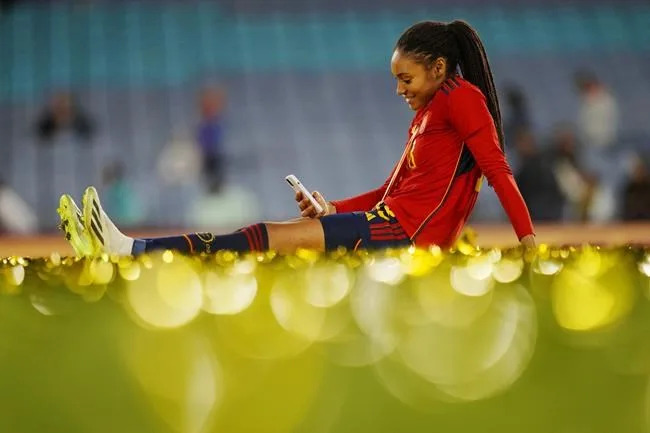
Not that Spain needed a reminder of this – "I want to remember all the women that have been pushing and fighting over the years for (us) to have better conditions. This is for them and from them," Golden Ball winner Aitana Bonmati said – but its federation provided one nonetheless. The players were still on the field playing in the confetti after winning their first World Cup title when the federation’s social account posted a photo of coach Jorge Vilda with the caption, "Vilda In."

That’s the same Jorge Vilda who created a training environment so intolerable that 15 of Spain’s top players said last year they wouldn’t play for the national team until conditions improved. The same Jorge Vilda who used his World Cup roster to exact petty revenge, taking only three of the 15 to the tournament in Australia and New Zealand despite several more saying they wished to return.

The federation included an emoji of an index finger raised in the No. 1 sign. But a middle finger would have been more appropriate because that’s essentially what the federation was giving its players.

Team Spain celebrates after beating England in the final an dwinning the 2023 World Cup in Sydney, Australia.

And it got worse! As the players received their champions medal, Spain federation president Luis Rubiales grabbed Jenni Hermoso, the team's all-time leading scorer, and kissed her on the lips without her permission. And without her interest.

"Yeah, I did not enjoy that," Hermoso told broadcasters afterward.

There are coaches, like Jill Ellis or German men’s coach Joachim Löw, whose fingerprints can be seen all over the championship trophy. Vilda is not one of those coaches. It is Spain’s exceptional players who are responsible for the World Cup title. Their skills were honed with their clubs – Barcelona, primarily – ­not with the national team.

His players are so talented all Vilda had to do was hand in a lineup and stay out of their way.

And he could barely manage that.

"We’ve suffered a lot over last 12 months," captain Olga Carmona, who gave Spain the only goal it needed in the 29th minute, said afterward. "But I think everything has a reason, and it’s made us a stronger team."

Now Spain will have to be strong again.

CARMONA: Spain's goal scorer learns after World Cup final her father died

Winning the World Cup gives the players leverage with the federation and they need to use it to exact the changes they want. The changes they need. Whether that means Vilda isn’t the coach going forward – his refusal to commit when asked multiple times if he plans to stay on was notable – or Rubiales is chastened or the federation provides more funding and resources, the players will never be in a better position to force changes than they are now.

The U.S. women are the model for this. They used the blockbuster success of their 1999 World Cup win to earn a new contract that gave them guaranteed paychecks. Their 2015 and 2019 titles laid the foundation for their landmark contract that assures them equal pay to the U.S. men, including an equal split of World Cup prize money.

Public opinion obviously helped the USWNT’s cause. The players were serenaded with chants of "Equal pay! Equal pay!" during the victory ceremony at the 2019 World Cup and again at their victory parade in New York City. When U.S. Soccer disparaged the players the following year in a court filing in the equal pay lawsuit, sponsors balked.

Ultimately, the federation realized this battle was costing far more than equality would. The same can happen in Spain.

Despite the discrimination and condescension that’s been baked in toward women’s soccer for decades in Spain, the sport has become exponentially popular.

Barcelona drew more than 91,000 people for games twice in 2022, and some 8,000 fans traveled to see this year’s Champions League final in the Netherlands. Four years ago, Atletico Madrid set what was then an attendance record with 60,739 fans. That broke a record set a few months earlier by the Athletic Club in Bilbao, Spain.

There were watch parties for Sunday’s final in more than 100 cities in Spain, and the ones in Madrid and Barcelona appeared to be packed.

If Spain fans believe the players are being treated unfairly, that will only put more pressure on the federation. Change might not happen overnight, but it will happen.

It’s not fair to ask Spain's players to continue fighting for equality when all they should be doing is celebrating. It’s infuriating that the players' greatest accomplishment has to be forever linked to their second-class treatment. But that’s how it is for women athletes.

A win on the field isn't the end of the fight. It has to be the beginning, or things will never change.

Follow USA TODAY Sports columnist Nancy Armour on social media @nrarmour.

This article originally appeared on USA TODAY: Spain players must use women's World Cup win to force needed changes

Angry reaction after Spanish soccer leader kissed a Women’s World Cup star on the mouth


The Canadian Press
Mon, August 21, 2023


MADRID (AP) — The leader of Spain’s soccer federation left a sour taste on the country’s Women’s World Cup victory after kissing a player on the lips during the medal ceremony, drawing criticism for inappropriate conduct in a sport that has struggled to overcome sexism.

The Spanish government and the world players’ union condemned the behavior of Luis Rubiales on Monday, a day after Spain’s 1-0 win over England. The soccer federation led by Rubiales sought to downplay the incident through a statement it attributed to the player he kissed.

Immediately after Spain's victory, Rubiales grabbed his crotch in a victory gesture — seemingly oblivious to 16-year-old Princess Infanta Sofía standing nearby. He later kissed player Jenni Hermoso on the lips during the medal and trophy ceremony on the field, drawing unwanted attention away from the celebration and marring the country's biggest day for women’s soccer.

The kiss was shocking given the sport’s long-standing allegations of sexual misconduct by male soccer presidents and coaches against female players on national teams. Two of the 32 World Cup teams, Haiti and Zambia, had to deal with the issue while qualifying for the tournament co-hosted by Australia and New Zealand.

Spain’s acting minister for sports and culture Miquel Iceta told public broadcaster RNE “it is unacceptable to kiss a player on the lips to congratulate her.” The world players' union called the kiss “deeply lamentable.”

On Sunday, Spain's government equality minister had an even stronger reaction.

“It is a form of sexual violence that women suffer on a daily basis, and which has been invisible so far, and which we should not normalize,” Irene Montero said wrote Sunday on X, the social media platform formerly known as Twitter.

The Spanish soccer federation released a statement late Sunday, attributed to Hermoso, to try to settle the controversy.

“It was a totally spontaneous mutual gesture due to the immense joy of winning a World Cup,” Hermoso said in the federation’s statement. “The president and I have a great relationship, his behavior with all of us has been excellent and it was a natural gesture of affection and gratitude.”

Rubiales, 45, led the world players’ union’s Spanish affiliate for eight years before being elected to lead the national soccer federation in 2018. The Spanish squad was in near-mutiny last year because of some players’ complaints about the culture under coach Jorge Vilda.

After the game, when Hermoso passed along the line of soccer dignitaries to collect her medal, Rubiales put his hands to her head and kissed her on the lips. He also hugged several other players and put his arm around Queen Letizia of Spain.

In an Instagram video in the dressing room after the incident, the players screamed and laughed while watching the kiss being replayed on a phone.

Hermoso can be seen laughing and shouting, “But I didn’t like it!” Asked by other players what she was doing, she shouted, “Look at me, look at me,” intimating she couldn’t do much about it.

FIFPRO, the Netherlands-based players' union, took a harsh view of Rubiales' actions.

“It is deeply lamentable that such a special moment for the players of the Spain national team that was taking place before a global television audience should be stained by the inappropriate conduct of an individual in a role carrying so much responsibility,” the union said in a statement.

“Uninitiated and uninvited physical gestures towards players are not appropriate or acceptable in any context. This is especially true when players are put in a position of vulnerability because a physical approach or gesture is initiated by a person who holds power over them.”

Rubiales also is a UEFA vice president and was the European soccer body's most senior elected representative at the final in Australia.

Video clips filmed after the final whistle of Sunday's match show Rubiales celebrating the victory in the front row of an exclusive section near the queen of Spain and FIFA president Gianni Infantino. Rubiales jumped with both arms in the air, pointing with both index fingers toward the field, then briefly grabbed his crotch with his right hand.

The former player has a key role in wooing soccer officials over the next year while trying to secure hosting rights for the men’s World Cup in 2030. Spain leads a joint bid with Portugal, Morocco and, currently, Ukraine for the 48-team tournament and is favored to win next year's decision.

UEFA and FIFA did not immediately respond Monday to requests for comment about Rubiales’s conduct.

___

Dunbar reported from Geneva.

___

Associated Press reporter Ciaran Giles contributed to this report.

___

AP Women's World Cup coverage: https://apnews.com/hub/fifa-womens-world-cup

David Brunat And Graham Dunbar, The Associated Press

Spain soccer president Luis Rubiales apologizes for kissing player, as calls for his resignation mount


Henry Bushnell
·Senior soccer reporter
Mon, August 21, 2023 

Spanish soccer federation president Luis Rubiales said in a Monday video that he "made a mistake" when he kissed Jenni Hermoso. (Photo by Maja Hitij/FIFA via Getty Images)

Luis Rubiales, the Spanish soccer federation president whose antics tarnished Spain's Women's World Cup title Sunday, publicly apologized Monday for kissing midfielder Jenni Hermoso during a postgame ceremony.

Rubiales forcibly kissed Hermoso on the lips during an enthusiastic embrace shortly after Hermoso received her winners medal on an on-field podium. The moment was captured by live TV broadcasts and triggered an international outcry.

"It seems unacceptable to me," Spain's minister for culture and sport, Miquel Iceta, said in a TV interview. "We're in a moment of equality, of rights and respect for women. We all have to be particularly careful in our attitudes and our actions. I think it's unacceptable to kiss a player on the lips to congratulate her."


Others pointed out that the federation's policy on sexual violence stipulates that "forced kisses" are considered "unacceptable conduct with immediate consequences." Fans, media members and a wide array of soccer figures called for his resignation or removal.

The Royal Spanish Football Federation has not yet announced any punishment. On Monday, it released a video to various media outlets that included Rubiales' apology.


"I made a mistake, for sure," Rubiales said in Spanish. "I have to accept it. In a moment of such emotion, without any bad intention or bad faith, what happened, happened, in a very spontaneous way, with no bad faith from either side.


"We saw it as something natural and normal," he continued in the video — which was not posted on federation's social media channels. "But on the outside it has caused commotion, because people have felt hurt by it, so I have to apologize; there's no alternative. I have to learn from this and understand that a president of an institution as important as the federation — above all in ceremonies and that kind of thing — should be more careful."

In the more immediate aftermath of the kiss, Rubiales had dismissed his critics as "idiots everywhere." He'd said on Spanish radio: "When two people have a minor show of affection, we can't heed idiocy."

He addressed that comment in his Monday video as well.


"There are also some declarations I made where, within this context, I said [the outcry] seemed like idiocy — because on the inside, nobody considered it important," he said. "But on the outside they had. So, I want to apologize to those people.

"I'm also saddened, because this is the biggest success in our history in women's football, the second World Cup that we've won, and this has affected the celebration."

He did not address his postgame locker-room declaration that he would marry Hermoso; nor his celebration shortly after the final whistle, which included grabbing his crotch; nor the battle with women's national team players that he publicized and inflamed last September.

FIFA has not yet commented on Rubiales' actions or any consequences.

Women's World Cup teams head home to different futures

Mon, August 21, 2023 


SYDNEY (AP) — Teams headed home from the Women's World Cup with uncertain futures but hopes that the monthlong tournament would spur new interest and further investment in the game.

For some teams, like Nigeria, the Philippines and Jamaica, the struggle for funding, support and recognition will continue.

More established teams like GermanyBrazil, Canada and the United States now begin the post-tournament soul-searching about what went wrong.

Spainwhich defeated England 1-0 in the final on Sunday, can revel as first-time champions.

“We need to be ready, because after this FIFA Women's World Cup women's football is going to explode in every single one of your countries,” FIFA chief women's football officer Sarai Bareman said at a women's soccer conference held in the days before the final. "We need to be ready for it. There will be millions and millions of women and girls around the world who will sign up to play football for the first time ever after this World Cup.

“Everyone needs to stand ready, with investment, with infrastructure, with coaches, with referees, with tournaments, member associations, federations, confederations. We need to stand ready to receive that interest and retain it in our game in a sustainable way.”

The next major tournament for women's soccer is next year's Olympics in FranceThe French were eliminated from the World Cup in a penalty shootout after a scoreless draw with co-host Australia in the quarterfinals.

Before France even got to the World Cup the team had some upheaval. Wendie Renard threatened not to play for the team, and the French federation responded by firing coach Corinne Diacre in March and hiring Herve Renard, who coached Saudi Arabia's men at the World Cup in Qatar.

Herve Renard, whose contract runs through the Paris Olympics, was already looking forward to next year.

“We have no regrets," he said. "Next year we’ll be back, we’ll be back at home and we are going to try and glean something from this.”

The United States is in the market for a new coach after the two-time defending World Cup champions crashed out of the tournament at the earliest point ever. Sweden defeated the United States in a penalty shootout in the round of 16.

U.S. coach Vlatko Andonovski resigned after the tournament. The team needs to work fast to name a replacement, because the Americans are among four teams who have already qualified for the Olympics — along with France, Brazil and Colombia.

The Brazilians didn’t emerge from the group stage for the first time since 1995. Afterward, Marta said a tearful goodbye after her sixth World Cup.

“Women’s football doesn’t end here. Women’s football in Brazil doesn’t end here,” Marta said. “We need to understand this.”

Nigeria has asked global players' union FIFPRO to intervene and make sure the team received the World Cup bonuses for every player participating in the tournament. Nigeria's players were each set to earn $60,000 for advancing to the knockout round. The Super Falcons fell to England on penalties in the round o1 6.

FIFPRO confirmed it was assisting the team in not only receiving the bonuses, but also other payments dating back to 2021.

FIFA dedicated individual payments from the prize pool for each player at the World Cup. All participants were to receive $30,000, with the total growing the further along teams got in the tournament. FIFPRO was going to lend help to make sure each player received the funds.

Spain's players each earned a $270,000 bonus for winning the tournament. The federation earned $4.29 million.

The Philippines was among eight teams playing in their first World Cup. The team upset New Zealand 1-0 in the group stage for a historic victory. But it wasn't enough to get the team out of the group stage.

Canada returns to a messy contract situation with its federation. The women's team has been without a contract for a year, and reached an interim funding agreement during the tournament that guaranteed the players would be paid.

The Canadians will be back at work soon, hosting Jamaica in an Olympic qualifier in late September.

The Reggae Girlz did not have many friendly matches in the run-up to the World Cup and there were crowdfunding campaigns to help the players pay for travel and accommodations. It was hoped that their success in the World Cup — they advanced to the knockout round for the first time — would translate into additional support from the Jamaican federation.

“The smaller countries will realize that there’s a platform out there and I think young women all over the world, they’re looking,” Jamaica coach Lorne Donaldson said. “I think all of these governments, everybody, it’s time to step up. Cut the bull crap and step up for women’s football and let’s move along.”

Morocco was another of the first-time teams in the World Cup and played well enough to advance to the knockout round, a first for an Arab and North African team at the World Cup.

Morocco has poured money into its women's program. The federation not only created an academy but it pays its players monthly wages to encourage young women to play.

“I look at these debutant teams, I look at these players, so investment is paying dividends,” former U.S. coach Jill Ellis said. “I am yelling from the highest mountain top that it’s not a matter of if you should, it’s why would you not invest in women’s football?”

___

AP Sports Writer John Pye contributed to this report.

___

AP Women's World Cup coverage: https://apnews.com/hub/fifa-womens-world-cup

Anne M. Peterson, The Associated Press

Women's World Cup champion Spain poised for long run among soccer elite with talented young team


Sun, August 20, 2023 


SYDNEY (AP) — Newly crowned Women's World Cup champion Spain has established itself for a long run among soccer's elite with its young and talented roster of rising stars.

La Roja defeated England 1-0 in Sunday's final for their first major tournament title. Over the course of the month-long event, Spain played through the turbulence of last year's player rebellion and the injury-diminished role of two-time Ballon d'Or winner Alexia Putellas.

Aitana Bonmati, at just 25 years old, solidified her credentials as a top midfielder, and 19-year-old forward Salma Paralluelo proved to be a rising global star.

“I know that this is the dream we've had since we were little. So right now it is difficult to comprehend. But when we get home, we’ll really know what we did," Paralluelo said. "It’s something huge.”

Spain joined Germany as the only two nations to win both men's and women's World Cup titles and Bonmati spoke about inspiring a generation — just like her hero Andres Iniesta influenced her in 2010 when the Spanish men won the World Cup in South Africa.

Bonmati and her teammates after the match were already wearing new jerseys that included the star above Spain's crest that signifies a World Cup title.

“Today we have this star and this medal and this cup, but it’s for all of them, all of those who have fought for more equality and to get us to a better place," said Bonmati. "We love that we could contribute our part to be role models for all those girls and boys. Very emotional to have achieved something so extraordinary.”

More than anything else, Spain's victory showed that the rest of the world is catching up to the traditional powers. Germany, Brazil and the United States all suffered surprisingly early exits from the tournament.

Few expected the traditional soccer powerhouses to have long gone home by the time Spain hoisted the trophy.

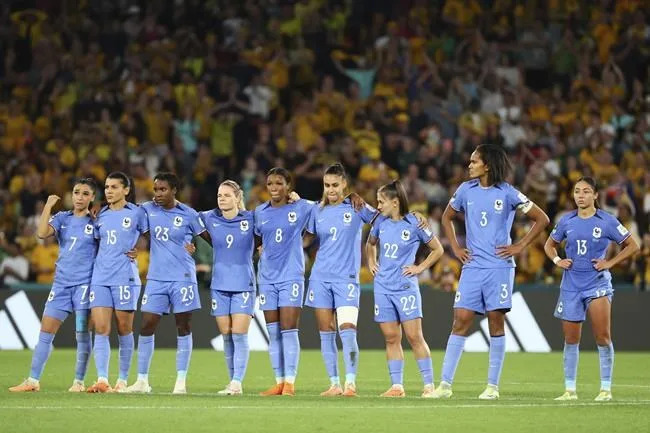
An expanded field of 32 teams was expected to expose the disparity in the women's game. But instead, teams including Morocco, South Africa and Jamaica all advanced to the knockout round to defy expectations. Morocco was one of eight teams playing in its first Women's World Cup.

The semifinals included four teams that had never won a World Cup title: Spain, England, Sweden and Australia. Sweden defeated Australia 2-0 in the third-place match.

Spain was certainly among the top teams heading into the tournament, but not the favorite. The favorite was the United States, the two-time defending champions. But the Americans were eliminated on a penalty shootout with Sweden in the Round of 16, the team's earliest departure from the tournament ever.

While Spain had been building to this point — nine players on the squad were from Champions League winner Barcelona, and the country had claimed the 2018 under-17 World Cup and the 2022 under-20 World Cup — turmoil surrounding the team in the past year had created doubts.

Last September, 15 players stepped down from the national team in order to protect their mental health. They called on the Spanish federation to create a more professional environment. Three of the “Las 15" — Bonmati, Ona Batlle and Mariona Caldentey — returned to the team for the tournament.

Then there was the uncertainty surrounding Putellas, the back-to-back Ballon d'Or winner, who tore her ACL last year and was clearly still working her way back during the course of the World Cup. She started on the bench for the title match, while Paralluelo got her first start.

“We fought hard, that’s the truth, until we felt like we had nothing left. But when we go to the airport and see a girl with a football or with a football jersey and the desire to play it fills us with energy again and makes us keep fighting for what we’re still missing,” Putellas said.

Spain's joy over the championship was tinged with sadness, too.

Following the match the Spanish federation reported that Olga Carmona's father had died following a long illness. She was told after the match.

Carmona scored the lone goal in the match against England. She also scored the game-winner in the 89th minute over Sweden in the semifinals. She is just the seventh player in tournament history to score in both the semifinals and finals.

Paralluelo, who won young player of the tournament honors, was among a group of players who stole the spotlight during the tournament. She joined Colombia's 18-year-old phenom Linda Caicedo, and 23-year-old Hinata Miyazawa, who scored five goals to win the tournament's Golden Boot.

Older stars played in their final World Cup, including Brazilian legend Marta, U.S. forward Megan Rapinoe, Sweden's Caroline Seger and Argentina's Estephani Banini.

“Everything that we’d hope for this to be on every level, it’s happened, in my opinion. We’ve seen rising stars. We’ve seen players saying farewell to the game. We’ve seen giants fall. We’ve seen newcomers,” former U.S. coach Jill Ellis said about the tournament. “I just think, all of these pieces here speak to the fact that if you do invest in this, you will reap incredible benefits.”

Bonmati won the Golden Ball award for the tournament's best player. Afterward, she said it was “not fair” to address Spain's tumultuous year. Putellas suggested that the players who stepped down were also a part of the team's World Cup journey.

Like her Barcelona teammate Paralluelo, Bonmati said the magnitude of what she called a “unique and historic” moment would take time to sink in.

“I am without words. I can't believe it,” she said. “I am going to need time to savor this victory. This trophy in incredible.”


Alexia Putellas
M|#11


Salma Paralluelo
F|#18


Olga Carmona


Mariona Caldentey
F|#8


Hinata Miyazawa
M|#7


Caroline Seger
M|#17


Megan Rapinoe
|F|#15


Ona Batlle
D|#2

___

AP World Cup coverage: https://apnews.com/hub/fifa-womens-world-cup

Anne M. Peterson, The Associated Press
2023 World Cup was a ‘turning point’ for women’s soccer. Now comes the real work

Henry Bushnell
Senior soccer reporter
Mon, Aug 21, 2023,

Women's World Cup makes $570m for FIFA - Infantino
We don't make enough revenues


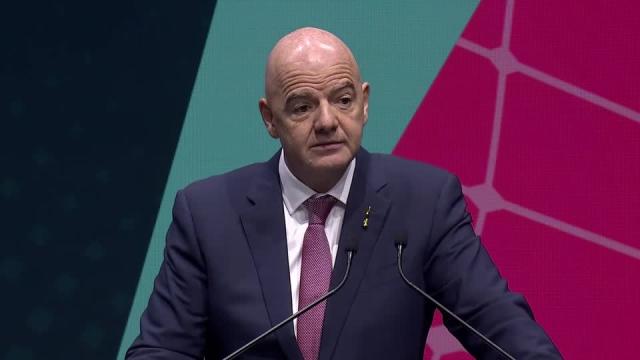
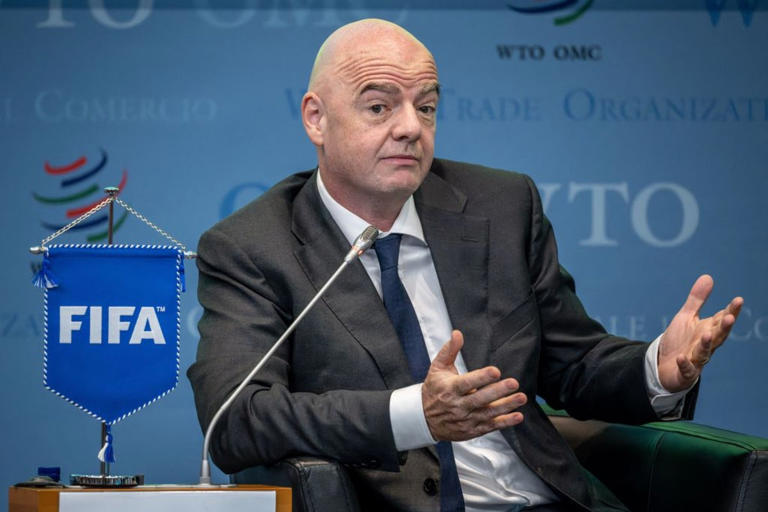
Gianni Infantino frequently speaks like an old man who listens only to old men. He is not quite as brazen as his FIFA predecessor, the dinosaurian Sepp Blatter. But his rhetoric sometimes strays from puzzling to cringey to absurd. On Friday, he went a step further, infuriating many with a quote that spread like wildfire, context be damned. Speaking at FIFA’s second Women’s Football Convention in Sydney, he told women to “pick the right battles, pick the right fights.”

He urged them to “push” for equality in soccer, to “push” on FIFA’s “doors.”

“You have the power to do it,” he said.

He never acknowledged that men, and he more so than anyone, have far more power and far more responsibility to right the historical wrongs that have suppressed women’s soccer for decades.

And the most baffling part of his baffling sermon was that he and FIFA, despite this rhetorical lapse, have actually been doing plenty of pushing themselves.

He was speaking on Day 30 of a wildly successful Women’s World Cup, a World Cup in which FIFA invested and from which FIFA reaped rewards. It smashed records and surpassed expectations. It changed players’ lives and laymen's perceptions. It was the “paradigm shift” that Megan Rapinoe had predicted, a point of no return for the women’s soccer rocketship, a $570 million bonanza that foretold future profits and limitless growth.

“The numbers speak for themselves,” Sarai Bareman, FIFA’s chief women's football officer, said in an emotional speech Saturday. “We've moved past potential. This tournament was a turning point. We've been talking about women's football as this cultural movement. And this year, we have felt a seismic shift in the way that people see the women's game.”

Their biggest challenge, now, is to sustain that shift in the three-year, 10-month interim between World Cups, and to use this quadrennial showcase to ease the broader sport’s growing pains rather than mask them.

“Yes, the World Cup is unbelievably special, but it is a bit of a bubble for some of these players; it’s not their everyday experience,” Sarah Gregorious, a director at FIFPRO, the global soccer players’ union, said Friday.

Many of those everyday experiences are still unstable, riddled with hardships and sexism — both acute and systemic.

And although FIFA can’t remedy everything alone, it can help.


FIFA president Gianni Infantino and Queen Letizia of Spain hold the trophy as Spain's players celebrate on the podium after winning the 2023 Women's World Cup final. (Photo by Izhar KHAN/AFP via Getty Images)

The business case, investment

Infantino’s now-infamous speech was also full of back-patting. It was self-congratulatory, as if to solicit praise for FIFA’s long-overdue women’s soccer awakening. FIFA, essentially, wants credit for cleaning up messes that its own neglect helped create. This branch of Infantino rhetoric irks some trailblazers who pushed for investment long before he did, before it became common sense.

And once again, the rhetoric actually undermines a new reality: FIFA seems to genuinely be doing good work.

Infantino isn’t some visionary feminist. But he is a ruthless businessman hellbent on growing FIFA revenues, and he seemingly awoke to the business case for women’s soccer last decade. He committed $1 billion to development worldwide. FIFA committed well over $400 million to the 2023 World Cup, to everything from improved accommodations for players to increased marketing and promotion. It took a tournament previously bundled with the men’s World Cup, essentially as a free add-on for broadcasters and sponsors, and began selling rights separately. It charged down this new path with the express goal of monetizing women’s soccer. And already, it is winning.

FIFA knew — because the women’s game had long been oppressively underpromoted — that the returns on investment might not be immediate. Some people, Infantino said, warned him that a properly funded Women’s World Cup might be a money-loser, to which he responded: “Well, if we have to subsidize, we'll subsidize.”

“But actually,” he said Friday at the close of the very first World Cup under FIFA’s new women’s soccer strategy, “this World Cup generated over $570 million in revenues. And so we broke even. We didn't lose any money. And we generated the second highest income of any [single-sport world championship] — besides of course the men’s World Cup — at a global stage.”

The on-field product was also spectacular. The decision to expand to 32 teams was vindicated by the likes of JamaicaSouth Africa and Morocco. The games drew unprecedented interest everywhere from Europe to Vietnam to Colombia. And perhaps the most refreshing benefit of FIFA’s investment was that the dominant storylines, at least for much of the month, weren’t about inequities or grievances; they were about gripping soccer.

And in the process, the common sense became undeniable. FIFA clearly sees it. Wealthy American investors increasingly see it in the National Women’s Soccer League. The women’s game can be lucrative. The problem is that, on all six continents, countless soccer officials (mostly men) still have their eyes closed.

Which is why South African players arrived at the World Cup in a fight with their soccer federation over bonus payments; and why Jamaican players had to launch a crowdfunding campaign to support their preparations; and why many others had to overcome abuse, the depths of which we’ll likely never know.

“Players are performing in spite of the mistreatment by the national federations,” Alex Culvin, FIFPRO’s head of strategy and research, told Yahoo Sports. “That’s fact.”


Starting players of South Africa line up prior to the round of 16 match between the Netherlands and South Africa at the 2023 FIFA Women's World Cup in Sydney, Australia, Aug. 6, 2023. (Photo by Zhang Chen/Xinhua via Getty Images)

And while the hopeful view, which Bareman expressed Friday, is that full Australian stadiums and inescapable buzz will naturally spread the gospel, history suggests that arms will have to be twisted.

“I think this is where FIFA needs to do more,” Rapinoe said back in June. “Yeah, you've done a lot [with the World Cup], but your power goes beyond that — to mandate that these federations support their teams the way that they would support everybody for the men's World Cup.”

“FIFA's role is the most important role,” Culvin said. “Without their pressure, without their enforcement, without their kind of strategic vision for women's football … [there are] member associations that maybe don't have the best intentions for their women's team.” FIFA’s imperative, she said, is “to really push them onto the next level.”
FIFA making strides, but accelerated growth of women’s soccer is key

Each of those member associations, the 211 national federations that comprise FIFA, gets funding from the global governing body via the FIFA Forward program. Its latest iteration promises $5 million to each federation over the coming four years for operational costs, $3 million “to execute well-planned, specific football projects” and up to $1.2 million in other need-based assistance.

The difficult part, as exposed by the U.S. Department of Justice last decade, is tracking where all that money actually goes.

FIFA claims — and most evidence seems to support the assertion — that its much-improved auditing system has largely ensured that the money goes toward soccer, rather than into rich men’s pockets. Still, though, there are questions around what percentage of that money goes toward the women’s game, and even concerns that World Cup prize money won’t reach players.

FIFA promised at least $30,000 to every Women’s World Cup player — and $60,000 to each Round of 16 participant, with sums increasing round by round — but the idea that these would be direct payments was a bit deceiving. Infantino admitted last month that they’d be made through the national associations, “and then the associations will of course make the relevant payments to their own players,” he said.

But will they? Infantino has twice called it a “recommendation” rather than a mandate. “That kind of leaves a little bit of uncertainty for the players,” Culvin, the FIFPRO head of strategy, said.

“But for us,” Culvin continued, “there's been assurances that that money will go directly [to players].” If it doesn’t, she said, “there should be consequences,” and she’s confident there would be. “We're very very hopeful that the distribution will be to players in the way that it was guaranteed, 6-10 weeks after the tournament is finished.”

Bareman, FIFA’s women’s soccer chief, told reporters in Sydney on Saturday that she “will personally be making sure that every dollar that gets paid that is for those players will end up in their bank accounts.” If it does, the $30,000 alone will allow some players to subsidize meager club salaries and fully professionalize. (A recent FIFPRO survey of 362 international women’s players found that 60% considered themselves semi-pros or amateurs.)

FIFA chief women's football officer Sarai Bareman delivers keynote speech during the FIFA Women's Football Convention on Aug. 19, 2023 in Sydney / Gadigal, Australia. (Photo by Maja Hitij/FIFA via Getty Images)

The broader worry is that FIFA won’t follow through on other commitments. It has talked about safeguarding but has often failed to protect players from abuse. It has talked about bolstering women’s club soccer with new competitions, but, as it prepares for a groundbreaking 32-team 2025 men’s Club World Cup, the women’s Club World Cup concept remains just that, a concept, as it has been for almost a decade.

When it goes beyond talking, when it executes strategies, this relatively progressive FIFA has done wonders for women’s soccer — for the sport its FIFA ancestors neglected. The 2023 World Cup was shiny new evidence of that. The 2027 World Cup — especially if co-hosted by the U.S. and Mexico — will surely be another extravaganza, and could be accompanied by equal pay.

But it’s the interim, and the thousands of players who’ll never reach a World Cup, that are equally important. It’s important that FIFA fuels the growth of the club game, and works collaboratively at national and local levels to accelerate the sport’s economic maturation.

“What's important for us at FIFPRO is that these conversations don't go away after [the World Cup final on] Sunday,” Gregorious said. “I want to make sure that everyone's still talking about the needs of these players and their rights come Monday, come September, come October, and into the years of the next Women's World Cup.”


‘It’s so patronising’: Gianni Infantino criticised for comments on women ahead of World Cup final

Story by Imogen Ainsworth 

GettyImages-1252530779.jpg© AFP via Getty Images

Gianni Infantino’s comments have sparked reaction on social media after the Fifa president encouraged women to “just push the doors” saying that they have the “power to convince us men”

Many have been left in a dumbfounded state of disbelief once more as yet another insensitive Infantino speech has surfaced, this time at a Fifa women’s football convention in Sydney in the build-up to the women’s World Cup final.

“And I say to all the women - and you know I have four daughters, so I have a few at home - I say to all the women, that you have the power to change,” the president said, in a strange attempt to show that he somehow relates to the struggles of women in football with his use the father-of-daughters narrative.

“Pick the right battles. Pick the right fights. You have the power to change. You have the power to convince us men what we have to do and what we don’t have to do. You do it. Just do it.

“With men, with Fifa, you will find open doors. Just push the doors. They are open. And do it also at national level, in every country, at continental level, in every confederation. Just keep pushing, keep the momentum, keep dreaming, and let’s really go for a full equality.”

His comments were deemed “patronising” and were quickly criticised, providing an unwelcome throwback to statements he made at last year’s men’s World Cup in Qatar where he gave his infamous speech, including the phrases “today I feel gay” and “today I feel disabled”.

Related video: Women's World Cup makes $570m for FIFA - Infantino (Reuters)
Duration 1:57  View on Watch

Football commentator Jacqui Oatley was one of a deluge of people who shared their views in reply to women’s football reporter Tom Garry’s post on social media platform X which read: “Gianni Infantino said, to the women in the room: "Pick the right battles. You have the power to change. You have the power to convince us men what we have to do and what we don’t have to do. Just do it. With men, with Fifa, you’ll find open doors. Just push the doors."

Oatley replied to the post saying: “This quote is actually…extraordinary. Though we shouldn’t be surprised. We’ve been battling for decades against this sort of nonsense. So, so poor from Infantino.”

Sports reporter and presenter Beth Fisher also expressed her disbelief and frustration as a result of the comments made in reaction to the same post.

“Didn’t think he could top “I feel gay” speech but this is utterly infuriating from the guy who heads up world football. Why have we got to convince you like we’re asking for a new car or something!? It’s so patronising I can’t deal and…JUST OPEN THE DOOR YOURSELF FFS!!!”

Australian football writer Samantha Lewis said in her response: “Infantino says this like women haven’t been banging on the door of football for over a century. it’s not women who lack the initiative or the knowledge or the ideas, it’s because men still own the house and haven’t let us in!”

Sports podcast and video producer Sophie Penney added to the discussion with her reply, saying: “So many things wrong with this from Infantino. Puts all the onus on women, men shouldn’t need ‘convincing’, what does he think we’ve been doing for the past however many years, patronising... I could go on.”

This was followed by a series of two additional posts by Penney, each with a picture of a door with the captions ‘Should I? #FIFAWW’ and ‘Is it time? #FIFAWWC #Infantino’.

Like Penney, many also chose to express their thoughts in the form of pictures, while others also joined the discourse with strongly worded posts.


More women than men have college degrees. That's good news for Democrats.

Story by Dante Chinni •1d

WASHINGTON — In the next few weeks college students will be flowing back onto campuses and the data show there will be a lot more women than men in lecture halls. That continues a trend that analysts have been seeing for years now and it is reshaping the country and its politics.

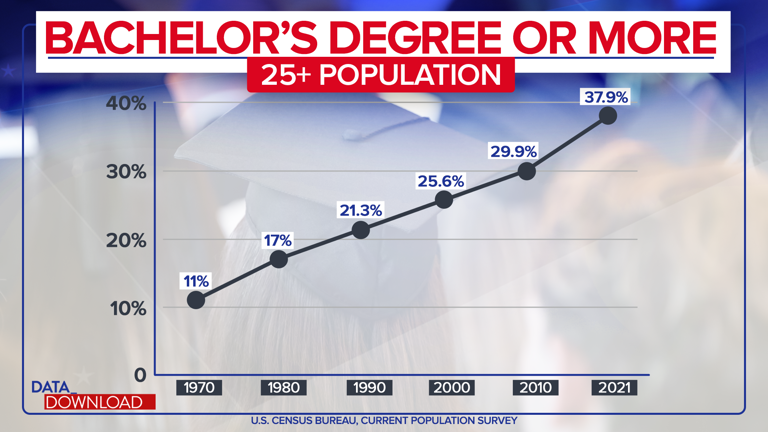
On the most basic level, the number and percentage of Americans with at least a bachelor’s degree has been rising steady, climbing nearly 30 points in the last 50 years.


More women than men have college degrees. That's good news for Democrats.

Back in 1970, only 11% of Americans 25-or-older had a bachelor’s degree. The number has risen every decade to roughly 38% in 2021, according to the data from the Census’s Current Population Survey.

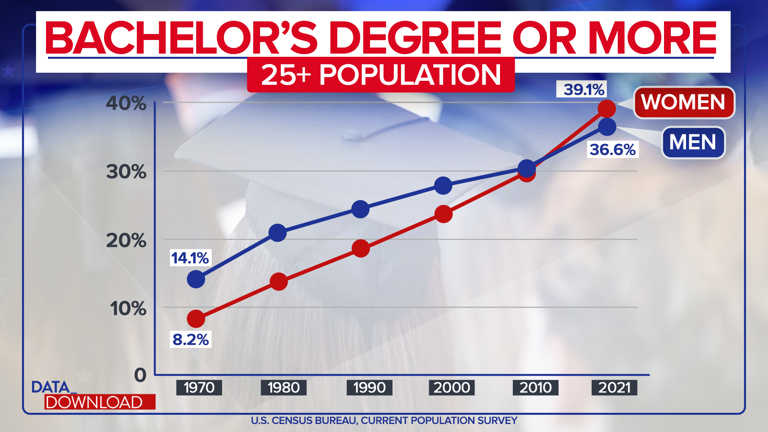
The jump since 2010 has been especially sharp and one of the big drivers of that has been more women completing their four-year degrees. In fact, in the last decade, women surpassed men in college completion.


More women than men have college degrees. That's good news for Democrats.

In 2021, the Census found that the number of American women with degrees was about 3 points higher than the figure for men — 39.1% versus 36.6% respectively. And looking back at the history of those figures shows how remarkable that change is.

Back in 1970, about 8 percent of 25-plus women had a bachelor’s. That was about 6 points below where American men were at that time. The difference actually grew slightly in 1980, but then women began closing the gap, and quickly. By 2010, the two sexes were almost even, before women surged ahead in the years since.

And to be clear, there is no reason to believe that trend is going to reverse any time soon. The latest college enrollment figures show a wide divide between the sexes regarding who is currently enrolled in college.


More women than men have college degrees. That's good news for Democrats.

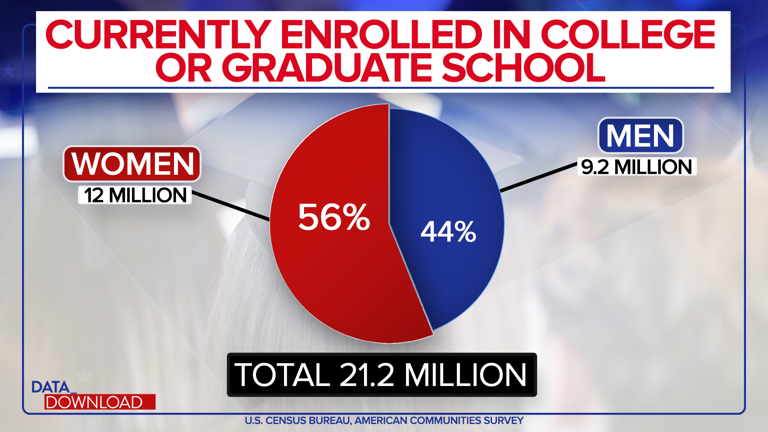
In 2021, the Census estimated there were about 21.1 million Americans currently enrolled in college, according to the annual American Community Survey. About 12 million of those people were female and about 9.2 million were male in that data. That’s a difference of about 2.6 million or a 56% to 44% split.

In other words, those current day figures certainly suggest the gap between men and women with college degrees is only likely to grow in coming years.

These data have a lot of meaning beyond who is paying tuition or paying off student loans. They have the potential to change who and how men and women marry (for decades data showed men married people of equal or lower educational attainment and women tended to marry those with equal or more education). And in the longer term, these numbers could have a real impact on who sits in the corner office in the business world. High-end positions tend to require more education and over time women seem more and more likely to be the applicants with degrees.

These figures also may have political impacts in the years ahead. Two of the biggest splits in politics in the last few decades involve sex and education and the college attainment and enrollment numbers look set to reinforce them.

Consider the divide between male and female voters. The “gender gap” in American politics, in which women lean solidly Democratic and men lean solidly Republican, has grown in recent decades and was notable in the 2020 election.


More women than men have college degrees. That's good news for Democrats.

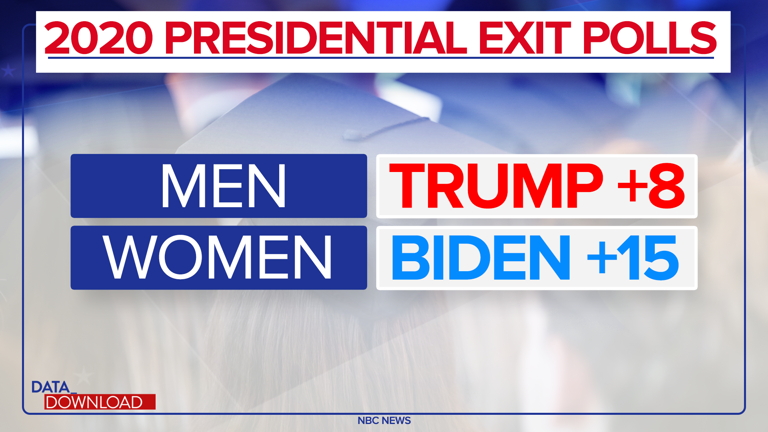
In that race, President Joe Biden won women voters by double digits, 15 points, and former President Donald Trump did very well with men, capturing them by 8 points, according to exit polls. That’s a partisan “gap” of more than 20 points between the sexes — big enough to impact messaging and campaign approaches — and there’s no reason to expect it to shrink any time soon. Abortion, an issue which resonates deeply with women, has grown as a focus with voters following the Supreme Court’s 2022 Dobbs decision, which overturned Roe v. Wade.

And educational attainment has become a significant factor in partisan affiliation as well. College graduates increasingly vote Democratic and that had big impacts on the most recent presidential race.


More women than men have college degrees. That's good news for Democrats.

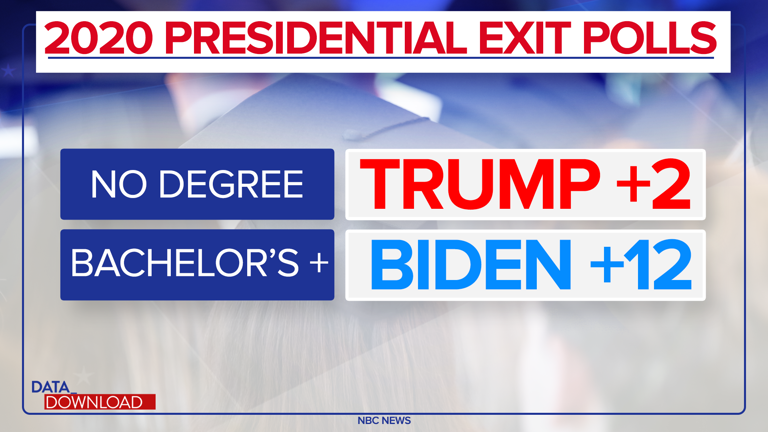
In 2020, voters with a college degree or more voted for Biden by 12 points — 55% to 43% for Trump, according to the exits. And voters without a degree selected Trump, albeit more narrowly, 50% to 48% for Biden.

Those political trends combined with the broader changes in who is going to and completing college may end up reinforcing each other and leading to a long-term shift where the nation’s two biggest political parties are increasingly divided by a mix of gender and education.

In 2023, politics is often talked about in terms of simple tribalism, a sport with voters who wear red or blue jerseys and just fight for their team. There is some truth to that. But underneath binary color code there are real differences that extend beyond politics, driven by voters who see and experience the world in different ways.

A woman with a college degree and a man without one may be driven politically by distinct sets of issues — economically and culturally — particularly in an economically unsettled time marked by big social changes and more limited government resources.

As students arrive on campus this fall those real-world gender/education differences seem likely to keep growing.

This article was originally published on NBCNews.com
TVO employees walk off the job Monday after negotiations stall

The Canadian Press
Mon, August 21, 2023 at 11:09 a.m. MDT·3 min read


TORONTO — Dozens of workers at Ontario’s public broadcaster walked off the job Monday morning after months of bargaining.

"We're living in a time where hard work is not paying off the way it used to for previous generations," said Meredith Martin, TVO's branch president with the Canadian Media Guild (CMG).

The union represents around 70 journalists, producers and education workers at the Ontario organization. Some employees at the broadcaster are represented by Unifor and are not part of the current bargaining process.

Earlier in August, almost 96 per cent of CMG members at TVO rejected an offer from the employer. The workers have been in a legal strike position since Friday morning.

One of the main sticking points is the use of contracts to fill permanent positions, the union previously said. It has also said the wages on offer are well below what’s needed for workers to catch up to the surging cost of living.

Members have received below-inflation wage increases for the past 10 years, CMG said in a previous press release, including three years of wage freezes.

The union says they deserve meaningful increases after seeing their wages capped by the one per cent limit imposed by Ontario provincial wage restraint law known as Bill 124, which capped salary increases for broader public sector workers at one per cent a year for three years. The law was declared unconstitutional last year, though the province has appealed.

Last Tuesday, the union said the wage increases on offer amounted to 2.75 per cent, 2.5 per cent, and 1.75 per cent increases over three years with a potential 1.75 per cent raise for a fourth year.

That's unchanged, said Martin.

TVO has been negotiating for months to find an agreement that is fair for employees and is "respectful of the public and donor dollars TVO manages," the organization said in a press release Monday.

"While it is unfortunate that we have not yet been able to come to a collective bargaining agreement with our CMG employees, TVO Media Education Group remains committed to continuing discussions with CMG and finding a resolution," CEO Jeffrey Orridge said in the release.

TVO viewers may notice changes to upcoming current affairs content, but will be able to watch other programs and documentaries as well as access content on TVO's app, website and newsletter, and education content on platforms like TVO Learn, the organization said.

TVO airs current affairs shows including “The Agenda with Steve Paikin,” but also has a mandate to provide learning resources that follow the provincial school curriculum.

The Ministry of Education has given an order to only create temporary contract jobs at TVO, even for permanent work, the union said in a previous release, adding that it has been told it won’t get a deal without this concession.

“These are public sector jobs that the government is trying to turn into gig work and CMG members at TVO cannot abide it,” the union said in a statement on Tuesday.

“By keeping workers in precarious contracts, TVO is denying workers health benefits, dismantling job security, and impairing the stability needed to deliver strong public services for all Ontarians.”

Some striking Metro workers were at the picket line Monday morning outside TVO's headquarters in solidarity, said Martin.

The Canadian Media Guild also represents some employees at The Canadian Press.

This report by The Canadian Press was first published Aug. 21, 2023.

Rosa Saba, The Canadian Press
As worker, housing shortages collide, Canada hones in on newcomers in skilled trades

Story by Uday Rana 

A new condo site under construction in Montreal on June 9, 2023. Canada has announced Express Entry invitations for newcomers with experience in the trades.© THE CANADIAN PRESS/Christinne Muschi

Governments can’t just ‘throw money’ to solve housing issues for asylum seekers: Fraser

As Canada faces a labour crunch and housing shortage, the federal government is launching a separate stream of entry for newcomers with work experience in skilled trades.

Newly appointed immigration minister Marc Miller announced on Tuesday the first round of invitations under the Express Entry system for people working in trades.

“It’s absolutely critical to address the shortage of skilled trades workers in our country, and part of the solution is helping the construction sector find and maintain the workers it needs,” said Miller in a statement, making his first major announcement as Canada’s new immigration minister.

"This round of category-based selection recognizes these skilled trades workers as essential, and I look forward to welcoming more of these talented individuals to Canada."

Sean Fraser, Miller’s predecessor, had announced in May that Canada would amend the Express Entry program by adding category-based selections.

“Category-based selection signals Canada’s commitment to attract top global talent and help meet the need for tradespeople to support the economy. These category-based selection rounds will continue throughout the year, alongside general invitation rounds, and more details will be announced in the coming weeks,” an Immigration Refugees and Citizenship Canada (IRCC) press release said.

The statement added that by welcoming people in skilled trades such as carpentry, plumbing and welding, Canada can help its construction sector attract skilled workers.

Trades is the latest category to be added to the list of categories eligible for the Express Entry program. The others are French-language proficiency, healthcare occupation, STEM (Science, Technology, Engineering and Mathematics) occupations, transportation occupations and agriculture and agri-food occupations.

To qualify for Express Entry in the trades category, an applicant must have accumulated, within the past three years, at least six months of full-time, continuous work experience (or an equal amount of part-time work experience) in skilled trades in Canada or abroad.

Video: Canada expanding immigration in health-care sector

The construction industry is short tens of thousands of workers, and experts say a coming wave of retirements could make the problem worse. Meanwhile, Canada is millions of homes behind what’s needed to reach housing affordability this decade.

The job vacancy rate in construction is at a record high with around 80,000 vacancies in the industry, said CIBC deputy chief economist Benjamin Tal in a recent note.

Those vacancies, which push up building costs and impede productivity, come at a time when the residential construction industry is under pressure to meet the demands of a growing population.

Canada Mortgage and Housing Corp. forecasts a need for 3.5 million more homes by 2030 than the country is currently on track to build.

The number of new homes built, however, has been in decline, from just over 271,000 in 2021 to 260,000 in 2022. And in May this year, the annual pace of housing starts dropped 23 per cent month over month, leading the CMHC’s chief economist to predict that just 210,000 to 220,000 new homes will be built by the end of the year.

— with files from the Canadian Press
Half of Canadians do not have a doctor, or battle for appointments: survey

Story by Katie Dangerfield 

The association representing doctors in Newfoundland and Labrador says the province has signed on to pay a private telehealth company more than double what it pays family doctors for a consultation.

In the midst of a family doctor shortage across the country, half of Canadians do not have a primary care physician or have difficulty securing a timely appointment with their current one, according to a recent survey.

The survey, released Thursday by Angus Reid Institute and the Canadian Medical Association (CMA), found that one in five Canadians said they don’t have a family doctor.

For those fortunate enough to have one, the struggle persists, as 29 per cent of respondents said it was difficult to get an appointment. Thirty-seven per cent of respondents said it usually takes a few days to get an appointment with their family doctor, while 15 per cent said they get in right away.

Among Canadians who do not have a family physician, 26 per cent have abandoned their search, while another 38 per cent have been looking for more than a year, the survey found.

"As a family physician working in Canada, I understand and I know the value of primary care," Dr. Kathleen Ross, president of the CMA, told Global News. "And when you don't have access to that, there's delayed diagnosis, difficulty navigating a complex system, patients are left to their own devices to try and sort out their medical concerns. We need to address this urgently."

A 2022 CMA report found that family physicians reported a higher rate of burnout than other medical or surgical specialists. And 62 per cent of family doctors said increased workload and lack of work-life balance negatively affected their mental health.

Video: Rural communities struggle to recruit family physicians

More than one in five Canadians — an estimated 6.5 million people — do not have a family physician or nurse practitioner they see regularly, according to a national survey released by OurCare.ca in April 2023.

And the extent of the shortage varies across the country, according to the CMA survey.

In Ontario, only 13 per cent of respondents reported lacking a family doctor, marking the lowest figure nationwide. In Quebec, this number doubles, with 26 per cent stating they do not have a general practitioner.

The shortage of family doctors is also a huge problem in Atlantic Canada. The survey found that roughly three in five in New Brunswick (61 per cent), Nova Scotia (67 per cent) and Newfoundland and Labrador (58 per cent) said they either don’t have a family doctor or it’s difficult to get an appointment with the one they have.

Recent immigrants to Canada also have difficulty accessing family doctors compared with those who have settled in the country for a longer time. For example, the survey found that 44 per cent of individuals who have been in Canada for less than five years said they do not have a family doctor. In contrast, the number drops for those who have been residents for over two decades, with 14 per cent reporting a similar dilemma.

"I think the average Canadian recognizes now that the health-care system is on its knees," Ross said.

"The cracks in our system are not new and they do run far too deeply for any one solution or any one entity or any one jurisdiction to solve on their own."

The survey highlighted that Canadians believe money is part of the solution to fix the country's broken health-care system, she said, but added that it is "definitely not the whole solution."

Global News
‘Frightening’ shortage of Canadian family doctor residents alarms experts
Duration 1:49   View on Watch

In February, Ottawa announced a health funding deal worth $196.1 billion over 10 years to the provinces and territories, including $46.2 billion in new money.

While a majority of Canadians (60 per cent) believe the funds will improve the health-care system, the majority in this group (51 per cent) believe the gains will be marginal, the survey found.

Two-thirds of Canadians said there are structural issues within the health-care system that cannot be resolved solely through money, according to the survey.

Canadians have priorities for what needs to be addressed and fixed.

For example, ensuring emergency departments are adequately staffed to avoid closures is a top-three priority for 43 per cent of Canadians. Reducing the mental health strain on health-care workers also ranks highly among potential fixes to the system (31 per cent). And reducing wait-lists for family doctors (27 per cent) and surgeries (31 per cent) is also a factor for Canadians.

"Streamlining application for physicians who want to work in Canada from other jurisdictions could be part of our manpower solution," Ross said. "But we recognize that when we do that, we're actually taking manpower from other countries and jurisdictions as well."

She said the CMA has been working to help the mobility of physicians across Canada.

"Having the ability to get a licence in one province and have that licence portable to other areas across Canada would go a long way to helping us address some of our challenges with staffing in rural and remote areas in particular," she said.

The survey was released the same day the CMA begins hosting its 2023 summit in Ottawa, which runs until Friday. Panels during the conference include addressing the physician shortage in Canada, the balance of public and private health care and systemic racism within the system.

The Angus Reid Institute and the Canadian Medical Association conducted an online survey from Aug. 1 to 8, 2023 among a representative randomized sample of 5,010 Canadian adults who are members of Angus Reid Forum. For comparison purposes only, a probability sample of this size would carry a margin of error of +/- 1 percentage points, 19 times out of 20. Discrepancies in or between totals are due to rounding. The survey was self-commissioned and paid for jointly by ARI and CMA.