Monday, August 21, 2023

The ‘dark fleet’ of tankers shipping Russian oil in the shadows

Andrew Roth
Sat, 19 August 2023

Photograph: Sergei Karpukhin/Reuters

It has been called Russia’s “ghost”, “shadow”, or “dark” fleet. Nearly 500 ships, many of them old tankers with murky ownership and obscure insurers, could be playing an integral role in moving Russian crude to China and other ports in Asia, because of a G7 price cap meant to keep foreign-currency oil revenues out of the Kremlin’s hands.

Often the ships use tactics designed to hide their location or the origin of the crude carried from Russian ports, which may later be refined in India and other countries and even re-exported to the western countries sanctioning the Kremlin.

The clandestine tactics include “AIS gaps”, created by switching off a vessel’s automatic identification system transponder; ship-to-ship transfers in international waters away from scrutiny; “flag hopping”, or altering a ship’s country of registration; and “complex ownership and management structures that change each month,” according to Michelle Wiese Bockmann, a senior analyst at Lloyd’s List Intelligence who has reported extensively on Russia’s dark fleet.

Some of the vessels are past their prime and considered unsafe, as in the case of the Pablo, a 27-year-old Gabon-registered tanker that suffered a large explosion off Malaysia in May. According to Le Monde, the ship allegedly has a record of carrying sanctioned Iranian crude, and had probably just delivered Russian oil to a Chinese port before the accident occurred.

Bockmann estimates nearly 12% of the world shipping market is now “dark” and able to exploit regulatory gaps. “If you want to hide in shipping, it’s very, very easy,” she said.

The role of dark ships will become more important after the value of Urals oil rose past a $60-a-barrel price cap. The cap, introduced last December, bars western companies from transporting, servicing or brokering cargoes of Russian crude worth more than that price.

Greek-flagged tankers insured by big companies might have accounted for 50% of port visits before the ban, Bockmann said. Now they make up just a fraction of them, probably because of fears about the cap and because Russia has reduced exports. Vessels less wary of regulation are expected to replace them.

There are regulatory gaps, and holes and shortcomings that prevent an embargo ever being enforced  
Michelle Wiese Bockmann, analyst

The shift toward dark shipping has been months in the making. “When it was quite obvious that sanctions were coming, the secondhand market for old, clapped-out tankers went bananas,” said Bockmann. “There were hundreds of transactions, and they all joined this dark fleet and started shipping Russian oil.”

The value of a 16- or 17-year-old medium-sized “Aframax” tanker doubled within six months, she said, even though most big oil companies refuse to charter tankers older than 15 years. Gatik Ship Management, a previously unknown firm, spent $1.5bn in about 12 months to acquire a fleet of old vessels that traded exclusively in Russian oil and products. “I’ve never seen it and I’ve looked at this industry for 25 years,” Bockmann said.

A Financial Times report indicated Gatik was likely to be connected to Rosneft, the Russian oil giant.

Last week, Bockmann reported that four successor companies to Gatik had been registered in Turkey.

The dark fleet shows just some of the difficulties in maintaining an energy embargo.

“There are regulatory gaps, and holes and shortcomings that prevent it ever being enforced,” Bockmann said.

“If your tanker is registered in Panama, your single-ship shell company is a brass-plate address in Liberia, your ship manager is in a shopping mall in India, you’ve got lowly paid crew from the Philippines, call at Russia and discharge at China, and use a dodgy P&I [insurance] company that’s based in the Seychelles, where does that bring you to any form of international regulation, despite all the rules and conventions out there?”
The Science Behind Japan's Plan to Empty Nuclear Wastewater Into Pacific


Shoko Oda
Mon, August 21, 2023 

(Bloomberg) -- Twisted sections of a reactor unit remain exposed at the Fukushima Dai-ichi nuclear plant and a crushed metal tank lies near the coastline, reminders of one of the world’s worst atomic disasters in 2011 and a response that’s already cost about 12 trillion yen ($83 billion).

Huge cranes are stationed across the site of Tokyo Electric Power Co.’s wrecked facility, while some areas have been covered with giant dome-like structures as work continues to manage the removal of dangerous fuel debris.

One of the most critical components of the current stage of decommissioning is much less obvious, a 10 centimeter (4 inch) wide pipe that funnels wastewater, in part generated as the stricken reactors are cooled, through a treatment process that will lead into the Pacific Ocean.

No element of Japan’s work to manage the risks from the disaster has been more contentious than its plan to start on Thursday discharging into the sea more than 1 million cubic meters of treated radioactive water — enough to fill 500 Olympic-size swimming pools — that’s currently stored in about 1,000 tanks.

Japan’s Prime Minister Fumio Kishida on Tuesday confirmed the process will start on Aug. 24 after a meeting of a cabinet panel. “If there are no issues with the weather and sea conditions, we expect the discharge to begin,” Kishida said. “The Japanese government will take responsibility to make sure the proposal is carried out safely, even if it takes decades until all of the treated water is discharged.”

China has vociferously opposed the plans and threatened to extend curbs on imports of seafood, while Japanese companies including cosmetics brands have faced consumer boycotts. Restaurants in Hong Kong are already hurriedly seeking alternatives for the supply of some ingredients previously sourced from parts of Japan.


The ocean is “not Japan’s private sewer,” Chinese Foreign Ministry spokesman Wang Wenbin said in June.


Public protests have taken place in South Korea, despite the government’s backing for Japan’s strategy. Any problems would have “an impact not just on our three countries, but all countries around the world,” President Yoon Suk Yeol said Friday at Camp David, after holding talks with Kishida and US President Joe Biden.

Releasing the vast volumes of water is necessary as storage tanks are forecast to hit capacity early next year, and because the full decommissioning of the site doesn’t allow for more giant vessels to be added. Discharges of cooling water from nuclear plants are also common practice across the industry.

“Controlled, gradual discharges of the treated water” into the Pacific Ocean “would have a negligible radiological impact on people and the environment,” the International Atomic Energy Agency said last month, offering approval for Japan’s proposal after a two-year safety review.

Radiation levels at Fukushima have fallen over the past decade to the point that regular visitors are no longer required to wear full-body protective suits. Guests must still carry a dosimeter, and cover up with long sleeves, goggles, masks and gloves. Tepco also asks those accessing the site to undergo scans to check bodily radiation before and after their visit.

A tour of the facility held last month was part of Tepco’s efforts to respond to concerns about the planned releases by presenting evidence, according to Junichi Matsumoto, the company’s chief officer for the advanced liquid processing system water management. “We are aware that there are people with a variety of opinions about this plan,” he told reporters at the site.

The process that’ll be used over about the next 30 years to release batches of the treated water about 1 kilometer (0.62 miles) off the coast breaks down into four basic steps: measurement and confirmation, transfer, dilution and discharge.

Water is pumped into the facility and used to cool the damaged reactors. About 130 cubic meters of liquid — which also includes rain and groundwater — becomes contaminated each day after contact with nuclear fuel debris. It’s pumped out and processed through the advanced liquid processing system, or ALPS, which uses a series of chemical reactions to lower concentrations of 62 radionuclides.

That process can’t remove tritium, a weakly radioactive form of hydrogen. Though it can be carcinogenic at high levels, a human would need to ingest billions of units of becquerels — a measure for radioactivity — before seeing any health effects. Water released by Tepco will have a concentration of less than 1,500 becquerels per liter.

After the initial treatment, a first series of measurements of radionuclide levels are taken before the water is moved on to vessels where it’s mixed and circulated for 144 hours. Independent analysis company Kaken Co. and the Japan Atomic Energy Agency then begin a further testing process that can last about two months.

China has complained the IAEA didn’t evaluate the long-term effectiveness of Japan’s purification equipment, and has argued that waste from a nuclear accident — rather than from the usual operation of a power plant — hasn’t previously been handled in this manner.

“We hope that the public can be reassured by the fact that it takes a long time” for the treated water to clear protocols, Kenichi Takahara, a Fukushima-based risk communicator for Tepco, told reporters during last month’s visit. The process is also deliberately slow, because Tepco is capable of releasing at most about 500 cubic meters of treated water a day — a fraction of the 510,000 cubic meters of seawater brought into the facility every 24 hours.

At the dilution sector of the facility, three large pumps pull in seawater that’s combined with the treated liquid to ensure the tritium concentration is “well below” guidelines set by Japan’s government and the World Health Organization, according to Tepco. By the time the process is completed, the treated water will have been diluted more than 350 times, Tepco calculates.

That diluted liquid then moves into a partially underground tank for further sampling. In the next steps, water flows through a deeper vessel and then along the discharge tunnel — which runs for a kilometer under the seabed. A spout built roughly 12 meters below the sea surface will flush the water out into the Pacific.

Read more: Nuclear Power’s Revival Reaches the Home of the Last Meltdown

For Kishida, who is already struggling with waning popularity, placating both domestic and international concerns about the process is crucial, and particularly as Japan also seeks to bolster energy security by reviving the nation’s nuclear sector.

“The Japanese government, including myself, will continue to provide highly transparent explanations and information,” he said Sunday during a visit to Fukushima. His aim is to use “every opportunity to promote understanding, not only in China but also in the international community.”


 Bloomberg Businessweek
Japan to start releasing Fukushima plant's treated radioactive water to sea as early as Thursday

Mon, August 21, 2023


TOKYO (AP) — Japan will start releasing treated and diluted radioactive wastewater from the Fukushima Daiichi nuclear plant into the Pacific Ocean as early as Thursday — a controversial but essential early step in the decades of work to shut down the facility 12 years after its meltdown disaster.

Prime Minister Fumio Kishida gave the final go-ahead Tuesday at a meeting of Cabinet ministers involved in the plan and instructed the operator, Tokyo Electric Power Company Holdings, to be ready to start the coastal release Thursday if weather and sea conditions permit.

Kishida said at the meeting that the release of the water is essential for the progress of the plant decommissioning and Fukushima prefecture’s recovery from the March 11, 2011, disaster.

He said the government has done everything for now to ensure the safety, combat the reputational damage for the fisheries and to provide transparent and scientific explanation to gain understanding in and outside the country. He pledged that the government will continue the effort until the end of the release and decommissioning, which will take decades.

A massive earthquake and tsunami destroyed the Fukushima Daiichi plant’s cooling systems, causing three of its reactors to melt and contaminating their cooling water. The water is collected, filtered and stored in about 1,000 tanks, which fill much of the plant's grounds and will reach their capacity in early 2024.

The release of the treated wastewater has faced strong opposition from Japanese fishing organizations, which worry about further damage to the reputation of their seafood as they struggle to recover from the nuclear disaster. Groups in South Korea and China have also raised concerns, turning it into a political and diplomatic issue.

The government and the plant operator, Tokyo Electric Power Company Holdings, say the water must be removed to make room for the plant’s decommissioning and to prevent accidental leaks from the tanks.

Junichi Matsumoto, TEPCO executive in charge of the water release, said in an interview with the Associated Press last month that the water release marks “a milestone,” but is still only an initial step in a daunting decommissioning process that is expected to take decades.

The easing of opposition from the fishing industry was key to the release because the government promised in 2015 not to start without “understanding” from fishing groups, after past accidental and unapproved discharges.

Masanobu Sakamoto, head of the National Federation of Fisheries Cooperatives, who met with Kishida on Monday, reiterated his organization’s opposition to the release, but acknowledged that members of the fishing community have gained some confidence about the safety of the move. They still fear damage to their industry, he said, and welcomed the government pledge for support.

The government has offered funding totaling 80 billion yen ($550 million) for sales promotion and other steps, and for sustainable fishing operations.

The government and TEPCO say the water will be treated and then diluted with massive seawater to levels way safer than international standards, its environmental and health impact negligibly small.

The International Atomic Energy Agency in a final report in July concluded that the release, if conducted as designed, will cause negligible impact on the environment and human health.

Scientists generally support the IAEA view, but some say long-term impact of the low-dose radioactivity that remains in the water needs attention.

Kishida’s government has stepped up outreach efforts to explain the plan to neighboring countries, especially South Korea, to keep the issue from interfering with their relationship.

Kishida said the effort has made progress and the international society is largely responding calmly to the plan. Still, Hong Kong said it would suspend exports from Fukushima and nine other prefectures if Japan went ahead with the plan, while China has stepped up radiation testing on Japanese fisheries products, delaying customs clearance.

Mari Yamaguchi, The Associated Press
Japan's Kishida visits Fukushima plant to highlight safety before start of treated water release
WHY IS THE OCEAN GLOWING GREEN?!

Sun, August 20, 2023


TOKYO (AP) — Japanese Prime Minister Fumio Kishida visited the tsunami-wrecked Fukushima nuclear plant Sunday and said an impending release of treated radioactive wastewater into the Pacific Ocean cannot be postponed.

He said the move is safe but his government will do its utmost to support fishing communities from the potential impact of damaging rumors during the decades-long project.

Kishida made his trip hours after returning from a summit with U.S. and South Korean leaders at the American presidential retreat of Camp David. Before leaving Washington on Friday, Kishida said it is time to make a decision on the treated water's release date, which has not been set due to the controversy surrounding the plan.

Kishida on Sunday saw wastewater filtering and dilution facilities and met with the plant and company executives. He told reporters that he confirmed their commitment to safely carrying out the upcoming water discharge. To make room for new facilities needed for the progress of the decommissioning, the treated water needs to be disposed of and tanks removed to make room.

The treated water discharge “by no means can be postponed for the decomissioning and Fukushima's recovery,” Kishida said.

He said he hoped to meet with representatives of fisheries organizations on Monday before his ministers decide the start date at a meeting next week. It is widely expected to be the end of August.

Kishida said the water release is a long-term project and that he is aware of the importance of recognizing the concerns and needs of local fishing groups. “I hope to convey the government position directly to the fisheries representatives,” he said.

Since the government announced the release plan two years ago, it has faced strong opposition from Japanese fishing organizations, which worry about further damage to the reputation of their seafood as they struggle to recover from the accident. Groups in South Korea and China have also raised concerns, turning it into a political and diplomatic issue.

The government and the plant operator, Tokyo Electric Power Co., or TEPCO, say the water must be removed to make room for the plant’s decommissioning and to prevent accidental leaks from the tanks because much of the water is still contaminated and needs further treatment.

Japan has obtained support from the International Atomic Energy Agency to improve transparency and credibility and to ensure the plan by TEPCO meets international safety standards. The government has also stepped up a campaign promoting the plan’s safety at home and through diplomatic channels.

The IAEA, in a final report in July, concluded that the TEPCO plan, if conducted strictly as designed, will cause negligible impact on the environment and human health, encouraging Japan to proceed.

While seeking understanding from the fishing community, the government has also worked to explain the plan to neighboring countries, especially South Korea, to keep the issue from interfering with their relationship-building. Japan, South Korea and the U.S. are working to bolster trilateral ties in the face of growing Chinese and North Korean threats.

South Korean President Yoon Suk Yeol's government recently showed support for the Japanese plan, but he faces criticism at home. During a joint news conference at Camp David, Yoon said he backs the IAEA's safety evaluation of the plan but stressed the need for transparent inspection by the international community.

Kishida said Sunday that the outreach efforts have made progress, and that the decision will factor in safety preparations and measures for possible reputational damage to the fisheries. He said the government has provided scientific explanation to counter unscientific criticism, including from China.

A massive March 11, 2011, earthquake and tsunami destroyed the Fukushima Daiichi plant’s cooling systems, causing three reactors to melt and contaminating their cooling water. The water is collected, filtered and stored in around 1,000 tanks, which will reach their capacity in early 2024.

The water is being treated with what’s called an Advanced Liquid Processing System, which can reduce the amounts of more than 60 selected radionuclides to government-set releasable levels, except for tritium, which the government and TEPCO say is safe for humans if consumed in small amounts.

Scientists generally agree that the environmental impact of the treated wastewater would be negligible, but some call for more attention to dozens of low-dose radionuclides that remain in it.

Mari Yamaguchi, The Associated Press
A Legally Besieged Trump Focuses on a Personal Goal: Revenge Against Hillary Clinton

Jose Pagliery
Sat, August 19, 2023 

Photo Illustration by Elizabeth Brockway/The Daily Beast/Reuters

Former President Donald Trump is a busy man.

He faces four different indictments, 91 felony charges, a quickly depleting political war chest, and is running for president. And yet, with all of his own legal problems, Trump is focused on a revenge lawsuit against his old political rival Hillary Clinton and her allies.

Most bizarre of all, Trump and his lawyer, Alina Habba, are suing Clinton in a manner that could land them a huge fine—which would be a second fine for this lawsuit.

Back in January, U.S. District Judge Donald M. Middlebrooks berated Trump and Habba for wasting everyone’s time in a blistering order that personally sanctioned them $937,989.

The ‘Nervous’ Pastor Swept Up in Trump’s Racketeering Case

“This case should never have been brought. Its inadequacy as a legal claim was evident from the start. No reasonable lawyer would have filed it,” Middlebrooks wrote, ripping into Trump and his lawyer for firing an indiscriminate spray of rubbish in “a quintessential shotgun pleading” that merely served “a political purpose.”

Middlebrooks was describing the way that Trump sued everyone he has publicly blamed for fueling pernicious conspiracies that he’s a Kremlin agent: Clinton, her 2016 campaign chair, Democratic lawyers, and FBI officials who launched the infamous Crossfire Hurricane investigation looking into Trump-Russia connections.

Then came the so-called Durham Report in May. In it, Department of Justice Special Counsel Robert Durham tried to defend the spectacular failure of his four-year investigation into potential malfeasance by the feds who investigated the Trump-Russia debacle.

While Fox News pundits waved it around as evidence of a Deep State anti-MAGA conspiracy, keen observers noted that it contained no bombshells and largely failed to glean much useful information—resulting in a low-end guilty plea and two failed prosecutions. To some, it read like a rehash of DOJ Inspector General Michael Horowitz’s behemoth report about the headache-inducing drama published back in December 2019.

Now, Trump and Habba are trying to reanimate their dead lawsuit by claiming that the Durham Report “seismically alters the legal landscape of this case.” In a court filing last month, Habba asserted that it “corroborates many facts and allegations about which this court expressed skepticism,” going on to boldly warn the judge—on the very first page—that she plans to ask him to step aside.

“The orders entered by this court imposing sanctions against President Trump and his counsel raise reasonable questions as to the appearance of impartiality,” she wrote, “and therefore a motion to disqualify is forthcoming.”

For another 18 pages, Habba describes all the ways the Durham Report somewhat aligns with the hundreds of allegations she made in her initial lawsuit.

For example, according to the Durham Report, the CIA director briefed then-FBI Director James Comey and other top Obama administration officials that Clinton planned to vilify Trump by spinning up stories about his supposed illicit Russian connections—three days before Comey decided to open a Trump-Russia investigation based on an unverified tip coming in from Australia. The only previous mention of that in the previous IG report seems to be a vague line and footnote about a White House Situation Room meeting.


Reuters/Brendan McDermid

But Trump’s lawyer goes on a limb to say that it means the FBI director was actively trying to help get Clinton elected—the same guy credited with delivering the deathstroke to her tepid presidential campaign when he broke with agency tradition and held a press conference to admonish Clinton and her staff for having a private email server and being “extremely careless in their handling of very sensitive, highly classified information.”

“Thus, it is not ‘implausible’ or ‘absurd’ that the Director of the FBI, Defendant Comey, conspired with Defendant Clinton, President Trump’s political opponent,” Habba wrote in her latest court filing.

In a more recent filing on Friday, another Trump lawyer, Jesse Binnall, also made the point that the Durham investigation’s failure to prosecute two men at trial isn’t relevant. His reasoning is that Durham had a much higher bar to prove he was right, given that criminal trials require jurors to be 100 percent certain of someone’s guilt. By contrast, Trump’s revenge lawsuit against Hillary and company is a civil matter, in which jurors need only be convinced by slightly more than 50 percent certainty.

The Durham acquittals and failure “does not mean that the findings are not true. Rather, this means that a jury did not find them guilty of the charges beyond a reasonable doubt. That is, of course, not the standard here,” Binnall wrote on Friday.

But overall, the Trump legal team also leans heavily into a Fox News reading of the Durham Report.

For example, the report does criticize the FBI for opening a Trump investigation based solely on a tip—without doing enough due diligence and checking with other spy agencies. It notes that “neither U.S. law enforcement nor the Intelligence Community appears to have possessed any actual evidence of collusion in their holdings at the commencement of the Crossfire Hurricane investigation.”

Habba uses that to say that there wasn’t any evidence at all—and chalks it up to political bias.

“As the Durham Report now confirms,” she claims, “the FBI opened an investigation into President Trump without ‘any actual evidence.’ The FBI did so swiftly, without evaluating any of the ‘evidence’ given to them, through agents with hostile feelings towards President Trump.”

But in doing so, she goes where the Durham Report dared not go. Notably, the former U.S. Attorney for Connecticut noted that “confirmation bias played a significant role” in the way that FBI agents were willing to ignore information that “did not support the narrative of a collusive relationship between Trump and Russia.”

But nowhere in his report did he mention political bias driving the FBI’s Trump-Russia probe. In fact, it actually notes the opposite, pointing out how the DOJ inspector general years earlier found that political bias didn’t actually guide the FBI officials who approved spying on a Trump campaign adviser.

The Georgia Trump Indictments Started a Fight That Democrats Will Win

The inspector general in 2019 “did not find documentary or testimonial evidence that political bias or improper motivation influenced the FBI's decision to seek FISA authority on Carter Page,” Durham quotes from the IG report.

But the biggest hurdle for Trump at this point is that it’s probably too late to relitigate the same things he’s been railing about at 2016 campaign speeches and Twitter and Air Force One and 2020 campaign speeches and Truth Social and Trump Force One and now 2024 campaign speeches.

Last year, Judge Middlebrooks already decided that it’s too late for Trump to sue over this stuff. When he dismissed Trump’s claims against everyone except the federal government back in September 2022, the judge noted that the former president simply waited too long to accuse everyone of a mob-like racketeering scheme—noting that Trump can’t lie and claim ignorance, because he’s been tweeting the same tired complaints about Clinton for years.

Trump “cannot in good faith claim to have had no knowledge of a claim that he broadcasted to his social media followers nearly five years ago,” Middlebrooks wrote last year.

While Habba claims that “the Durham Report provides new context” to the lawsuit, she’s also running that risk that Middlebrooks will use this as an opportunity to closely scrutinize the Durham Report—and drill down on just how not new it actually is.

And this judge—an appointee of Hillary Clinton’s husband and former president, Bill—has already shown zero patience for Trump’s deliberate misreading of official government findings.

As he noted when scolding Habba earlier this year, the IG report sure caught missteps but in the end, senior FBI officials were still “in compliance with Department and FBI policies” and “Crossfire Hurricane was opened for an authorized investigative purpose and with sufficient factual predicate.”

Trump “and his lawyers are of course free to reject the conclusion of the Inspector General. But they cannot misrepresent it in a pleading,” Middlebrooks wrote then.

And he’ll probably say the same thing again.

The Unbelievably Bonkers Conspiracy Theorist Running For Governor Of North Carolina

Jennifer Bendery
Mon, August 21, 2023 

North Carolina GOP gubernatorial candidate Mark Robinson has said it himself: He’s a conspiracy theorist.

He didn’t specify in that March interview what that means in terms of what he believes. It turns out it means he has spread virtually every conspiracy theory you can think of.

Robinson, who is the state’s lieutenant governor, has said he “wouldn’t be surprised” if the 1969 moon landing was fake and the 9/11 terrorist attacks were an “inside job.” He’s “SERIOUSLY skeptical” of President John F. Kennedy’s assassination and of the 2017 mass shooting in Las Vegas. He falsely accused David Hogg, a survivor of the 2018 mass shooting at Marjory Stoneman Douglas High School in Parkland, Florida, of being a paid actor. He’s claimed that climate change is based on “junk science.”

And those are just the dangerous theories he’s echoed that have been previously reported.

In lesser-noticed social media posts, Robinson has said that news coverage of police shootings is part of a media conspiracy “designed to push US towards their new world order.” He and his wife both liked a since-deleted Facebook comment that stated, “WWG1WGA are my ‘Identity’ letters,” a reference to the QAnon rallying cry “Where we go one, we go all.” In October 2018, on a day when authorities intercepted pipe bombs intended for President Barack Obama, Secretary of State Hillary Clinton and CNN, Robinson suggested on Facebook that they had done it to themselves. “If you can’t beat ’em, bomb yourself,” he wrote.

He followed that with another Facebook post claiming, “This entire ‘bombing’ story is faker than a $20 Rolex sold on a New York City sidewalk.” Months later, another post on his Facebook page parroted the conspiracy theory that the pipe bomb incident was “manufactured” and “fake.”

Robinson is also a regularproponent of conspiracies claiming the music industry is being run by Satan and the Illuminati. He has called Beyoncé’s music “satanic” and described Jay-Z as “demonic” and sent by Satan to turn people away from Jesus. He suggested that the 2014 Boko Haram kidnapping of schoolgirls in Nigeria was orchestrated by billionaire Democratic philanthropist George Soros, a frequent target of antisemitic attacks by Republicans.

This Republican state official has alsoroutinelypushed the “New World Order” conspiracy theory, which involves forced depopulation programs, a secretive ruling class of reptiles and “elite globalists” on a satanic mission to bring about the “end times.”

Yeah.

A Robinson campaign spokesperson did not respond to a request for comment on whether he stands by all of these claims.

North Carolina Lt. Gov. Mark Robinson, who believes Beyoncé is "satanic" and that the 1969 moon landing may have been fake, is currently the leading Republican candidate for governor.

It’s still early in the campaign season. There are other, comparatively normal but still conservative GOP candidates running, including former U.S. Rep. Mark Walker and Dale Folwell, the state treasurer. But Robinson is currently the front-runner to be the GOP’s nominee for governor. How is this possible?

He has two key things going for him that other Republican candidates don’t have, said David McLennan, a political science professor at Meredith College in Raleigh, North Carolina.

He’s got name recognition, and he’s got the backing of former President Donald Trump.

“I think this does bother people on the Republican side,” McLennan said of Robinson being a wild conspiracy theorist. “They just haven’t figured out how to organize their efforts to help another candidate compete against Robinson.”

A Walker campaign spokesperson did not respond to a request for comment.

On the Democratic side, Attorney General Josh Stein is the only major candidate to formally announce a campaign. Current Gov. Roy Cooper, a Democrat, is term-limited out in 2024.

A Stein campaign spokesperson declined comment.

Robinson has also modeled himself after Trump and appears to be trying to deflect all criticisms in the same way, said Chris Cooper, the Robert Lee Madison distinguished professor of political science and public affairs at Western Carolina University in Cullowhee.

“It’s for the same reason Trump is under four indictments and is the leading candidate for the Republican nomination for the presidency,” Cooper said. “He’s the favorite because he’s the favorite…. The inflammatory rhetoric is already baked into people’s opinions of him. We already knew he was engaged in these types of behaviors. So every news story about Robinson doesn’t really provide the voter with new information. So he can continue to weather the storm.”

Robinson is also charismatic, Cooper said, which has helped him to build a national profile and raise a lot of money. His race is a factor, too, he said.

“He’s an African American Republican at a time when many Republicans feel they are being accused of being racist for being Republicans,” he added.

Steven Greene, a political science professor at North Carolina State University in Raleigh, said Robinson simply “represents the culture war id of the Republican Party.”

“He is the Republican Party writ large,” Greene said. “One of the major themes of Trump’s campaign could be considered a conspiracy theory, which is that the 2020 presidential election was stolen. Republican primary voters have shown they are very, very willing to, shall we say, be comfortable with their political leaders holding conspiracy views.”

He is the Republican Party writ large.Steven Greene, North Carolina State University political science professor

All of the North Carolina political experts HuffPost spoke to for this story said Robinson is likely to be the GOP nominee for governor and possibly will go on to become governor, given that North Carolina is a swing state. Of the major election forecasters, the Cook Political Report rates the race as “leans Democratic,” while Inside Elections and the University of Virginia’s Crystal Ball both consider the race a tossup.

But Greene predicted that Robinson’s extremism will ultimately backfire on him, just as it did with the GOP’s gubernatorial nominee in 2020, Dan Forest.

“Dan Forest’s problem, and the reason he lost, was because he was seen as too extreme of a social conservative. Mark Robinson is Forest on steroids,” Greene said.

“We have seen ever since the elevation of Trump, Republican primary voters, again and again, time and time and time again, choosing the candidate who makes an awful general election candidate in a purple state,” he said. “My presumption is Mark Robinson will fall right into this pattern.”
A potential first-of-its-kind fighter-jet purchase could be a sign Saudi Arabia isn't happy with what it's getting from the US


Paul Iddon
Updated Mon, August 21, 2023 

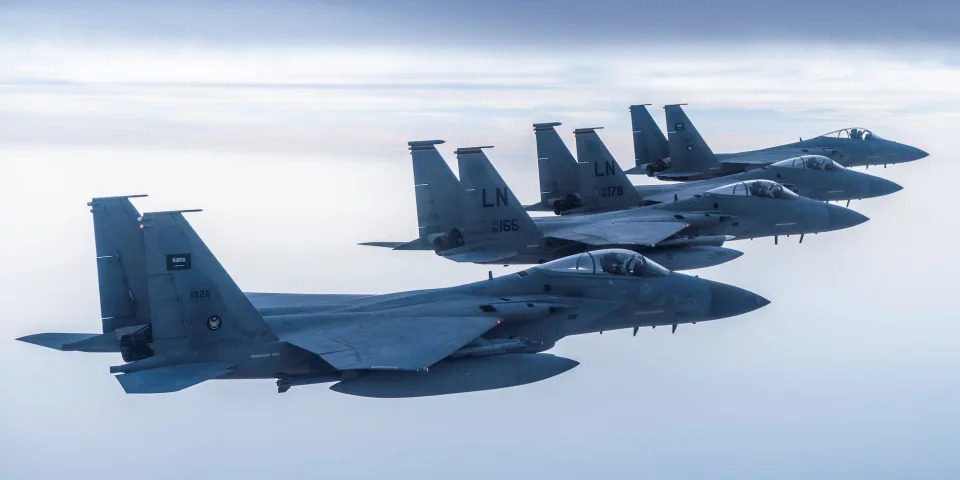
Royal Saudi Air Force F-15Cs fly with US Air Force F-15Cs in June 2019.
US Navy/Handout via REUTERS

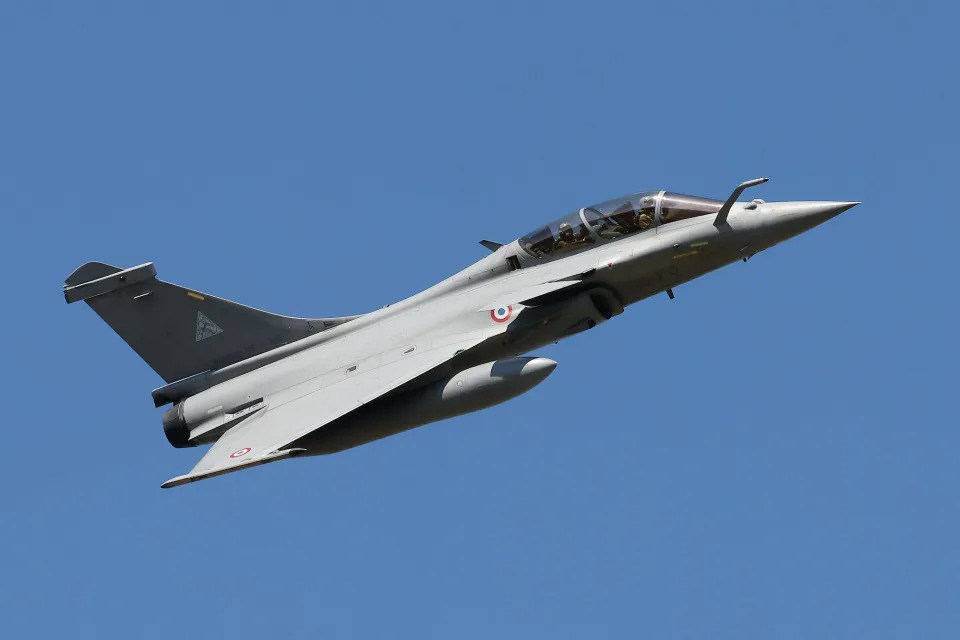
Saudi Arabia is reportedly considering a large number of French-made Dassault Rafale fighter jets.


Such a purchase would be a break from Saudi Arabia's long history of buying US and British jets.


This suggests Riyadh doesn't think its traditional partners will be as reliable in the future.


Saudi Arabia has spent decades building an enormous air force composed exclusively of advanced US and British fighter jets. But Riyadh's reported interest in potentially purchasing a large number of French jets may be a sign it doesn't think its longtime patrons are as reliable as before.

In December, France's La Tribune financial newspaper, citing unnamed sources, reported that Saudi Arabia was considering acquiring 100 to 200 Dassault Rafale fighters. The report came amid developments suggesting that the US and other nations might not provide military equipment to Riyadh in the future.

After Riyadh cut oil production in October, US lawmakers proposed legislation freezing all American arms sales to the kingdom, which could have grounded most of the Saudi air force and would further fray already strained US-Saudi relations.

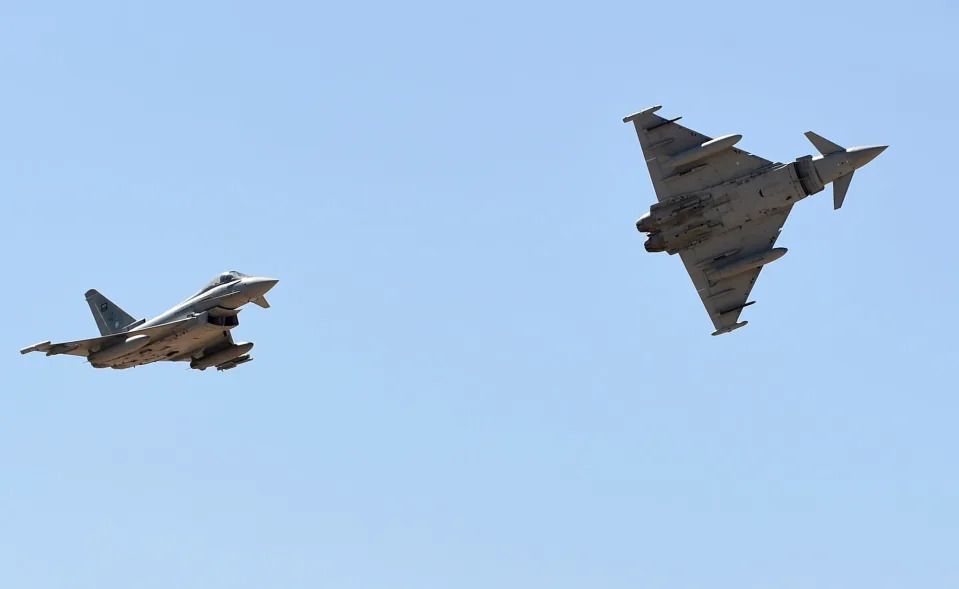
In July, Germany announced it would not allow additional Eurofighter Typhoon fighter jets to be delivered to Saudi Arabia. The Saudi air force has 72 Eurofighters, second only to the number of US-made F-15s it has.

Saudi Arabia's neighbors in the United Arab Emirates and Qatar have built up large fleets of Western-made jets that include dozens of Rafales. The La Tribune report, while unconfirmed, suggests political and practical concerns are pushing the Saudis toward the French jet.
French appeal

A French Dassault Rafale flying near Salon-de-Provence in May 2022.Toni Anne Barson/Getty Images

Buying more Typhoons would be "the sensible move" since the Saudis have the infrastructure to train pilots and operate that jet, "but a German block prevents that," said Sébastien Roblin, a widely published military-aviation journalist.

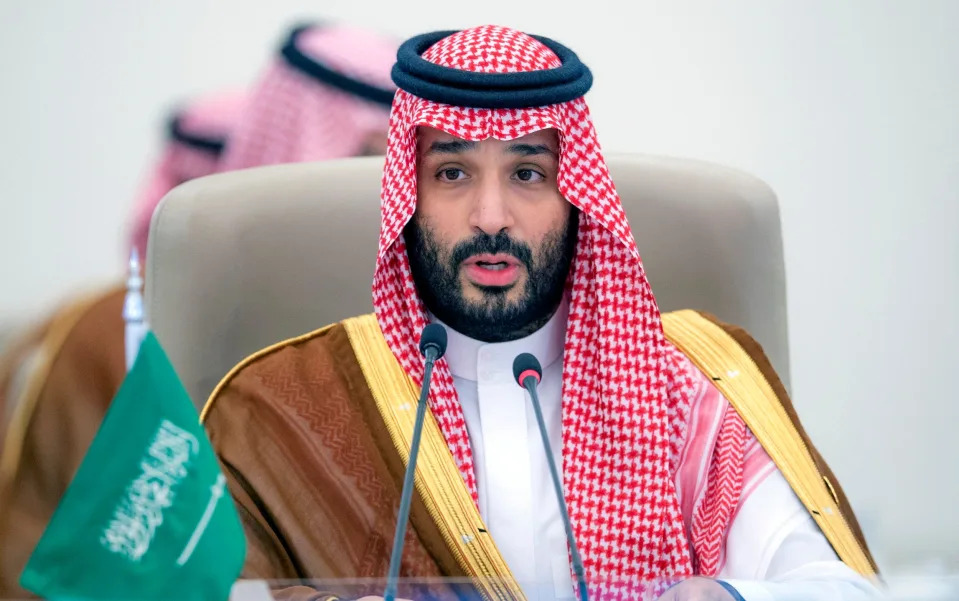
Saudi Crown Prince Mohammed bin Salman is "not currently inclined to throw Washington any free bones by ordering F-15EXs," and despite an "about-face" by President Joe Biden, Roblin said, the Saudis know that future jet sales "could be disrupted by domestic political revulsion for Riyadh's actions domestically or the war in Yemen."

As bin Salman pursues a detente with his main rival, Iran, and improves relations with China, opposition to such sales may only increase.

Roblin noted that France has sold armored vehicles, helicopters, artillery, air-to-ground Damocles targeting pods, and SCALP cruise missiles to Riyadh and that French political culture values having "a diversified, independent defense sector" and is therefore "much less susceptible to human-rights-based misgivings, which has enabled sustained arms sales to a wider stable of clients in the Middle East."


Saudi Eurofighter Typhoon fighter jets near Riyadh in January 2017.FAYEZ NURELDINE/AFP via Getty Images

Consequently, Saudi Arabia buying 100 or more Rafales would be a big "economic win" that would "score Riyadh an upgraded strategic partner outside of Washington or London," Roblin said, though he pointed out that Gulf states have a habit of hyping arms buys from new sources, including Russia or China, to elicit "jealous counteroffers from their 'main' strategic partners."

Ryan Bohl, a senior Middle East and North Africa analyst at the risk-intelligence company RANE, said Rafales could be an "attractive option" to Riyadh, considering the sanctions the US and Germany imposed on it after the assassination of the journalist Jamal Khashoggi in 2018.

French jets are also modern and built by a NATO country, potentially reducing issues with integrating the jets with the Saudis' other Western aircraft. France's less restrictive end-user agreements "underlines this attractiveness," Bohl added.

Riyadh's non-NATO options for jets are relatively limited, and buying Russian or Chinese jets would likely incur US sanctions, which makes Saudi interest in the Rafale seem "realistic," Bohl said. "Saudi Arabia wants to diversify its air force so that if it has an interruption with one of its arm suppliers, like the United States, its air wing doesn't grind to a halt."
Shifting US-Saudi ties

President Joe Biden and Crown Prince Mohammed bin Salman in July 2022.Bandar Algaloud/Reuters

In the near term, Saudi Arabia may find Rafales more burdensome than beneficial, given its extensive investment in US and British aircraft.

"I would be surprised if the Royal Saudi Air Force procured Rafale, given the size and well-established state of its F-15 and Typhoon fleets," Justin Bronk, an expert on airpower at the Royal United Services Institute, told Insider.

Such pragmatic concerns have kept Saudi Arabia from buying French fighters in the past. After all, Bohl said, it's much easier to build an air force with pilots who train on a single system or with systems from a single country of origin. And despite the sophistication of French military hardware, it hasn't been used in battle as much as US equipment has and therefore lacks a "combat record as a selling point" like US-made weapons, Bohl added.

Limits on the Rafale's technology and availability may also deter Riyadh.

A Saudi Air Force F-15 taxis for takeoff at King Faisal Air Base in February 2021.US Air Force/Staff Sgt. Katherine Walters

While the Rafale F4 is "one of the most advanced and versatile of the 4.5-generation fighters on the market," it is "not a true stealth fighter" with the advanced capabilities Saudi Arabia wants, Roblin said.

Even if Riyadh ordered Rafales tomorrow, they would take at least several years to arrive. "Right now, a big problem is Dassault's factory is already booked with orders for over a hundred additional aircraft for Croatia, Egypt, India, Indonesia, Greece, and the United Arab Emirates," Roblin said.

The strength of US-Saudi relations has kept Riyadh firmly in the US camp for decades, but Bohl said that relationship has "fundamentally shifted" and the US is no longer "as expansive of a defense partner" as in the past, a trend that may add to the appeal of other countries' weapons.

"Under previous kings, Saudi Arabia saw the United States as a reliable protector of its security and was willing to do favors through energy policy and arms deals for Washington in exchange for this guarantee," Bohl told Insider. "That led to Riyadh being less willing to do special favors for the United States, like going to it exclusively for arms purchases."

Paul Iddon is a freelance journalist and columnist who writes about Middle East developments, military affairs, politics, and history. His articles have appeared in a variety of publications focused on the region.


Saudi Arabia sets its sights on Britain’s military jewel


Howard Mustoe
Sun, 20 August 2023 

Mohammed bin Salman is attempting to reinvent the petrodollar kingdom - /SPA/AFP via Getty Images

Oil pumps have long dotted Saudi Arabia’s desert landscape, but they could soon be joined by a raft of factories.

Crown Prince Mohammed bin Salman wants to turn the country into the Gulf’s manufacturing powerhouse as it moves away from oil and gas.

The heir to Saudi Arabia’s $2 trillion throne wants to increase industrial exports to $148bn (£116bn) by 2030, tripling factory numbers to 36,000 by 2035 which will churn out everything from warships to cars.


So far, he has poured investment into Lucid, a US-based electric car maker which plans to build a factory in the country, while also striking a planned joint venture with Navantia, the Spanish state-owned builder of naval vessels.

Now, he has his sights set on another lucrative, albeit expensive and notoriously complex market – fighter jets.

It was announced last week that the controversial ruler is set to visit the UK in autumn, which came after a flurry of speculation around Saudi Arabia joining one of Britain’s largest military projects.

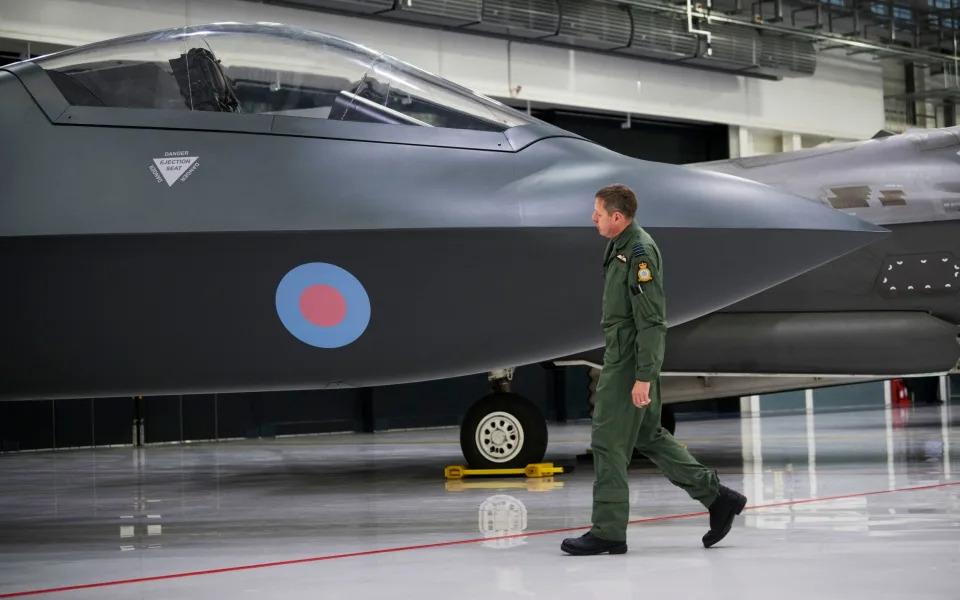
Downing Street reportedly wants to make the Kingdom part of the £72bn Tempest programme, initially, an Anglo-Italian effort which Japan joined last year.

Saudi’s deep pockets will be welcome, but industrial insiders are concerned about the nation’s technological offering, as well as its political baggage.

The Tempest project aims to bring a sixth-generation fighter jet into service by the middle of the next decade, replacing the Eurofighter Typhoon.

Notably, Saudi reportedly wants to become a formal partner in the programme rather than simply buying the finished product as a customer, as it has with the Typhoon.

Any partnership will need large capital investment, but it will secure Saudi new local jobs and a hand in designing Tempest, delivering the technological expertise the ruler craves.


Saudi Arabia’s bid to join the Tempest fighter jet programme as an equal partner are said to have unsettled Japanese officials - David Rose

However, speculation around the state’s involvement, alongside the planned visit, has reignited concerns over the Kingdom’s human rights record and its approach to gay rights.

Homosexuality is still a criminal offence punishable by death, while the country is also involved in a years-long war in Yemen.

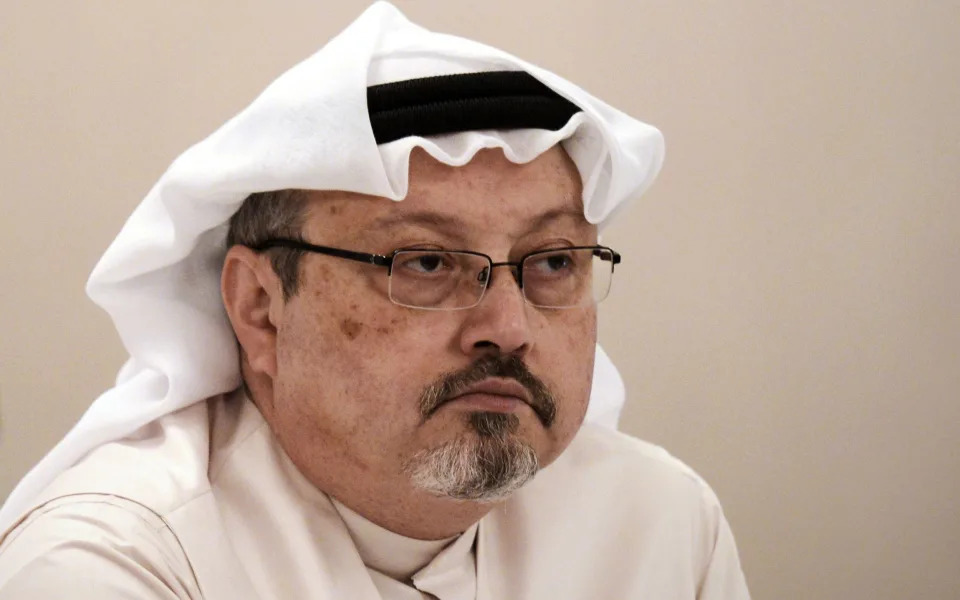
It will also be Mohammed bin Salman’s (MBS) first UK visit since the murder of Washington Post journalist Jamal Khashoggi, who was killed and dismembered on the orders of the Crown Prince, according to analysis by the CIA.

He has denied any involvement.

From a financial perspective, the huge cost of building ever more complex military hardware makes the country an attractive bet with its wealth and keen stance.

But bringing on such a controversial partner has already caused reported discomfort among Japanese officials.

Another question raised by insiders is what the country can add in terms of high-end jet design, with only a handful of countries in the world capable of building supersonic aircraft.

Under MBS, however, Saudi Arabia has supercharged its investment and ambitions in industry, technology and defence as part of the Vision 2030 programme, as the ruler aims to wean the country off oil.

“Through the national industrial strategy and in partnership with the private sector, the Kingdom will become a leading industrial powerhouse that contributes to securing global supply chains and exports high-tech products to the world,” MBS said last year.


The brutal murder of Saudi journalist Jamal Khashoggi in 2018 still casts a shadow onto perceptions of the Kingdom today - MOHAMMED AL-SHAIKH / AFP

The country already has a manufacturing champion in Saudi Arabia’s Basic Industries Corporation, known as SABIC.

With prominence in the chemical sector, it also makes car parts, cosmetics ingredients and metals, bringing in $53bn in sales last year.

The country is also liberalising at pace, says Roxana Mohammadian-Molina, a former investment banker and finance technology entrepreneur, who has done business in Saudi Arabia.

“When you go there it is completely unexpected compared to the preconceived idea that people have,” she said. “It is very open. I have travelled there alone many times, you really feel very safe.

“They are very open to doing business. They are really keen to partner with other countries, particularly the UK universities that can attract talent.”

She pointed to the recent success of Tamara, a payment platform based in Riyadh which picked up a $150m loan from Goldman Sachs in March.

“Ambitions are very high. I think this is a very long process, you’re not going to become a tech hub overnight,” she says. “But the thing is in Saudi Arabia, things move very quickly.”

Liberalisation is among the changes taking place in the country, she added.

“You have big cities like Riyadh that are very advanced and progressive and have a young population, but you also have smaller cities and towns that are still very traditional, it is a fine balance for those interests.”


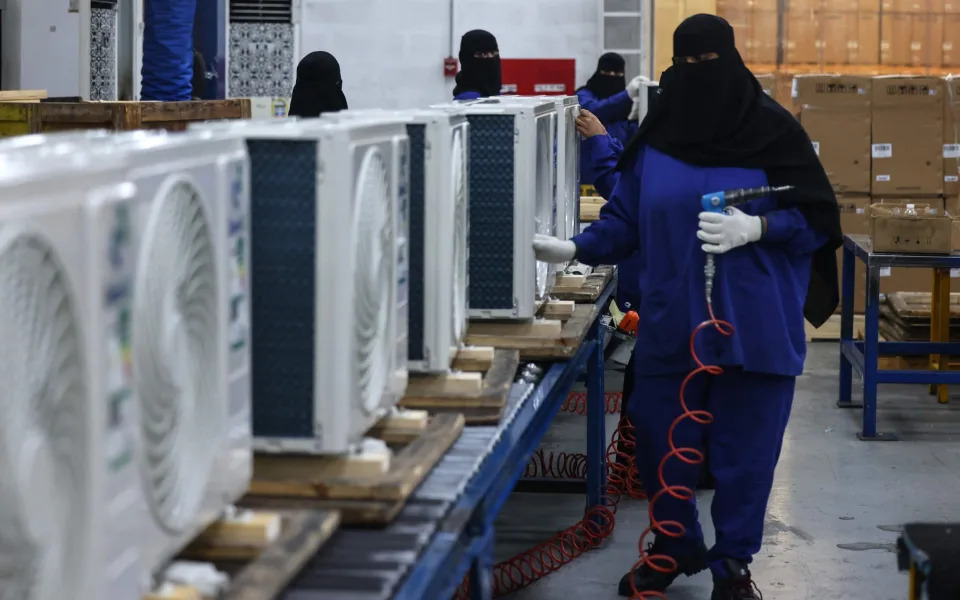
Women are playing a greater role in the Saudi economy as efforts to liberalise the Gulf state gather pace - FAYEZ NURELDINE/AFP

Saudi Arabia is likely to employ a broad spread of investments before focusing on areas it can excel, said Ayham Kamel, head of Eurasia Group’s Middle East and North Africa research team.

“I think it requires them to have experimented with different sectors for a while before they double down,” he says. “It’s really a wide net. I would expect it to be more focused in the future, but we are not there yet.”

The country’s investments today range from stakes in Nintendo, Uber and Boeing, to Newcastle United FC and its controversial takeover of Golf’s PGA tour through its LIV Golf rival.

Saudi also wants to become a leader in artificial intelligence and is hoovering up the specialist computer chips necessary to develop an AI economy, according to recent reports

Mr Kamel says Riyadh is “ambitious to get into the high-tech industry and migrate part of the production in Saudi Arabia”, he adds.

Riyadh’s plan to increase its defence industrial knowledge is already underway.

In December, the Kingdom signed its deal with Spanish shipbuilder Navatia to form a joint venture to build warships. The final details of the deal will be ironed out next year, but the agreement allows for all of the construction to be done in Saudi shipyards.

The deal allowed the country to “localise military industry” defence minister Prince Khaled bin Salman said at the time.

UK investment chiefs are now keen to snap up more of Saudi’s income rather than see it go to rivals like Spain.

One City veteran who has experience investing in the country expressed frustration about the poor perception of Saudi Arabia in press coverage.

He said: “Saudi Arabia is changing for the good at a stunning speed and to be honest the parts of the press coverage here have been almost profligate in their jaundiced, biased reporting.

“Saudi is far more than Khashoggi. And British business is considered good business. Saudi is the UK’s primary trading partner in the Middle East and the UK is Saudi Arabia’s closest European ally.”

The country was the UK’s 10th-biggest export customer for services last year and Britain enjoys a £7bn trading surplus with Saudi.

But in the eyes of outside investors and potential customers, its human rights record must improve. The country executed 196 people last year, the highest number since Amnesty International started recording the numbers 30 years ago.

Polly Truscott, Amnesty International UK’s foreign policy adviser, said MBS “must be properly held to account for abuses by Saudi officials, including Khashoggi’s murder, the widespread use of torture in Saudi jails and the indiscriminate bombing of civilians in Yemen.”


Axiom Space raises $350 million in round led by Saudi, Korean investors


Reuters
Mon, August 21, 2023

(Reuters) - Axiom Space has raised $350 million in a funding round led by Saudi Arabia's Aljazira Capital and Korean healthcare firm Boryung as the startup works with NASA to develop a private space station.

The company declined to disclose its valuation on Monday. Axiom said the round took its total raise so far to $505 million and made it the space startup to receive the second-most funding in 2023, only behind Elon Musk's SpaceX.

The move comes at a time when hopes have risen of a thaw in the funding winter for space startups, after investments in the sector stayed flat in the second quarter after more than halving in the first three months of the year.

Axiom, which also has a $1.26 billion contract with the U.S. space agency NASA to develop spacesuits for use on the moon and other space programs, expects the first module of its private space station to launch by 2026.

The company has also trained astronauts taken by SpaceX rockets to the International Space Station (ISS) as the once government-dominated space industry in the United States becomes increasingly privatized. It said it has achieved more than $2.2 billion in customer contracts.

(Reporting by Arsheeya Bajwa in Bengaluru; Editing by Shailesh Kuber)
U$A
RETURN OF THE GOOD OLD BOYS
A right-wing sheriffs group that challenges federal law is gaining acceptance around the country


Mon, August 21, 2023 


GRAND RAPIDS, Mich. (AP) — Against the background hum of the convention center, Dar Leaf settled into a club chair to explain the sacred mission of America’s sheriffs, his bright blue eyes and warm smile belying the intensity of the cause.

“The sheriff is supposed to be protecting the public from evil,” the chief law enforcement officer for Barry County, Michigan, said during a break in the National Sheriffs’ Association 2023 conference in June. “When your government is evil or out of line, that’s what the sheriff is there for, protecting them from that.”

Leaf is on the advisory board of the Constitutional Sheriffs and Peace Officers Association, founded in 2011 by former Arizona sheriff Richard Mack. The group, known as CSPOA, teaches that elected sheriffs must “protect their citizens from the overreach of an out-of-control federal government” by refusing to enforce any law they deem unconstitutional or “unjust.”

“The safest way to actually achieve that is to have local law enforcement understand that they have no obligation to enforce such laws,” Mack said in an interview. “They’re not laws at all anyway. If they’re unjust laws, they are laws of tyranny.”

___

This project was produced by the Howard Center for Investigative Journalism, in collaboration with the Arizona Center for Investigative Reporting. The Howard Center, based at Arizona State University’s Walter Cronkite School of Journalism and Mass Communication, is an initiative of the Scripps Howard Fund in honor of the late news industry executive and pioneer Roy W. Howard. AZCIR is a nonpartisan, nonprofit newsroom that focuses on data-driven investigative journalism. For more see https://azcir.org/cspoa/. Contact us at howardcenter@asu.edu.

___

The sheriffs group has railed against gun control laws, COVID-19 mask mandates and public health restrictions, as well as alleged election fraud. It has also quietly spread its ideology across the country, seeking to become more mainstream in part by securing state approval for taxpayer-funded law enforcement training, the Howard Center for Investigative Journalism found.

Over the last five years, the group has hosted trainings, rallies, speeches and meetings in at least 30 states for law enforcement officers, political figures, private organizations and members of the public, according to the Howard Center’s seven-month probe, conducted in collaboration with the Arizona Center for Investigative Reporting.

The group has held formal trainings on its “constitutional” curriculum for law enforcement officers in at least 13 of those states. In six states, the training was approved for officers’ continuing education credits. The group also has supporters who sit on three state boards in charge of law enforcement training standards.

Legal experts warn that such training — especially when it’s approved for state credit — can undermine the democratic processes enshrined in the U.S. Constitution and is part of what McCord called a “broader insurrectionist ideology” that has gripped the nation since the 2020 presidential election.

“They have no authority, not under their state constitutions or implementing statutes to decide what’s constitutional and what’s not constitutional. That’s what courts have the authority to do, not sheriffs,” said Mary McCord, a former federal prosecutor and executive director of the Institute for Constitutional Advocacy and Protection at Georgetown University.

“There’s another sort of evil lurking there,” McCord added, “because CSPOA is now essentially part of a broader movement in the United States to think it’s OK to use political violence if we disagree with some sort of government policy.”

At least one state, Texas, canceled credit for the sheriffs’ training after determining the course content – which it said included a reference to “this is a war” – was more political than educational. But other states, such as Tennessee, have approved the training, in part because it was hosted by a local law enforcement agency.

Unlike other law enforcement continuing education, such as firearms training, the sheriffs’ curriculum is largely a polemic on the alleged constitutional underpinnings of sheriffs’ absolute authority to both interpret and refuse to enforce certain laws. One brochure advertising the group’s seminars states: “The County Sheriff is the one who can say to the feds, ‘Beyond these bounds you shall not pass.’”

Since 2018, the Howard Center-AZCIR investigation found, at least 69 sheriffs nationwide have either been identified as members of the group or publicly supported it, though at least one later disavowed the organization. A 2021 survey of sheriffs by academic researchers working with the nonprofit Marshall Project found that more than 200 of the estimated 500 sheriffs who responded agreed with the group’s ideology.

In addition, reporters found, at least a dozen U.S. counties influenced by the sheriffs group have considered “constitutional county” resolutions over the past two years. The resolutions range from a simple reaffirmation of support for the constitutional rights of county residents to empowering local government, including sheriffs, to refuse to enforce state and federal laws they interpret as unconstitutional. Officials in two Nevada counties – Lander and Elko – have become official CSPOA constitutional counties, a step that includes a $2,500 lifetime fee paid directly to the sheriffs group.

Nationwide, there are some 3,000 sheriffs, whose salaries are funded by taxpayers. They serve as the chief law enforcement officers in their counties and are the only elected peace officers in the country. They appoint deputy sheriffs and jailers and service the courts in their jurisdictions. Especially in rural areas, sheriffs hold immense sway over what happens in their county.

Amy Cooter, research director at the Middlebury Institute Center on Terrorism, Extremism and Counterterrorism, said many sheriffs join the group from “a misinformed but well-meaning perspective.” But, she added, it also allows some sheriffs to “potentially engage in extremism by not enforcing legal, lawful, legitimate orders.”

Some states have pushed back against the group’s training efforts, and not all sheriffs subscribe to the group’s ideology. Many at the National Sheriffs’ Association conference distanced themselves from the constitutional sheriffs or claimed not to know what they were about.

“When I took an oath 17 years ago as sheriff, I took the oath to uphold the Constitution, not overstep it,” said Troy Wellman, sheriff of Moody County, South Dakota, and a vice president of the National Sheriffs’ Association.

And there has been public pushback in some counties led by “constitutional sheriffs.” In Klickitat County, Washington, residents alleged Sheriff Bob Songer, a board member of the sheriffs group, engaged in fearmongering and intimidation. He was the target of a formal complaint in 2022 that the state’s law enforcement standards agency ultimately dismissed for lack of jurisdiction.

The public-facing image of the sheriffs group, which is led by white men, prominently features the American flag and the experiences of Black civil rights icons who pushed back against unjust laws. But details of its operations are closely held, and its finances are shielded from public scrutiny. It was briefly registered as a nonprofit in Arizona, but internal records indicate it is now a private company.

The group does not release its list of dues-paying members, nor does it publicize information about where or how it conducts trainings. The sympathies of the group’s leaders for right-wing, white-nationalist extremist causes, however, are well documented.

Mack was an early board member of the Oath Keepers, the group involved in the Jan. 6 attack on the U.S. Capitol. Although he said he split with the group several years ago when it became a militia, Mack still speaks at Oath Keeper-affiliated rallies.

Leaf was investigated, but not charged, in connection with the Michigan attorney general’s investigation into the alleged illegal seizure and breach of vote-counting machines in 2020. He also appeared at an election-denier rally with two men later charged in the conspiracy to kidnap Michigan’s Democratic Gov. Gretchen Whitmer.

Michael Peroutka, another sheriffs group board member and former candidate for Maryland’s attorney general, was once affiliated with the League of the South, which supports “a free and independent Southern republic.” At a 2019 sheriffs’ training event, he said, “There is a creator God. Our rights come from him. The purpose of civil government is to secure and defend God-given rights.”

Jon Lewis, a research fellow at George Washington University’s Program on Extremism, described the sheriffs group as “insidious” and said it had become “mainstream standard-bearers for entrance into more violent forms of extremism.”

“Just because it’s not as overt in their subversion of the democratic system, just because it’s quieter about how it does it and what it’s calling for, doesn’t make the ideas any less dangerous,” said Lewis.

Brendon Derr of the Arizona Center for Investigative Reporting and Jimmy Cloutier, Heaven LaMartz and Annabella Medina of the Howard Center for Investigative Journalism contributed to this story.

_____________

This project was produced by the Howard Center for Investigative Journalism, in collaboration with the Arizona Center for Investigative Reporting. The Howard Center, based at Arizona State University’s Walter Cronkite School of Journalism and Mass Communication, is an initiative of the Scripps Howard Fund in honor of the late news industry executive and pioneer Roy W. Howard. AZCIR is a nonpartisan, nonprofit newsroom that focuses on data-driven investigative journalism. For more see https://azcir.org/cspoa/. Contact us at howardcenter@asu.edu.

Tj L’heureux, Adrienne Washington, Albert Serna Jr., Anisa Shabir And Isaac Stone Simonelli, The Howard Center For Investigative Journalism And Arizona Center For Investigative Reporting, The Associated Press
Rats looting Roman villa entombed by Vesuvius highlight living conditions of slaves


Nick Squires
Sun, August 20, 2023 

The slaves room were discovered in a villa around 600 metres from Pompeii

Archaeologists excavating servants’ quarters in the remains of a sprawling Roman villa in Pompeii have found that slaves were not the only occupants of the cramped space – rats and mice were living beneath their beds.

Scientists have unearthed the entombed remains of two wood mice, an adult and a baby, inside an amphora that lay beneath one of the beds that were squeezed into the tiny room in the Civita Giuliana villa, which lay about 2,000ft (just over 600 metres) north of the walls of the ancient city.

In a crudely-made clay jug underneath another bed, they found the remains of a black rat, Rattus rattus – the species blamed for spreading the plague.

The rat seems to have hopped into the jug to feed on a “semi-liquid substance”, the exact nature of which remains unclear, archaeologists said.

The three rodents died, along with thousands of ancient Romans, when Pompeii was hit by a pyroclastic flow of hot ash and volcanic debris caused by the eruption of Mount Vesuvius in AD79.

The animals are among a plethora of intriguing new discoveries that archaeologists have made in two remarkably well-preserved slaves’ rooms, which were unearthed in November 2021.

Painstaking analysis has revealed that the two small rooms included wooden cupboards, shelves on which rested cups and plates and other crockery, large baskets, amphorae and an oil lamp hung from a nail in the wall.

Experts also found wooden beds sprung with rope netting as well as a simple four-legged bench, a knife blade, a small scythe and the rectangular iron blade of a hoe. While organic materials such as wood and leather have long since decomposed, their imprints were conserved by the blanketing layers of volcanic ash.

Rattus rattus

The finding “suggests that the black rat was already widespread in the Pompeii area in the first century AD,” Gabriel Zuchtriegel, the director of the archaeological site, wrote in a paper published on Sunday called, Of Mice and Men – new discoveries in the servants’ quarters of the Roman villa of Civita Giuliana near Pompeii.

Although rats and mice feature prominently in ancient Roman literature, fables and jokes, “the scale of ancient rodent infestation and its possible impact on the spread of diseases is still debated,” said Prof Zuchtriegel.

It would be an exaggeration to say that ancient Roman towns were crawling with rats, but “the presence of no less than three rodents suggests that the impact of mice and rats on ancient hygiene, disease control and storage conditions should not be underestimated”.

The detail and quality of the discoveries offer a “virtually photographic quality into the lives” of slaves in ancient Roman, people who barely appear in written sources, said Prof Zuchtriegel.

“When looking at the rodent-infested rooms at Civita Giuliana, we are invited to appreciate how in spite of everything, the people living here struggled to maintain a minimum of dignity and comfort.”

In a statement, the culture ministry added: “These details once again underline the conditions of precarity and poor hygiene in which the lower echelons of society lived during that time.”

Scientists have found no traces of bars on the windows of the slaves’ rooms or locks on the doors, suggesting they were not physically coerced to remain on the estate.

Subtle control

Control was exerted through more subtle means – allowing a male slave to take a female slave as his partner, for instance, forming a relationship that would then produce children.

That forged connections and a degree of reliance between the enslaved peoples and their owners, archaeologists said.

There was also a pecking order between slaves, in which some were elevated to the role of overseers and given special rights and privileges, said Prof Zuchtriegel.

Excavations at the Civita Giuliana villa were first carried out in the early 20th century but resumed in 2017, when Carabinieri police found that the site was being plundered by illegal diggers.

Archaeologists have made a series of remarkable discoveries at Pompeii in recent years, thanks to a €105 million (£89.8m) project funded by the EU dubbed Great Pompeii, from the remains of horses to a ceremonial chariot decorated with silver and bronze medallions and several human victims of the eruption of Vesuvius.

“What we are learning about the material conditions and social organisation of that era opens up new horizons for historical and archaeological studies,” said Gennaro Sangiuliano, the culture minister.

The discoveries made at Pompeii shed light on “notable aspects of daily life in antiquity,” he added.