It’s possible that I shall make an ass of myself. But in that case one can always get out of it with a little dialectic. I have, of course, so worded my proposition as to be right either way (K.Marx, Letter to F.Engels on the Indian Mutiny)
Monday, August 21, 2023
Manager with Colorado cannabis business is tapped to lead New Mexico's team of marijuana regulators
Mon, August 21, 2023 at 5:42 p.m. MDT·1 min read
SANTA FE, N.M. (AP) — A manager with one of Colorado’s largest cannabis companies will serve as the next director of New Mexico’s Cannabis Control Division.
New Mexico announced the hiring of Todd Stevens on Monday, saying he has years of experience working in Colorado’s marijuana industry. He most recently served as the manager of training and development at Native Roots Cannabis Co.
Stevens’ appointment follows a year of turnover at the division and comes as regulators try to ramp up enforcement against non-compliant businesses. Most recently, a state district judge granted the division’s request to halt operations at an Albuquerque business that regulators claimed was unlawfully selling out-of-state cannabis products and manufacturing extracts without a proper license or permit.
Stevens said in a statement that he wanted to help the industry become an economic driver while protecting consumer safety.
“In the past year, New Mexico has established a thriving new industry, licensed more than 2,000 cannabis businesses, and held those businesses to the high standard that comes with an adult-use cannabis market,” he said.
During his time in Colorado, Stevens was part of the design and development of training and recertification for more than 200 retail employees and oversaw operations at five dispensaries.
The Associated Press
I was a USPS letter carrier for 44 years. To protect us from extreme heat, the postal service needs to provide more training and air-conditioned trucks.
Story by khawkinson@insider.com (Katie Hawkinson ) •23h Mike Kurz retired this summer after 44 years as a USPS letter carrier.
This as-told-to essay is based on a series of conversations with Mike Kurz, a 65-year-old recently-retired USPS city letter carrier from Elizabeth City, North Carolina about heat-related safety for USPS employees. It's been edited for length and clarity.
When I had to undergo treatment for sepsis in May and take a break from work, I wasn't planning on retiring from my job as a letter carrier for the US Postal Service. In fact, I planned on staying on for another two or three years.
But I'm glad I did because ever since the beginning of July, temperatures have been in the upper nineties. And in the past couple of years, there's been a handful of letter carriers who have died from heat-related illness.
I worked as a letter carrier for 44 years. Throughout my career, I experienced varying degrees of heat-related illness more times than I can count. I can't stress enough how bad it gets in the heat. I learned the signs of heat-related illness, and it saved me
Throughout my career, I suffered heat-related illness often, with at least one incident every few years.
My most recent incident of heat-related illness happened over two summers ago, at the height of the COVID-19 pandemic. I was delivering mail and had to pull over to go into an air-conditioned church because I was dizzy and nauseous, which are two symptoms associated with heat illness. Plus, it was a day with high heat and humidity — and I had no air conditioning in my truck.
I always worried during the pandemic. People were secluded in their houses so if I fainted in my truck or while I was walking outside because of the heat, nobody would be out there to actually see it happen.
Thankfully, that never happened, and I didn't have to go to the hospital that day because I was able to tell the signs before they escalated. I took off the rest of the day and went home.
But some letter carriers don't have the same experience I do to recognize the signs.
Kurz says the USPS should implement further training to keep letter carriers safe in the heat.
The USPS must improve their heat safety training and give us air-conditioned trucks
While the USPS has the Heat Illness Prevention Program, we need further education. In order to protect letter carriers from heat-related illness and death, the postal service should improve the quality of their heat-safety training and invite experienced letter carriers like me to lead them.
As the president of my local union branch, I've given several talks on heat safety to employees. Having someone like me come in and talk to them — who has on-the-ground experience — rather than reading from a script that comes from national headquarters, would help improve education. Someone like me could elaborate a lot more thanks to on-the-ground experience.
Some national employees were former letter carriers, but people like the current postmaster general, Louis DeJoy, were not. We get blurbs from the national office, but they're not long enough. And since we've had DeJoy as the postmaster, they haven't explained a lot.
We also need air-conditioned trucks. Many of our trucks have been in use since 1989 and do not come with air conditioning. I've been saying for 25 years we need air conditioning.
The USPS has gotten wise to it and is now building new ones with air conditioning. Several of them are supposed to be electric vehicles or hybrids, too. This will help because letter carriers won't be dealing with heat from the engine either. Letter carriers have to remember their health is more important than the mail
I also tell my fellow letter carriers to use wet towels on their heads and neck to keep cool. I recommend materials like terry, which works best for cooling. I also often brought several bottles of water with me on shift.
In the last 15 years, I've had two employees at my union branch go to the hospital for heat-related illness because they worried more about delivering mail.
If it's between your health and the mail, you should always prioritize your health.
Zoom's scrapped proposal to mine user data causes concern about our virtual and private Indigenous Knowledge
Story by Andrew Wiebe, PhD Student, Information, University of Toronto Platforms like Zoom have been helpful in bridging geographical distances. However, a recent proposal to mine data raises questions about ownership of Indigenous Knowledge.
Even though Zoom pedalled back this time, their drive to gather data highlights the possibility of future hidden data extraction by them and other big tech companies.
More specifically, as a researcher working with and looking at Indigenous communities and their data, I am concerned about the privacy of these valuable data sets from Indigenous communities on Turtle Island.
Vulnerable Indigenous Knowledge
Over the past three years, Zoom calls have become a tool for organization and activism for many Indigenous communities.
For my own work, I use video and voice chat which lets us balance geographical differences to collaborate and share, as well as access communities that are hard to reach. Discussing issues with queer community members of different Indigenous Nations is often private and perhaps even sacred.
These conversations have elements that are public facing, but they also contain wisdom from Elders or Knowledge Keepers specifically trained to know what they can and cannot share in specific spaces. Some of this knowledge is sacred and is part of promoting and preserving Indigenous (and sometimes queer) ways of being.
A valuable commodity
This private information is constantly at risk of extraction from companies seeking to monetize or otherwise gain from our data.
Indigenous Knowledge represents a large gap in current big data. AI only works with large data sets which enables predictive technology to operate.
With knowledges that are primarily oral, it is difficult to gather proper data sets that often come from writing. The possibility for big companies to gather audio and visual data, could render this oral information visible by machines. Protecting communities
“Refusing research” has been an important concept for protecting marginalized communities from the extractive practices of researchers aiming to obtain data.
Related video: M&A is a strong possibility for Zoom, it needs to acquire new technologies, says CFRA's Keith Snyder (CNBC)
However, if platforms are extracting data without our knowledge, or demand our consent in order to use a service, a conflict emerges.
The conflict becomes one of free choice versus free-to-leave: If we do not consent to use the infrastructure, we simply do not get access to that service. Access to voice and video sharing infrastructure has been a fundamental component of activism and community research, especially post COVID-19.
Can we ‘opt-out?’
Can we accept or refuse to be turned into research data?
Each individual who is opting for nearly any big service is being tracked to some capacity. And so, there needs to be a critical element of what is considered private.
Likewise, Zoom has the ability to gather this data, whether or not they use it for AI with consent. There is an anxiety that next time, the ambiguity will go unnoticed or perhaps force consent to access a seemingly necessary service.
As someone who looks at ethical data collection and mobilization, I believe we all need to be critical of those requests to have access to our private data when using these services.
The relationship between data and Indigenous communities and the Canadian government has always been fraught. However, after the work of the Truth and Reconciliation Commission in Canada (which concluded in 2015), it became even more clear that access to data and information is crucial to achieving justice and truth in relation to our histories.
For Indigenous peoples whose history has been systematically erased, demanding that organizations return records and data has become an important element of achieving the truth behind the experiences of Indian Residential School survivors. Communities have both the desire and need to have their data returned so that they can maintain ownership, control, access and manage permissions to access information.
Ease of Zoom for communication
In-person collaboration between Indigenous communities can be difficult because of things like geographical differences, the lack of public transportation, and interruptions in Indigenous sovereignty. These issues continue the social and political fragmentation caused by settler colonialism to isolate these communities from one another.
Many of these challenges have been alleviated by information technologies like Zoom. And a platform like Zoom has been potentially unifying by bridging space. However, it could also become a tool to recreate the problem of data extraction in a new way.
We need to be attentive to these kinds of data gathering possibilities that offer to extract data from users.
These technological infrastructures may disproportionately harm Indigenous communities by making their private and sacred knowledges legible by AI. Data collection for AI could lead to the commodification of this sacred knowledge for profit.
Protecting this kind of data is not just the responsibility of Indigenous communities but a shared commitment that has a present and future urgency. This article is republished from The Conversation, a nonprofit news site dedicated to sharing ideas from academic experts.
'Passages' filmmaker Ira Sachs battles shameful censorship for beautifully passionate movie
"Basically what the MPA is doing is saying, 'if you create images like these, you will be punished,'" the filmmaker said about the movie's NC-17 rating
Veteran filmmaker Ira Sachs' movie Passages, starring Ben Whishaw, Franz Rogowski and Adèle Exarchopoulos, beautifully depicts the complexities of power and desire in relationships, but was unfortunately hit by shameful censorship.
In Passages we're first introduced to Tomas (Rogowski) a self-involved filmmaker in Paris who's married to Martin (Whishaw). Following his personal feelings and attraction, and not particularly thinking about his husband at all, Tomas has an affair with a young woman, Agathe (Exarchopoulos), unravelling his marriage.
"It was the dark days of the pandemic and I wanted intimacy," Sachs told Yahoo Canada. "When I imagined the movie that I might one day get to make, it was a film of actors and bodies and sex, and something that cinema uniquely can offer to the viewer, which is a kind of closeness that turns into pleasure."
"I also wanted to make a film that was driven by desire, and the gap between what the characters have and what they want. So a love triangle was kind of the answer for us."
L to R: Franz Rogowski (Tomas) and Ben Whishaw (Martin) in Passages (Courtesy of MUBI)
'I had great examples of men in movies behaving badly'
Tomas is a particularly interesting character. He easily has narcissistic tendencies, but as the film progresses, we see that he does have empathy for others, at least in some capacity. Sachs expertly puts his own stamp on a lead character that engages in behaviour that's not particularly admirable.
"I had great examples of men in movies behaving badly, specifically James Cagney was an inspiration," Sachs said. "I watched a lot of film noir during the making of this movie and beforehand, every film is about a guy doing the wrong thing."
"That lineage going through Marlon Brando on to Travis Bickle [from the movie Taxi Driver], these are all interesting cinematic characters. So I found it very natural. I also knew that Franz is creating a performance, which is different than just watching someone like Donald Trump, for example. Someone playing Donald Trump is different than being Donald Trump, and I think the play is really part of the pleasure of the performance."
In looking at this love triangle, Sachs isn't particularly quick to bring the audience into the room, so to speak. That very much evolves as the story progresses. As the filmmaker explains, it's a movie that is "a series of middles."
"I'm comfortable with the audience being disoriented in the beginning, because I believe that with time, they will become central, they will become inside the film," Sachs said. "What's important is that every scene have authenticity and that it be constructed with narrative direction."
"I'm telling the story, but I want the audience to feel like there is an atmosphere of freedom. So that becomes a balance and editing becomes very important. Working with Sophie Reine, the French editor on the film, you want the audience to not know where they're going, but feel comfortable that someone is taking them there."
L to R: Franz Rogowski (Tomas) and Adèle Exarchopoulos (Agathe) in PASSAGES (Courtesy of MUBI) 'We're going into some time of repression and denial'
A movie with a similar storyline, created by someone with less commitment to authenticity, would be quick to label what the love triangle is. But Sachs avoids that construct entirely. This relationship isn't confined to a specific definition, it's just the result of passion and feeling. But that's something the filmmaker said he took from his actors.
"The actors taught me where to go, really," Sachs said. "They are from a generation following my own and I think they exist in a moment in which the labels don't seem to work, the way that they were needed to when I was their age."
"It'd be very interesting to make this film again with three 70 year-olds. It would be a very different story, because identity means something different for queer people, and also for non-queer people, then it [did] 30 years ago. That is one form of progress. I think in terms of imagery, I'm not sure we're making progress, I think we're going into some time of repression and denial, that I want to be a part of challenging."
This image released by Mubi shows Ben Whishaw, left, and Franz Rogowski in a scene from "Passages." (Mubi via AP)
'If you create images like these, you will be punished'
In advance of the film's wider release to the public, Passages received an NC-17 rating from the Motion Pictures Association (MPA). Mubi, the film's distributor, has decided to release the film unrated.
In a widely shared interview with the Los Angeles Times, Sachs called the decision "cultural censorship."
"It’s really about a form of cultural censorship that is quite dangerous, particularly in a culture which is already battling, in such extreme ways, the possibility of LGBT imagery to exist," he told The Times back in July.
Sachs stressed that he's not necessarily particularly worried about this censorship for his own filmmaking, but he's more worried about the precedent this sets for other filmmakers.
"I'm not worried about myself because I got to make the film that I wanted to make, and I feel very supported both by my producer Saïd Ben Saïd and by my distributor Mubi," Sachs said. "I'm more worried about the warning shot that this kind of censorship makes towards other filmmakers who want to create free images."
"Basically what the MPA is doing is saying, 'if you create images like these, you will be punished.' Foucault would consider this a nightmare of control. That's what it is."
The filmmaker added that the significant question is not necessarily the rating for this movie, but why does the MPA still exists at all.
"This should actually be a moment you go, 'Wait a minute. Why do we follow a nameless group of parents,'" Sachs said. "That's also such a creepy naming of a group, 'nameless parents.'"
"In America, when you start hearing about nameless parents, you think about libraries in Texas. So why is this progressive industry, a modern industry, an industry that supports individuality, supposedly, following a nameless board of parents telling them what should and should not be seen?"
Foucault would consider this a nightmare of control. That's what it is.
Sachs went on to stress that it's not just the MPA, but other key stakeholders, people and organizations with power, that are participating in this censorship.
"It's the festivals run by men who want to hold on to power. It's the distribution companies run by men who want to hold on to power. It's the government's run by men who want to hold on to power," Sachs stressed. "There's a lot of systems that you have to try to resist to make original, personal work."
"And I'm a man of great privilege. So consider all the people with less privilege, and where are those voices."
Passages opens Aug. 11 in select Toronto and Vancouver theatres, Aug. 18 in Montreal, Quebec City and Ottawa, and throughout the summer in other Canadian cities
ONTARIO
Facing a rising tide of hatred, North Bay Pride picks protest over parade
Story by Aya Dufour •2w
North Bay community members will see a protest instead of a parade during this year's Pride celebrations in the northern Ontario city.
Jason Maclennan, North Bay Pride's director of communications, said the switch is necessary to reflect the need for change.
"A Pride parade is people celebrating who they are," he said. "A march is people demanding change, and that's what we need to have right now."
Instead of having a festive tone, the Sept. 16 event will focus on demanding more equity and inclusion.
Maclennan said community members have been facing increased hate, including online comments, death threats, and the normalization of anti-trans and anti-LGBTQ discourse in public life.
"People need to stop sharing hate and misinformation about the community."
He said hate groups tend to comprise only a few people, but they are organized.
"They will use buzzwords like grooming, and instead of actually researching and looking into it, [people] fall for that narrative.
"It's an emotional response," he said. "Then they share it, and it becomes bigger, and bigger and bigger."
He added this kind of discourse is detrimental to the 2SLGBTQ+ community in North Bay.
"It's forcing people back in the closet, denying who they are," he said.
"It contributes to suicide rates in youth and people not understanding their children when they come out."
Maclennan said the group has struggled to meet with local elected officials to express their concerns.
Related video: Thousands take in Vancouver Pride Parade (Global News)
"It's so important that political leaders step up against hate and if they aren't doing that, they shouldn't be in politics," he said.
The riding's member of Parliament, Anthony Rota, was not available to comment on this before publication of this story, and MPP Vic Fideli did not respond to CBC's request for comment.
Anti-LGBTQ+ hate crimes rising elsewhere
Laur O'Gorman, chair of Fierté Sudbury Pride, said the organization also wanted to plan a march instead of a parade during their events in July.
"Especially this year, with all the pushback, we felt like we really had to do a march, something that is stronger and more political," they said.
At the time, the Greater Sudbury Police Service (GSPS) said in an email to CBC News that it respected Sudbury Pride's decision to cancel the parade and would "continue to work towards repairing and creating relationships built on mutual respect and understanding."
Still, O'Gorman believes actions are needed to slow down the pace of anti-LGBTQ+ hate.
"I frequently find things about myself coming up online," they said. "There are posts saying that I'm friends with pedophiles and that we have pedophiles on the Pride board. Not true at all."
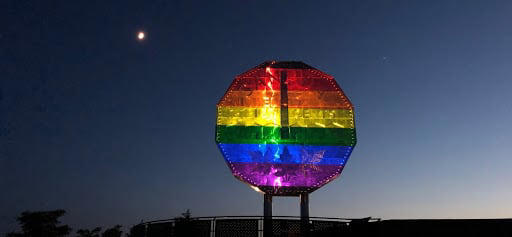
Fierté Sudbury Pride has lit up the Big Nickel with the Pride colours in past Pride events.
O'Gorman said they have also received threats, including one captured on video.
"That person said: 'I know where you live, I know when you're home, I know when you're away, and I'm going to do something Sudbury will be remembered for.'"
Another incident included being followed in the street and having insults hurled at them.
O'Gorman said they brought evidence of these threats to the police, but added no action was taken as authorities do not consider these to be "direct threats."
Contacted by CBC News to respond to O'Gorman's comment, Sudbury police said in an email Tuesday: "We would be happy to review the matter once provided the specifics regarding the incident."
O'Gorman believes North Bay Pride is doing the right thing in holding a protest.
"We would have loved to march, because it's badly needed. For us, though, we needed to do it without the police leading the way."
A store owner was killed over a Pride flag she flew in front of her California business
CEDAR GLEN, Calif. (AP) — A dispute over an LGBTQ+ pride flag at a California clothing store spiraled into deadly violence this weekend when a man shot and killed the 66-year-old business owner right in front of her shop, authorities said.
The man ran away from the store after the shooting Friday night but was later found and killed in a confrontation with officers from the San Bernardino County Sheriff’s Department.
The agency said Laura Ann Carleton was pronounced dead at Mag.Pi, the store she owned and operated in Cedar Glen. The small community in the San Bernadino Mountains is roughly 60 miles (96 kilometers) east of downtown Los Angeles.
Before the shooting, the man “made several disparaging remarks about a rainbow flag that stood outside the store,” sheriff's officials said.
It was not immediately clear what happened when officers confronted the man, whose identity hadn't been released as of Sunday.
Carleton, who preferred to be called “Lauri,” is survived by her husband and nine children in a blended family.
An LGBTQ group in nearby Lake Arrowhead said Carleton didn’t identify as a member of the LGBTQ+ community. But she spent time helping and advocating for everyone, and was defending her Pride flags placed in front of her shop on the night of the shooting, the group said.
There was an outpouring of support on social media over the weekend, with commenters expressing shock and sadness on the store's accounts. Many included rainbow flag emojis.
Law enforcement agencies in several states have investigated the destruction of rainbow Pride flags as potential hate crimes in recent years.
The Associated Press
Four dead after scissor lift topples at house under construction
NOT SCISSORLIFT OPERATROR CERTIFIED The Canadian Press Sun, August 20, 2023
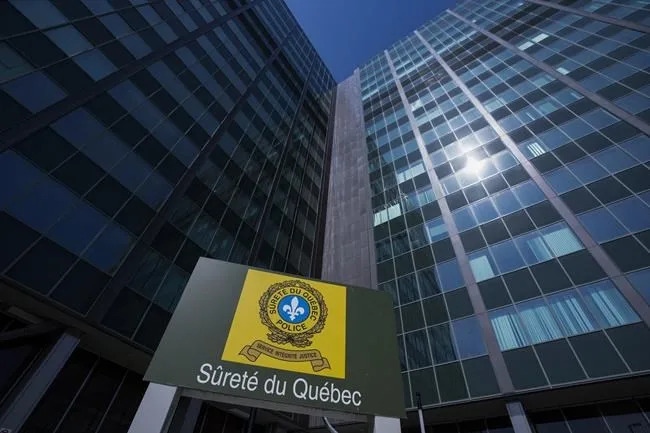
MONTREAL — Four family members are dead after a construction project turned tragic over the weekend in Quebec's Bas-St-Laurent region, provincial police say.
Investigators said two men and two women were working on a new house atop a scissor lift on Saturday in St-Léandre, a rural municipality of fewer than 400 people, when the device toppled for an unknown reason. "The occupants fell several meters. On the spot, we found the death of one of them," said provincial police spokesman Stéphane Tremblay, referring to a 27-year-old man.
He said three others were badly injured and were taken to hospital but died during the night.
Tremblay confirmed Sunday that the four people were part of the same family.
The victims include a 27-year-old man and a 24-year-old woman from St-Léandre and a 53-year-old woman and 60-year-old man from Rivière-du-Loup.
Officials said a coroner's inquest is underway, while an investigation by Quebec's workplace health and safety board aims to determine whether an equipment breakdown occurred.
TOO MANY ON THE SCISSOR LIFT
This report by The Canadian Press was first published Aug. 20, 2023.
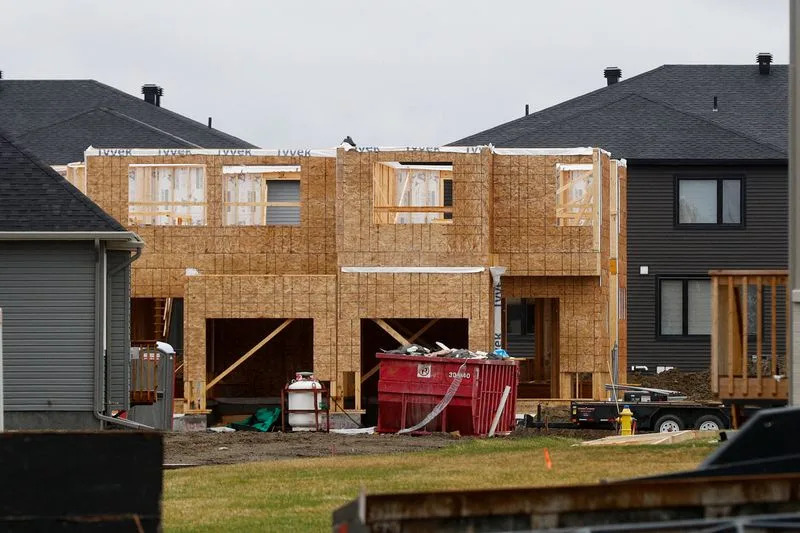
Canada considering foreign student visa cap to address housing shortage Reuters Mon, August 21, 2023 FILE PHOTO: Houses are seen for sale and under construction in a neighbourhood of Ottawa
OTTAWA (Reuters) - The Canadian government, under pressure over the rising cost of housing, could consider capping foreign student visas, which have rocketed in recent years, new Housing Minister Sean Fraser said on Monday.
Official data show there were more than 800,000 foreign students with active visas in 2022, up from 275,000 in 2012. Canada is a popular destination for international students since it is relatively easy to obtain a work permit.
Fraser, who was immigration minister before taking up his job last month, said the sharp rise in the number of students was putting pronounced pressure on some housing markets.
Asked whether a cap could be imposed on the number of foreign students, he said, "I think that is one of the options that we ought to consider." The government has not yet made a decision, he added.
"We've got temporary immigration programs that were never designed to see such explosive growth in such a short period of time," Fraser told reporters on the sidelines of a cabinet retreat in the Atlantic province of Prince Edward Island.
The official opposition Conservative Party, ahead in the polls of a federal election which must be held by October 2025, say the Liberal government of Prime Minister Justin Trudeau is not doing enough to tackle the housing issue.
Canada, which has a population of around 39.5 million people, plans to take in a record 500,000 new permanent residents in 2025. Fraser said limiting the number of newcomers was not the answer.
(Reporting by David Ljunggren; Editing by Josie Kao)
Post comparing 2003, 2023 Kelowna wildfires misses the mark: 'Photos are not enough'
Dr. Sylvain Charlebois, also known as 'The Food Professor,' tweeted two pictures comparing wildfires in Kelowna in 2003 and 2023
On Aug. 20, Dr. Sylvain Charlebois, the director of the Agri-Food Analytics Lab at Dalhousie University, posted two pictures of the Kelowna fires that took place in B.C. 20 years apart, suggesting the two fires don’t look all that different.
This comes after the wildfire season has gotten significantly worse for Canada in 2023, becoming the worst on record according to government figured reported by BBC News.
A July 2023 article titled Why Canada's Wildfires Are So Bad This Year" by the College of Natural Resources in North Carolina found: “The release of carbon dioxide and other greenhouse gases continues to drive changes in the climate, contributing to warmer-than-average surface temperatures and shifting precipitation patterns — trends that are expected to increase the frequency, intensity and duration of wildfires.”
Since its posting, Charlebois’ tweet has gotten major attention on the platform. While some people were quick to jump on the train and support his theory, others were upset at the apparent denial of climate change. Some suggested that there is more to climate change than photo comparisons.
In an interview with Yahoo Canada, Ryan Ness, the Director of Adaptation at the Canadian Climate Institute, said that we may see the kind of wildfires that affect Kelowna much more often than every 20 years in the future.
"We have to recognize that what we're seeing is the beginning of our new climate reality. Wildfires are going to be more frequent and more severe than they ever have been before on average," Ness said.
While Canada has always had extreme weather and climate-related disasters, Ness added that the current state of the fires is not something to be brushed off.
"It's always possible to point to some historic example of a flood or a wildfire and say, 'Oh well, it's always been this way,'" Ness said.
"While it is true that we've always had floods and we've always had wildfires, the difference now is how often they're occurring, how big they are when they do occur, and how much they're happening just about everywhere."
On X, the platform formerly known as Twitter, more users quote-posted Charlebois' post, lambasting the notion that the wildfires are alike.
How do the wildfires in 2003 compare to 2023?
The McDougall Creek wildfire burns on the mountainside above houses in West Kelowna, B.C., on Friday, August 18, 2023. THE CANADIAN PRESS/Darryl Dyck
The Okanagan Mountain Park Fire in 2003 was unquestionably tragic. The fire consumed 250 square kilometres, an area that is nearly twice the size of the city of Vancouver. More than 33,00 people were forced to leave their homes and it caused approximately $200 million in damages.
While the fire died on its own weeks later in mid-September, it was the biggest interface fire B.C. has had until this year.
The current McDougall Creek wildfire featured in Charlebois' post has now caused 30,000 people to be under evacuation orders while another 36,000 were under alert to be ready to flee, according to the Guardian.
As of Sunday afternoon, 410 square kilometres were covered in the area by the blaze. Currently, 3,400 workers are involved in firefighting in B.C. with West Kelowna fire chief Jason Brolund, announcing that 500 firefighters are specifically engaged in managing the McDougall Creek wildfire.
This is about double the size of the previous record of 7.3 million hectares in 1989 and is roughly the size of Greece.
Since posting his initial tweet, Charlebois has updated it to include a call for people to set politics aside and concentrate on helping those who have been impacted by these terrible incidents.
Federal government urged to commit financial aid for displaced N.W.T residents
CBC Mon, August 21, 2023 Evacuees without transportation line up in Yellowknife on Aug. 17. Roughly 20,000 of the city's residents are displaced due to nearby wildfires, along with residents from many other N.W.T. communities. (Tyson Koschik/CBC - image credit)
Calls are growing, both from inside and outside the federal government, for Canada to help the people of the Northwest Territories who are being financially affected by wildfires as costs mount for residents who fled their homes.
Gosma Buddoo, who lives in Yellowknife, fled to Edmonton along with some of his employees who live in Hay River, N.W.T.
The group incurred a week's worth of hotel expenses before finding a better arrangement.
"We are going to have to buy clothes because we just packed basically for a few days when we were leaving," he said.
"Food is another issue because we don't have access to cooking facilities at our hotel. So we have to buy meals on the go, which is more expensive than preparing your own meals."
On Sunday, N.W.T. Premier Caroline Cochrane described the coming bill for the wildfires as a large one. The territory will need financial help but Prime Minister Justin Trudeau hasn't committed any money yet, she said.
The issue prompted a call from NDP Leader Jagmeet Singh for immediate federal support.
"People and community leaders are dealing with the stress of this horrible situation — they should not have to fend for themselves," he stated.
'Support is needed very quickly'
N.W.T. Liberal MP Michael McLeod said he's encouraging his government to do more to help.
"Discussions are happening now. So I'm hoping we're going to have some answers fairly soon. Money and support is needed very quickly," he said.
He told CBC that the federal government has supported the United Way's efforts to help affected communities through a donation-matching program.
Member of Parliament Michael McLeod in Nahanni Butte on Sept. 30.
N.W.T. MP Michael McLeod, pictured here in Nahanni Butte on Sept. 30, 2022, says he wants to see the federal government decide soon on financial aid for N.W.T. residents. (Jenna Dulewich/CBC)
Indigenous governments are also receiving support from the federal government; in turn, several are offering direct financial assistance to evacuees.
McLeod said there is also a process in place to make it easier to apply for employment insurance if you cannot work while evacuated, he said.
Federal ministries have not yet been able to provide CBC with a complete picture of what funding the United Way and Indigenous governments have received or details about what additional aid may be coming.
N.W.T. says no financial aid for evacuees who organized own travel, accommodations
CBC Mon, August 21, 2023 Officials in the Northwest Territories are expected to hold a virtual news conference at 7 p.m. MT (9 p.m. ET) to update residents on the wildfire situation and resulting evacuations. (Tyson Koschik/CBC - image credit)
The N.W.T. government will not be offering financial support to evacuees who found their own accommodations, nor does it intend to help cover travel costs for people who left in their own vehicles, a spokesman for the territorial government says.
People who relied on the N.W.T.'s evacuation flights will have assistance returning when the order is lifted, said Jennifer Young, director of corporate affairs for the territory's municipal and community affairs department, said during a Monday evening wildfire update.
"If you self-evacuated on your own means, the expectation will be that you re-enter on your own means," said Young.
Instead, residents should be looking into their insurance policies to help cover expenses, she said.
Approximately 68 per cent of residents in N.W.T. have evacuated due to wildfires, Young added during the Monday update.
A wildfire burning about 15 kilometres northwest of Yellowknife caused the evacuation of about 20,000 from the N.W.T. capital city beginning late last week.
Nearby Dene communities of Dettah and Ndilǫ, as well as residences along the Ingraham Trail, were also evacuated. Other N.W.T. communities under evacuation orders are Jean Marie River, Kakiska, Kátł'odeeche First Nation, Hay River, Enterprise and Fort Smith.
Lighter winds, rain and firefighting tactics over the weekend helped prevent the fire's advance toward Yellowknife. It was forecast to travel up to four kilometres closer to the city; instead, it only moved between 100 and 200 metres, according to fire officials.
Mike Westwick, N.W.T. fire Information officer, said crews are looking at weeks of work before most people can go home, but that is dependent on a lot of factors, especially weather.
The rain that fell in the Yellowknife area over the past 72 hours helped reduce fire activity and gave firefighters a chance to assess the situation better.
But he said the rain is not enough to end the threat to the city, he said there would need to be about 60 millimetres in a 10-day span of rain.
In context, there has been only around 10 millimetres in the past few days and the forecast is looking dry in the coming days.
Westwick said the biggest concern for fire crews is the wildfire burning about four kilometres from Fort Smith, N.W.T.
He said they expect challenging winds which could push the fire toward the community again.
Westwick said crews have been working on a control line and structural protection.
The Hay River fire remains eight kilometres from the community, 10 kilometres from K'atl'odeeche First Nation and 14 kilometres from Kakisa.
"We're concerned by the incoming weather over the next few days," Westwick said of the fire near those communities.
But he said he's happy with the protections that have been put into place in recent days, including dozer lines and sprinklers.
"They're going to continue to stand tall and continue to do that work and stay safe," he said of the crews on the ground.
N.W.T. premier says no commitment from Trudeau on financial assistance for evacuees
CBC Sun, August 20, 2023 N.W.T. Premier Caroline Cochrane says the prime minister has not committed financial assistance to the residents who have been displaced from the Northwest Territories as a result of wildfire evacuation orders. (Liny Lamberink/CBC - image credit)
The prime minister has not committed financial assistance to the residents who have been displaced from the Northwest Territories as a result of wildfire evacuation orders, according to the premier.
A wildfire burning out of control northwest of Yellowknife triggered the evacuation of the N.W.T.'s capital city of about 20,000 people, the neighbouring Yellowknives Dene communities of Ndilǫ and Dettah and residences along the Ingraham Trail last week.
The N.W.T. communities of Fort Smith, Enterprise, Hay River, Kátł'odeeche First Nation, Kakisa and Jean Marie River are also under evacuation orders.
In a virtual news conference on Sunday night, Premier Caroline Cochrane said Prime Minister Justin Trudeau guaranteed the federal government would "put a priority on making sure that we were safe. Didn't say financial supports, in fairness."
Cochrane said she has also been in touch with Finance Minister Chrystia Freeland.
"This is going to be a large bill and we are going to need financial help going forward."
"Not only are we looking at the evacuations, we need to bring people home, we don't know how long it will be so I have emphasized to Minister Freeland that we may be asking for more supports."
Evacuees leave Yellowknife
Evacuees leave Yellowknife by road on Friday. (Tyson Koschik/CBC)
Trudeau made an announcement on Sunday where he said he had spoken with Cochrane but gave no details on the conversation.
N.W.T.'s Liberal MP Michael McLeod has not been present for the daily news conferences hosted by the territorial government.
Weather to worsen fire situation in South Slave region
Weather conditions in the N.W.T.'s South Slave region are expected to worsen, increasing the wildfire threat to the communities of Hay River, Kakisa, Enterprise and Fort Smith, according to NWT Fire.
Mike Westwick, N.W.T. fire information officer, said at the news conference that the weather could push fire closer to Fort Smith.
"Got some tough days ahead for our friends in the South Slave for sure," he said.
"Keep your thoughts and your prayers if you're giving them with Fort Smith and Hay River."
In Yellowknife, he said fire suppression efforts held the fire northwest of the city from moving closer to the community. He said initial estimates were that it could move four kilometres closer on Sunday, but that didn't happen.
Westwick said as long as conditions stay dry and windy, the fire will present a risk to the community.
"We do expect to see more fire activity on this fire going forward," he said.
"We've got a serious situation here," he said.
He said the Jean Marie River fire hasn't grown in the past few days.
Homeless population not left behind: officials
Government officials and law enforcement said they believe most, if not all, of Yellowknife's homeless population have made it out of the city.
Jennifer Young, director of corporate affairs for the department of Municipal and Community Affairs, said members of the underhoused population are registered at evacuation centres. She said the supports available to them depends on the evacuation centre, but that many have social programs available.
N.W.T. RCMP spokesperson Cpl. Matt Halstead said officers in Yellowknife have checked in on members of the underhoused community and helped them evacuate.
"It should go without saying that these individuals have their own decision making ability and no one has been forced to leave," he said.
"We believe the vast majority, if not all, of our shelter users and underhoused have made it to evacuation centres."
YOU'RE WELCOME
Justin Trudeau thanks Canadians for respecting family's privacy after split with wife
CANADIANS ARE POLITE
CBC Mon, August 21, 2023 Prime Minister Justin Trudeau speaks to reporters on Aug. 18, 2023. (Jason Franson/The Canadian Press - image credit)
Prime Minister Justin Trudeau thanked Canadians Monday for respecting his family's privacy after he and his wife, Sophie Grégoire Trudeau, announced earlier this month they were separating.
"I really, really want to thank Canadians for having been so incredibly gracious and incredibly generous in respecting our privacy and our space," Trudeau said during a media availability in P.E.I. ahead of a three-day cabinet retreat. It was his first public statement on the separation since it was announced.
"I got a really good 10 days with the family to focus on the kids, to focus on being together and moving forward."
Trudeau and Grégoire announced their separation in statements posted to social media on August 2. They have been married for 18 years.
They have three children together: two sons, Xavier, 15, and Hadrien, 9, and one daughter, 14-year-old Ella-Grace.
"I want to thank all the people who've reached out over the past number of weeks with warm wishes, with personal messages, with personal stories that have been just wonderful and positive," Trudeau added.
According to a statement from the Prime Minister's Office released when the separation was announced, Trudeau and Grégoire Trudeau have "signed a legal separation agreement."
"They have worked to ensure that all legal and ethical steps with regards to their decision to separate have been taken, and will continue to do so moving forward," Trudeau's office said.