Wednesday, October 18, 2023

DUCK, YOU SUCKERS
City-size comet racing toward Earth regrows 'horns' after massive volcanic eruption
Harry Baker
Mon, October 16, 2023 

A fuzzy image of a comet's coma shaped like a pair of horns.

An enormous volcanic comet the size of a small city has violently exploded for the second time in four months as it hurtles toward the sun. And just like the previous eruption, the cloud of ice and gas emitted what looked like a gigantic pair of horns.

The comet, named 12P/Pons-Brooks, is a cryovolcanic — or cold volcano — comet. It has a solid nucleus, with an estimated diameter of 18.6 miles (30 kilometers), and is filled with a mix of ice, dust and gas known as cryomagma. The nucleus is surrounded by a fuzzy cloud of gas called a coma, which leaks out of the comet's interior.

When solar radiation heats the comet's insides, the pressure builds up and the comet violently explodes, shooting its frosty guts out into space through large cracks in the nucleus's shell.


On Oct. 5, astronomers detected a large outburst from 12P, after the comet became dozens of times brighter due to the extra light reflecting from its expanded coma, according to the British Astronomical Association (BAA), which has been closely monitoring the comet

Over the next few days, the comet's coma expanded further and developed its "peculiar horns," Spaceweather.com reported. Some experts joked that the irregular shape of the coma also makes the comet look like a science fiction spaceship, such as the Millennium Falcon from Star Wars.

Related: Bright new comet discovered zooming toward the sun could outshine the stars next year


The unusual shape of the comet's coma is likely due to an irregularity in the shape of 12P's nucleus, Richard Miles, a BAA astronomer, told Live Science after the comet's previous eruption. The outflowing gas is likely being partially obstructed by a notch sticking out on the nucleus, Miles said. As the gas continues to expand away from the comet, the irregularity in the coma's shape becomes more defined and noticeable, he added.

12P is currently hurtling toward the inner solar system, where it will be slingshotted around the sun on its highly elliptical 71-year orbit around our home star — similar to the green comet Nishimura, which pulled off a near-identical maneuver on Sept. 17.

12P will reach its closest point to Earth on April 21, 2024, when it may become visible to the naked eye before being catapulted back toward the outer solar system. It will not return until 2095.

This is the second time 12P has sprouted its horns this year. On July 20, astronomers witnessed the comet blow its top for the first time in 69 years (mainly due to its outbursts being less frequent and harder to spot during the rest of its orbit). On that occasion, 12P's coma grew to around 143,000 miles (230,000 km), which is around 7,000 times wider than the comet's nucleus.

Related: Watch the biggest-ever comet outburst spray dust across the cosmos


It is unclear how large the coma grew during the most recent eruption, but there are signs the outburst was "twice as intense" as the previous one, the BAA noted. By now, the coma has likely shrunk back to near its normal size.

As 12P continues to race toward the sun, there is a high probability that we will witness several more major eruptions. It is possible that those eruptions will be even bigger than the most recent one as the comet soaks up more solar radiation, according to Spaceweather.com.

related stories

See green comet Nishimura's tail get whipped away by powerful solar storm as it slingshots around the sun

Optical illusion gives rare green comet an ‘anti-tail’ that seemingly defies physics

Largest comet ever seen has a heart 'blacker than coal,' and it's headed this way

But 12P is not the only volcanic comet that astronomers are currently monitoring: 29P/Schwassmann-Wachmann (29P) — the most volatile volcanic comet in the solar system — has also had several noticeable eruptions in the last year.

In December 2022, 29P experienced its largest eruption in around 12 years, which sprayed around 1 million tons of cryomagma into space. And in April this year, for the first time ever, scientists accurately predicted one of 29P's eruptions before it actually happened, thanks to a slight increase in the comet's brightness in the lead-up to the icy explosion.

India’s Modi declares goal to land human on Moon by 2040

Vishwam Sankaran
Wed, October 18, 2023 

India’s Modi declares goal to land human on Moon by 2040

India’s prime minister Narendra Modi has directed the country’s space agency to aim to send the first Indian to the Moon by 2040.

At a high level meeting on Tuesday, Mr Modi directed the space agency’s top leaders that the country should now aim for new and ambitious goals, including putting an Indian on the Moon and setting up the nation’s own indigenous space station by 2035.

The meeting was organised to assess the progress of India’s planned crewed orbital launch to space as part of its Gaganyaan Mission in 2025.

India’s Department of Space reportedly presented a comprehensive overview of the Gaganyaan Mission, including various technologies developed so far and updates on human-rated launch vehicles.

In the coming months, around 20 major tests, including three uncrewed missions of the Human Rated Launch Vehicle (HLVM3) are planned for the mission, the government noted in a statement.

The meeting evaluated the readiness of the Gaganyaan mission, affirming its launch in 2025.

Building on the success of India’s space initiatives, including the recent Chandrayan-3 mission to the Moon’s south pole, and the Aditya L1 mission to the Sun, the Indian prime minister directed that India should now aim for setting up “Bharatiya Antariksha Station (Indian Space Station)” by 2035 and sending the first Indian to the Moon by 2040.

The space department is planning to develop a roadmap for further exploration of the Moon, including a series of Chandrayaan missions and the development of a Next Generation Launch Vehicle (NGLV).

The government agency is also considering and planning the construction of a new launch pad as well as the setting up of “human-centric Laboratories and associated technologies.”

Mr Modi also called upon Indian scientists to work towards further missions to other planets in the Solar System, including a venus orbiter mission and a Mars lander.

India wants a space station by 2035, moon mission by 2040
Patrick Hilsman
Tue, October 17, 2023 

After a series of successful space exploration milestones, including the launch of the Aditya-L1 solar observation mission shown here, the Indian government says it plans on building an Indian space station by 2035 and landing an Indian crew on the moon by 2040. File Photo by Piyal Adhikary/EPA-EFE

Oct. 17 (UPI) -- The Indian government wants an Indian space station by the year 2035 and a crewed Indian mission to land on the moon by 2040.

Prime Minister Narendra Modi's office announced the goals after a meeting to update the prime minister on the progress of India's Gaganyaan program, which intends to pave the way for independent crewed Indian missions into space.

"It was noted that around 20 major tests, including three uncrewed missions of the Human Rated Launch Vehicle (HLVM3) are planned," the prime minister's office said in a press release Tuesday.

In August, India's Chandryaan-3 lunar mission successfully set down on the moon.

In September, the Aditya-L1 spacecraft, which will study solar magnetic storms emanating from the sun, successfully departed.

The goals were announced after a meeting between space officials and India's Prime Minister Narendra Modi. File Photo by Indian Space Research Organization

"The Department of Space presented a comprehensive overview of the Gaganyaan Mission, including various technologies developed so far such as human-rated launch vehicles and system qualification," the prime minister's office said.

The Indian Space Research Organization is testing the Gaganyaan capsule and hopes to fly crewed missions in the next few years.

"The Department of Space will develop for moon exploration. This will encompass a series of Chandrayaan missions, the development of the Next Generation Lauch Vehicle (NGLV)," the prime minister's office said.

India's first astronaut, Rakesh Sharma, spent time aboard the Soviet Salyut 7 space station in 1984.

Indian-American astronaut Kalpana Chawla became the first Indian woman to travel to space in 1997, when she flew aboard the Space Shuttle Columbia. In 2003, Chawla was killed when the Columbia disintegrated while reentering the atmosphere.

India Eyes a New Spaceflight Age as Gaganyaan Countdown Begins

Passant Rabie
Tue, October 17, 2023 


The Flight Test Vehicle Abort Mission-1 (TV-D1) getting prepped for launch.

Still on a high from launching back-to-back missions to the Moon and Sun, India is now ready to test its ability to send astronauts to space.

The Indian Space Research Organization (ISRO) is set to launch an empty crew module and bring it back to Earth to test the capsule’s emergency escape system. The Gaganyaan mission will lift off on Saturday, October 21 at 10:30 p.m. ET (8:00 a.m. local time) from Satish Dhawan Space Center, according to ISRO. The empty crew module will be recovered after touching down in the Bay of Bengal.

India is testing the crew module as part of its plan to launch astronauts to low Earth orbit in 2024 as part of the country’s growing spaceflight ambitions.

In late August, Chandrayaan-3, India’s second attempt at a touchdown on the lunar surface, achieved a soft landing on the Moon’s south polar region. The mission placed India among the few countries, including the Soviet Union, U.S., and China, that have successfully landed on the Moon. Additionally, it marked the first landing on the lunar south pole (though China begs to differ on this point). Shortly after, India headed towards the Sun with its Aditya-L1 mission, which launched in September to observe solar activity and study space weather.

India recently revealed an even more ambitious timeline to set up its own space station, the Bharatiya Antariksha Station, in Earth orbit by 2035 and send the first Indian to the Moon by 2040, local media announced.

Following the launch of an empty test capsule on Saturday, ISRO wants to carry out another test flight that will carry a robot to orbit, according to Reuters. “Before the ultimate manned ‘Gaganyaan’ mission, there will be a test flight next year, which will carry Vyommitra, the female robot astronaut,” Jitendra Singh, deputy minister for science and technology, is quoted as saying.

Gizmodo

India's Agnikul gets $26.7M to prepare for commercial space launches

Jagmeet Singh
Updated Tue, October 17, 2023 

Image Credits: Agnikul

Agnikul, an Indian space tech startup developing small-lift launch vehicles, has raised $26.7 million in fresh investment as it looks to begin commercial launches using its customizable satellite rocket.

Companies — from big tech giants to startups — are looking to launch their small satellites (up to 500 kg in weight) to space to improve their existing technologies and bring new experiences, such as precise location tracking and internet connectivity for remote areas. As underlined by the European Commission, this has ramped up the demand for smaller rockets.

Small satellites have typically been launched as secondary payloads on larger launch vehicles. Existing players, including Elon Musk's SpaceX, have been conducting ride-share missions for small satellite launches. However, their growing demand has encouraged space companies to seek specific solutions. Astra, Virgin Orbit and Rocket Lab are some U.S. space companies that have introduced small satellite launch vehicles to cater to the growing demand. Nevertheless, the gap between the demand and supply of small launch vehicles is still quite significant by most accounts, leaving enough room for new entrants.

Agnikul is one such entrant, via its Agnibaan small satellite rocket. It will use a single-piece engine with no assembly or conventional manufacturing process to offer a faster production timeline and tailor-made launches. It'll instead use additive manufacturing, otherwise known as 3D printing — the same approach being taken by U.S.-based Relativity Space. The Chennai-based startup has showcased some glimpses of its plan by launching a 3D-printed engine called Agnilet, which was successfully test-fired in early 2021.

Last year, Agnikul secured a patent for the engine and established its facility to build many such engines using end-to-end 3D printing. It also launched India's first private launchpad and mission control center at the Satish Dhawan Space Centre in Sriharikota, located in the Southern Indian state of Andhra Pradesh, in November and started the integration process of its launch vehicle Agnibaan SOrTeD (Suborbital Technological Demonstrator) in August.

Srinath Ravichandran, co-founder and CEO of Agnikul, told TechCrunch that the startup looks to complement India's space agency, the Indian Space Research Organisation (ISRO), and is targeting to handle launches in the less than 300 kg payloads segment.

"When the customer looks at India for a solution, we are filling the gap not directly addressed by ISRO today," he said in an interview.

ISRO currently has its Small Satellite Launch Vehicle (SSLV) to launch satellites weighing up to 500 kilograms in a low-Earth orbit. However, the space agency intends to fully transfer the vehicle to the private sector through bidding.

Ravichandran founded Agnikul along with Moin SPM and IIT Madras professor SR Chakravarthy in 2017. In December 2020, it became the first Indian private space company to sign an agreement with ISRO. Subsequently, the startup began developing its launch service for satellites weighing up to 100 kg using the Agnibaan rocket into a 700-kilometer (about 435 miles) Earth orbit.

"We have not yet done commercial launches; we have not entered the commercialization phase. But at the same time, today, people are able to look at what we have done with the money we have received, how efficient we have been on capital, and what technology we have been able to build," Ravichandran asserted.

Without disclosing specifics, he added that the startup has received some inbound interest from potential launch customers, mainly from companies in Europe and Japan, and also signed memorandums of understanding with a few. India also has some satellite tech startups that could become Agnikul's customers after it starts commercialization following its first test flight, which is expected sometime before the end of 2023.

The space of small satellite launch vehicles where Agnikul operates already has Indian startup Skyroot Aerospace backed by GIC, Sherpalo Ventures and Graph Ventures, among other investors. The latter has Vikram S to take 80 kg payloads to 100-kilometer altitude. Similarly, there is global competition from players such as Rocket Lab, which also has the Electron rocket for small satellite launches. However, Ravichandran said the ability to customize the vehicle depending on payload requirements helps bring a cost-effective advantage to Agnikul.

"The vehicle can be tailored to whatever payload is being asked or to whatever orbit it is being asked to go to, without compromising on the cost itself," he said. "So just because you have only 30–40 kg to launch, we don't believe in pricing at a very high dollar per kg. We say between 30 to 300 kgs, anyone in that range, the dollar per kg would be still the same."

He continued that the vehicle is also being designed to be launched using mobile launchpads, and that they can be reused.

Agnikul currently has a headcount of around 225 people, predominantly in manufacturing and launch operations. It operates from four facilities and the mission control center.

With the capital infusion, the startup is looking to go beyond its first few launches and hire talent to help realize and manufacture multiple launch vehicles.

"It's about getting out of a very design-focused phase into a phase of design+production+manufacturing, with quality as a prime focus, wherein we'll be able to actually tell our customers that okay, your assets are safe with us," Ravichandran stated.

"Agnikul's pursuit of innovative space solutions aligns with our investment focus on India's leading-edge deep tech sectors," said Arun Kumar, managing partner at Agnikul investor Celesta Capital, in a prepared statement. "We are excited to support their pioneering vision and innovative approach to modernizing and democratizing the space industry. Their mission underscores the spirit of collaboration amongst the Indian Space Research Organization, space regulators, and entrepreneurs in driving advancements within India's vibrant space-tech ecosystem."

Agnikul sees an annual demand for about 50 tons in the less than 300 kgs satellite launch segment. Therefore, it plans to develop multiple variants of its Agnibaan rocket and increase launches from one or two per year to one or two per month over time.

"As India's answer to SpaceX, Agnikul is poised to revolutionize the space industry not just domestically but globally. Led by Srinath, Moin and Prof. Satya, the team is super passionate, and we wish them all the success in their first mission," said Sailesh Ramakrishnan, managing partner at Rocketship.vc, which also participated in the round.

Agnikul is one of the examples of how India's space tech industry has emerged in the last few years. The country opened its space sector for private companies in June 2020 and created the Indian National Space Promotion and Authorisation Centre (IN-SPACe) as a nodal agency to collaborate with startups. Since then, it has seen significant growth in space activities.

The South Asian nation, which currently has over 150 space tech startups, introduced its anticipated space policy in April, detailing public and private cooperation guidelines. The country also saw successful launches of missions, including its highly acclaimed moon lander mission Chandrayaan-3 and solar probe Aditya-L1. Additionally, India's growing space activities gained attention — and attracted investments — from Big Tech companies, including Google and Microsoft.

Foreign satellite launches helped India generate $174 million, with $157 million coming in the last nine years, the government recently said in the parliament. However, the industry demands clarity on foreign direct investments in Indian space tech startups and the recently released guidelines for the private sector as it moves forward.

Equity investments in the Indian space tech startup ecosystem soared nearly 312% to $114.9 million in 2022 from $27.9 million in 2020, according to the data shared by analyst firm Tracxn. As much as $65.5 million was invested in 2023 alone.

"From our early days with Agnikul, it's been a thrilling journey," said Anirudh A. Damani, fund manager at Artha Venture Fund. "Now, seeing them draw such esteemed investors showcases not just their current achievements but hints at the groundbreaking feats on the horizon in the space tech sector. Doubling our investment isn't merely a financial move — it's a ringing endorsement of our faith in Agnikul's prowess. We're all in, eager to see — and support — every giant leap they make in reshaping space exploration."

The all-equity Series B funding round saw participation from Celesta Capital, Rocketship.vc and Artha Select Fund. Agnikul's existing investors Artha Venture Fund, Pi Ventures, Speciale Invest and Mayfield India also participated in the round. The six-year-old startup has raised $40 million in capital to date, including the $11 million Series A round in May 2021.


Tesla looks to maintain EV dominance by pushing for stricter fuel standards

Rebecca Bellan
Tue, October 17, 2023 


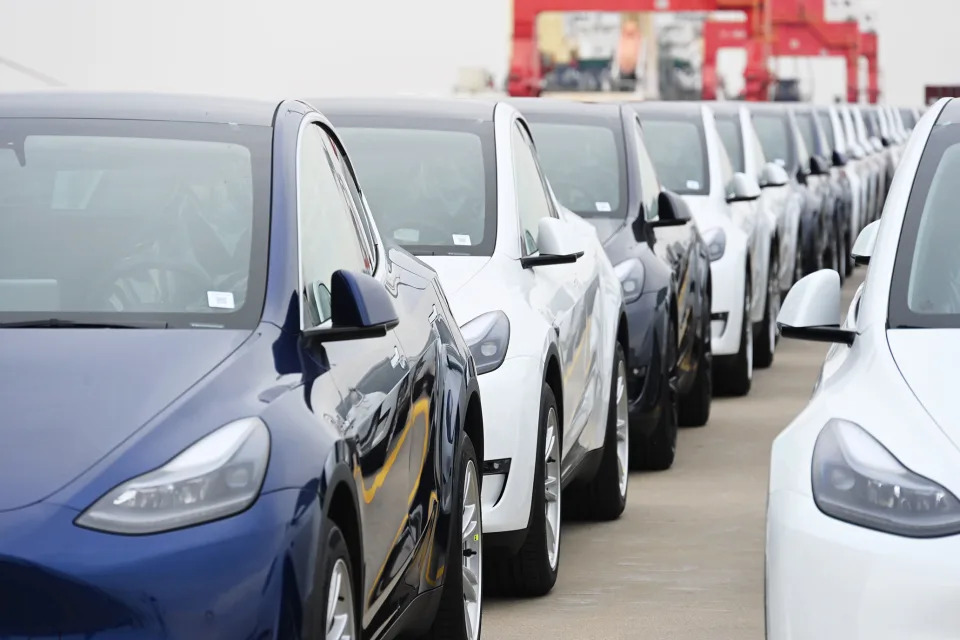
Tesla has already cornered the electric vehicle market in the U.S. Now it's calling for stricter regulations that will give it even more of an edge.

The Elon Musk–owned automaker is urging the Biden administration to adopt tougher fuel economy standards than regulators have proposed, a move that is likely to irritate legacy automakers like General Motors, Ford and Stellantis. Collectively, those three companies face a combined $10.5 billion in noncompliance fines from 2027 to 2032 under the proposed standards and have already urged regulators to ease up.

Tesla's call on regulators to double down is another way for the company to one-up its competitors. GM, Ford and Stellantis are embroiled in a bitter union strike that has already cost them $3.45 billion and will affect their rollout of electric vehicles. And as strike costs mount, these automakers appear to be dealing with softening demand for their EVs, which are priced at a premium. Tesla's workforce is non-unionized and it only produces electric vehicles, so the company stands to gain from both the strikes and stricter fuel standards.

And Tesla might just need the boost if it wants to continue to dominate the EV market share in the U.S. The company has been slashing its car prices to boost sales. And while Tesla delivered a record number of vehicles in the third quarter this year, its market share is down 10 points from a year ago.

In a letter to the National Highway Traffic Safety Administration (NHTSA), Tesla said the agency should finalize rules to increase the Corporate Average Fuel Economy (CAFE) standards by 6% annually for passenger cars and 8% annually for trucks and SUVs. That's up from the NHTSA's proposal of 2% for cars and 4% for trucks and SUVs, which would reach an average fleet fuel economy of 58 miles per gallon by 2032.

Tesla argues its own proposals would "significantly reduce energy consumption, mitigate climate change, and appropriately recognize the increasing marketplace adoption of BEV technology in both the light-duty and [heavy-duty pickup truck] sectors." That last part is important. One of the main themes throughout Tesla's letter to the NHTSA is that the agency doesn't correctly consider the current and projected market penetration of EVs.

Tesla writes that numerous manufacturers -- like Toyota, Hyundai, JLR and Subaru -- have announced EV production goals that fall within the timeframe of the proposed standard, and highlighted the over $115 billion that automakers and battery makers have committed to expand EV and battery production in North America.

"EVs represent 9.1 percent of new light-duty vehicle sales in the second quarter of 2023," reads the letter. "Continuing this rapid growth has led to estimates that by 2024 every third commercially newly registered car could be an electric vehicle."

Tesla also calls NHTSA out for leaving out future vehicle models, like the Cybertruck pickup, from its modeling. The rollout of the futuristic-looking pickup truck has been long delayed, but Tesla said it expects to begin deliveries of the Cybertruck later this year. The EV maker appears to have shared with the NHTSA how many vehicles it will deliver this year and its plans for production ramp up in order. That information was redacted from the published version of the letter, but it's clear Tesla thinks it can produce enough so that the heavy-duty pickup truck standards it suggested will by "technologically feasible" by 2024.

The NHTSA's proposal also includes a note to reduce "off-cycle credits," which allow automakers to earn credits for adopting technologies that improve the real-world fuel efficiency of their vehicles beyond what the CAFE standard tests measure. Things like improved air-conditioning systems and advanced engine stop-start systems that shut off the engine when the vehicle is stopped. Tesla says the NHTSA should take those things off the table entirely.

"Even if reduced, the continuing of off-cycle crediting creates asymmetry in the regulation favoring ICE vehicles, diverts research and development investment away from the best emissions reduction technology of electrification, and unnecessarily weakens the stringency of the standard," writes Tesla.

Throughout the letter, Tesla peppered its humble brags about its own technological capabilities with reminders that its suggested fuel standards would result in better climate outcomes. And indeed, harsher fuel standards would result in fewer emissions, but only if automakers are able to adhere to those standards. If not, they'll just be paying fines for noncompliance.

The Alliance for Automotive Innovation last month said automakers would face more than $14 billion in noncompliance penalties between 2027 and 2032 under the proposed standards. Toyota on Tuesday said those fines are proof that the standards are not technologically feasible.

Most other automakers have called the NHTSA's proposals unreasonable and have requested revisions. They almost certainly couldn't stomach the more radical standards Tesla is proposing.

The American Automotive Policy Council, a group that represents the Detroit Three automakers (GM, Ford and Stellantis), urged the NHTSA to halve its proposed fuel economy increases to 2% for trucks, claiming the proposal would "disproportionately impact the truck fleet." The organization said 83% of the vehicles produced by Ford, GM and Stellantis are trucks.

Once again, Tesla would be safe here. The EV automaker began initial delivery of its electric Semi truck in December 2022, and in January announced a $3.6 billion expansion to its Nevada gigafactory in large part to scale manufacturing of the Class 8 truck.

Earlier this year, the Department of Energy also proposed to revise how it calculates petroleum-equivalent fuel economy ratings for EVs in the CAFE program, something that the Zero Emission Transportation Association, a coalition of companies advocating for 100% EV sales, has backed. Yet automakers have said that revision would devalue the fuel economy of EVs by 72%.


BHP to Sell Coking Coal Mines to Whitehaven for $3.2 Billion


Sybilla Gross and Megawati Wijaya
Wed, October 18, 2023 


(Bloomberg) -- BHP Group Ltd. agreed to sell two Australian coking coal operations to Whitehaven Coal Ltd. for at least $3.2 billion, as the world’s biggest miner extends its withdrawal from fossil fuels.

Whitehaven will pay $3.2 billion for the assets, along with additional payments of up to $900 million contingent on realized pricing exceeding agreed thresholds, it said in a statement Wednesday. It is also considering selling a minority stake in the assets to global steel producers through a joint venture, it added.

Shares of Whitehaven in Sydney closed 11% higher for the biggest jump since October 2020. Trading in the shares was halted during the morning, and resumed after the company released its statement. BHP finished up 0.7%.

Read More: BHP’s Iron Ore Output Falls 4% as It Confirms Coal Mine Sale

BHP co-owns the mines, which supply metallurgical coal to steelmakers in markets including China and India, in a 50:50 joint venture with Mitsubishi Corp. The bidding process for the two mines drew competition from rivals including Indonesia-based mining contractor Bukit Makmur Mandiri Utama PT, Stanmore Resources Ltd. and Peabody Energy Corp.

Since 2021, BHP has announced sales of coal, oil and gas assets in locations including Australia, the US and Colombia under Chief Executive Officer Mike Henry’s strategy to refocus the producer’s portfolio on materials tied to growth in renewable energy, electric vehicles and agriculture. The Melbourne-based company this year completed its biggest deal in more than a decade to add OZ Minerals Ltd. and boost volumes of copper, a key transition metal.

Henry has also focused on shedding costlier mines and argues BHP should only retain its highest-quality metallurgical coal operations which can potentially help customers limit some emissions in the steelmaking process. Royalties on output imposed by Queensland’s government mean the coal mines are unlikely to win major investment in the future, he previously said.

BHP will be the No. 3 supplier of the material after completing the sales and could seek to exit its stakes in remaining assets, Liberum Capital Ltd. said in a Sept. 20 note.

Read more: BHP Plans to Keep Remaining Coal After Completing Mine Sales

The producer has no current plans to consider sales of other Queensland coking coal operations, Chief Development Officer Johan van Jaarsveld said Oct. 5 in Melbourne.

BHP’s sale of the two mines was labeled “irresponsible” by the Australasian Centre for Corporate Responsibility, a shareholder advocacy group.

“Whitehaven Coal is a company determined to keep digging up and burning coal as more responsible stewards race to limit global warming,” the group said in an emailed statement. Selling “fossil fuel assets to climate laggards does nothing to assist the urgently required cuts to real world emissions,” it added.

Whitehaven said the acquisition of the two mines, which doesn’t require shareholder approval, is expected to be completed in the June 2024 quarter.

The sale announcement comes as BHP said iron ore production from Western Australia fell 4% in the three months to Sept. 30 from the year-before period. Still, it reaffirmed its total output forecast of the steelmaking material for the full-year that started July 1 at between 282 million to 294 million tons. It also said copper output rose 11% in its first quarter, while metallurgical coal fell 16%.

--With assistance from Georgina McKay.

Most Read from Bloomberg Businessweek
Bank of America warned consumers they would be pushed to the ‘point of pain’—and CEO Brian Moynihan says we’ve now reached that point

Eleanor Pringle
Wed, October 18, 2023 


It's a message now echoing in every corner of Wall Street: consumers have finally run out of steam.

It's an eventuality Bank of America has predicted since March, when analysts warned that the Fed would push consumers to the "point of pain" in order to tame inflation.

And now according to Bank of America's CEO, Brian Moynihan, that time has come.

Speaking to CNBC's 'Squawk on the Street', Moynihan said the way consumers are acting is consistent with a "low growth, low inflation economy" which the U.S. saw from 2016 to 2019.

In a given year, Bank of America customers spend $4 trillion dollars—be it using a debit or credit card, writing a check, confirming a bank transfer, or taking cash out to spend.

From 2021 to 2022 that spend grew by 10%, Moynihan said, and began dropping to 9% in Q1 2023.

Now that growth figure has dropped to 4.5%, he added, signaling consumers are either too nervous to spend the money they have, or have less in their pandemic-boosted savings accounts to sustain their spending levels.

"That is the same of September and October," Moynihan continued. "That growth rate ... is consistent to where we were in '16, '17, '18, '19 which was a low growth, low inflation economy."

"Consumers' activity has slowed down ... it's slowed by half, and that means the consumer is being slowed down by the interest rate environment and all the stuff going on."
Lower income homes are impacted more

Moynihan went on to support an observation made by Citigroup CEO Jane Fraser, who said "cracks" are beginning to show in consumer spending, particularly by lower-end consumers.

Fraser said that while Citi’s data shows consumer spending is still “good” and is in positive figures, the growth has begun to “come off,” explaining to CNBC that in September numbers, “the softening of the growth in demand, is…evident.”

Savings are down for lower-end consumers, Fraser added: “They’re very low at the moment and I think some of the excess savings from the COVID years are close to depletion.”

Moynihan said that Bank of America has found similar trends. He said median income households have lower account balances and are spending down their pandemic war chests.

Higher income households have similarly moved their money out of checking accounts, but have instead moved their fortunes into investments.

"You're seeing that deterioration of positive balances and consumers in those medium income households down a little bit," Moynihan said. "That means they're spending some money in excess of what they bring in. So that means the economy has slowed down, consistent with a low growth, low inflation economy."
Is the Fed's plan working?

If the so-called 'YOLO spenders' (you only live once) have indeed run dry and the economy is inching back, as Moynihan says, to low growth—then has the Fed's plan really paid off?

The first priority of the Fed was to tackle inflation—which has indeed come down. In September 2023, inflation sat at 3.7%, down from 8.3% a year prior.

Economists seem largely satisfied by this effort—though many have warned the most difficult part of bringing inflation down lies ahead.

Treasury secretary Janet Yellen remarked inflation is being “really well-behaved” while Wharton professor Jeremy Siegel believes rates will hold steady in November.

In his weekly Wisdom Tree commentary, Professor Siegel observed there is still a great deal of economic uncertainty—not least tensions in the Middle East.

Despite this, Professor Siegel wrote: "We're poised for a year-end rally in equities and a good year for 2024."

This story was originally featured on Fortune.com
CRIMINAL CAPITALI$M
Singapore to Inspect Credit Suisse, Others in Major Scandal


Chanyaporn Chanjaroen
Wed, October 18, 2023 


(Bloomberg) -- Singapore’s financial regulator will conduct an on-site inspection of Credit Suisse Group AG after at least one of its customers was charged for money laundering in a scandal that has rocked the city-state.

The local unit of Credit Suisse will be among banks the Monetary Authority of Singapore plans to examine to determine whether they properly handled the monitoring of wealthy clients, according to people familiar with the matter. Officials from the regulator are set to interview personnel and review documents within weeks, the people said, asking not to be identified as the information isn’t public.

The planned inspection underscores the seriousness of the scandal that has ensnared at least 10 domestic and international banks in the Asian financial hub. More than S$2.8 billion ($2 billion) of assets from cash to jewelry have been seized from a group of alleged money launderers with Chinese origin.

The MAS’s upcoming visit would be outside its regular engagements with banks, and signals potential issues with the lenders’ sizable exposure to the suspects and overall handling of client vetting, the people said. Credit Suisse is among the banks that have relationships with either the accused, or their companies. One of the suspects, Vang Shuiming, held S$92 million at the Swiss lender, the biggest known account so far in the case.

Credit Suisse declined to comment. An MAS spokesperson referred Bloomberg News to comments made in parliament this month by Minister of State Alvin Tan, who said the regulator is conducting supervisory reviews and inspections of the banks with “a major nexus” to the case. Tan also said it was concerning that financial assets made up the vast bulk of what was seized so far.

For Credit Suisse, the review is but one of many headaches its new parent UBS Group AG will have to deal with as it focuses on integrating thousands of employees from its former rival across the world. The MAS did a similar inspection on Credit Suisse in 2017 for its role in the 1MDB saga, Malaysia’s biggest corruption case, and consequently the bank was fined S$700,000. The amount was the smallest penalty the regulator imposed on banks in Singapore at the time.

With 1MDB, MAS’ actions in the aftermath of the scandal also included banning financiers over breaches and shuttering the local units of two Swiss banks.

Besides Credit Suisse, Vang also had bank accounts with others including Bank Julius Baer where he had S$33 million as well as United Overseas Bank Ltd. and RHB Bank Bhd.’s local unit, according to police affidavits. Vang’s other charges include forgery of a bank document to trick Citibank Singapore Ltd.

Another suspect, Wang Dehai, stashed millions at UBS, Industrial & Commercial Bank of China Ltd and Bank of China Ltd. in Hong Kong, according to a police affidavit seen by Bloomberg News after a court hearing Wednesday. Wang has been wanted in China for alleged illegal online gambling activities since 2017, according to the document, which referred to UBS as Union Bank of Switzerland.

It is not clear which other banks will be subject to the MAS inspection, which could look into what red flags were raised internally and when so-called suspicious transaction reports were filed, the people added.

After the case erupted in August, banks in the city-state have further stepped up existing scrutiny on clients especially those of Chinese origins with multiple passports, Bloomberg reported last month. The authorities are also looking into how one or more of the accused may have been linked to single family offices with incentives, and will tighten the rules where necessary.

Investigations of the money-laundering ring date back to 2021 after banks and companies filed suspicious transaction reports, communications minister Josephine Teo told parliament. The MAS earlier said these reports had alerted authorities to suspicious activities attempted through the country’s financial system.

--With assistance from Joyce Koh and Low De Wei.

(Updates with UBS and two major banks’ involvement in scandal in ninth paragraph. An earlier version updated with details of MAS actions after another scandal.)

Most Read from Bloomberg Businessweek
Amazon rolls out robotic system at Houston warehouse to speed up deliveries

Reuters
Wed, October 18, 2023 


(Reuters) - Amazon.com said on Wednesday it was using a robotic system at one of its Houston warehouses to improve inventory management and speed up deliveries, building on its years-long bet that automation will help boost sales and worker safety.

The technology, called "Sequoia", brings together a series of systems including mobile robots and robotic arms.

Amazon said Sequoia can help identify and store inventory 75% faster, while reducing the time to process orders at a warehouse by as much as 25%.

The e-commerce giant has been investing aggressively in automation for years, using them to package orders and creating technology that enables cashier-less retail stores, among others.

Several other major retailers have also recently laid out plans to invest in robotic systems, with rival Walmart saying earlier this year it expects about 65% of its stores to be serviced by automation by the end of its fiscal year 2026.

Amazon, which has been in the crosshairs of U.S. safety regulators for allegedly hazardous conditions at its warehouses, is also banking on robots to improve worker safety.

The company said it would begin testing a bipedal robot called "Digit" from Agility Robotics, a startup backed by Amazon. Digit, already in testing at Ford, can move, grasp, and handle items in warehouses.

(Reporting by Zaheer Kachwala in Bengaluru; Editing by Shounak Dasgupta)


DUST IS DANGEROUS
Federal jury convicts 2 employees in fatal Wisconsin corn mill explosion

HARM VENHUIZEN
Tue, October 17, 2023 

 Part of the Didion Milling Plant in Cambria, Wis., lies in ruins following an explosion on June 1, 2017. A federal jury has convicted two Didion Milling senior employees of falsifying records and obstructing an investigation into the fatal corn dust explosion at the company's Cambria plant in 2017, Justice Department officials announced on Tuesday, Oct. 17, 2023. 
(John Hart/Wisconsin State Journal via AP, File) 


MADISON, Wis. (AP) — A federal jury has convicted two senior employees at a Wisconsin corn plant of falsifying records and obstructing an investigation into a fatal corn dust explosion in 2017, Justice Department officials announced on Tuesday.

Corn dust is explosive, and high concentrations are dangerous. Federal regulations require grain mill operators to perform regular cleanings to reduce dust accumulations that could fuel a blast.

Jurors found Derrick Clark, vice president of operations at Didion Milling, and Shawn Mesner, a former food safety superintendent at the company, guilty of multiple safety, environmental and fraud charges on Friday. The two men are the latest in a growing list of Didion employees found guilty in association with the 2017 explosion that killed five people at the company's Cambria corn mill.

Attorneys listed for both men did not immediately respond to voicemails seeking comment on Tuesday.

Didion Milling pleaded guilty in September to charges that its employees falsified environmental and safety compliance records for years leading up to the explosion. The company agreed to pay a $1 million fine and $10.25 million to the estates of the five workers who were killed.

Clark was convicted on Friday of making false Clean Air Act compliance certifications and lying to investigators during a deposition. Mesner was found guilty of conspiring to mislead Occupational Safety and Health Administration investigators by lying on sanitation records that tracked cleanings meant to remove corn dust from the mill.

“Derrick Clark and Shawn Messner chose to intentionally mislead OSHA investigators and made false statements about their knowledge of working conditions at the plant to protect themselves and cover their mistakes,” OSHA Regional Administrator Bill Donovan said in a statement.

Sentencing hearings have not yet been scheduled for either of the men. At least five other Didion employees have pleaded guilty or been convicted of charges including concealing environmental violations, lying to investigators and falsifying cleaning logs.

___

Harm Venhuizen is a corps member for the Associated Press/Report for America Statehouse News Initiative. Report for America is a nonprofit national service program that places journalists in local newsrooms to report on undercovered issues.
WORKERS CAPITAL
AI should cut pensions costs, highlight risks -report

Reuters
Mon, October 16, 2023 


LONDON (Reuters) - Artificial intelligence should improve pensions performance by cutting costs and highlighting upcoming risks, the Mercer CFA Institute's global pensions report said on Tuesday, with the Netherlands in top spot in this year's index.

Additional uses for AI could include building customised portfolios and identifying market anomalies, although AI was unlikely to be able to predict market movements with accuracy so uncertainty will remain, the report said.

"The ongoing expansion of AI within the operations and decisions of investment managers could lead to more efficient and better-informed decision-making processes, which could potentially lead to higher real investment returns to pension plan members," said David Knox, senior partner at Mercer.

The annual survey, which is sponsored by the CFA Institute association of investment professionals in collaboration with Mercer and the Monash Centre for Financial Studies, also pointed to risks of AI models generating fake information when used in a new context, and of cyber attacks against pension members' data.

The Netherlands scored top marks in the survey of 47 pension systems around the world for the level of private and public sector pension benefits available, the sustainability of the system to last decades into the future and the quality of its governance, knocking Iceland off last year's top position.

Iceland came second and Denmark third in the 2023 index.

(Reporting by Carolyn Cohn; Editing by Alexander Smith)

EU securities watchdog warns investors over crypto market protections

Huw Jones
Tue, October 17, 2023 

FILE PHOTO: Bitcoin and ether souvenir tokens plunge into water


By Huw Jones

LONDON (Reuters) - Investors will not be protected under European Union cryptoasset market rules until at least the end of 2024, and even then they should still be ready to lose all their money, the bloc's securities watchdog said on Tuesday.

The EU was the first jurisdiction in the world to approve a comprehensive set of rules to regulate markets for cryptoassets like bitcoin, which entered into force in June but won't be fully applied until December 2024.

Regulating crypto has become more urgent for regulators after the collapse of crypto exchange FTX and with huge volatility in bitcoin prices.

Cryptoassets are currently unregulated under EU securities rules, and the European Securities and Markets Authority (ESMA) said investors would not benefit from any EU-level regulatory and supervisory safeguards, or recourse mechanisms under the new rules, known as MiCA, until December 2024.

"Even with the implementation of MiCA, retail investors must be aware that there will be no such thing as a ‘safe’ cryptoasset," the EU watchdog said in a statement.

"Can you afford to lose all the money you are planning to invest?" ESMA said, adding that cryptoassets were prone to "novel operational and security risks".

Full protections may not be available in EU states that grant an 18-month transitional period for crypto firms to operate without an EU licence, meaning customers may not be covered until July 2026.

A significant number of crypto firms would probably continue to offer their services under the transitional terms until mid-2026, ESMA said.

Crypto firms from non-EU countries will be allowed to provide services to customers in the bloc that have specifically requested them, and even then only on a "strictly limited" basis.

"While this exemption will be subject to further guidance by ESMA, it should be understood as very narrowly framed and as such must be regarded as the exception; and it cannot be assumed, nor exploited to circumvent MiCA," ESMA said.

The watchdog said it was working with national regulators to encourage convergence in applying MiCA rules as soon as possible so that firms understand that the EU is not a place for "forum-shopping or illicit practices".

(Reporting by Huw Jones; Editing by Emelia Sithole-Matarise)