It’s possible that I shall make an ass of myself. But in that case one can always get out of it with a little dialectic. I have, of course, so worded my proposition as to be right either way (K.Marx, Letter to F.Engels on the Indian Mutiny)
Wednesday, October 18, 2023
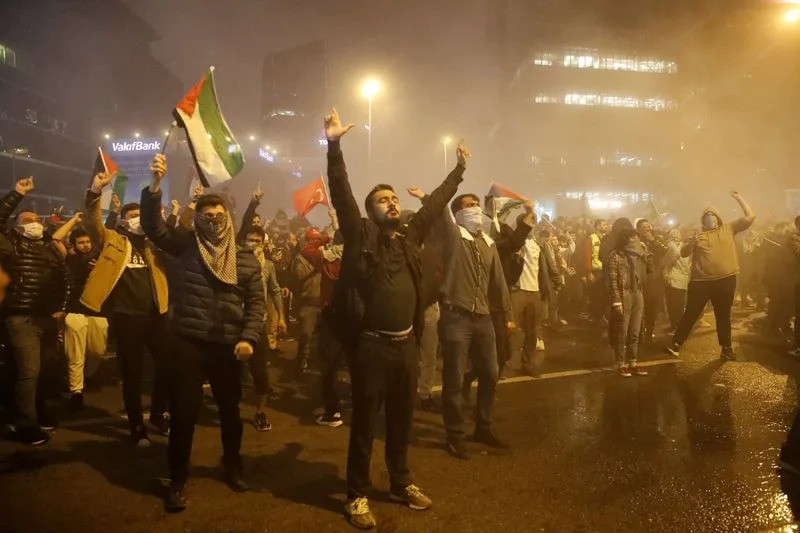
Fury grows in Turkey against Israel, fresh protests staged
Ece Toksabay and Ali Kucukgocmen Updated Wed, October 18, 2023
Pro-Palestinian protest near the Israeli Consulate in Istanbul
By Ece Toksabay and Ali Kucukgocmen
ANKARA (Reuters) -Turkish protesters staged fresh anti-Israel demonstrations on Wednesday as Turkey was set to declare three days of mourning following a blast that killed large numbers of Palestinians at a Gaza hospital.
Palestinian officials said the blast at Al-Ahli al-Arabi hospital was caused by an Israeli air strike. Israel blamed the blast on a failed rocket launch by the Palestinian Islamic Jihad group, which denied responsibility.
President Tayyip Erdogan called the explosion "the latest example of Israeli attacks devoid of the most basic human values".
Turkey's presidential communications office quickly branded Israel's claim "#FakeNews" on social media platform X.
Erdogan declared three days of mourning in Turkey late on Wednesday for the Palestinians killed at the hospital in Gaza.
Overnight Turks marched with Palestinian flags and chanted slogans denouncing Israel in at least a dozen Turkish cities, including outside the Israeli embassy in the capital Ankara.
Police used pepper spray and water cannon to disperse thousands of protesters who tried to enter the compound of Israel's consulate in Istanbul, Turkey's largest city. Five people were detained, the Istanbul governor's office said.
Israel's National Security Council (NSC) issued a warning against travel to Turkey, citing fears that Israelis would be targeted by those angry at the war. It also urged Israeli citizens in Turkey to leave as soon as possible.
Following the NSC's appeal, Israeli airlines arranged flights from Istanbul late on Wednesday for Israelis who want to leave Turkey.
"I want to be at home. That's all," an Israeli woman, who declined to give her name, told Reuters while queuing for the flight check-in at Istanbul Airport.
On Wednesday, there was a large security presence around the consulate, with hundreds of police officers and around 10 water cannon vehicles deployed behind a line of metal barriers. Police conducted identity checks on those seeking to pass through.
Protesters held fresh demonstrations near consulates of Israel and the United States in Istanbul on Wednesday evening. In Ankara, a few hundred protesters marched following a symbolic funeral prayer held for those killed in the hospital.
The U.S. consulate in southern city of Adana will remain closed until further notice and U.S. government personnel have been instructed to minimise movements in Turkey due to protests, the U.S. Embassy in Ankara said in a statement.
Political analysts said the Gaza hospital blast could have dire consequences for ties between Israel and Turkey.
"Ankara is now likely to assume a much harder anti-Israel stance...," said Wolfango Piccoli at Teneo.
"Erdogan may even decide to abandon the rapprochement with Israel, which was initiated in 2022 after more than 10 years of fraught ties between the two countries... A deterioration in relations between Turkey and Israel would also likely impact Turkey-U.S. ties, creating further stress between the two NATO allies at a volatile time."
(Reporting by Ece Toksabay, Mert Ozkan and Huseyin Hayatsever in Ankara, Bulent Usta, Dilara Senkaya, Daren Butler, Ali Kucukgocmen, Umit Bektas and Mehmet Emin Caliskan in Istanbul, Steven Scheer in Jerusalem; Editing by Gareth Jones and Sandra Maler)
Gaza carnage spreads anger across Mideast, alarming US allies and threatening to widen conflict
SAMY MAGDY and JOSEPH KRAUSS Updated Wed, October 18, 2023
1 / 19 Lebanon US Israel Palestinians Protesters try to remove barbed wires that block a road leading to the U.S. embassy, during a demonstration in solidarity with the Palestinian people in Gaza, in Aukar, a northern suburb of Beirut, Lebanon, Wednesday, Oct. 18, 2023. Hundreds of angry protesters are clashing with Lebanese security forces in the Lebanese suburb Aukar near the United States Embassy to support Gaza in its ongoing war with Israel. (AP Photo/Bilal Hussein)
CAIRO (AP) — Within hours after a blast was said to have killed hundreds at a Gaza hospital, protesters hurled stones at Palestinian security forces in the occupied West Bank and at riot police in neighboring Jordan, venting fury at their leaders for failing to stop the carnage.
A summit planned in Jordan on Wednesday between U.S. , Jordan's King Abdullah II, Egyptian President Abdel Fattah el-Sissi and Palestinian was canceled after Abbas withdrew in protest.
U.S. Secretary of State Antony Blinken had spent much of the past week meeting with Arab leaders to try to ease tensions, but those efforts are now in doubt following the hospital blast. The raw nerve of decades of Palestinian suffering, left exposed by U.S.-brokered normalization agreements between Israel and Arab states, is throbbing once again, threatening broader unrest.
“This war, which has entered a dangerous phase, will plunge the region into an unspeakable disaster,” warned Abdullah, who is among the closest Western allies in the Mideast.
There were conflicting claims of who was responsible for the hospital blast. Officials in Gaza quickly blamed an Israeli airstrike. Israel denied it was involved and released a flurry of video, audio and other information that it said showed the blast was due to a rocket misfire by Islamic Jihad, another militant group operating in Gaza. Islamic Jihad dismissed that claim.
The Associated Press has not independently verified any of the claims or evidence released by the parties.
Biden, speaking in Tel Aviv, said the blast appeared to have been caused “by the other team,” not Israel.
But there was no doubt among the Arab protesters who gathered in several countries late Tuesday to condemn what they saw as an Israeli atrocity.
In the Israeli-occupied West Bank, which has been under lockdown since a bloody Oct. 7 rampage by Hamas militants ignited the war, protesters clashed with Palestinian security forces and called for the overthrow of Abbas.
Israel and the West have long viewed Abbas as a partner in reducing tensions, but his Palestinian Authority is widely seen by Palestinians as a corrupt and autocratic accomplice to Israel's military occupation of the West Bank.
Jordan, long considered a bastion of stability in the region, has seen mass protests in recent days. Late Tuesday, pro-Palestinian protesters tried to storm the Israeli Embassy.
“They are all normalizing Arab rulers, none of them are free, the free ones are all dead!" one protester shouted. "Arab countries are unable to do anything!”
Egypt was the first Arab country to make peace with Israel, in the late 1970s. Jordan followed in 1994.
Thousands of students rallied at Egyptian universities on Wednesday to condemn Israeli strikes on Gaza. Protesters in Cairo, Alexandria and other cities chanted “Death to Israel” and “With our souls, with our blood, we sacrifice for you, Al-Aqsa,” referring to a contested Jerusalem holy site. A smaller protest was held near the U.S. Embassy in Cairo on Tuesday.
Such protests are rare in Egypt, where authorities have clamped down on dissent for over a decade. But fears that Israel could push Gaza's 2.3 million residents into Egypt's Sinai Peninsula, and soaring consumer prices due to runaway inflation, could prove a volatile mix in the country, where a popular uprising toppled a U.S.-backed autocrat in 2011.
Protests also erupted in Lebanon, where Hezbollah has traded fire with Israeli forces at the border, threatening to enter the war with its massive arsenal of rockets. Hundreds of protesters clashed with Lebanese security forces on Wednesday near the U.S. Embassy in Beirut, where riot police lobbed dozens of tear gas cannisters and fired water cannons to disperse demonstrators.
Protests have also been held in Morocco and Bahrain, two countries that forged diplomatic ties with Israel three years ago as part of the Abraham Accords.
“The Arab street has a voice. That voice may have been ignored in the past by governments in the region and the West … but they cannot do this anymore,” said Badr al-Saif, a history professor at Kuwait University. “People are on fire.”
As recently as a couple of weeks ago, the regional outlook seemed far different.
He said Israel was “at the cusp of an even more dramatic breakthrough" — a historic agreement with Saudi Arabia that the Biden administration had been focused on in recent months.
The Abraham Accords, with the United Arab Emirates, Bahrain, Morocco and Sudan, were reached with autocratic leaders willing to set aside the Palestinian issue in order to secure their own benefits from the U.S. The UAE hoped for advanced fighter jets. Morocco won U.S. support for its claim to Western Sahara, and Sudan's ruling military junta got longstanding U.S. sanctions lifted.
Saudi Arabia had asked for a U.S. defense pact and aid in establishing a civilian nuclear program, as well as a substantial concession to the Palestinians that the Saudis have yet to publicly spell out.
Shimrit Meir, who served as a diplomatic adviser to former Israeli Prime Minister Naftali Bennett, said “time will tell” what impact the war will have on normalization efforts.
“In the short term, they will suffer, especially the hope for a breakthrough" with Saudi Arabia, she said. “In the longer run, Israel’s appeal and value to these countries comes from its military strength. Therefore, the need for it to restore its deterrence is above any other considerations.”
Despite all the high-level diplomacy, ordinary Arabs and Muslims still express strong solidarity with the Palestinian cause. During last year's World Cup soccer tournament, for example, Palestinian flags were waved in abundance even though the national team did not compete.
The recent devastation in Gaza has stirred those sentiments again.
“No Arab government is able to extend its hand to Israel amid its aggression on the Palestinians,” said Ammar Ali Hassan, an Egyptian political scientist.
“The Arab peoples won’t accept such a move. Even the rulers wouldn’t benefit from such ties at this time."
___
Krauss reported from Jerusalem. Associated Press writers Kareem Chehayeb in Beirut and Amy Teibel in Jerusalem contributed to this report.
Opinion
Granderson: Those campus rallies aren't just pro-Palestinian. They're anti-colonial
LZ Granderson Wed, October 18, 2023 Students rally in support of Palestinians on the UCLA campus on Oct. 12.
(Luis Sinco / Los Angeles Times)
Abe Baker-Butler, a junior at Yale University, was working on an essay in the library on Oct. 7 when his phone began buzzing and wouldn’t stop. Israel was under attack.
As president of the American Jewish Committee’s Campus Global Board, Baker-Butler was receiving texts from Jewish college students around the world, some of whom he had met during his most recent visit to Israel in June. Among those in the group chat were Israeli military reservists who have since returned to active duty.
Then came the “free Palestine” protests.
After the killings and kidnappings of Israeli civilians, he said, “these campus rallies were supporting the success" of Hamas.
“I couldn’t believe it. These campus activists were holding a rally in what they say is in celebration of the resistance. I was extremely angry and disappointed,” Baker-Butler told me, adding: “A lot of Jewish students don’t feel safe.”
Antisemitism has long been a part of America’s fabric. In fact, in May the Biden administration released its National Strategy to Counter Antisemitism — the first of its kind — because of recent years’ uptick in violence and rhetoric against the Jewish community in the U.S.
Still, the beyond-tone-deaf rallies on campuses were a shock for a lot of people, including me. The death toll was still climbing in Israel, and it seemed many college students not only didn’t care about the civilian victims but even supported what Hamas had done.
I’m currently a visiting scholar at my alma mater, Western Michigan University, and I have not seen such protests on that campus. But I did witness one at Arizona State, one of the largest schools in the country. There were a lot of pro-Palestinian young people out marching, and many drivers honked their support as they passed.
Without question, antisemitism is a significant factor behind attendance at some of these rallies. Any event that celebrates a Hamas terrorist attack against Israeli civilians gets that label automatically in my book.
However, another driving force is anticolonialism. And therein lies the challenge for not only Baker-Butler and the American Jewish Committee, but also the Biden administration and other progressives disturbed by pro-Palestinian rallies that erupted almost immediately after the massacres.
To a certain kind of educated younger audience, the modern state of Israel looks a lot like yet another byproduct of European imperialism. They aren’t all wrong about that. There was the British Mandate for Palestine in 1923, which set the stage for dueling Palestinian and Jewish nationalist movements. Before settling on land in the Middle East, one Zionist leader proposed territory in what’s now Kenya as a possible safe haven for Jews — as if the land in question were unoccupied and England’s to offer.
Imperialism was alive and well when modern Israel was created in 1948 and hadn’t even had the decency to cloak itself under new names. England still had a “secretary of state for the colonies” until 1966. So, yes, from a certain perspective, any defense of Israel sounds like a defense of a colonial land grab. And the legitimacy of that idea has very much gone out of style.
Many progressives are no longer interested in perpetuating nonsensical folklore such as “Thanksgiving was a celebration” or “Columbus discovered America.” Indigenous Peoples’ Day is a thing now. Modern audiences get prickly about narratives that leave out messy colonial history. Many understandably want to keep complexity in our understanding of the world we inherited.
When I’ve spoken one on one with pro-Palestinian students, they acknowledge that what Hamas did was wrong. They also don’t hesitate to point out that Israel is a relatively recent creation, founded after World War II, and that Gaza — even before the bombings of recent days — was a resource-starved open-air prison.
It is my sense that for many attendees at pro-Palestinian rallies on campuses, the focus is on the past 100 years in the region, not the events from earlier this month. Today’s 20-year-olds have grown up with a historical awareness that fewer had in previous generations. That doesn’t mean they all arrive at the same interpretations.
“It’s not colonization,” Baker-Butler said. "Israel is the homeland of the Jewish people. Modern politics says Israel was established in World War II, but the Jewish people have lived on the land much longer than that.”
So how would the president of the American Jewish Committee’s campus group imagine making that point to his fellow students around the nation who are attending pro-Palestinian rallies? He says it starts with moving past fear and anger.
“The only way to have these conversations is through small-group, in-person dialogue and talking face to face,” he said.
The organization recently provided parents and guardians tools to guide conversations about the Israel-Hamas war. On Thursday, Baker-Butler will be part of a virtual forum intended to let Jewish students share their feelings about the war and the challenges they currently face on campus.
“I have many friends in Israel, and many of them have lost friends and loved ones,” Baker-Butler said. “I was messaging one friend and asked if he was OK and he said, ‘Yeah, but a bunch of my friends were murdered.’ What kind of world are we living in?”
It's a world that's full of rage and violence. One in need of more compassion. One we’re counting on future generations to redeem.
The One Word Biden Failed to Say During His Big Speech in Israel
Edith Olmsted Wed, October 18, 2023
There was one word sorely missing from President Biden’s big speech in Israel on Wednesday: “ceasefire.”
Biden visited Israel on Wednesday to express solidarity with the country and meet with leaders there. In a lackluster speech from Tel Aviv, he cautioned against Israeli aggression and condemned Hamas, but carefully avoided calling for a de-escalation in the conflict.
“Hamas committed atrocities that recall the worst ravages of ISIS, unleashing pure, unadulterated evil upon the world. There’s no rationalizing it, no excusing it. Period,” Biden said.
He made the distinction that the “vast majority of Palestinians are not Hamas. Hamas does not represent the Palestinian people,” he said.
However, he only issued a soft warning to Israel: “While you feel that rage, don’t be consumed by it.”
“After 9/11 we were enraged in the United States. While we sought justice and got justice, we also made mistakes,” he said.
Biden did not call for a ceasefire or de-escalation, and promised to support Israel. “I know the choices are never clear or easy,” he said.
“What sets us apart from the terrorists is we believe in the fundamental dignity of every life,” Biden said, but he made no mention of the egregious statements made by many Israeli officials suggesting they believe just the opposite, and no condemnation of Israel’s indiscriminate massacre of Palestinians.
Israel’s immense military response in Gaza has left over 3,000 Palestinians dead and over 12,000 thousand injured, according to the Palestinian Ministry of Health. Israel continues to block Gaza from receiving any food, water, electricity, or humanitarian aid. On Tuesday, a bombing at a hospital in Gaza wounded and injured hundreds of people, further exacerbating the humanitarian crisis. Palestinian officials have blamed an Israeli airstrike, but Israeli officials claim that a misfired Hamas rocket was to blame, a point which Biden echoed in his speech.
Instead of calling for a ceasefire, Biden made it clear that his priorities lie with the Israelis.
“For me, as the American president, there is no higher priority than the release and safe return of all these hostages,” he said.
Biden said that the violence “cuts deeper” in Israel, because of the “scars left by millennia of antisemitism.” He pointed out that the day of Hamas’s incursion was the deadliest day for the Jewish people since the Holocaust.
“The world watched then. It knew. And the world did nothing. We will not stand by and do nothing again,” he said referring to mass genocide. This sentiment sits in stark contrast to statements like those of Holocaust scholar Raz Segal, who has called Israel’s military response in Gaza a “textbook case of genocide.”
Biden’s silence fits with a HuffPost report last week that found that U.S. diplomats have been warned not to use the words “de-escalation/ceasefire,” “end to violence/bloodshed,” and “restoring calm.”
Biden’s speech also comes shortly after the U.S. vetoed a U.N. Security Council resolution that condemned Hamas’s attack, condemned all violence against civilians, and called for a “humanitarian pause” in Gaza. The U.S. was the only country in the UNSC to veto this resolution.
The Inexcusable Omission in Biden’s Big Israel Speech
Alex Shephard
NEW REPUBLIC Wed, October 18, 2023
Much of the coverage of Joe Biden’s speech in Israel on Wednesday has understandably focused ona warning. “Justice must be done,” Biden said, hours after arriving in Tel Aviv. “I caution this: While you feel that rage, don’t be consumed by it. After 9/11, we were enraged in the U.S. While we sought justice and got justice, we also made mistakes.”
It was an evocative and apt word of caution. The devastating attacks on civilians perpetrated by Hamas on October 7 recall the brutality of the September 11 attacks. But it’s also highly reminiscent of the errors in judgment that can be made in the hot haze of retribution, specifically the lack of concern for civilian deaths in retaliatory strikes and, relatedly, the apparent lack of concern for the potential short and long-term consequences of retaliatory actions in general. Israel, much like the United States did in response to 9/11, has adopted an abstract, possibly unfulfillable goal that justifies endless war: in this case, the eradication of Hamas.
Biden’s flick to the way our own military misadventures paved the road to regret was perhaps the only suggestion that restraint might be the more intelligent choice. The message was hardly subtle, even if Biden didn’t exactly spell it out. After 9/11, the U.S. blundered into two wars that each lasted longer than a decade, destabilized an entire region, and permanently tarnished its reputation. In related remarks, Biden called on Israelis to recognize the humanity of Palestinians, millions of whom are currently trapped in Gaza, with limited access to food, water, and electricity. “The vast majority of Palestinians are not Hamas,” Biden said. “Hamas does not represent the Palestinian people.”
Some of Biden’s rhetoric was overbaked—one presumes that when he says we received the “justice” we sought, he means the death of bin Laden and the destruction of Al Qaeda (more or less), a few highlights plucked from a mostly dreary reel. But it’s rare to hear a president speak about great national errors in this fashion. It certainly stands apart from notable past efforts to speak with a chastened tongue—one thinks of Ronald Reagan’s passive “mistakes were made” commentary offered in the wake of the Iran-Contra scandal.
Nonetheless, it’s hard to quibble with the comparison Biden attempted to make. These particular parallels with 9/11—perhaps the only ones that matter—are clear. Israel, bent on vengeance, has already killed thousands of Palestinian civilians in retaliation. The conflict is already spiraling out of control, and there is a very real possibility that it could touch off a regional conflict with profound, devastating, and unknown consequences. Israel may get a feeling of retribution, as America did after 9/11. But in doing so it may unleash a metric ton of devastation, also as America did after 9/11.
By invoking the September 11 attacks, Biden made it clear that he and his administration understand the potential, and indeed likely, risks of Israel’s profoundly dehumanizing and destructive response to Hamas’s heinous attacks. The problem was that the rest of the speech, in which Biden, in no uncertain terms, made it clear that his administration will continue to back those attacks for as long as possible, undercut the virtuous recollection of September 11. And there was one particular omission that stood out in its grave absence—the one word that could halt this deadly misery: ceasefire. The one unimpeachable position that Biden can take right now, as the fog of war threatens to consume everyone, is that a cessation of hostilities would be morally correct, politically sound, effective from a humanitarian perspective, and would push the conflict in the direction in needs to go right now: everyone sitting down and talking to one another.
The need for a ceasefire is especially great given that Israel’s prime minister, , is an untrustworthy ally who is bent on exacerbating the conflict in order to prolong his loosening grip on power. “Netanyahu suddenly faces a long, bloody war with the Palestinians after spending most of his political career sidelining, short-shrifting, and underestimating them, all the while relying on his country’s military superiority—including its Iron Dome anti-missile system—to protect Israel,” wroteForeign Policy’s Michael Hirsch. His Cabinet is stacked with far-right ultranationalists; he himself took a number of actions that explicitly elevated Hamas, all for his political benefit.
Even with its warnings, Biden’s speech mostly gave Netanyahu the political cover to continue striking Gaza with impunity. Thousands of missiles have struck Gaza over the last week, killing more than 3,000 Palestinians. “Hamas committed atrocities that recall the worst ravages of ISIS, unleashing pure unadulterated evil upon the world,” Biden said. He went on to say that his administration would be seeking an “unprecedented support package for Israel’s defense,” to the tune of $10 billion.
It’s impossible to square this gargantuan sum that Biden proposes to hand over to Netanyahu with his other admonitions, which call to mind the small fortunes that were lost to sinkholes in Iraq and Afghanistan. The administration is trying to do two equally impossible things at once. It is urging Israel, as Biden has said, to use restraint and avoid civilian casualties. At the same time, it is pledging to underwrite, to the tune of billions of dollars, weapons that will undoubtedly lead to vastly more civilian deaths.
What is Biden getting in exchange for this money? At the moment, he needs that leverage to buy him a freer hand to moderate Netanyahu’s approach to the war. Biden has promised $100 million in aid to Gaza and was able to ensure that food, water, and medicine would be able to enter Gaza via Egypt—welcome news given that an Israeli blockade has kept vital aid from reaching the area for days. But this was the extent of the rewards wrought by America’s diplomatic efforts.
Biden, notably, did not call for Israel to allow Palestinian civilians to peacefully evacuate, which means that hundreds of thousands of people are still effectively trapped in the line of fire. A planned summit in Jordan with leaders from that country, Israel, and Egypt was abruptly called off in the wake of the bombing of a hospital in Gaza that Biden said U.S. intelligence believes was the result of a failed rocket launch from a Palestinian militant group. Whatever avenue this might have provided to push for further diplomacy or concessions made to protect civilians throughout the conflict zone has been scuttled, at least for now. And without that summit, Biden was left to awkwardly thread a needle between vociferously backing Israel and urging restraint.
With Biden facing a spiraling conflict, logjammed diplomacy, and a yawning leadership vacuum, fixes are in short supply. Fortunately there is an off-ramp available—one that only a handful of Democrats, most of whom are progressives, have suggested: calling for a ceasefire. Without a ceasefire, there is little doubt that civilian deaths will continue to mount, both from Israeli airstrikes and a possible ground invasion of North Gaza, but also from the deprivation of food, clean water, and access to basic medical necessities that will follow in the wake of further military action. These deaths will only further inflame the conflict and tensions within the region and potentially precipitate its widening. Hamas’s attacks and the Israeli response have already all but destroyed the Abraham Accords. If it continues, it could bring the entire region into an uncontrollable, devastating, and unwinnable war.
A ceasefire is, of course, unlikely. Israel’s stated goal is the destruction of Hamas; a ceasefire would require negotiations with the militant group, which is unimaginable at this moment. Still, the cause of peace can’t advance if Biden doesn’t fix peace as his position—and writing billion-dollar checks to further fund the conflict certainly won’t push events in the right direction. But even limited success on this front will made a massive difference: A halt in the bombing to allow civilians to flee would buy time for diplomatic efforts—and to potentially find ground for a longer-term ceasefire. With his hoped-for diplomatic summit called off, Biden has only a limited array of options to push everyone on the path of least bloodshed. Calling for a ceasefire would, at the very least, change the conversation—and make better use of the knowledge hard won from actions we regret.
‘On Thin Ice’: Some Biden Administration Staffers Feel Stifled Discussing Horrors In Gaza
Akbar Shahid Ahmed Updated Wed, October 18, 2023
President departed for Israel on Tuesday evening on a high-stakes diplomatic visit amid ongoing Israeli-Palestinian bloodshed that has killed more than 4,000 people so far. As Biden grapples with the crisis, several U.S. officials told HuffPost it has become difficult to have a full debate within his administration about what’s happening in Israel-Palestine ― and in particular that people who want to talk about Israeli restraint or humanitarian protections for Palestinians feel stifled.
Several staffers across multiple agencies, most of whom work on national security issues, told HuffPost they and their colleagues worry about retaliation at work for questioning Israel’s conduct amid the U.S.-backed Israeli campaign to avenge an Oct. 7 attack by Hamas, the Palestinian militant group, that killed more than 1,400 Israelis.
The fear is especially intense among staffers with Muslim backgrounds. On Sunday, presidential personnel office chief Gautam Raghavan organized a call with close to a dozen current and former high-level Muslim appointees to discuss their concerns. Some staffers said they felt unsafe voicing their opinions around colleagues because it could endanger their careers, according to a person on the call, which has not been previously reported.
And officials tracking the escalating fighting are quietly sharing dark predictions about the ultimate toll of Israel’s operation in Gaza, Hamas’s base, along with pessimism about their ability to influence the situation and Biden’s commitment to reducing tensions.
The period since the Hamas attack represents “the first time in the administration that there was a real culture of silence,” one official said. “It feels like post-9/11 where you feel like your thoughts are being policed, and you’re really afraid of being seen as anti-American or an anti-Semite.”
A career civil servant described tension between their commitment to challenging rights abuses and their job.
“I’m trying to educate people about Palestine through social media, but I’m worried I’ll lose my security clearance for criticizing the president or blaming the U.S. for civilian massacre,” they told HuffPost. “I feel like there’s no place for me in America anymore, and I’m on thin ice with my clearance because of my heritage and because I care about my people dying.”
The seemingly stifled internal debate undercuts Biden’s narrative that his administration is historically diverse and open to perspectives from traditionally marginalized groups, including on questions of global affairs.
It feels like post-9/11 where you feel like your thoughts are being policed, and you’re really afraid of being seen as anti-American or an anti-Semite.An administration official
In a region where America’s traditional foreign policy-making processes have so far yielded dubious results, some officials say the administration is now falling back into bad old habits rather than taking advantage of the personnel it recruited.
“One reason to want a diverse staff is to have a variety of inputs into your decision-making, not just to check a box on a little quota sheet — you want to benefit from the more informed decision-making that happens from a broader set of experiences having a seat at the table,” a person in the administration told HuffPost. “The inner, inner circle on these issues is not at all diverse. Does that completely explain the monstrous disregard for innocent Palestinian lives? No, but it’s hard to think these things are entirely disconnected.”
White House officials say the Biden administration is making a concerted effort to elicit a range of views from officials on Israel-Palestine. In the coming days, White House chief of staff Jeff Zients plans to hold a “listening session with Muslim, Arab, and Palestinian staff to hear from them directly,” as well as ask Cabinet secretaries to do so at their own agencies, a White House official told HuffPost via email. The plans have not been previously reported.
Zients has also overseen a “thorough internal and external outreach strategy to Muslim, Arab, and Palestinian American communities,” the official added.
“President Biden and Vice President Harris have been unequivocal: there is no place for hate in America ― not against Muslims, not against Arab Americans, not against Jews ― not against anyone,” Robyn Patterson, a White House spokesperson, told HuffPost via email. “He’s assembled the most diverse presidential administration in history and is proud of the open, collaborative role his appointees play in advising on policy and strategy ― including Muslim and Arab American team members. He will continue to use all available tools to combat hate against Muslim and Arab Americans.”
But with many Biden staffers already deeply demoralized, that outreach could be perceived as window dressing if there’s little proof it creates a more inclusive decision-making process.
Describing “a chilling effect,” one of the officials said their chief concern “as a policy person is that America is not going to get the good policy idea.”
“I don’t want us dragged back into another Middle East war,” they added.
A Distorted Debate
One official described the first few days of the current crisis as “extremely hard.” The Biden administration launched a strategy focused on showing solidarity for Israel ― while the country pummeled residential neighborhoods in Gaza and cut off electricity and water supplies for the region.
U.S. government agencies tackling a flare-up abroad normally develop a step-by-step plan to support American partners, the official said. “We built Ukraine aid with, ‘What does Ukraine need?’”
Yet it was clear to them the White House wanted to send a dramatic show of assistance to Israel as soon as possible. The official initially felt unable to highlight concerns about the consequences for Palestinians in policy discussions.
“It took me till Wednesday or Thursday to have the courage to say, ‘I don’t think it would be good for America if we are seen as responsible for killing Palestinian children,’” they said. “There was awkward silence like a pin could drop, and I’m like, ‘Are they going to report me to the House Un-American Activities Committee?’”
Amid the tragic aftermath of the bombing of Gaza's Al-Ahli Baptist Hospital on Tuesday, doctors at Al-Shifa Hospital gather to make a press statement, surrounded by lifeless Palestinian bodies.
Some officials said they felt there was little interest in perspectives that were not primarily about Israel’s losses. One pointed to an internal White House message from Zients after the Hamas attack that expressed solidarity with Jewish staff and those with Israeli ties but did not mention how Israel’s response was affecting Gazans. Another cited the State Department’s internal counseling program for employees affected by the situation, which referenced Israel but not the occupied Palestinian territories.
Calling the period “disillusioning,” the person who works in the administration said: “There is a sense that the administration’s policy decisions show stunning disregard for innocent Palestinians ― and that same dehumanization is also reflected in how staff are being treated.”
“It’s jarring for people because there is so much care for some lives, both abroad and in terms of thinking about how certain staff must be feeling,” the person continued.
Officials told HuffPost that some staffers did not feel the administration’s stated support for people on both sides was genuine.
A White House official noted that on Sunday, after the Islamophobia-inspired murder of a child in Illinois, Zients emailed all White House staff condemning the “the horrific act of hate” and adding: “The events of the last week have been challenging for all of us ― and I wanted to take a moment to acknowledge how difficult it has been for our Palestinian, Arab, and Muslim American colleagues ― in addition to our Jewish colleagues.”
The internal message has not previously been described publicly.
U.S. officials, including Biden and Secretary of State Antony Blinken, also publicly mentioned humanitarian concerns in Gaza with increasing frequency over the past week and repeatedly said they expect Israel to abide by the laws of war in its campaign against Hamas.
Still, one national security official cited an incident from recent days as emblematic of how the U.S. is not doing enough to help vulnerable people.
On Sunday, Blinken said the Rafah Crossing out of Gaza ― which leads into Egypt and is the only exit point from the strip that does not lead into Israel ― would reopen. Egyptian officials echoed that message, and on Monday the U.S. embassy to Israel told the hundreds of Americans trapped in Gaza to head to the crossing. Then Israel bombed it for the fourth time this month, and it remained closed all day.
“You basically asked a bunch of Americans ― most of whom have very young children ― to risk their lives to go to a border crossing that they then couldn’t cross. That’s an embarrassment to us,” the official said. “As American citizens, they went and they trusted their government, and they’re waiting in the hot sun all day for the border to not open.”
The events of the last week have been challenging for all of us ― and I wanted to take a moment to acknowledge how difficult it has been for our Palestinian, Arab, and Muslim American colleagues.White House chief of staff Jeff Zients
In crafting its policy, the Biden administration would benefit from “connecting the dots” of Israeli officials’ statements around revenge and how aggressive their campaign has already been, another official argued. On Tuesday, far-right Israeli minister Itamar Ben-Gvir declared that the only thing that should be allowed into Gaza until Hamas and allied militants free their nearly 200 hostages captured on Oct. 7, are “hundreds of tons of explosives… not an ounce of humanitarian aid.”
A number of staff at national security agencies have passed around a Jewish Currents essay from a scholar who suggested Israel is seeking to carry out a genocide, the U.S. official said.
The officials want high-level Americans to acknowledge past analyses that estimate tens of thousands of deaths in the kind of ground invasion of Gaza that Israel is preparing to launch. Many more people will likely be permanently displaced.
“The inter-agency is now patching band-aids and not thinking in a structural way,” they argued.
In multiple statements, Biden has drawn a distinction between Hamas and the Palestinian people in general. The militant group has not held an election in Gaza since 2006 and permits little dissent there.
Asked whether they see that as a strong enough or even honest message, the official said: “I take [the White House’s] word on it ― but there’s a bit of cognitive dissonance.”
“Collective punishment of 2.3 million people is in no way, shape or form consistent with, ‘We believe Hamas and the Palestinian people are separate,’” they continued. “You need an action to show that you’re separating these two things.”
‘A Reckoning Moment’
When Raghavan invited current and former Muslim officials in the administration to a weekend call, a person involved in the session told HuffPost that attendees spoke to him about two main themes: the risk of increased Islamophobia nationwide and a sense that Muslim staff in the administration were in danger.
The person said Raghavan called the policy process around Israel-Palestine “broken.” Raghavan denied saying that in an email to HuffPost, writing: “That is false. I only talked about how we could support and affirm our team members.”
Republican lawmakers and right-wing media outlets have spent years targeting Biden administration officials with links to the Muslim-majority world and suggesting they are not truly loyal to the U.S.
The administration has “a long-term structure in place to fully defend staff” facing such attacks, a White House spokesperson told HuffPost. They noted that the administration has increased funding to shield religiously affiliated institutions and will dispatch Small Business Administration deputy chief Dilawar Syed to this week’s vigil for Wadea Al Fayoume, the Palestinian-American child murdered on Saturday, with a letter from Biden.
A Muslim American former official who recently left the administration told HuffPost the White House “made clear our voices were respected and wanted.”
“My sense from folks who have been involved in the crisis response is that this remains the case today,” the former staffer continued, contrasting Biden’s repeated condemnations of Islamophobia with former President Donald Trump calling for a renewed Muslim ban amid the uptick in Israeli-Palestinian fighting.
Yet the combination of feeling implicated and vulnerable in alarming U.S. policy simply on the basis of identity could end up driving away some talented staff.
One official described hearing from peers that they were considering leaving their posts.
Another official ― a career bureaucrat who has worked on foreign policy for more than a decade ― said people are more alarmed about the situation in Gaza than they have been during past flare-ups in the region. The official described a culture of “self-censorship,” particularly among younger staff; they said those staffers appear to be “shocked” by how the administration’s response to what’s happening in Gaza differs from Biden’s campaign rhetoric about prioritizing human rights and his emphasis on protecting civilians in the Ukraine war.
“It’s fully in [the Biden administration’s] hands to say there’s not going to be mass atrocities,” the official said.
Current conditions are forcing “a reckoning moment,” the person in the administration said.
“There’s a deep, deep sorrow and pain for people as they’re seeing the death count rapidly mount and a panicked and alarmed sense of, ‘How are we allowing this to happen?’” they continued. “The pride I felt serving in President Biden’s administration has given way to deep shame. May God forgive us.”