Saturday, December 23, 2023

Former Credit Suisse CEO Tidjane Thiam elected to lead Ivory Coast opposition

Ivorian-French banker Tidjane Thiam was Friday elected leader of the main opposition Democratic Party of Ivory Coast, a victory which puts him in position to contest the next presidential election in 2025.

Issued on: 23/12/2023 
Former Credit Suisse CEO Tidjane Thiam, the newly-elected president of the Democratic Party of Cote d'Ivoire (PDCI), gestures after his election during the 8th extraordinary congress of the Democratic Party of Cote d'Ivoire (PDCI-RDA) at the Felix Houphouet Boigny Foundation for Peace Research in Yamoussoukro, Ivory Coast on December 23, 2023
© Sia Kambou, AFP

By: NEWS WIRES

Thiam, a former boss of banking giant Credit Suisse, won very comfortably with 96.5 percent of the vote against 3.2 percent for his rival Jean-Marc Yace, the mayor of a commune in the economic hub Abidjan, according to the results announced late Friday.

"It is with great humility that I accept the responsibility that you have decided to entrust to me," Thiam said.

More than 6,000 delegates took part in the vote at a party congress in the capital Yamoussoukro.

Thiam was the favourite and had the support of a large majority of the party's lawmakers.

With this election, the Democratic Party (PDCI) hopes to rejuvenate its image following the death of its former leader Henri Konan Bedie, in early August at the age of 89.

It was once the sole legal party in Ivory Coast and ruled for decades following the country's 1960 independence from France, but lost power after a 1999 coup.

At 61, Thiam is a relatively young top political figure in the West African nation and is returning after more than 20 years abroad.

"Our new president will have to put us back in working order. He will have to give more responsibilities to the young people of the party," said interim party president Philippe Cowppli-Bony, 91.

"We have been treated too much as a party of old people. It's positive to see two young candidates, it's nice," said Ohoueu Assi, a congressman from Guiglo in the west.

The party, which is eyeing a return to power in two years, also proposed supporting Thiam's nomination for the 2025 race.

"2025 will be a crucial electoral year for our party, we must be ready," Thiam said.

"If Thiam is our candidate, which I hope, we will have the capacity to return to power," said Cyprien Koffi, a delegate from San Pedro in the southwest.

"He can breathe new life into it."

Once an ally of President Alassane Ouattara, in power since 2011, the PDCI regained its place in the opposition in 2018 and boycotted the last presidential election.

More than two decades after leaving Ivory Coast following the 1999 coup, Thiam returns after a high-profile business career.

In 1982 he was the first Ivorian to pass the entrance exam for the Ecole Polytechnique in Paris, from which he graduated two years later before an initial career as an engineer.


He then spent a few years with consulting firm McKinsey before being tapped by the powers that be in Ivory Coast.

An early career as a government minister was interrupted in 1999 when a coup toppled president Bedie and the PDCI has not regained power since.

Daily newsletterReceive essential international news every morningSubscribe

He then went into the private sector abroad, first with insurance firm Aviva and then as CEO of Prudential before becoming head of Credit Suisse in 2015.

After leading a restructuring of the bank, his initially praised strategy was criticised after three consecutive years of losses and a fall in its share price.

He stepped down in 2020 after a corporate espionage scandal at the bank, which he denied involvement in.


Thiam is also a great-nephew of Ivory Coast's long-serving first president, and PDCI founder, Felix Houphouet-Boigny.

(AFP)
PRIVATIZED POLICING

Argentinian protest organisers will have to cover security costs, government says

The organizers of the first protest against Argentine President Javier Milei's government will have to cough up tens of thousands of dollars to cover the cost of security forces deployed to the demonstration, the government's spokesman said Friday.


Issued on: 23/12/2023 - 
People attend a protest organised by state workers against Argentinian President Javier Milei's adjustment policy in Buenos Aires, Argentina on December 22, 2023. 
© Cristina Sille, Reuters

By: 
NEWS WIRES

Thousands turned out for the march on Wednesday to oppose Milei's austerity measures and commemorate the deadly 2001 protests that followed the country's economic meltdown.

Spokesman Manuel Adorni said a heavy deployment of police, paramilitary officers and anti-riot forces, cost 60 million pesos ($73,000 at the official exchange rate).

"The bill will be sent to the social movements" who will "bear the responsibility of the cost which should not fall on citizens."

Organizers had criticized the heavy show of security as an attempt at provocation.

"This reminds me of the dictatorship" of 1976 to 1983, said Eduardo Belliboni, leader of the leftist movement Polo Obrero.

The security operation was supervised from police headquarters by the right-wing president's Security Minister Patricia Bullrich, televised images showed.

Milei's government has sought to clamp down on hundreds of annual traffic-clogging demonstrations in the capital, also threatening to withdraw social assistance from those who block roads.

(AFP)
The democratization of empathy has been made possible by ChatGPT


By Dr. Tim Sandle
Published December 21, 2023

ChatGPT can deliver an essay, computer code... or legal text, within seconds. — © AFP INDRANIL MUKHERJEE

According to Alok Kulkarni AI chatbots and human agents are set to collaborate to deliver hyper-personalized CX. It will also follow that Artificial General Intelligence will disrupt the knowledge economy and democratize intelligence.

As how businesses will adapt to these changes, it is likely that organizations will need to evolve their CX strategies to accommodate machine customers. Customer experience (CX) refers to how a business engages with its customers at every point of their buying journey.

Alok Kulkarni is Co-Founder and CEO of Cyara and he has outlined his thoughts to Digital Journal for some key changes in 2024.

AI chatbots and human agents collaborate to deliver hyper-personalized CX

In charting variations to CX for next year, Kulkarni thinks: “In a ChatGPT-dominated future, contact centers will experience a significant transformation, with a substantial portion of the workload shifting from human interactions to AI-driven chatbots. These chatbots will offer a hyper-personalized omnichannel experience, streamlining customer interactions without the need for multiple vendors.”

He also thinks technology will evolve through the learning capabilities of AI: “While AI chatbots will handle routine tasks, human agents will retain a crucial role, particularly in scenarios requiring empathy and nuanced judgments. The democratization of empathy, made possible by ChatGPT, is a notable evolution. However, given the inherent flaws in current AI models, such as bias, hallucinations and drift, enterprises will need to continuously train and test their chatbots to ensure a seamless transformation with minimal risk and maximum customization at scale. In 2024, human agents will focus on addressing unforeseen circumstances and complex interactions, helping to reduce response times as AI bots adeptly handle changing customer needs and service demands.”

Artificial General Intelligence will disrupt the knowledge economy and democratize intelligence

Kulkarni also sees technology evolving in new and exciting ways: “We will see continued advancements in Language Models, with increased adoption by contact centres to augment human efficiency. These models, serving as humans in the loop, will gradually take on more tasks that were traditionally performed by humans. The outcomes of these interactions will serve as valuable training data, facilitating the evolving role of AI bots in contact centre operations.”

Further advances include: “We can also anticipate the maturation of Language Models, especially Large Language Models toward Artificial General Intelligence, which will significantly disrupt the knowledge economy, especially in the customer service industry. This technology’s acceleration will also lead to the democratization of intelligence–becoming as ubiquitous in customers’ lives as a cell phone–as they leverage advanced AI capabilities to enhance their daily experiences. Ethical considerations and the responsible use of AI technologies will become increasingly crucial as AI becomes more prevalent, and it will be imperative to strike the right balance between innovation and ethical frameworks to ensure fair and unbiased outcomes.”

Organizations will evolve their CX strategies to accommodate machine customers

The impact of technology will also force companies to adapt and to reflect on organisation culture, notes Kulkarni: “The emergence of machine customers in 2024 will introduce a new dimension to the customer experience, especially in the support realm. Organizations will need to adapt their support strategies to accommodate non-human economic actors. This may involve creating specialized interfaces and communication channels designed to interact with machine customers. Automation will play a crucial role in handling routine transactions and inquiries, allowing human agents to focus on more complex issues that may arise in interactions with machine customers.”

As well as automation, cybersecurity will also be impacted, according to Kulkarni: “Organizations must also heighten security measures to accurately identify and authenticate machine customer requests to guard against potential deep fakes. This is essential as building trusted relationships with human customers while ensuring efficiencies for machine customers will be paramount. Serving machine customers will require organizations to take a more proactive approach that involves developing APIs and integration capabilities for seamless communication, alongside creating self-service options tailored specifically for machine customers to enhance their overall experience.”
Op-Ed: Printed text better for comprehension than digital says new study

By Paul Wallis
DIDGITAL JOURNAL
Published December 22, 2023

Ed Maggs is managing director of Maggs Bros antiquarian booksellers. 
— © AFP CHRIS RADBURN

It’s been a long argument about this subject. Researchers at the University of Valencia have come up with a lot of arguments in favor of print text In their study. Not everyone will be pleased with that outcome.

One of the biggest rocks thrown by the study is the statement that print text is 6 to 8 times better for comprehension. Bear in mind how much training material is digital, and you can see the instant problem.

This is also a bit of a sacred cause for traditional readers who don’t like electronic media. They are now vindicated …perhaps.

There’s a lot more to this argument which is far from obvious:

Different media naturally result in different behaviors. You can’t scroll through a print text. A static screen full of text is a different series of focal lengths and lighting.

The basis of literacy is comprehension, regardless of the types of media used. *

*Literate comprehension means being able to critique information and accurately recall it, from basic information to critique level.

*Quality of information and the quality of its delivery add to these issues. Some people do great science, but their information can be more like a cryptic crossword.

*Even the physical properties of digital text are a problem. Cheapskate pale or iffy fonts do not help readers. You can zoom in and get out of focus, too, partially obscuring the pages. In print text, that font size is long since out of fashion with publishers.

*The type of reading and type of reader are also important. An engaged reader is by definition more involved than a casual reader. If the reader is adding to their knowledge base, the importance of the text is much higher.

The study found that the “reading mindset” for digital media tends to be “shallower”. This could be habituated behavior, and let’s face it, the main reason for constant scrolling is avoiding unnecessary content.

On the other side of this message is the study finding that comprehension improves for secondary school and undergraduates. That may mean simply more pressure or better focus. Other information says that the type of reading material discourages comprehension, which is quite understandable.

There is a major distinction between specialized content and “bits and pieces” of information in any learning environment. Do you remember and prioritize a single paragraph when reading? You might, but mixed media is also a very mixed bag.

I’ve been working online as a writer for decades including a lot of commercial writing. I do both print and digital media. One thing I’ve learned about digital media is that big solid blocks of text are more like obstacle courses for readers than assets to reading.

It’s more eyestrain than information. Comprehension is subject to fatigue. There’s also boredom, repetition, and lack of incentive in the case of the more turgid texts.

The scrolling mindset and the reading mindset are very different. You can’t blame people for scrolling through large slabs of text to get to specific points. Readers need signposts like headings and bullet points for scrolling simply because there is so much to read.

Then there’s the type of digital media to be considered. According to researchers, social media users showed “minimal association with text comprehension”. That’s a very polite way of putting it.

The value of this study is that comprehension is now, finally, a subject for study. It’s long overdue.

__________________________________________________

Disclaimer
The opinions expressed in this Op-Ed are those of the author. They do not purport to reflect the opinions or views of the Digital Journal or its members.

Cops recover second sex video involving scandal-plagued Moms for Liberty leader: report

Brad Reed
December 22, 2023 

TAMPA, FL - JULY 15: A Moms for Liberty hat is seen in the hallway during the inaugural Moms For Liberty Summit at the Tampa Marriott Water Street on July 15, 2022 in Tampa, Florida. (Photo by Octavio Jones/Getty Images)

Police have reportedly recovered a second sex video involving Bridget Ziegler, a leader of the Moms for Liberty group that is dedicated to banning books that purportedly contain sexually explicit content from schools.

The Florida Trident reports that police recovered the video while investigating rape accusations against her husband, Christian Ziegler, who earlier this month was suspended from his role as Florida Republican Party chairman.

Sources tell the Florida Trident that the new video involves the Moms for Liberty leader "engaging in sexual relations with a woman," although it's not known at this point whether it's with the same woman who accused her husband of raping her.

"In response to a specific public record request for that video, the Sarasota Police Department on Thursday asserted the video was exempt from disclosure due to the ongoing criminal investigation," writes the Trident. "The video, according to sources, was obtained by police after a search warrant was executed on Christian Ziegler’s cell phone and Google account in November to recover evidence in connection with the alleged rape."

Ziegler and her organization have succeeded in getting multiple books banned from Florida schools, and one school district has even gone so far as to pull John Milton's "Paradise Lost" and other literary classics from the shelves for fear of running afoul of laws championed by Moms for Liberty that bar the teaching of subjects such as critical race theory and LGBTQ-related issues in classrooms.
Editorial: State of disorder: Texas Gov. Greg Abbott’s latest demagoguery on migrants

2023/12/22
Texas Gov. Greg Abbott speaks during a news conference on Jan. 31, 2023, in Austin, Texas.
 - Brandon Bell/Getty Images North America/TNS

Texas Gov. Greg Abbott is up to it again, signing an unlawful new state law to make crossing into the country illegally a state misdemeanor. We don’t expect it to last much beyond when the ink has dried.

Regular readers might recall that, for well more than a year now, we’ve been warning that Abbott’s immigration demagoguery wouldn’t stop and in fact would only intensify as long as he faced few consequences for it. New Yorkers are probably most familiar with his busing of thousands of migrants north to the city, arguably the genesis of the broader wave of arrivals that has come to dominate political life here.

The stunt was done without any real coordination or notice because, from the start, the governor didn’t care one bit about the health and safety of the real human beings on those buses, including many families with children, instead seeing them as opportune tools for his posturing.

Yet that was far from Abbott’s first border antic, and this recent move to wrest away control of immigration away from the federal government — for many reasons the only level that legally has a policymaking and regulatory role — has plenty of precedent.

His insistence on inspecting commercial vehicles coming into the state from Mexico this April — in partial duplication of the inspections already done by federal customs personnel whose job it actually is to do so — snarled trade with our largest trade partner and almost triggered an international incident. Undeterred by the fiasco, he did it again a month later.

His Operation Lone Star began in 2021 as a series of state law enforcement and National Guard deployments to the border region, largely for show but occasionally to arrest migrants on the strained reasoning of trespassing on private property. The effort quickly became a disaster, leading to the suicide deaths of several troops, but Abbott just expanded it further, eventually adding buoys and razor wire that seemed designed to maim or kill migrants, and which eventually appear to have fulfilled that purpose.

At least that time the federal government took action, suing Abbott and eventually getting an appeals court to order him to take down his floating barrier, but the man in Austin just keeps churning out his drivel.

Let’s be crystal clear that no state has any conceivable ground to stand on in attempting to criminalize entry without federal inspection. Similar state laws, including some infamously passed in Arizona more than a decade ago, were struck down.

Texas’ attempt will turn out no differently, because for a century and a half, the ability to regulate immigration has been vested exclusively in the federal government, a fact that probably wouldn’t bother Abbott much if it cut in the other direction; we imagine that if Gov. Hochul set up her own checkpoints along the Canadian border with laxer entry standards than those required by federal law, Abbott would be screaming.

Of course, Abbott knows this, and he doesn’t really care because he wins either way. Either the law stands and he gets to use more state power against helpless migrants, or it gets struck down and he gets to get rabble-rouse about how his tough-on-immigrants plans are getting foiled by liberal judges. Everyone else, of course, loses.

___

© New York Daily News

FRIENDLY FIRE
Commentary: US soldiers at risk of suffering brain injuries from their own weapons

2023/12/22
This picture taken December 26, 2011 shows the Pentagon building in Washington, DC. - AFP/Getty Images North America/TNS

The military is currently experiencing a mental health crisis, with suicide now the second leading cause of death for service members. Brain injuries suffered by service members are a big part of this crisis, and new information has revealed the risk that service members face even if they don’t deploy.

A recent New York Times investigation into artillery crews serving in Iraq and Syria found that those service members suffered from brain injuries caused by the firing of their own weapons. These injuries are also coming from shoulder mounted weapons and may have also played a role in the mental state of the Maine mass shooter.

I served with many of the men in The New York Times article on the artillery crews in Iraq and Syria and know them well. I have seen what effects these injuries have had on their lives and have experienced it myself. What happened to us doesn’t have to happen to other service members, if the Department of Defense and Congress acts.

It’s hard to explain how it feels to be behind an artillery piece when it fires: the force from the explosion that threw a hundred-pound shell for miles, knocking the breath out of you and causing a shudder in your bones. When the dust clouds began to form from the sand blown off the walls and ground, filling our noses with soot, and staining our uniforms to the point they sometimes looked white, I also often had a dull pain in my head like I had just gotten hit in the face.

It’s worse if you’re inside or under something; one day I was asleep under a truck when an M777 howitzer suddenly fired a few feet away, the shock wave forcefully ejected me from my slumber and threw me in a state best described as being between consciousness — the world spinning as I tried to remember where I was.

Now imagine experiencing that feeling over 6,000 times, in the span of less than nine months, like the artillery unit I was with. Or tens of thousands of times, like some of the Marine artillery crews who supported operations in Syria. The high amount of rounds my other units fired during the war on the Islamic State is something that U.S. military wasn’t prepared for, acknowledging as much in a report published in 2019 on the amount of injuries being suffered due to this heavy rate of firing.

I didn’t realize that Iraq was just the beginning of hellish experience I would have as I was forced to navigate a care system that told me that these explosions somehow hadn’t caused me lasting damage, which included headaches and effects on my mental state. The insidious thing about these types of wounds is that service members often have to attempt to convince the military doctors that they need help. To this day I still suffer from difficulties.

Traumatic brain inju­ries (TBIs) caused by explosions and other hazards during military service have been linked to mental health issues, including suicide; research published just this August analyzing a cohort of almost 900,000 Service Members found that individuals with a history of military-identified TBI had significantly higher rates of new-onset mental health conditions than those without. Additional research has shown that among service members who have suffered moderate traumatic brain injuries (MTBIs) in the military, they have a suicide rate that is almost three times the national average.

I remember the night my head started to ring like a doorbell in northern Iraq. It was a dull throbbing pain and I sat there rubbing the sore spot as I tried to go sleep, wondering what was going on. When I got home, I could literally feel something in my head before my mood shifted. It is a horrifying feeling to know that something may be wrong with you and worse, there’s nothing you can do about it as your life is affected in a multitude of ways. These blast injuries can occur not only in combat, but also during training.

The first step toward any attempt to tackle this problem starts with the DOD. Congress in 2020 asked the that the DOD measure blast pressure troops were exposed to and track blast exposure history routinely, but that still hasn’t been done almost four years later.

The thing about military health care is that if there’s no record of an event occurring, then you’re not going to get treatment on active duty or as a veteran. The DOD also needs to ensure the best practices to protect against TBI are being undertaken, service members are being properly tested for TBI symptoms, and that TBI exposure is properly tracked in service member medical records. This is not currently happening. The scale of this problem is not even fully understood — and for artillery personnel, there’s no way to avoid exposure to these types of injury unless current practices change. Thousands may be at risk.

The issue of these injuries won’t just end with us. Outside of artillery units, service members continue to suffer TBIs from attacks in Syria and Iraq even as the DOD has still not properly enacted its own protocols. Just like us, they’re going to eventually come back home as they suffer from an illness that has no clear answer. They don’t have to, though.

If the DOD takes the right steps, or at least enforces the measures it already has in place, hundreds if not thousands of service members can be saved.

____

Daniel Johnson is a doctoral fellow at the Hussman School of Media and Journalism at the University of North Carolina at Chapel Hill. Johnson was a journalist in the Army in 2016 in Iraq and has contributed reporting to The New York Times and The Washington Post.
Fascism Watch


Dr. Jennifer Mercieca writes: "Conditions are right for fascism, we have all the ingredients for fascism, but fascism is not pre-determined—we can still stop it."


Published: December 21, 2023
By Dr. Jennifer Mercieca

We are a nation on “fascism watch.” Donald Trump has a history of refusing to follow the rule of law, he incited an insurrection against the peaceful transferal of power, he claims to want to be a “dictator” if he wins power, and he has released plans to install people into government who are loyal to him instead of the Constitution. These are all signs that he plans an autocratic takeover of the United States.

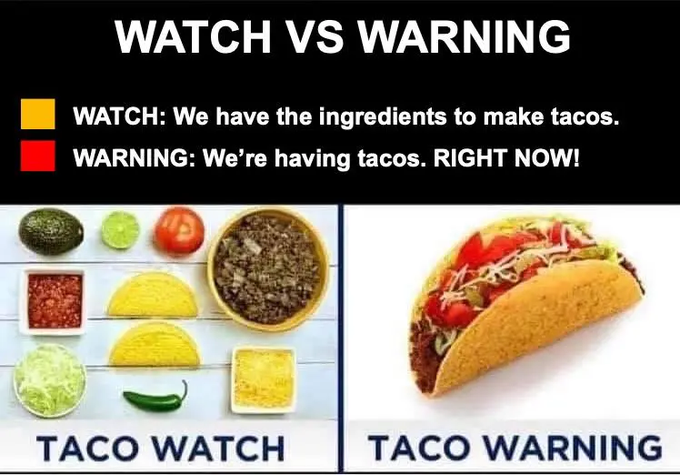
When Meteorologists predict catastrophic weather events like hurricanes and tornados they distinguish between a “watch” and “warning.” A “watch” means that we should be on the lookout for dangerous weather (conditions are possibly dangerous); a warning means the dangerous weather is actually happening in the next few minutes.

We are a nation on “fascism watch,” but it isn’t a “fascism warning.” Conditions are right for fascism, we have all the ingredients for fascism, but fascism is not pre-determined—we can still stop it.


This is an important distinction. Wannabe fascists like Donald Trump seize power by telling the nation that democracy is weak, and fascism is pre-determined or fated. Fascists want us to give up in advance; they want us to believe that 2024 is a fascism warning, not a fascism watch. It’s a fascism watch, not a warning.

Meteorologists teach people the warning signs so they know when a tornado is heading toward them: the sky may turn dark or green, it might hail, there may be a loud roar like a freight train, and/or there might be a funnel cloud. If you see any of those signs you should seek shelter immediately because a dangerous tornado is likely to be nearby.

We’re on “fascism watch,” so what should we watch for? What are the warning signs that a democratic government like ours is backsliding into fascism?

The U.S. Agency for International Development (USAID) studies democratic backsliding around the world. They define it as “a change in a combination of competitive electoral procedures, civil and political liberties, and accountability.” When elections are no longer free and fair, when civil and political liberties are denied to all, and when political leaders are no longer accountable to the rule of law, democracy has turned into autocracy.

In 2016, democratic erosion scholar Jeff Colgan created a useful 10 point list of signs of emerging authoritarianism. Here is his original list with a little bit of added explanation:

1. Media intimidation and restrictions (autocrats intimidate the media, so that they won’t try to hold the autocrat accountable to the rule of law).

2. Identification of crises or political paralysis to justify emergency measures (autocrats take advantage of crisis or make up crises in order to seize the opportunity as a “state of exception” to use dictatorial powers. Sometimes they use “nothing has been done” as a similar excuse).

3. Attacks on minorities; scapegoating foreigners (autocrats try to activate Right-Wing Authoritarians with fear appeals about “impure” foreigners, using “disgust” words like “vermin” and treating people as “hate-objects” to create a climate of nationalistic “us” versus “them).

4. Closing spaces for civil society (autocrats seek to close off “third spaces” or spaces where people gather together and form bridging social capital. Bridging social capital builds trust among people and autocracy thrives on distrust).

5. Rhetorical rejection of current political system; discourse shift (autocrats denigrate American values like democracy and the rule or law or begin to change the meanings of the key terms of national values).

6. Expanding the size of courts or other bodies to stack it with partisan judges/officials (creating a set of loyalist judicial officials who will follow the autocrat’s will rather than the Constitution or the rule of law).

7. Modifying rules to impose or eliminate term limits on officials, especially election officials (autocrats prevent free and fair elections by gaming the electoral process with gerrymandering, changing voter qualifications, changing election laws, contesting election results, installing loyalists as election officials, intimidating non-compliant election officials)

8. Weakening the legislature/intimidating legislators (autocrats seek to prevent the checks and balances of the system from holding them accountable to the rule of law or the Constitution by weakening legislative power, installing compliant loyalists in the legislature, and purging non-compliant people from the legislature).

9. Silencing political opposition (autocrats use communication as a weapon with threats of force or intimidation, public shaming, overwhelming the public sphere with lies or distractions, controlling the networks of public communication).

10. Significant increase of internal security forces (using paramilitary organizations, gangs, militia, or police for the autocrat’s purposes rather than the common good).

Autocrats around the world have done these things as they’ve taken over governments. You might think the signs of democratic backsliding would be very obvious, but government scholar Lee Morgenbesser explains that if you’re looking for American democracy to end with a big bang, like a violent coup, then you’re looking for the wrong signs.

Today’s autocratic takeovers are more subtle and less obviously violent. Today wannabe autocrats like Trump use strategies that are “designed to mimic the presence of horizontal and vertical accountability, but also prevent the actual practice of it. The most sophisticated form of autocratic rule now encourages laws to be bent, not broken; institutions to be managed, not made meaningless; political opponents to be circumscribed, not eliminated; citizens to be disempowered, not indoctrinated; economic gains to be distributed, not concentrated; and foreign engagement to be self-reinforcing, not self-defeating.”

The 2024 presidential election will be between two political figures as much as it is between democracy and autocracy—between a government that follows the democratic principle of the “rule of law” (in which “the law is supreme,” which means it binds and protects everyone equally) and one that follows the autocratic “rule by law” strategy (the law is used as a weapon to reward friends, punish enemies, and consolidate power). Conditions are right for fascism; be on alert for the warning signs.

Hitler 'didn't say it the way I said it': Trump defends Nazi-style rhetoric
YEAH HE SAID IT IN GERMAN
Brad Reed
RAW STORY
December 22, 2023 

Adolph Hitler, Donald Trump (Hitler via archives/Trump via AFP)

Former President Donald Trump on Friday defended his use of Nazi-style rhetoric to describe immigrants by claiming that he had no idea his words directly echoed those of Adolf Hitler.

In his autobiographical manifesto "Mein Kampf," Hitler posited that in the past great cultures died out due to "blood poisoning," and he said that Jews in Europe were primarily responsible for such "poisoning" in Germany.

"A racially pure people which is conscious of its blood can never be enslaved by the Jew," argued Hitler, who today is known as one of the worst mass murderers in human history. "... And so he tries systematically to lower the racial level by a continuous poisoning of individuals."

DON'T MISS: Trump’s Iowa Faith Leader Coalition includes bigots, advocate of killing Obama

Trump in recent speeches has similarly claimed that immigrants are "poisoning the blood" of America.

In an interview with right-wing talk radio show host Hugh Hewitt, however, Trump claimed ignorance of Hitler's words, while also saying that he didn't mean to give his own remarks about "blood poisoning" the same sinister connotations that Hitler did.

"I know nothing about Hitler," said Trump, as transcribed by Politico reporter Sam Stein. "I’m not a student of Hitler. I never read his works. They say that he said something about blood. He didn’t say it the way I said it, it's a very different kind of statement."

Watch the video below or at this link.


Alpha, beta, theta: what are brain states and brain waves? And can we control them?

The Conversation
December 22, 2023 

Brain

There’s no shortage of apps and technology that claim to shift the brain into a “theta” state – said to help with relaxation, inward focus and sleep.

But what exactly does it mean to change one’s “mental state”? And is that even possible? For now, the evidence remains murky. But our understanding of the brain is growing exponentially as our methods of investigation improve.
Brain-measuring tech is evolving

Currently, no single approach to imaging or measuring brain activity gives us the whole picture. What we “see” in the brain depends on which tool we use to “look”. There are myriad ways to do this, but each one comes with trade-offs.

We learnt a lot about brain activity in the 1980s thanks to the advent of magnetic resonance imaging (MRI).

Eventually we invented “functional MRI”, which allows us to link brain activity with certain functions or behaviours in real time by measuring the brain’s use of oxygenated blood during a task.

We can also measure electrical activity using EEG (electroencephalography). This can accurately measure the timing of brain waves as they occur, but isn’t very accurate at identifying which specific areas of the brain they occur in.

Alternatively, we can measure the brain’s response to magnetic stimulation. This is very accurate in terms of area and timing, but only as long as it’s close to the surface.
What are brain states?

All of our simple and complex behaviours, as well as our cognition (thoughts) have a foundation in brain activity, or “neural activity”. Neurons – the brain’s nerve cells – communicate by a sequence of electrical impulses and chemical signals called “neurotransmitters”.

Neurons are very greedy for fuel from the blood and require a lot of support from companion cells. Hence, a lot of measurement of the site, amount and timing of brain activity is done via measuring electrical activity, neurotransmitter levels or blood flow.

We can consider this activity at three levels. The first is a single-cell level, wherein individual neurons communicate. But measurement at this level is difficult (laboratory-based) and provides a limited picture.

As such, we rely more on measurements done on a network level, where a series of neurons or networks are activated. Or, we measure whole-of-brain activity patterns which can incorporate one or more so-called “brain states”.

According to a recent definition, brain states are “recurring activity patterns distributed across the brain that emerge from physiological or cognitive processes”. These states are functionally relevant, which means they are related to behaviour.

Brain states involve the synchronisation of different brain regions, something that’s been most readily observed in animal models, usually rodents. Only now are we starting to see some evidence in human studies.

Various kinds of states

The most commonly-studied brain states in both rodents and humans are states of “arousal” and “resting”. You can picture these as various levels of alertness.

Studies show environmental factors and activity influence our brain states. Activities or environments with high cognitive demands drive “attentional” brain states (so-called task-induced brain states) with increased connectivity. Examples of task-induced brain states include complex behaviours such as reward anticipation, mood, hunger and so on.

In contrast, a brain state such as “mind-wandering” seems to be divorced from one’s environment and tasks. Dropping into daydreaming is, by definition, without connection to the real world.

We can’t currently disentangle multiple “states” that exist in the brain at any given time and place. As mentioned earlier, this is because of the trade-offs that come with recording spatial (brain region) versus temporal (timing) brain activity.
Brain states vs brain waves

Brain state work can be couched in terms such as alpha, delta and so forth. However, this is actually referring to brain waves which specifically come from measuring brain activity using EEG.

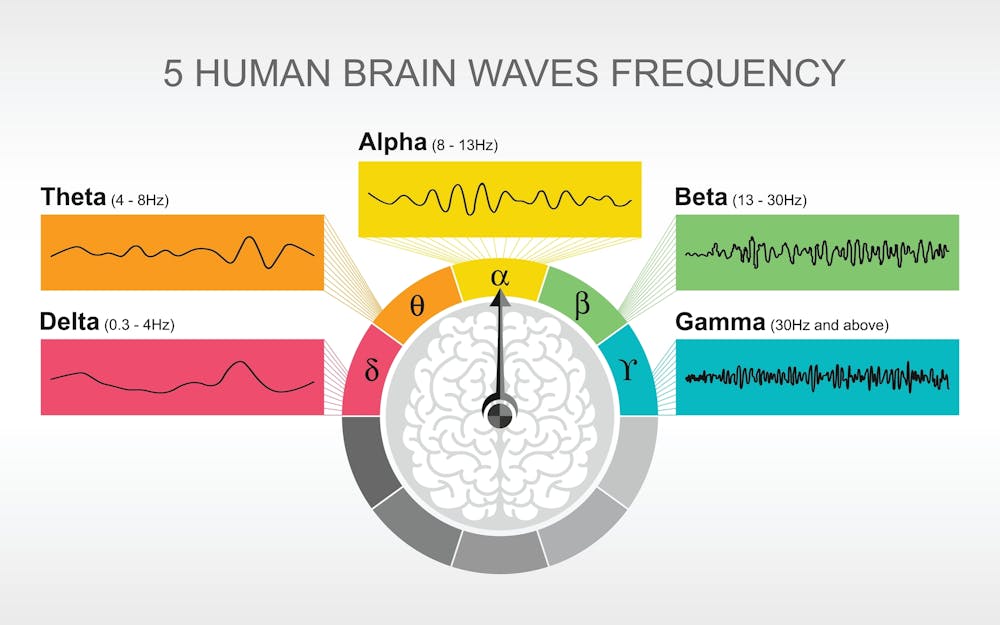
EEG picks up on changing electrical activity in the brain, which can be sorted into different frequencies (based on wavelength). Classically, these frequencies have had specific associations:gamma is linked with states or tasks that require more focused concentration

beta is linked with higher anxiety and more active states, with attention often directed externally

alpha is linked with being very relaxed, and passive attention (such as listening quietly but not engaging)

theta is linked with deep relaxation and inward focus

and delta is linked with deep sleep.

Brain wave patterns are used a lot to monitor sleep stages. When we fall asleep we go from drowsy, light attention that’s easily roused (alpha), to being relaxed and no longer alert (theta), to being deeply asleep (delta).


Brainwaves are grouped into five different wavelength categories. Shutterstock

Can we control our brain states?


The question on many people’s minds is: can we judiciously and intentionally influence our brain states?

For now, it’s likely too simplistic to suggest we can do this, as the actual mechanisms that influence brain states remain hard to detangle. Nonetheless, researchers are investigating everything from the use of drugs, to environmental cues, to practising mindfulness, meditation and sensory manipulation.

Controversially, brain wave patterns are used in something called “neurofeedback” therapy. In these treatments, people are given feedback (such as visual or auditory) based on their brain wave activity and are then tasked with trying to maintain or change it. To stay in a required state they may be encouraged to control their thoughts, relax, or breathe in certain ways.

The applications of this work are predominantly around mental health, including for individuals who have experienced trauma, or who have difficulty self-regulating – which may manifest as poor attention or emotional turbulence.

However, although these techniques have intuitive appeal, they don’t account for the issue of multiple brain states being present at any given time. Overall, clinical studies have been largely inconclusive, and proponents of neurofeedback therapy remain frustrated by a lack of orthodox support.

Other forms of neurofeedback are delivered by MRI-generated data. Participants engaging in mental tasks are given signals based on their neural activity, which they use to try and “up-regulate” (activate) regions of the brain involved in positive emotions. This could, for instance, be useful for helping people with depression.

Another potential method claimed to purportedly change brain states involves different sensory inputs. Binaural beats are perhaps the most popular example, wherein two different wavelengths of sound are played in each ear. But the evidence for such techniques is similarly mixed.

Treatments such as neurofeedback therapy are often very costly, and their success likely relies as much on the therapeutic relationship than the actual therapy.

On the bright side, there’s no evidence these treatment do any harm – other than potentially delaying treatments which have been proven to be beneficial.

Susan Hillier, Professor: Neuroscience and Rehabilitation, University of South Australia

This article is republished from The Conversation under a Creative Commons license. Read the original article.


AND OF COURSE LETS NOT FORGET THE 
THETA OR E-METER OF SCIENTOLOGY


\


1958


Wild ‘super pigs’ from Canada could become a new front in the war on feral hogs
"EVIL COMES FROM THE NORTH"
LOG LADY, TWIN PEAKS

The Conversation
December 22, 2023

Feral hogs’ long snouts and tusks allow them to rip and root their way across the landscape in search of food. 
USDA/Flickr, CC BY

They go by many names – pigs, hogs, swine, razorbacks – but whatever you call them, wild pigs (Sus scrofa) are one of the most damaging invasive species in North America. They cause millions of dollars in crop damage yearly and harbor dozens of pathogens that threaten humans and pets, as well as meat production systems.

Although wild pigs have been present in North America for centuries, their populations have rapidly expanded over the past several decades. Recent studies estimate that since the 1980s the wild pig population in the United States has nearly tripled and expanded from 18 to 35 states. More recently, they have spread rapidly across Canada, and these populations are threatening to invade the U.S. from the north.

The wild pigs in Canada are unique because they were originally crossbred by humans to be larger and more cold-hardy than their feral cousins to the south. This suite of traits has earned them the name “super pigs” for good reason. Adults can reach weights exceeding 500 pounds, which is twice the size of the largest wild pigs sampled across many U.S. sites in a 2022 study.

As a wildlife ecologist, I study how wild pigs alter their surroundings and affect other wildlife species. Early detection and rapid response is of utmost importance in eradicating an invasive species, because invasions are more manageable when populations are small and geographically restricted. This is especially true for species like wild pigs that have a high reproductive rate, can readily move into new areas and can change their behavior to avoid being captured or killed.

Minnesota wildlife experts are keeping a wary eye on their northern border for signs of wild ‘super pigs’ moving down from Canada.


Omnivores on the hoof

Much concern over the spread of wild pigs has focused on economic damage, which was recently estimated at about US$2.5 billion annually in the United States.

Wild pigs have a unique collection of traits that make them problematic to humans. When we told one private landowner about the results from our studies, he responded: “That makes sense. Pigs eat all the stuff the other wildlife do – they just eat it first, and then they go ahead and eat the wildlife, too. They pretty much eat anything with a calorie in it.”

More scientifically, wild pigs are called extreme generalist foragers, which means they can survive on many different foods. A global review of their dietary habits found that plants represent 90% of their diet – primarily agricultural crops, plus the fruits, seeds, leaves, stems and roots of wild plants.


Lesser prairie chickens are a ground-nesting species – found in parts of Colorado, Kansas, New Mexico, Oklahoma and Texas – that is listed under the Endangered Species Act. Feral hogs prey on the birds and their eggs and damage the birds’ habitat by rooting up and consuming native plants and spreading invasive plant seeds. Greg Kramos/USFWS

Wild pigs also eat most small animals, along with fungi and invertebrates such as insect larvae, clams and mussels, particularly in places where pigs are not native. For example, a 2019 study reported that wild pigs were digging up eggs laid by endangered loggerhead sea turtles on an island off the coast of South Carolina, reducing the turtles’ nesting success to zero in some years.

And these pigs do “just eat it first.” They compete for resources that other wildlife need, which can have negative effects on other species.

However, they likely do their most severe damage through predation. Wild pigs kill and eat rodents, deer, birds, snakes, frogs, lizards and salamanders. This probably best explains why colleagues and I found in one study that forest patches with wild pigs had 26% fewer mammal and bird species than similar forest patches without pigs.

This decrease in diversity was similar to that found with other invasive predators. And our findings are consistent with a global analysis showing that invasive mammalian predators that have no natural predators themselves – especially generalist foragers like wild pigs – cause by far the most extinctions.

Altering ecosystems

Many questions about wild pigs’ ecological impacts have yet to be answered. For example, they may harm other wild species indirectly, rather than eating them or depleting their food supply.

Our work shows that wild pigs can alter the behavior of common native wildlife species, such as raccoons, squirrels and deer. Using trail cameras, we found that when wild pigs were present, other animals altered their activity patterns in various ways to avoid them. Such shifts may have additional cascading effects on ecosystems, because they change how and when species interact in the food web.


Another major concern is wild pigs’ potential to spread disease. They carry numerous pathogens, including brucellosis and tuberculosis. However, little ecological research has been done on this issue, and scientists have not yet demonstrated that an increasing abundance of wild pigs reduces the abundance of native wildlife via disease transmission.

Feral hogs can be seen rooting up the soil in this trail camera footage from Alabama.


Interestingly, in their native range in Europe and Asia, pigs do not cause as much ecological damage. In fact, some studies indicate that they may modify habitat in important ways for species that have evolved with them, such as frogs and salamanders.

So far, however, there is virtually no scientific evidence that feral pigs provide any benefits in North America. One review of wild pig impacts discussed the potential for private landowners plagued with pigs to generate revenue from selling pig meat or opportunities to hunt them. And it’s possible that wild pigs could serve as an alternative food source for imperiled large predators, or that their wallowing and foraging behavior in some cases could mimic that of locally eradicated or extinct species.

But the scientific consensus today is that in North America, wild pigs are a growing threat to both ecosystems and the economy. It is unclear how invading super pigs would contribute to the overall threat, but bigger pigs likely cause more damage and are generally better predators and competitors.

While efforts to control wild pigs are well underway in the U.S., incursions by Canadian super pigs may complicate the job. Invasive super pigs make for catchy headlines, but their potential effects are no joke.

This is an updated version of an article originally published on Aug. 26, 2019.

Marcus Lashley, Associate Professor of Wildlife Ecology, University of Florida


This article is republished from The Conversation under a Creative Commons license. Read the original article.