Saturday, December 23, 2023

Meta Is Systematically Censoring Pro-Palestine Posts, Human Rights Watch Finds

The company has implemented “sweeping bans” on content supporting Palestinian rights, the group’s report found.
December 21, 2023
A close-up of a finger is pointing to the Facebook mobile app on a smartphone screen, which is displayed alongside other apps including Instagram, WhatsApp, Telegram, TikTok, Tinder, YouTube, and Messenger, on November 30, 2023.
JONATHAN RAA / NURPHOTO VIA GETTY IMAGES

2024 is going to be the most important year yet for fearless, trustworthy journalism. Will you make a tax-deductible, end-of-year donation to support our work? Any amount you give will be matched!

Meta, the company that owns Facebook and Instagram, has been censoring posts from pro-Palestine voices, a new analysis from Human Rights Watch finds, lending evidence to what many advocates for Palestinian rights have suspected since Israel’s current assault began.

Human Rights Watch analyzed posts on Facebook and Instagram from over 60 countries and found that the platforms have been taking down posts in support of Palestine for erroneous reasons. This censorship is “systemic and global,” Human Rights Watch writes in its 51-page report.

The report finds several underlying reasons driving the censorship: inconsistent enforcement of Meta’s content policies, automated content removal, granting requests from governments to remove certain content, and “sweeping bans” on so-called “terrorist” activity — seemingly using definitions that liken all support of Palestinian rights to “terrorism,” a dangerous conflation that has been increasingly common in the past months.

The group found 1,050 cases of censorship on Instagram and Facebook, with 1,049 of the posts supporting Palestine and one post being taken down in support of Israel. Even Human Rights Watch’s post calling for evidence of censorship appeared to be suppressed, the report finds, with dozens of users reporting being unable to interact with the post.

Censorship took several forms, the report found. Researchers documented over 100 cases each of posts being taken down, accounts being suspended or disabled, account activity being restricted in various ways, like being unable to “like” posts or follow accounts, and “shadow banning,” in which the reach of an account is severely limited without the user being formally notified.

RELATED STORY
Corporate media outlets have treated Palestinian suffering as a nonstory for many decades.
By Andy Lee Roth & Mickey Huff , TRUTHOUTDecember 2, 2023

“Meta’s censorship of content in support of Palestine adds insult to injury at a time of unspeakable atrocities and repression already stifling Palestinians’ expression,” Deborah Brown, acting associate technology and human rights director for Human Rights Watch, said in a statement. “Social media is an essential platform for people to bear witness and speak out against abuses while Meta’s censorship is furthering the erasure of Palestinians’ suffering.”

The findings represent a small sample of the number of instances of censorship, the group said, with Human Rights Watch receiving hundreds more reports from users after the report was finalized. The report isn’t a representative sample, the report said, meaning that it can’t be extrapolated to make conclusions about Meta’s censorship practices across their entire platforms.

It is a show, however, that the company is taking steps to suppress information about Israel’s genocidal assault on Gaza in a time when many institutions are working to silence people who speak up in favor of Palestine. On top of the recurring communications blackouts in Gaza and the near-constant flow of disinformation on Israel’s massacre, these institutions and companies have worked to muddy the waters of the assault, in which over 20,000 Palestinians have been killed and people in Gaza are staring down the barrel of issues of rapidly worsening hunger and disease across the region.

This has long been a practice within Meta, Human Rights Watch researchers have found. A similar report done by the group in 2021 found that Facebook was removing content by Palestinians and pro-Palestinian voices. Meta commissioned an independent report probing the issue in response to the report, but despite recommendations that the company change its policies to avoid censoring content supporting Palestinian rights, the company has still not made sufficient changes, the group said.

This article is licensed under Creative Commons (CC BY-NC-ND 4.0), and you are free to share and republish under the terms of the license.


SHARON ZHANG  is a news writer at Truthout covering politics, climate and labor. Before coming to Truthout, Sharon had written stories for Pacific Standard, The New Republic, and more. She has a master’s degree in environmental studies. She can be found on Twitter: @zhang_sharon.


Human Rights Watch reports content in support of Palestine on Meta being censored

Human Rights Watch released a new report on the patterns of censoring pro-Palestinian content on Meta, specifically Instagram and Facebook. Their report came after reviewing over 1,000 cases and finding more than 30% of the content or action taken was without appeal. The censorship consisted of removal of content, suspension of accounts, restrictions on features like Instagram and Facebook Live, and shadow banning. Human Rights Watch is sending a clear message to Meta: 'Stop silencing support for Palestine.

December 23, 2023 
US labour unions lead protest at AIPAC's New York office

Brooke Anderson
Washington, D.C.
23 December, 2023

American labour unions led a protest this week in front of the New York office of AIPAC, amid growing global discontent over US military support for Israel.

US labour leaders demonstrated for a ceasefire in Gaza in front of the AIPAC office in New York. [Getty]

Some of the largest American labour unions led a protest this week in front of the New York office of the American Israel Public Affairs Committee (AIPAC) to call for a ceasefire on Thursday, amid growing global discontent over US military support for Israel's war on Gaza.

Protesters held signs with the names of top federally-elected New York state politicians along with the amount that they have received from the Israel lobby group.

The demonstrators highlighted AIPAC funding to senators Kristin Gillibrand and Chuck Schumer, as well as Representative Hakeem Jeffries, who have received hundreds of thousands of dollars from AIPAC. Other signs read "Workers Demand Ceasefire Now" and "Free Palestine" as they chanted in front of AIPAC's downtown New York City office.

The unions leading the demonstration were the United Auto Workers, the American Postal Workers Union, as well as the United Electrical, Radio, and Machine Workers. They were joined by Adalah Justice Project, American Muslims for Palestine NY/NJ Jewish Voice for Peace-NY, New York Communities for Change, the New York Working Families Party, and the New York City Democratic Socialists of America.

"For many years, we've stayed out of the conflict or unquestionably supported the state of Israel. Now, with people dying in this war, it's time to reconsider that," Brandon Mancilla, Region 9A director for the UAW, which includes New York, New England and Puerto Rico, told The New Arab.

He emphasised that as a labour movement, they should be standing with all vulnerable groups, including Palestinians. He also noted that many auto union workers are Arabs from Michigan, an important swing state for the presidential election, and that the UAW hasn't yet endorsed a candidate for US president. He said, "Biden really fumbled his response to the war."


UAW and American Postal Workers Union Members Lead NYC March for Gaza

The march came a week after leaders of several major unions joined progressive lawmakers to demand a ceasefire.
December 22, 2023
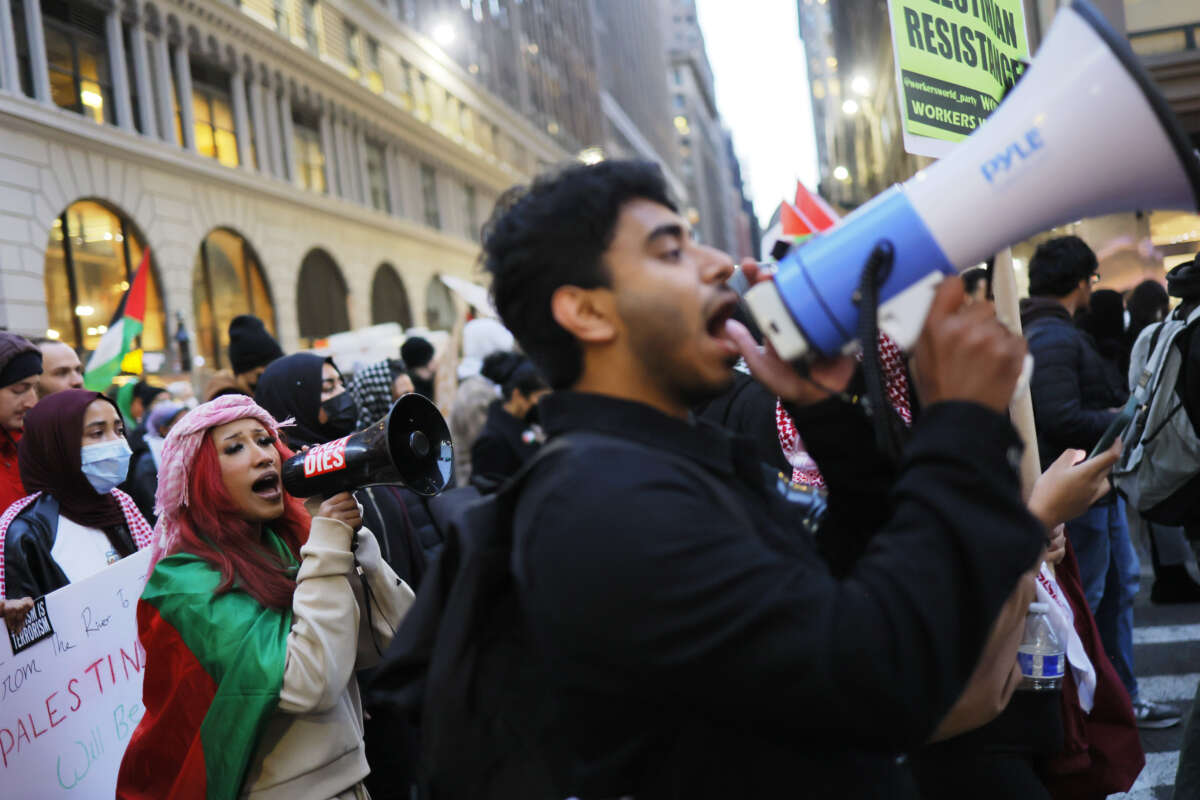
Protesters participate in a Global Strike for Gaza on December 18, 2023, in New York City.
MICHAEL M. SANTIAGO / GETTY IMAGES

Unions, Jewish groups, and other organizations led a march in New York City Thursday night to demand a cease-fire in the U.S.-backed Israeli war on Gaza and pressure their members of Congress to stop taking campaign cash from pro-Israel lobbyists.

Members of the United Auto Workers (UAW) Region 9A; American Postal Workers Union (APWU); United Electrical, Radio, and Machine Workers (UE) Eastern Region; New York City’s arm of Democratic Socialists of America (NYC-DSA); Adalah Justice Project, American Muslims for Palestine N.Y./N.J.; Jewish Voice for Peace-N.Y.; New York Communities for Change; the New York Working Families Party; and more took to the streets to call for “peace and justice for Palestine.”

They carried signs stressing U.S. worker demands for a cease-fire in the conflict that has killed more than 20,000 Palestinians in Gaza, including over 8,000 children. The signs also highlighted how much money Senate Majority Leader Chuck Schumer, Sen. Kirsten Gillibrand, and House Minority Leader Hakeem Jeffries — all New York Democrats — have taken from the American Israel Public Affairs Committee (AIPAC).

AIPAC is reportedly planning to spend at least $100 million in 2024 Democratic primaries, aiming to unseat cease-fire supporters, particularly “Squad” members — Reps. Jamaal Bowman (D-N.Y.), Cori Bush (D-Mo.), Summer Lee (D-Pa.), Alexandria Ocasio-Cortez (D-N.Y.), Ilhan Omar (D-Minn.), Ayanna Pressley (D-Mass.), and Rashida Tlaib (D-Mich.).

“For two months, the whole world has watched as the Israeli military launched its assault on Gaza,” said organizers of Thursday’s march, who rallied behind a clear message: “Stop the Bombs! Cease-fire now!”

Biden and Democrats are looking to resurrect — and in some cases expand — the Trump administration’s worst policies.
By Thomas Kennedy & Corey Hill , TRUTHOUT  December 21, 2023

“Disease, hunger, and thirst are spreading rapidly,” they continued. “Two million Palestinians have been displaced and thousands imprisoned by the Israeli state.”

The United States gives Israel $3.8 billion in annual military aid and U.S. President Joe Biden has asked Congress for another $14.3 billion for the war effort. As the march organizers put it: “This horror has unfolded with the full support of the U.S. government. Our out-of-touch representatives, instead of siding with their constituents are siding with AIPAC, a racist right-wing lobby group.”

“But we will not let them ignore this growing working-class movement. Hundreds of thousands of regular people have taken to the streets, jammed the phone lines and inboxes of their representatives, stopped traffic, staged sit-ins, and more, to demand peace and justice,” they added. “We demand our N.Y. senators call for an immediate and lasting cease-fire, vote NO on the $14 billion aid bill, and refuse far-right AIPAC contributions! And we will continue to march, protest, disrupt, and fight until we end this genocide.”

The NYC march came a week after leaders of unions such as the UAW, APWU, and UE held a press conference with Democrats including Bush, Ocasio-Cortez, Omar, and Tlaib at the U.S. Capitol in Washington, D.C. to demand a cease-fire.

Noting UAW president Shawn Fain’s participation, John Nichols wrote for The Nation:

For Tlaib, the only Palestinian American member of Congress and an outspoken advocate for a cease-fire, it was an especially poignant moment. She noted, “I’m a proud daughter of a UAW worker, and I know my Yaba [father], if he was here, he would be so proud. The UAW taught him he deserved human dignity, even though he only had a fourth-grade education, even though he was Palestinian, even though he was Muslim. On that assembly line, he was equal to every single human being on that line. Who did that for him? The United Auto Workers did that for him.”

Fain, for his part, delivered a clear call for a change in U.S. policy.

“The only path forward to peace and social justice is a cease-fire,” said the UAW leader.

Thursday’s demonstration coincided with intense debates over a cease-fire resolution at the United Nations Security Council in New York City. The United States, one of five nations with veto power, has delayed multiple expected votes on the measure this week.

This piece was reprinted by Truthout with permission or license. It may not be reproduced in any form without permission or license from the source.

JESSICA CORBETT is a staff writer with Common Dreams.
How Oil Money Turned Louisiana Into the Prison Capital of the World


A series of events in the 1970s led to the state’s penal system becoming intertwined with the swings of its oil economy.
December 22, 2023
Part of the Strategic Petroleum Reserve, a gulf coast refinery covers acres of low-lying marshland in Louisiana, on June 1, 1980.
ROBERT NICKELSBERG / LIAISON VIA GETTY IMAGES


On October 14, 2023, Louisiana elected far right candidate Jeff Landry to the governor’s mansion. As the state’s current attorney general, Landry (a former police officer and sheriff’s deputy) has made headlines for his creation of an anti-crime policing task force for New Orleans, suing the state to block clemency appeals by those on death row, and advocating to make public the criminal records of juveniles in predominately Black areas of the state. Landry’s dedication to “law and order” has been matched by his commitment to extractive industries. As a climate change denier, he has pushed for more aggressive off-shore drilling in the Gulf of Mexico and sued the Environmental Protection Agency for overreach. As governor, he is poised to roll back the moderate criminal legal system reforms enacted under Gov. John Bel Edwards in 2017, and further deregulate the oil and gas industries. These political moves will further tie Louisiana to the destructive prison and petrochemical sectors — limiting and cutting short the lives of countless residents.

This political coupling of mass incarceration and petrocapitalism is nothing new for the state. In 1901, Louisiana purchased the notorious Angola plantation to serve as the Louisiana State Penitentiary, and oil was struck in the state for the first time. Yet, as documented in my book, Prison Capital: Mass Incarceration and Struggles for Abolition Democracy in Louisiana, not until the 1970s did the growth of Louisiana’s penal system become intertwined with the swings of the state’s oil economy. This is not to reduce Louisiana’s standing as an epicenter of mass incarceration to a “resource curse.” Political power blocs and struggles, not natural resources, shape policy makers’ decisions. With that said, one cannot understand Louisiana officials’ unprecedented expansion of the state’s punishment regime without understanding the seesaw of petrocapitalism.

Over the course of the 20th century, Louisiana developed its political economy on oil extraction and refinement. Amid the black gold rush of the 1920s, Gov. Huey Long rose to power on a populist platform that promised the people of Louisiana state investments in social welfare through increasing taxes on oil companies. Long’s petro populism was modest insofar as he never called for the public ownership of the state’s natural resources, and the taxes he championed were relatively limited. However, this petro populism still ushered in the beginning of Louisiana’s fiscal dependency on oil revenues. As Jason Theriot documents in his book American Energy, Imperiled Coast, generation after generation of state leaders incentivized new rounds of oil extraction to fill state coffers and enrich oil capitalists at the expense of a diversified political economy and the erosion of coastal wetlands. By the 1970s, Louisiana had become economically dependent on the volatile commodity of oil.

The 1970s also marked a new era for the Louisiana penal system. The legitimacy of Angola had reached a breaking point. Four Black prisoners — Arthur Mitchell, Hayes Williams, Lazarus Joseph and Lee Stevenson — filed an extensive lawsuit against Angola in 1971 for issues including medical neglect, unsafe facilities, religious discrimination against Muslims, racial segregation and the violence of solitary confinement. In 1975, federal Judge Elmer Gordon West ruled in favor of the plaintiffs and declared the prison to be in a state of “extreme public emergency.” Sweeping changes were ordered in the name of restoring imprisoned people’s constitutional rights and population limits were placed on Angola.

At first, liberal reformers running the Louisiana Department of Corrections (DOC) responded by pushing for a slew of reforms they believed would make Angola a more orderly, safe and modern prison: ending the trusty guard system, racially integrating prison dormitories and work assignments, and investing in repairs and security technologies. At the heart of their reforms was a push for their “decentralization plan” to shrink or even shutter Angola and replace the plantation penitentiary with smaller regional urban prisons.

RELATED STORY
The state spends up to $150,000 on each incarcerated child, which could fund education rather than locking up kids.
September 19, 2023


Louisiana’s budget was so flush with oil surpluses that for three straight years, prison construction costs were covered with cash on hand instead of the more typical debt financing.

While the federal court agreed this was one possible avenue out of the crisis, Judge West mandated that Angola be downsized or decommissioned in two years’ time. Otherwise, officials would need to expand the prison. The short timeline given by the courts and local opposition to new prisons by urban residents in their cities made the decentralization plan unfeasible. Instead, Louisiana sought to resolve the crisis by enlarging the prison system in rural areas. As the 1978 Governor’s Office Long Range Prison Study shows, officials added 1,400 new beds to Angola and built three new state prisons within five years of the federal court rulings. This expansion of the Louisiana carceral state was framed by government officials — from Judge West to the governor of Louisiana — as a form of “humanitarian” reform, without any concern given to the state’s increased power to cage more Louisianians.

But such penal expansion is never cheap.

The Rise — and Fall — of Petrochemical Revenues

In Louisiana, the state’s petrochemical revenues allowed the state to take on substantial prison construction years earlier than other states under similar federal court orders. As noted by scholars, such as Timothy Mitchell and Judith Stein, the 1970s were a dramatic period for the global oil economy. In 1973, the Organization of the Petroleum Exporting Countries (OPEC) raised the tax rate on oil production while Arab oil states placed an embargo on the U.S. in response to President Richard Nixon’s support for Israel in the Yom Kippur War. In response, U.S. oil prices shot up fourfold, creating strains on the U.S. economy. Coupled with the devaluation of the U.S. dollar, this produced the 1973-1975 U.S. recession. However, for Louisiana, the increase in oil prices led to more oil taxes for the state. The OPEC oil crisis produced not a budgetary shortage but an unexpected windfall of revenue and buffered Louisiana from the national recession As state executive budgets document at length, Louisiana officials were able to funnel $100 million to new carceral construction, increasing the DOC’s operating budget from $17.3 million in 1972 to $45 million in 1977 in the name of liberal reforms. In fact, Louisiana’s budget was so flush with oil surpluses that for three straight years, prison construction costs were covered with cash on hand instead of the more typical debt financing. By 1980, the state’s prison capacity was double what it was in 1970.

However, when oil prices dropped following the global oil glut in the 1980s, Louisiana found itself in a tailspin. New Right Gov. David Treen leveraged the fiscal crisis to institute law and order austerity — cutting social programs alongside bulking up investments in prisons, jails and policing. For the first time in years, the state’s budget projections outpaced revenues. With the state scrambling for resources, Treen cut $270 million from across the state budget in 1982, which included a 25 percent cut to the Department of Labor. During this time, unemployment rates skyrocketed to the point that the Louisiana unemployment program went broke when unemployment claims wildly outpaced reserves. The following year proved even more dire. Treen pushed not to raise taxes or to marshal resources to cushion the devastation the recession was having on people’s lives; instead, Treen cut another $120 million from critical state services in 1983. These policy measures transitioned what had begun as a fiscal crisis into a manufactured economic one.

This expansion of the Louisiana carceral state was framed by government officials as a form of “humanitarian” reform, without any concern given to the state’s increased power to cage more Louisianians.

While incarcerated people at Angola hoped this economic crisis would compel the state to abandon its intensified punishment regime, this was not to be so. Although the state could not cut certain baselines due to the mandates of the federal court orders, Treen went above and beyond in funneling dwindling state funds into the already bloated DOC budget. Unlike every other sector of the state, the DOC did not experience cuts but rather a 23 percent budgetary gain during the first years of the early 1980s recession. When the interest rates for prison construction were too expensive, Treen implemented double-bunking — or doubling the number of people in prison cells and dormitories. When the federal courts berated Treen for this move, Treen reallocated funds from public works into jail construction while the state legislature allocated an additional $34 million to building prisons.

While these policies immiserated Louisianians across race, gender and geography, they particularly eviscerated urban Black communities. Treen matched his investments in prisons with a slew of new “tough on crime” initiatives that targeted increasing numbers of people for longer and longer prison sentences. This came as Black Louisianians experienced some of the highest unemployment rates in the nation — upwards of 20 percent — during the oil bust years, according to archived reports of the Bureau of Labor Statistics. Under law-and-order austerity — the coupling of state disinvestments in the social wage alongside investments in mass incarceration — Black Louisianians were disproportionately laid off with a shrinking safety net to soften the blow. At the same time, “law and order” law-making, policing and prosecution targeted urban Black communities who had been structurally abandoned by the labor market. This dual crisis ballooned the prison population. According to incarcerated journalists at The Angolite, the Angola news magazine, between 1975 and 1985 the state’s prison population jumped from 4,000 to 12,500 people.

During the 1970s and 1980s, both liberal reformers and law-and-order politicians invested in expanding the Louisiana carceral state. Yet in both cases, it was petrochemical tax dollars that made such expansions materially possible. Policy makers’ development of the Louisiana political economy on the volatile industries of oil and gas has ensured cyclical economic crises that have normalized precarity and provided cover for politicians who claim that the only legitimate sectors to invest in are prisons and police. All the while, the extraction and refinement of oil and gas destroy wetlands and increase carbon emissions — together exacerbating Louisiana’s vulnerability to climate change.

Yet, Louisiana is not destined to forever be a place built on the extractions of petrochemicals and prisons. As organizers with Taproot Earth remind us in their Gulf to Appalachia Climate Action Strategy, building just climate futures requires disinvestments from carceral infrastructures as part and parcel of the urgent reworking of our political economy.

Even with Jeff Landry as governor, abolitionists and environmental justice activists will continue to fight for a state invested in the care of its people. As a front line of these intertwined struggles, Louisiana reminds us of the life and death stakes of the new world we are fighting for.

Copyright © Truthout. 

LYDIA PELOT-HOBBS is an assistant professor of Geography and African American & Africana Studies at the University of Kentucky where she teaches and writes on mass incarceration, racial capitalism, and social movements.


On yer bike: London firms turn to cargo bikes

London (AFP) – On a busy north London street, plumber Ben Hume-Wright zipped through the heavy rush-hour traffic to his next job by bike.


Issued on: 20/12/2023 
More businesses are turning to E-cargo bikes to beat London traffic 
© Daniel MATTHEWS / AFP

Trades such as his used to rely on vans but many are now choosing to do more business using two or sometimes three wheels.

Since switching his Ford diesel pickup truck for an electric cargo bike two years ago, Hume-Wright said he has been busier than ever.

"I used to take on a maximum of five or six appointments" a day, he told AFP as the traffic ground forward behind him.

"I'll now book in six, seven and possibly even eight, because I know that I'm not going to get stuck in traffic."

Hume-Wright set up in 2010 and was reliant on his van for 11 years. But now describes it as a "glorified shed" handy for storing parts and tools.

When faced with a big installation job, he gets a supplier to deliver bulkier items directly to the client's address.

He then shows up on his bike with just the tools needed for the job.

"It's cheaper, I don't have any of the fuel costs and I just enjoy it. It's a lot more fun," he said.

Growth strategy


Transport for London (TfL), the local government body responsible for most of the British capital's transport network, launched its first "Cargo Bike Action Plan" earlier this year.

It wants to "promote and enable" their growth, given a rise in polluting van deliveries from online shopping since the pandemic.

Cargo bikes are popular in places such as Denmark and the Netherlands 
© Liselotte Sabroe / Ritzau Scanpix/AFP

The use of cargo bikes, which can cost several thousand pounds (dollars), also increased during lockdown and encouraging their use chimes with Mayor Sadiq Khan's aim of a carbon net-zero city by 2030.

TfL estimates that the move towards cargo bikes could save up to 30,000 tonnes of CO2 emissions a year across Greater London by that time.

Cargo bikes were popular across northern Europe until the mid-20th century but fell out of favour as motorised vehicles gained ground.

Their revival began in the early 2000s in cycling-crazy Denmark and the Netherlands, which unlike London are blessed with flat terrain and good cycling infrastructure.

The number of cargo bikes on the streets of Copenhagen increased from 20,000 in 2020 to more than 40,000 in 2022, the city said.

In Germany -- Europe's largest market for E-cargo bikes -- 165,000 units were sold in 2022.

Ben Jaconelli, chief executive of leading E-bike and E-cargo bike firm Fully Charged, said UK growth has been "astronomical".

He co-founded the firm in 2014, when the sight of an electric cargo bike was a rarity. "Nowadays, it's almost rare not to see," he added.

The Bicycle Association, a UK trade body, reported a 30-percent increase in UK sales of E-cargo bikes in the year to May 2023.

Contributory factors include the controversial expansion of London's ultra-low emission zone, which charges the drivers of the most polluting vehicles.

In London, traffic is heavy but yet to return to its pre-pandemic levels 
© JUSTIN TALLIS / AFP

Van fleet


Logistics company Zhero is also committed to using the bikes. It transports fine art between studios, galleries and related businesses such as framers.

Like Hume-Wright, environmental considerations were a key factor for the switch. But co-founder Joe Sharpe called it a "straight-up financial decision".

Joe Sharpe, co-founder of green logistics company Zhero, transports fine art by bike 
© Daniel MATTHEWS / AFP

"It's cheaper to move things by cargo bikes than it is by van," he said near Sadie Coles HQ gallery, a regular client in the busy Soho district.

"They're the most logical vehicle for moving things around the city... Sometimes we might be doing 30 to 40 deliveries a day on a cargo bike.

"In a van, eight to 10."

Vans -- or more specifically a fleet of E-vans -- are still a part of Zhero's business, in part for insurance reasons.

Zhero are insured for up to £25,000 (nearly $32,000) to transport artwork by bike, but that rises tenfold when transporting art in an E-van.

Sharpe hopes that the insurance world will adapt to the changing norms of logistics companies, but concedes that vans may always be "a part of the fabric" of cities.

Back in the warren of railway arches that make up Fully Charged HQ, an optimistic Jaconelli declared that this is "the decade of the E-cargo bike".

"Ultimately, I believe that all businesses will be using electric cargo bikes in some capacity in the future," he said. "Why would they not?"

video-phz/fg

© 2023 AFP
HINDUTVA IS ARYAN FASCISM
India court to weigh future of mosque in Hindu holy city


New Delhi (AFP) – An Indian court has weighed into one of the country's most bitter religious disagreements by greenlighting cases on whether a mosque in the holy city of Varanasi should be opened to Hindu worshippers.

Issued on: 20/12/2023 - 
The 17th century Gyanvapi mosque is among several Islamic places of worship that Hindu activists have sought for decades to reclaim for their faith © SANJAY KANOJIA / AFP/File
ADVERTISING


The Gyanvapi mosque was built in the 17th century by the Muslim Mughal empire then ruling over much of India in a city where Hindu faithful from across the country cremate their loved ones by the Ganges river.

It is among several Islamic places of worship that Hindu activists, backed by Prime Minister Narendra Modi's party, have sought for decades to reclaim for their faith in disputes that have previously sparked deadly religious riots.

The Allahabad High Court on Tuesday directed a lower bench to evaluate petitions on the future of the mosque, which historians say was built over the demolished ruins of a temple to the Hindu deity Shiva.

The decision would permit several civil suits to proceed from Hindus demanding the right to worship at the Gyanvapi site and the restoration of a temple on its grounds.

Presiding justice Rohit Ranjan Agarwal ordered a lower court to rule on the site's future within six months, describing the dispute as a matter of "national importance".

"It is not a suit between two individual parties. It affects two major communities of the country," he said, according to local media reports published Wednesday.

Emboldened right-wing Hindu groups have laid claim to several Muslim sites of worship they say were built atop ancient temples during Mughal rule.

Hindu zealots in 1992 demolished the centuries-old Babri Masjid in the nearby city of Ayodhya, sparking sectarian riots that killed more than 1,000 people nationwide.

A decades-long court battle over the future of the ruined mosque's site ended in 2019 when the Supreme Court permitted the construction of a temple to the deity Ram, who according to scripture was born in the city.

Prime Minister Modi, whose party has campaigned for the temple for decades, will inaugurate the structure next month ahead of national elections in which he is widely expected to win a third term.

Modi's party has come to be the dominant force in Indian politics thanks to its muscular appeals to the country's Hindu majority, emboldening the faith's hardliners.

Calls for India to enshrine Hindu supremacy in law have rapidly grown louder since he took office in 2014, making its 210-million-odd Muslims increasingly anxious about their future.

© 2023 AFP
Music gives Gaza children respite from horrors of war

Rafah (Palestinian Territories) (AFP) – It takes a while but slowly the children gathered around volunteer entertainer Ruaa Hassuna in a Gaza camp start clapping along as her music offers some respite from the horrors around them.


Issued on: 20/12/2023 - 
Volunteer entertainer Ruaa Hassouna plays her oud to Palestinian children in one of the makeshift camps that are now home to most of the Gaza Strip's 2.4 million people 
© SAID KHATIB / AFP

Smiles light up the faces of the children, huddled amid the tents outside the south Gaza town of Rafah which shelter hundreds of thousands of Palestinians driven from their homes by more than two months of relentless Israeli bombardment.

Hassuna is part of a troupe of more than a dozen volunteer entertainers who travel from camp to makeshift camp on a mission to provide children with some escape, however brief, from the death and destruction they have witnessed.

The 23-year-old plays the oud, a lute-like stringed instrument popular across the Middle East. Other volunteers entertain the children with slapstick, acrobatics, story-telling or dance.

"We use whatever means we can to remove the children from the war," says the 23-year-old. "The aim of getting them to sing is to alleviate their stress."

Hassuna says that when her young audiences hear her oud, they "no longer hear the hum of the drones" deployed by the Israeli army, instead immersing themselves in the music.

The United Nations says children make up half of the 1.9 million Palestinians displaced since the onset of the Israel-Hamas war.

They have been forced to abandon their daily routines and live under Israeli bombardment since Hamas's October 7 attacks on Israel killed about 1,140 people, according to an AFP count based on Israel figures.
'I want my childhood back'

Hassuna's troupe travels to a different camp every day, putting on a three-hour performance in each.
The troupe of entertainers is the brainchild of returning expatriate Awni Farhat who says he wanted to do something to address the impact of the war on children's mental health © SAID KHATIB / AFP

"It's an important project because, from what we've observed, the psychological state of the children is very bad," said returning expatriate Awni Farhat, the person behind the initiative.

This space "allows them to unburden themselves of the psychological problems created by this war", said Farhat, who lives in the Netherlands but returned to Gaza during a week-long humanitarian truce in late November.

The UN children's agency, UNICEF, has described the Gaza Strip as "the most dangerous place in the world" for a child.

Speaking after a two-week visit to the besieged coastal enclave, UNICEF spokesman James Elder said he had witnessed children hospitalised for amputations who were then "killed in those hospitals" by Israeli bombardments.

The health ministry in the Hamas-run territory says more than 19,667 people have been killed in Gaza during the war, most of them women or children.

Many of the children in the troupe's audiences are hardened beyond their years, their innocence shattered by fear and bereavement.

"I want to forget my worries and forget the people I've lost," said 15-year-old Nizar Shaheen, adding that he felt "suffocated" by life in the camps.

"I want to live my childhood like we did before," he said, adding: "We don't know where to go. Today, there's no food, no water, there's nothing."

© 2023 AFP
'He lost all feminists in France': Macron stands by Derpardieu, 'misses appointment with history'


Issued on: 22/12/2023 


French President Emmanuel Macron on Thursday faced accusations of siding with sexual aggressors after saying film icon Gerard Depardieu, charged with rape and facing a litany of sexual assault claims, was the target of "a manhunt". Depardieu, who has made more than 200 films and TV series, was charged with rape in 2020 and has been accused of sexual harassment and assault by more than a dozen women. He currently faces fresh scrutiny over sexist comments caught on camera during a trip to North Korea in 2018 that were broadcast for the first time in a documentary on national television earlier this month. Asked in a television interview on Wednesday whether Depardieu should be stripped of France's highest state award, which he received nearly three decades ago, Macron said: "You will never see me take part in a manhunt. I hate that kind of thing. "The presumption of innocence is part of our values." Macron said he had "huge admiration" for Depardieu, whom he called "an immense actor". But Generation.s Feministe, a feminist collective, said Macron's comments were "an insult" to all women who had suffered sexual violence, "first and foremost those who accused Depardieu". With the French president under heavy fire for remarks wholeheartedly defending France's cinema legend, FRANCE 24's François Picard is joined by Natacha Henry, award-winning author and international consultant on gender-based violence for the Council of Europe and the European Commission. She is also a Fellow of the German Marshall Fund of the United States.

07:13  
FRANCE 24 © 2023
Video by:  FRANCE 24
French government escapes €1.1 billion fine for climate inaction in 'Case of the Century'

France's moves to limit climate damage came late but were sufficient, a French court ruled on Friday, in a blow to attempts by environmental campaigners to impose a 1.1 billion euro ($1.21 billion) penalty on the state for alleged failings.


Issued on: 22/12/2023 -
A view shows emissions from the chimneys of Yara France plant in Montoir-de-Bretagne near Saint-Nazaire, France, March 4, 2022. 
© Stephane Mahe, Reuters

By: NEWS WIRES

The ruling comes two years after a landmark legal order on France to honour its climate change commitments and take all necessary measures to repair ecological damage and stop further carbon emissions rises by end-December 2022 at the latest.

Campaign groups including Greenpeace and Oxfam lodged a motion to impose a penalty on the state, alleging President Emmanuel Macron's government had not taken sufficient action to comply with the initial court order to lower emissions.

"The Court first found that the State, in compliance with the injunction issued against it, had adopted or implemented measures capable of remedying the damage in question", the Paris administrative court said in its ruling issued on Friday.

Although data from 2021 and 2022 showed some shortcomings, these did not justify a penalty because excess emissions were offset by a sharp drop in the first quarter of 2023, it added.

Read more Paris court finds French state guilty of climate inaction in 'Case of the Century'

The court also rejected the argument that because emissions had fallen mainly thanks to external factors, notably the COVID-19 pandemic and soaring energy prices resulting from the war in Ukraine, over the last two years this reflected a failure by the state to take necessary actions.

The campaign groups said they would appeal the ruling.

Daily newsletterReceive essential international news every morningSubscribe

"We are more determined than ever to ensure that the 2021 condemnation of the government and France's climate commitments are respected," said Jean-François Julliard of Greenpeace France.

"The government's action is far too half-hearted, and sometimes even harmful to the climate," he added.

France's strategy to tackle climate change relies heavily on making increased use of nuclear energy, with at least six new reactors planned for construction over the next decade.

The government is in the process of phasing out coal as a source of energy, investing in rail infrastructure and encouraging voluntary sector-by-sector saving measures.

(Reuters)
DECRIMINALIZE DRUGS
Cocaine market sees new players, bananas and Amazon submarines: report

Bogotá (AFP) – The global cocaine market is changing.

Issued on: 22/12/2023 - 
Colombia cultivated a record 230,000 hectares of coca leaf in 2022, and produced 1,738 tonnes of cocaine, according to the United Nations 
© Schneyder Mendoza / AFP/File

Colombia is still the biggest producer of the drug, but other actors are taking an ever bigger role in manufacturing and distributing it, according to a report based on thousands of Colombian prosecutor's files leaked by hackers.

A group of around a hundred journalists has deciphered some seven million emails and 38,000 files leaked by the Guacamaya hacktivist group which in 2022 broke into the computer systems of security agencies and armies from Mexico, Chile, Peru, Salvador and Colombia.

The so-called "Narcofiles" report outlines the networks of cocaine production and trafficking around the world.

"The market is changing," Nathan Jaccard, Latin America editor for the Organized Crime and Corruption Reporting Project (OCCRP), a consortium of investigative journalists which accessed the files, told AFP.

Colombia cultivated a record 230,000 hectares of coca leaf in 2022, and produced 1,738 tonnes of cocaine, according to the United Nations.

However, the country's cocaine trade has been hard hit by falling coca leaf prices and the emergence of new, synthetic drugs such as fentanyl.

The "Narcofiles" report shows that Mexican, Albanian, Brazilian, Ecuadorian and Israeli groups are starting to gain power in the global drug trade.

"Colombia no longer plays a leading role in the international drug trafficking chain," explains Elizabeth Dickinson, an analyst at Crisis Group.

A leaked memorandum between Colombia and Israel describes a "significant increase" in crimes committed in the South American country by Israelis attracted by sex tourism and linked, according to local authorities, to cocaine trafficking.

Bananas and submarines

The "Narcofiles" also revealed the growing role of the banana industry in the export of cocaine, and an increase in trafficking along routes such as the Amazon River, from which more and more submarines loaded with cocaine head to the Atlantic.

Coca paste is treated in Colombia © JOAQUIN SARMIENTO / AFP/File

According to the European Commission, 70 percent of drug seizures in Europe take place at ports. Traffickers use banana shipments to hide their goods, as fresh produce passes customs checks more quickly.

Another new hotspot in the cocaine market is the triple border point where Peru, Colombia and Brazil meet in the Amazon.

This region was "relatively calm 15 years ago", said Jaccard.

The report also reveals that coca leaf plantations have multiplied in Central America and Mexico, while coca paste is increasingly being processed in laboratories in Europe.

"Drug traffickers are deciding to move closer to the markets" to reduce costs and risks, while maximizing profits, Jaccard explained.

Some of the changes mean that Colombian cartels and their kingpins, the likes of Pablo Escobar, no longer "run the show," said Dickinson.

Although large criminal structures such as the Clan del Golfo, the world's leading producer of cocaine, continue to operate in the country, "we are witnessing a process of atomization of groups" which reduces their power, said Jaccard.

© 2023 AFP


Online video games, the latest hunting grounds for drug cartels

Strasbourg (France) (AFP) – Narcotics police the world over are sprucing up their video game skills, as cartels go increasingly online to sell drugs and recruit dealers.


Issued on: 20/12/2023 
Online games provide perfect cover for cartels to discreetly sell drugs or find personnel © Chris DELMAS / AFP/File

"Cartels have been incredibly tech savvy over recent years, reaching vast audiences," Benjamin Shultz, foreign malign influence analyst at Deloitte, told a Council of Europe meeting.

"The Sinaloa Cartel has a Twitter account with almost 200,000 followers and they tend to post nearly daily, engaging and posting images and other contents that glorify what they do," he said. The account has since been shut down.

To bring greater attention to the role of online gaming in the drug trade, the Council of Europe's Pompidou Group, which works on international drug issues, held a forum in Mexico City on December 19 and 20.

Online games such as "Grand Theft Auto" or "World of Warcraft" provide perfect cover for cartels to discreetly sell drugs or find personnel.

Emoji conversations


"The darknet has been decreasing in popularity for cartels, law enforcement has gotten pretty good at getting into the darknet, whereas video games garner really untapped resources and are very unmonitored," Shultz said.

In online games, users can connect with almost anyone, teenagers can talk to strangers, and there are not many controls, he explained.

The games' internal messaging systems are extremely difficult to intercept, particularly when traffickers communicate with emoticons or emojis.
In online games, users can connect with almost anyone 
© JEAN-CHRISTOPHE VERHAEGEN / AFP/File

An entire conversation can be carried out with symbols, avoiding any suspect words that could trigger attention.

Within drug circles in the United States, the electric plug emoji means "dealer," a small palm tree means "marijuana," and a key stands for "cocaine."

Mexican police were the first to notice the practice, with an early case involving three adolescents aged 11 to 14 who were recruited while playing "Garena Free Fire" and offered $200 a week to be lookouts in Mexico City.

The three were arrested just before boarding a bus that their recruiter had bought them tickets for.

'Not an isolated phenomenon'

"This type of transaction and dealing is still much more common on Instagram or Snapchat, and most of the cases with video games have been localised near the US-Mexico border," Shultz said.

"In Europe video games are very unregulated, they're not monitored so this could be very well percolating under the surface," he added.

Thomas Kattau, deputy executive secretary of the Council of Europe's Pompidou Group, said "it is a global issue, and the idea is you need to have a forum where we can make law enforcement and governments aware of the phenomenon."

"Mexico is the country that has taken the lead on this issue and brought it to the attention of law enforcement," he said.

"And now we have seen similar things occurring in the UK and other countries, and therefore we see it is not an anecdotal, isolated phenomenon, but something which is quickly replicating."

Shultz and Kattau suggest better education both for parents and their children about the risks of online games, as well as greater efforts by game developers to reinforce protections, above all by using artificial intelligence to improve surveillance software.

© 2023 AFP
France's undocumented migrants face uncertain future under new immigration law

Despite facing serious labour shortages, the French government passed a more restrictive immigration bill this week after watering down measures that would have streamlined the legalisation of foreign workers. 

But some of the law's new provisions may still offer a glimmer of hope for the country’s hundreds of thousands of undocumented migrants.

Issued on: 22/12/2023 
People queue in front of the prefecture of Lyon as they wait to obtain a renewal of their residence permit.
© Jeff Pachoud, AFP

By: Gregor THOMPSON AFP

Until it became unstuck, the sticking point – as far as France’s right wing was concerned – for the Macron government’s sweeping immigration bill was how to deal with the country’s undocumented migrants.

In presenting the bill's initial text a year ago, Interior Minister Gérald Darmanin and Labour Minister Olivier Dussopt included provisions making it easier to legalise undocumented migrants working in sectors with labour shortages. But representatives from Marine Le Pen's far-right National Rally party repeatedly stated they would not endorse legislation granting undocumented workers legal status.

After the language of the bill was significantly weakened in a joint committee, Le Pen saw an opening for a strategic victory and changed course; it passed the National Assembly (lower house) on Tuesday with Le Pen's endorsement.

While it does not go as far as the original text, the new law gives undocumented workers in high-demand occupations a path to obtaining residency permits. Speaking a day after the law was passed, Darmanin said he expects the number of legalisations (régularisations) to double, with “ten thousand additional foreign workers each year".

At the same time, the law will make it more difficult – and more risky – for undocumented workers in France: a law abolished by former president François Hollande that allowed police to fine foreigners up to €3,750 if they are found to be in the country unlawfully has been reintroduced. The bill also steps up sanctions against companies employing illegal workers.

‘Sans papiers’


The number of undocumented workers, or what the French call the “sans papiers” (without papers), is impossible to calculate. Darmanin himself estimates the number to be between 600,000 and 900,000.

Amadou* moved to France from Mali on a work visa in 2001 (overstaying a legal visa is the most common path to becoming an undocumented migrant in Europe).

Finding work has never been a problem. He has primarily worked in the hospitality sector and in retirement homes – he currently works at a restaurant in Paris’s 7th arrondissement (district). “I’ve been working in France for 19 years without a holiday, without any sick days or absences,” he says.

Amadou first applied for working papers – to no avail – in 2012. The second time he applied, in 2018, he was denied because he didn’t have children or a partner to support. Since then, despite help from his employer, he has been unable to get another meeting.

Amadou belongs to an association that supports undocumented migrants in Montreuil, a suburb just east of Paris. He often participates in protests but realises he and people like him are largely powerless. “I’d like to get my papers but, considering it’s [the politicians] who decide, we are not their priority,” he says.

France’s right-wing Les Republicains party and the far-right National Rally are reluctant to endorse a path towards legalisation because they believe migrants choose France for its advantageous social system. Therefore, the logic goes, making life difficult for migrants will prevent more migrants from coming – an idea that has no grounding in research.

Read moreMacron accused of doing far-right’s bidding with stricter immigration law

By contrast, studies have found that legalising migrants has positive macroeconomic and fiscal outcomes in developed countries.

Citing research from the Institute of Labour Economics, French economist Pierre Cahuc argued for the significant advantages that legalisation can have on a country's economy in the French financial daily Les Echos.

“It is a crucial factor to take into account in the context of low growth and an ageing population,” Cahuc said. “From a purely fiscal standpoint, legalisation could also have a positive impact since declared work generates income for the state coffers.”

Violaine Carrère, a lawyer at Gisti, an immigrant information and support group, agrees. “When you are on a payroll, you pay into social security. And with a real salary, you can spend more."

Not only does it benefit the economy, Carrère says, becoming legal enables migrants "to integrate fully and lead a dignified life".

“Staying stuck, working all the time – it’s not a life that many people would want to live,” says Amadou.

“Everyone wants to be happy, have a good life, a roof and a family. If you’re a sans papier it’s all out of reach.”

Labour shortages

Under French President Emmanuel Macron, unemployment has fallen to 7.4% of the workforce, the lowest level in more than a decade. He has pledged to continue this mission, pushing for full employment (which the country’s labour organisation considers to be 5%).

At the same time, eight out of 10 professions in France saw labour shortages in 2022, according to the Directorate for Research, Studies and Statistics (Direction de l'Animation de la recherche, des Études et des Statistiques). This increased from seven out of 10 in 2021 due to France’s ageing population and a wave of resignations.

Targeting low domestic unemployment rates while seeking a concurrent increase in migrant labour might seem contradictory. But it is simply not possible to make up for France’s worker shortfalls with a supply of domestic labour that is mostly young – some 17% of French youth are unemployed, significantly higher than the EU average.

Research is focusing on three central reasons for this, says migration policy analyst Anna Piccinni. The first and second are skill disparities and remuneration: much of the increasingly qualified youth are not motivated by low-skilled jobs, especially if the salary level is not what they expect.

Piccinni’s third reason is that labour shortages are often localised and migrants offer a more mobile labour force – filling the gaps that non-migrant workers might be unable or unwilling to fill. “Often, shortages of low-skilled labour are not in urban areas, where the youth move for their studies and then stick around for jobs,” she says. “Migrants have the potential to fill these gaps.”

Indeed, she points out that many municipalities across Europe are now creating incentives to retain migrant populations – such as Altena, a small town in Germany known for its successful integration scheme.

This point has not been lost on France's business community. Speaking to Radio Classique in the lead-up to Tuesday’s vote, Patrick Martin, who heads the French entrepreneurs' union, said relying on a foreign labour force is necessary for the country.

“We are already experiencing enormous recruitment pressure,” Martin said. “We have to call a spade a spade and make a choice" to allow a larger immigrant workforce.

For Piccinni, this cannot be achieved without fewer bureaucratic hurdles for issuing work permits to migrants who have already demonstrated a commitment to participating in the economy. “This has to be part of the solution,” she says.

Even the most anti-immigration governments in Europe are doing this, she points out. Georgia Meloni’s government in Italy signed a decree in March allowing 82,000 non-EU migrant workers to work in the country because of seasonal labour shortages.

“Beyond the perception of migration as a threat to social cohesion and security, some governments are aware and willing to recognise the role it has in [fulfilling] employers' needs,” Piccinni says.

* Not his real name